11.4 Fundamentals of Probability
Some important questionsWhat is probability?Why study probability?What is the probability of winning the Maryland lottery?What is the probability of being struck by a lightning?What is the probability of getting an A in the class?
Computing Theoretical ProbabilityIf an event E has n(E) equally-likely outcomes and its sample space S has n(s) equally-likely outcomes, the theoretical probability of event E, denoted by P(E) is		P(E) = number of outcomes in event E  = n(E)			total # of possible outcomes           n(S)
Example 1A die is rolled once.  Find the probability of getting:a.  5   b.  an even number   c.  a number greater than 2   d.  a number less than 6   e.  a number greater than 4
Example 2You are dealt a standard 52-card deck.  Find the probability of being dealtA.   A kingB.  A red cardC.  A fiveD.  A picture cardE.  A red queenF.  A club
Probabilities in GeneticsBlood type problem:  What is the chance of having a blood type AB if your parents have types AO and BB.Dimples:  Facial dimples are examples of dominant genes which means that if a person has genotype DD or Dd, he or she will have a dimple.  A person with no dimple has a genotype of dd.  What is the chance of producing an offspring with a dimple if one parent has a dimple and the other has none?
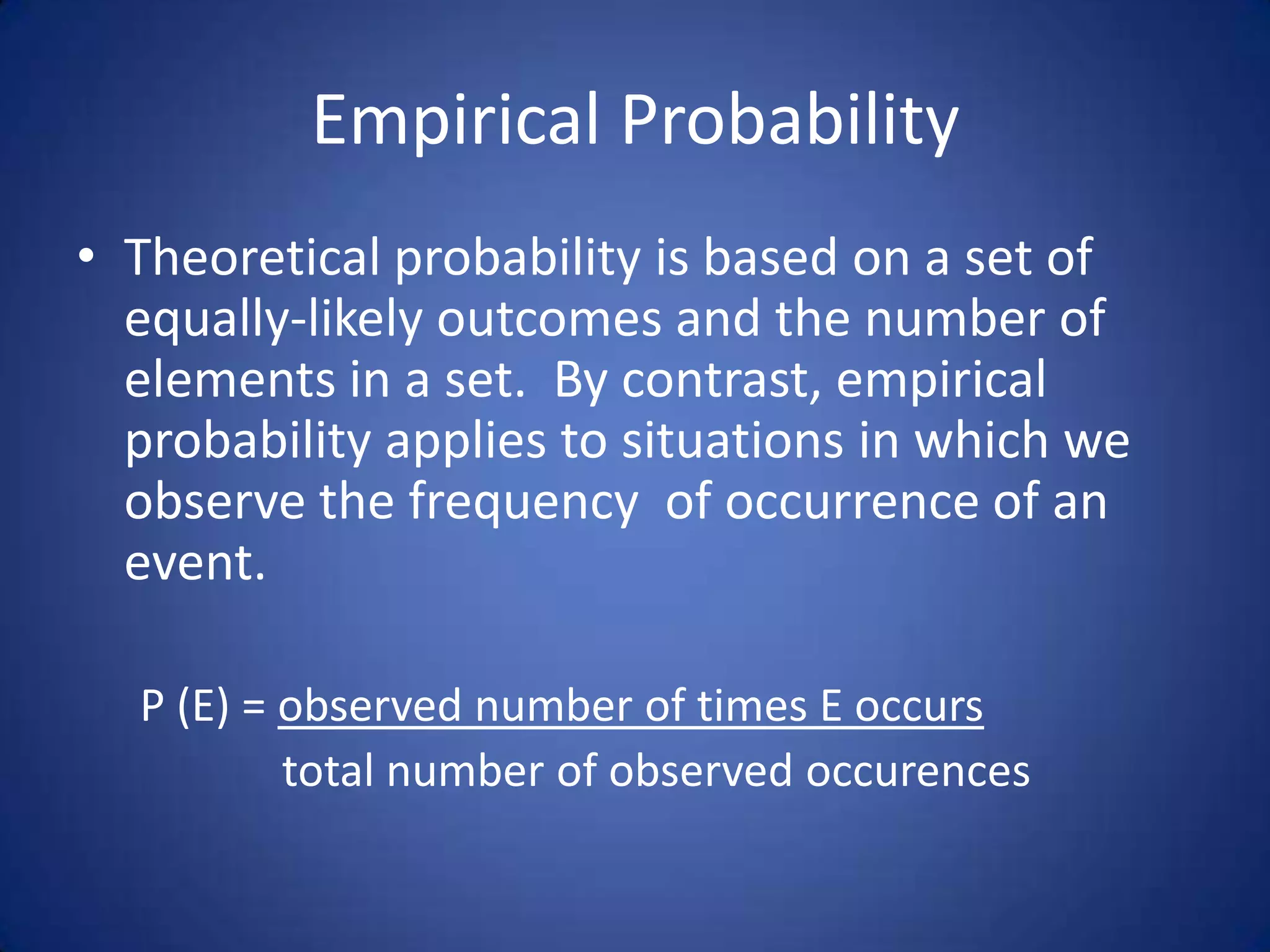
Empirical ProbabilityTheoretical probability is based on a set of equally-likely outcomes and the number of elements in a set.  By contrast, empirical probability applies to situations in which we observe the frequency  of occurrence of an event.P (E) = observed number of times E occurs		       total number of observed occurences
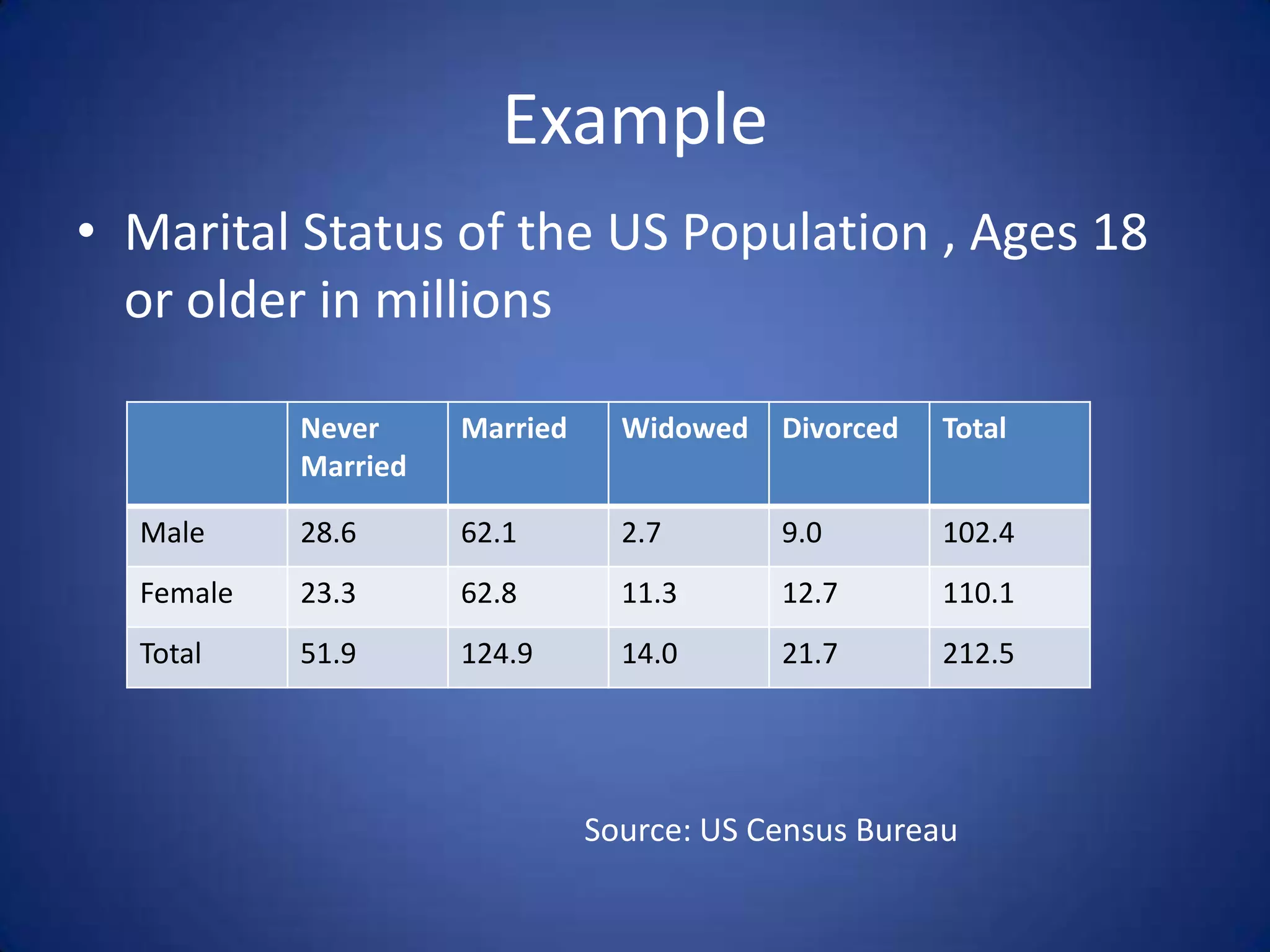
ExampleMarital Status of the US Population , Ages 18 or older in millionsSource: US Census Bureau
Questions:What is the probability of randomly selecting a female?What is the probability of randomly selecting a divorced person?What is the probability of randomly selecting a married male?
AssignmentsClasswork: Checkpoints 1-4 p. 580-584And do #s 2-30 (evens)HW: p. 585-586, #s 1-39 (odd); 49-63 (odd)

11.4 Probability

  • 1.
  • 2.
    Some important questionsWhatis probability?Why study probability?What is the probability of winning the Maryland lottery?What is the probability of being struck by a lightning?What is the probability of getting an A in the class?
  • 3.
    Computing Theoretical ProbabilityIfan event E has n(E) equally-likely outcomes and its sample space S has n(s) equally-likely outcomes, the theoretical probability of event E, denoted by P(E) is P(E) = number of outcomes in event E = n(E) total # of possible outcomes n(S)
  • 4.
    Example 1A dieis rolled once. Find the probability of getting:a. 5 b. an even number c. a number greater than 2 d. a number less than 6 e. a number greater than 4
  • 5.
    Example 2You aredealt a standard 52-card deck. Find the probability of being dealtA. A kingB. A red cardC. A fiveD. A picture cardE. A red queenF. A club
  • 6.
    Probabilities in GeneticsBloodtype problem: What is the chance of having a blood type AB if your parents have types AO and BB.Dimples: Facial dimples are examples of dominant genes which means that if a person has genotype DD or Dd, he or she will have a dimple. A person with no dimple has a genotype of dd. What is the chance of producing an offspring with a dimple if one parent has a dimple and the other has none?
  • 7.
    Empirical ProbabilityTheoretical probabilityis based on a set of equally-likely outcomes and the number of elements in a set. By contrast, empirical probability applies to situations in which we observe the frequency of occurrence of an event.P (E) = observed number of times E occurs total number of observed occurences
  • 8.
    ExampleMarital Status ofthe US Population , Ages 18 or older in millionsSource: US Census Bureau
  • 9.
    Questions:What is theprobability of randomly selecting a female?What is the probability of randomly selecting a divorced person?What is the probability of randomly selecting a married male?
  • 10.
    AssignmentsClasswork: Checkpoints 1-4p. 580-584And do #s 2-30 (evens)HW: p. 585-586, #s 1-39 (odd); 49-63 (odd)