Outlines
1. Definition
2 classification of vacuum vaginal delivery by station.
3. Indications of vacuum delivery.
4. contraindication.
5.Prerequisites for Vacuum Vaginal Delivery
6. procedure
7. Complications
8 advantages
9. disadvantages
Definition of VVD
-It is a mode of operative delivery wherewith a small soft
silastic cup is held on the fetal head by negative
pressure from a vacuum pump.
-Traction is applied with contraction to argument
maternal expulsive effort to deliver the baby.
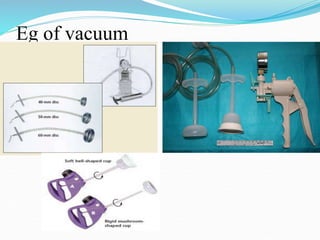
Eg of vacuum
Classification of Vacuum Assisted
Vaginal
Delivery by Station
1. Outlet
-the scalp is visible at the introitus without separating the
labia.
-The fetal head is at or on the perineum.
-The head in the right or left occipitoanterior or -
occipitoposteriorposition.
-Rotation does not exceed 45 degrees.
2.Low
-The leading edge of the fetal skull is station +2 cm or more.
3. Mid
-The head is engaged, but the leading edge of the skull is
above station +2 cm.
4. High
-Vacuum vaginal delivery is not included in this
classification.
Indications for Vacuum Vaginal Delivery
1. Prolonged second stage of labor
2. Non reassuring fetal heart tones or other suspicion of
immediate or potential fetal compromise
3. Shorten the 2nd stage
4. Maternal exhaustion.
5. Trials of vacuum delivery.
Contraindications for Vacuum-Assisted Vaginal
Delivery
a. Absolute Contraindications
1.Failure to fulfill all the requirements for vaginal
delivery
— Incomplete dilatation of the cervix
— Intact fetal membranes
— Unengaged vertex
2. Abnormalities of labor
-Fetal malpresentation (eg, breech, transverse lie, brow,
face)
-Suspected cephalopelvic disproportion
-Estimated gestational age < 34 weeks
-Estimated fetal weight < 2500 g
3.Failure to obtain informed consent from the patient
3. Underlying fetal disorder
— Fetal bleeding disorders (eg, hemophilia,
alloimmune thrombocytopenia)
— Fetal dematerializing diseases (eg, osteogenesis
imperfecta)
b. Relative Contraindications
-Suspected fetal macrosomia.
- Uncertainty about fetal position
- Inadequate anesthesia
-Overlapping cranial bones.
-Prior scalp sampling or multiple attempts at fetal scalp
electrode placement.
Prerequisites for Vacuum Assisted
Vaginal Delivery
a. Maternal Criteria
-Adequate analgesia
-Patient in the Lithotomy position
-Bladder empty
-Adequate pelvis
-Verbal or written consent obtained
b. Fetal Criteria
-Vertex presentation
-The fetal head must be engaged in the pelvis
-The position of the fetal head must be known
-The station of the fetal head must be 0/5
-The estimated fetal weight must be documented
(ideally 2500-4500 g)
-The attitude of the fetal head and the presence of caput
succedaneum and/or molding should be noted
c.Uteroplacental Criteria
-Cervix fully dilated
-Membranes ruptured
-No placenta previa
d. Other Criteria
-An experienced operator
who is fully acquainted
with the use of the
instrument
-Ability to monitor fetal
well-being continuously
-The capability to perform
an emergency cesarean
delivery if required
Procedure (Mnemonic)
A – Anesthesia
- Address the patient
- Assistants should be on hand for delivery and for
neonatal resuscitations.
B – Bladder  catheterization to empty the bladder
C – Cervix  fully dilated / membranes ruptured
D –Determine  position, station, pelvic adequacy
E – Equipment  inspect vacuum cup, pump, tubing,
 check pressure
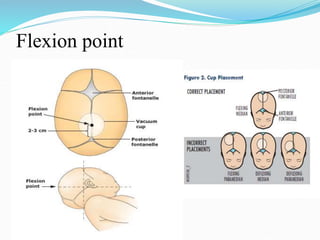
F – Flexion Point- position the cup 2-3cm anterior to the
posterior fontanel
- low pressure 10 cm H2O initially & between cont
- sweep finger around cup to clear maternal tissue
- ↑ pressure to 60 cm H2O with the next contraction
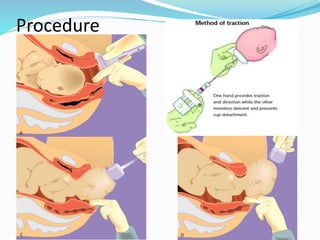
G – Gentle traction - pull with contractions only
- traction in the axis of the birth canal
- ask the mother to push during cont
- right angles to the plane of the cup
Flexion point
H – Halt - when 3 disengagements of the vacuum “pop-offs”
- more than 20 minutes have elapsed
- 3 consecutive pulls result in no progress or delivery
I – Incision - consider episiotomy if laceration imminent
J – Jaw - remove vacuum when jaw is reachable or
delivery assured
Procedure
Complications
1. Maternal Complications
-Vaginal laceration due to entrapment of vaginal mucosa
between suction cup & fetal head
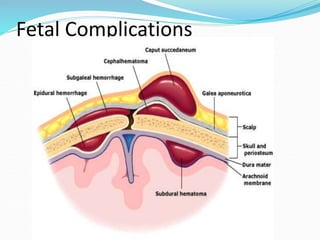
2. Fetal Complications
1. Scalp injuries
 abrasion & lacerations 12.6%
scalp necrosis 0.25-1.8%
2. Cephalohematoma  25%  jaundice /anemia
3. Intracranial hemorrhage  2.5%
4. Subgaleal hematoma
5. Retinal hemorrhage
Fetal Complications
Advantages of vacuum delivery
• Simple to use
• Less force applied to fetal head
• Done in LA/Block
• No increase in diameter of presenting head
• Less maternal soft tissue injury
• Less fetal injury
Disadvantage
1. Maternal effort required
2. Possible longer delivery time than with forceps or C/S
3. Small increase in incidence of cephalohematoma

11. VACUUM DELIVERY.ppt

  • 2.
    Outlines 1. Definition 2 classificationof vacuum vaginal delivery by station. 3. Indications of vacuum delivery. 4. contraindication. 5.Prerequisites for Vacuum Vaginal Delivery 6. procedure 7. Complications 8 advantages 9. disadvantages
  • 3.
    Definition of VVD -Itis a mode of operative delivery wherewith a small soft silastic cup is held on the fetal head by negative pressure from a vacuum pump. -Traction is applied with contraction to argument maternal expulsive effort to deliver the baby.
  • 4.
  • 5.
    Classification of VacuumAssisted Vaginal Delivery by Station 1. Outlet -the scalp is visible at the introitus without separating the labia. -The fetal head is at or on the perineum. -The head in the right or left occipitoanterior or - occipitoposteriorposition. -Rotation does not exceed 45 degrees.
  • 6.
    2.Low -The leading edgeof the fetal skull is station +2 cm or more. 3. Mid -The head is engaged, but the leading edge of the skull is above station +2 cm. 4. High -Vacuum vaginal delivery is not included in this classification.
  • 7.
    Indications for VacuumVaginal Delivery 1. Prolonged second stage of labor 2. Non reassuring fetal heart tones or other suspicion of immediate or potential fetal compromise 3. Shorten the 2nd stage 4. Maternal exhaustion. 5. Trials of vacuum delivery.
  • 8.
    Contraindications for Vacuum-AssistedVaginal Delivery a. Absolute Contraindications 1.Failure to fulfill all the requirements for vaginal delivery — Incomplete dilatation of the cervix — Intact fetal membranes — Unengaged vertex
  • 9.
    2. Abnormalities oflabor -Fetal malpresentation (eg, breech, transverse lie, brow, face) -Suspected cephalopelvic disproportion -Estimated gestational age < 34 weeks -Estimated fetal weight < 2500 g 3.Failure to obtain informed consent from the patient
  • 10.
    3. Underlying fetaldisorder — Fetal bleeding disorders (eg, hemophilia, alloimmune thrombocytopenia) — Fetal dematerializing diseases (eg, osteogenesis imperfecta)
  • 11.
    b. Relative Contraindications -Suspectedfetal macrosomia. - Uncertainty about fetal position - Inadequate anesthesia -Overlapping cranial bones. -Prior scalp sampling or multiple attempts at fetal scalp electrode placement.
  • 12.
    Prerequisites for VacuumAssisted Vaginal Delivery a. Maternal Criteria -Adequate analgesia -Patient in the Lithotomy position -Bladder empty -Adequate pelvis -Verbal or written consent obtained
  • 13.
    b. Fetal Criteria -Vertexpresentation -The fetal head must be engaged in the pelvis -The position of the fetal head must be known -The station of the fetal head must be 0/5 -The estimated fetal weight must be documented (ideally 2500-4500 g) -The attitude of the fetal head and the presence of caput succedaneum and/or molding should be noted
  • 14.
    c.Uteroplacental Criteria -Cervix fullydilated -Membranes ruptured -No placenta previa d. Other Criteria -An experienced operator who is fully acquainted with the use of the instrument -Ability to monitor fetal well-being continuously -The capability to perform an emergency cesarean delivery if required
  • 15.
    Procedure (Mnemonic) A –Anesthesia - Address the patient - Assistants should be on hand for delivery and for neonatal resuscitations. B – Bladder  catheterization to empty the bladder C – Cervix  fully dilated / membranes ruptured D –Determine  position, station, pelvic adequacy E – Equipment  inspect vacuum cup, pump, tubing,  check pressure
  • 16.
    F – FlexionPoint- position the cup 2-3cm anterior to the posterior fontanel - low pressure 10 cm H2O initially & between cont - sweep finger around cup to clear maternal tissue - ↑ pressure to 60 cm H2O with the next contraction G – Gentle traction - pull with contractions only - traction in the axis of the birth canal - ask the mother to push during cont - right angles to the plane of the cup
  • 17.
  • 18.
    H – Halt- when 3 disengagements of the vacuum “pop-offs” - more than 20 minutes have elapsed - 3 consecutive pulls result in no progress or delivery I – Incision - consider episiotomy if laceration imminent J – Jaw - remove vacuum when jaw is reachable or delivery assured
  • 19.
  • 20.
    Complications 1. Maternal Complications -Vaginallaceration due to entrapment of vaginal mucosa between suction cup & fetal head
  • 21.
    2. Fetal Complications 1.Scalp injuries  abrasion & lacerations 12.6% scalp necrosis 0.25-1.8% 2. Cephalohematoma  25%  jaundice /anemia 3. Intracranial hemorrhage  2.5% 4. Subgaleal hematoma 5. Retinal hemorrhage
  • 22.
  • 23.
    Advantages of vacuumdelivery • Simple to use • Less force applied to fetal head • Done in LA/Block • No increase in diameter of presenting head • Less maternal soft tissue injury • Less fetal injury
  • 24.
    Disadvantage 1. Maternal effortrequired 2. Possible longer delivery time than with forceps or C/S 3. Small increase in incidence of cephalohematoma