Course by Stephen Mann
introducing
Mind Explosion Course
Business Consultant
Member of the Institute of Directors
Licensed Trainer with ASET and EDI
Working with Boston University, Genzyme, UK Government etc.
The Basic stuff
Fire
Toilets
Rules of the room
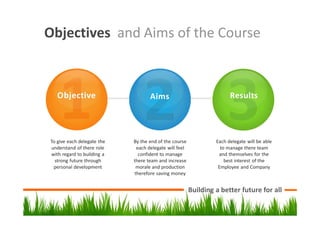
Objectives and Aims of the Course
Building a better future for all
Objective Aims Results
To give each delegate the
understand of there role
with regard to building a
strong future through
personal development
By the end of the course
each delegate will feel
confident to manage
there team and increase
morale and production
therefore saving money
Each delegate will be able
to manage there team
and themselves for the
best interest of the
Employee and Company
My Personal Aims
• Open you thoughts
– You will only get out what
you put in
• Get you thinking
– About you
– About your role
– People around you
• Ideas
– Your ideas
– My ideas
– Group ideas
This course is designed to open you up
to new ideas and concepts
Some of this course may not suit your
learning style
Some of the course you might already
know
Some of the course may waste your
time
BUT its your choice if you wish to: -
learn
review
or help
Today
Welcome to Mind Explosion
Taking Personal Responsibility
Having Self-Belief
Galatea Effect
The DNA of a Team
Coaching and Mentoring
Leadership
Employee Motivation and Engagement
Employee Retention
Team building working as a team
BY
Stephen Mann
Welcome to
Over this session
I want to blow your mind
and show you how much
POWER
you have inside you
The Power
To change your LIFE
The Power
To Change your FUTURE
Is a new training system I have
developed over years of working in
business management and the study
of human behaviour
I worked with many adults and
children as a personal councillor
I have trained tens of thousands of
people around the world
I have learnt from them all and
brought all this knowledge together
Bar Bending
Its all about the
POWER of your
Mind
7 Key Points
to changing your
life
1. Take Personal Responsibility
2. Taking Action
3. Involving Others
4. Defining your Goals
5. Planning your Priorities
6. Having Self Belief
7. Having a STRONG REASON WHY
Taking Personal Responsibility
Its not the cards it how you play your hand
Choose to be Un-Woolly Be Precise
You Must take Responsibility
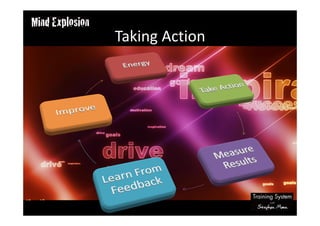
Taking Action
Taking Action
Taking Action
Taking Action
Taking Action
Taking Action
Involving Others
Involving Others
Involving Others
Involving Others
Involving Others
Involving Others
Defining Your Goals
So what is a Goal
It’s a dream with a
deadline
Defining Your Goals
Focus and decide what
you want, Leave the how
to later
Beware the YES but HOW
syndrome
Defining Your Goals
What do you want to have?
MATERIAL GOALS
ACTIVITY GOALS
DEVELOPMENT GOALS
Defining Your Goals
Whatever the mind
can conceive and
believe it can be
achieved
Defining Your Goals
How can you
eat an Elephant
Planning and Priorities
Having Self Belief
Having Self Belief
Having Self Belief
Having Self Belief
Having Self Belief
Re-CAP
Taking Personal Responsibility
Taking Action
Involving Others
Planning Your Priorities
Defining your Goal
Having Self Belief
Having a Strong Reason Why
Now it up to you
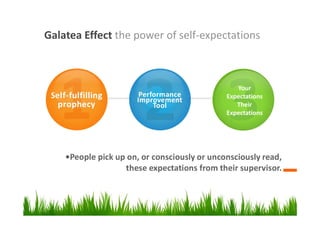
Galatea Effect the power of self-expectations
•People pick up on, or consciously or unconsciously read,
these expectations from their supervisor.
Self-fulfilling
prophecy
Performance
Improvement
Tool
Your
Expectations
Their
Expectations
•Every supervisor has expectations of the
people who report to him.
•Supervisors communicate these expectations
consciously or unconsciously.
•People pick up on, or consciously or
unconsciously read, these expectations from
their supervisor.
•People perform in ways that are consistent
with the expectations they have picked up on
from the supervisor.
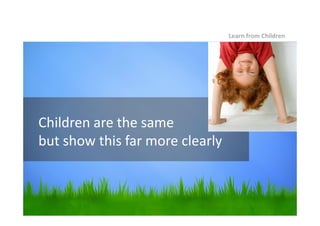
Children are the same
but show this far more clearly
Learn from Children
•Provide opportunities for the employee to experience increasingly challenging assignments.
Make sure he/she succeeds at each level before moving forward.
•Enable the employee to participate in potentially successful projects that bring continuous
improvement to the workplace.
•Provide one-to-one coaching with the employee. This coaching should emphasize
improving what the employee does well rather than focusing on the employee's weaknesses.
•Provide developmental opportunities that reflect what the employee is interested in
learning.
•Assign a successful senior employee to play a developmental mentoring role with the
employee.
•Hold frequent, positive verbal interactions with the employee and communicate
consistently your firm belief in the employee's ability to perform the job. Keep feedback
positive and developmental where possible.
Improvement tools
• Skills, Knowledge, confidence, ability
• You can tether an Adult elephant with the same cord that held him as a baby
To what extent do you believe you have what it takes
• Dream Stealers
• Concepts of Failure
• Limiting self talk
• Negative comments by others
BEWARE
• You never progress further than the thoughts of your own mind
• Sowing things in your own mind and reeping what you sow
• Change you belief and change your reality
Create your own Reality
• More Options More Choice
• Recognising talents and Qualities in yourself
• Nothing to fear but fear itself
• I will not let any one walk though my mind with there dirty feet
Have Flexibility
Having Self Belief
What does it mean to you
The DNA of a Team
• How to build a team to WIN
The A Team
In 1972, a crack
commando unit was sent
to prison by a military
court for a crime they
didn't commit.
The A Team
These four men
promptly escaped from
a maximum-security
stockade to the Los
Angeles underground.
The A Team
Today, still wanted by
the government,
they survive as
soldiers of fortune.
The A Team
If you have a problem,
if no one else can help,
and if you can find
them, maybe you can
hire the A-Team.
The A Team
The key elements of its effectiveness: a
cigar-chomping master of disguise, an ace
pilot, a devilishly handsome con man, a
mechanic with a Mohawk
and an amazingly sweet van.
The A-Team went off the air in 1987 –
still wanted by the government –
but television has never produced a
better blueprint for team building
Clear Roles
Those particulars might not
translate to all business
settings. But clear definition
of roles is a hallmark of
effective Team Work
Team Size
• The A Team was only 4
• A little small
• France and England, which bloodied each
other for centuries before they noticed ...
Germany.
• Perhaps a little bit to big
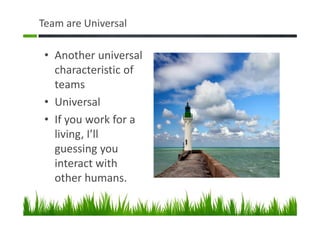
Team are Universal
• Another universal
characteristic of
teams
• Universal
• If you work for a
living, I’ll
guessing you
interact with
other humans.
If you think this is mushy stuff? Think again?
• Sony. CEO Howard Stringer
• Trying to restore the fighting spirit (and
higher profits)
• Building on decentralized teams.
• Their theme: Sony United.
Other examples
• The team that built Facebook or Google
• The cutthroat yet symbiotic pack of cyclists in
the Tour de France
• GB Olympic team
• I could go on and on
The DNA
Each of these stories challenges
a piece of conventional wisdom.
If "hire great people" seems like
great advice BUT?
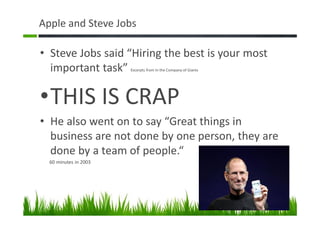
Apple and Steve Jobs
• Steve Jobs said “Hiring the best is your most
important task” Excerpts from In the Company of Giants
•THIS IS CRAP
• He also went on to say “Great things in
business are not done by one person, they are
done by a team of people.“
60 minutes in 2003
The DNA of Teams
The fact is, most of
what you've read
about teamwork is
Crap, Rubbish
Example
• August 2008, Manchester City Football
club was purchased by Abu Dhabi United
Group.
• There spent in 9 months $200 million
• City finished the season in fifth position
in the Premier League
• But there had the top players in the
world?
• It has taken them season to come
together and work like a team
So where do you start
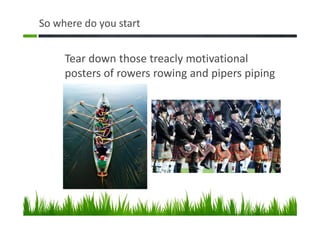
Tear down those treacly motivational
posters of rowers rowing and pipers piping
The DNA
• I am certainly not against the concept of
teamwork
• But that's the point
• All the happy-sounding twaddle obscures the
actual practice of it
• Teamwork is a practice
Great teamwork is an outcome
You can only create the
conditions for it to flourish.
Like getting rich or falling in
love, you cannot simply will
it to happen.
The DNA
Becoming skilled at doing
more with others may be
the single most important
thing you can do
The DNA
• You have to learn to be a team
• You have to have clear roles
• You have to have clear objectives
• You work on people strengths not weakness
• You work to work together
The DNA
Humans aren't hard-
wired to succeed or fail
at it. We can go either
way.
The DNA
If you put a group of children in a
room to solve a problem, the
typical result is one kid dominating
and others looking totally
disengaged
Its not a team
The DNA
• But if teachers take the time to establish
norms - roles, goals, etc. - not only will the
children behave according to the new norms,
but they will enforce rules on others within
the group.
• There will work as part of a team
The DNA of team building
• Structure
• Roles
• Objectives
• Aims and goals
• Practice
• Communication including listening
• Lead by example
The Paper Tower
• 5 mins to think
• 3 mins to build
• Don’t waste time, agree as a group and work
together as a team
Coaching and Mentoring
Creating a Mentoring Culture
In a mentoring culture, eight hallmarks build on and strengthen each other. All
are present, at least to some degree, however they manifest themselves
differently depending on the organizations previous success with mentoring.
When each hallmark is consistently present, the mentoring culture is fuller
and more robust. As more and more of each hallmark is found in an
organization, the mentoring culture becomes progressively more sustainable.
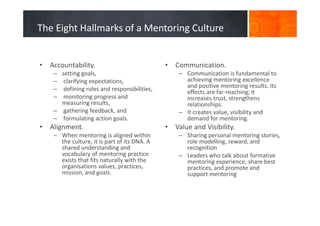
The Eight Hallmarks of a Mentoring Culture
• Accountability.
– setting goals,
– clarifying expectations,
– defining roles and responsibilities,
– monitoring progress and
measuring results,
– gathering feedback, and
– formulating action goals.
• Alignment.
– When mentoring is aligned within
the culture, it is part of its DNA. A
shared understanding and
vocabulary of mentoring practice
exists that fits naturally with the
organisations values, practices,
mission, and goals.
• Communication.
– Communication is fundamental to
achieving mentoring excellence
and positive mentoring results. Its
effects are far-reaching; it
increases trust, strengthens
relationships.
– It creates value, visibility and
demand for mentoring.
• Value and Visibility.
– Sharing personal mentoring stories,
role modelling, reward, and
recognition
– Leaders who talk about formative
mentoring experience, share best
practices, and promote and
support mentoring
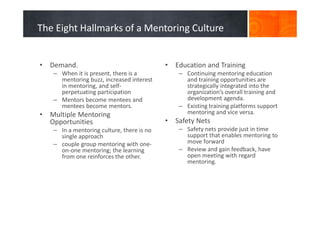
The Eight Hallmarks of a Mentoring Culture
• Demand.
– When it is present, there is a
mentoring buzz, increased interest
in mentoring, and self-
perpetuating participation
– Mentors become mentees and
mentees become mentors.
• Multiple Mentoring
Opportunities
– In a mentoring culture, there is no
single approach
– couple group mentoring with one-
on-one mentoring; the learning
from one reinforces the other.
• Education and Training
– Continuing mentoring education
and training opportunities are
strategically integrated into the
organization’s overall training and
development agenda.
– Existing training platforms support
mentoring and vice versa.
• Safety Nets
– Safety nets provide just in time
support that enables mentoring to
move forward
– Review and gain feedback, have
open meeting with regard
mentoring.
Leadership
There are 3 types of leaders in my view
The three leaders
• Trait Theory
– Some personality traits may lead people naturally into
leadership roles. This is the Trait Theory.
– Small number of people
– True leaders are rare
– This is because the combination of skills, personality
and ambition essential to leadership are difficult to
develop and exhibit
The three leaders
• The Great Events Theory
– A crisis or important event may cause a person to
rise to the occasion, which brings out extraordinary
leadership qualities in an ordinary person. This is the
Great Events Theory.
– We may not known we have it, but through a crisis it
comes together
The three leaders
• Transformational Theory
– •People can choose to become leaders. People can
learn leadership skills. This is the Transformational
Leadership Theory.”
– The Transformational Leadership Theory is the one I
believe is correct for most leaders today. This belief
forms the basis for my thinking about leadership.
So how to become a leader
• The first, and most important characteristic, of
a leader is the decision to become a leader
• Leaders decide that they want to provide
others with vision, direct the course of future
events and inspire others to success
• Leaders people follow are accountable and
trustworthy and there don’t blame others for
there mistakes.
Leaders have followers
• Followers need to believe that, at the end of
the journey, they will be recognized and
rewarded for their contribution
• The leader must help followers answer the
question, “What’s in it for me”?
• Successful leaders are honest about the
potential risks
• They communicate information clearly
Positional Power
• CEO, Department Head, Business Founder
• Leadership qualities combined with positional
power magnify the ability
Question for you all
Does positional power make you a great
leader?
Employee Motivation
But its not all about the money
Motivation
• What do people work for?
• Love
• Personal Fulfilment
• Accomplish Goals
• Meaningful
• Meeting people
• Challenge
• Interaction
The reasons for working are as
individual as the person.
Bottom line, however, is that
almost everyone works for
money
Whatever you call it:
compensation, salary, bonuses,
benefits or remuneration,
money pays the bills.
Money provides housing, gives
children clothing and food, sends
teens to college, and allows
leisure activities, and eventually,
retirement. To underplay the
importance of money and
benefits as motivation for
people who work is a mistake.
If you provide a living wage for
your employees, you can then
work on additional motivation
issues. Without the fair, living
wage, however, you risk losing
your best people to a better-
paying employer.
But that’s not what its all about?
• Money makes us go to work, but it does not
make us work?
• People don’t leave for money, we have to pay
people a fair wage, but there never leave for
money, there will not look for other work
because of money, therefore there don’t leave
for money.
You the Manager that’s the
Secret
The keys to financial success and a
profitable business are not the strategies
or the systems of the firm. The character
and skill of individual managers, who
practice what they preach, and recognize
the manager's role in coaching
employees
Its all about the Managers
• If a business wants its people to make a lot of
money for them, then it must set high
standards and give employees something they
can get excited about. These employees must
be managed by someone who is trustworthy,
cares about people as well as the business,
and acts with integrity.
Key employee retention is critical to the
long term health and success
of your business
Employee Retention
Please Note
• The Baby Boom
• Aged 40 to 58 the baby boom
• Aged 25-34 generation X
• World wide problem, over the next 10 years
more people will retire and there will be less
workers.
Employee retention is one of the
primary measures of the health
of your organisation. If you are
losing critical staff members, you
can safely bet that other people
in their departments are looking
as well.
THIS COURSE WILL HELP
Everything we are doing will help with keep the right people
THE BIGGEST MISTAKES
lack of clarity about expectations,
lack of clarity about earning potential,
lack of feedback about performance,
failure to hold scheduled meetings, and
failure to provide a framework within which the employee
perceives he can succeed.
How much money would you like
to safe in your department?
So a question for you
How much does it cost to
employee a new starter
Take your role/job, what is the
cost to employee you?
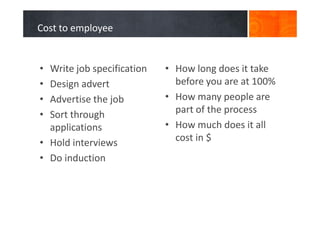
Cost to employee
• Write job specification
• Design advert
• Advertise the job
• Sort through
applications
• Hold interviews
• Do induction
• How long does it take
before you are at 100%
• How many people are
part of the process
• How much does it all
cost in $
Work out the following
How long in time?, how many
people?, and how much does it
cost?
In your groups
Key employee retention is critical to the
long term health and success
of your business
Employee Retention
FEEDBACK THE RESULTS
Paper and straws
The Game that changes
5 Paper Balls
Dropped at different times
Highest score wins
Tip think first about the size
of your balls
Really hope you found this course interesting
Review time
My Personal Aims
• Open you thoughts
– You will only get out what
you put in
• Get you thinking
– About you
– About your role
– People around you
• Ideas
– Your ideas
– My ideas
– Group ideas
This course is designed to open you up
to new ideas and concepts
Some of this course may not suit your
learning style
Some of the course you might already
know
Some of the course may waste your
time
BUT its your choice if you wish to: -
learn
review
or help
Thank you for your time,
I wish you the very best in
your future, professional
and personally

11 one day masterclass (Стивен Манн)

  • 1.
    Course by StephenMann introducing Mind Explosion Course
  • 2.
    Business Consultant Member ofthe Institute of Directors Licensed Trainer with ASET and EDI Working with Boston University, Genzyme, UK Government etc.
  • 3.
  • 4.
    Objectives and Aimsof the Course Building a better future for all Objective Aims Results To give each delegate the understand of there role with regard to building a strong future through personal development By the end of the course each delegate will feel confident to manage there team and increase morale and production therefore saving money Each delegate will be able to manage there team and themselves for the best interest of the Employee and Company
  • 5.
    My Personal Aims •Open you thoughts – You will only get out what you put in • Get you thinking – About you – About your role – People around you • Ideas – Your ideas – My ideas – Group ideas This course is designed to open you up to new ideas and concepts Some of this course may not suit your learning style Some of the course you might already know Some of the course may waste your time BUT its your choice if you wish to: - learn review or help
  • 6.
    Today Welcome to MindExplosion Taking Personal Responsibility Having Self-Belief Galatea Effect The DNA of a Team Coaching and Mentoring Leadership Employee Motivation and Engagement Employee Retention Team building working as a team
  • 8.
  • 9.
    Over this session Iwant to blow your mind and show you how much POWER you have inside you
  • 10.
    The Power To changeyour LIFE The Power To Change your FUTURE
  • 12.
    Is a newtraining system I have developed over years of working in business management and the study of human behaviour
  • 13.
    I worked withmany adults and children as a personal councillor I have trained tens of thousands of people around the world I have learnt from them all and brought all this knowledge together
  • 14.
  • 15.
    Its all aboutthe POWER of your Mind
  • 16.
    7 Key Points tochanging your life
  • 17.
    1. Take PersonalResponsibility 2. Taking Action 3. Involving Others 4. Defining your Goals 5. Planning your Priorities 6. Having Self Belief 7. Having a STRONG REASON WHY
  • 18.
    Taking Personal Responsibility Itsnot the cards it how you play your hand Choose to be Un-Woolly Be Precise You Must take Responsibility
  • 19.
  • 20.
  • 21.
  • 22.
  • 23.
  • 24.
  • 25.
  • 26.
  • 27.
  • 28.
  • 29.
  • 30.
  • 31.
    Defining Your Goals Sowhat is a Goal It’s a dream with a deadline
  • 32.
    Defining Your Goals Focusand decide what you want, Leave the how to later Beware the YES but HOW syndrome
  • 33.
    Defining Your Goals Whatdo you want to have? MATERIAL GOALS ACTIVITY GOALS DEVELOPMENT GOALS
  • 34.
    Defining Your Goals Whateverthe mind can conceive and believe it can be achieved
  • 35.
    Defining Your Goals Howcan you eat an Elephant
  • 36.
  • 37.
  • 38.
  • 39.
  • 40.
  • 41.
  • 42.
  • 43.
  • 44.
  • 45.
  • 46.
  • 47.
  • 48.
  • 49.
  • 50.
  • 51.
    Re-CAP Taking Personal Responsibility TakingAction Involving Others Planning Your Priorities Defining your Goal Having Self Belief
  • 52.
    Having a StrongReason Why
  • 53.
    Having a StrongReason Why
  • 54.
    Having a StrongReason Why
  • 55.
    Having a StrongReason Why
  • 56.
    Having a StrongReason Why
  • 57.
    Having a StrongReason Why
  • 58.
    Now it upto you
  • 63.
    Galatea Effect thepower of self-expectations •People pick up on, or consciously or unconsciously read, these expectations from their supervisor. Self-fulfilling prophecy Performance Improvement Tool Your Expectations Their Expectations
  • 64.
    •Every supervisor hasexpectations of the people who report to him. •Supervisors communicate these expectations consciously or unconsciously. •People pick up on, or consciously or unconsciously read, these expectations from their supervisor. •People perform in ways that are consistent with the expectations they have picked up on from the supervisor.
  • 65.
    Children are thesame but show this far more clearly Learn from Children
  • 66.
    •Provide opportunities forthe employee to experience increasingly challenging assignments. Make sure he/she succeeds at each level before moving forward. •Enable the employee to participate in potentially successful projects that bring continuous improvement to the workplace. •Provide one-to-one coaching with the employee. This coaching should emphasize improving what the employee does well rather than focusing on the employee's weaknesses. •Provide developmental opportunities that reflect what the employee is interested in learning. •Assign a successful senior employee to play a developmental mentoring role with the employee. •Hold frequent, positive verbal interactions with the employee and communicate consistently your firm belief in the employee's ability to perform the job. Keep feedback positive and developmental where possible. Improvement tools
  • 67.
    • Skills, Knowledge,confidence, ability • You can tether an Adult elephant with the same cord that held him as a baby To what extent do you believe you have what it takes • Dream Stealers • Concepts of Failure • Limiting self talk • Negative comments by others BEWARE • You never progress further than the thoughts of your own mind • Sowing things in your own mind and reeping what you sow • Change you belief and change your reality Create your own Reality • More Options More Choice • Recognising talents and Qualities in yourself • Nothing to fear but fear itself • I will not let any one walk though my mind with there dirty feet Have Flexibility Having Self Belief What does it mean to you
  • 68.
    The DNA ofa Team • How to build a team to WIN
  • 69.
    The A Team In1972, a crack commando unit was sent to prison by a military court for a crime they didn't commit.
  • 70.
    The A Team Thesefour men promptly escaped from a maximum-security stockade to the Los Angeles underground.
  • 71.
    The A Team Today,still wanted by the government, they survive as soldiers of fortune.
  • 72.
    The A Team Ifyou have a problem, if no one else can help, and if you can find them, maybe you can hire the A-Team.
  • 73.
  • 74.
    The key elementsof its effectiveness: a cigar-chomping master of disguise, an ace pilot, a devilishly handsome con man, a mechanic with a Mohawk and an amazingly sweet van. The A-Team went off the air in 1987 – still wanted by the government – but television has never produced a better blueprint for team building
  • 75.
    Clear Roles Those particularsmight not translate to all business settings. But clear definition of roles is a hallmark of effective Team Work
  • 76.
    Team Size • TheA Team was only 4 • A little small • France and England, which bloodied each other for centuries before they noticed ... Germany. • Perhaps a little bit to big
  • 77.
    Team are Universal •Another universal characteristic of teams • Universal • If you work for a living, I’ll guessing you interact with other humans.
  • 78.
    If you thinkthis is mushy stuff? Think again? • Sony. CEO Howard Stringer • Trying to restore the fighting spirit (and higher profits) • Building on decentralized teams. • Their theme: Sony United.
  • 79.
    Other examples • Theteam that built Facebook or Google • The cutthroat yet symbiotic pack of cyclists in the Tour de France • GB Olympic team • I could go on and on
  • 80.
    The DNA Each ofthese stories challenges a piece of conventional wisdom. If "hire great people" seems like great advice BUT?
  • 81.
    Apple and SteveJobs • Steve Jobs said “Hiring the best is your most important task” Excerpts from In the Company of Giants •THIS IS CRAP • He also went on to say “Great things in business are not done by one person, they are done by a team of people.“ 60 minutes in 2003
  • 82.
    The DNA ofTeams The fact is, most of what you've read about teamwork is Crap, Rubbish
  • 83.
    Example • August 2008,Manchester City Football club was purchased by Abu Dhabi United Group. • There spent in 9 months $200 million • City finished the season in fifth position in the Premier League • But there had the top players in the world? • It has taken them season to come together and work like a team
  • 84.
    So where doyou start Tear down those treacly motivational posters of rowers rowing and pipers piping
  • 85.
    The DNA • Iam certainly not against the concept of teamwork • But that's the point • All the happy-sounding twaddle obscures the actual practice of it • Teamwork is a practice
  • 86.
    Great teamwork isan outcome You can only create the conditions for it to flourish. Like getting rich or falling in love, you cannot simply will it to happen.
  • 87.
    The DNA Becoming skilledat doing more with others may be the single most important thing you can do
  • 88.
    The DNA • Youhave to learn to be a team • You have to have clear roles • You have to have clear objectives • You work on people strengths not weakness • You work to work together
  • 89.
    The DNA Humans aren'thard- wired to succeed or fail at it. We can go either way.
  • 90.
    The DNA If youput a group of children in a room to solve a problem, the typical result is one kid dominating and others looking totally disengaged Its not a team
  • 91.
    The DNA • Butif teachers take the time to establish norms - roles, goals, etc. - not only will the children behave according to the new norms, but they will enforce rules on others within the group. • There will work as part of a team
  • 92.
    The DNA ofteam building • Structure • Roles • Objectives • Aims and goals • Practice • Communication including listening • Lead by example
  • 93.
    The Paper Tower •5 mins to think • 3 mins to build • Don’t waste time, agree as a group and work together as a team
  • 94.
  • 95.
    Creating a MentoringCulture In a mentoring culture, eight hallmarks build on and strengthen each other. All are present, at least to some degree, however they manifest themselves differently depending on the organizations previous success with mentoring. When each hallmark is consistently present, the mentoring culture is fuller and more robust. As more and more of each hallmark is found in an organization, the mentoring culture becomes progressively more sustainable.
  • 96.
    The Eight Hallmarksof a Mentoring Culture • Accountability. – setting goals, – clarifying expectations, – defining roles and responsibilities, – monitoring progress and measuring results, – gathering feedback, and – formulating action goals. • Alignment. – When mentoring is aligned within the culture, it is part of its DNA. A shared understanding and vocabulary of mentoring practice exists that fits naturally with the organisations values, practices, mission, and goals. • Communication. – Communication is fundamental to achieving mentoring excellence and positive mentoring results. Its effects are far-reaching; it increases trust, strengthens relationships. – It creates value, visibility and demand for mentoring. • Value and Visibility. – Sharing personal mentoring stories, role modelling, reward, and recognition – Leaders who talk about formative mentoring experience, share best practices, and promote and support mentoring
  • 97.
    The Eight Hallmarksof a Mentoring Culture • Demand. – When it is present, there is a mentoring buzz, increased interest in mentoring, and self- perpetuating participation – Mentors become mentees and mentees become mentors. • Multiple Mentoring Opportunities – In a mentoring culture, there is no single approach – couple group mentoring with one- on-one mentoring; the learning from one reinforces the other. • Education and Training – Continuing mentoring education and training opportunities are strategically integrated into the organization’s overall training and development agenda. – Existing training platforms support mentoring and vice versa. • Safety Nets – Safety nets provide just in time support that enables mentoring to move forward – Review and gain feedback, have open meeting with regard mentoring.
  • 98.
    Leadership There are 3types of leaders in my view
  • 99.
    The three leaders •Trait Theory – Some personality traits may lead people naturally into leadership roles. This is the Trait Theory. – Small number of people – True leaders are rare – This is because the combination of skills, personality and ambition essential to leadership are difficult to develop and exhibit
  • 100.
    The three leaders •The Great Events Theory – A crisis or important event may cause a person to rise to the occasion, which brings out extraordinary leadership qualities in an ordinary person. This is the Great Events Theory. – We may not known we have it, but through a crisis it comes together
  • 101.
    The three leaders •Transformational Theory – •People can choose to become leaders. People can learn leadership skills. This is the Transformational Leadership Theory.” – The Transformational Leadership Theory is the one I believe is correct for most leaders today. This belief forms the basis for my thinking about leadership.
  • 102.
    So how tobecome a leader • The first, and most important characteristic, of a leader is the decision to become a leader • Leaders decide that they want to provide others with vision, direct the course of future events and inspire others to success • Leaders people follow are accountable and trustworthy and there don’t blame others for there mistakes.
  • 103.
    Leaders have followers •Followers need to believe that, at the end of the journey, they will be recognized and rewarded for their contribution • The leader must help followers answer the question, “What’s in it for me”? • Successful leaders are honest about the potential risks • They communicate information clearly
  • 104.
    Positional Power • CEO,Department Head, Business Founder • Leadership qualities combined with positional power magnify the ability Question for you all Does positional power make you a great leader?
  • 105.
    Employee Motivation But itsnot all about the money
  • 106.
    Motivation • What dopeople work for? • Love • Personal Fulfilment • Accomplish Goals • Meaningful • Meeting people • Challenge • Interaction The reasons for working are as individual as the person.
  • 107.
    Bottom line, however,is that almost everyone works for money
  • 108.
    Whatever you callit: compensation, salary, bonuses, benefits or remuneration, money pays the bills.
  • 109.
    Money provides housing,gives children clothing and food, sends teens to college, and allows leisure activities, and eventually, retirement. To underplay the importance of money and benefits as motivation for people who work is a mistake.
  • 110.
    If you providea living wage for your employees, you can then work on additional motivation issues. Without the fair, living wage, however, you risk losing your best people to a better- paying employer.
  • 111.
    But that’s notwhat its all about? • Money makes us go to work, but it does not make us work? • People don’t leave for money, we have to pay people a fair wage, but there never leave for money, there will not look for other work because of money, therefore there don’t leave for money.
  • 113.
    You the Managerthat’s the Secret The keys to financial success and a profitable business are not the strategies or the systems of the firm. The character and skill of individual managers, who practice what they preach, and recognize the manager's role in coaching employees
  • 114.
    Its all aboutthe Managers • If a business wants its people to make a lot of money for them, then it must set high standards and give employees something they can get excited about. These employees must be managed by someone who is trustworthy, cares about people as well as the business, and acts with integrity.
  • 115.
    Key employee retentionis critical to the long term health and success of your business Employee Retention
  • 116.
    Please Note • TheBaby Boom • Aged 40 to 58 the baby boom • Aged 25-34 generation X • World wide problem, over the next 10 years more people will retire and there will be less workers.
  • 117.
    Employee retention isone of the primary measures of the health of your organisation. If you are losing critical staff members, you can safely bet that other people in their departments are looking as well.
  • 118.
    THIS COURSE WILLHELP Everything we are doing will help with keep the right people
  • 119.
    THE BIGGEST MISTAKES lackof clarity about expectations, lack of clarity about earning potential, lack of feedback about performance, failure to hold scheduled meetings, and failure to provide a framework within which the employee perceives he can succeed.
  • 120.
    How much moneywould you like to safe in your department? So a question for you
  • 121.
    How much doesit cost to employee a new starter Take your role/job, what is the cost to employee you?
  • 122.
    Cost to employee •Write job specification • Design advert • Advertise the job • Sort through applications • Hold interviews • Do induction • How long does it take before you are at 100% • How many people are part of the process • How much does it all cost in $
  • 123.
    Work out thefollowing How long in time?, how many people?, and how much does it cost? In your groups
  • 124.
    Key employee retentionis critical to the long term health and success of your business Employee Retention FEEDBACK THE RESULTS
  • 125.
    Paper and straws TheGame that changes
  • 126.
    5 Paper Balls Droppedat different times Highest score wins Tip think first about the size of your balls
  • 127.
    Really hope youfound this course interesting Review time
  • 128.
    My Personal Aims •Open you thoughts – You will only get out what you put in • Get you thinking – About you – About your role – People around you • Ideas – Your ideas – My ideas – Group ideas This course is designed to open you up to new ideas and concepts Some of this course may not suit your learning style Some of the course you might already know Some of the course may waste your time BUT its your choice if you wish to: - learn review or help
  • 129.
    Thank you foryour time, I wish you the very best in your future, professional and personally