Memory. N
Masina
Grade 8
Elements of
Art
Elements of Art
The building blocks or ingredients of art.
They structure and carry the work.
What are the elements
of arts?
The Elements of Art are the “tools” that artists use to
make art.

There
are

7
of
them:
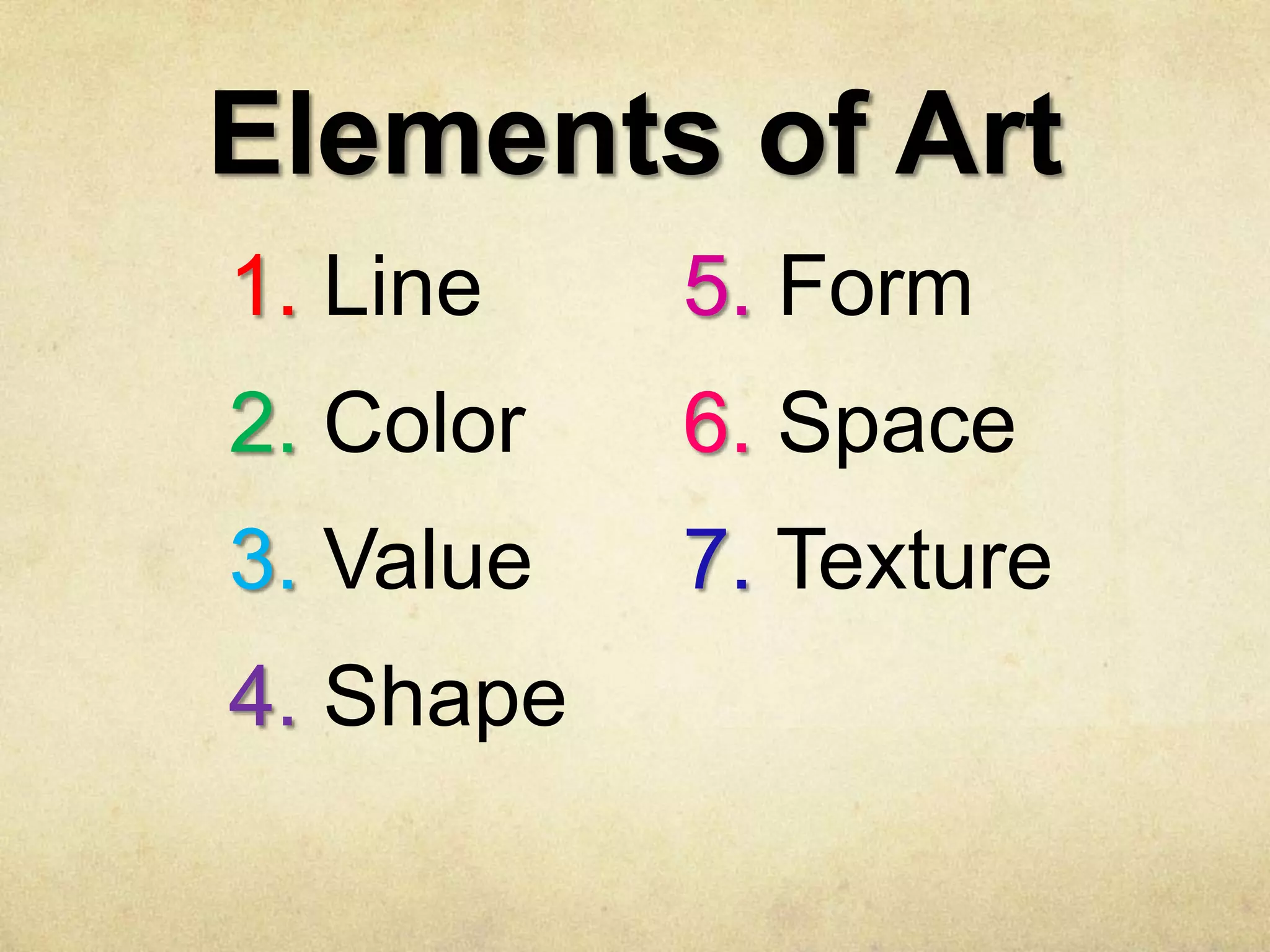
Elements of Art
1. Line

5. Form

2. Color

6. Space

3. Value

7. Texture

4. Shape
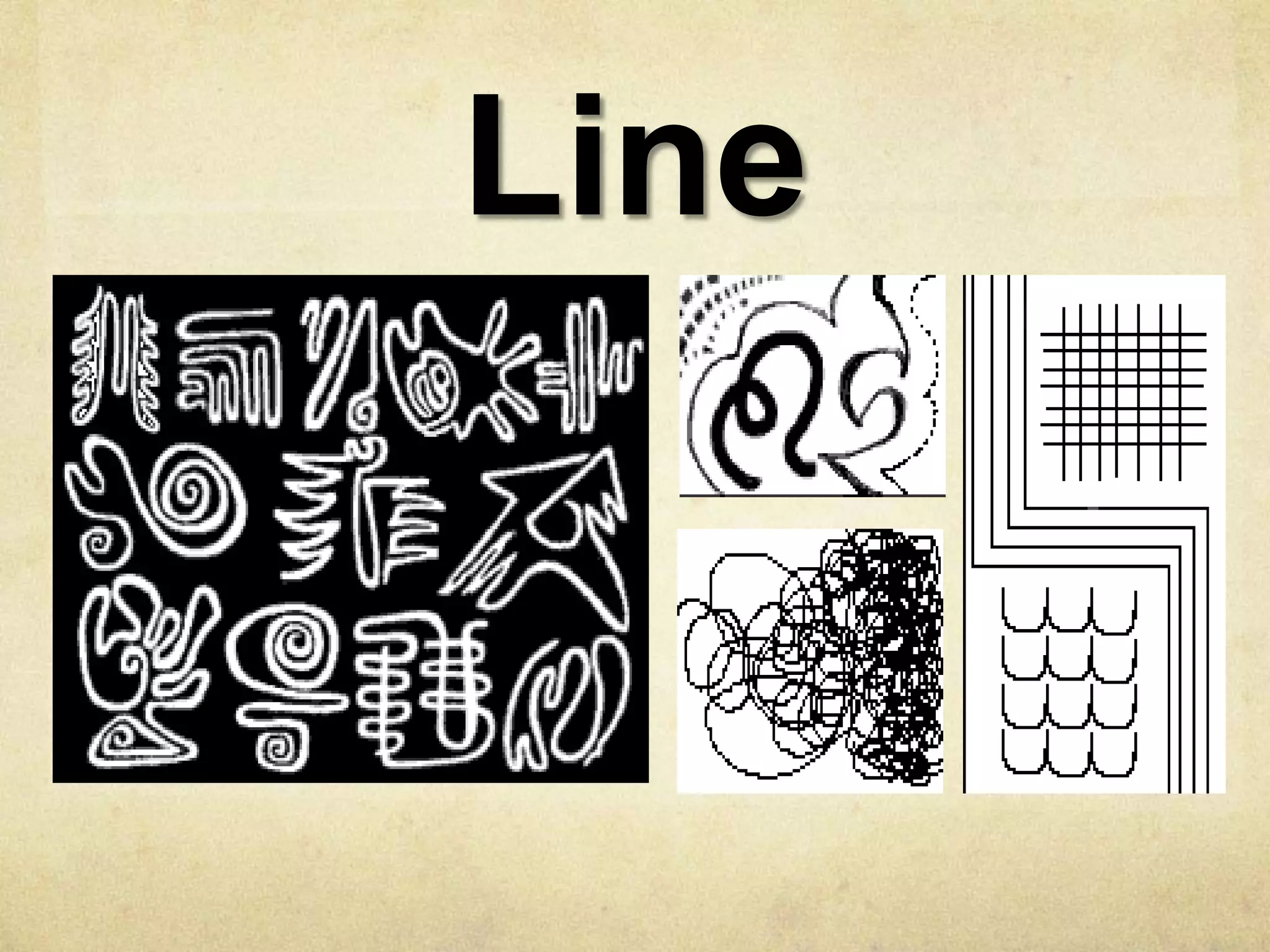
Line
Line
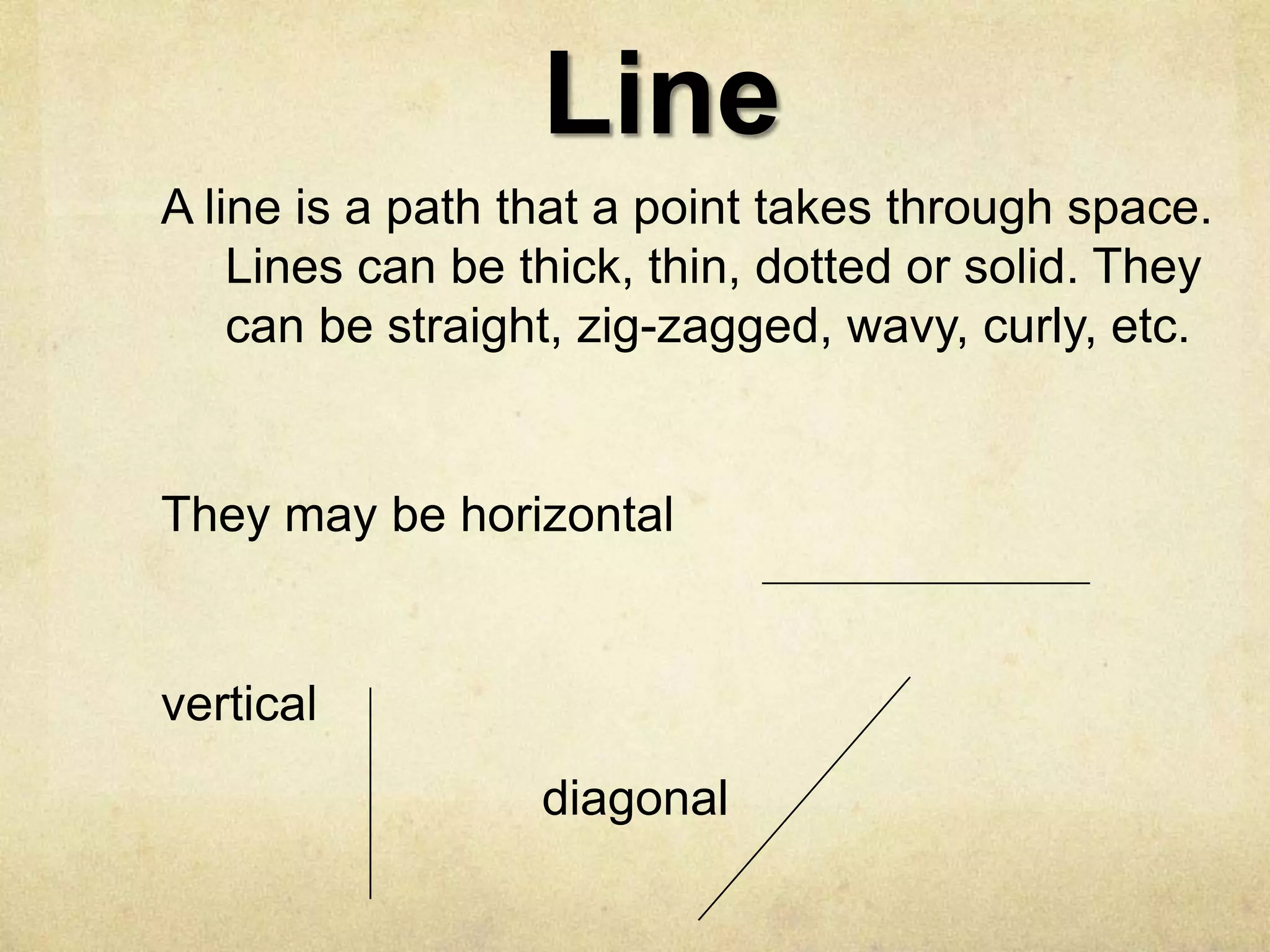
A line is a path that a point takes through space.
Lines can be thick, thin, dotted or solid. They
can be straight, zig-zagged, wavy, curly, etc.

They may be horizontal

vertical

diagonal
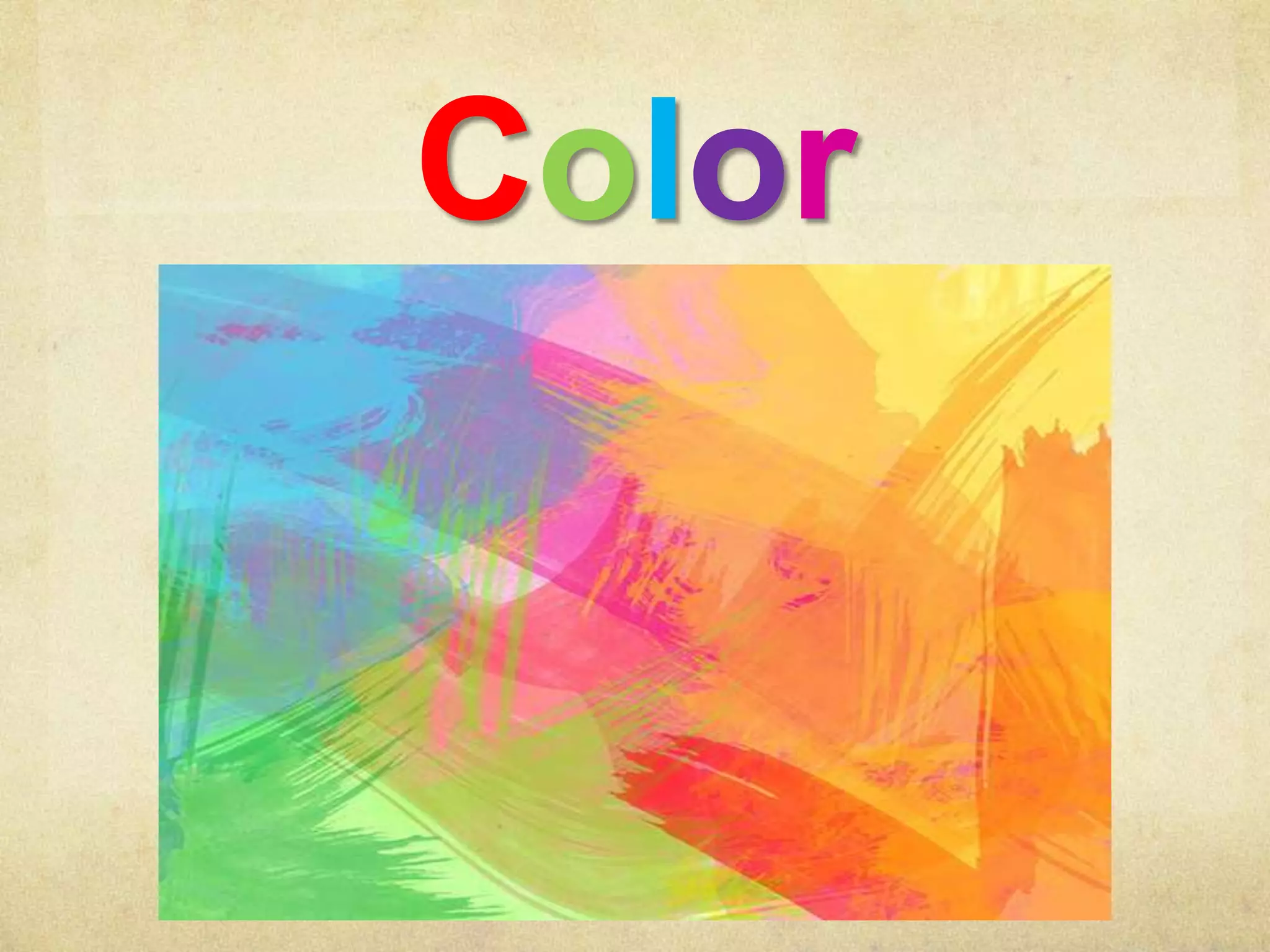
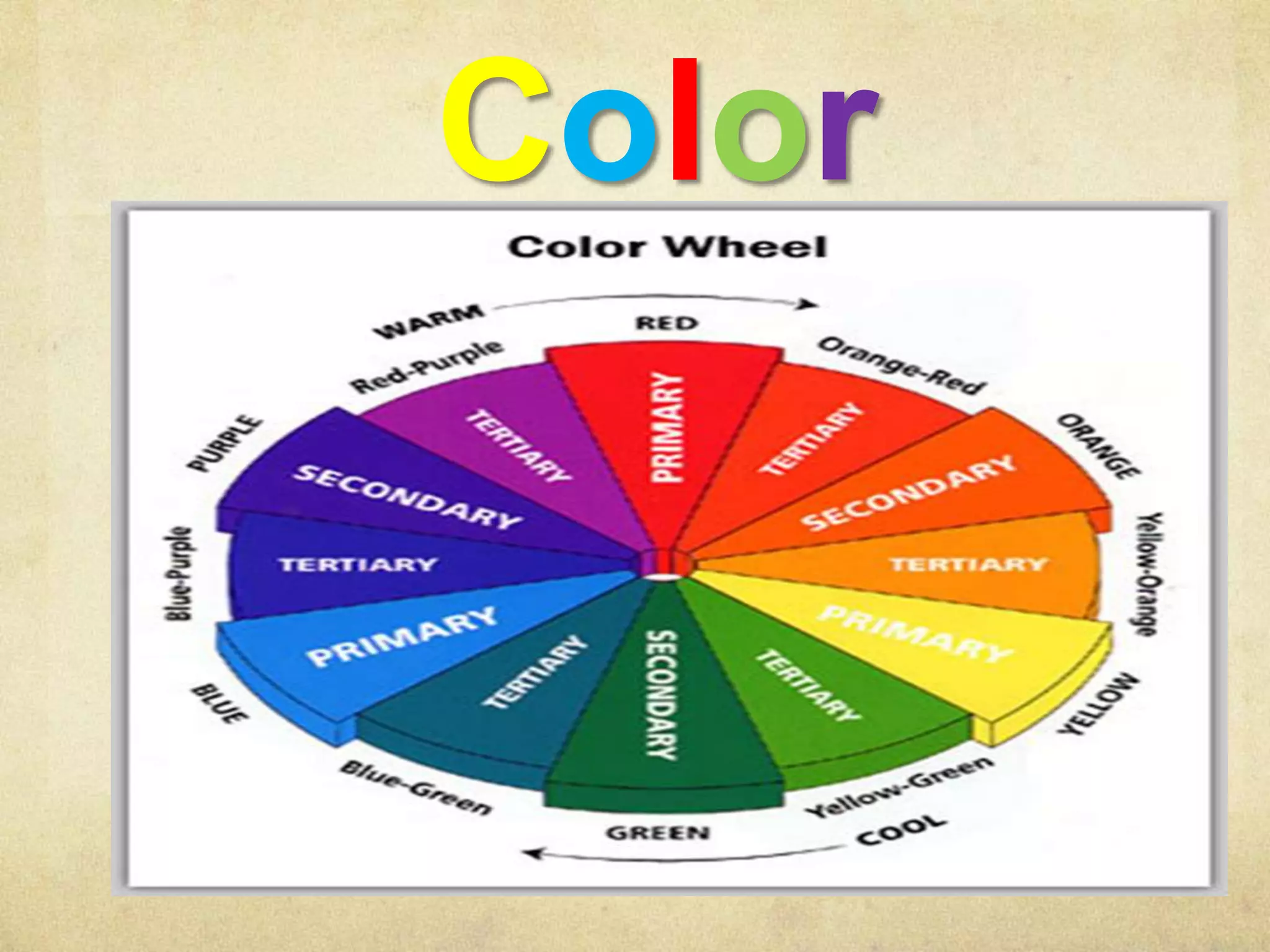
Color
Color
Color has three properties:
1. HUE: this is the name of the colors
2. VALUE: refers to the lightness or
darkness of a hue.

3. INTENSITY: refers to the purity of
the hue (called “Chroma”)
Color
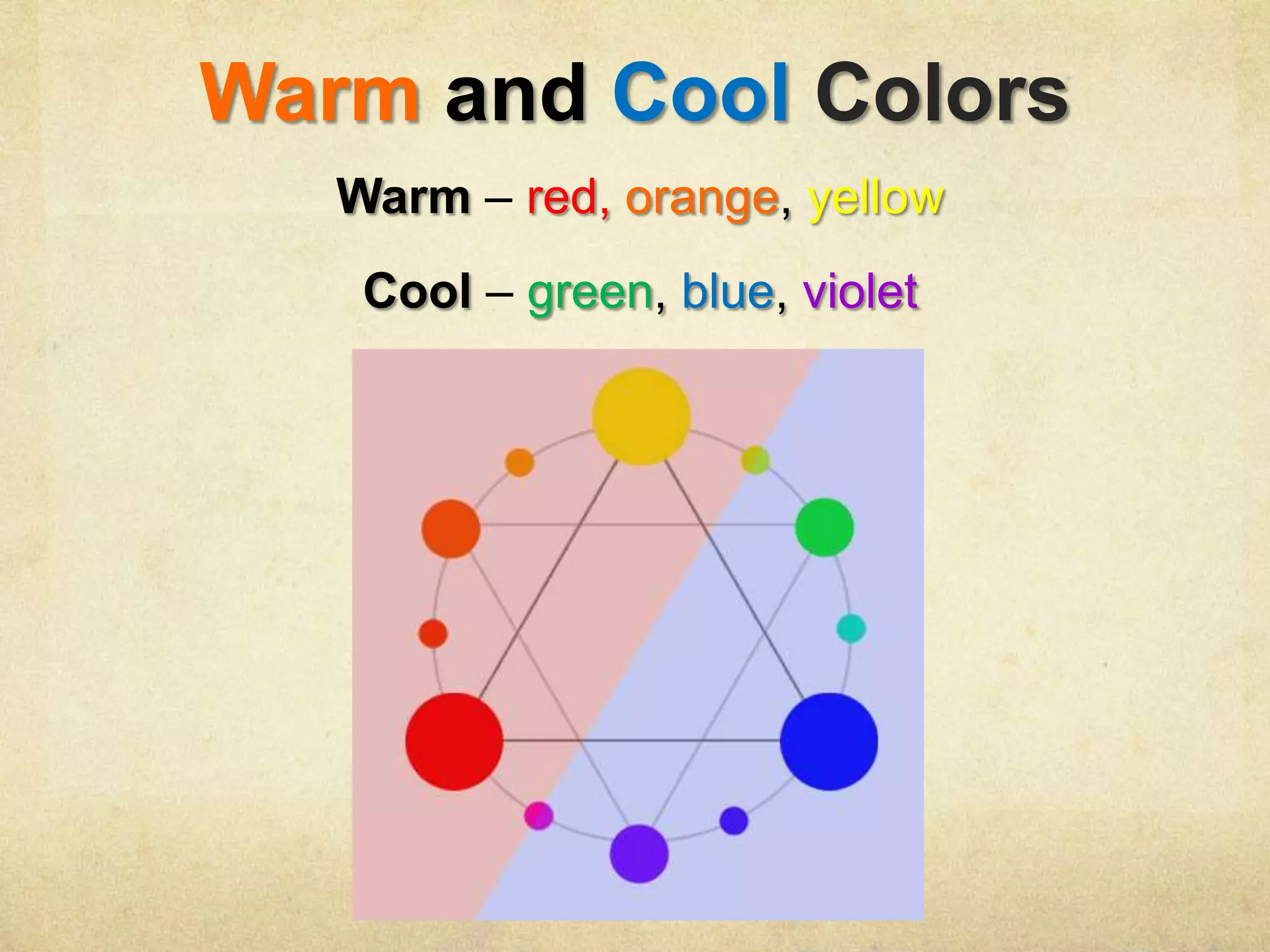
Warm and Cool Colors
Warm – red, orange, yellow
Cool – green, blue, violet
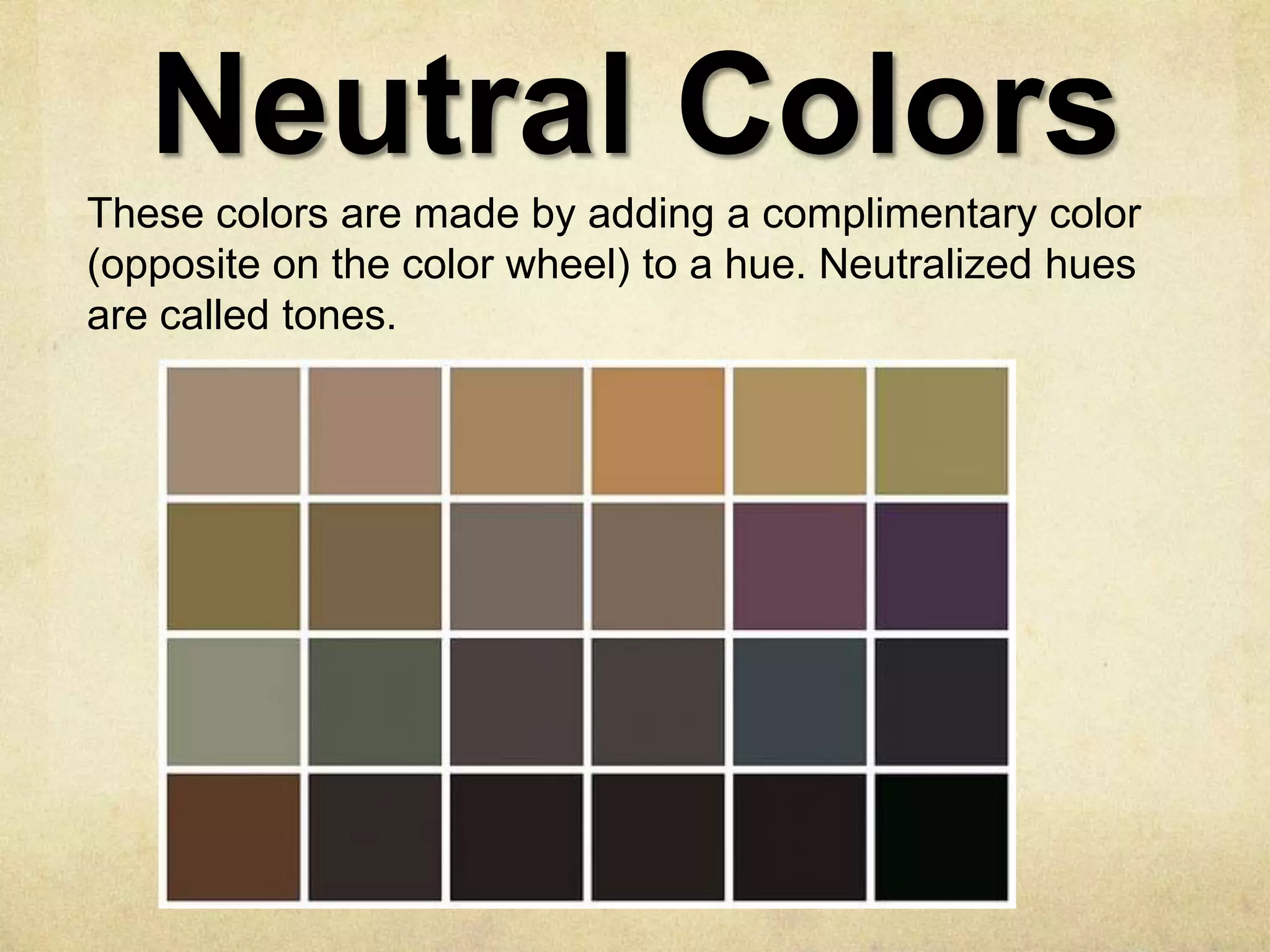
Neutral Colors
These colors are made by adding a complimentary color
(opposite on the color wheel) to a hue. Neutralized hues
are called tones.
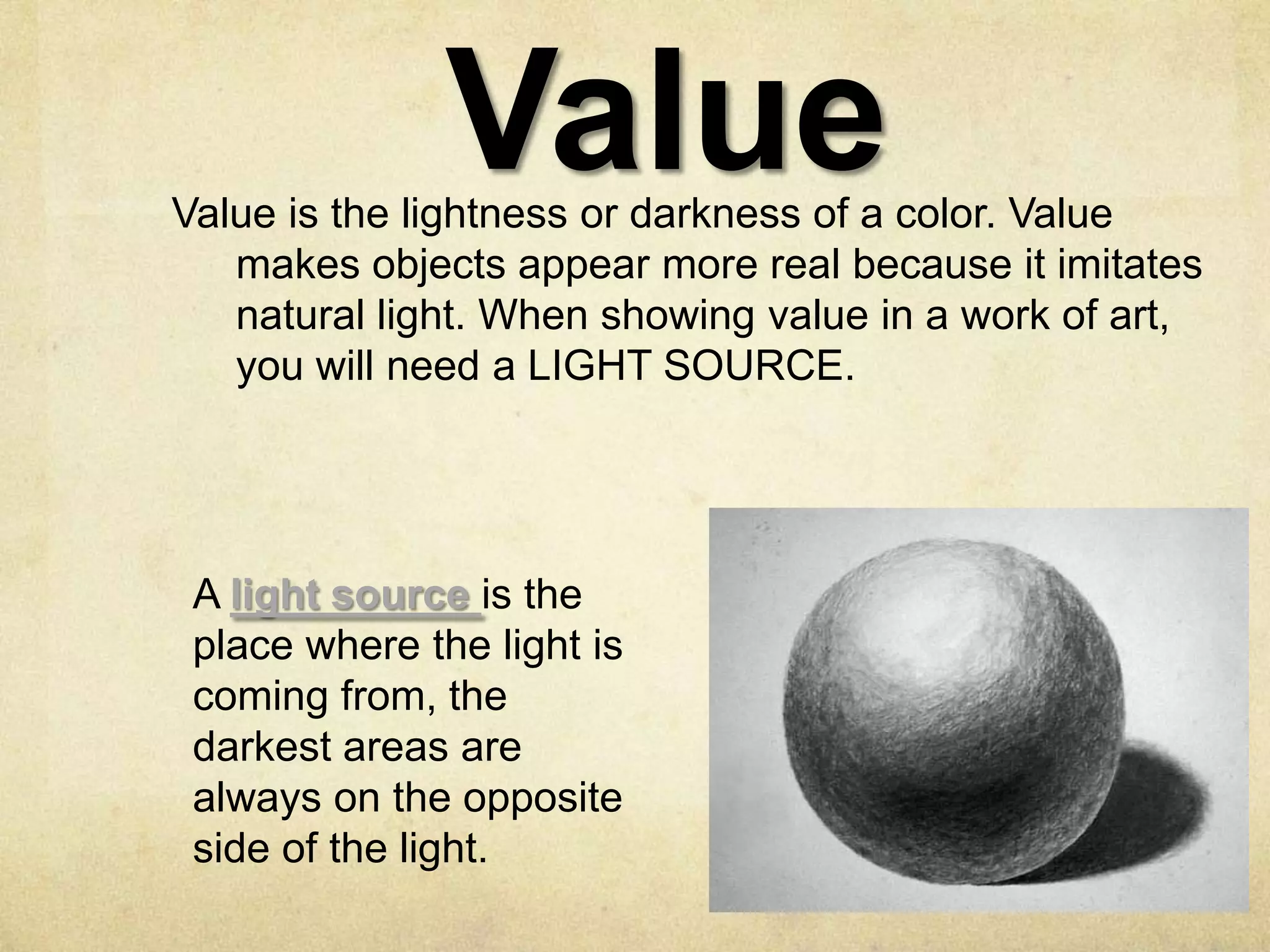
Value

Value is the lightness or darkness of a color. Value
makes objects appear more real because it imitates
natural light. When showing value in a work of art,
you will need a LIGHT SOURCE.

A light source is the
place where the light is
coming from, the
darkest areas are
always on the opposite
side of the light.
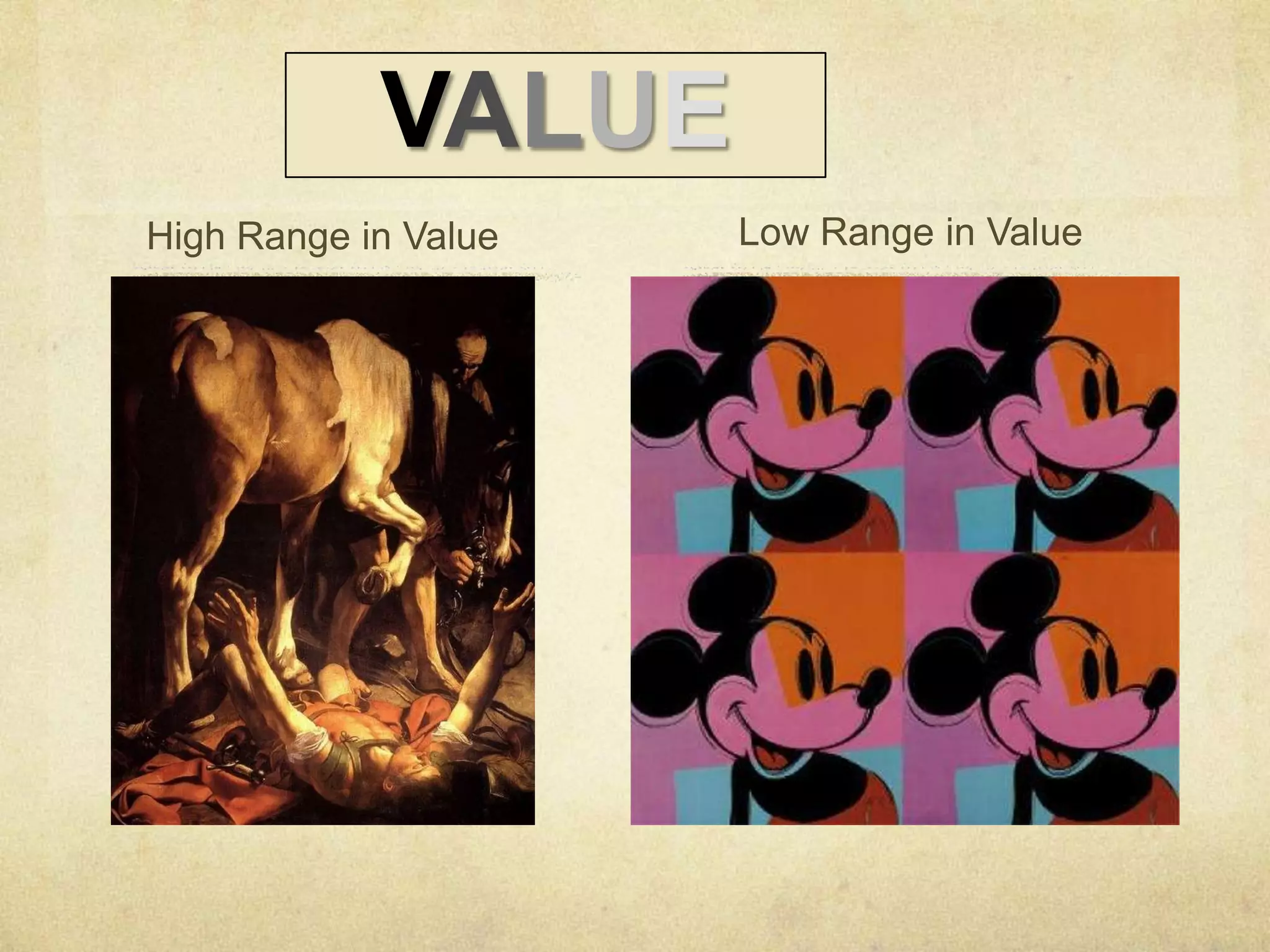
VALUE
High Range in Value

Low Range in Value
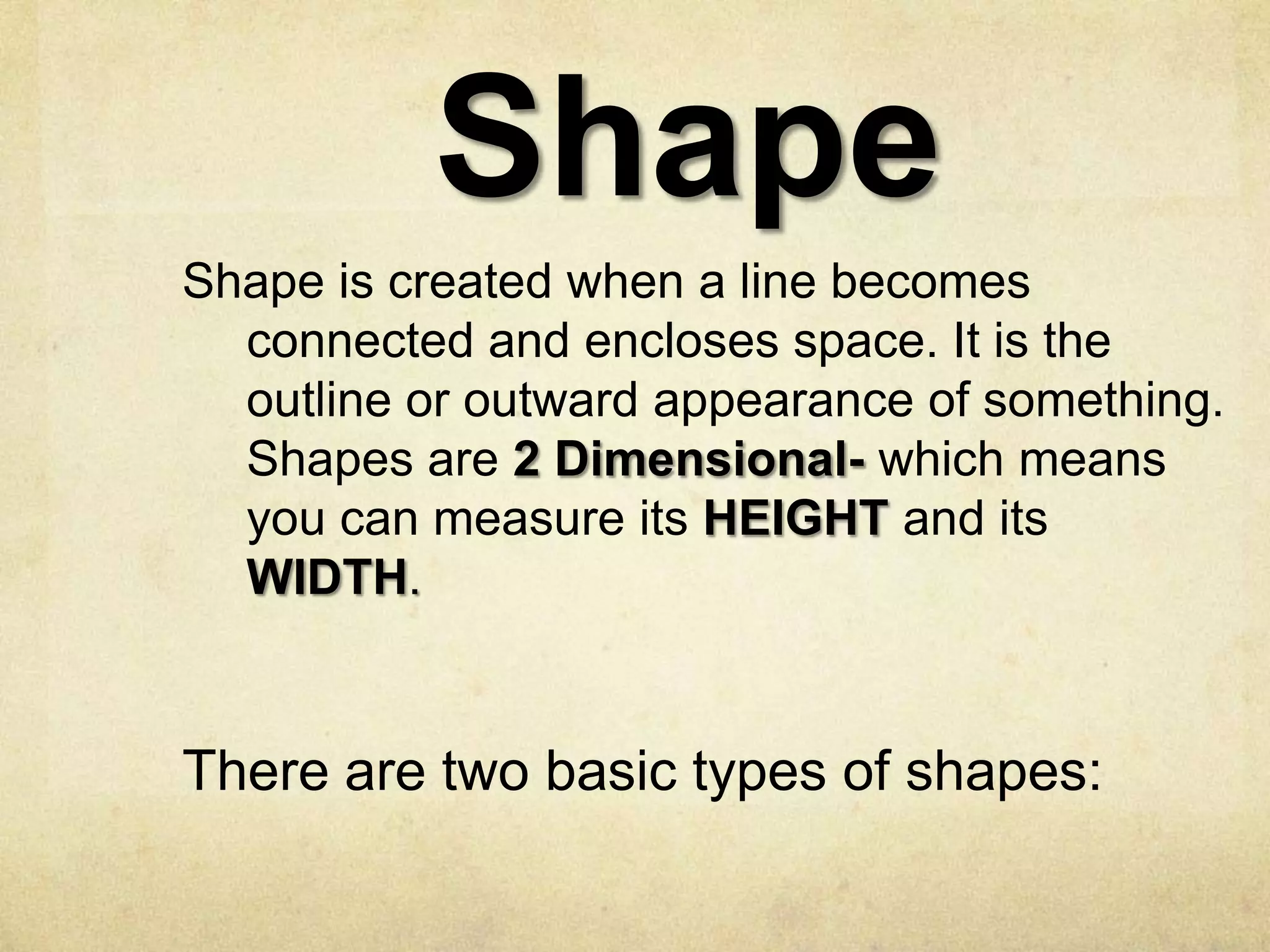
Shape
Shape is created when a line becomes
connected and encloses space. It is the
outline or outward appearance of something.
Shapes are 2 Dimensional- which means
you can measure its HEIGHT and its
WIDTH.

There are two basic types of shapes:
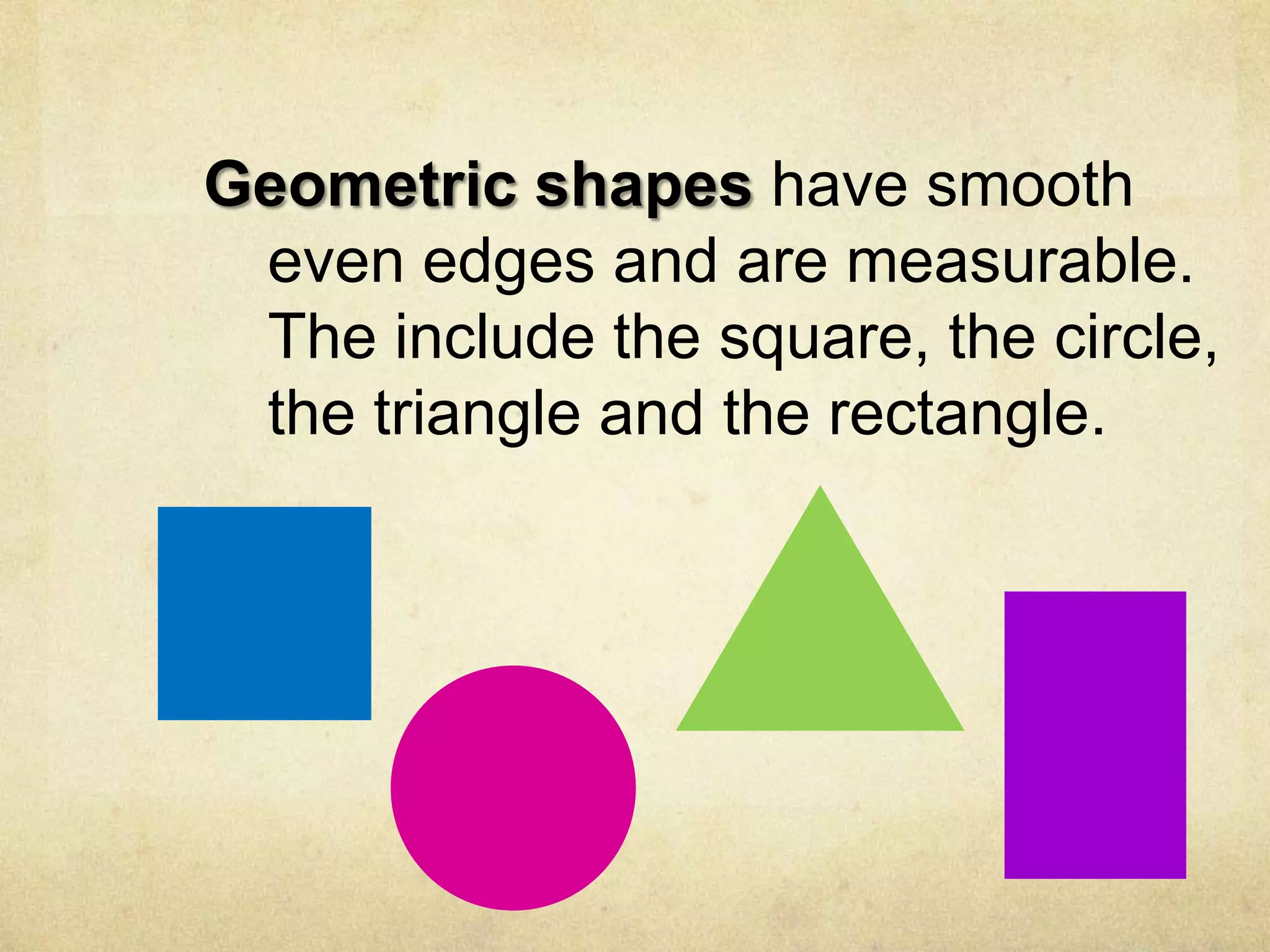
Geometric shapes have smooth
even edges and are measurable.
The include the square, the circle,
the triangle and the rectangle.
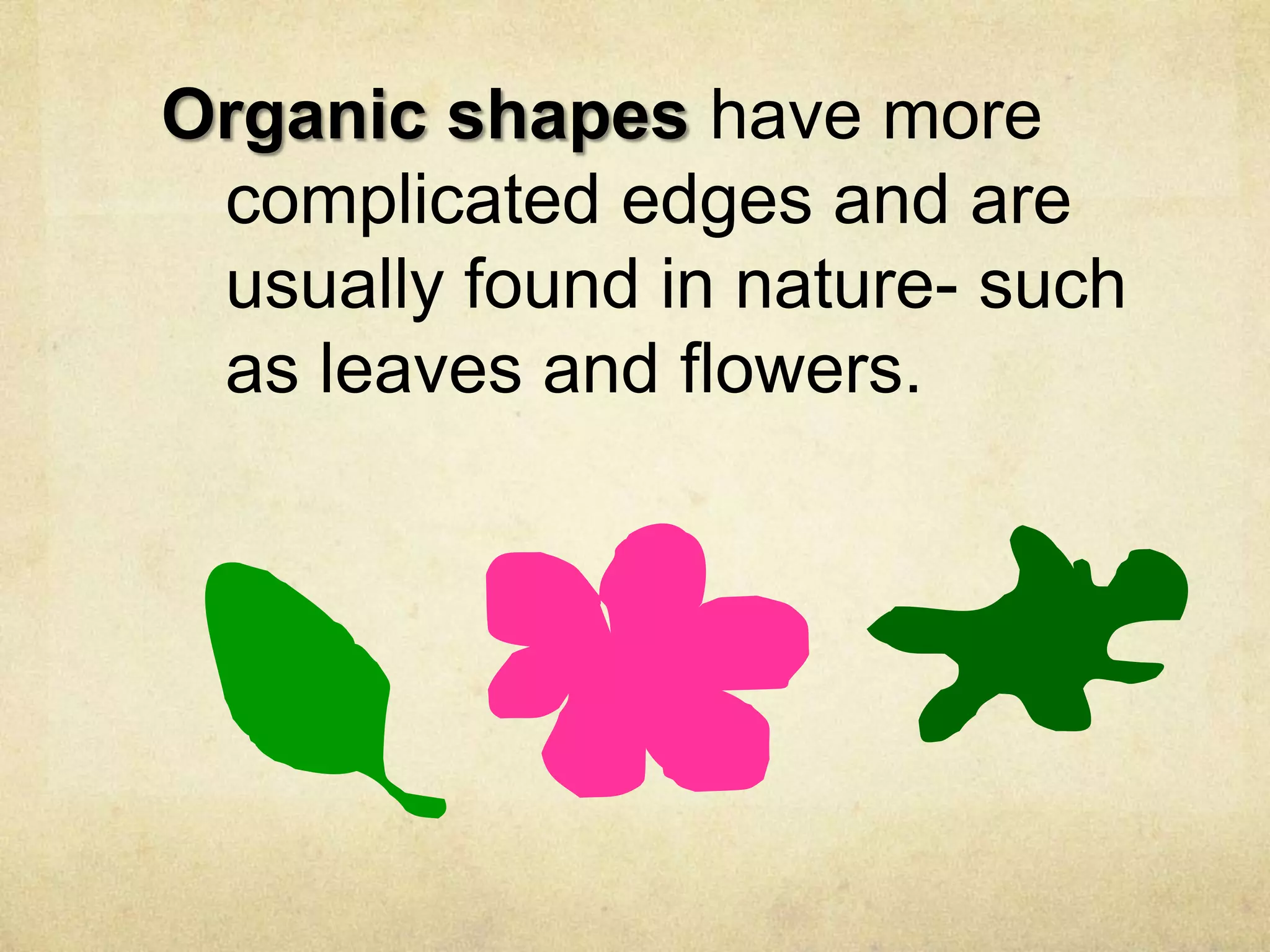
Organic shapes have more
complicated edges and are
usually found in nature- such
as leaves and flowers.
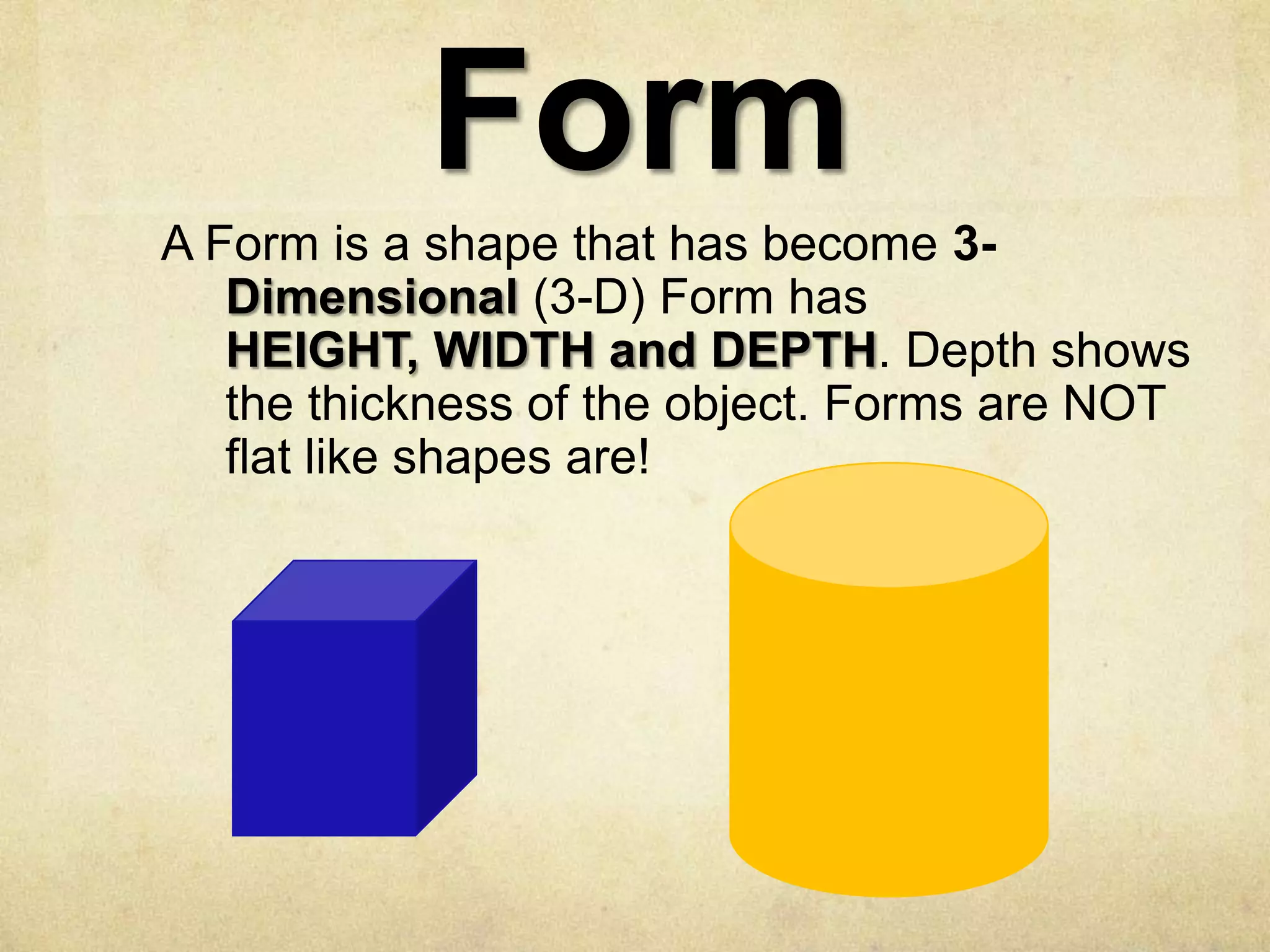
Form
A Form is a shape that has become 3Dimensional (3-D) Form has
HEIGHT, WIDTH and DEPTH. Depth shows
the thickness of the object. Forms are NOT
flat like shapes are!
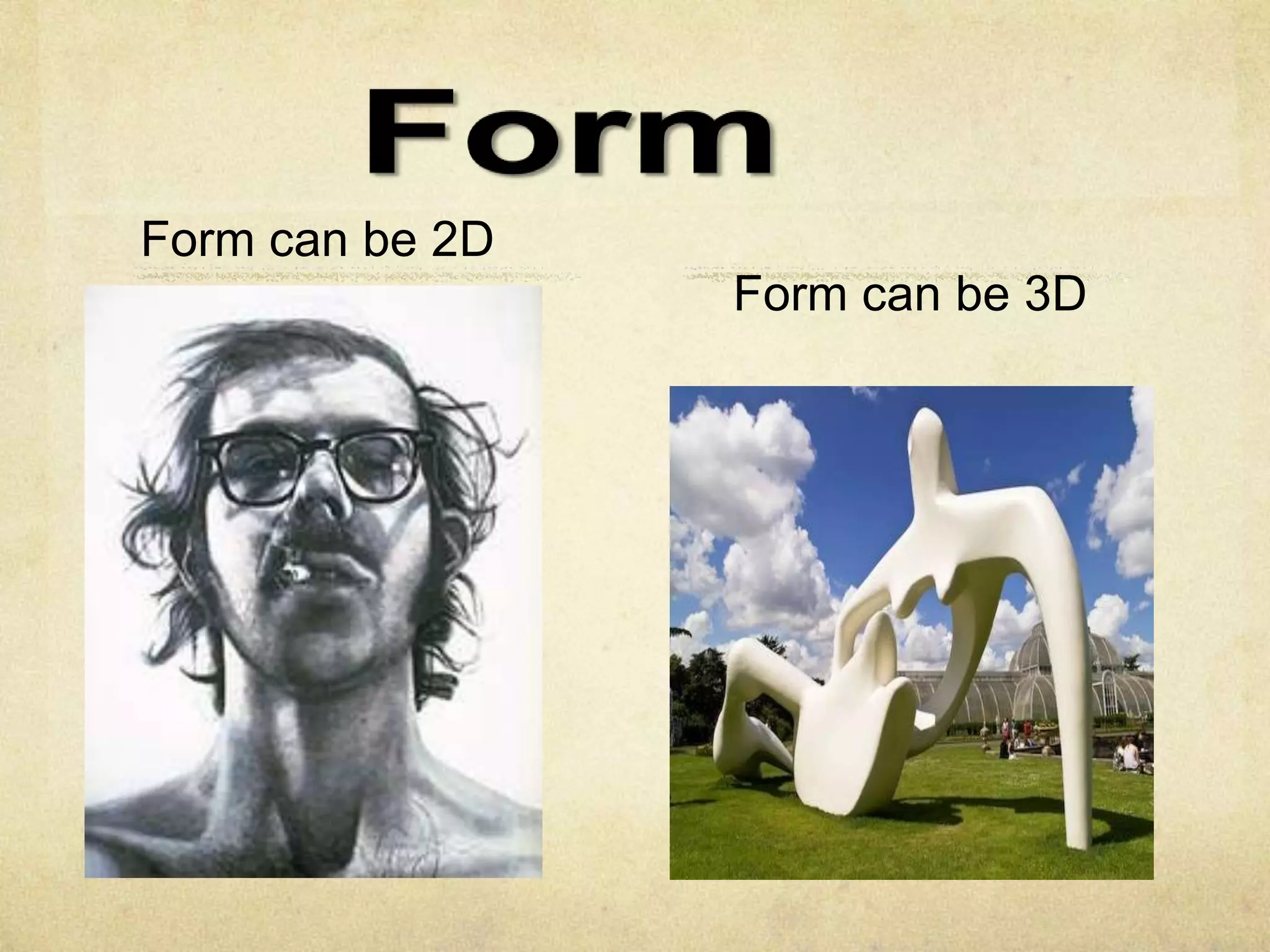
Form can be 2D
Form can be 3D
.

S

p
c

a
e
S p a c e
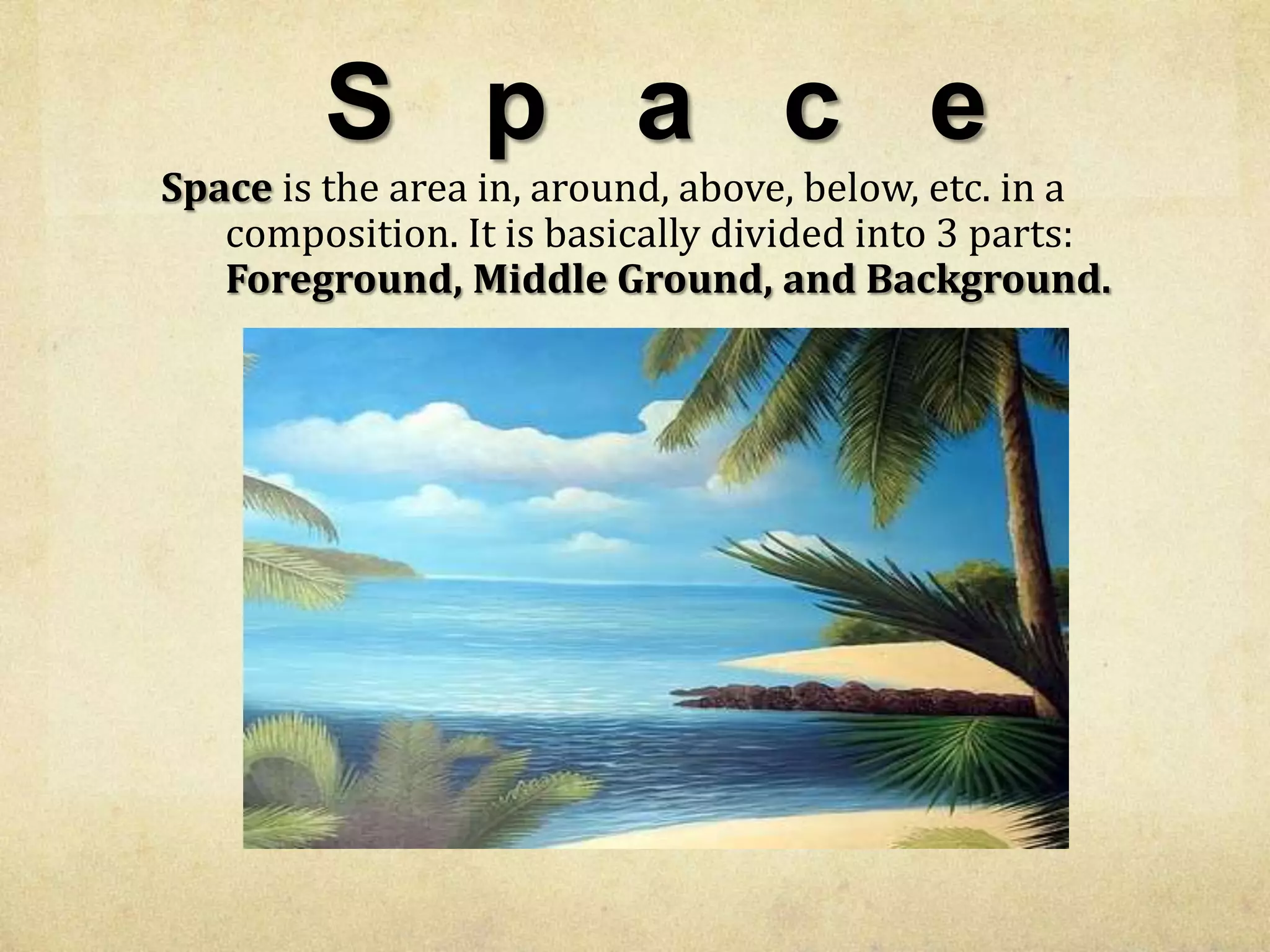
Space is the area in, around, above, below, etc. in a
composition. It is basically divided into 3 parts:
Foreground, Middle Ground, and Background.
S p a c e

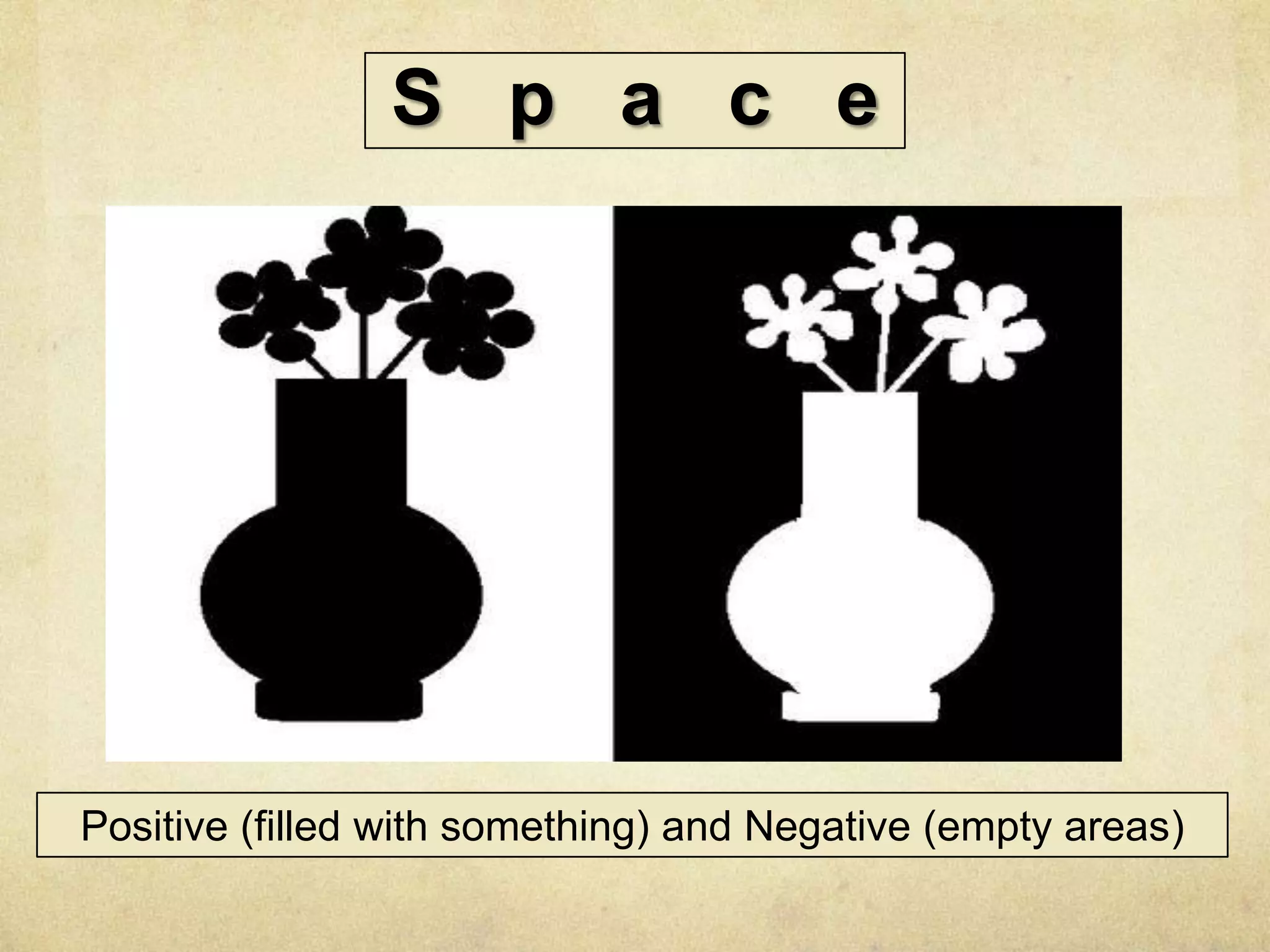
Positive (filled with something) and Negative (empty areas)
S p a c e
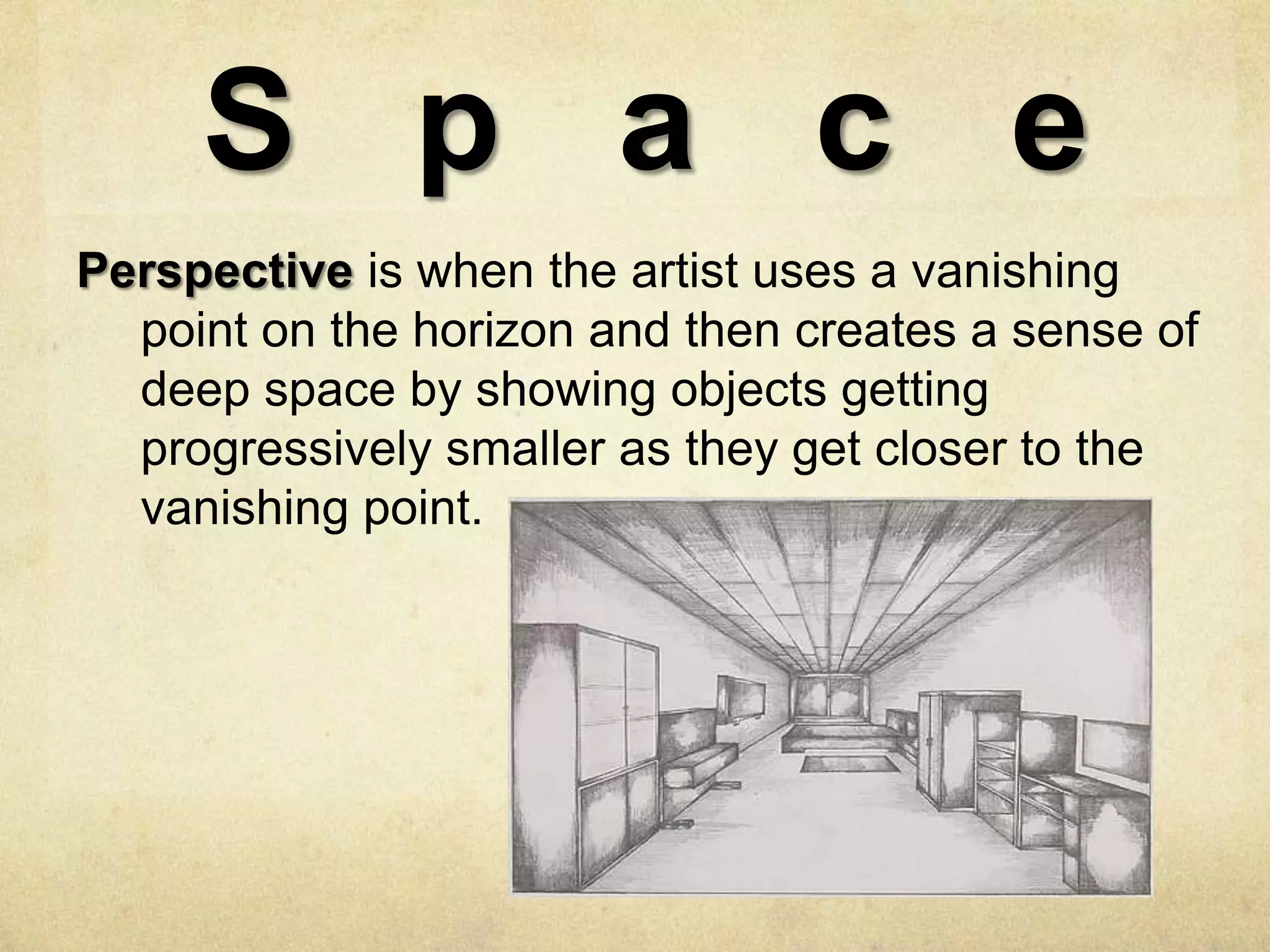
Perspective is when the artist uses a vanishing
point on the horizon and then creates a sense of
deep space by showing objects getting
progressively smaller as they get closer to the
vanishing point.
TEXTURE

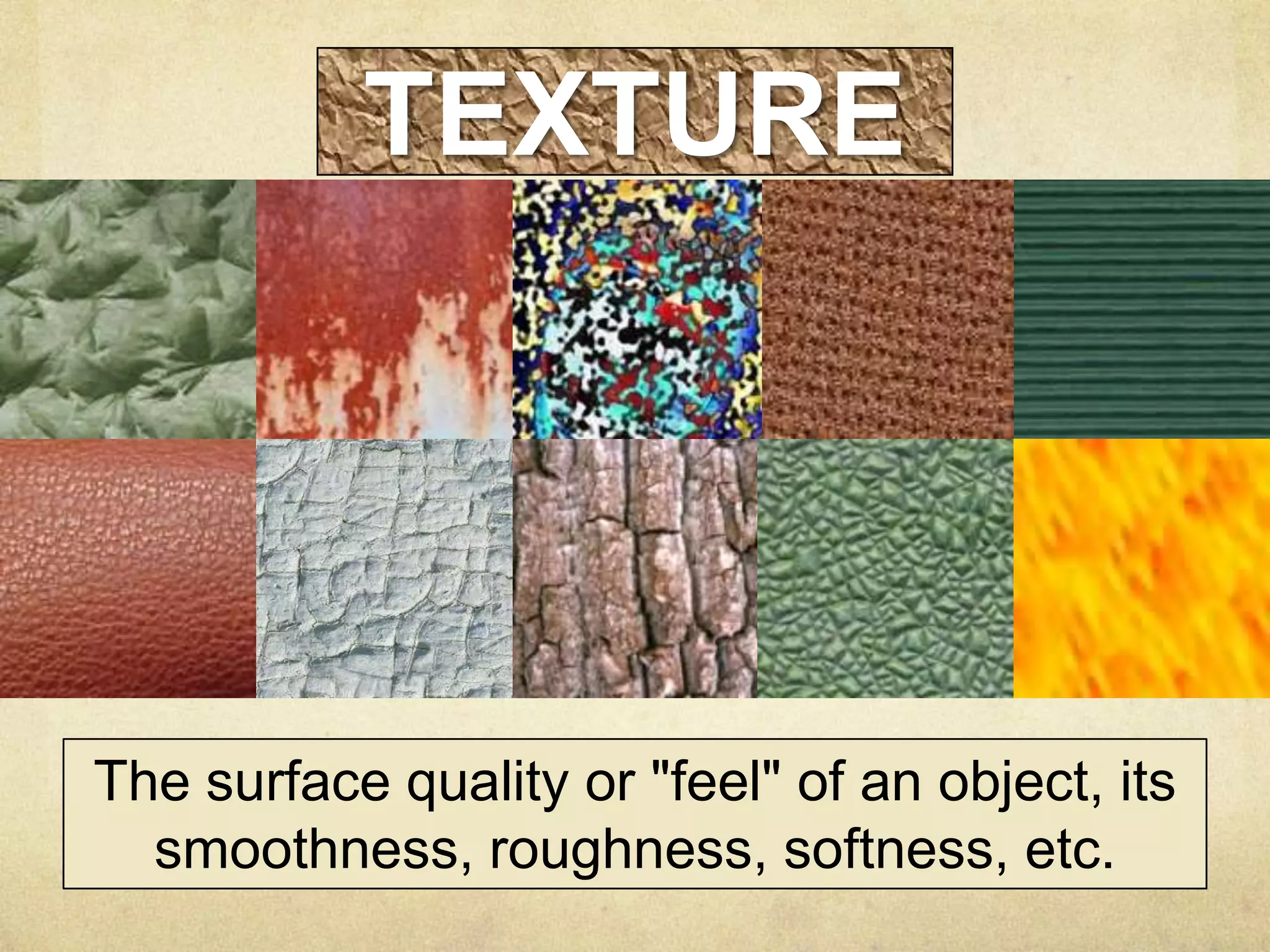
The surface quality or "feel" of an object, its
smoothness, roughness, softness, etc.
TEXTURE

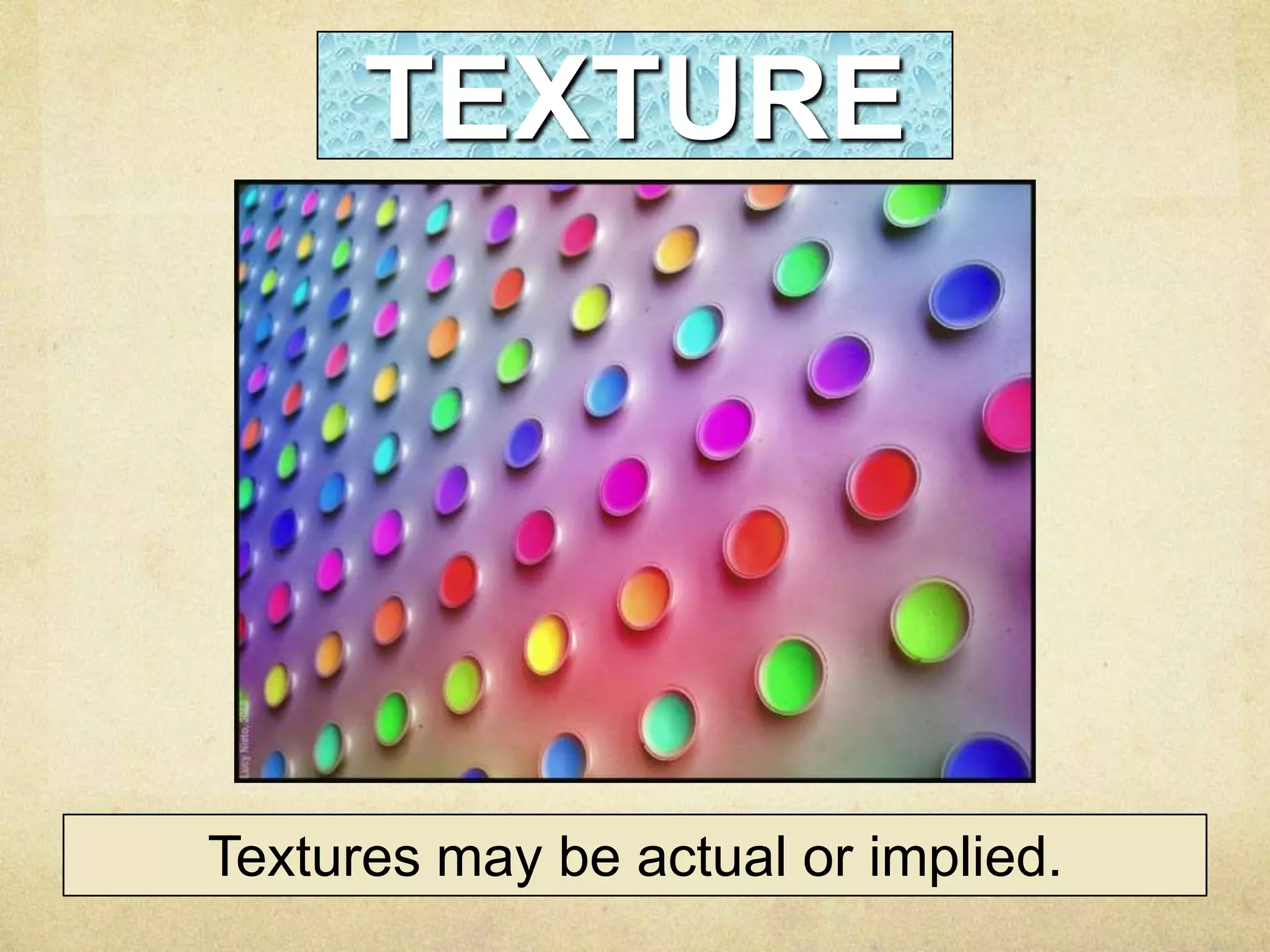
Textures may be actual or implied.
TEXTURE
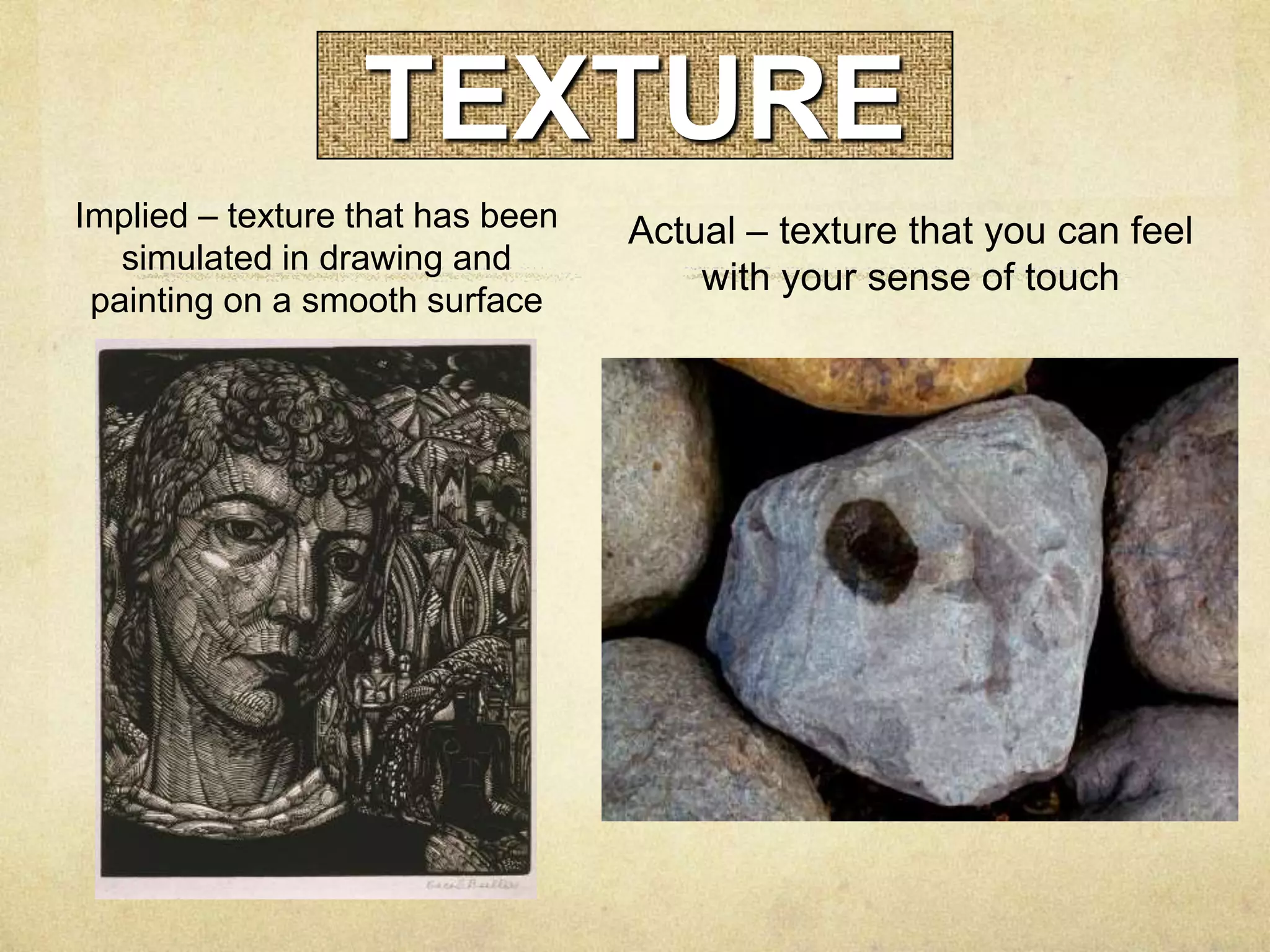
Implied – texture that has been
simulated in drawing and
painting on a smooth surface

Actual – texture that you can feel
with your sense of touch
References
This presentation is a mash up of 3 different sources. They
are:

Dkotopoulis. S ( 2010) The Elements of Art, the ingredients
for a great composition
http://www.slideshare.net/dkotopoulis/the-elements-of-art
Accessed on 05 March 2014
Duckworth. S (2013) Elements of Art
http://www.slideshare.net/ShawnDuckworth/elements-ofart-26721998 Accessed on 05 March 2014
Restrepo. N (2011) Elements of Art
http://www.slideshare.net/maunilpatel766/elements-of-art9747693 Accessed on 05 March 2014

Elements of Art

  • 1.
  • 2.
    Elements of Art Thebuilding blocks or ingredients of art. They structure and carry the work.
  • 3.
    What are theelements of arts? The Elements of Art are the “tools” that artists use to make art. There are 7 of them:
  • 4.
    Elements of Art 1.Line 5. Form 2. Color 6. Space 3. Value 7. Texture 4. Shape
  • 5.
  • 6.
    Line A line isa path that a point takes through space. Lines can be thick, thin, dotted or solid. They can be straight, zig-zagged, wavy, curly, etc. They may be horizontal vertical diagonal
  • 7.
  • 8.
    Color Color has threeproperties: 1. HUE: this is the name of the colors 2. VALUE: refers to the lightness or darkness of a hue. 3. INTENSITY: refers to the purity of the hue (called “Chroma”)
  • 9.
  • 10.
    Warm and CoolColors Warm – red, orange, yellow Cool – green, blue, violet
  • 11.
    Neutral Colors These colorsare made by adding a complimentary color (opposite on the color wheel) to a hue. Neutralized hues are called tones.
  • 12.
    Value Value is thelightness or darkness of a color. Value makes objects appear more real because it imitates natural light. When showing value in a work of art, you will need a LIGHT SOURCE. A light source is the place where the light is coming from, the darkest areas are always on the opposite side of the light.
  • 13.
    VALUE High Range inValue Low Range in Value
  • 14.
    Shape Shape is createdwhen a line becomes connected and encloses space. It is the outline or outward appearance of something. Shapes are 2 Dimensional- which means you can measure its HEIGHT and its WIDTH. There are two basic types of shapes:
  • 15.
    Geometric shapes havesmooth even edges and are measurable. The include the square, the circle, the triangle and the rectangle.
  • 16.
    Organic shapes havemore complicated edges and are usually found in nature- such as leaves and flowers.
  • 17.
    Form A Form isa shape that has become 3Dimensional (3-D) Form has HEIGHT, WIDTH and DEPTH. Depth shows the thickness of the object. Forms are NOT flat like shapes are!
  • 18.
    Form can be2D Form can be 3D
  • 19.
  • 20.
    S p ac e Space is the area in, around, above, below, etc. in a composition. It is basically divided into 3 parts: Foreground, Middle Ground, and Background.
  • 21.
    S p ac e Positive (filled with something) and Negative (empty areas)
  • 22.
    S p ac e Perspective is when the artist uses a vanishing point on the horizon and then creates a sense of deep space by showing objects getting progressively smaller as they get closer to the vanishing point.
  • 23.
    TEXTURE The surface qualityor "feel" of an object, its smoothness, roughness, softness, etc.
  • 24.
    TEXTURE Textures may beactual or implied.
  • 25.
    TEXTURE Implied – texturethat has been simulated in drawing and painting on a smooth surface Actual – texture that you can feel with your sense of touch
  • 26.
    References This presentation isa mash up of 3 different sources. They are: Dkotopoulis. S ( 2010) The Elements of Art, the ingredients for a great composition http://www.slideshare.net/dkotopoulis/the-elements-of-art Accessed on 05 March 2014 Duckworth. S (2013) Elements of Art http://www.slideshare.net/ShawnDuckworth/elements-ofart-26721998 Accessed on 05 March 2014 Restrepo. N (2011) Elements of Art http://www.slideshare.net/maunilpatel766/elements-of-art9747693 Accessed on 05 March 2014