1
2. Water And PH
•Water accounts for about 70% of a cell's weight,
and most intracellular reactions occur in an
aqueous environment.
•Life therefore hinges on the properties of water.
Properties of water
–Polarity
–Hydrogen bonding potential
–Specific heat, heat of vaporization
–Nucleophilic (electron rich)
–Ionization
–Water is an ideal biological solvent
2
Role of water in biological system
•Water can dissolve most of biologically important molecules
(universal solvent ).
•Water act as a medium for diffusion of molecules in the cell
•Osmotic concentration of cell is maintained by water.
•Water is the source for H+ ions for photosynthesis.
•Oxygen is released by hydrolysis of water during
photosynthesis.
•Water act as a reactant in the hydrolysis reaction
• Water support aquatic plants and animals
•Water cools the body by sweating process
•Seed germination requires water
•The main medium of blood and lymphatic system is water
•Act as lubricant in the joints
3
CONT.
•Hydrophilic and hydrophobic interactions of
macromolecules permit formation and stabilization of
cell membrane, conformation of proteins
• Ice has less density than water
• Water is transparent
• Water can form buffers with acid and base
• Due to the high heat capacity, water prevents the effect
of temperature flu ctuations in the surrounding
•In each water molecule (H2O) the two H atoms are linked
to the O atom by covalent bonds
•The two bonds are highly polar because the O is strongly
attractive for electrons, whereas the H is only weakly
attractive.
4
cont
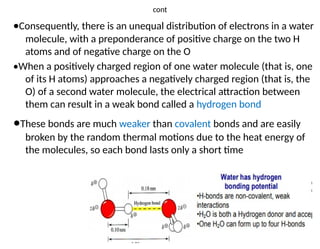
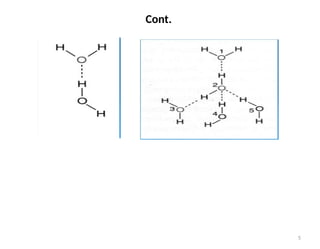
•Consequently, there is an unequal distribution of electrons in a water
molecule, with a preponderance of positive charge on the two H
atoms and of negative charge on the O
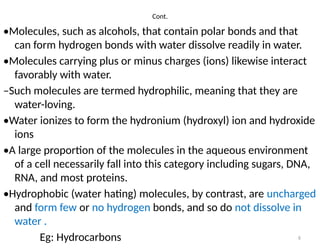
•When a positively charged region of one water molecule (that is, one
of its H atoms) approaches a negatively charged region (that is, the
O) of a second water molecule, the electrical attraction between
them can result in a weak bond called a hydrogen bond
•These bonds are much weaker than covalent bonds and are easily
broken by the random thermal motions due to the heat energy of
the molecules, so each bond lasts only a short time
5
Cont.
6
Cont.
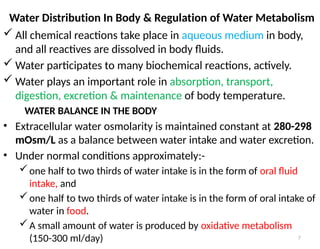
•Molecules, such as alcohols, that contain polar bonds and that
can form hydrogen bonds with water dissolve readily in water.
•Molecules carrying plus or minus charges (ions) likewise interact
favorably with water.
–Such molecules are termed hydrophilic, meaning that they are
water-loving.
•Water ionizes to form the hydronium (hydroxyl) ion and hydroxide
ions
•A large proportion of the molecules in the aqueous environment
of a cell necessarily fall into this category including sugars, DNA,
RNA, and most proteins.
•Hydrophobic (water hating) molecules, by contrast, are uncharged
and form few or no hydrogen bonds, and so do not dissolve in
water .
Eg: Hydrocarbons
7
Water Distribution In Body & Regulation of Water Metabolism
 All chemical reactions take place in aqueous medium in body,
and all reactives are dissolved in body fluids.
 Water participates to many biochemical reactions, actively.
 Water plays an important role in absorption, transport,
digestion, excretion & maintenance of body temperature.
WATER BALANCE IN THE BODY
• Extracellular water osmolarity is maintained constant at 280-298
mOsm/L as a balance between water intake and water excretion.
• Under normal conditions approximately:-
one half to two thirds of water intake is in the form of oral fluid
intake, and
one half to two thirds of water intake is in the form of oral intake of
water in food.
A small amount of water is produced by oxidative metabolism
(150-300 ml/day)
8
Acıd-Base Balance and Buffers
 The end-products of the catabolism of carbonhydrates, lipids
and proteins are generally acidic molecules in living
organisms.
 In metabolic reactions, 22 000 mEq acid (organic acids,
inorganic acids and CO2) is produced per day.
 H+
is a direct participant for many reactions, and enzymes.
 increased [H+
] can easily alter the charges and functions of
proteins, enzymes, nucleic acids, some hormones and
membranes.
 Normal blood pH is 7.35-7.45.
 Values <6.8 (Acidosis or acidemia )or > 7.70 are toxic(Alkalosis
or alkalemia ) can result in coma, cardiac failure, and
circulatory collapse.
 In living organisms, pH of the body fluids are tightly regulated
by biological buffers and some organs (lungs and kidneys).
9
Acid-base theory
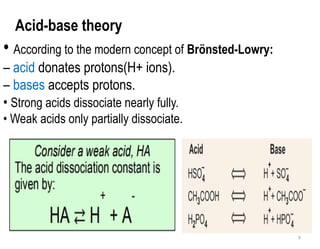
• According to the modern concept of Brönsted-Lowry:
– acid donates protons(H+ ions).
– bases accepts protons.
• Strong acids dissociate nearly fully.
• Weak acids only partially dissociate.
10
Cont
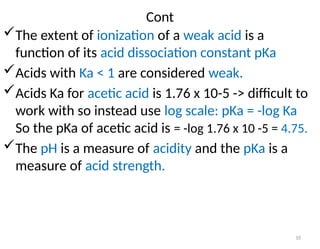
The extent of ionization of a weak acid is a
function of its acid dissociation constant pKa
Acids with Ka < 1 are considered weak.
Acids Ka for acetic acid is 1.76 x 10⁻⁵ -> difficult to
work with so instead use log scale: pKa = -log Ka
So the pKa of acetic acid is = -log 1.76 x 10 -5 = 4.75.
The pH is a measure of acidity and the pKa is a
measure of acid strength.
11
Definition of PH and pka
pH is the (-) logarithm of [H+
]
PH = -log [H+
]
 Scale ranges from 1 to 14.
 1 means only H+ are present, 14 means no
H+ present.
pOH is the (-) logarithm of [OH-
]
pOH = -log [OH-
]
For water;
 [H+]=[OH-]=10-7
M, pH=7 and
pH+pOH=14 (calculated)
• A solution with PH<7 is acidic and
• A solution with PH>7 is basic
Acids are [H+
] donors
Bases are [H+
] acceptors
12
Buffers
₋ Buffer is a solution ( or a substance) that has the ability to maintain pH &
bring it back to its optimal value by addition or removal of H+
; Buffer
+ H+
H+
Buffer
₋ Buffer tend to resist changes in pH when small amounts of strong acid
[H+
] or strong base [OH-
] are added.
₋ A buffer system consists of:-
 a weak acid (the proton donor) and its conjugate base (weak bases
and their salts).
₋ A mixture of equal concentrations of acetic acid and acetate ion is a buffer
system.
₋ One can soak up excess protons (acid), the other can soak up excess
hydroxide (base).
₋ When a strong acid (HCl) is added:
CH3COO-
+ HCl  CH3COOH + Cl-
-
When a strong base (NaOH) is added:
CH3COOH +NaOH  CH3COO-
+H2O + Na+
13
cont
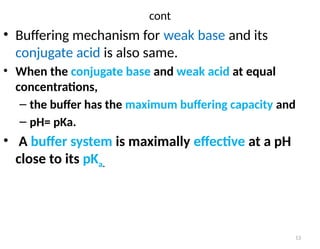
• Buffering mechanism for weak base and its
conjugate acid is also same.
• When the conjugate base and weak acid at equal
concentrations,
– the buffer has the maximum buffering capacity and
– pH= pKa.
• A buffer system is maximally effective at a pH
close to its pKa.
14
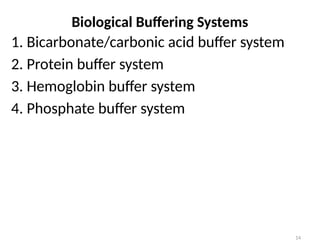
1. Bicarbonate/carbonic acid buffer system
2. Protein buffer system
3. Hemoglobin buffer system
4. Phosphate buffer system
Biological Buffering Systems
15
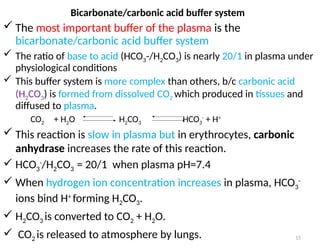
 The most important buffer of the plasma is the
bicarbonate/carbonic acid buffer system
 The ratio of base to acid (HCO3-/H2CO3) is nearly 20/1 in plasma under
physiological conditions
 This buffer system is more complex than others, b/c carbonic acid
(H2CO3) is formed from dissolved CO2 which produced in tissues and
diffused to plasma.
CO2 + H2O H2CO3 HCO3
-
+ H+
 This reaction is slow in plasma but in erythrocytes, carbonic
anhydrase increases the rate of this reaction.
 HCO3
-
/H2CO3 = 20/1 when plasma pH=7.4
 When hydrogen ion concentration increases in plasma, HCO3
-
ions bind H+
forming H2CO3.
 H2CO3 is converted to CO2 + H2O.
 CO2 is released to atmosphere by lungs.
Bicarbonate/carbonic acid buffer system
16
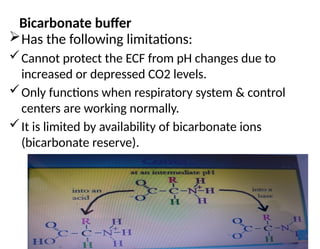
Bicarbonate buffer
Has the following limitations:
Cannot protect the ECF from pH changes due to
increased or depressed CO2 levels.
Only functions when respiratory system & control
centers are working normally.
It is limited by availability of bicarbonate ions
(bicarbonate reserve).
17
 The carboxyl & amino groups are what enable proteins to act as
buffers.
 At neutral pH the carboxyl ion is present as COO- instead of COOH
(Acidic medium= becomes COOH Basic medium- becomes COO- ) while the
amino group is actually-NH3+ (acidic medium) NH2 (Basic medium).
 In proteins, ionizable R groups (COOH groups of aspartate & glutamate,
NH2 groups of lysine, arginine & histidine) and N-terminale -NH2
groups of some amino acids are responsible for buffering.
 Proteins, especially albumin, account for the %95 of the non-
bicarbonate buffer value of the plasma. Buffering effect of proteins is
low in plasma
 Proteins are much more effective buffers in intracellular medium.
 The most important buffer groups of proteins in the physiological pH
range are the imidazole groups of histidine which has a pKa value of 6.5
 Each albumin molecule contains 16 histidines
Protein buffer system
18
 Hemoglobin (Hb) is a protein which carries O2 to tissues
and CO2 from tissues to lungs and is an effective buffer.
 The most important buffer groups of Hb are histidines. Each
globin chain contains 9 histidine.
 %95 of CO2which is released from tissues to plasma is
diffused into erythrocytes.
 In erythrocytes, carbonic anhydrase constitutes H2CO3 from
CO2 and H2O and then HCO3
-
and H+
are released by the
ionization of H2CO3.
Carbonic anhydrase
CO2 + H2O H2CO3 HCO3
-
+ H+
 Released protons take part in the formation of salt bridges
between globin chains of Hb, and lead the change in the
conformation of Hb molecule in tissue capillaries.
Hemoglobin buffer system
19
 The binding of proton and CO2 is conversly related to binding
of oxygen.
 In tissue capillaries proton and CO2 binding decreases the
oxygen binding capacity of Hb so that oxygen is released by
Hb.
 This effect of pH and CO2 concentration on the binding and
release of oxygen by Hb is called the Bohr Effect.
 Because of the accumulation of HCO3
-
formed by ionization of
H2CO3 within erythrocytes, there is a concentration gradient
for HCO3
-
between plasma and erythrocytes.
 In that case, HCO3
-
ions rapidly move from erythrocytes to
plasma, and Cl-
ions move from plasma to erythrocytes to
provide electrochemical balance.
 This shift of Cl-
is referred to as the chloride shift.
20
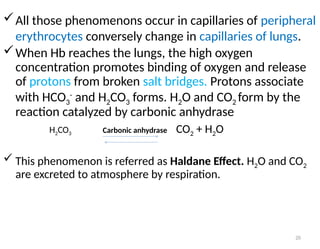
All those phenomenons occur in capillaries of peripheral
erythrocytes conversely change in capillaries of lungs.
When Hb reaches the lungs, the high oxygen
concentration promotes binding of oxygen and release
of protons from broken salt bridges. Protons associate
with HCO3
-
and H2CO3 forms. H2O and CO2 form by the
reaction catalyzed by carbonic anhydrase
H2CO3 Carbonic anhydrase CO2 + H2O
 This phenomenon is referred as Haldane Effect. H2O and CO2
are excreted to atmosphere by respiration.
21
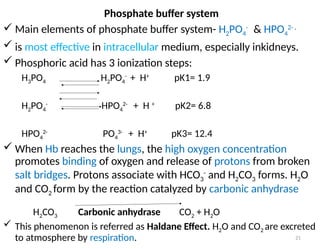
 Main elements of phosphate buffer system- H2PO4
-
& HPO4
2- .
 is most effective in intracellular medium, especially inkidneys.
 Phosphoric acid has 3 ionization steps:
H3PO4 H2PO4
-
+ H+
pK1= 1.9
H2PO4
-
HPO4
2-
+ H +
pK2= 6.8
HPO4
2-
PO4
3-
+ H+
pK3= 12.4
 When Hb reaches the lungs, the high oxygen concentration
promotes binding of oxygen and release of protons from broken
salt bridges. Protons associate with HCO3
-
and H2CO3 forms. H2O
and CO2 form by the reaction catalyzed by carbonic anhydrase
H2CO3 Carbonic anhydrase CO2 + H2O
 This phenomenon is referred as Haldane Effect. H2O and CO2 are excreted
to atmosphere by respiration.
Phosphate buffer system
22
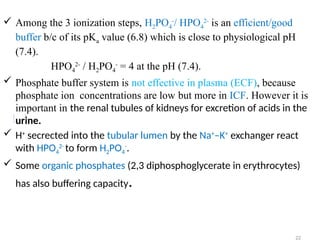
 Among the 3 ionization steps, H2PO4
-
/ HPO4
2-
is an efficient/good
buffer b/c of its pKa value (6.8) which is close to physiological pH
(7.4).
HPO4
2-
/ H2PO4
-
= 4 at the pH (7.4).
 Phosphate buffer system is not effective in plasma (ECF), because
phosphate ion concentrations are low but more in ICF. However it is
important in the renal tubules of kidneys for excretion of acids in the
urine.
 H+
secrected into the tubular lumen by the Na+
–K+
exchanger react
with HPO4
2-
to form H2PO4
-
.
 Some organic phosphates (2,3 diphosphoglycerate in erythrocytes)
has also buffering capacity.
23
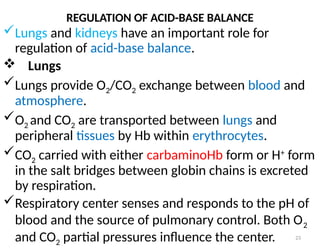
Lungs and kidneys have an important role for
regulation of acid-base balance.
 Lungs
Lungs provide O2/CO2 exchange between blood and
atmosphere.
O2 and CO2 are transported between lungs and
peripheral tissues by Hb within erythrocytes.
CO2 carried with either carbaminoHb form or H+
form
in the salt bridges between globin chains is excreted
by respiration.
Respiratory center senses and responds to the pH of
blood and the source of pulmonary control. Both O2
and CO2 partial pressures influence the center.
REGULATION OF ACID-BASE BALANCE
24
A decrease in pH results in an increased respiratory
rate and deeper breathing.
A decrease in respiratory rate leads to
accumulation of CO2 and decrease in pH.
Pulmonary response is rapid (max. at 3-6 h) while
renal compensation is relatively slower.
Kidneys
The kidneys secrete protons through 3 mechanisms:
1. Reabsorbsion of HCO3
-
2. Na+
/H+
exchange
3. Production of ammonia and excretion of NH4
+
25
The proximal tubule is responsible for
reabsorbsion of HCO3
-
filtered through glomeruli.
In tubuler cells CO2 reacts with H2O to form H2CO3
HCO3
-
derived from dissociation of H2CO3 is
reabsorbed to plasma
1. Reabsorbsion of HCO3
-
26
H+
secreted into the tubules in exchange for Na+
from
the tubular fluid by Na+
/H+
-ATPase combines with
HCO3
-
to form CO2 and water.
The CO2 diffuses into the tubular cells where it is
rehydrated to H2CO3 by carbonic anhdydrase.
H2CO3 dissociates to HCO3
-
and H+
.The HCO3
-
is
reabsorbed anddiffuses into the blood stream.
K+
ions compete with H+
for Na+
/H+
exchange. When K+
ions excretion increase in urine, excretion of H+
ions
decreases.
Na+
/H+
exchange may also be coupled to formation of
H2PO4
-
from HPO4
2-
in the lumen.
2. Na+
/H+
exchange
27
These disorders are classified according to their
cause:
1. Metabolic acidosis
2. Respiratory acidosis
3. Metabolic alkalosis
4. Respiratory alkalosis
pH is lower than 7.37 in acidosis, higher than
7.44 in alkalosis.
DISORDERS OF ACID-BASE BALANCE
28
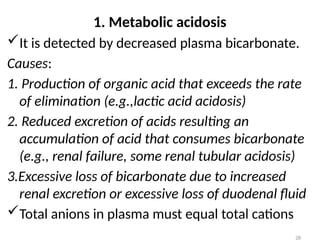
It is detected by decreased plasma bicarbonate.
Causes:
1. Production of organic acid that exceeds the rate
of elimination (e.g.,lactic acid acidosis)
2. Reduced excretion of acids resulting an
accumulation of acid that consumes bicarbonate
(e.g., renal failure, some renal tubular acidosis)
3.Excessive loss of bicarbonate due to increased
renal excretion or excessive loss of duodenal fluid
Total anions in plasma must equal total cations
1. Metabolic acidosis
29
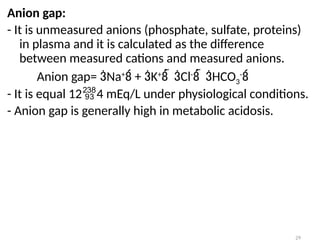
Anion gap:
- It is unmeasured anions (phosphate, sulfate, proteins)
in plasma and it is calculated as the difference
between measured cations and measured anions.
Anion gap= Na+
 + K+
  Cl-
  HCO3
-

- It is equal 124 mEq/L under physiological conditions.
- Anion gap is generally high in metabolic acidosis.
30
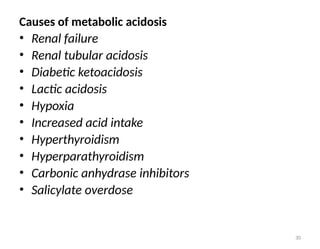
• Renal failure
• Renal tubular acidosis
• Diabetic ketoacidosis
• Lactic acidosis
• Hypoxia
• Increased acid intake
• Hyperthyroidism
• Hyperparathyroidism
• Carbonic anhydrase inhibitors
• Salicylate overdose
Causes of metabolic acidosis
31
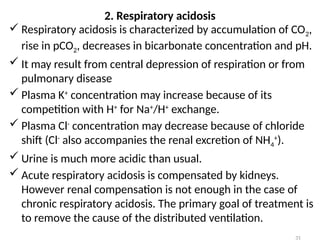
 Respiratory acidosis is characterized by accumulation of CO2,
rise in pCO2, decreases in bicarbonate concentration and pH.
 It may result from central depression of respiration or from
pulmonary disease
 Plasma K+
concentration may increase because of its
competition with H+
for Na+
/H+
exchange.
 Plasma Cl-
concentration may decrease because of chloride
shift (Cl-
also accompanies the renal excretion of NH4
+
).
 Urine is much more acidic than usual.
 Acute respiratory acidosis is compensated by kidneys.
However renal compensation is not enough in the case of
chronic respiratory acidosis. The primary goal of treatment is
to remove the cause of the distributed ventilation.
2. Respiratory acidosis
32
• Narcotic or barbiturate overdose- drug
• Trauma
• Infection
• Cerebrovascular accident
• Asthma, obstructive lung diseases
Causes of Respiratory Acidosis
33
• Metabolic alkalosis is characterized by elevated plasma bicarbonate
level.
• It may result from administration of excessive amount of alkali or
vomiting which causes loss of H+
and Cl-
.
• Plasma level of bicarbonate is high, K+
and Cl-
are low, urine is much
more alkaline than usual.
• When pH> 7.55 many of anions bind the Ca2+
ions so that ionized Ca2+
concentration decreases in plasma. This leads the cramps and
convulsions.
• Metabolic alkalosis is compensated by lungs and kidneys. Respiratory
rate is decreased by lungs as a result of depression of respiratory
center by high pH, therefore CO2 is kept .
• Renal compensation involves decreased reabsorbtion of bicarbonate,
Na+
/H+
exchange and NH4
+
formation which lead formation of alkaline
urine.
3. Metabolic alkalosis
34
• Loss of hidrogen ions from GIS
• K+
deficiency
• Hyperaldosteronism
• Cushing syndrome
• Antiacids, diüretics, corticosteroids
Causes of metabolic alkalosis
35
Respiratory alkalosis occurs when the respiratory
rate increases abnormally and leads to decrease in
PCO2 and rise in blood pH.
Hyperventilation occurs in hysteria, pulmonary
irritation and head injury with damage to
respiratory center.
The increase in blood pH is buffered by plasma
bicarbonate buffer system.
Renal compensation seldom occurs because this
type of alkalosis is usually transitory.
The increase in blood pH is buffered by plasma
bicarbonate buffer system.
4. Respiratory alkalosis

2. water and PH measuring presentation.pptx

  • 1.
    1 2. Water AndPH •Water accounts for about 70% of a cell's weight, and most intracellular reactions occur in an aqueous environment. •Life therefore hinges on the properties of water. Properties of water –Polarity –Hydrogen bonding potential –Specific heat, heat of vaporization –Nucleophilic (electron rich) –Ionization –Water is an ideal biological solvent
  • 2.
    2 Role of waterin biological system •Water can dissolve most of biologically important molecules (universal solvent ). •Water act as a medium for diffusion of molecules in the cell •Osmotic concentration of cell is maintained by water. •Water is the source for H+ ions for photosynthesis. •Oxygen is released by hydrolysis of water during photosynthesis. •Water act as a reactant in the hydrolysis reaction • Water support aquatic plants and animals •Water cools the body by sweating process •Seed germination requires water •The main medium of blood and lymphatic system is water •Act as lubricant in the joints
  • 3.
    3 CONT. •Hydrophilic and hydrophobicinteractions of macromolecules permit formation and stabilization of cell membrane, conformation of proteins • Ice has less density than water • Water is transparent • Water can form buffers with acid and base • Due to the high heat capacity, water prevents the effect of temperature flu ctuations in the surrounding •In each water molecule (H2O) the two H atoms are linked to the O atom by covalent bonds •The two bonds are highly polar because the O is strongly attractive for electrons, whereas the H is only weakly attractive.
  • 4.
    4 cont •Consequently, there isan unequal distribution of electrons in a water molecule, with a preponderance of positive charge on the two H atoms and of negative charge on the O •When a positively charged region of one water molecule (that is, one of its H atoms) approaches a negatively charged region (that is, the O) of a second water molecule, the electrical attraction between them can result in a weak bond called a hydrogen bond •These bonds are much weaker than covalent bonds and are easily broken by the random thermal motions due to the heat energy of the molecules, so each bond lasts only a short time
  • 5.
  • 6.
    6 Cont. •Molecules, such asalcohols, that contain polar bonds and that can form hydrogen bonds with water dissolve readily in water. •Molecules carrying plus or minus charges (ions) likewise interact favorably with water. –Such molecules are termed hydrophilic, meaning that they are water-loving. •Water ionizes to form the hydronium (hydroxyl) ion and hydroxide ions •A large proportion of the molecules in the aqueous environment of a cell necessarily fall into this category including sugars, DNA, RNA, and most proteins. •Hydrophobic (water hating) molecules, by contrast, are uncharged and form few or no hydrogen bonds, and so do not dissolve in water . Eg: Hydrocarbons
  • 7.
    7 Water Distribution InBody & Regulation of Water Metabolism  All chemical reactions take place in aqueous medium in body, and all reactives are dissolved in body fluids.  Water participates to many biochemical reactions, actively.  Water plays an important role in absorption, transport, digestion, excretion & maintenance of body temperature. WATER BALANCE IN THE BODY • Extracellular water osmolarity is maintained constant at 280-298 mOsm/L as a balance between water intake and water excretion. • Under normal conditions approximately:- one half to two thirds of water intake is in the form of oral fluid intake, and one half to two thirds of water intake is in the form of oral intake of water in food. A small amount of water is produced by oxidative metabolism (150-300 ml/day)
  • 8.
    8 Acıd-Base Balance andBuffers  The end-products of the catabolism of carbonhydrates, lipids and proteins are generally acidic molecules in living organisms.  In metabolic reactions, 22 000 mEq acid (organic acids, inorganic acids and CO2) is produced per day.  H+ is a direct participant for many reactions, and enzymes.  increased [H+ ] can easily alter the charges and functions of proteins, enzymes, nucleic acids, some hormones and membranes.  Normal blood pH is 7.35-7.45.  Values <6.8 (Acidosis or acidemia )or > 7.70 are toxic(Alkalosis or alkalemia ) can result in coma, cardiac failure, and circulatory collapse.  In living organisms, pH of the body fluids are tightly regulated by biological buffers and some organs (lungs and kidneys).
  • 9.
    9 Acid-base theory • Accordingto the modern concept of Brönsted-Lowry: – acid donates protons(H+ ions). – bases accepts protons. • Strong acids dissociate nearly fully. • Weak acids only partially dissociate.
  • 10.
    10 Cont The extent ofionization of a weak acid is a function of its acid dissociation constant pKa Acids with Ka < 1 are considered weak. Acids Ka for acetic acid is 1.76 x 10⁻⁵ -> difficult to work with so instead use log scale: pKa = -log Ka So the pKa of acetic acid is = -log 1.76 x 10 -5 = 4.75. The pH is a measure of acidity and the pKa is a measure of acid strength.
  • 11.
    11 Definition of PHand pka pH is the (-) logarithm of [H+ ] PH = -log [H+ ]  Scale ranges from 1 to 14.  1 means only H+ are present, 14 means no H+ present. pOH is the (-) logarithm of [OH- ] pOH = -log [OH- ] For water;  [H+]=[OH-]=10-7 M, pH=7 and pH+pOH=14 (calculated) • A solution with PH<7 is acidic and • A solution with PH>7 is basic Acids are [H+ ] donors Bases are [H+ ] acceptors
  • 12.
    12 Buffers ₋ Buffer isa solution ( or a substance) that has the ability to maintain pH & bring it back to its optimal value by addition or removal of H+ ; Buffer + H+ H+ Buffer ₋ Buffer tend to resist changes in pH when small amounts of strong acid [H+ ] or strong base [OH- ] are added. ₋ A buffer system consists of:-  a weak acid (the proton donor) and its conjugate base (weak bases and their salts). ₋ A mixture of equal concentrations of acetic acid and acetate ion is a buffer system. ₋ One can soak up excess protons (acid), the other can soak up excess hydroxide (base). ₋ When a strong acid (HCl) is added: CH3COO- + HCl  CH3COOH + Cl- - When a strong base (NaOH) is added: CH3COOH +NaOH  CH3COO- +H2O + Na+
  • 13.
    13 cont • Buffering mechanismfor weak base and its conjugate acid is also same. • When the conjugate base and weak acid at equal concentrations, – the buffer has the maximum buffering capacity and – pH= pKa. • A buffer system is maximally effective at a pH close to its pKa.
  • 14.
    14 1. Bicarbonate/carbonic acidbuffer system 2. Protein buffer system 3. Hemoglobin buffer system 4. Phosphate buffer system Biological Buffering Systems
  • 15.
    15  The mostimportant buffer of the plasma is the bicarbonate/carbonic acid buffer system  The ratio of base to acid (HCO3-/H2CO3) is nearly 20/1 in plasma under physiological conditions  This buffer system is more complex than others, b/c carbonic acid (H2CO3) is formed from dissolved CO2 which produced in tissues and diffused to plasma. CO2 + H2O H2CO3 HCO3 - + H+  This reaction is slow in plasma but in erythrocytes, carbonic anhydrase increases the rate of this reaction.  HCO3 - /H2CO3 = 20/1 when plasma pH=7.4  When hydrogen ion concentration increases in plasma, HCO3 - ions bind H+ forming H2CO3.  H2CO3 is converted to CO2 + H2O.  CO2 is released to atmosphere by lungs. Bicarbonate/carbonic acid buffer system
  • 16.
    16 Bicarbonate buffer Has thefollowing limitations: Cannot protect the ECF from pH changes due to increased or depressed CO2 levels. Only functions when respiratory system & control centers are working normally. It is limited by availability of bicarbonate ions (bicarbonate reserve).
  • 17.
    17  The carboxyl& amino groups are what enable proteins to act as buffers.  At neutral pH the carboxyl ion is present as COO- instead of COOH (Acidic medium= becomes COOH Basic medium- becomes COO- ) while the amino group is actually-NH3+ (acidic medium) NH2 (Basic medium).  In proteins, ionizable R groups (COOH groups of aspartate & glutamate, NH2 groups of lysine, arginine & histidine) and N-terminale -NH2 groups of some amino acids are responsible for buffering.  Proteins, especially albumin, account for the %95 of the non- bicarbonate buffer value of the plasma. Buffering effect of proteins is low in plasma  Proteins are much more effective buffers in intracellular medium.  The most important buffer groups of proteins in the physiological pH range are the imidazole groups of histidine which has a pKa value of 6.5  Each albumin molecule contains 16 histidines Protein buffer system
  • 18.
    18  Hemoglobin (Hb)is a protein which carries O2 to tissues and CO2 from tissues to lungs and is an effective buffer.  The most important buffer groups of Hb are histidines. Each globin chain contains 9 histidine.  %95 of CO2which is released from tissues to plasma is diffused into erythrocytes.  In erythrocytes, carbonic anhydrase constitutes H2CO3 from CO2 and H2O and then HCO3 - and H+ are released by the ionization of H2CO3. Carbonic anhydrase CO2 + H2O H2CO3 HCO3 - + H+  Released protons take part in the formation of salt bridges between globin chains of Hb, and lead the change in the conformation of Hb molecule in tissue capillaries. Hemoglobin buffer system
  • 19.
    19  The bindingof proton and CO2 is conversly related to binding of oxygen.  In tissue capillaries proton and CO2 binding decreases the oxygen binding capacity of Hb so that oxygen is released by Hb.  This effect of pH and CO2 concentration on the binding and release of oxygen by Hb is called the Bohr Effect.  Because of the accumulation of HCO3 - formed by ionization of H2CO3 within erythrocytes, there is a concentration gradient for HCO3 - between plasma and erythrocytes.  In that case, HCO3 - ions rapidly move from erythrocytes to plasma, and Cl- ions move from plasma to erythrocytes to provide electrochemical balance.  This shift of Cl- is referred to as the chloride shift.
  • 20.
    20 All those phenomenonsoccur in capillaries of peripheral erythrocytes conversely change in capillaries of lungs. When Hb reaches the lungs, the high oxygen concentration promotes binding of oxygen and release of protons from broken salt bridges. Protons associate with HCO3 - and H2CO3 forms. H2O and CO2 form by the reaction catalyzed by carbonic anhydrase H2CO3 Carbonic anhydrase CO2 + H2O  This phenomenon is referred as Haldane Effect. H2O and CO2 are excreted to atmosphere by respiration.
  • 21.
    21  Main elementsof phosphate buffer system- H2PO4 - & HPO4 2- .  is most effective in intracellular medium, especially inkidneys.  Phosphoric acid has 3 ionization steps: H3PO4 H2PO4 - + H+ pK1= 1.9 H2PO4 - HPO4 2- + H + pK2= 6.8 HPO4 2- PO4 3- + H+ pK3= 12.4  When Hb reaches the lungs, the high oxygen concentration promotes binding of oxygen and release of protons from broken salt bridges. Protons associate with HCO3 - and H2CO3 forms. H2O and CO2 form by the reaction catalyzed by carbonic anhydrase H2CO3 Carbonic anhydrase CO2 + H2O  This phenomenon is referred as Haldane Effect. H2O and CO2 are excreted to atmosphere by respiration. Phosphate buffer system
  • 22.
    22  Among the3 ionization steps, H2PO4 - / HPO4 2- is an efficient/good buffer b/c of its pKa value (6.8) which is close to physiological pH (7.4). HPO4 2- / H2PO4 - = 4 at the pH (7.4).  Phosphate buffer system is not effective in plasma (ECF), because phosphate ion concentrations are low but more in ICF. However it is important in the renal tubules of kidneys for excretion of acids in the urine.  H+ secrected into the tubular lumen by the Na+ –K+ exchanger react with HPO4 2- to form H2PO4 - .  Some organic phosphates (2,3 diphosphoglycerate in erythrocytes) has also buffering capacity.
  • 23.
    23 Lungs and kidneyshave an important role for regulation of acid-base balance.  Lungs Lungs provide O2/CO2 exchange between blood and atmosphere. O2 and CO2 are transported between lungs and peripheral tissues by Hb within erythrocytes. CO2 carried with either carbaminoHb form or H+ form in the salt bridges between globin chains is excreted by respiration. Respiratory center senses and responds to the pH of blood and the source of pulmonary control. Both O2 and CO2 partial pressures influence the center. REGULATION OF ACID-BASE BALANCE
  • 24.
    24 A decrease inpH results in an increased respiratory rate and deeper breathing. A decrease in respiratory rate leads to accumulation of CO2 and decrease in pH. Pulmonary response is rapid (max. at 3-6 h) while renal compensation is relatively slower. Kidneys The kidneys secrete protons through 3 mechanisms: 1. Reabsorbsion of HCO3 - 2. Na+ /H+ exchange 3. Production of ammonia and excretion of NH4 +
  • 25.
    25 The proximal tubuleis responsible for reabsorbsion of HCO3 - filtered through glomeruli. In tubuler cells CO2 reacts with H2O to form H2CO3 HCO3 - derived from dissociation of H2CO3 is reabsorbed to plasma 1. Reabsorbsion of HCO3 -
  • 26.
    26 H+ secreted into thetubules in exchange for Na+ from the tubular fluid by Na+ /H+ -ATPase combines with HCO3 - to form CO2 and water. The CO2 diffuses into the tubular cells where it is rehydrated to H2CO3 by carbonic anhdydrase. H2CO3 dissociates to HCO3 - and H+ .The HCO3 - is reabsorbed anddiffuses into the blood stream. K+ ions compete with H+ for Na+ /H+ exchange. When K+ ions excretion increase in urine, excretion of H+ ions decreases. Na+ /H+ exchange may also be coupled to formation of H2PO4 - from HPO4 2- in the lumen. 2. Na+ /H+ exchange
  • 27.
    27 These disorders areclassified according to their cause: 1. Metabolic acidosis 2. Respiratory acidosis 3. Metabolic alkalosis 4. Respiratory alkalosis pH is lower than 7.37 in acidosis, higher than 7.44 in alkalosis. DISORDERS OF ACID-BASE BALANCE
  • 28.
    28 It is detectedby decreased plasma bicarbonate. Causes: 1. Production of organic acid that exceeds the rate of elimination (e.g.,lactic acid acidosis) 2. Reduced excretion of acids resulting an accumulation of acid that consumes bicarbonate (e.g., renal failure, some renal tubular acidosis) 3.Excessive loss of bicarbonate due to increased renal excretion or excessive loss of duodenal fluid Total anions in plasma must equal total cations 1. Metabolic acidosis
  • 29.
    29 Anion gap: - Itis unmeasured anions (phosphate, sulfate, proteins) in plasma and it is calculated as the difference between measured cations and measured anions. Anion gap= Na+  + K+   Cl-   HCO3 -  - It is equal 124 mEq/L under physiological conditions. - Anion gap is generally high in metabolic acidosis.
  • 30.
    30 • Renal failure •Renal tubular acidosis • Diabetic ketoacidosis • Lactic acidosis • Hypoxia • Increased acid intake • Hyperthyroidism • Hyperparathyroidism • Carbonic anhydrase inhibitors • Salicylate overdose Causes of metabolic acidosis
  • 31.
    31  Respiratory acidosisis characterized by accumulation of CO2, rise in pCO2, decreases in bicarbonate concentration and pH.  It may result from central depression of respiration or from pulmonary disease  Plasma K+ concentration may increase because of its competition with H+ for Na+ /H+ exchange.  Plasma Cl- concentration may decrease because of chloride shift (Cl- also accompanies the renal excretion of NH4 + ).  Urine is much more acidic than usual.  Acute respiratory acidosis is compensated by kidneys. However renal compensation is not enough in the case of chronic respiratory acidosis. The primary goal of treatment is to remove the cause of the distributed ventilation. 2. Respiratory acidosis
  • 32.
    32 • Narcotic orbarbiturate overdose- drug • Trauma • Infection • Cerebrovascular accident • Asthma, obstructive lung diseases Causes of Respiratory Acidosis
  • 33.
    33 • Metabolic alkalosisis characterized by elevated plasma bicarbonate level. • It may result from administration of excessive amount of alkali or vomiting which causes loss of H+ and Cl- . • Plasma level of bicarbonate is high, K+ and Cl- are low, urine is much more alkaline than usual. • When pH> 7.55 many of anions bind the Ca2+ ions so that ionized Ca2+ concentration decreases in plasma. This leads the cramps and convulsions. • Metabolic alkalosis is compensated by lungs and kidneys. Respiratory rate is decreased by lungs as a result of depression of respiratory center by high pH, therefore CO2 is kept . • Renal compensation involves decreased reabsorbtion of bicarbonate, Na+ /H+ exchange and NH4 + formation which lead formation of alkaline urine. 3. Metabolic alkalosis
  • 34.
    34 • Loss ofhidrogen ions from GIS • K+ deficiency • Hyperaldosteronism • Cushing syndrome • Antiacids, diüretics, corticosteroids Causes of metabolic alkalosis
  • 35.
    35 Respiratory alkalosis occurswhen the respiratory rate increases abnormally and leads to decrease in PCO2 and rise in blood pH. Hyperventilation occurs in hysteria, pulmonary irritation and head injury with damage to respiratory center. The increase in blood pH is buffered by plasma bicarbonate buffer system. Renal compensation seldom occurs because this type of alkalosis is usually transitory. The increase in blood pH is buffered by plasma bicarbonate buffer system. 4. Respiratory alkalosis

Editor's Notes

  • #9 Note: It is to be noted that cations such as Na+, K+, Ca++, Mg++ cannot donate or accept protons and so are neither acids nor bases. Such substances have been termed aprotes.