Illumination Model 고려대학교 컴퓨터 그래픽스 연구실
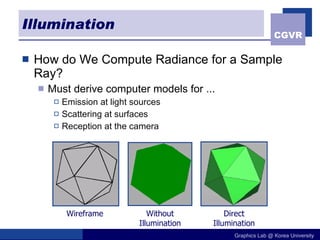
Illumination How do We Compute Radiance for a Sample Ray? Must derive computer models for ... Emission at light sources Scattering at surfaces Reception at the camera Wireframe Without Illumination Direct Illumination
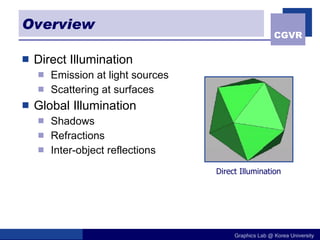
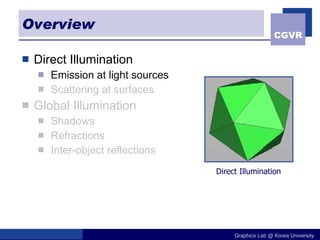
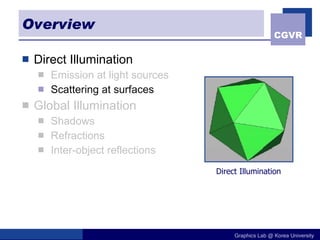
Overview Direct Illumination Emission at light sources Scattering at surfaces Global Illumination Shadows Refractions Inter-object reflections Direct Illumination
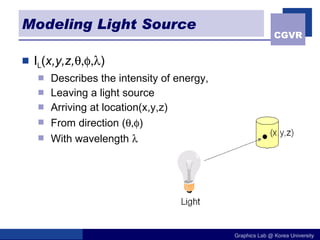
Modeling Light Source I L ( x,y,z,  ) Describes the intensity of energy, Leaving a light source Arriving at location(x,y,z) From direction (  ) With wavelength  
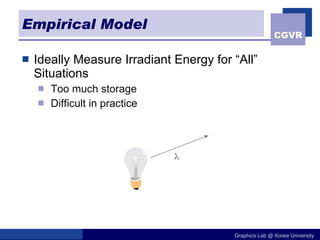
Empirical Model Ideally Measure Irradiant Energy for “All” Situations Too much storage Difficult in practice
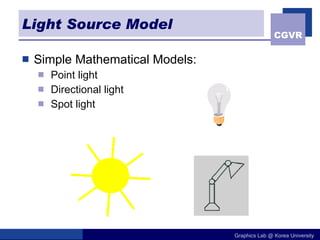
Light Source Model Simple Mathematical Models: Point light Directional light Spot light
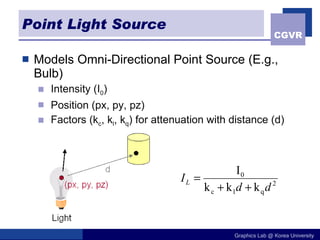
Point Light Source Models Omni-Directional Point Source (E.g., Bulb) Intensity (I 0 ) Position (px, py, pz) Factors (k c , k l , k q ) for attenuation with distance (d)
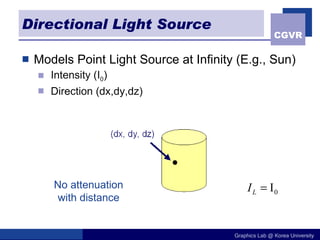
Directional Light Source Models Point Light Source at Infinity (E.g., Sun) Intensity (I 0 ) Direction (dx,dy,dz) No attenuation with distance
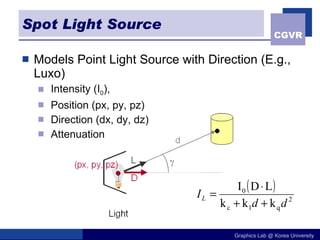
Spot Light Source  Models Point Light Source with Direction (E.g., Luxo) Intensity (I 0 ), Position (px, py, pz) Direction (dx, dy, dz) Attenuation
Overview Direct Illumination Emission at light sources Scattering at surfaces Global Illumination Shadows Refractions Inter-object reflections Direct Illumination
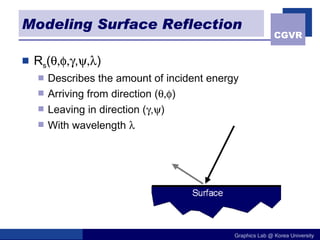
Modeling Surface Reflection R s (  ,  ) Describes the amount of incident energy Arriving from direction (  )  Leaving in direction (  ,  ) With wavelength  
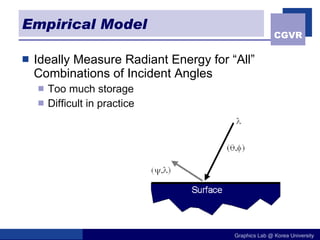
Empirical Model Ideally Measure Radiant Energy for “All” Combinations of Incident Angles Too much storage Difficult in practice
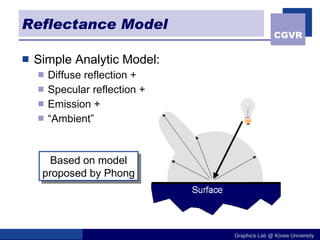
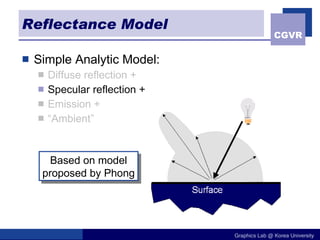
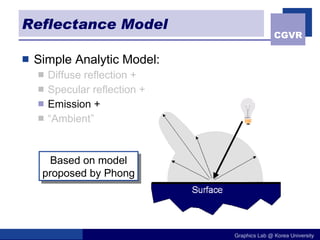
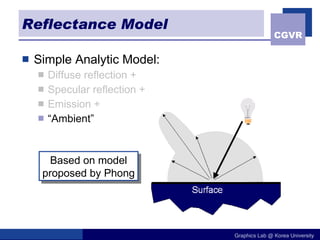
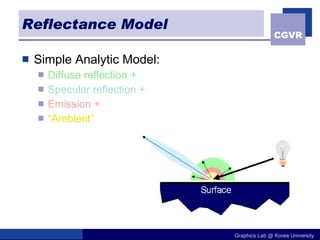
Reflectance Model Simple Analytic Model: Diffuse reflection + Specular reflection + Emission + “ Ambient” Based on model proposed by Phong
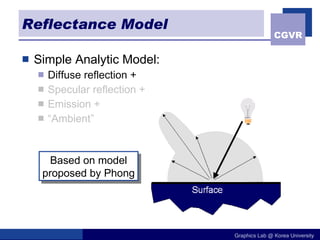
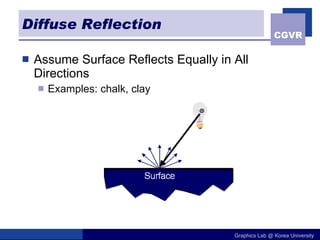
Diffuse Reflection Assume Surface Reflects Equally in All Directions Examples: chalk, clay
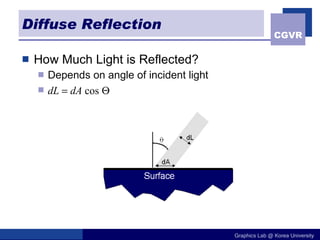
Diffuse Reflection How Much Light is Reflected? Depends on angle of incident light dL  dA  cos  
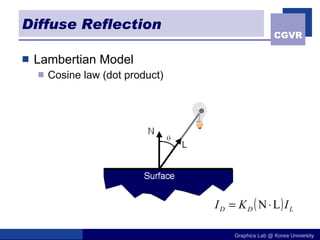
Diffuse Reflection Lambertian Model Cosine law (dot product)
Reflectance Model Simple Analytic Model: Diffuse reflection + Specular reflection + Emission + “ Ambient” Based on model proposed by Phong
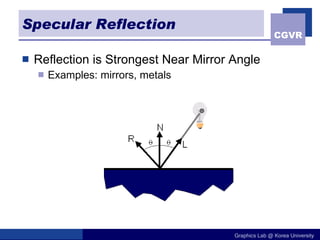
Specular Reflection Reflection is Strongest Near Mirror Angle Examples: mirrors, metals
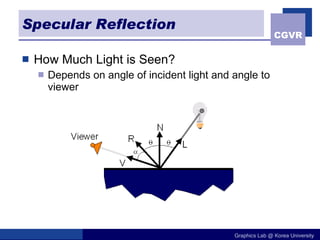
Specular Reflection How Much Light is Seen? Depends on angle of incident light and angle to viewer
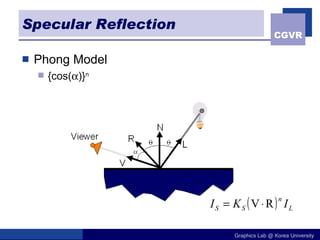
Specular Reflection Phong Model {cos(  )} n
Reflectance Model Simple Analytic Model: Diffuse reflection + Specular reflection + Emission + “ Ambient” Based on model proposed by Phong
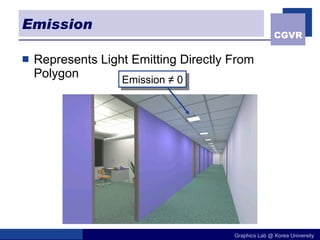
Emission Represents Light Emitting Directly From Polygon Emission  ≠ 0
Reflectance Model Simple Analytic Model: Diffuse reflection + Specular reflection + Emission + “ Ambient” Based on model proposed by Phong
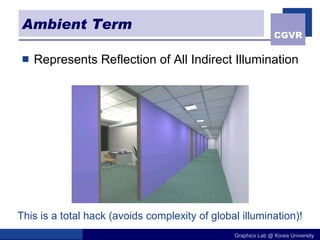
Ambient Term Represents Reflection of All Indirect Illumination This is a total hack (avoids complexity of global illumination)!
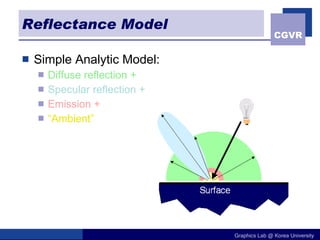
Reflectance Model Simple Analytic Model: Diffuse reflection + Specular reflection + Emission + “ Ambient”
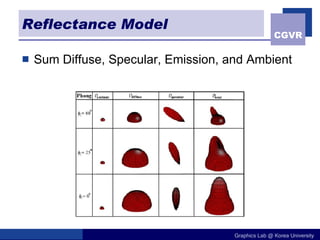
Reflectance Model Sum Diffuse, Specular, Emission, and Ambient
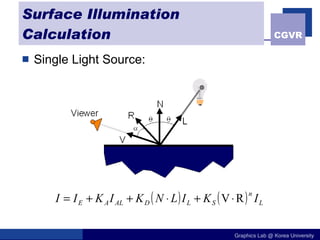
Surface Illumination Calculation Single Light Source:
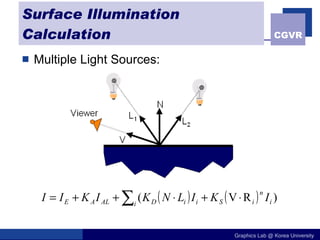
Surface Illumination Calculation Multiple Light Sources:
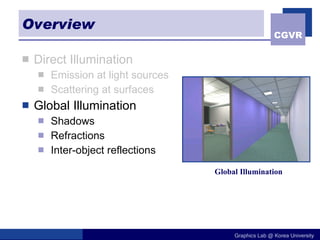
Overview Direct Illumination Emission at light sources Scattering at surfaces Global Illumination Shadows Refractions Inter-object reflections Global Illumination
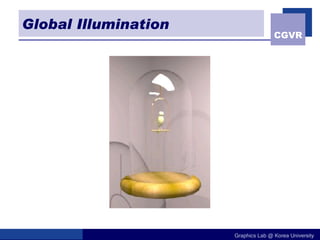
Global Illumination
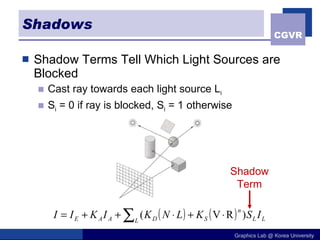
Shadows Shadow Terms Tell Which Light Sources are Blocked Cast ray towards each light source L i S i  = 0 if ray is blocked, S i  = 1 otherwise Shadow Term
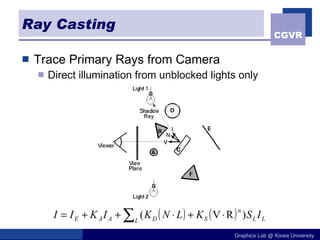
Ray Casting Trace Primary Rays from Camera Direct illumination from unblocked lights only
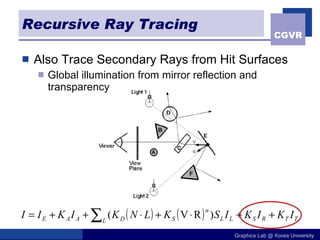
Recursive Ray Tracing Also Trace Secondary Rays from Hit Surfaces Global illumination from mirror reflection and transparency
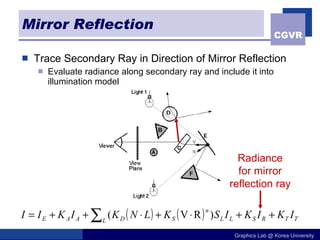
Mirror Reflection Trace Secondary Ray in Direction of Mirror Reflection Evaluate radiance along secondary ray and include it into illumination model Radiance for mirror reflection ray
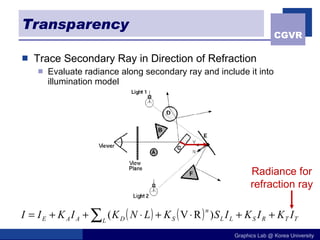
Transparency Trace Secondary Ray in Direction of Refraction Evaluate radiance along secondary ray and include it into illumination model Radiance for refraction ray
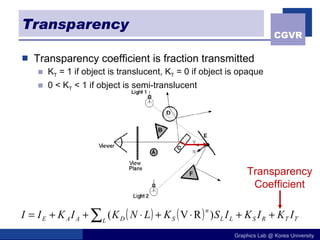
Transparency Transparency coefficient is fraction transmitted K T  = 1 if object is translucent, K T  = 0 if object is opaque 0 < K T  < 1 if object is semi-translucent Transparency Coefficient
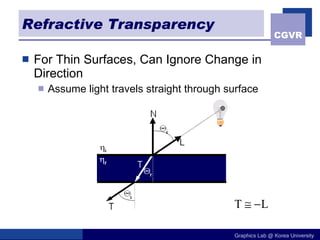
Refractive Transparency For Thin Surfaces, Can Ignore Change in Direction Assume light travels straight through surface
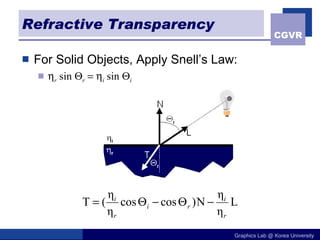
Refractive Transparency For Solid Objects, Apply Snell’s Law:  r   sin    r  i  sin   i 
Summary Direct Illumination Ray casting Usually use simple analytic approximations for light source emission and surface reflectance Global illumination Recursive ray tracing Incorporate shadows, mirror reflections, and pure refractions
Illumination Terminology Radiant power [flux] ( Φ ) Rate at which light energy is transmitted (in Watts). Radiant Intensity (I) Power radiated onto a unit solid angle in direction( in Watt/sr) e.g.: energy distribution of a light source (inverse square law) Radiance (L) Radiant intensity per unit projected surface area( in Watts/m 2 sr) e.g.: light carried by a single ray (no inverse square law) Irradianc (E) Incident flux density on a locally planar area (in Watts/m 2  ) Radiosity (B) Exitant flux density from a locally planar area ( in Watts/m 2  )

10illumination

  • 1.
    Illumination Model 고려대학교컴퓨터 그래픽스 연구실
  • 2.
    Illumination How doWe Compute Radiance for a Sample Ray? Must derive computer models for ... Emission at light sources Scattering at surfaces Reception at the camera Wireframe Without Illumination Direct Illumination
  • 3.
    Overview Direct IlluminationEmission at light sources Scattering at surfaces Global Illumination Shadows Refractions Inter-object reflections Direct Illumination
  • 4.
    Overview Direct IlluminationEmission at light sources Scattering at surfaces Global Illumination Shadows Refractions Inter-object reflections Direct Illumination
  • 5.
    Modeling Light SourceI L ( x,y,z,  ) Describes the intensity of energy, Leaving a light source Arriving at location(x,y,z) From direction (  ) With wavelength 
  • 6.
    Empirical Model IdeallyMeasure Irradiant Energy for “All” Situations Too much storage Difficult in practice
  • 7.
    Light Source ModelSimple Mathematical Models: Point light Directional light Spot light
  • 8.
    Point Light SourceModels Omni-Directional Point Source (E.g., Bulb) Intensity (I 0 ) Position (px, py, pz) Factors (k c , k l , k q ) for attenuation with distance (d)
  • 9.
    Directional Light SourceModels Point Light Source at Infinity (E.g., Sun) Intensity (I 0 ) Direction (dx,dy,dz) No attenuation with distance
  • 10.
    Spot Light Source Models Point Light Source with Direction (E.g., Luxo) Intensity (I 0 ), Position (px, py, pz) Direction (dx, dy, dz) Attenuation
  • 11.
    Overview Direct IlluminationEmission at light sources Scattering at surfaces Global Illumination Shadows Refractions Inter-object reflections Direct Illumination
  • 12.
    Modeling Surface ReflectionR s (  ,  ) Describes the amount of incident energy Arriving from direction (  ) Leaving in direction (  ,  ) With wavelength 
  • 13.
    Empirical Model IdeallyMeasure Radiant Energy for “All” Combinations of Incident Angles Too much storage Difficult in practice
  • 14.
    Reflectance Model SimpleAnalytic Model: Diffuse reflection + Specular reflection + Emission + “ Ambient” Based on model proposed by Phong
  • 15.
    Reflectance Model SimpleAnalytic Model: Diffuse reflection + Specular reflection + Emission + “ Ambient” Based on model proposed by Phong
  • 16.
    Diffuse Reflection AssumeSurface Reflects Equally in All Directions Examples: chalk, clay
  • 17.
    Diffuse Reflection HowMuch Light is Reflected? Depends on angle of incident light dL  dA  cos 
  • 18.
    Diffuse Reflection LambertianModel Cosine law (dot product)
  • 19.
    Reflectance Model SimpleAnalytic Model: Diffuse reflection + Specular reflection + Emission + “ Ambient” Based on model proposed by Phong
  • 20.
    Specular Reflection Reflectionis Strongest Near Mirror Angle Examples: mirrors, metals
  • 21.
    Specular Reflection HowMuch Light is Seen? Depends on angle of incident light and angle to viewer
  • 22.
    Specular Reflection PhongModel {cos(  )} n
  • 23.
    Reflectance Model SimpleAnalytic Model: Diffuse reflection + Specular reflection + Emission + “ Ambient” Based on model proposed by Phong
  • 24.
    Emission Represents LightEmitting Directly From Polygon Emission ≠ 0
  • 25.
    Reflectance Model SimpleAnalytic Model: Diffuse reflection + Specular reflection + Emission + “ Ambient” Based on model proposed by Phong
  • 26.
    Ambient Term RepresentsReflection of All Indirect Illumination This is a total hack (avoids complexity of global illumination)!
  • 27.
    Reflectance Model SimpleAnalytic Model: Diffuse reflection + Specular reflection + Emission + “ Ambient”
  • 28.
    Reflectance Model SimpleAnalytic Model: Diffuse reflection + Specular reflection + Emission + “ Ambient”
  • 29.
    Reflectance Model SumDiffuse, Specular, Emission, and Ambient
  • 30.
  • 31.
    Surface Illumination CalculationMultiple Light Sources:
  • 32.
    Overview Direct IlluminationEmission at light sources Scattering at surfaces Global Illumination Shadows Refractions Inter-object reflections Global Illumination
  • 33.
  • 34.
    Shadows Shadow TermsTell Which Light Sources are Blocked Cast ray towards each light source L i S i = 0 if ray is blocked, S i = 1 otherwise Shadow Term
  • 35.
    Ray Casting TracePrimary Rays from Camera Direct illumination from unblocked lights only
  • 36.
    Recursive Ray TracingAlso Trace Secondary Rays from Hit Surfaces Global illumination from mirror reflection and transparency
  • 37.
    Mirror Reflection TraceSecondary Ray in Direction of Mirror Reflection Evaluate radiance along secondary ray and include it into illumination model Radiance for mirror reflection ray
  • 38.
    Transparency Trace SecondaryRay in Direction of Refraction Evaluate radiance along secondary ray and include it into illumination model Radiance for refraction ray
  • 39.
    Transparency Transparency coefficientis fraction transmitted K T = 1 if object is translucent, K T = 0 if object is opaque 0 < K T < 1 if object is semi-translucent Transparency Coefficient
  • 40.
    Refractive Transparency ForThin Surfaces, Can Ignore Change in Direction Assume light travels straight through surface
  • 41.
    Refractive Transparency ForSolid Objects, Apply Snell’s Law:  r sin  r  i  sin  i 
  • 42.
    Summary Direct IlluminationRay casting Usually use simple analytic approximations for light source emission and surface reflectance Global illumination Recursive ray tracing Incorporate shadows, mirror reflections, and pure refractions
  • 43.
    Illumination Terminology Radiantpower [flux] ( Φ ) Rate at which light energy is transmitted (in Watts). Radiant Intensity (I) Power radiated onto a unit solid angle in direction( in Watt/sr) e.g.: energy distribution of a light source (inverse square law) Radiance (L) Radiant intensity per unit projected surface area( in Watts/m 2 sr) e.g.: light carried by a single ray (no inverse square law) Irradianc (E) Incident flux density on a locally planar area (in Watts/m 2 ) Radiosity (B) Exitant flux density from a locally planar area ( in Watts/m 2 )