Illumination And
Shading Model
Bilqes Ahmed Mohmoud
Illumination Models and Shading
• Light Source Models
• Ambient Illumination
• Diffuse Reflection
• Specular Reflection
• Polygon Rendering Methods
• Flat Shading
• Gouraud Shading
• Phong Shading
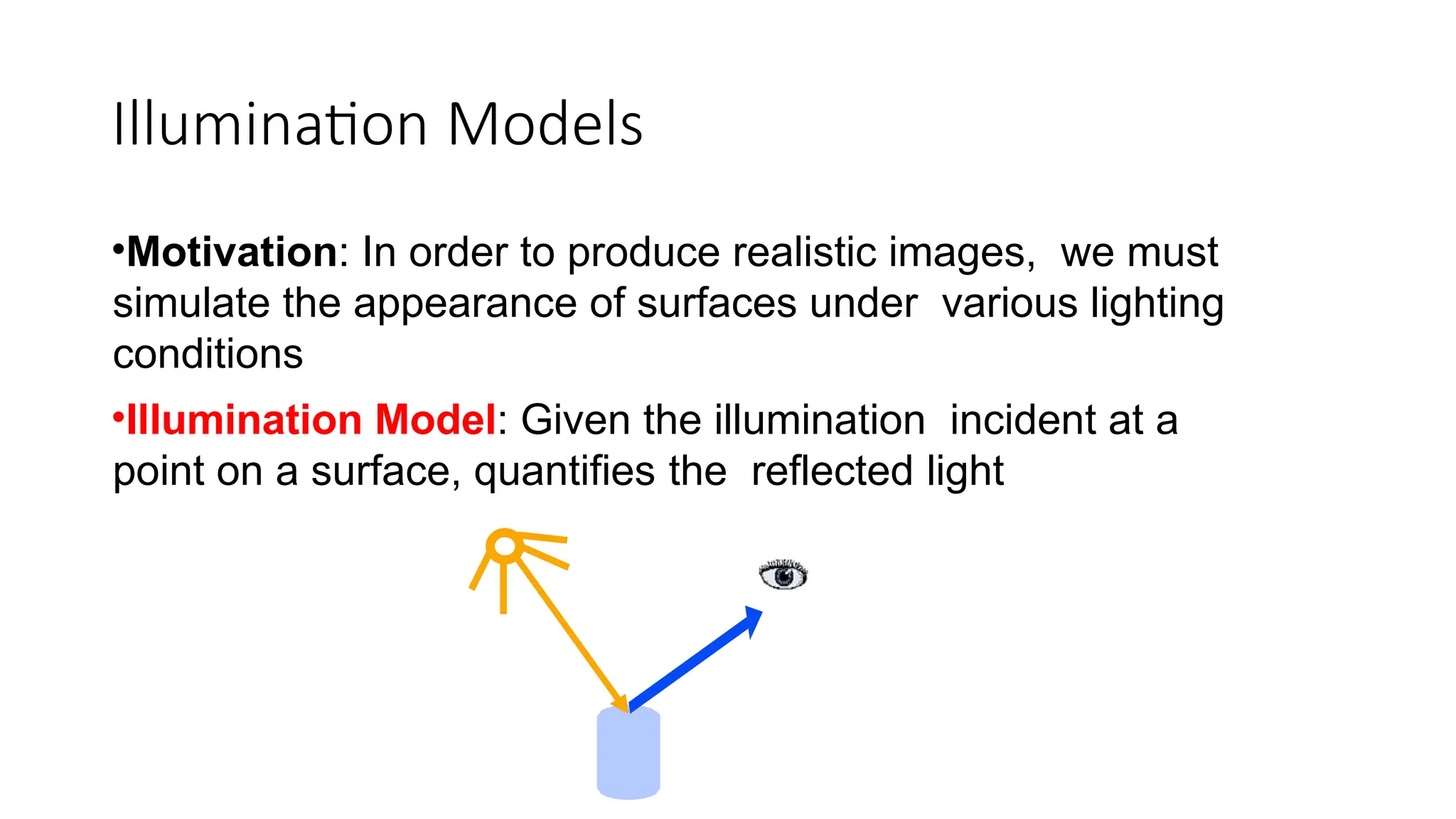
Illumination Models
•Motivation: In order to produce realistic images, we must
simulate the appearance of surfaces under various lighting
conditions
•Illumination Model: Given the illumination incident at a
point on a surface, quantifies the reflected light
Illumination Model Parameters
•Lighting effects are described with models that consider the
interaction of light sources with object surfaces
•The factors determining the lighting effects are:
– The light source parameters:
• Positions
• Electromagnetic Spectrum
• Shape
– The surface parameters
• Position
• Reflectance properties
• Position of nearby surfaces
– The eye (camera) parameters
• Position
• Sensor spectrum sensitivities
Illumination Models and Rendering
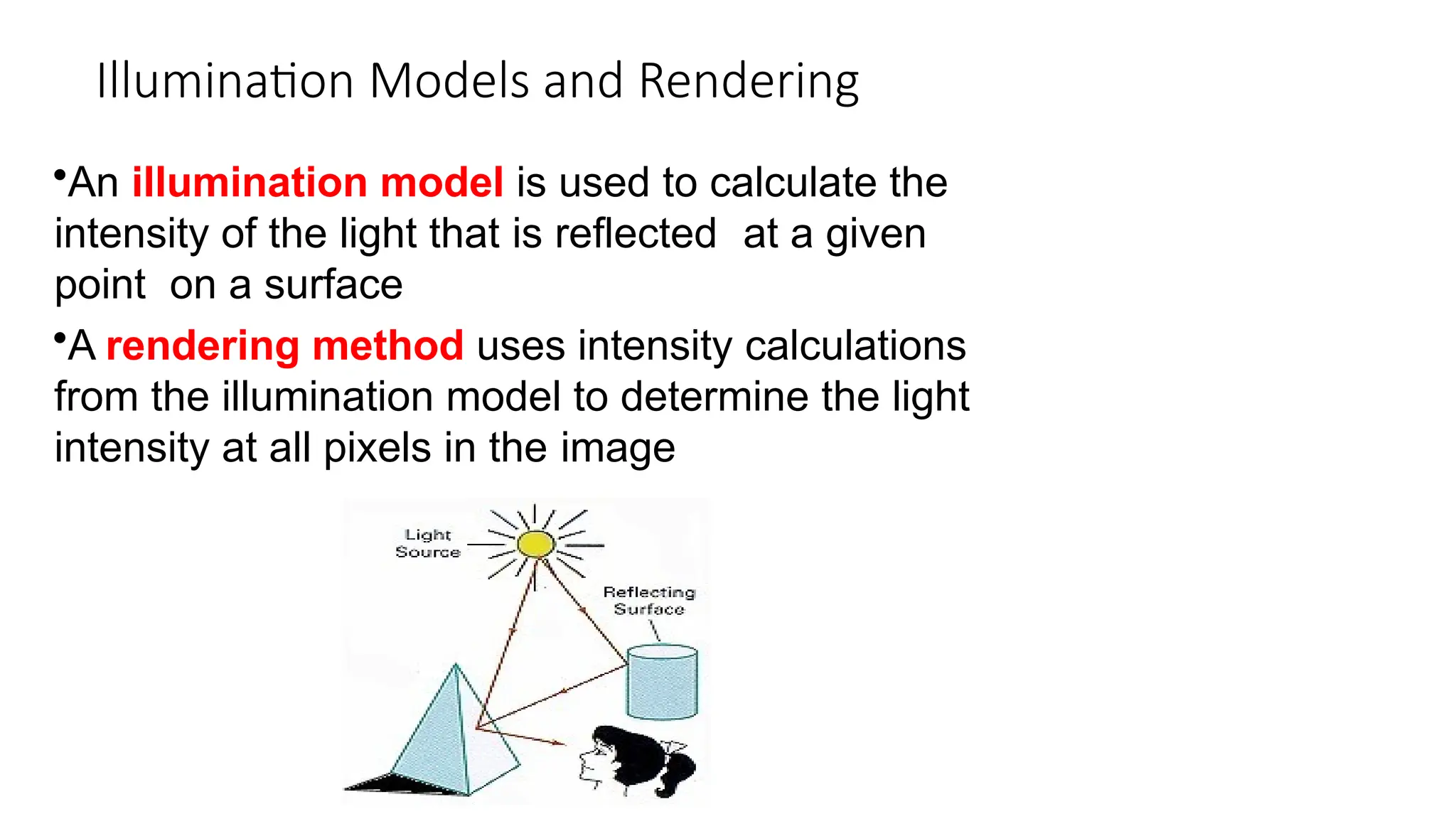
•An illumination model is used to calculate the
intensity of the light that is reflected at a given
point on a surface
•A rendering method uses intensity calculations
from the illumination model to determine the light
intensity at all pixels in the image
Illumination Models
• Simplified and fast methods for calculating
surfaces intensities, mostly empirical
• Calculations are based on optical properties
of surfaces and the lighting conditions (no
reflected sources nor shadows)
• Light sources are considered to be point
sources
• Reasonably good approximation for most
scenes
Ambient Illumination
• Assume there is some non-directional light
in the environment (background light)
• The amount of ambient light incident on
each object is constant for all surfaces and
over all directions
• Very simple model, not very realistic
• OpenGL default
Ambient Illumination
• The reflected intensity Iamb of any point on the
surface is:
Ia - ambient light intensity
Ka  [0,1] - surface ambient reflectivity
• In principle Ia and Ka are functions of color, so we
have IR
amb, IG
amb and IB
Iamb = Ka Ia
Ambient Illumination
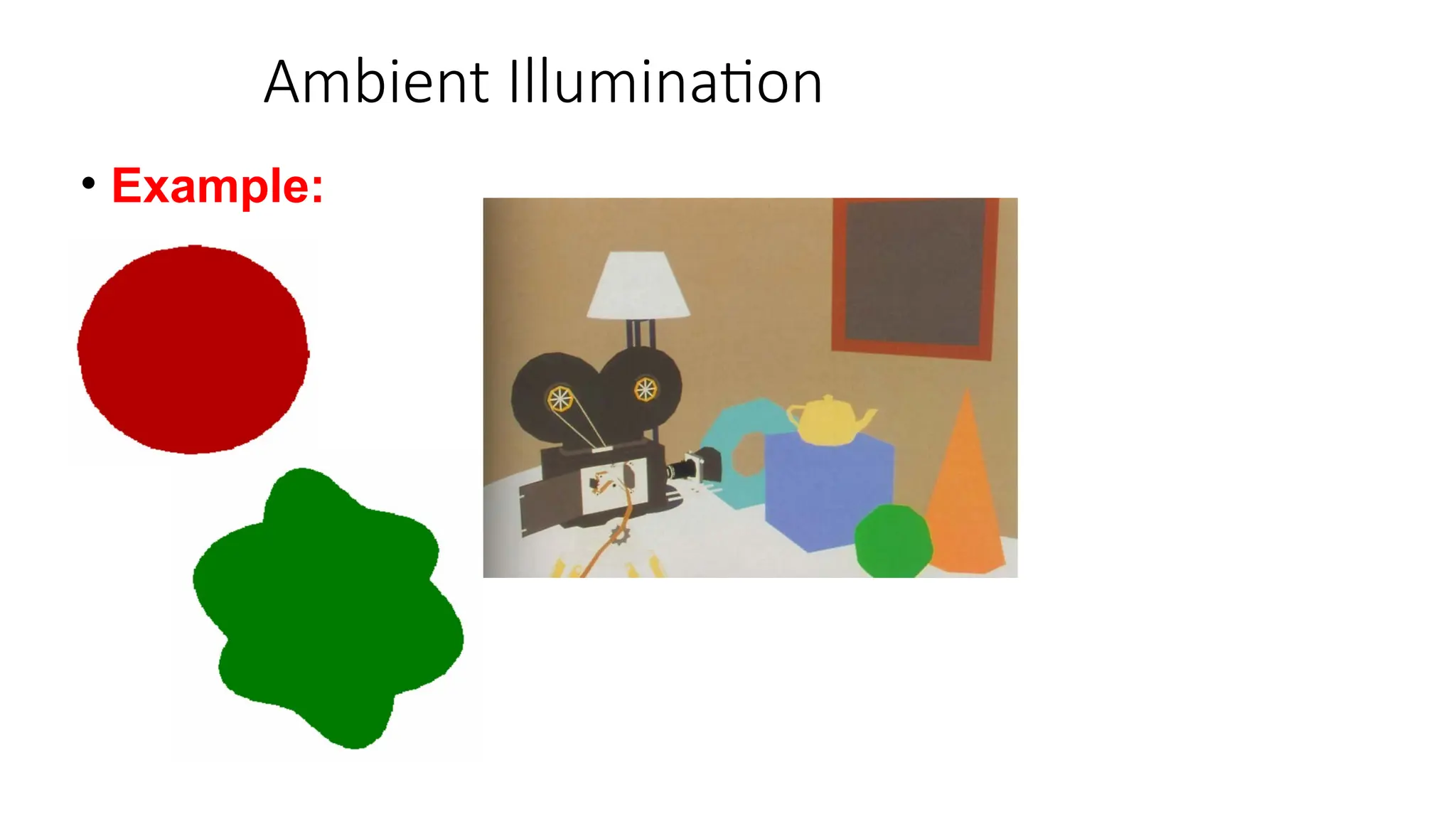
• Example:
Diffuse Reflection
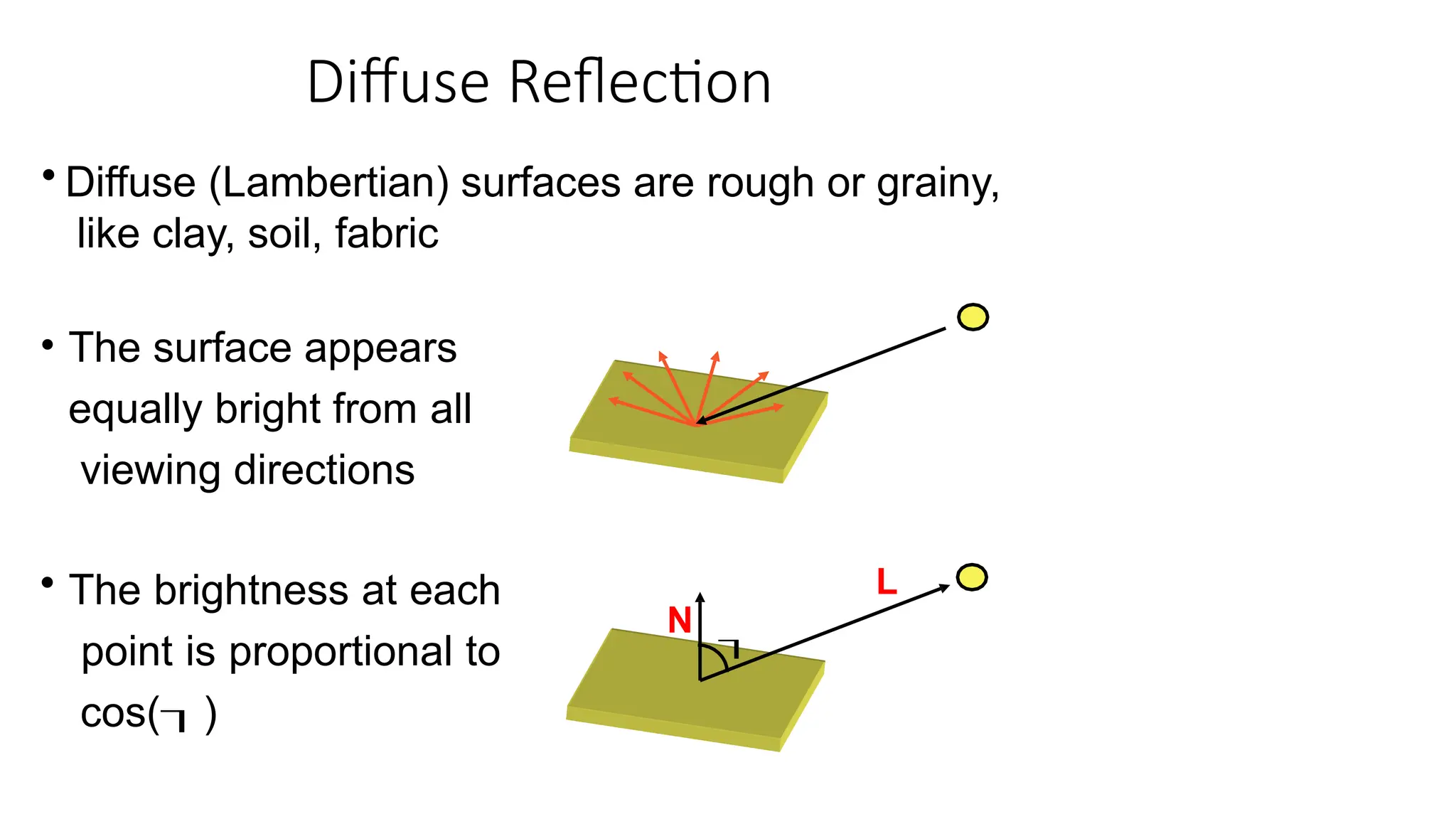
• Diffuse (Lambertian) surfaces are rough or grainy,
like clay, soil, fabric
• The surface appears
equally bright from all
viewing directions
• The brightness at each
point is proportional to
cos()

N
L
Diffuse Reflection
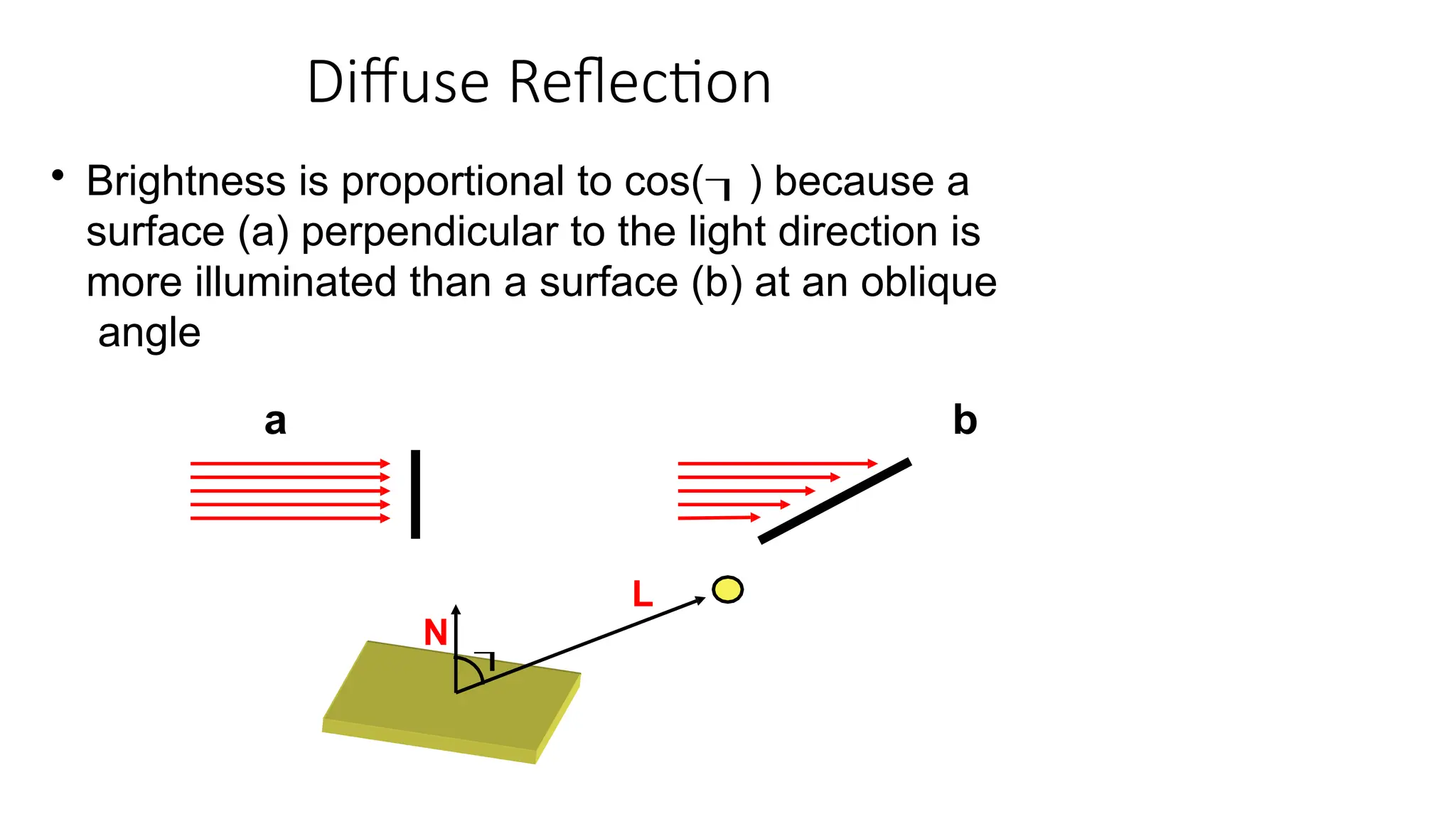
• Brightness is proportional to cos() because a
surface (a) perpendicular to the light direction is
more illuminated than a surface (b) at an oblique
angle
a b

N
L
Diffuse Reflection
• The reflected intensity Idiff of a point on the
surface is:
Idiff = Kd Ipcos() = Kd
Ip(NL)
Ip - the point light intensity. May appear as
attenuated source fatt(r)IP
Kd  [0,1] - the surface diffuse
reflectivity N - the surface normal
L - the light direction
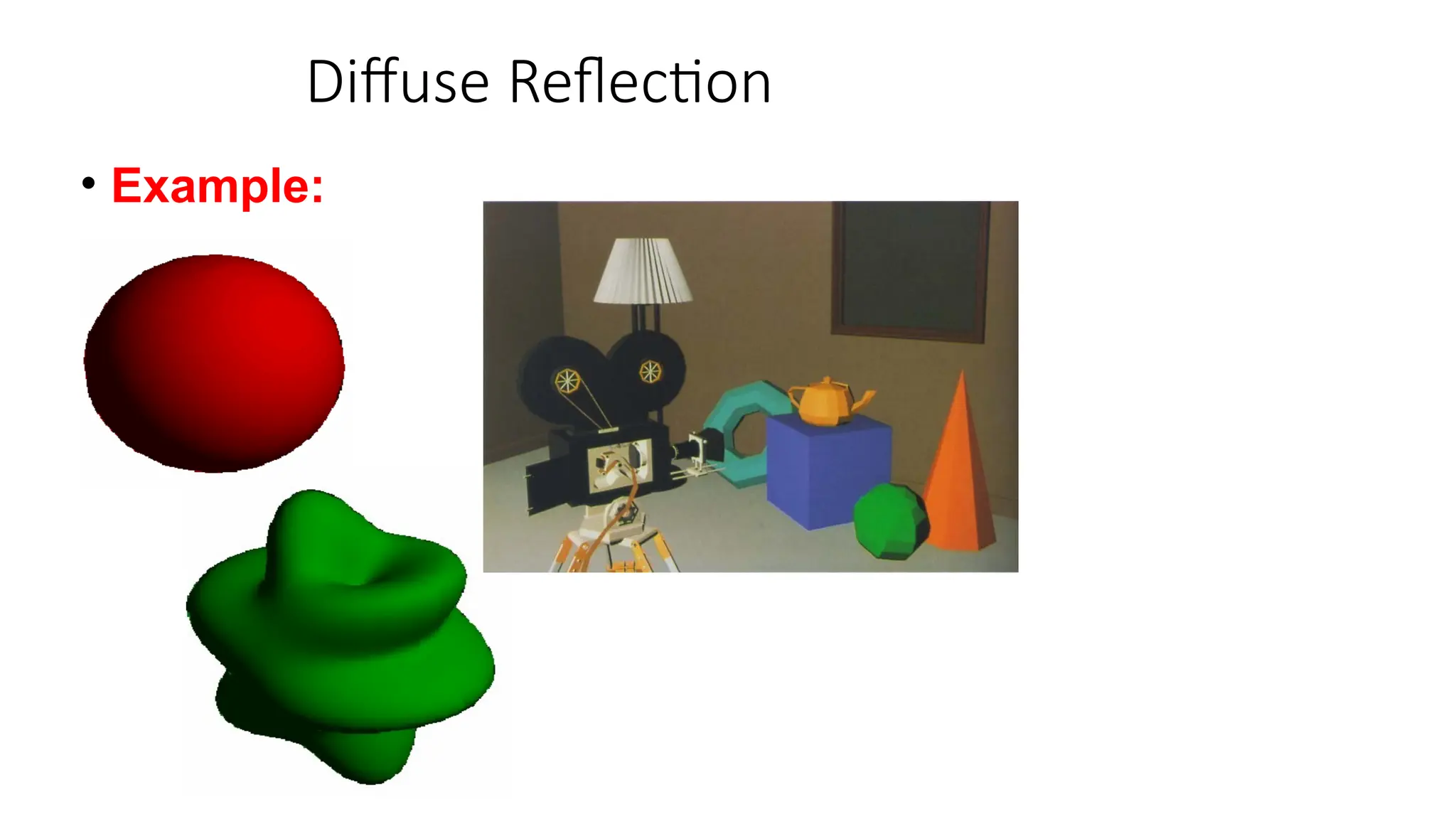
Diffuse Reflection
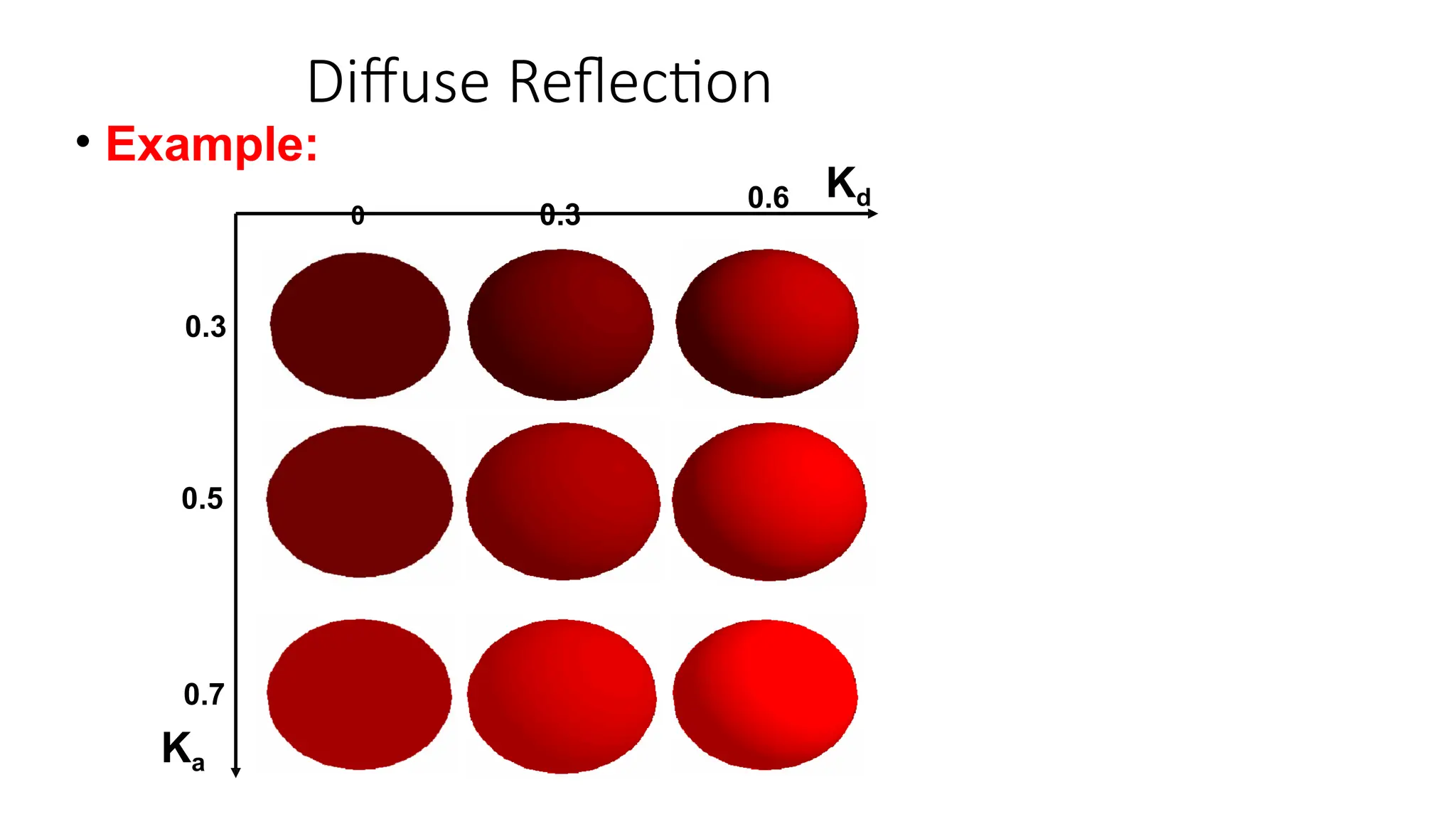
• Example:
Diffuse Reflection
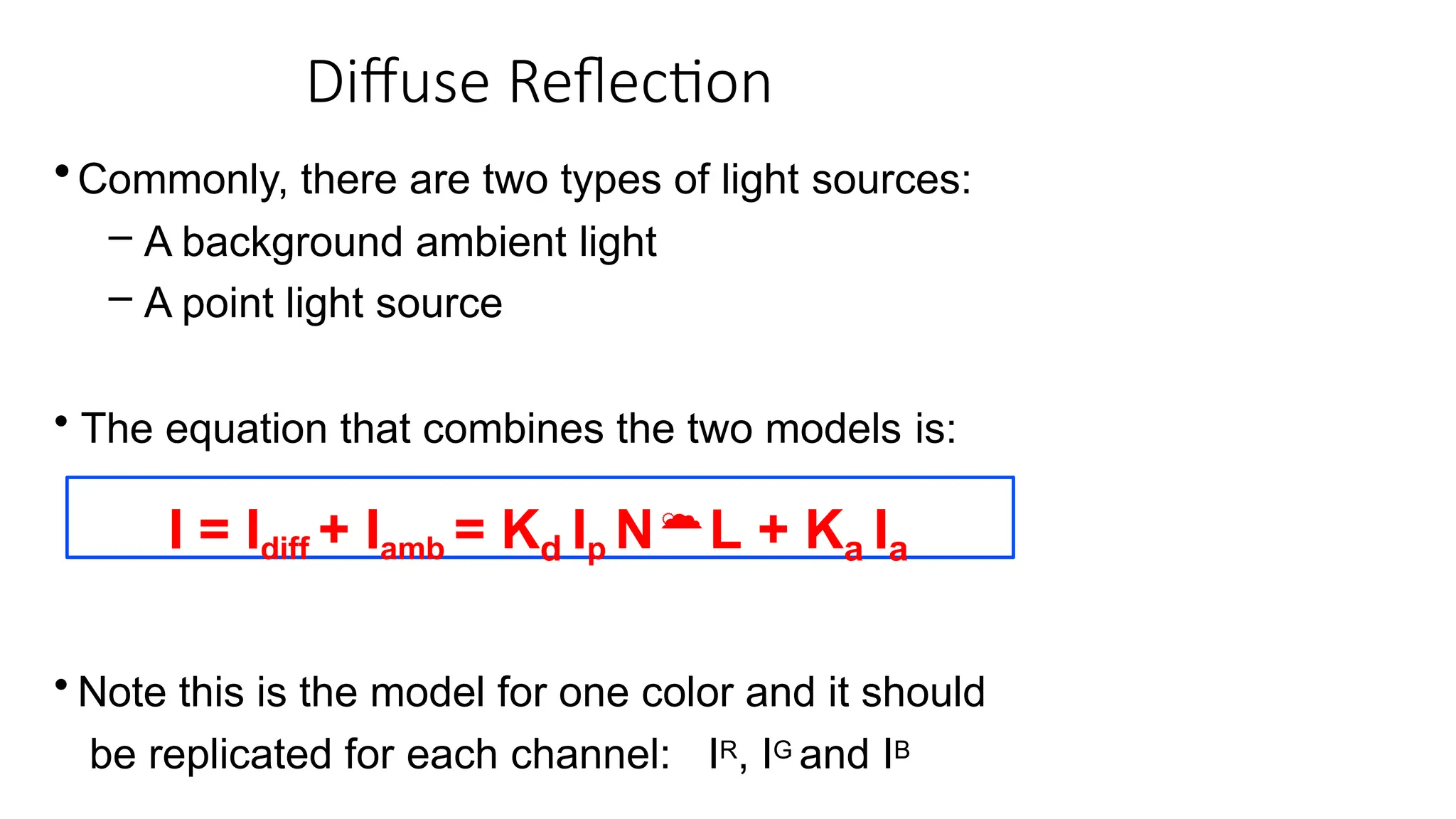
•Commonly, there are two types of light sources:
– A background ambient light
– A point light source
• The equation that combines the two models is:
I = Idiff + Iamb = Kd Ip NL + Ka Ia
• Note this is the model for one color and it should
be replicated for each channel: IR, IG and IB
Diffuse Reflection
• Example:
0 0.3
0.6
0.3
0.5
0.7
Ka
Kd
Specular Reflection
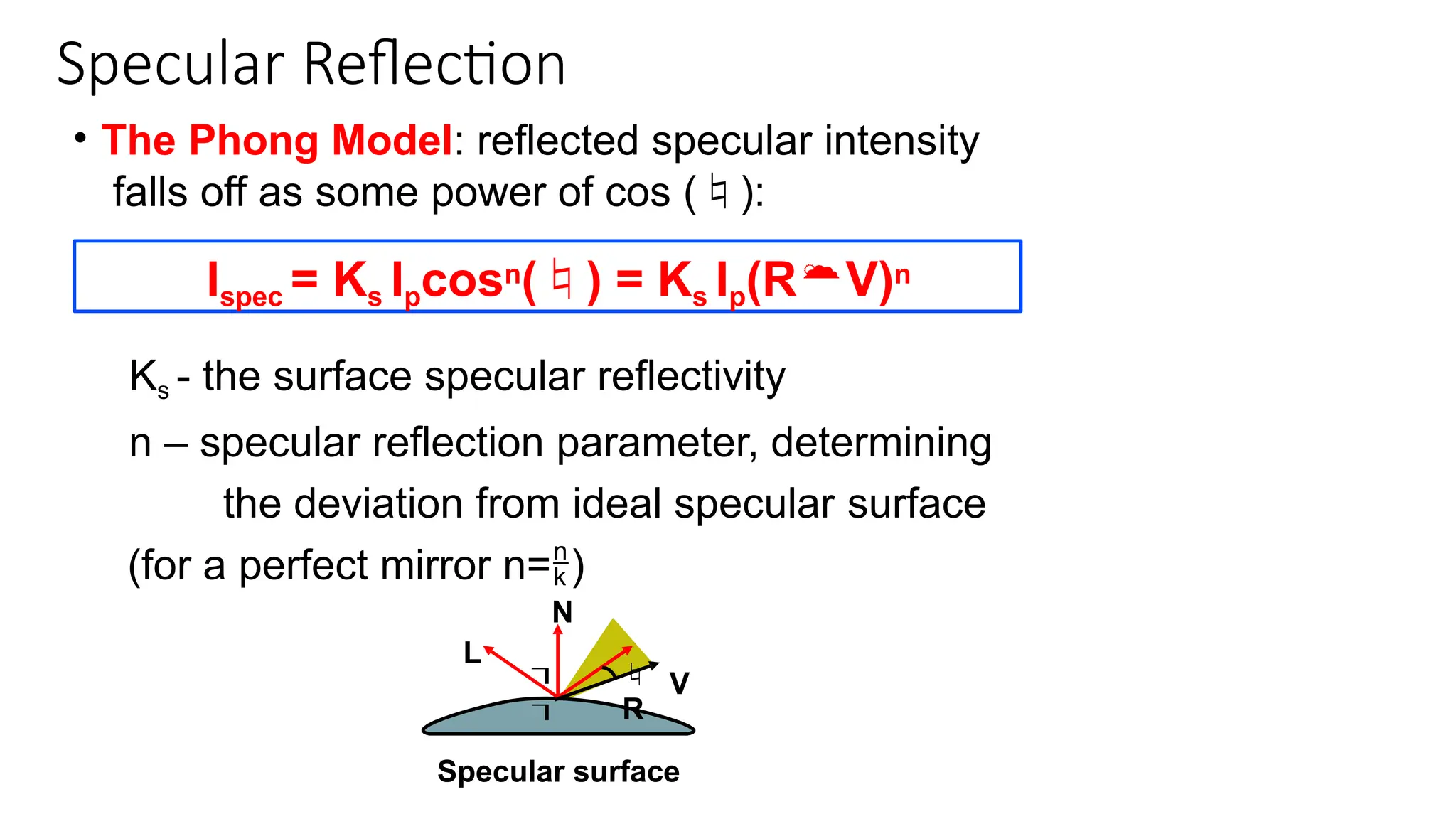
• The Phong Model: reflected specular intensity
falls off as some power of cos ():
Ispec = Ks Ipcosn() = Ks Ip(RV)n


Ks - the surface specular reflectivity
n – specular reflection parameter, determining
the deviation from ideal specular surface
(for a perfect mirror n=)
N
L

R
V
Specular surface
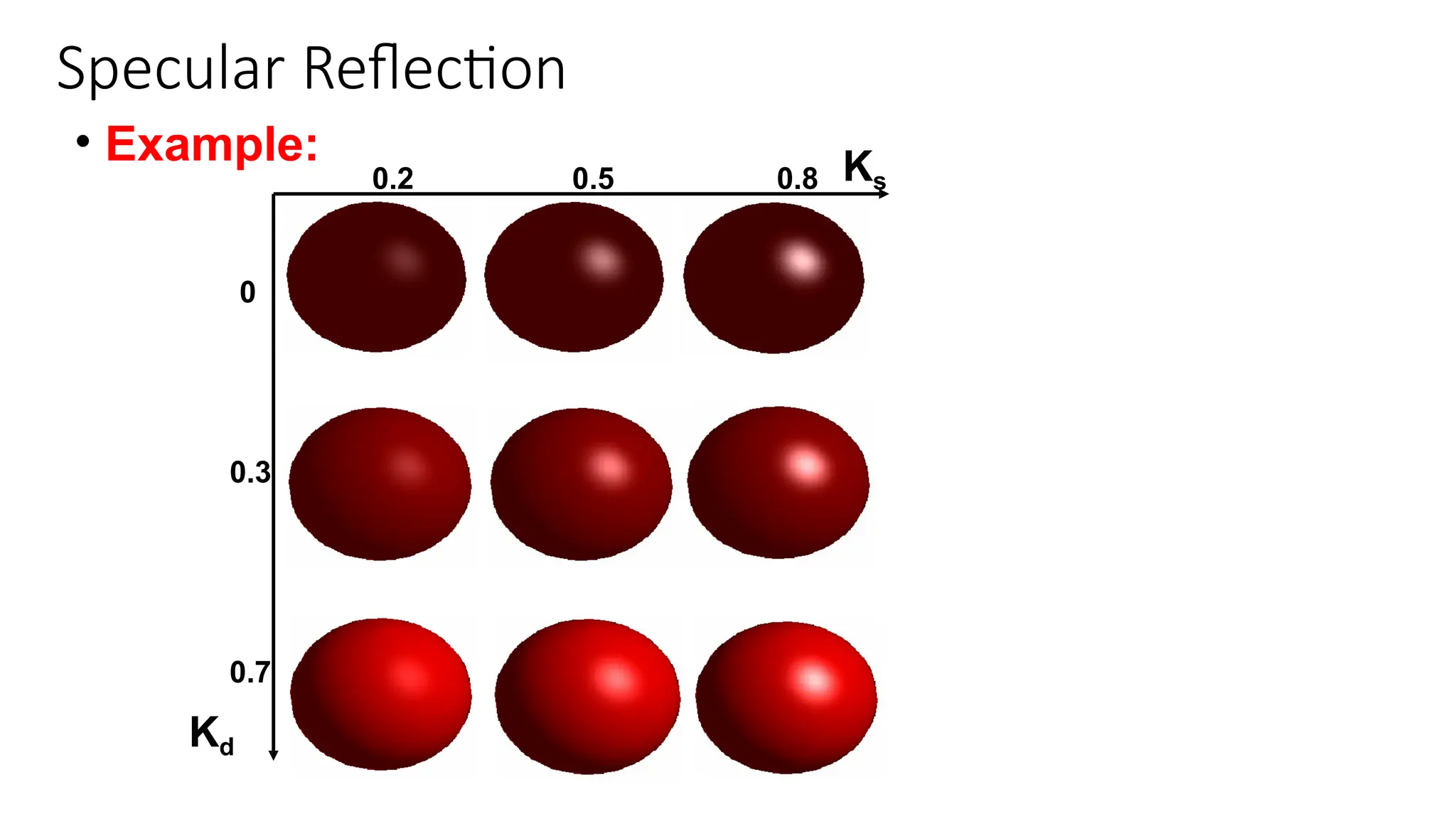
Specular Reflection
• Example:
0.2 0.5 0.8
0
0.3
0.7
Kd
Ks
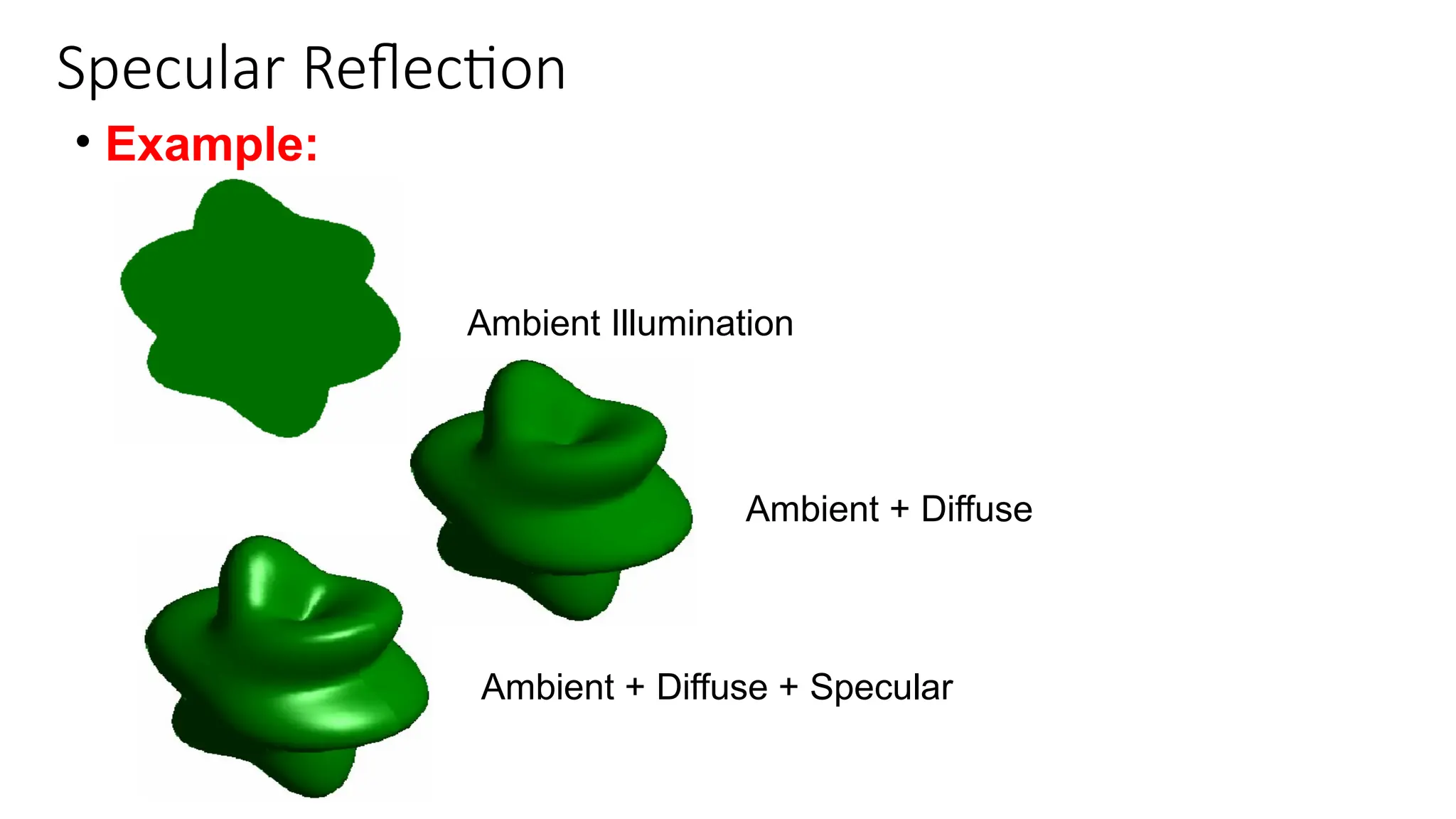
Specular Reflection
• Example:
Ambient Illumination
Ambient + Diffuse
Ambient + Diffuse + Specular
Polygon Rendering Methods
• A freeform surface can be approximated
by polyhedra
• Rendering: calculate the illumination at
each surface point
• Applying the illumination model at each
surface point is computationally expensive
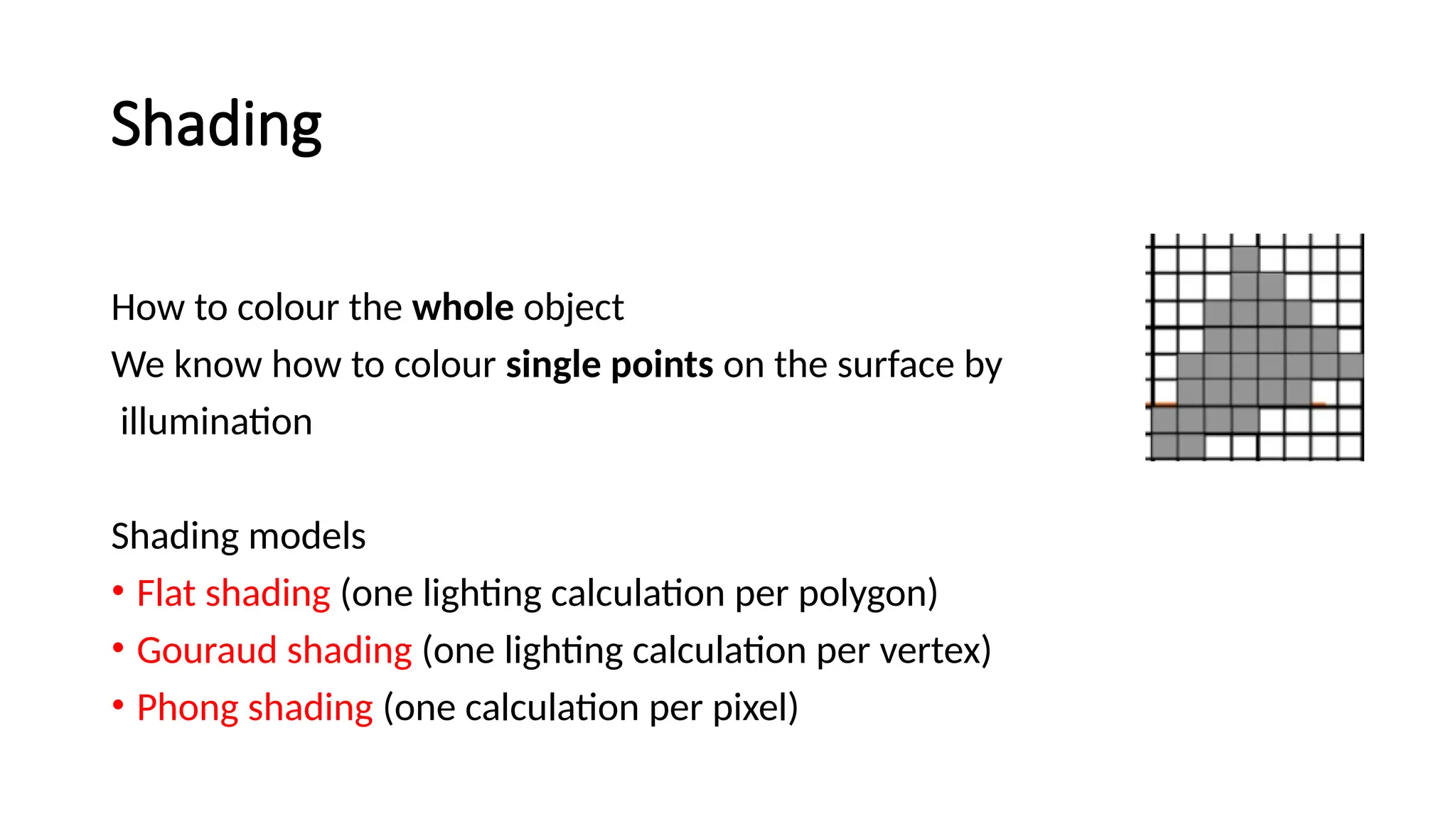
Shading
How to colour the whole object
We know how to colour single points on the surface by
illumination
Shading models
• Flat shading (one lighting calculation per polygon)
• Gouraud shading (one lighting calculation per vertex)
• Phong shading (one calculation per pixel)
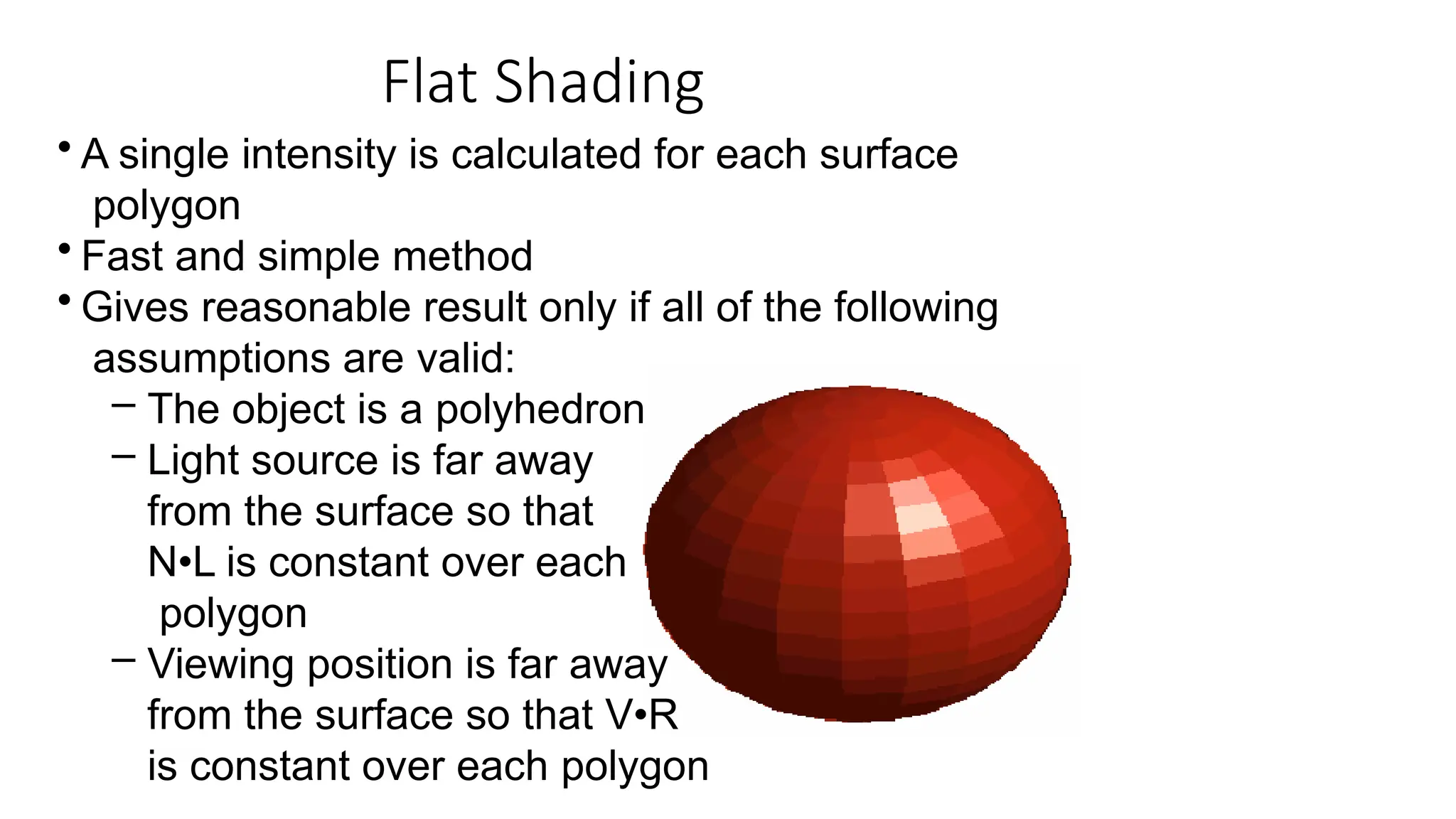
Flat Shading
• A single intensity is calculated for each surface
polygon
• Fast and simple method
• Gives reasonable result only if all of the following
assumptions are valid:
– The object is a polyhedron
– Light source is far away
from the surface so that
N•L is constant over each
polygon
– Viewing position is far away
from the surface so that V•R
is constant over each polygon
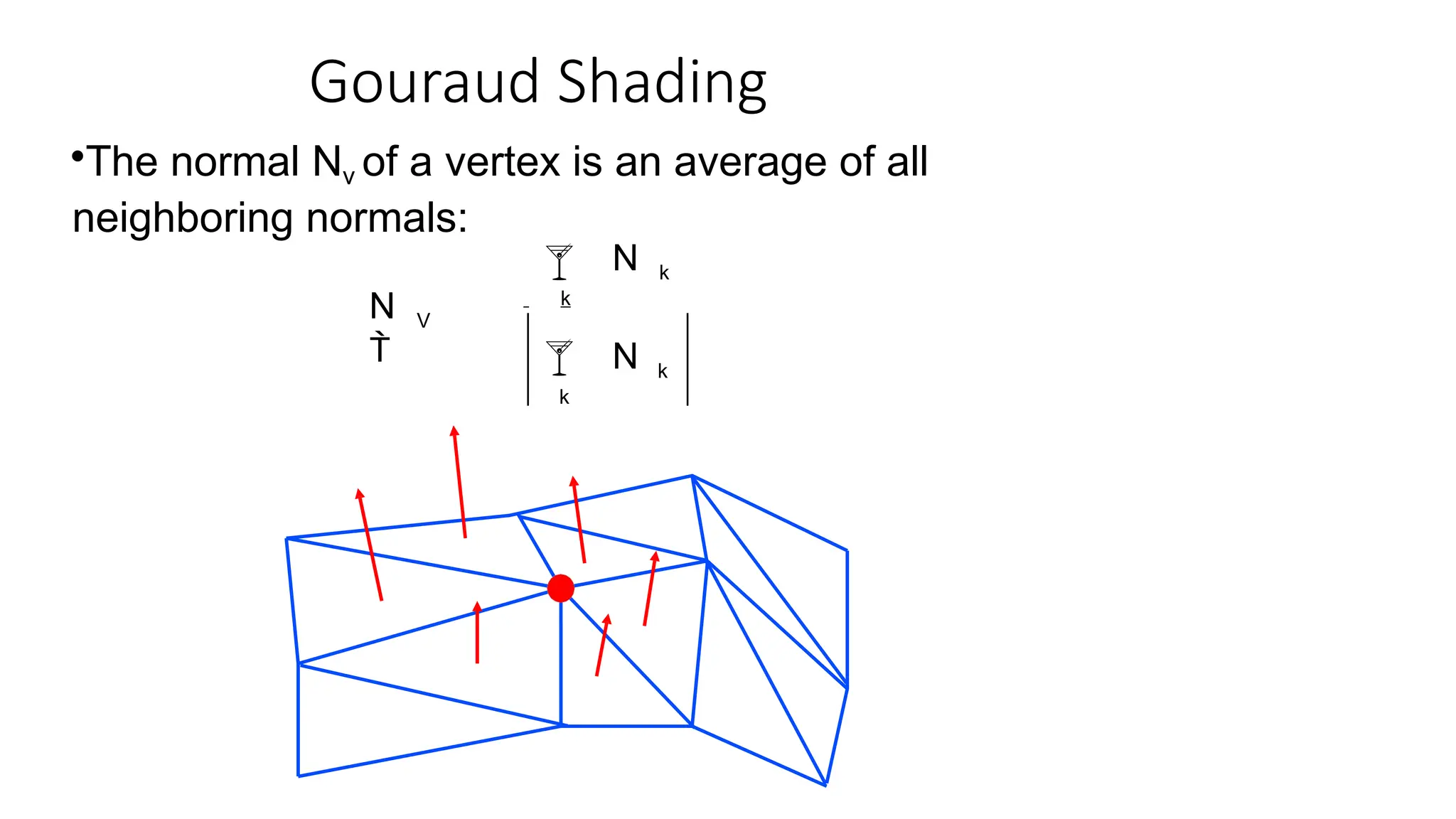
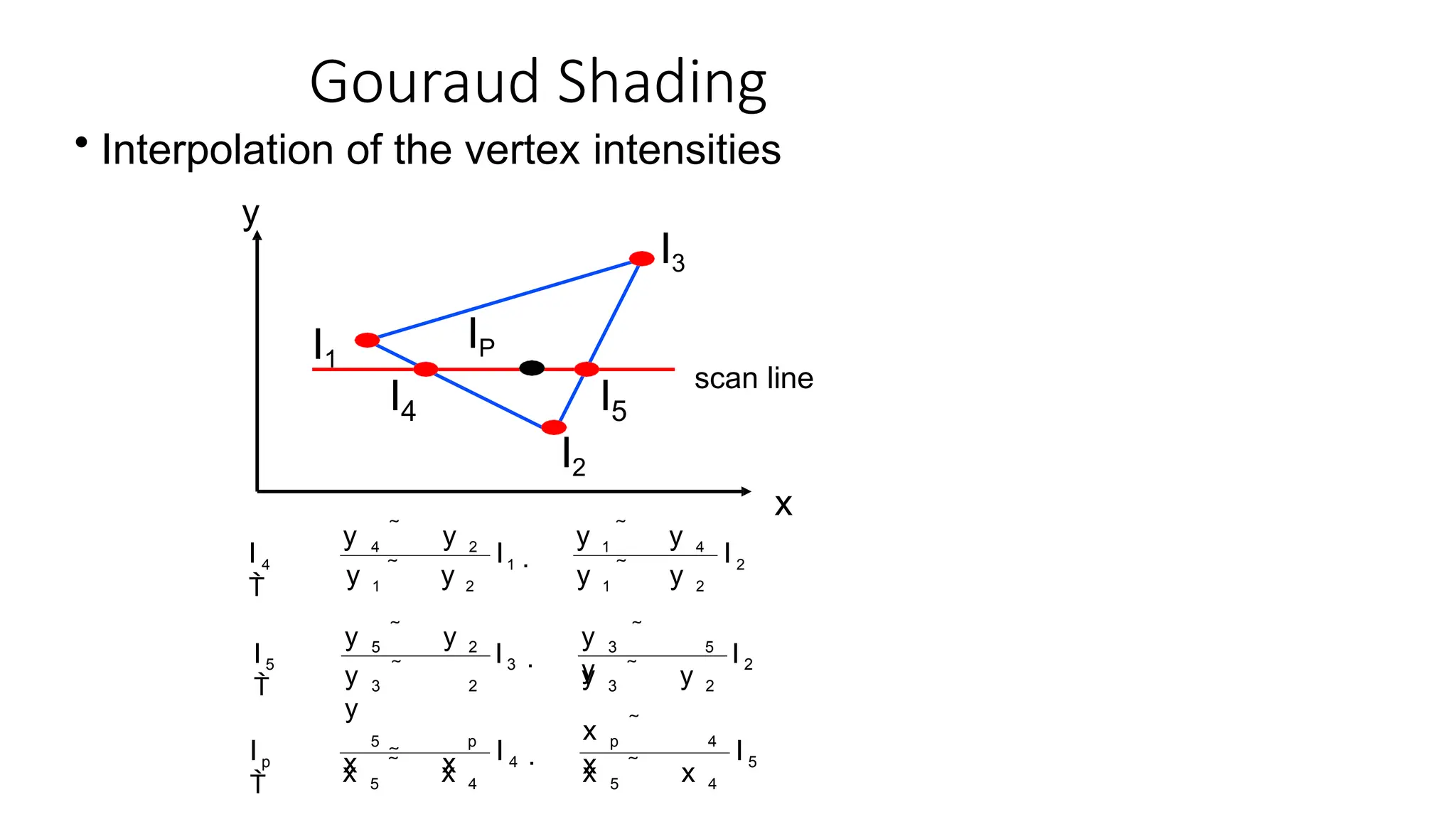
Gouraud Shading
•The normal Nv of a vertex is an average of all
neighboring normals:

k
k
k
 k
V
N
N
N

Gouraud Shading
2
2
1
4
1
1
2
1
2
4
4 I
y  y
I 
y  y
I

2
2
3
5
3
3
2
3
2
5
5 I
y  y
y 
y
I 
y  y
y  y
I

5
4
5
4
p
4
4
5
p
5
p I
x  x
y  y
x 
x
I 
x  x
y 
y
x  x
I

I1
I I
4 5
scan line
I2
x
• Interpolation of the vertex intensities
y
I3
IP
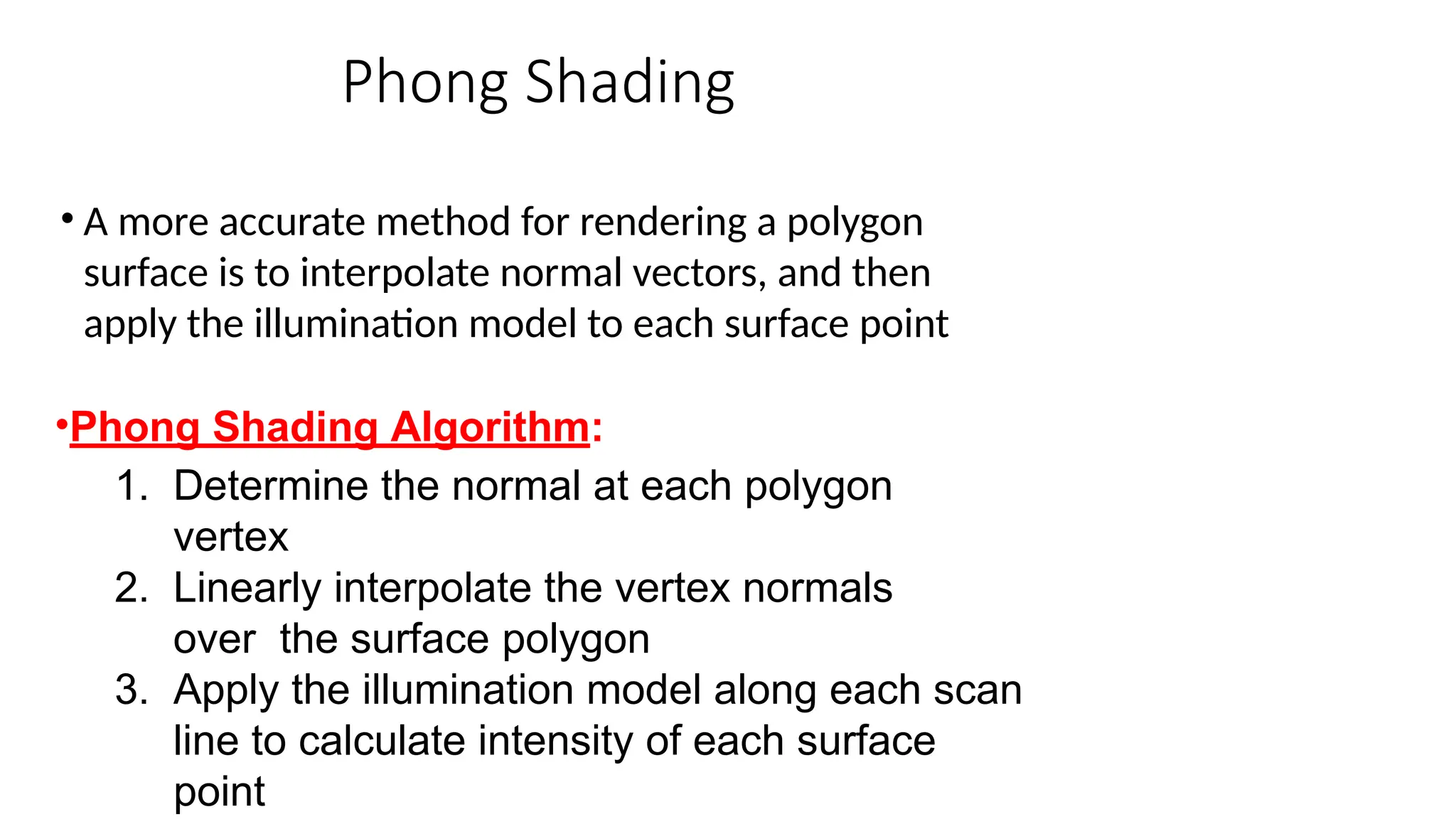
Phong Shading
• A more accurate method for rendering a polygon
surface is to interpolate normal vectors, and then
apply the illumination model to each surface point
•Phong Shading Algorithm:
1. Determine the normal at each polygon
vertex
2. Linearly interpolate the vertex normals
over the surface polygon
3. Apply the illumination model along each scan
line to calculate intensity of each surface
point
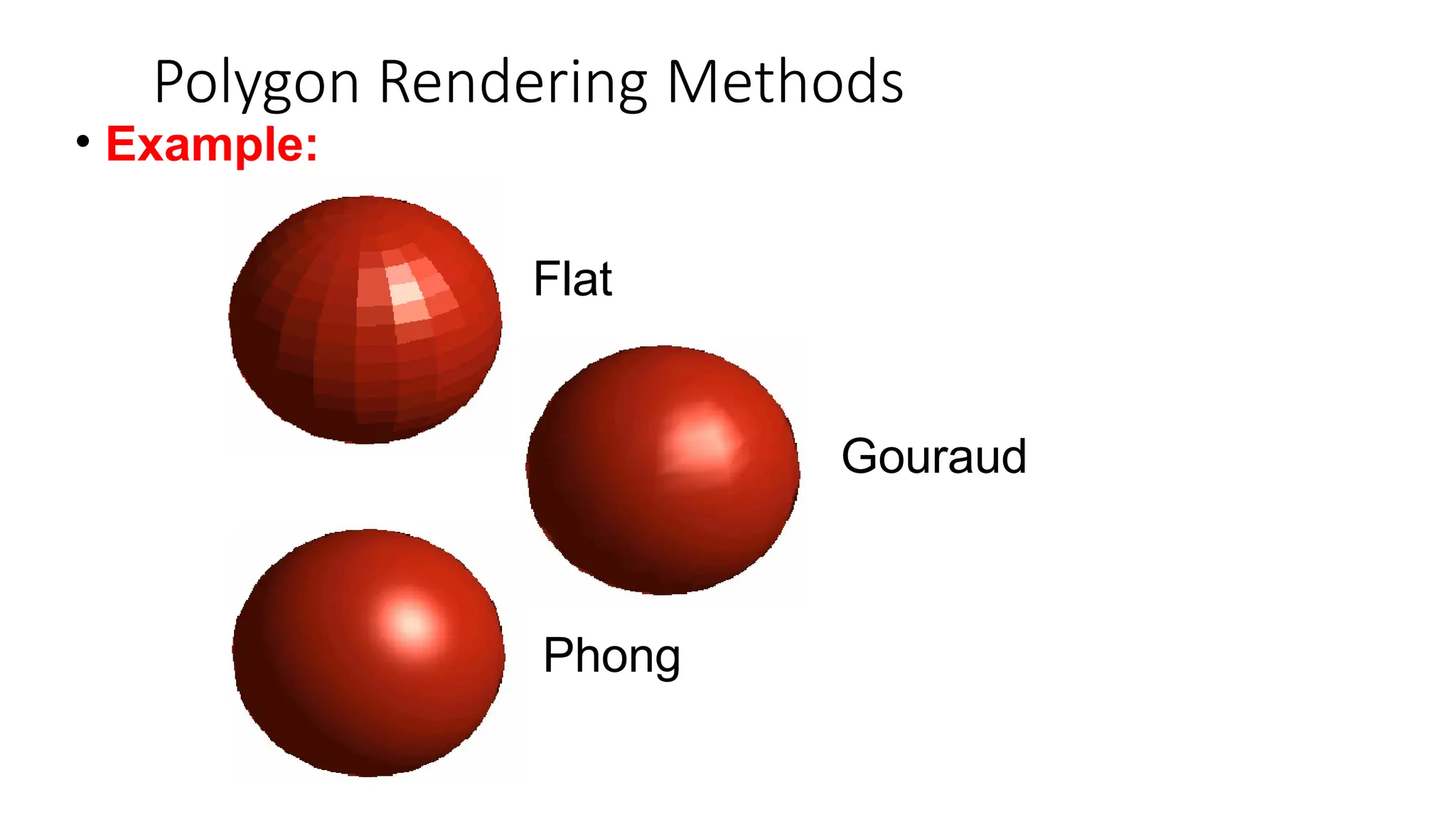
Polygon Rendering Methods
• Example:
Flat
Gouraud
Phong
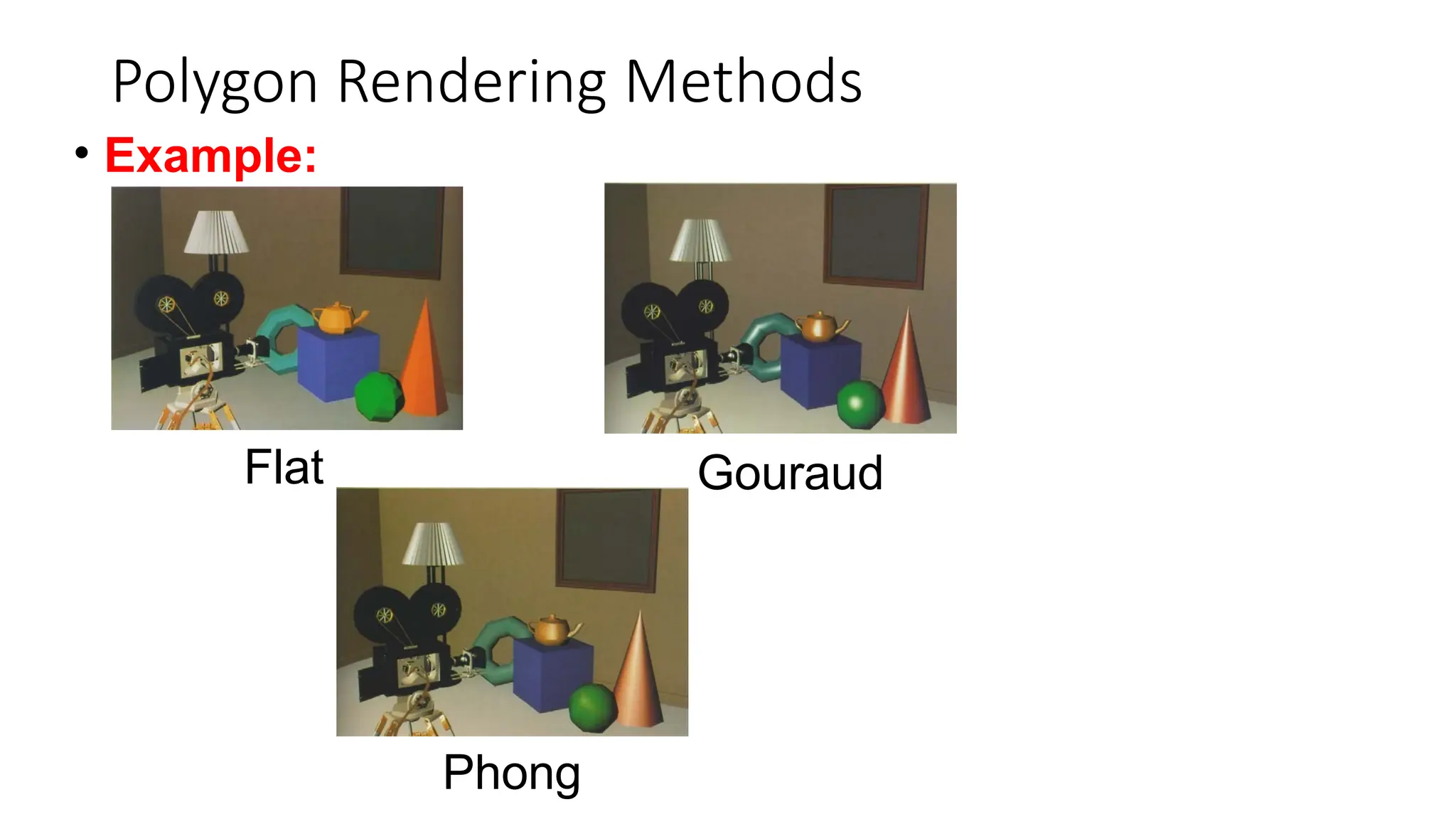
Polygon Rendering Methods
• Example:
Flat Gouraud
Phong
Texture mapping
Adding Surface detail by mapping texture patterns to the surface
Mapping algorithm to modify the shading:
– Texture mapping
– Bump mapping
– Displacement mapping
– Environmental mapping
Thank You

Illumination Models in graphic computer vision and Shading.pptx

  • 1.
  • 2.
    Illumination Models andShading • Light Source Models • Ambient Illumination • Diffuse Reflection • Specular Reflection • Polygon Rendering Methods • Flat Shading • Gouraud Shading • Phong Shading
  • 3.
    Illumination Models •Motivation: Inorder to produce realistic images, we must simulate the appearance of surfaces under various lighting conditions •Illumination Model: Given the illumination incident at a point on a surface, quantifies the reflected light
  • 4.
    Illumination Model Parameters •Lightingeffects are described with models that consider the interaction of light sources with object surfaces •The factors determining the lighting effects are: – The light source parameters: • Positions • Electromagnetic Spectrum • Shape – The surface parameters • Position • Reflectance properties • Position of nearby surfaces – The eye (camera) parameters • Position • Sensor spectrum sensitivities
  • 5.
    Illumination Models andRendering •An illumination model is used to calculate the intensity of the light that is reflected at a given point on a surface •A rendering method uses intensity calculations from the illumination model to determine the light intensity at all pixels in the image
  • 6.
    Illumination Models • Simplifiedand fast methods for calculating surfaces intensities, mostly empirical • Calculations are based on optical properties of surfaces and the lighting conditions (no reflected sources nor shadows) • Light sources are considered to be point sources • Reasonably good approximation for most scenes
  • 7.
    Ambient Illumination • Assumethere is some non-directional light in the environment (background light) • The amount of ambient light incident on each object is constant for all surfaces and over all directions • Very simple model, not very realistic • OpenGL default
  • 8.
    Ambient Illumination • Thereflected intensity Iamb of any point on the surface is: Ia - ambient light intensity Ka  [0,1] - surface ambient reflectivity • In principle Ia and Ka are functions of color, so we have IR amb, IG amb and IB Iamb = Ka Ia
  • 9.
  • 10.
    Diffuse Reflection • Diffuse(Lambertian) surfaces are rough or grainy, like clay, soil, fabric • The surface appears equally bright from all viewing directions • The brightness at each point is proportional to cos()  N L
  • 11.
    Diffuse Reflection • Brightnessis proportional to cos() because a surface (a) perpendicular to the light direction is more illuminated than a surface (b) at an oblique angle a b  N L
  • 12.
    Diffuse Reflection • Thereflected intensity Idiff of a point on the surface is: Idiff = Kd Ipcos() = Kd Ip(NL) Ip - the point light intensity. May appear as attenuated source fatt(r)IP Kd  [0,1] - the surface diffuse reflectivity N - the surface normal L - the light direction
  • 13.
  • 14.
    Diffuse Reflection •Commonly, thereare two types of light sources: – A background ambient light – A point light source • The equation that combines the two models is: I = Idiff + Iamb = Kd Ip NL + Ka Ia • Note this is the model for one color and it should be replicated for each channel: IR, IG and IB
  • 15.
    Diffuse Reflection • Example: 00.3 0.6 0.3 0.5 0.7 Ka Kd
  • 16.
    Specular Reflection • ThePhong Model: reflected specular intensity falls off as some power of cos (): Ispec = Ks Ipcosn() = Ks Ip(RV)n   Ks - the surface specular reflectivity n – specular reflection parameter, determining the deviation from ideal specular surface (for a perfect mirror n=) N L  R V Specular surface
  • 17.
    Specular Reflection • Example: 0.20.5 0.8 0 0.3 0.7 Kd Ks
  • 18.
    Specular Reflection • Example: AmbientIllumination Ambient + Diffuse Ambient + Diffuse + Specular
  • 19.
    Polygon Rendering Methods •A freeform surface can be approximated by polyhedra • Rendering: calculate the illumination at each surface point • Applying the illumination model at each surface point is computationally expensive
  • 20.
    Shading How to colourthe whole object We know how to colour single points on the surface by illumination Shading models • Flat shading (one lighting calculation per polygon) • Gouraud shading (one lighting calculation per vertex) • Phong shading (one calculation per pixel)
  • 21.
    Flat Shading • Asingle intensity is calculated for each surface polygon • Fast and simple method • Gives reasonable result only if all of the following assumptions are valid: – The object is a polyhedron – Light source is far away from the surface so that N•L is constant over each polygon – Viewing position is far away from the surface so that V•R is constant over each polygon
  • 22.
    Gouraud Shading •The normalNv of a vertex is an average of all neighboring normals:  k k k  k V N N N 
  • 23.
    Gouraud Shading 2 2 1 4 1 1 2 1 2 4 4 I y y I  y  y I  2 2 3 5 3 3 2 3 2 5 5 I y  y y  y I  y  y y  y I  5 4 5 4 p 4 4 5 p 5 p I x  x y  y x  x I  x  x y  y x  x I  I1 I I 4 5 scan line I2 x • Interpolation of the vertex intensities y I3 IP
  • 24.
    Phong Shading • Amore accurate method for rendering a polygon surface is to interpolate normal vectors, and then apply the illumination model to each surface point •Phong Shading Algorithm: 1. Determine the normal at each polygon vertex 2. Linearly interpolate the vertex normals over the surface polygon 3. Apply the illumination model along each scan line to calculate intensity of each surface point
  • 25.
    Polygon Rendering Methods •Example: Flat Gouraud Phong
  • 26.
    Polygon Rendering Methods •Example: Flat Gouraud Phong
  • 27.
    Texture mapping Adding Surfacedetail by mapping texture patterns to the surface Mapping algorithm to modify the shading: – Texture mapping – Bump mapping – Displacement mapping – Environmental mapping
  • 28.