This presentation is made possible by the support of the American People through the United States Agency
for International Development (USAID). The contents of this presentation are the sole responsibility of Rick
Rasmussen and do not necessarily reflect the views of USAID or the United States Government.
Crafting a successful merger
1
Definitions:
•  Merger: One corporation is combined with and
disappears into another corporation
–  Statutory Merger: done under the law
•  Corporate Acquisition: The process by which the stock or
assets of a corporation come to be owned by a buyer.
Can be a purchase of stock or a purchase of assets.
•  Acquisition is the generic term. A merger is the narrow
technical term for the legal procedure
Why corporations are looking for acquisitions
•  Vertical Integration
•  Diversification
•  New market entry
•  Strategic alliance
•  Customer acquisition
•  Reduce potential
competition
Potential Exit paths
•  Porter model
Current
Industry
Structure
(rivalry amongst
competitors)
Potential Entrants
Customers
Substitutes
Suppliers
Vertical Integration
•  Strategic model used to achieve
economies in purchasing, sales and/
or distribution
•  Vertical backward integration:
–  Buying a supplier
•  Vertical forward integration:
–  Buying current or potential customers
•  Danger – loosing leverage or
relationships with your other suppliers
or customers
Suppliers
Company
Customers
Diversification
•  Product (or service) extension:
–  Adding a product or service to be sold in the same
geography, generally to the same customers
–  Example: water company buys a company that sells sodas
•  Geographic diversification:
–  Merging with a company in a similar business in a different
territory
•  Danger: entry into a field of activity and a geographic
area where the acquirer has no present operations
(High Risk)
Valuation Fundamentals
•  Valuation is an absolute art.
•  How much is a company worth?
–  As much as someone is willing to pay!
•  Should be based on operations and future value, not assets and
risk factors come into play
•  Different objective methods can be applied in order to validate
valuations:
–  Replacement Value
–  Investment or Average Rate of Return
–  Payback
–  Internal Rate of Return (IRR)
–  Market Value
–  Comparable Net Worth to Market Value
–  Discounted Cash Flow
Corporate Control Takeover Mechanisms
•  Friendly mergers
–  Both firms agree that combining them would be value creating.
–  There may be an exchange of stock or one firm may make a tender offer for the other
firm's stock.
–  Friendly mergers and takeovers account for most of the transaction volume that
occurs.
•  Hostile takeovers.
–  Occur when there is conflict between the acquirers and acquirees over the price that
should be paid, the effectiveness of the policies that will be implemented and so forth.
–  Hostile tender offers allow the acquirers to go over the heads of the target
management and appeal directly to their shareholders.
–  This mechanism is potentially very important in ensuring an efficient allocation of
resources.
•  Proxy contests
–  A group of shareholders trying to persuade the remaining shareholders to unseat the
existing board of directors.
–  Used to change a firm's policies, to have her and others with similar views voted onto
the board of directors at a shareholders meeting. Group solicits proxies from other
shareholders which allows group to vote other’s shares.
–  Difficult to win because holdings are often spread among many individuals and groups.
Buyout Structures
•  Compensation:
–  Cash
–  Stock
–  Vested with “earn-out” milestones
•  Stock transactions are more easily financed vs. cash
–  Debt and lease obligations
–  Sale
–  Sale of assets
–  Company break up, partitioning, and resale
–  Loans
–  Bonds
–  Seller Take back Financing
Structures
•  All dependent on situation. Strong legal and investment
banking advice is recommended
•  Stock Purchase
•  Asset Purchase
•  Taxable Forward Merger
•  Taxable Reverse Merger
•  Taxable Forward Subsidiary Merger
•  Tax Free Forward Merger (Reorganization)
•  Tax Free Forward Triangular Merger
Acquisition Agreement
•  Covers Due Diligence concerns
•  Representations and Warranties
•  Covenants
–  actions to be done and actions prohibited
•  Conditions to Closing
•  Indemnity (protections)
•  Termination Procedures
•  Employment Agreements
•  Stockholder Agreements
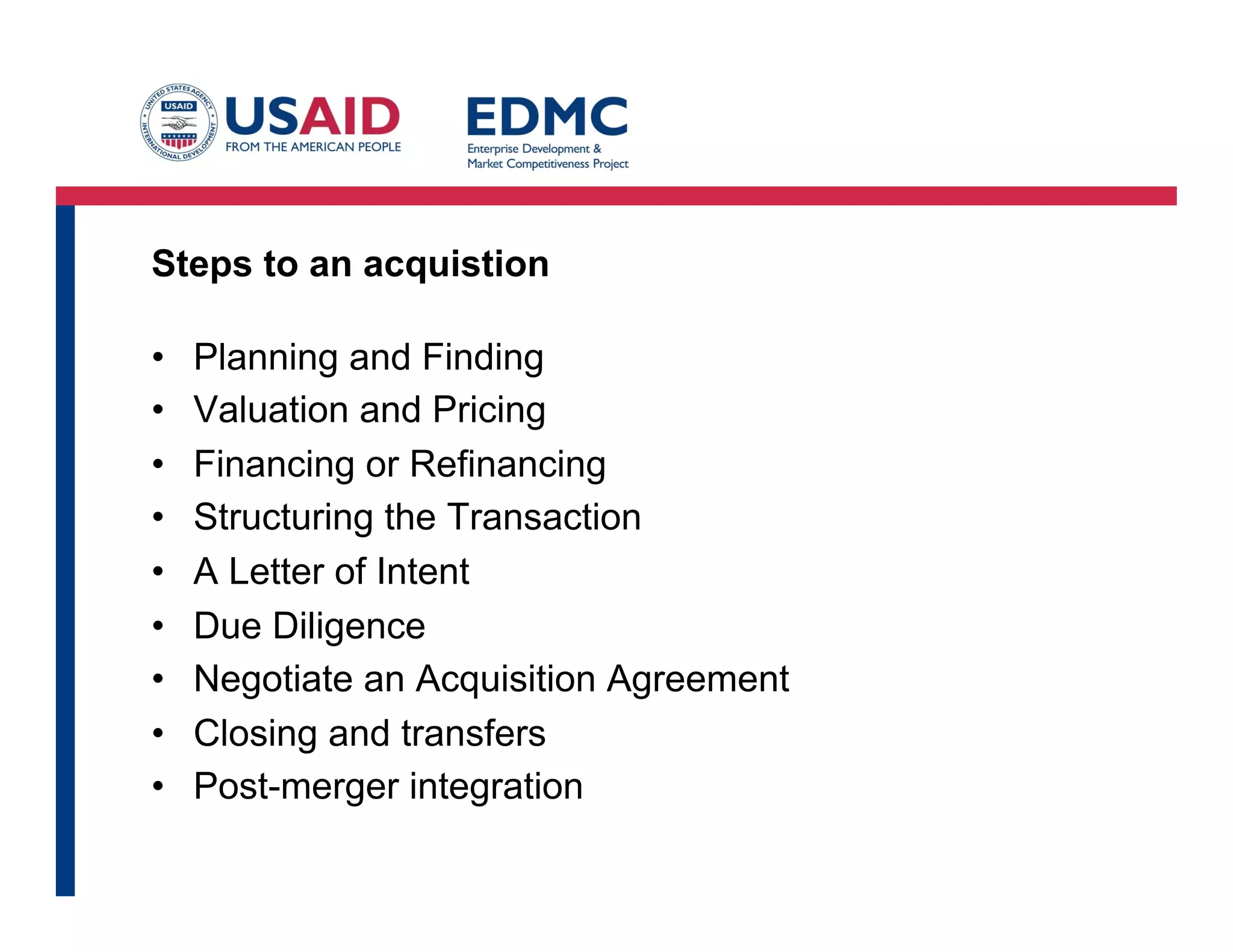
Steps to an acquistion
•  Planning and Finding
•  Valuation and Pricing
•  Financing or Refinancing
•  Structuring the Transaction
•  A Letter of Intent
•  Due Diligence
•  Negotiate an Acquisition Agreement
•  Closing and transfers
•  Post-merger integration
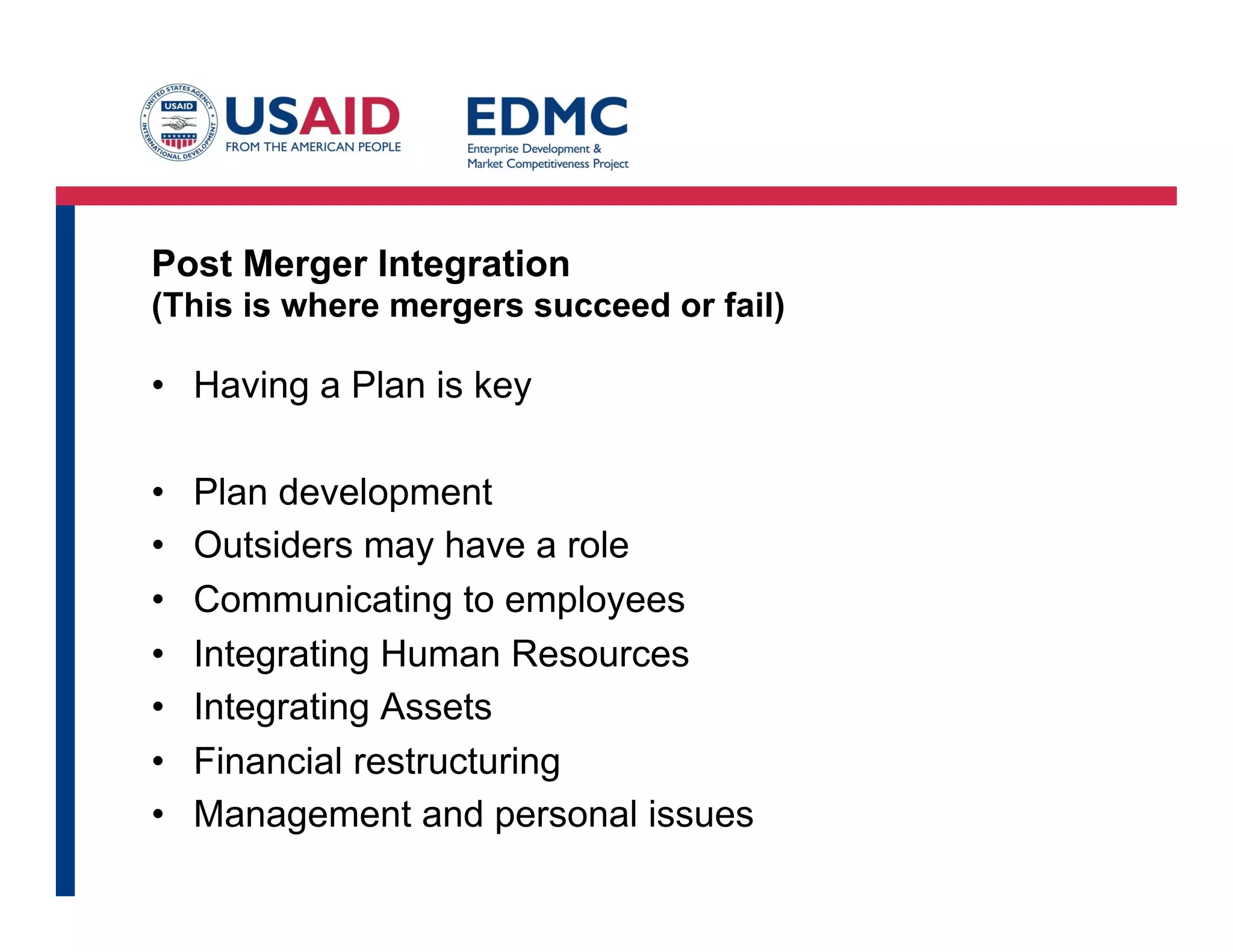
Post Merger Integration
(This is where mergers succeed or fail)
•  Having a Plan is key
•  Plan development
•  Outsiders may have a role
•  Communicating to employees
•  Integrating Human Resources
•  Integrating Assets
•  Financial restructuring
•  Management and personal issues
Consolidation Process
•  Who becomes:
–  President, CEO, Chairman?
•  Stand-alone division or subsumed into acquirer
•  Eliminating redundancies – “synergies”
–  You don’t need two:
•  Finance departments
•  Facilities groups
•  QA departments
•  HR Departments
•  …
•  Value of brands
•  Department-by-department
•  Product line-by-product line
Congratulations on your merger!
May everything go as well as planned…

10.4 successful merger.pptx

  • 1.
    This presentation ismade possible by the support of the American People through the United States Agency for International Development (USAID). The contents of this presentation are the sole responsibility of Rick Rasmussen and do not necessarily reflect the views of USAID or the United States Government. Crafting a successful merger 1
  • 2.
    Definitions: •  Merger: Onecorporation is combined with and disappears into another corporation –  Statutory Merger: done under the law •  Corporate Acquisition: The process by which the stock or assets of a corporation come to be owned by a buyer. Can be a purchase of stock or a purchase of assets. •  Acquisition is the generic term. A merger is the narrow technical term for the legal procedure
  • 3.
    Why corporations arelooking for acquisitions •  Vertical Integration •  Diversification •  New market entry •  Strategic alliance •  Customer acquisition •  Reduce potential competition
  • 4.
    Potential Exit paths • Porter model Current Industry Structure (rivalry amongst competitors) Potential Entrants Customers Substitutes Suppliers
  • 5.
    Vertical Integration •  Strategicmodel used to achieve economies in purchasing, sales and/ or distribution •  Vertical backward integration: –  Buying a supplier •  Vertical forward integration: –  Buying current or potential customers •  Danger – loosing leverage or relationships with your other suppliers or customers Suppliers Company Customers
  • 6.
    Diversification •  Product (orservice) extension: –  Adding a product or service to be sold in the same geography, generally to the same customers –  Example: water company buys a company that sells sodas •  Geographic diversification: –  Merging with a company in a similar business in a different territory •  Danger: entry into a field of activity and a geographic area where the acquirer has no present operations (High Risk)
  • 7.
    Valuation Fundamentals •  Valuationis an absolute art. •  How much is a company worth? –  As much as someone is willing to pay! •  Should be based on operations and future value, not assets and risk factors come into play •  Different objective methods can be applied in order to validate valuations: –  Replacement Value –  Investment or Average Rate of Return –  Payback –  Internal Rate of Return (IRR) –  Market Value –  Comparable Net Worth to Market Value –  Discounted Cash Flow
  • 8.
    Corporate Control TakeoverMechanisms •  Friendly mergers –  Both firms agree that combining them would be value creating. –  There may be an exchange of stock or one firm may make a tender offer for the other firm's stock. –  Friendly mergers and takeovers account for most of the transaction volume that occurs. •  Hostile takeovers. –  Occur when there is conflict between the acquirers and acquirees over the price that should be paid, the effectiveness of the policies that will be implemented and so forth. –  Hostile tender offers allow the acquirers to go over the heads of the target management and appeal directly to their shareholders. –  This mechanism is potentially very important in ensuring an efficient allocation of resources. •  Proxy contests –  A group of shareholders trying to persuade the remaining shareholders to unseat the existing board of directors. –  Used to change a firm's policies, to have her and others with similar views voted onto the board of directors at a shareholders meeting. Group solicits proxies from other shareholders which allows group to vote other’s shares. –  Difficult to win because holdings are often spread among many individuals and groups.
  • 9.
    Buyout Structures •  Compensation: – Cash –  Stock –  Vested with “earn-out” milestones •  Stock transactions are more easily financed vs. cash –  Debt and lease obligations –  Sale –  Sale of assets –  Company break up, partitioning, and resale –  Loans –  Bonds –  Seller Take back Financing
  • 10.
    Structures •  All dependenton situation. Strong legal and investment banking advice is recommended •  Stock Purchase •  Asset Purchase •  Taxable Forward Merger •  Taxable Reverse Merger •  Taxable Forward Subsidiary Merger •  Tax Free Forward Merger (Reorganization) •  Tax Free Forward Triangular Merger
  • 11.
    Acquisition Agreement •  CoversDue Diligence concerns •  Representations and Warranties •  Covenants –  actions to be done and actions prohibited •  Conditions to Closing •  Indemnity (protections) •  Termination Procedures •  Employment Agreements •  Stockholder Agreements
  • 12.
    Steps to anacquistion •  Planning and Finding •  Valuation and Pricing •  Financing or Refinancing •  Structuring the Transaction •  A Letter of Intent •  Due Diligence •  Negotiate an Acquisition Agreement •  Closing and transfers •  Post-merger integration
  • 13.
    Post Merger Integration (Thisis where mergers succeed or fail) •  Having a Plan is key •  Plan development •  Outsiders may have a role •  Communicating to employees •  Integrating Human Resources •  Integrating Assets •  Financial restructuring •  Management and personal issues
  • 14.
    Consolidation Process •  Whobecomes: –  President, CEO, Chairman? •  Stand-alone division or subsumed into acquirer •  Eliminating redundancies – “synergies” –  You don’t need two: •  Finance departments •  Facilities groups •  QA departments •  HR Departments •  … •  Value of brands •  Department-by-department •  Product line-by-product line
  • 15.
    Congratulations on yourmerger! May everything go as well as planned…