MERGERS AND ACQUISITIONS- AN INTRODUCTIONBY VARUN PRABHU
WHY ARE YOU HERETo learn the basics of mergers and acquisitionsTo acquire knowledge about specialist M&A firmsTo know how to valuate a businessTo learn how to control brand considerations after a mergerTo know the effects of mergers on management
AGENDAWhat is a M&A?Differentiating M & ACommon Ways of Business ValuationHow Do We Get Finance?Specialist M&A Advisory FirmsWhat Motives Lie Behind?Effects on ManagementBrand Building or Brand Destroying?Factors of the Merger MovementMerger WavesCross Border M & AMajor M&A’s
WHAT IS A M&A?An aspect of corporate strategy, corporate finance  and strategic management.Deals with buying, selling, combining of different companies that canAidFinanceHelp		a growing company in a given industry grow rapidly without having to create a new business entity.
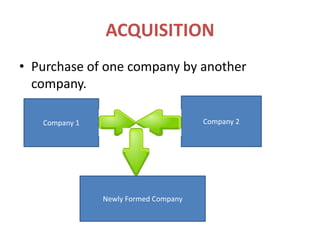
ACQUISITIONPurchase of one company by another company.Company 2Company 1Newly Formed Company
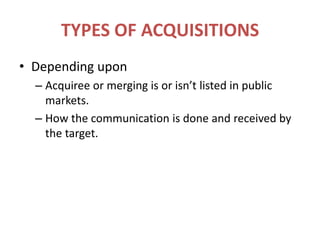
TYPES OF ACQUISITIONSDepending uponAcquiree or merging is or isn’t listed in public markets.How the communication is done and received by the target.
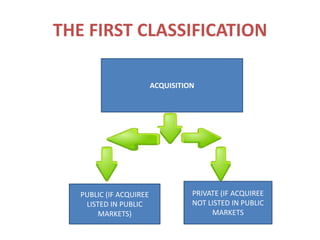
THE FIRST CLASSIFICATIONACQUISITIONPRIVATE (IF ACQUIREE NOT LISTED IN PUBLIC MARKETSPUBLIC (IF ACQUIREE LISTED IN PUBLIC MARKETS)
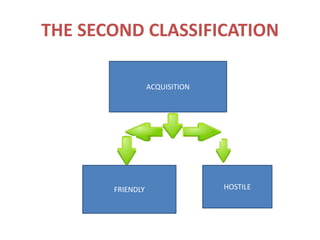
THE SECOND CLASSIFICATIONACQUISITIONFRIENDLYHOSTILE
CONFIDENTIALITY BUBBLEQuite normal for M&A deal communication to take place in a so called ‘confidentiality bubble’.Here information flows are restricted due to confidentiality agreements.
FRIENDLY ACQUISITIONSCompanies cooperate in negotiations.Synonymous to merger of equals.
HOSTILE ACQUISITIONSTakeover target unwilling to be purchased.It can also be if the acquiree company has no prior knowledge of offer.Hostile takeovers do turn friendly in the end. Most of the times.For the above thing to happen, offer is usually improved.
REVERSE TAKEOVERSAcquisition usually refers to purchase of smaller firm by larger firm.Sometimes, smaller firm acquire management control of a larger / longer established company.Keep its name for combined entity.Known as reverse takeover.
REVERSE MERGERAnother type of acquisition.Is a deal enabling a private company to become a public company.The deal enables private company by listing in a short time period.Occurs when a private company has strong prospects and is eager to raise financing, buys a publicly listed shell company.Usually the public one is one withNo businessLimited assets
SOME STATISTICSAchieving acquisition successfully has proven to be tough.Various studies show 50% of them are unsuccessful.Process very complex, many dimensions influence its outcome.Variety of structures used in securing asset control.Different tax and regulatory implications
THE ACQUISITION PROCESSBuyer buys shares of target companyOwnership control conveys effective control over assets, but since company is going concern, liabilities come as well.Buyer buys assets of target company.Cash target receives from sell-off is paid back to its shareholders byDividendThrough liquidationIf buyer buys out entire assets, then target company = empty shell.Buyer often cherry picks his assets
SOME OTHER TERMSThere are some other terms used as well like:DemergersSpin-offSpin-outSometimes used to indicate a situation where one company splits into two, generating a 2nd company separately listed on a stock exchange.
DIFFERENTIATING MERGERS AND ACQUISITIONSBoth terms are often used synonymously.They mean slightly different things in reality.
ACQUISITIONS FIRSTWhen one company takes over another, clearly establishes as its new owner.Legal View: target ceases to exist.Buyer swallows targetBuyer’s stock continues to be traded.
MERGERS NEXTHappens when two firms agree to go forward as a single new company rather than remain separate.Often precisely termed as merger of equals.Firms are often of same size.Both companies stock surrenderedNew company stock put into place instead.Example: 1999 merger of GlaxoWellcome and SmithKline Beecham, both firms ceased to exist and a new firm GlaxoSmithKline was created.
MERGERS IN PRACTICEActually the principle of mergers of equals don’t really happen.Usually one company buys another.Simply allow acquired firm to pronounce it as a merger, though technically it is an acquisition.Being purchased always portends negative connotations.Therefore, they term it as merger, makes takeover more acceptable.Example : takeover of Chrysler by Daimler-Benz in 1999.Purchase deal also a merger -> friendly takeovers.Hostile takeovers -> mainly acquisitions.
COMMON WAYS OF BUSINESS VALUATIONAsset ValuationHistorical Earnings ValuationFuture Maintainable Earnings ValuationRelative ValuationDiscounted Cash Flow Valuation
ASSET VALUATIONValuations are made for:Excess or restricted cashOther non-operating assets and liabilitiesLack of marketability discountControl premiumAbove or below market leasesExcess salaries in case private companiesTypical adjustments include:Working capital adjustmentDeferred capital expendituresCost of goods sold adjustmentNon recurring professional fees and costsCertain non operating income/expense items
VALUATION OF INTANGIBLE ASSETSCan be made for intangible assets like:PatentsCopyrightsSoftwareTrade secretsCustomer relationshipsUses eitherPresent value modelEstimating the costs to recreate itProcess time consuming and costlyOften necessary for financial reporting and intellectual property transactions.Stock markets give only an indirect value.Can be regarded as difference between its market capitalization and its book value.
VALUATION OF MINING PROJECTSProcess of determining the value of a mining property.Sometimes required for:Initial Public OffersFairness opinionsLitigationsMergers and acquisitionsShareholder related mattersFair market value is standard value.CIMVal Standards are recognized standards for mining project valuations.
HISTORICAL EARNINGS VALUATIONUses EPS (Earnings Per Share) values for valuation of stock.Figures can be used for forecasting performance by visiting free financial sites such as Yahoo Finance.
RELATIVE VALUATIONGeneric term that refers to the notion of comparing asset price to market value of similar assets.Presumably spot pricing anomalies on securities market.Compare certain financial ratios such as:Price to book valuePrice to earningsEV/EBITDAMainly statistical and historicalCompare national or industry stock performance to economic and market fundamentals like:GDP growthInterest rateInflation forecastsEarnings growthNational equity index
DISCOUNTED CASH FLOW METHODAbbreviated as DCFUses concepts of time value of moneyAll future cash flows are estimated and discounted to give their present values(PV’s).Sum of all future values, is net present value (NPV).Widely used in investment finance, real estate development, corporate financial managementMost commonly used method is exponential discounting.Other methods are:Hyperbolic discountingDiscount rate used is Weighted Average Cost of Capital (WACC).
METHODS OF PROJECT APPRAISALEquity ApproachFlow To Equity ApproachEntity ApproachAdjusted Present Value ApproachWeighted Average Cost Of Capital ApproachTotal Cash Flow Approach
SHORTCOMINGS OF DCFCommercial banks have widely used DCF for construction projects.These have following shortcomings:Discount rate assumptions rely on market for competing investments, rates change drastically over time.Straight line assumptions generally based upon historic increases in market rent but never factors in the cyclical nature of many real estate markets.Sometimes leads to overvaluation of assetsPowerful method of valuation though not devoid of shortcomingsMerely a mechanical tool, makes it subject to axiom of garbage in garbage outsmall changes in input can lead to large changes in company value.To avoid we can use simple annuity.
THE VALUATION PROFESSIONALSProfessionals who do business valuations use a combination of some of them.Information in balance sheet or income statement is obtained using the following accounting measures:Notice to ReaderReview EngagementAuditAccurate business valuation most important aspect of M&A.Major impact on value of business sold for.
HOW DO WE GET FINANCE?We can differentiate mergers and acquisitions by the way they are financed.Various methods of financing include:CashStock
THINK STRATEGIC!!!!With pure cash deals, no doubt on real bid value.Contingency of share payment removed.,Cash offer preempts competitors.
TAXESShould be evaluated with counsel of Competent tax advisorsCompetent accounting advisors
CASH V/S SHARESWith a share deal, buyer’s capital structure might be affected and control of new company modified.If issuance of shares necessary, shareholders might prevent capital increase.Risk removed with cash transaction.In cash deal, balance sheet of buyer will be modified, liquidity ratios might decrease.In stock transactions, lower profitability ratios might show.
THE CASH DEALIf buyer pays cash, there are 3 main financing options:Cash on Hand: consumes financial slack. May decrease debt rating. No major transaction costs,Issue of debt: consumes financial slack. May decrease debt rating. Increases cost of debt. Transaction costs include underwriting or closing costs of 1% to 3% of face value.Issue of stock: increases financial slack, may improve debt rating, reduce cost of debt, transaction costs include fees for preparation of proxy statement, an extraordinary shareholder meeting, registration.
THE STOCK DEALIf buyer pays with stock:Issue of StockShares in Treasury: increases financial slack, improve debt rating, reduce cost of debt, transaction costs include brokerage fees if shares repurchased in market otherwise no major costs.
LETS GENERALIZE…Stock will create flexibility.Transaction costs also to be considered but tend to have greater impact.Remember:Buyers tend to offer stock when they believe their shares are overvalued and cash when undervalued.
SPECIALIST M&A ADVISORY FIRMSProvided usually byFull service investment banksRecently, specialized M&A firms have emerged.Sometimes referred to as Transition Companies.Assisting business referred to as companies in transition.
WHAT MOTIVES LIE BEHIND?Economy of scaleEconomy of scopeCross sellingSynergyTaxationGeographical or other diversificationsResource transferVertical integrationAbsorption of similar businesses under single management.Manager’s hubrisEmpire buildingManager’s compensation.
ECONOMY OF SCALECombined company can often reduce its fixed costsCan remove duplicate departmentsLower company costsIncrease profit margins.
ECONOMY OF SCOPERelates to efficiencies primarily associated with demand side changesIncreasing/decreasing scope of marketing and distribution
INCREASED MARKET SHAREAssumes that buyer will be absorbing a major competitor.Thus increase revenue/market share to set prices.
SYNERGYManagerial economics such as increased opportunity of managerial specializations.Purchasing economies due to increased order size and associated bulk buying discounts.
CROSS SELLINGA bank buying a stock broking firmManufacturer acquiring and selling complementary products.
TAXATIONProfitable company can buy a loss maker to use target’s loss as their advantage by reducing their tax liability.But there are certain regulations to follow.
GEOGRAPHICAL DIVERSIFICATIONDesigned to smooth company earningsSmoothens stock priceGives conservative investors more confidenceBut does not always deliver value to shareholders.
RESOURCE TRANSFERResources unevenly distributed across firms.Can create value byOvercoming information asymmetryCombining scarce resources
VERTICAL INTEGRATIONOccurs when an upstream firm merges with a downstream firm.One reason is externality problem.Common example is double marginalization
EFFECTS ON MANAGEMENTM&A according to some studies destroy leadership continuity in target companies.Target companies lose 21% of their executives each year following an acquisition.
BRAND CONSIDERATIONSM&A’s often create brand problems.4 different approaches:Keep one name and discontinue other. Ex: United Airlines and Continental Airlines Merger.Keep one name and demote other: Caterpillar Inc. keeping Bucyrus International.Keep both names and use together: Pricewaterhouse Coopers.Discard both legacy names and adopt new one:merger of Bell Atlantic and GTE which became Verizon Communications. This merger was successful.Merger of Yellow Freight and Roadway Corporation which became YRC Worldwide. This merger was partially successful, brand value lost.Factors range from political to tactical.Ego as well as rational factors drive choice.Rational factors : brand value, costs involved with changing brands.
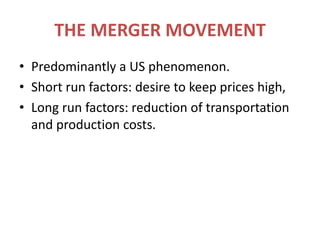
THE MERGER MOVEMENTPredominantly a US phenomenon.Short run factors: desire to keep prices high,Long run factors: reduction of transportation and production costs.
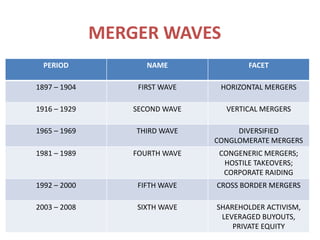
MERGER WAVES
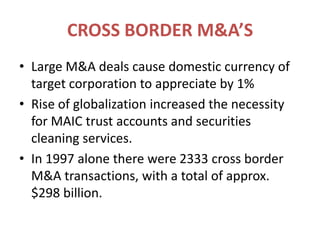
CROSS BORDER M&A’SLarge M&A deals cause domestic currency of target corporation to appreciate by 1%Rise of globalization increased the necessity for MAIC trust accounts and securities cleaning services.In 1997 alone there were 2333 cross border M&A transactions, with a total of approx. $298 billion.
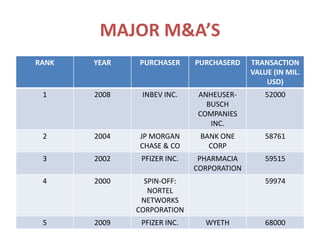
MAJOR M&A’S
QUESTIONS?
BIBLIOGRAPHYwww.en.wikipedia.org
THANK YOU

Mergers And Acquisitions

  • 1.
    MERGERS AND ACQUISITIONS-AN INTRODUCTIONBY VARUN PRABHU
  • 2.
    WHY ARE YOUHERETo learn the basics of mergers and acquisitionsTo acquire knowledge about specialist M&A firmsTo know how to valuate a businessTo learn how to control brand considerations after a mergerTo know the effects of mergers on management
  • 3.
    AGENDAWhat is aM&A?Differentiating M & ACommon Ways of Business ValuationHow Do We Get Finance?Specialist M&A Advisory FirmsWhat Motives Lie Behind?Effects on ManagementBrand Building or Brand Destroying?Factors of the Merger MovementMerger WavesCross Border M & AMajor M&A’s
  • 4.
    WHAT IS AM&A?An aspect of corporate strategy, corporate finance and strategic management.Deals with buying, selling, combining of different companies that canAidFinanceHelp a growing company in a given industry grow rapidly without having to create a new business entity.
  • 5.
    ACQUISITIONPurchase of onecompany by another company.Company 2Company 1Newly Formed Company
  • 6.
    TYPES OF ACQUISITIONSDependinguponAcquiree or merging is or isn’t listed in public markets.How the communication is done and received by the target.
  • 7.
    THE FIRST CLASSIFICATIONACQUISITIONPRIVATE(IF ACQUIREE NOT LISTED IN PUBLIC MARKETSPUBLIC (IF ACQUIREE LISTED IN PUBLIC MARKETS)
  • 8.
  • 9.
    CONFIDENTIALITY BUBBLEQuite normalfor M&A deal communication to take place in a so called ‘confidentiality bubble’.Here information flows are restricted due to confidentiality agreements.
  • 10.
    FRIENDLY ACQUISITIONSCompanies cooperatein negotiations.Synonymous to merger of equals.
  • 11.
    HOSTILE ACQUISITIONSTakeover targetunwilling to be purchased.It can also be if the acquiree company has no prior knowledge of offer.Hostile takeovers do turn friendly in the end. Most of the times.For the above thing to happen, offer is usually improved.
  • 12.
    REVERSE TAKEOVERSAcquisition usuallyrefers to purchase of smaller firm by larger firm.Sometimes, smaller firm acquire management control of a larger / longer established company.Keep its name for combined entity.Known as reverse takeover.
  • 13.
    REVERSE MERGERAnother typeof acquisition.Is a deal enabling a private company to become a public company.The deal enables private company by listing in a short time period.Occurs when a private company has strong prospects and is eager to raise financing, buys a publicly listed shell company.Usually the public one is one withNo businessLimited assets
  • 14.
    SOME STATISTICSAchieving acquisitionsuccessfully has proven to be tough.Various studies show 50% of them are unsuccessful.Process very complex, many dimensions influence its outcome.Variety of structures used in securing asset control.Different tax and regulatory implications
  • 15.
    THE ACQUISITION PROCESSBuyerbuys shares of target companyOwnership control conveys effective control over assets, but since company is going concern, liabilities come as well.Buyer buys assets of target company.Cash target receives from sell-off is paid back to its shareholders byDividendThrough liquidationIf buyer buys out entire assets, then target company = empty shell.Buyer often cherry picks his assets
  • 16.
    SOME OTHER TERMSThereare some other terms used as well like:DemergersSpin-offSpin-outSometimes used to indicate a situation where one company splits into two, generating a 2nd company separately listed on a stock exchange.
  • 17.
    DIFFERENTIATING MERGERS ANDACQUISITIONSBoth terms are often used synonymously.They mean slightly different things in reality.
  • 18.
    ACQUISITIONS FIRSTWhen onecompany takes over another, clearly establishes as its new owner.Legal View: target ceases to exist.Buyer swallows targetBuyer’s stock continues to be traded.
  • 19.
    MERGERS NEXTHappens whentwo firms agree to go forward as a single new company rather than remain separate.Often precisely termed as merger of equals.Firms are often of same size.Both companies stock surrenderedNew company stock put into place instead.Example: 1999 merger of GlaxoWellcome and SmithKline Beecham, both firms ceased to exist and a new firm GlaxoSmithKline was created.
  • 20.
    MERGERS IN PRACTICEActuallythe principle of mergers of equals don’t really happen.Usually one company buys another.Simply allow acquired firm to pronounce it as a merger, though technically it is an acquisition.Being purchased always portends negative connotations.Therefore, they term it as merger, makes takeover more acceptable.Example : takeover of Chrysler by Daimler-Benz in 1999.Purchase deal also a merger -> friendly takeovers.Hostile takeovers -> mainly acquisitions.
  • 21.
    COMMON WAYS OFBUSINESS VALUATIONAsset ValuationHistorical Earnings ValuationFuture Maintainable Earnings ValuationRelative ValuationDiscounted Cash Flow Valuation
  • 22.
    ASSET VALUATIONValuations aremade for:Excess or restricted cashOther non-operating assets and liabilitiesLack of marketability discountControl premiumAbove or below market leasesExcess salaries in case private companiesTypical adjustments include:Working capital adjustmentDeferred capital expendituresCost of goods sold adjustmentNon recurring professional fees and costsCertain non operating income/expense items
  • 23.
    VALUATION OF INTANGIBLEASSETSCan be made for intangible assets like:PatentsCopyrightsSoftwareTrade secretsCustomer relationshipsUses eitherPresent value modelEstimating the costs to recreate itProcess time consuming and costlyOften necessary for financial reporting and intellectual property transactions.Stock markets give only an indirect value.Can be regarded as difference between its market capitalization and its book value.
  • 24.
    VALUATION OF MININGPROJECTSProcess of determining the value of a mining property.Sometimes required for:Initial Public OffersFairness opinionsLitigationsMergers and acquisitionsShareholder related mattersFair market value is standard value.CIMVal Standards are recognized standards for mining project valuations.
  • 25.
    HISTORICAL EARNINGS VALUATIONUsesEPS (Earnings Per Share) values for valuation of stock.Figures can be used for forecasting performance by visiting free financial sites such as Yahoo Finance.
  • 26.
    RELATIVE VALUATIONGeneric termthat refers to the notion of comparing asset price to market value of similar assets.Presumably spot pricing anomalies on securities market.Compare certain financial ratios such as:Price to book valuePrice to earningsEV/EBITDAMainly statistical and historicalCompare national or industry stock performance to economic and market fundamentals like:GDP growthInterest rateInflation forecastsEarnings growthNational equity index
  • 27.
    DISCOUNTED CASH FLOWMETHODAbbreviated as DCFUses concepts of time value of moneyAll future cash flows are estimated and discounted to give their present values(PV’s).Sum of all future values, is net present value (NPV).Widely used in investment finance, real estate development, corporate financial managementMost commonly used method is exponential discounting.Other methods are:Hyperbolic discountingDiscount rate used is Weighted Average Cost of Capital (WACC).
  • 28.
    METHODS OF PROJECTAPPRAISALEquity ApproachFlow To Equity ApproachEntity ApproachAdjusted Present Value ApproachWeighted Average Cost Of Capital ApproachTotal Cash Flow Approach
  • 29.
    SHORTCOMINGS OF DCFCommercialbanks have widely used DCF for construction projects.These have following shortcomings:Discount rate assumptions rely on market for competing investments, rates change drastically over time.Straight line assumptions generally based upon historic increases in market rent but never factors in the cyclical nature of many real estate markets.Sometimes leads to overvaluation of assetsPowerful method of valuation though not devoid of shortcomingsMerely a mechanical tool, makes it subject to axiom of garbage in garbage outsmall changes in input can lead to large changes in company value.To avoid we can use simple annuity.
  • 30.
    THE VALUATION PROFESSIONALSProfessionalswho do business valuations use a combination of some of them.Information in balance sheet or income statement is obtained using the following accounting measures:Notice to ReaderReview EngagementAuditAccurate business valuation most important aspect of M&A.Major impact on value of business sold for.
  • 31.
    HOW DO WEGET FINANCE?We can differentiate mergers and acquisitions by the way they are financed.Various methods of financing include:CashStock
  • 32.
    THINK STRATEGIC!!!!With purecash deals, no doubt on real bid value.Contingency of share payment removed.,Cash offer preempts competitors.
  • 33.
    TAXESShould be evaluatedwith counsel of Competent tax advisorsCompetent accounting advisors
  • 34.
    CASH V/S SHARESWitha share deal, buyer’s capital structure might be affected and control of new company modified.If issuance of shares necessary, shareholders might prevent capital increase.Risk removed with cash transaction.In cash deal, balance sheet of buyer will be modified, liquidity ratios might decrease.In stock transactions, lower profitability ratios might show.
  • 35.
    THE CASH DEALIfbuyer pays cash, there are 3 main financing options:Cash on Hand: consumes financial slack. May decrease debt rating. No major transaction costs,Issue of debt: consumes financial slack. May decrease debt rating. Increases cost of debt. Transaction costs include underwriting or closing costs of 1% to 3% of face value.Issue of stock: increases financial slack, may improve debt rating, reduce cost of debt, transaction costs include fees for preparation of proxy statement, an extraordinary shareholder meeting, registration.
  • 36.
    THE STOCK DEALIfbuyer pays with stock:Issue of StockShares in Treasury: increases financial slack, improve debt rating, reduce cost of debt, transaction costs include brokerage fees if shares repurchased in market otherwise no major costs.
  • 37.
    LETS GENERALIZE…Stock willcreate flexibility.Transaction costs also to be considered but tend to have greater impact.Remember:Buyers tend to offer stock when they believe their shares are overvalued and cash when undervalued.
  • 38.
    SPECIALIST M&A ADVISORYFIRMSProvided usually byFull service investment banksRecently, specialized M&A firms have emerged.Sometimes referred to as Transition Companies.Assisting business referred to as companies in transition.
  • 39.
    WHAT MOTIVES LIEBEHIND?Economy of scaleEconomy of scopeCross sellingSynergyTaxationGeographical or other diversificationsResource transferVertical integrationAbsorption of similar businesses under single management.Manager’s hubrisEmpire buildingManager’s compensation.
  • 40.
    ECONOMY OF SCALECombinedcompany can often reduce its fixed costsCan remove duplicate departmentsLower company costsIncrease profit margins.
  • 41.
    ECONOMY OF SCOPERelatesto efficiencies primarily associated with demand side changesIncreasing/decreasing scope of marketing and distribution
  • 42.
    INCREASED MARKET SHAREAssumesthat buyer will be absorbing a major competitor.Thus increase revenue/market share to set prices.
  • 43.
    SYNERGYManagerial economics suchas increased opportunity of managerial specializations.Purchasing economies due to increased order size and associated bulk buying discounts.
  • 44.
    CROSS SELLINGA bankbuying a stock broking firmManufacturer acquiring and selling complementary products.
  • 45.
    TAXATIONProfitable company canbuy a loss maker to use target’s loss as their advantage by reducing their tax liability.But there are certain regulations to follow.
  • 46.
    GEOGRAPHICAL DIVERSIFICATIONDesigned tosmooth company earningsSmoothens stock priceGives conservative investors more confidenceBut does not always deliver value to shareholders.
  • 47.
    RESOURCE TRANSFERResources unevenlydistributed across firms.Can create value byOvercoming information asymmetryCombining scarce resources
  • 48.
    VERTICAL INTEGRATIONOccurs whenan upstream firm merges with a downstream firm.One reason is externality problem.Common example is double marginalization
  • 49.
    EFFECTS ON MANAGEMENTM&Aaccording to some studies destroy leadership continuity in target companies.Target companies lose 21% of their executives each year following an acquisition.
  • 50.
    BRAND CONSIDERATIONSM&A’s oftencreate brand problems.4 different approaches:Keep one name and discontinue other. Ex: United Airlines and Continental Airlines Merger.Keep one name and demote other: Caterpillar Inc. keeping Bucyrus International.Keep both names and use together: Pricewaterhouse Coopers.Discard both legacy names and adopt new one:merger of Bell Atlantic and GTE which became Verizon Communications. This merger was successful.Merger of Yellow Freight and Roadway Corporation which became YRC Worldwide. This merger was partially successful, brand value lost.Factors range from political to tactical.Ego as well as rational factors drive choice.Rational factors : brand value, costs involved with changing brands.
  • 51.
    THE MERGER MOVEMENTPredominantlya US phenomenon.Short run factors: desire to keep prices high,Long run factors: reduction of transportation and production costs.
  • 52.
  • 53.
    CROSS BORDER M&A’SLargeM&A deals cause domestic currency of target corporation to appreciate by 1%Rise of globalization increased the necessity for MAIC trust accounts and securities cleaning services.In 1997 alone there were 2333 cross border M&A transactions, with a total of approx. $298 billion.
  • 54.
  • 55.
  • 56.
  • 57.