






Seemant Shrivastav
Agenda
• Bootstrapping – How to bootstrap your start-up
• Sources of Finance- Various sources of finances
• Managing your Company’s finances
• How to survive tough times
• Fundraising Trends
• Conclusion- Q&A
How to Bootstrap?
How to Bootstrap?
• Stick to a business domain you know and love.
• Start from own Home/Friends or relatives Home
• Try & manage as much work as possible amongst
founding team
• Find cost effective resources/interns
• Look for freebies , deals , free trials etc
• Plan and track your finances, avoid unnecessary
expenses
• Don’t waste time & money at conferences, seminars
unless your product is ready
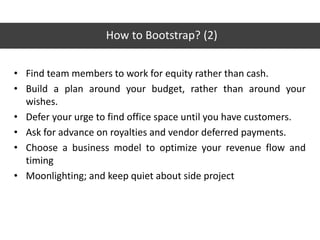
How to Bootstrap? (2)
• Find team members to work for equity rather than cash.
• Build a plan around your budget, rather than around your
wishes.
• Defer your urge to find office space until you have customers.
• Ask for advance on royalties and vendor deferred payments.
• Choose a business model to optimize your revenue flow and
timing
• Moonlighting; and keep quiet about side project
Sources of
Finance
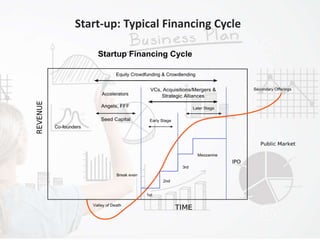
Start-up: Typical Financing Cycle
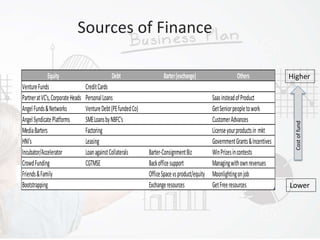
Equity Debt Barter(exchange) Others
VentureFunds CreditCards
PartneratVC's,CorporateHeads PersonalLoans SaasinsteadofProduct
AngelFunds&Networks VentureDebt(PEfundedCo) GetSeniorpeopletowork
AngelSyndicatePlatforms SMELoansbyNBFC's CustomerAdvances
MediaBarters Factoring Licenseyourproductsin mkt
HNI's Leasing GovernmentGrants&Incentives
Incubator/Accelerator LoanagainstCollaterals Barter-ConsignmentBiz WinPrizesincontests
CrowdFunding CGTMSE Backofficesupport Managingwithownrevenues
Friends&Family OfficeSpacevsproduct/equity Moonlightingonjob
Bootstrapping Exchangeresources GetFreeresources
Costoffund
Sources of Finance
Higher
Lower
Debt Financing: Lessor known Sources
• Banking Surrogacy
• CGTSME Loans
• MUDRA Loans
• Factoring
• Venture Debt
Managing
Finances
Basic Financial Terms
• Profit & Loss A/c
• Balance Sheet
• Cash Flow Statement
• Business Plan
• Budgeting
• Accounts Payable
• Accounts Receivable
• Direct Costs
• Indirect Costs
• Operating Margins
• Net profit
• Cash Burn Rate
• Debt Equity Ratio
• Current Ratio
• Debt Service Coverage
• Interest Coverage
• IRR/ROCE
Golden Financial Management Rules
• Never Invest your money without ensuring that assets
you acquire can generate a return which is at least
equal to the cost of your capital
• Invest your money in such a way that the assets will
generate an inflow of funds before liabilities demand
an outflow
(*source: Romancing The Balance Sheet by Anil Lamba)
Surviving
Tough
Times
Go Back to Basics
• Generate Profit & not Sales
• Cut unnecessary expenses
• Pay minute attention to cash flows
• Manage Working Capital efficiently
• Don’t use short term funds for long term purposes
• Be wary of unsecured & high cost debts
Further Survival
• Negotiate credit terms with Vendors and Customers
• Look for Hidden sources of cash (especially for slightly
mature business) in your books
• Sell off unwanted assets to generate cash
• Explore advances from Customers
• Lay off people (if unavoidable) on best possible terms
Fund Raising Trends
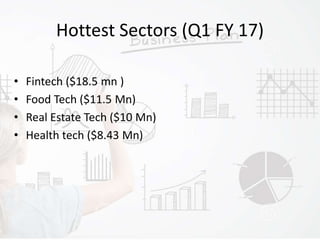
Hottest Sectors (Q1 FY 17)
• Fintech ($18.5 mn )
• Food Tech ($11.5 Mn)
• Real Estate Tech ($10 Mn)
• Health tech ($8.43 Mn)
Fund raise Questions
• How much funding should I raise?
• When should I raise money? At what stage should I
not?
• How much equity should I give? At what terms?
• How should I value my company?
• How should I give equity when I am unable to value
my company?
Fund raise Questions (2)
• How should I reach out to investors?
• How many investors would I have to reach to find
one?
• How long will this process take ?
• Should I appoint anyone for the process ?
• How much will the fund raising process cost
• What is the right structure/instrument
To Conclude
• Define your round – amount, tranche, dilution
• Structure a process – Project Plan and CRM
• Seeking advice – entrepreneurs, investors, mentors,
industry guys – ask for advice, you get money; ask
money, get advice
• Selecting a VC – Terms, Follow On, Strategic Support,
Brand Name, Time to money, Integrity/Competition,
Dilution
• Finding a good CA/lawyer
Seemant@attentiocs.com
+91-9820597897
Thanks

Managing startup finances

  • 1.
  • 2.
    Agenda • Bootstrapping –How to bootstrap your start-up • Sources of Finance- Various sources of finances • Managing your Company’s finances • How to survive tough times • Fundraising Trends • Conclusion- Q&A
  • 3.
  • 4.
    How to Bootstrap? •Stick to a business domain you know and love. • Start from own Home/Friends or relatives Home • Try & manage as much work as possible amongst founding team • Find cost effective resources/interns • Look for freebies , deals , free trials etc • Plan and track your finances, avoid unnecessary expenses • Don’t waste time & money at conferences, seminars unless your product is ready
  • 5.
    How to Bootstrap?(2) • Find team members to work for equity rather than cash. • Build a plan around your budget, rather than around your wishes. • Defer your urge to find office space until you have customers. • Ask for advance on royalties and vendor deferred payments. • Choose a business model to optimize your revenue flow and timing • Moonlighting; and keep quiet about side project
  • 7.
  • 8.
  • 9.
    Equity Debt Barter(exchange)Others VentureFunds CreditCards PartneratVC's,CorporateHeads PersonalLoans SaasinsteadofProduct AngelFunds&Networks VentureDebt(PEfundedCo) GetSeniorpeopletowork AngelSyndicatePlatforms SMELoansbyNBFC's CustomerAdvances MediaBarters Factoring Licenseyourproductsin mkt HNI's Leasing GovernmentGrants&Incentives Incubator/Accelerator LoanagainstCollaterals Barter-ConsignmentBiz WinPrizesincontests CrowdFunding CGTMSE Backofficesupport Managingwithownrevenues Friends&Family OfficeSpacevsproduct/equity Moonlightingonjob Bootstrapping Exchangeresources GetFreeresources Costoffund Sources of Finance Higher Lower
  • 10.
    Debt Financing: Lessorknown Sources • Banking Surrogacy • CGTSME Loans • MUDRA Loans • Factoring • Venture Debt
  • 11.
  • 12.
    Basic Financial Terms •Profit & Loss A/c • Balance Sheet • Cash Flow Statement • Business Plan • Budgeting • Accounts Payable • Accounts Receivable • Direct Costs • Indirect Costs • Operating Margins • Net profit • Cash Burn Rate • Debt Equity Ratio • Current Ratio • Debt Service Coverage • Interest Coverage • IRR/ROCE
  • 13.
    Golden Financial ManagementRules • Never Invest your money without ensuring that assets you acquire can generate a return which is at least equal to the cost of your capital • Invest your money in such a way that the assets will generate an inflow of funds before liabilities demand an outflow (*source: Romancing The Balance Sheet by Anil Lamba)
  • 14.
  • 15.
    Go Back toBasics • Generate Profit & not Sales • Cut unnecessary expenses • Pay minute attention to cash flows • Manage Working Capital efficiently • Don’t use short term funds for long term purposes • Be wary of unsecured & high cost debts
  • 16.
    Further Survival • Negotiatecredit terms with Vendors and Customers • Look for Hidden sources of cash (especially for slightly mature business) in your books • Sell off unwanted assets to generate cash • Explore advances from Customers • Lay off people (if unavoidable) on best possible terms
  • 17.
  • 18.
    Hottest Sectors (Q1FY 17) • Fintech ($18.5 mn ) • Food Tech ($11.5 Mn) • Real Estate Tech ($10 Mn) • Health tech ($8.43 Mn)
  • 20.
    Fund raise Questions •How much funding should I raise? • When should I raise money? At what stage should I not? • How much equity should I give? At what terms? • How should I value my company? • How should I give equity when I am unable to value my company?
  • 21.
    Fund raise Questions(2) • How should I reach out to investors? • How many investors would I have to reach to find one? • How long will this process take ? • Should I appoint anyone for the process ? • How much will the fund raising process cost • What is the right structure/instrument
  • 22.
    To Conclude • Defineyour round – amount, tranche, dilution • Structure a process – Project Plan and CRM • Seeking advice – entrepreneurs, investors, mentors, industry guys – ask for advice, you get money; ask money, get advice • Selecting a VC – Terms, Follow On, Strategic Support, Brand Name, Time to money, Integrity/Competition, Dilution • Finding a good CA/lawyer
  • 23.

Editor's Notes

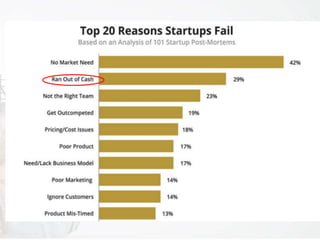
  • #7 https://www.asia.finance/knowledge-vault/venture-capital-entrepreneur/why-do-startups-fail/
  • #20 http://economictimes.indiatimes.com/small-biz/startups/state-of-startups-indias-top-funded-companies-for-2017/articleshow/59877942.cms
  • #24 https://www.fastcompany.com/3003827/why-most-venture-backed-companies-fail