Accelerators, Incubators, etc.
Get out of the Garage…

This presentation is made possible by the support of the American People through the United States Agency
for International Development (USAID). The contents of this presentation are the sole responsibility of Rick
Rasmussen and do not necessarily reflect the views of USAID or the United States Government.
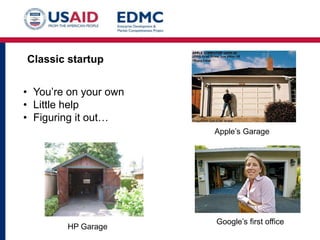
Classic startup
• You’re on your own
• Little help
• Figuring it out…
Apple’s Garage

HP Garage

Google’s first office
Now: Lots of help

•
•
•
•
•
•
•
•
•

Accelerators
Incubators
Startup Camps
Bootcamps
Hackathons
Pitching contests
Seed funds
Weekends
Conferences…

•
•
•
•
•
•
•
•
•

Meetups
University Programs
Geek trips
Trade missions
Ex-pat organizations
Diaspora
Angel Groups
Mentors
Government programs
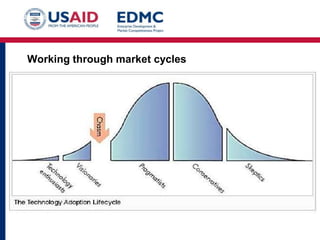
Working through market cycles
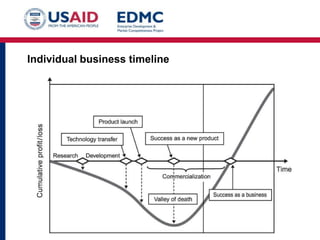
Individual business timeline
History: Incubators

• An idea  Hire a team  Build and grow

• Prototype: Idealab, Bill Gross, Pasadena CA, 1996.
– Come up with business ideas then recruit outsiders to bring
it to life.
– “Those ideas can gestate for much longer periods of time
and the incubator takes a much larger amount of equity”.
IdeaLabs
•
•
•
•
•
•
•
•
•

AirWave Wireless
Answers.com
Blastoff.com
CarsDirect
Citysearch
Commission Junction
eSolar
eToys.com
eVoice

•
•
•
•
•
•
•
•
•
•
•
•

GoTo.com
Intranets.com
NetZero
Picasa
PerfectMarket.com
PetSmart.com
Punchcard.com
Swap.com
Tickets.com
Triptrotting
Ubermedia.com
Utility.com
Communities built to help startups

• Ad hoc resources
– Meetups, conferences, …

• Structural assistance
– Universities, governments

• Venture-based models
– Funds
– Accelerators
Physical locations

• Venture-based models
– Accelerators and funds

• For-profit models
– Incubators, Ecobators..
Government-funded accelerators
• Overall goal: Develop a startup economy in a
country, region, city or neighborhood
– Government funded, typically under resourced
– May have a top-down sector focus
– May have a relationship with a local university

• Typically don’t take equity, may have a “pay-back
accounting system
• Generally ineffective as government and entrepreneurs
have different agendas and different levels of energy.
Government motivation
• A means of meeting a variety of economic and
socioeconomic policy needs:
–
–
–
–
–
–
–
–
–

Creating jobs and wealth
Fostering a community's entrepreneurial climate
Technology commercialization
Diversifying local economies
Building or accelerating growth of local industry clusters
Business creation and retention
Encouraging women or minority entrepreneurship
Identifying potential spin-in or spin-out business opportunities
Community revitalization
Canadian Model
• Identified need, sponsored by DFAIT
• Bootcamps
– Silicon Valley goes to Canada
– Education and judging

• Short-term programs
– 48 Hours in the Valley

• Canadian Technology Accelerators (CTA)
– Soft Landing for 3-6 months
Canadian model results

• 120 companies over 3 years
• No companies moved
• Over 20% set up local development offices
• Survey after 2 years
– Average employment increased by 3x
– Average revenue increased by 10x
Local Diaspora

• Diaspora support
– C100
Seed Accelerators

• A venture model
• Formal process to review, fund and assist chosen
startups with a fixed program.
• See accelerators support the startups with
funding, training, mentoring and events for a specific
period (typically 3 months) in exchange for equity
History

• Early seed accelerator include
– Y Combinator, Silicon Valley 2005
– TechStars, Boulder CO, 2006
– Seedcamp, London, 2007

• Over 250 seed accelerators in
US, Europe, Asia, Latin America
Fund-based Accelerators
• The business model is based on generating venture-style
returns, not on rent or fees for services.
• Seed accelerators do not necessarily need to include a
physical space, but many do.
• The process that startups go through in the accelerator
can be separated into five distinct phases:
–
–
–
–
–

awareness,
application,
program,
demo day,
post demo day.
Accelerator process - Application
• Startups accepted in cohort batches.
– Recognition of being chosen to be part of the accelerator.
– Peer support and feedback that the classes provide is an
important advantage.
– Mentoring, connections

• Highly competitive.
– Y Combinator and TechStars have application acceptance
rates of 1% to 3%

• Awareness
• Application
Accelerator Process - Implementation

• Program
– A seed investment in the startups is usually made in
exchange for equity. Typical investment is $25,000.
– During this time, they receive intensive mentoring and
training, and they are expected to iterate rapidly.

• Demo Day
– Startups "graduate”, typically after 3 months.
– the startups present to investors

• Post Demo Day
Notable Accelerators
Bay Area:
Y Combinator
AngelPad
Kicklabs
500 Startups

Mountain View
San Francisco
San Francisco
Mountain View

Elsewhere:
TechStars
DreamIt Ventures
Launchpad LA
Excelerate Labs
TechNexus
Tech Wildcatters

Boulder, plus six other
Philadelphia, New York, Israel
Los Angeles
Chicago
Chicago
Dallas
Local Accelerators

• San Francisco:
– AngelPad, Greenstar , Pivotal Labs, Kicklabs, i/o
Ventures, The Alchemist
Accelerator, PARISOMA, Matter, Runway, Digital
Garage, Sandbox Suites

• Silicon Valley
– Y Combinator, Upwest Labs, Founder’s
Institute, Innospring, Vodafone Xone, 500 Startups, Startup
Weekend

• East Bay
– Techliminal, Hackerspaces
Business Incubators
• Support the development of research and technology
parks in their dedication to startup and early-stage
companies.
• Research and technology parks, on the other hand, tend
to be large-scale projects that house everything from
corporate, government or university labs to very small
companies.
• Most research and technology parks do not offer business
assistance services, which are the hallmark of a business
incubation program. However, many research and
technology parks house incubation programs.
Most common incubator services:
•
•
•
•
•
•
•
•
•
•
•
•
•
•
•
•
•

Help with business basics
Networking activities
Marketing assistance
High-speed Internet access
Help with accounting/financial management
Access to bank loans, loan funds and guarantee programs
Help with presentation skills
Links to higher education resources
Links to strategic partners
Access to angel investors or venture capital
Comprehensive business training programs
Advisory boards and mentors
Management team identification
Help with business etiquette
Technology commercialization assistance
Help with regulatory compliance
Intellectual property management
Co-working spaces
Business accelerators

• For-profit models with investment upside
• Rely on various sources of income
–
–
–
–

Rental
Sponsorships
Value-added services
Events

• Support startups as long as is practical or viable
Philosophy
• I'm a bit anti-mentoring as that usually connotes one
person that is assigned to the company and enforces their
personal views and imposes opinions on what is needed sometimes right, often wrong.
• I'm more of the opinion that it takes a community to raise a
company (it takes a village to raise a child). We have that
community here and execute these beliefs on a daily
basis. Initial interview, education, open
resources, individual, peer and group mentorship, strong
connections, events… .

4 accelerators, incubators

  • 1.
    Accelerators, Incubators, etc. Getout of the Garage… This presentation is made possible by the support of the American People through the United States Agency for International Development (USAID). The contents of this presentation are the sole responsibility of Rick Rasmussen and do not necessarily reflect the views of USAID or the United States Government.
  • 2.
    Classic startup • You’reon your own • Little help • Figuring it out… Apple’s Garage HP Garage Google’s first office
  • 3.
    Now: Lots ofhelp • • • • • • • • • Accelerators Incubators Startup Camps Bootcamps Hackathons Pitching contests Seed funds Weekends Conferences… • • • • • • • • • Meetups University Programs Geek trips Trade missions Ex-pat organizations Diaspora Angel Groups Mentors Government programs
  • 4.
  • 5.
  • 6.
    History: Incubators • Anidea  Hire a team  Build and grow • Prototype: Idealab, Bill Gross, Pasadena CA, 1996. – Come up with business ideas then recruit outsiders to bring it to life. – “Those ideas can gestate for much longer periods of time and the incubator takes a much larger amount of equity”.
  • 7.
  • 8.
    Communities built tohelp startups • Ad hoc resources – Meetups, conferences, … • Structural assistance – Universities, governments • Venture-based models – Funds – Accelerators
  • 9.
    Physical locations • Venture-basedmodels – Accelerators and funds • For-profit models – Incubators, Ecobators..
  • 10.
    Government-funded accelerators • Overallgoal: Develop a startup economy in a country, region, city or neighborhood – Government funded, typically under resourced – May have a top-down sector focus – May have a relationship with a local university • Typically don’t take equity, may have a “pay-back accounting system • Generally ineffective as government and entrepreneurs have different agendas and different levels of energy.
  • 11.
    Government motivation • Ameans of meeting a variety of economic and socioeconomic policy needs: – – – – – – – – – Creating jobs and wealth Fostering a community's entrepreneurial climate Technology commercialization Diversifying local economies Building or accelerating growth of local industry clusters Business creation and retention Encouraging women or minority entrepreneurship Identifying potential spin-in or spin-out business opportunities Community revitalization
  • 12.
    Canadian Model • Identifiedneed, sponsored by DFAIT • Bootcamps – Silicon Valley goes to Canada – Education and judging • Short-term programs – 48 Hours in the Valley • Canadian Technology Accelerators (CTA) – Soft Landing for 3-6 months
  • 13.
    Canadian model results •120 companies over 3 years • No companies moved • Over 20% set up local development offices • Survey after 2 years – Average employment increased by 3x – Average revenue increased by 10x
  • 14.
  • 15.
    Seed Accelerators • Aventure model • Formal process to review, fund and assist chosen startups with a fixed program. • See accelerators support the startups with funding, training, mentoring and events for a specific period (typically 3 months) in exchange for equity
  • 16.
    History • Early seedaccelerator include – Y Combinator, Silicon Valley 2005 – TechStars, Boulder CO, 2006 – Seedcamp, London, 2007 • Over 250 seed accelerators in US, Europe, Asia, Latin America
  • 17.
    Fund-based Accelerators • Thebusiness model is based on generating venture-style returns, not on rent or fees for services. • Seed accelerators do not necessarily need to include a physical space, but many do. • The process that startups go through in the accelerator can be separated into five distinct phases: – – – – – awareness, application, program, demo day, post demo day.
  • 18.
    Accelerator process -Application • Startups accepted in cohort batches. – Recognition of being chosen to be part of the accelerator. – Peer support and feedback that the classes provide is an important advantage. – Mentoring, connections • Highly competitive. – Y Combinator and TechStars have application acceptance rates of 1% to 3% • Awareness • Application
  • 19.
    Accelerator Process -Implementation • Program – A seed investment in the startups is usually made in exchange for equity. Typical investment is $25,000. – During this time, they receive intensive mentoring and training, and they are expected to iterate rapidly. • Demo Day – Startups "graduate”, typically after 3 months. – the startups present to investors • Post Demo Day
  • 20.
    Notable Accelerators Bay Area: YCombinator AngelPad Kicklabs 500 Startups Mountain View San Francisco San Francisco Mountain View Elsewhere: TechStars DreamIt Ventures Launchpad LA Excelerate Labs TechNexus Tech Wildcatters Boulder, plus six other Philadelphia, New York, Israel Los Angeles Chicago Chicago Dallas
  • 21.
    Local Accelerators • SanFrancisco: – AngelPad, Greenstar , Pivotal Labs, Kicklabs, i/o Ventures, The Alchemist Accelerator, PARISOMA, Matter, Runway, Digital Garage, Sandbox Suites • Silicon Valley – Y Combinator, Upwest Labs, Founder’s Institute, Innospring, Vodafone Xone, 500 Startups, Startup Weekend • East Bay – Techliminal, Hackerspaces
  • 22.
    Business Incubators • Supportthe development of research and technology parks in their dedication to startup and early-stage companies. • Research and technology parks, on the other hand, tend to be large-scale projects that house everything from corporate, government or university labs to very small companies. • Most research and technology parks do not offer business assistance services, which are the hallmark of a business incubation program. However, many research and technology parks house incubation programs.
  • 23.
    Most common incubatorservices: • • • • • • • • • • • • • • • • • Help with business basics Networking activities Marketing assistance High-speed Internet access Help with accounting/financial management Access to bank loans, loan funds and guarantee programs Help with presentation skills Links to higher education resources Links to strategic partners Access to angel investors or venture capital Comprehensive business training programs Advisory boards and mentors Management team identification Help with business etiquette Technology commercialization assistance Help with regulatory compliance Intellectual property management
  • 24.
  • 25.
    Business accelerators • For-profitmodels with investment upside • Rely on various sources of income – – – – Rental Sponsorships Value-added services Events • Support startups as long as is practical or viable
  • 26.
    Philosophy • I'm abit anti-mentoring as that usually connotes one person that is assigned to the company and enforces their personal views and imposes opinions on what is needed sometimes right, often wrong. • I'm more of the opinion that it takes a community to raise a company (it takes a village to raise a child). We have that community here and execute these beliefs on a daily basis. Initial interview, education, open resources, individual, peer and group mentorship, strong connections, events… .