ADVANCED TECHNIQUES
FOR
SMALL ORCHARDS
University of California
2011 Master Gardener
Conference.
Herb Machleder
hmachled@ucla.edu
Importance of tree structure for a healthy and productive orchard:
1. Why change the nature of the tree from native ecology to the orchard?
a. Results of the Natural Selection process
b. Use of grafted rootstock
2. Training and Pruning as complimentary techniques
a. The Tools
i. Training: Spreading, Staking, Weighting, Notching
ii. Pruning: Bypass pruners, Anvil pruners, Girdling knife
b. The Techniques
i. Basic tree configurations: Central Leader, Open Center, Variations
ii. The standard pruning cuts: Heading, Thinning, Stopping, Renewal
iii.Recognizing Fruiting from Vegetative; wood, shoots, and buds
3. Small Area Orchard Strategies, and special techniques
a. Special configurations (Dwarfing rootstocks and Genetic Dwarfs)
i. Espaliers and Trellis, Multiple Grafted Trees
ii. “Four in a hole,” Fruit Bush, Container grown trees
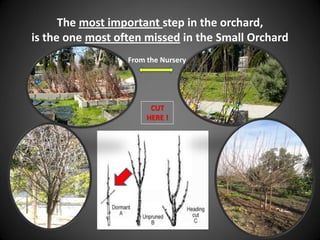
The most important step in the orchard,
is the one most often missed in the Small Orchard
CUT
HERE !
From the Nursery
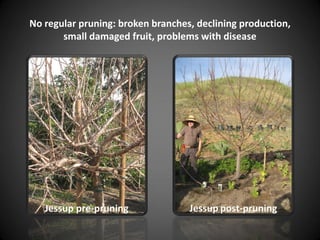
No regular pruning: broken branches, declining production,
small damaged fruit, problems with disease
Jessup pre-pruning Jessup post-pruning
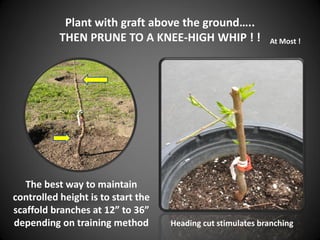
Plant with graft above the ground…..
THEN PRUNE TO A KNEE-HIGH WHIP ! ! At Most !
The best way to maintain
controlled height is to start the
scaffold branches at 12” to 36”
depending on training method Heading cut stimulates branching
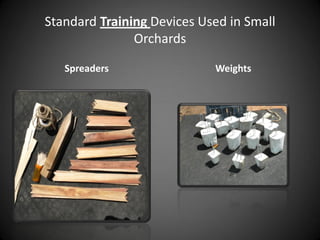
Standard Training Devices Used in Small
Orchards
Spreaders Weights
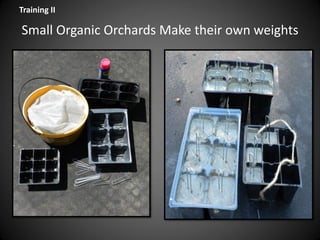
Small Organic Orchards Make their own weights
Training II
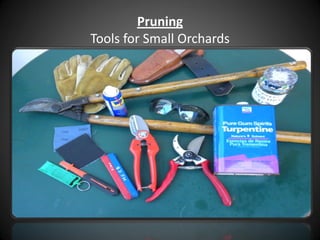
Pruning
Tools for Small Orchards
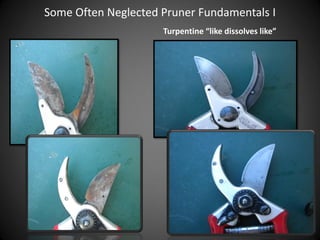
Some Often Neglected Pruner Fundamentals I
Turpentine “like dissolves like”
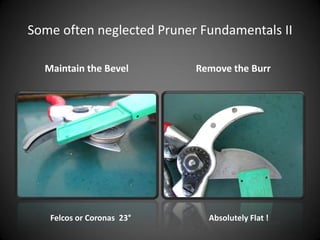
Some often neglected Pruner Fundamentals II
Maintain the Bevel Remove the Burr
Felcos or Coronas 23° Absolutely Flat !
The Sharper the Cut the Better the Healing
One sheet – clean cut - Pruners ready
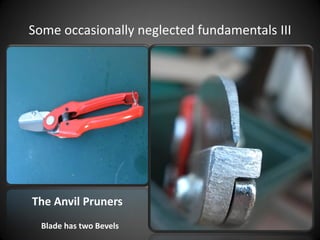
Some occasionally neglected fundamentals III
The Anvil Pruners
Blade has two Bevels
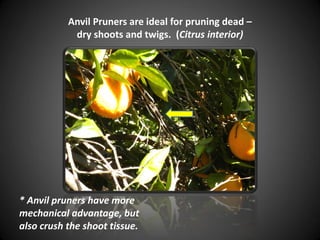
Anvil Pruners are ideal for pruning dead –
dry shoots and twigs. (Citrus interior)
* Anvil pruners have more
mechanical advantage, but
also crush the shoot tissue.
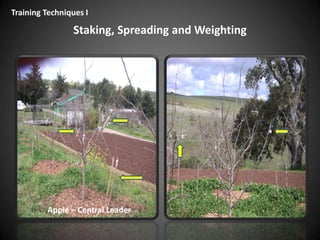
Staking, Spreading and Weighting
Training Techniques I
Apple – Central Leader
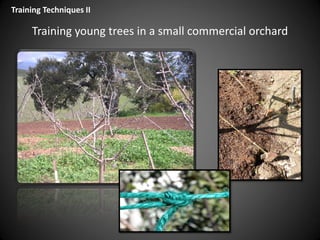
Training young trees in a small commercial orchard
Training Techniques II
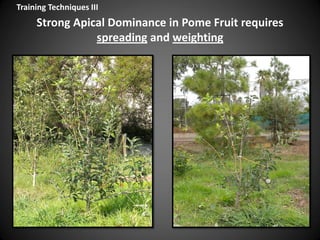
Strong Apical Dominance in Pome Fruit requires
spreading and weighting
Training Techniques III
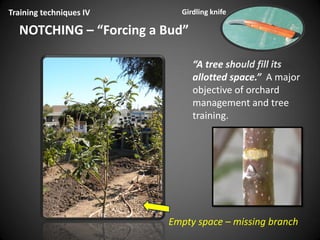
NOTCHING – “Forcing a Bud”
Training techniques IV
“A tree should fill its
allotted space.” A major
objective of orchard
management and tree
training.
Empty space – missing branch
Girdling knife
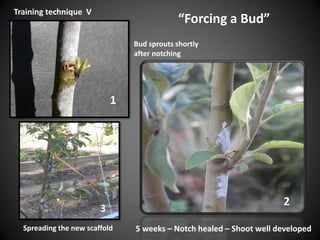
“Forcing a Bud”
1
2
3
Training technique V
5 weeks – Notch healed – Shoot well developed
Bud sprouts shortly
after notching
Spreading the new scaffold
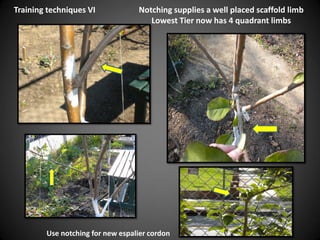
Notching supplies a well placed scaffold limb
Lowest Tier now has 4 quadrant limbs
Training techniques VI
Use notching for new espalier cordon
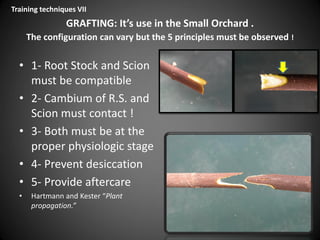
GRAFTING: It’s use in the Small Orchard .
The configuration can vary but the 5 principles must be observed !
• 1- Root Stock and Scion
must be compatible
• 2- Cambium of R.S. and
Scion must contact !
• 3- Both must be at the
proper physiologic stage
• 4- Prevent desiccation
• 5- Provide aftercare
• Hartmann and Kester “Plant
propagation.”
Training techniques VII
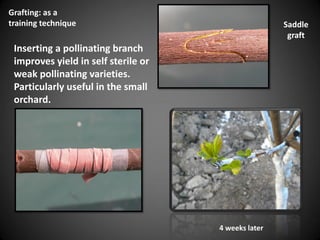
Saddle
graft
Grafting: as a
training technique
Inserting a pollinating branch
improves yield in self sterile or
weak pollinating varieties.
Particularly useful in the small
orchard.
4 weeks later
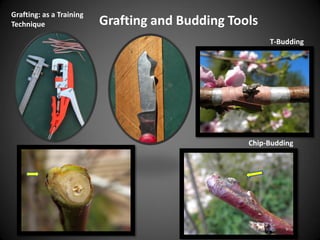
Grafting and Budding Tools
Grafting: as a Training
Technique
T-Budding
Chip-Budding
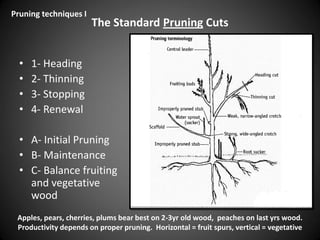
The Standard Pruning Cuts
• 1- Heading
• 2- Thinning
• 3- Stopping
• 4- Renewal
• A- Initial Pruning
• B- Maintenance
• C- Balance fruiting
and vegetative
wood
Pruning techniques I
Apples, pears, cherries, plums bear best on 2-3yr old wood, peaches on last yrs wood.
Productivity depends on proper pruning. Horizontal = fruit spurs, vertical = vegetative
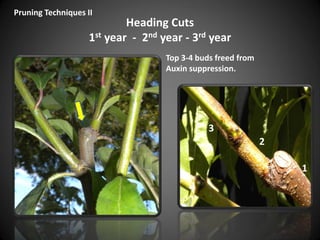
Heading Cuts
1st year - 2nd year - 3rd year
Pruning Techniques II
1
2
3
Top 3-4 buds freed from
Auxin suppression.
Thinning Cuts
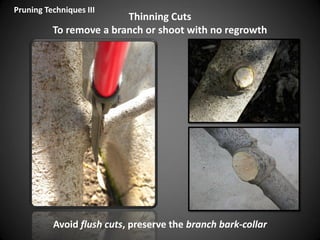
To remove a branch or shoot with no regrowth
Pruning Techniques III
Avoid flush cuts, preserve the branch bark-collar
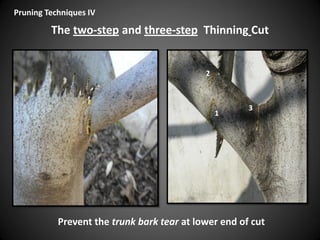
The two-step and three-step Thinning Cut
1
2
3
Pruning Techniques IV
Prevent the trunk bark tear at lower end of cut
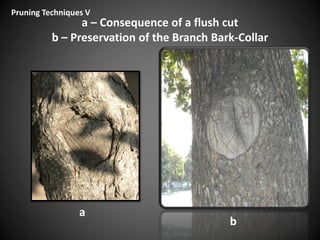
a – Consequence of a flush cut
b – Preservation of the Branch Bark-Collar
a
b
Pruning Techniques V
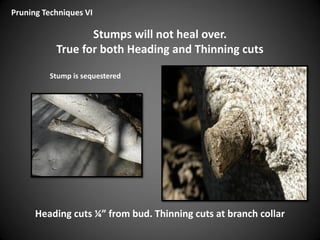
Stumps will not heal over.
True for both Heading and Thinning cuts
Pruning Techniques VI
Heading cuts ¼” from bud. Thinning cuts at branch collar
Stump is sequestered
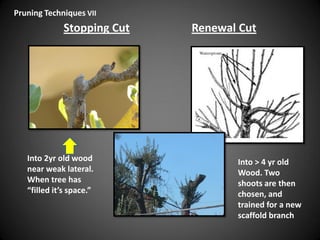
Stopping Cut Renewal Cut
Into 2yr old wood
near weak lateral.
When tree has
“filled it’s space.”
Into > 4 yr old
Wood. Two
shoots are then
chosen, and
trained for a new
scaffold branch
Pruning Techniques VII
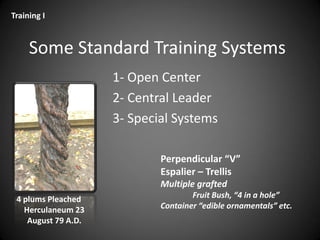
Some Standard Training Systems
1- Open Center
2- Central Leader
3- Special Systems
Perpendicular “V”
Espalier – Trellis
Multiple grafted
Fruit Bush, “4 in a hole”
Container “edible ornamentals” etc.
Training I
4 plums Pleached
Herculaneum 23
August 79 A.D.
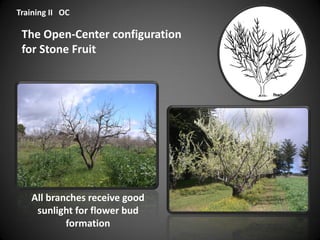
The Open-Center configuration
for Stone Fruit
Training II OC
All branches receive good
sunlight for flower bud
formation
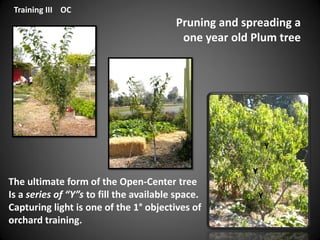
Pruning and spreading a
one year old Plum tree
Y
Y
Y
The ultimate form of the Open-Center tree
Is a series of “Y”s to fill the available space.
Capturing light is one of the 1° objectives of
orchard training.
Training III OC
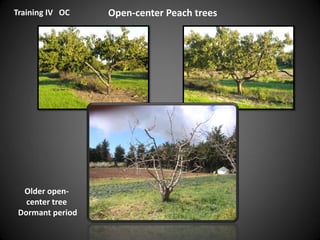
Open-center Peach trees
Older open-
center tree
Dormant period
Training IV OC
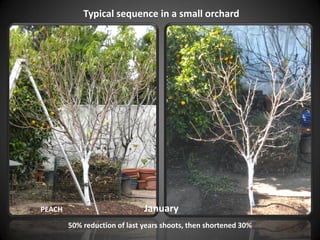
Typical sequence in a small orchard
January
PEACH
50% reduction of last years shoots, then shortened 30%
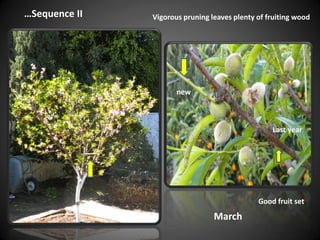
…Sequence II
March
Good fruit set
new
Last year
Vigorous pruning leaves plenty of fruiting wood
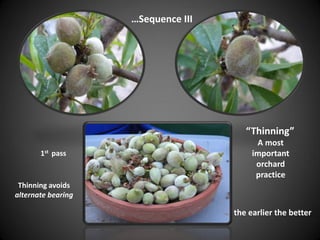
…Sequence III
“Thinning”
A most
important
orchard
practice
the earlier the better
1st pass
Thinning avoids
alternate bearing
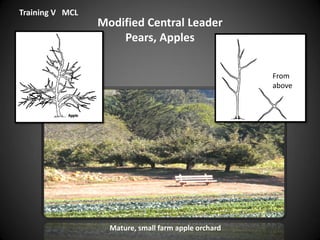
Modified Central Leader
Pears, Apples
Training V MCL
From
above
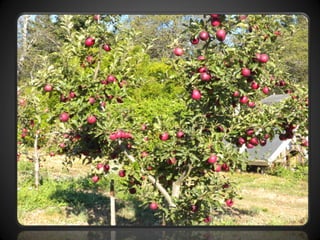
Mature, small farm apple orchard
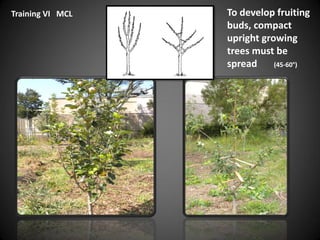
To develop fruiting
buds, compact
upright growing
trees must be
spread (45-60°)
Training VI MCL
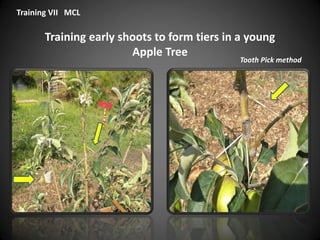
Training early shoots to form tiers in a young
Apple Tree
Training VII MCL
Tooth Pick method
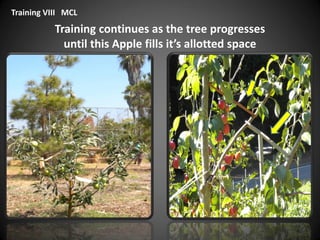
Training continues as the tree progresses
until this Apple fills it’s allotted space
Training VIII MCL
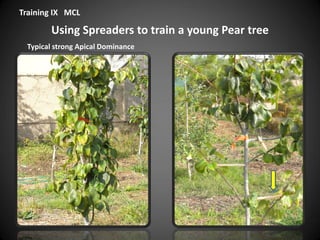
Using Spreaders to train a young Pear tree
Training IX MCL
Typical strong Apical Dominance
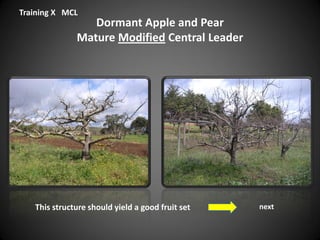
Dormant Apple and Pear
Mature Modified Central Leader
Training X MCL
This structure should yield a good fruit set next
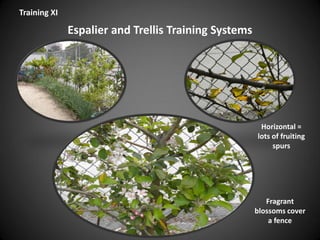
Espalier and Trellis Training Systems
Training XI
Fragrant
blossoms cover
a fence
Horizontal =
lots of fruiting
spurs
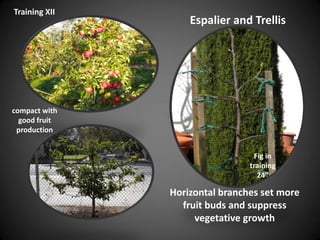
Espalier and Trellis
Horizontal branches set more
fruit buds and suppress
vegetative growth
Training XII
Fig in
training
24”
compact with
good fruit
production
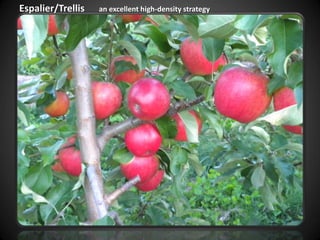
Espalier/Trellis an excellent high-density strategy
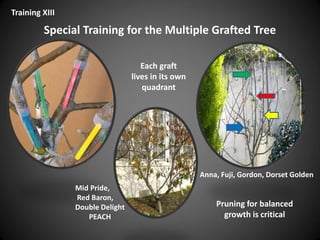
Special Training for the Multiple Grafted Tree
Each graft
lives in its own
quadrant
Pruning for balanced
growth is critical
Mid Pride,
Red Baron,
Double Delight
PEACH
Training XIII
Anna, Fuji, Gordon, Dorset Golden
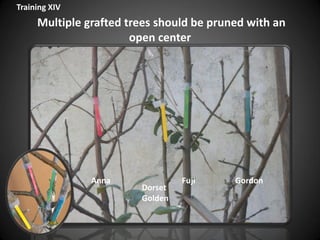
Multiple grafted trees should be pruned with an
open center
Anna
Dorset
Golden
Fuji Gordon
Training XIV
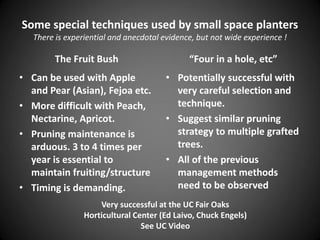
Some special techniques used by small space planters
There is experiential and anecdotal evidence, but not wide experience !
The Fruit Bush
• Can be used with Apple
and Pear (Asian), Fejoa etc.
• More difficult with Peach,
Nectarine, Apricot.
• Pruning maintenance is
arduous. 3 to 4 times per
year is essential to
maintain fruiting/structure
• Timing is demanding.
“Four in a hole, etc”
• Potentially successful with
very careful selection and
technique.
• Suggest similar pruning
strategy to multiple grafted
trees.
• All of the previous
management methods
need to be observed
Very successful at the UC Fair Oaks
Horticultural Center (Ed Laivo, Chuck Engels)
See UC Video
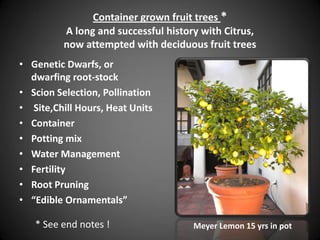
Container grown fruit trees *
A long and successful history with Citrus,
now attempted with deciduous fruit trees
• Genetic Dwarfs, or
dwarfing root-stock
• Scion Selection, Pollination
• Site,Chill Hours, Heat Units
• Container
• Potting mix
• Water Management
• Fertility
• Root Pruning
• “Edible Ornamentals”
* See end notes ! Meyer Lemon 15 yrs in pot
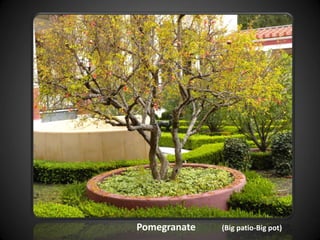
Pomegranate (Big patio-Big pot)
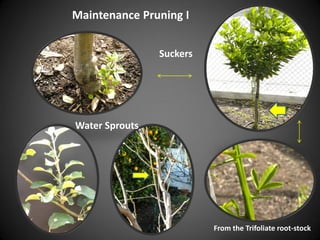
Maintenance Pruning I
Suckers
Water Sprouts
From the Trifoliate root-stock
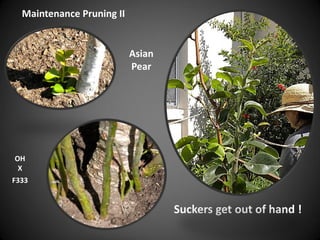
Maintenance Pruning II
Suckers get out of hand !
OH
X
F333
Asian
Pear
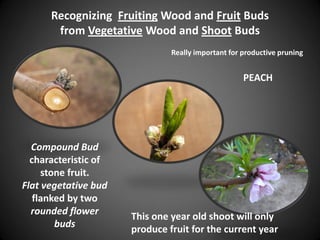
Recognizing Fruiting Wood and Fruit Buds
from Vegetative Wood and Shoot Buds
Compound Bud
characteristic of
stone fruit.
Flat vegetative bud
flanked by two
rounded flower
buds
PEACH
This one year old shoot will only
produce fruit for the current year
Really important for productive pruning
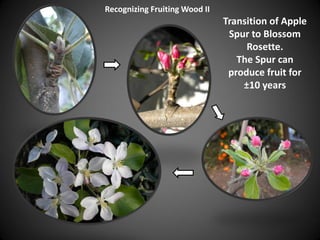
Transition of Apple
Spur to Blossom
Rosette.
The Spur can
produce fruit for
±10 years
Recognizing Fruiting Wood II
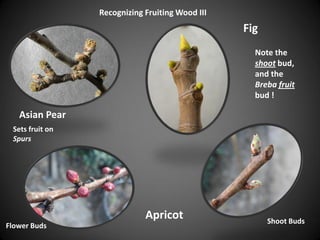
Asian Pear
Fig
Apricot
Note the
shoot bud,
and the
Breba fruit
bud !
Shoot Buds
Flower Buds
Sets fruit on
Spurs
Recognizing Fruiting Wood III
and so…….
Some important objectives of pruning and training are:
 To control tree height and fill available space
 “light on the orchard floor is wasted!”
 Provide strong, open scaffold structure
 Branch-trunk angles at 45-60° (fruit spurs/growth-shoot balance)
 Ensure good light and air penetration
 Sunlight = sugar, color, flavor, size. Air flow = < disease resistance
 Balance vegetative and fruiting wood
 For good yearly crops and adequate new growth
 Renew fruiting wood regularly
 To maintain fruit production as tree matures
 Seasonal corrective, and maintenance care
One more slide ……………………….
Caution !
If followed, the foregoing
recommendations
may result in the necessity for
further, more expensive
equipment purchases.
“Disclaimer”
THANK YOU ALL
herb
End Notes: The Pruning Scale, A
Methodical Pruning Sequence, Some
examples of root stock for dwarfing,
tried and tested planting mixes for
container trees etc.
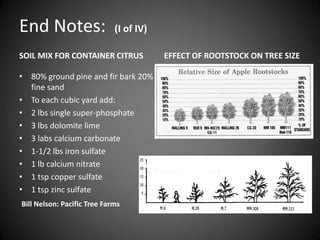
End Notes: (I of IV)
SOIL MIX FOR CONTAINER CITRUS
• 80% ground pine and fir bark 20%
fine sand
• To each cubic yard add:
• 2 lbs single super-phosphate
• 3 lbs dolomite lime
• 3 labs calcium carbonate
• 1-1/2 lbs iron sulfate
• 1 lb calcium nitrate
• 1 tsp copper sulfate
• 1 tsp zinc sulfate
EFFECT OF ROOTSTOCK ON TREE SIZE
Bill Nelson: Pacific Tree Farms
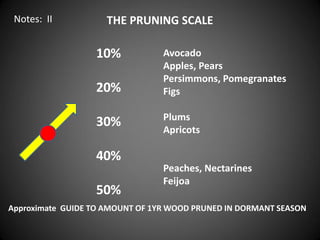
THE PRUNING SCALE
10%
20%
30%
40%
50%
Approximate GUIDE TO AMOUNT OF 1YR WOOD PRUNED IN DORMANT SEASON
Avocado
Apples, Pears
Persimmons, Pomegranates
Figs
Plums
Apricots
Peaches, Nectarines
Feijoa
Notes: II
A pruning guide used by the L.A. Urban Orchard Team
PRUNING SEQUENCE
• A methodical approach for pruning teams
• Start with: generic pruning, common to fruit trees (thinning cuts)
1. Suckers, Water Sprouts
2. Broken shoots or branches, Downward pointing shoots/branches
3. Diseases shoots/branches (canker, oozing etc.)
• Advance to : Maintenance Pruning
1. Rubbing shoots or branches
2. Crowded shoots or branches
3. Twiggy growth
• Progress to:
1. Shortening fruiting wood (refer to Pruning Scale)
• Finish with:
1. Heading cuts to reduce height 8’, cut highest shoots to outward pointing
bud
2. Renewal Cuts and Stopping Cuts
Notes: III
http://mo.laschools.org/green-spaces/documents/view/funding-resources/reference-
documents/How_to_Use_the_Tree_Matrix.pdf
http://www.carthaycenterschool.org/forms/TrainingPruningWorkShop.pdf
Notes: IV
An example of a method for selecting trees for a specific site:
An example of an Instructors Guide for a Tree Pruning and
Training Course. Or an expanded explanation of the material
presented in this Small Orchard Management discussion.
Links to some more information on the
Web
Report of the “Small Space Fruit Production” course at the Wolfskill
U.C. Davis/ USDA-ARS Experimental Orchards.
• “ While most of the audience
were Master Gardeners, it was
amazing to see how many
were not exactly sure what to
do when they get a tree. No
wonder the ‘EZ-Picks’ are so
popular !”
• L.E. Cooke Co.
• Center for Urban Horticulture
• 12 September 2009
• In transitioning from a
Standard Orchard to a High
Density Planting, whether on
semi-dwarfing, dwarfing, or
even a genetic dwarf, the
principles of Training and
Pruning are the basically the
same only more so. If you plan
to invest in the change you
need to carefully review your
procedures.
• Michigan Agricultural Ext. to
Commercial Orchard Conf.
The presentation was designed
to address this issue !

102170

  • 1.
    ADVANCED TECHNIQUES FOR SMALL ORCHARDS Universityof California 2011 Master Gardener Conference. Herb Machleder hmachled@ucla.edu
  • 2.
    Importance of treestructure for a healthy and productive orchard: 1. Why change the nature of the tree from native ecology to the orchard? a. Results of the Natural Selection process b. Use of grafted rootstock 2. Training and Pruning as complimentary techniques a. The Tools i. Training: Spreading, Staking, Weighting, Notching ii. Pruning: Bypass pruners, Anvil pruners, Girdling knife b. The Techniques i. Basic tree configurations: Central Leader, Open Center, Variations ii. The standard pruning cuts: Heading, Thinning, Stopping, Renewal iii.Recognizing Fruiting from Vegetative; wood, shoots, and buds 3. Small Area Orchard Strategies, and special techniques a. Special configurations (Dwarfing rootstocks and Genetic Dwarfs) i. Espaliers and Trellis, Multiple Grafted Trees ii. “Four in a hole,” Fruit Bush, Container grown trees
  • 3.
    The most importantstep in the orchard, is the one most often missed in the Small Orchard CUT HERE ! From the Nursery
  • 4.
    No regular pruning:broken branches, declining production, small damaged fruit, problems with disease Jessup pre-pruning Jessup post-pruning
  • 5.
    Plant with graftabove the ground….. THEN PRUNE TO A KNEE-HIGH WHIP ! ! At Most ! The best way to maintain controlled height is to start the scaffold branches at 12” to 36” depending on training method Heading cut stimulates branching
  • 6.
    Standard Training DevicesUsed in Small Orchards Spreaders Weights
  • 7.
    Small Organic OrchardsMake their own weights Training II
  • 8.
  • 9.
    Some Often NeglectedPruner Fundamentals I Turpentine “like dissolves like”
  • 10.
    Some often neglectedPruner Fundamentals II Maintain the Bevel Remove the Burr Felcos or Coronas 23° Absolutely Flat !
  • 11.
    The Sharper theCut the Better the Healing One sheet – clean cut - Pruners ready
  • 12.
    Some occasionally neglectedfundamentals III The Anvil Pruners Blade has two Bevels
  • 13.
    Anvil Pruners areideal for pruning dead – dry shoots and twigs. (Citrus interior) * Anvil pruners have more mechanical advantage, but also crush the shoot tissue.
  • 14.
    Staking, Spreading andWeighting Training Techniques I Apple – Central Leader
  • 15.
    Training young treesin a small commercial orchard Training Techniques II
  • 16.
    Strong Apical Dominancein Pome Fruit requires spreading and weighting Training Techniques III
  • 17.
    NOTCHING – “Forcinga Bud” Training techniques IV “A tree should fill its allotted space.” A major objective of orchard management and tree training. Empty space – missing branch Girdling knife
  • 18.
    “Forcing a Bud” 1 2 3 Trainingtechnique V 5 weeks – Notch healed – Shoot well developed Bud sprouts shortly after notching Spreading the new scaffold
  • 19.
    Notching supplies awell placed scaffold limb Lowest Tier now has 4 quadrant limbs Training techniques VI Use notching for new espalier cordon
  • 20.
    GRAFTING: It’s usein the Small Orchard . The configuration can vary but the 5 principles must be observed ! • 1- Root Stock and Scion must be compatible • 2- Cambium of R.S. and Scion must contact ! • 3- Both must be at the proper physiologic stage • 4- Prevent desiccation • 5- Provide aftercare • Hartmann and Kester “Plant propagation.” Training techniques VII
  • 21.
    Saddle graft Grafting: as a trainingtechnique Inserting a pollinating branch improves yield in self sterile or weak pollinating varieties. Particularly useful in the small orchard. 4 weeks later
  • 22.
    Grafting and BuddingTools Grafting: as a Training Technique T-Budding Chip-Budding
  • 23.
    The Standard PruningCuts • 1- Heading • 2- Thinning • 3- Stopping • 4- Renewal • A- Initial Pruning • B- Maintenance • C- Balance fruiting and vegetative wood Pruning techniques I Apples, pears, cherries, plums bear best on 2-3yr old wood, peaches on last yrs wood. Productivity depends on proper pruning. Horizontal = fruit spurs, vertical = vegetative
  • 24.
    Heading Cuts 1st year- 2nd year - 3rd year Pruning Techniques II 1 2 3 Top 3-4 buds freed from Auxin suppression.
  • 25.
    Thinning Cuts To removea branch or shoot with no regrowth Pruning Techniques III Avoid flush cuts, preserve the branch bark-collar
  • 26.
    The two-step andthree-step Thinning Cut 1 2 3 Pruning Techniques IV Prevent the trunk bark tear at lower end of cut
  • 27.
    a – Consequenceof a flush cut b – Preservation of the Branch Bark-Collar a b Pruning Techniques V
  • 28.
    Stumps will notheal over. True for both Heading and Thinning cuts Pruning Techniques VI Heading cuts ¼” from bud. Thinning cuts at branch collar Stump is sequestered
  • 29.
    Stopping Cut RenewalCut Into 2yr old wood near weak lateral. When tree has “filled it’s space.” Into > 4 yr old Wood. Two shoots are then chosen, and trained for a new scaffold branch Pruning Techniques VII
  • 30.
    Some Standard TrainingSystems 1- Open Center 2- Central Leader 3- Special Systems Perpendicular “V” Espalier – Trellis Multiple grafted Fruit Bush, “4 in a hole” Container “edible ornamentals” etc. Training I 4 plums Pleached Herculaneum 23 August 79 A.D.
  • 31.
    The Open-Center configuration forStone Fruit Training II OC All branches receive good sunlight for flower bud formation
  • 32.
    Pruning and spreadinga one year old Plum tree Y Y Y The ultimate form of the Open-Center tree Is a series of “Y”s to fill the available space. Capturing light is one of the 1° objectives of orchard training. Training III OC
  • 33.
    Open-center Peach trees Olderopen- center tree Dormant period Training IV OC
  • 34.
    Typical sequence ina small orchard January PEACH 50% reduction of last years shoots, then shortened 30%
  • 35.
    …Sequence II March Good fruitset new Last year Vigorous pruning leaves plenty of fruiting wood
  • 36.
    …Sequence III “Thinning” A most important orchard practice theearlier the better 1st pass Thinning avoids alternate bearing
  • 37.
    Modified Central Leader Pears,Apples Training V MCL From above Mature, small farm apple orchard
  • 38.
    To develop fruiting buds,compact upright growing trees must be spread (45-60°) Training VI MCL
  • 39.
    Training early shootsto form tiers in a young Apple Tree Training VII MCL Tooth Pick method
  • 40.
    Training continues asthe tree progresses until this Apple fills it’s allotted space Training VIII MCL
  • 41.
    Using Spreaders totrain a young Pear tree Training IX MCL Typical strong Apical Dominance
  • 42.
    Dormant Apple andPear Mature Modified Central Leader Training X MCL This structure should yield a good fruit set next
  • 44.
    Espalier and TrellisTraining Systems Training XI Fragrant blossoms cover a fence Horizontal = lots of fruiting spurs
  • 45.
    Espalier and Trellis Horizontalbranches set more fruit buds and suppress vegetative growth Training XII Fig in training 24” compact with good fruit production
  • 46.
    Espalier/Trellis an excellenthigh-density strategy
  • 47.
    Special Training forthe Multiple Grafted Tree Each graft lives in its own quadrant Pruning for balanced growth is critical Mid Pride, Red Baron, Double Delight PEACH Training XIII Anna, Fuji, Gordon, Dorset Golden
  • 48.
    Multiple grafted treesshould be pruned with an open center Anna Dorset Golden Fuji Gordon Training XIV
  • 49.
    Some special techniquesused by small space planters There is experiential and anecdotal evidence, but not wide experience ! The Fruit Bush • Can be used with Apple and Pear (Asian), Fejoa etc. • More difficult with Peach, Nectarine, Apricot. • Pruning maintenance is arduous. 3 to 4 times per year is essential to maintain fruiting/structure • Timing is demanding. “Four in a hole, etc” • Potentially successful with very careful selection and technique. • Suggest similar pruning strategy to multiple grafted trees. • All of the previous management methods need to be observed Very successful at the UC Fair Oaks Horticultural Center (Ed Laivo, Chuck Engels) See UC Video
  • 50.
    Container grown fruittrees * A long and successful history with Citrus, now attempted with deciduous fruit trees • Genetic Dwarfs, or dwarfing root-stock • Scion Selection, Pollination • Site,Chill Hours, Heat Units • Container • Potting mix • Water Management • Fertility • Root Pruning • “Edible Ornamentals” * See end notes ! Meyer Lemon 15 yrs in pot
  • 51.
  • 52.
    Maintenance Pruning I Suckers WaterSprouts From the Trifoliate root-stock
  • 53.
    Maintenance Pruning II Suckersget out of hand ! OH X F333 Asian Pear
  • 54.
    Recognizing Fruiting Woodand Fruit Buds from Vegetative Wood and Shoot Buds Compound Bud characteristic of stone fruit. Flat vegetative bud flanked by two rounded flower buds PEACH This one year old shoot will only produce fruit for the current year Really important for productive pruning
  • 55.
    Transition of Apple Spurto Blossom Rosette. The Spur can produce fruit for ±10 years Recognizing Fruiting Wood II
  • 56.
    Asian Pear Fig Apricot Note the shootbud, and the Breba fruit bud ! Shoot Buds Flower Buds Sets fruit on Spurs Recognizing Fruiting Wood III
  • 57.
    and so……. Some importantobjectives of pruning and training are:  To control tree height and fill available space  “light on the orchard floor is wasted!”  Provide strong, open scaffold structure  Branch-trunk angles at 45-60° (fruit spurs/growth-shoot balance)  Ensure good light and air penetration  Sunlight = sugar, color, flavor, size. Air flow = < disease resistance  Balance vegetative and fruiting wood  For good yearly crops and adequate new growth  Renew fruiting wood regularly  To maintain fruit production as tree matures  Seasonal corrective, and maintenance care
  • 58.
    One more slide……………………….
  • 59.
    Caution ! If followed,the foregoing recommendations may result in the necessity for further, more expensive equipment purchases. “Disclaimer”
  • 60.
  • 61.
    End Notes: ThePruning Scale, A Methodical Pruning Sequence, Some examples of root stock for dwarfing, tried and tested planting mixes for container trees etc.
  • 62.
    End Notes: (Iof IV) SOIL MIX FOR CONTAINER CITRUS • 80% ground pine and fir bark 20% fine sand • To each cubic yard add: • 2 lbs single super-phosphate • 3 lbs dolomite lime • 3 labs calcium carbonate • 1-1/2 lbs iron sulfate • 1 lb calcium nitrate • 1 tsp copper sulfate • 1 tsp zinc sulfate EFFECT OF ROOTSTOCK ON TREE SIZE Bill Nelson: Pacific Tree Farms
  • 63.
    THE PRUNING SCALE 10% 20% 30% 40% 50% ApproximateGUIDE TO AMOUNT OF 1YR WOOD PRUNED IN DORMANT SEASON Avocado Apples, Pears Persimmons, Pomegranates Figs Plums Apricots Peaches, Nectarines Feijoa Notes: II
  • 64.
    A pruning guideused by the L.A. Urban Orchard Team PRUNING SEQUENCE • A methodical approach for pruning teams • Start with: generic pruning, common to fruit trees (thinning cuts) 1. Suckers, Water Sprouts 2. Broken shoots or branches, Downward pointing shoots/branches 3. Diseases shoots/branches (canker, oozing etc.) • Advance to : Maintenance Pruning 1. Rubbing shoots or branches 2. Crowded shoots or branches 3. Twiggy growth • Progress to: 1. Shortening fruiting wood (refer to Pruning Scale) • Finish with: 1. Heading cuts to reduce height 8’, cut highest shoots to outward pointing bud 2. Renewal Cuts and Stopping Cuts Notes: III
  • 65.
    http://mo.laschools.org/green-spaces/documents/view/funding-resources/reference- documents/How_to_Use_the_Tree_Matrix.pdf http://www.carthaycenterschool.org/forms/TrainingPruningWorkShop.pdf Notes: IV An exampleof a method for selecting trees for a specific site: An example of an Instructors Guide for a Tree Pruning and Training Course. Or an expanded explanation of the material presented in this Small Orchard Management discussion. Links to some more information on the Web
  • 66.
    Report of the“Small Space Fruit Production” course at the Wolfskill U.C. Davis/ USDA-ARS Experimental Orchards. • “ While most of the audience were Master Gardeners, it was amazing to see how many were not exactly sure what to do when they get a tree. No wonder the ‘EZ-Picks’ are so popular !” • L.E. Cooke Co. • Center for Urban Horticulture • 12 September 2009 • In transitioning from a Standard Orchard to a High Density Planting, whether on semi-dwarfing, dwarfing, or even a genetic dwarf, the principles of Training and Pruning are the basically the same only more so. If you plan to invest in the change you need to carefully review your procedures. • Michigan Agricultural Ext. to Commercial Orchard Conf. The presentation was designed to address this issue !