COMPARATIVE FINANCIAL EFFICIENCY OF TRAINING SYSTEMS AND
ROOTSTOCKS FOR ‘ALPINE’ NECTARINES (Prunus persica var. nectarine)
Waldo J. Maree
Thesis presented in partial fulfillment of the requirements for the degree of Master of
Science in Agriculture (Horticulture) at the University of Stellenbosch.
Supervisor: Prof. P.J.C. Stassen (Department of Horticultural Science)
Co-supervisor: Dr J.P. Lombard (Department of Agricultural Economics)
December 2006
I
DECLARATION
I, the undersigned, hereby declare that the work contained in this thesis is my own
original work and that I have not previously in its entirety or in part submitted it at any
university for a degree.
__________________ __________________
Signature Date
II
SUMMARY
Most nectarine orchards in South Africa are currently planted at a distance of 4 x
1.5 m (2 500 trees/ha). These trees are mainly sylleptically trained to a central leader,
although many producers also use the proleptic route. The former produces relatively
high yields early in the lifetime of the orchard. A problem with nectarine production in
South Africa is the lack of efficient rootstocks in terms of aspects such as size-control
and the use of nematode-resistant rootstocks. The aim of this study is to evaluate different
training systems for nectarine production and to investigate the role of three rootstocks
that play a dominant role in the peach industry in South Africa.
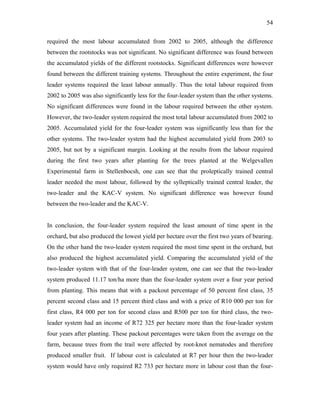
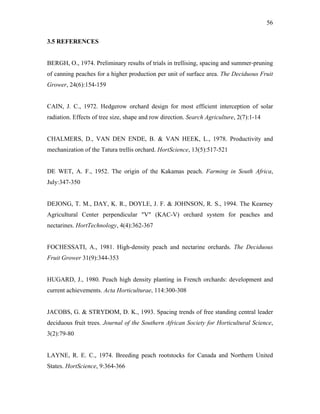
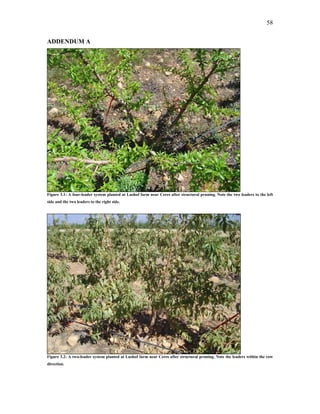
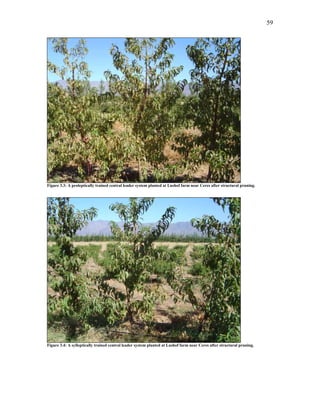
‘Alpine’ nectarines were planted in the winter of 2002 at Lushof near Ceres, Western
Cape, South Africa (33º18’S, 19º20’E). The trees were trained according to four different
training systems: a four-leader system (5 x 3 m; 667 trees/ha), a two-leader system (5 x
1.5 m; 1 333 trees/ha), a proleptically trained central leader (5 x 1 m; 2 000 trees/ha), and
a sylleptically trained central leader (5 x 1 m; 2 000 trees/ha). The trees were planted on
three different rootstocks: GF 667; SAPO 778; Kakamas seedling. The time spent per tree
on pruning, thinning and picking was recorded. During harvest, the number of fruit and
fruit mass per tree were recorded. Light measurements were recorded annually after
summer pruning. The measurements were taken at different heights and at different
depths in the canopy. To compare the training systems on an economic basis, the data
from the trial together with projected data gathered from farmers and advisors were used
to calculate the net present value (NPV) and internal rate of return (IRR) for each training
system.
The results showed that rootstock only played a significant role when it came to fruit
mass (fruit size). Fruit from trees on SAPO 778 were heavier, indicating bigger fruit, than
fruit from trees on Kakamas seedling rootstocks and this can play a role in packout
percentage and income. In terms of the training system, the four-leader system took the
most time to manage per tree. However, this system took the least time to manage per
hectare during the initial years.
III
No differences were found between the two central leaders. They both took the longest
time to manage per hectare. The four-leader system produced significantly less fruit than
any of the other systems during the first two years of production. In the third year of
production, there was no significant difference found between the systems.
Light penetration seemed to be the poorest at the middle and bottom of the canopy for
trees trained to a central leader. Because of the open centre of the four-leader system,
light penetration into the middle of these trees was good, but poor light penetration
occurred in the upper and outer parts of the canopy underneath the scaffold branches.
Poor light penetration occurred in the parts lower than 1.5 m from the ground for all the
systems. This was the area that was measured in this study.
The result of an economic comparison showed that according to the IRR rating, the four-
leader system should be preferred. The final decision should however be made according
to the NPV rating. Results obtained from NPV calculations did not lead to the same
conclusions as could be made from the IRR calculations. According to the rating of the
NPV at five percent discounting rate, the two-leader should be the preferred system,
while the proleptically trained central leader system should be preferred at a ten percent
discounting rate. This implies that when the opportunity cost is low, the two-leader
system should be preferred, and when the opportunity cost is high, the proleptically
trained central leader system should be preferred.
IV
OPSOMMING
In Suid-Afrika word die meeste nektarien boorde tans aangeplant teen ‘n
plantafstand van 4 x 1.5 m (2 500 bome per hektaar). Die bome word sillepties opgelei
volgens ‘n sentrale leier sisteem, alhoewel baie produsente ook gebruik maak van die
proleptiese roete. Die sentrale leier sisteem het wel bewys dat dit redelike hoë produksies
vroeg kan lewer. ‘n Probleem met nektarien produksie in Suid-Afrika is die gebrek aan ‘n
effektiewe onderstam ten opsige van aspekte soos groei-regulering en bestandheid teen
aalwurm. Die doel van hierdie studie is om alternatiewe opleisisteme vir nektariens en die
invloed van drie onderstamme wat ’n groot rol speel in perske produksie in Suid Africa te
ondersoek.
‘Alpine’ nektarien bome is in die winter van 2002 aangeplant op Lushof naby Ceres,
Wes-Kaap, Suid-Afrika (33º18’S, 19º20’E). Die bome is opgelei volgens vier
verskillende sisteme: ‘n vier-leier sisteem (5 x 3 m; 667 bome/ha), ‘n twee-leier sisteem
(5 x 1.5 m; 1 333 bome/ha), ‘n prolepties opgeleide sentrale leier (5 x 1 m; 2 000
bome/ha), en ‘n sillepties opgeleide sentrale leier (5 x 1 m; 2 000 bome/ha). Die bome is
op drie verskillende onderstamme geplant: GF 667; SAPO 778; Kakamas saailing. Die
tyd spandeer per boom op snoei, uitdun en pluk is geneem. Tydens pluk is die aantal
vrugte en massa vrugte per boom gemeet. Ligmetings is gedoen na elke somersnoei. Die
metings is gedoen op verskillende hoogtes en verskillende dieptes in die boom. Die bome
is op ‘n ekonomiese basis vergelyk deur die netto huidige waarde (NHW) en die interne
opbrengskoers (IOK) van elke sisteem te bepaal deur inligting van die proef te gebruik
saam met inligting ontvang van produsente en raadgewers.
Die resultate wys dat die onderstam slegs ‘n rol speel by vruggewig. Vrugte van bome op
SAPO 778 onderstamme het vrugte produseer wat swaarder is wat dui op groter vrugte as
vrugte van bome op Kakamas saailing onderstamme. Die aspek kan egter van belang
wees die uitpak persentasie en inkomste verkry. In terme van opleistelsel het die vier-
leier sisteem die langste per boom geneem om te bestuur. Per hektaar het die sisteem
egter die minste tyd geneem om te bestuur.
V
Daar is geen verskil gevind tussen die twee sentral leiers. Albei het die langste per
hektaar gevat om te bestuur. Die vier-leier sisteem het betekenisvol minder vrugte
produseer as die ander sisteme in die eerste twee jaar van produksie. In die derde jaar van
produksie was daar egter geen verskil tussen die sisteme nie.
Lig penetrasie blyk om die swakste te wees vir sentrale leiers aan die onderkant en in die
middel van die boom. Lig penetrasie in die middel van die vier-leier bome is goed as
gevolg van die oop struktuur van die bome. Swak lig penetrasie kom egter voor in die
boonste buitenste dele van die boom aan die onderkant van die raamtakke. Swak lig
penetrasie het voorgekom in dele onder 1.5 meter van die grond by al die sisteme. Dit is
die gedeelte wat in die studie gemeet is.
Die resultate volgens die IOK berekening wys dat die vier-leier sisteem die gunsteling
keuse moet wees. Die finale besluit lê egter by die rangorde volgens die NHW
berekening. Die resultaat van die NHW rangorde is nie dieselfde as dié van die IOK nie.
Volgens die NHW resultate met ‘n verdiskonterings koers van vyf persent is die twee-
leier sisteem die gunsteling keuse. Volgens die NHW resultate met ‘n verdiskonterings
koers van tien pesent is die prolepties opgeleiede sentral leier sisteem egter die gunsteling
keuse. Dit beteken dat met lae geleentheidskoste die twee-leier sisteem voorkeur geniet
en met hoë geleentheidskoste die prolepties opgeleide sentrale leier die gunsteling
sisteem is.
VI
ACKNOWLEDGEMENTS
I wish to express my gratitude to the following people and institutions for their
contributions to the completion of this study:
Prof. Piet Stassen (Dept. of Horticultural Science, University of Stellenbosch) as
supervisor, for his guidance, insight and constructive criticism.
Dr. Jan Lombard (Dept. of Agricultural Economics, University of Stellenbosch) as co-
supervisor, for his technical input and helpful advice.
Mardé Booyse, for her valuable help with the statistical analysis.
The owner, Robert Graaff, and management, especially Danie Viljoen, of Lushof farm
for providing the trial site as well as assistance during the experiment.
Marco du Toit, for his help with the trail at Welgevallen Experimental farm.
My mom and dad, for their encouragement and patience during my studies at
Stellenbosch.
My Heavenly Father, for giving me the ability to complete this study.
VII
TABLE OF CONTENTS
Declaration I
Summary II
Opsomming IV
Acknowledgements VI
Chapter I: Introduction and objectives 1
1.1 Background 1
1.2 Motivation 1
1.3 Methodology 1
1.4 Objectives 2
1.5 Layout 2
1.6 References 4
Chapter II: Literature study 5
2.1 Introduction 5
2.2 Light environment in an orchard 7
2.3 Orchard systems 11
2.3.1 Rootstocks 11
2.3.1.1 Kakamas seedling 13
2.3.1.2 SAPO 778 14
2.3.1.3 GF 677 14
2.3.2 Training systems 15
2.3.2.1 The open-vase system 16
2.3.2.2 The closed-vase system 17
2.3.2.3 The central leader system 19
2.3.2.4 The palmette system 21
2.3.2.5 The ‘Y’-shaped system 23
VIII
2.3.2.6 The four-leader system 27
2.3.3 Tree density 28
2.4 Financial evaluation methods 29
2.5 References 33
Chapter III: The role of training system and rootstock for nectarines on production and
labour input 44
3.1 Introduction 44
3.2 Materials and methods 46
3.3 Results and discussion 50
3.4 Conclusions 52
3.5 References 56
Addendum A 58
Addendum B 62
Chapter IV: The role of light distribution in the lower canopy of four different training
systems for ‘Alpine’ nectarines 71
4.1 Introduction 71
4.2 Materials and methods 72
4.3 Results and discussion 75
4.4 Conclusions 76
4.5 References 78
Addendum A 80
Addendum B 83
IX
Chapter V: Financial evaluation of four different training systems for ‘Alpine’
nectarines 87
5.1 Introduction 87
5.2 Methods and assumptions 89
5.3 Results and discussion 92
5.4 Conclusions 93
5.5 References 95
Addendum A 96
Addendum B 100
Chapter VI: Conclusions 104
1
CHAPTER I
INTRODUCTION AND OBJECTIVES
1.1 BACKGROUND
In 2004 South Africa produced 210 000 tons peaches and nectarines, making it
the fourth largest producer of peaches and nectarines in the southern hemisphere (OABS,
2004). Seventeen percent of the total 1417 hectares of nectarines planted in South Africa
comprise of the cultivar ‘Alpine’ (OABS, 2004). ‘Alpine’ is an early dessert nectarine
with a bright red skin colour and a good taste. In the 2003/2004 season a total of 273 740
cartons of ‘Alpine’ was exported mainly to the UK and Europe (OABS, 2004). Currently
most nectarine orchards in South Africa are planted at distances of 4 × 1.5 meter and
trained sylleptically according to the central leader system (Huysamer, 1997).
1.2 MOTIVATION
It has been shown that the central leader system used on nectarines can produce
relative high yields. This system does however have certain disadvantages. Light
interception with a central leader system is less sufficient than with a multi-leader system
or an open-vase system. Gaps are created between the trees in the top parts. If the central
leader is trained sylleptically, basal dominance must be managed. If the central leader
trained proleptically, strong wood higher up in the tree can develop and give rise to
overshadowing. Because all growth is directed into one leader, tree height management is
important. Another problem with nectarine production in South Africa is the lack of
efficient rootstocks in terms of aspects such as size-control and the use of nematode-
resistant rootstocks. The use of multiple-leader trees may have advantages over the
problems mentioned above.
1.3 METHODOLOGY
An ‘Alpine’ nectarine orchard was planted in August 2002 at Lushof farm near
Ceres, Western Cape, South Africa (33º18’S, 19º20’E). The trees were trained according
to four different training systems, namely a four-leader system (5 x 3 m; 667 trees/ha), a
two-leader system (5 x 1.5 m; 1 333 trees/ha), a proleptically trained central leader (5 x 1
2
m; 2 000 trees/ha), and a sylleptically trained central leader (5 x 1 m; 2 000 trees/ha). The
trees were planted on three different rootstocks, namely GF 667, SAPO 778, and
Kakamas seedling. The time spent per tree on pruning, thinning and picking was
recorded. During harvest, number of fruit and fruit mass per tree were also recorded.
Light measurements were recorded annually after summer pruning. The measurements
were taken at different heights and at different depths in the canopy. To compare the
training systems on an economic basis, the data from the trail together with projected data
gather from producers and advisors were used to calculate the net present value (NPV)
and internal rate of return (IRR) for each training system.
1.4 OBJECTIVES
The aim of this study is to evaluate different training systems for nectarine
production and to investigate the role of three rootstocks that play a dominant role in the
peach industry in South Africa. The four different training in combination with the three
different rootstocks would be compared in terms of time necessary for winter and
summer pruning, fruit thinning and picking. Yield would be recorded as well as yield
efficiency. Light utilization of the four different training systems will be investigated to
identify possible problem areas in terms of light penetration. Using all the available
information the different training systems will be compared on an economic basis with
the use of capital budgeting methods. The objectives for this study are:
• To investigate how rootstock will influence production and labour input.
• To compare the four different training systems in terms of production and
labour input.
• To examine the light penetration into the canopy for the four different
training systems.
• To make an economic comparison of the four different training systems
using capital budgeting methods.
1.5 LAYOUT
This thesis is written in ‘publication’ style and consists of a literature overview
and three ‘publications’. In the literature study (Chapter II) an overview is given of
3
nectarine production in South Africa, including a description of the different training
systems and rootstocks commonly used. Chapter (III) is the first of the ‘publication’
where the different training systems and rootstocks are compared in terms of production
and labour input. The second ‘publication’ (Chapter IV) investigates the role of light in
the different training systems. The third ‘publication’ (Chapter V) compares the different
training systems on an economic basis. Chapter VI is a summary of the conclusions made
in the different ‘publications’.
4
1.6 REFERENCES
OABS, 2004. Key deciduous fruit statistics. PO Box 25, Paarl 7620, South Africa
HUYSAMER, M., 1997. Integrating cultivar, rootstock and environment in the export
driven South African deciduous fruit industry. Acta Horticulturae, 451:755-760
5
CHAPTER II
LITERATURE STUDY
2.1 INTRODUCTION
In 2004 South Africa was the fourth largest producer of peaches and nectarines in
the southern hemisphere, producing 210 000 ton. In 2003 South Africa exported 7 223
tons, making it the fourth biggest exporter of nectarines and peaches in the southern
hemisphere after Chile, Argentina and Australia. Worldwide, South Africa was the 14th
biggest producer of peaches and nectarines, with China being the biggest,
producing 5 782 000 ton in 2004 (OABS, 2004).
Peach production in South Africa increased by more than 30% from 2001 to 2004, the
biggest increase in production of any deciduous fruit grown in South Africa (OABS,
2004). ‘Alpine’ is the dominant nectarine cultivar produced in South Africa. ‘Alpine’ is
an early dessert nectarine and was bred by the ARC Infruitec-Nietvoorbij in South Africa.
It was released in 1997. It is a cross between ‘Sunlight’ and ‘May-Glo’ nectarines
(http://www.fishercapespan.com/sites/products). ‘Alpine’ nectarines have a bright red
skin colour with a good taste. It is harvested middle to late November and has good
storage ability for 4 weeks at -0.5ºC (Stargrow, 2004). The 237 hectares of ‘Alpines’
currently planted comprise 17% of the total area under peach and nectarine production on
South Africa. In the 2003/2004 season a total of 273 740 cartons of ‘Alpine’ was
exported mainly to the UK and Europe (OABS, 2004).
It is therefore impossible to ignore the importance of nectarine production in South
Africa, especially that of ‘Alpine’. Currently most nectarine orchards are planted at
distances of 4 × 1.5 meter and trained sylleptically according to the central leader system
(Huysamer, 1997). It has been shown that these orchards can produce relative high yields.
This system does however have certain disadvantages. Light interception with a central
leader system is less efficient than with a multi-leader system or a open-vase system. A
central leader system grows in height because all the energy for growth is channeled into
one leader. If trained sylleptically, basal dominance must be managed. If trained
proleptically, strong wood higher up in the tree can develop and give rise to
6
overshadowing. If the cost per tree is high this can be a factor. In South Africa the cost of
nursery trees is however still relative affordable. The questions is whether a multiple-
leader systems would be more labour and light efficient and still relate to higher income
that a central leader system.
During the past 40 years there have been remarkable changes in apple production systems
to improve the efficiency of apple orchards. Even is South Africa there have been
changes in apple production systems. Robinson (1997) showed how size-controlling
rootstocks for apples have significantly reduced tree vigour, measured as trunk cross-
sectional area, without affecting fruit quality significantly. Worldwide, as well as locally,
there has also been a tendency to use more intensive orchard systems such as the ‘Super
Spindle’ system to produce high yields earlier in the lifetime of the orchard (Weber,
2000a). The option of a vigor controlling rootstock as well as more intensive training
systems have made it possible for producers to plant at increasingly higher densities.
Over the years these higher density plantings have shown increased apple production per
hectare substantially during the early years (Palmer et al., 1989; Weber 2000b; Widmer
and Krebs, 2001; Robinson and Hoying, 2002).
In many parts of the world peach and nectarine systems have adjusted much more slowly.
The low density ‘Open Vase’’ training system was one of the first systems to be used on
peaches and is still used in many parts of the world today as the predominant training
system for peaches. One of the reasons that peach tree training was slow to evolve is
because of the lack of a effective size-controlling rootstock for stone fruit (Layne, 1974).
Only very recently did DeJong et al. (2005) identify three rootstocks for California peach
and nectarine production that reduce trunk circumference, reduce pruning and still
produce adequate fruit size and crop yields. Only one of these rootstocks is currently
being commercially propagated. In South Africa systems for peach and nectarine
production developed parallel with that of apples (Stadler and Stassen, 1985a).
7
2.2 LIGHT ENVIRONMENT IN AN ORCHARD
A big influence on the change in production system is the need to utilize the light
environment within an orchard as efficiently as possible. One of the most important
factors in the design of an efficient orchard system is the interception, penetration and
distribution of daily sunlight by and into the tree canopy. Summer pruning is seen as an
essential tool to manage growth in higher density peach orchards (Stadler and Stassen,
1985a).
The importance of sufficient light interception begins with the photosynthesis.
Photosynthesis is the process by which a plant uses water and CO2 to produce O2 and
organic compounds (carbohydrates) through a series of integrated chemical reactions.
These chemical reactions take place in the chloroplasts, which are situated in leaves of
green plants (Ksenzhek, 1998). The energy needed for these chemical reactions is
provided through the absorption of sunlight. Sunlight is radiated at different wavelengths
from the sun to the earth’s surface. Radiation that can be absorbed by the leaves and be
used as energy has wavelengths between 400 and 700 nm and is called photosynthetically
active radiation (PAR) (Ksenzhek, 1998). PAR is measured in µmol.s-1
.m-2
. Research has
shown that at levels of unlimited PAR, photosynthesis is inhibited by other factors such
as the rate of carbon exchange between the leaf and the atmosphere (Yunus, 2000).
DeJong and Doyle (1985) found that the carbon exchange rate (CER) of a peach leaf is
saturated at more or less 800 µmol.s-1
.m-2
PAR. The whole canopy CER would however
be saturated at about 1 600 µmol.s-1
.m-2
PAR (Giuliani et al. 1998). Very few studies
have shown whole fruit tree canopies to absorb such high levels of PAR. Another factor
that can inhibit photosynthesis under natural conditions is temperature. Tan and Buttery
(1986) found an increase in photosynthetic rate as temperature increased at low PAR
levels. They also found that an increase in PAR increased the optimum temperature for
the photosynthetic rate. It is however very difficult and expensive to increase the
temperature in a commercial orchard. It would thus be more appropriate to attempt to
increase PAR levels in an orchard to increase the photosynthetic rate.
8
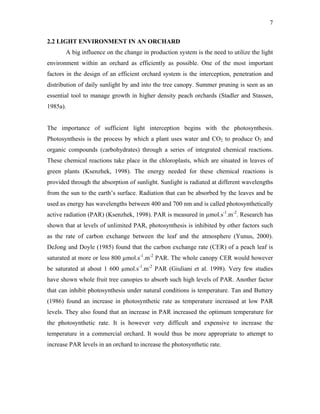
Higher light interception has been found to increase apple production (Robinson and
Lakso, 1989). Robinson and Lakso (1989) reported that the yield of ‘Empire’ and
‘Redchief Delicious’ apples trees increased linearly with an increase in light interception
(Figure 1). Figure 2.1 shows the relationship between cumulative yield and PAR
interception for four orchard systems.
Figure 2.1: Relationship between cumulative yield and PAR intercepted for 4 orchard systems
(±S.E.). The solid line is the regression through the origin for the Delicious Central Leaders and the
dotted line is for the Empire Y-trellis. A steeper slope indicates greater efficiency. (Source:
ROBINSON, T. L. AND LAKSO, A. N., 1989. Light interception, yield and fruit quality of ‘Empire’
and ‘Delicious’ apple trees grown in four orchard systems. Acta Horticulturae 243:175-184)
Guiliani et al. (1998) also found a linear relationship for whole-canopy photosynthesis
and the amount of light intercepted by a three-year-old ‘Redgold’ nectarine orchard. It is
thus important for a tree to intercept a high percentage of the available light to produce
high yields. Light intercepted by an orchard is measured as the amount of available light
intercepted by the canopy and not striking the orchard floor (Rom, 1991). Jackson and
Palmer (1972) have stated that 70% light interception is the optimum for a mature
orchard. Light intercepted is a function of the leaf surface area of the tree canopy,
measured as the leaf area index (LAI) of a tree. LAI is the ratio of leaf area to ground
area on one side of the tree (Jackson, 1980). One way of increasing the LAI and reducing
9
the amount of light that falls on the orchard floor is by planting at higher densities.
Hampson et al. (2004) proved that LAI increased with higher planting density, and hence
light interception increased. In an experiment they compared a ‘slender spindle’, ‘tall
spindle’ and a ‘Geneva Y’ trellis system and found that to achieve a light interception of
at least 50 percent, a planting density of between 1 800 and 2 200 trees/ha was needed for
‘Royal Gala’ and ‘Summerland McIntosh’ apple trees, depending on the system used.
Not only is light interception important, but light distribution within the tree canopy plays
just as vital role in light utilization. An adequate amount of light is necessary throughout
the whole canopy to stimulate reproductive development and fruit quality. The amount of
available light decreases towards the centre or the bottom of a tree canopy where the LAI
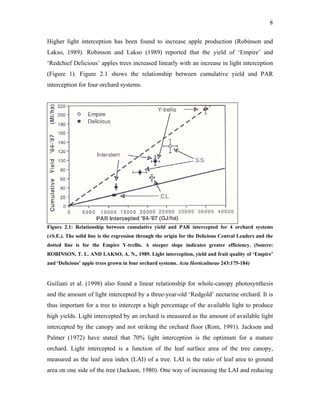
is the highest. Many researchers, including Johnson and Lakso (1991) used Beer’s Law
of light attenuation to illustrate how in theory light intensity decreases as it is distributed
deeper into the tree canopy. Beer’s Law states that:
I / I0
= e-KL
where: I is the light intensity below a leaf area index of L
I0
is the light intensity above the canopy
K is the light extinction coefficient
L is the leaf area index
Figure 2.2 illustrates how less light is available as the leaf area index increases.
10
Figure 2.2: Beer’s Law of light attenuation. Light intensity decreases as an exponential decay
function through the canopy. (Source: JOHNSON, R. .S. AND LAKSO, A. N., 1991. Approaches to
modeling light interception in orchards. HortScience 26(8):1002-1004)
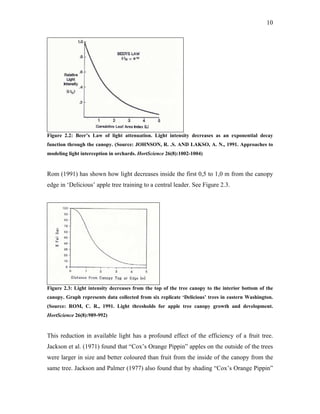
Rom (1991) has shown how light decreases inside the first 0,5 to 1,0 m from the canopy
edge in ‘Delicious’ apple tree training to a central leader. See Figure 2.3.
Figure 2.3: Light intensity decreases from the top of the tree canopy to the interior bottom of the
canopy. Graph represents data collected from six replicate ‘Delicious’ trees in eastern Washington.
(Source: ROM, C. R., 1991. Light thresholds for apple tree canopy growth and development.
HortScience 26(8):989-992)
This reduction in available light has a profound effect of the efficiency of a fruit tree.
Jackson et al. (1971) found that “Cox’s Orange Pippin” apples on the outside of the trees
were larger in size and better coloured than fruit from the inside of the canopy from the
same tree. Jackson and Palmer (1977) also found that by shading “Cox’s Orange Pippin”
11
apple trees to receive 11% of full sunlight, shoot growth was significantly influenced.
The number of shoots, and total shoot length and weight were significantly reduced
compared to trees that were unshaded. They also found a reduction in flower bud
formation in the shaded trees, which had residual negative effect on the percentage of
flowers which set fruit in the following year. Consequently, fruit set and fruit size were
reduced remarkably in the shaded trees. This variation in light levels within a canopy thus
has a significant effect on apple production. Génard and Baret (1994) reported a variation
in light levels within the canopy of peach trees. Fruit position would therefore also have
an effect on fruit quality. This was confirmed experimentally by Caruso et al. (1998).
Fruit from the upper part of a ‘Spring Lady’ peach tree trained to a central leader were
larger in size than fruit from the lower part of the same canopy.
The minimum threshold for photosynthesis is said to be a 30% of full sunlight (Cain,
1972). It is therefore of utmost importance that the whole canopy receives sufficient light
and that it is distributed throughout the whole canopy for a tree to perform efficiently.
2.3 ORCHARD SYSTEMS
Light interception is a function of canopy size and shape. These factors are
influenced by the choice of rootstock, training system and planting density.
2.3.1 Rootstock
The choice of rootstock is one of the most effective methods by which to manage
tree growth and canopy size. Size-controlling rootstocks reduce vigour and can thus
reduce the time spent on pruning and managing the desired tree canopy. As previously
mentioned, a size-controlling rootstock for stone fruit is not available. In the past peach
trees worldwide were predominately grafted on seedling rootstocks (Rom, 1983). These
rootstocks were effective in low density planting as they produced vigorous trees.
Because of the high vigour of peach seedling rootstock as well as other limitations such
as their susceptibility to nematodes, producers were forced to look at alternative
rootstocks as production systems intensified. Clonal rootstocks such as the peach-almond
hybrid ‘GF 677’ were developed. The performance of a rootstock is dependent on its
12
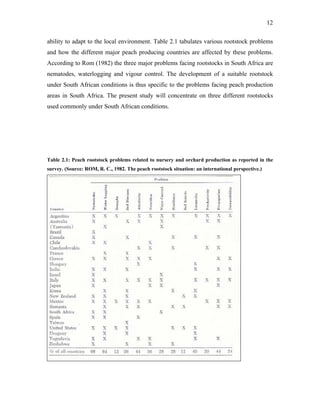
ability to adapt to the local environment. Table 2.1 tabulates various rootstock problems
and how the different major peach producing countries are affected by these problems.
According to Rom (1982) the three major problems facing rootstocks in South Africa are
nematodes, waterlogging and vigour control. The development of a suitable rootstock
under South African conditions is thus specific to the problems facing peach production
areas in South Africa. The present study will concentrate on three different rootstocks
used commonly under South African conditions.
Table 2.1: Peach rootstock problems related to nursery and orchard production as reported in the
survey. (Source: ROM, R. C., 1982. The peach rootstock situation: an international perspective.)
13
2.3.1.1 Kakamas seedling:
In South Africa, as in the rest of the world, the peach seedling was used as the primary
rootstock for peach production. Wallace (1896) reported on peach production in South
Africa as early as the 19th
century. The first production peach in South Africa seems to be
the ‘St-Helena’ cling peach. This peach was planted all over South Africa and in some of
the more northern parts it adapted so well that it became known as the ‘Transvaal yellow
peach’. ‘Kakamas’ is a selection of this ‘Transvaal’ yellow peach (De Wet, 1952).
‘Kakamas’ seedling became the standard for rootstock selection because of its ability to
adapt very well to the South African conditions. Over the years, certain limitations have
put some pressure on the popularity of this rootstock. As with most peach seedling
rootstocks (Rowe and Catlin, 1971), ‘Kakamas seedling’ is very sensitive to wet
conditions (Stassen and Van Zyl, 1982). This has limited the use of this rootstock in the
south western parts of the country where winter and early spring rainfall create
waterlogged conditions. Waterlogged soils are soils in which the water has displaced all
the oxygen and anaerobic conditions are created. The sensitivity of peach roots is due to
the fact that under anaerobic conditions a toxic hydrogen cyanide (HCN) gas or prussic
acid is formed in the plant. This prussic acid is derived from prunasin, a cyanogenic
glycoside which is hydrolyzed under anaerobic conditions (Rowe and Catlin, 1971; Du
Preez, 1980). Even short periods of waterlogging can cause these toxic concentrations to
increase slightly, which causes a quick and irreversible die-back of the plant (Du Preez,
1980).
Another disadvantage of the ‘Kakamas’ seedling rootstocks is its susceptibility to
nematodes. The root-knot nematode (Meloilogyne spp) and ring nematode (Criconemella
xenoplax) are commonly associated with peach tree diseases. Stassen and van Zyl (1979)
showed that the ‘Kakamas’ seedling rootstock is very susceptible to root-knot nematode
infestation. Symptoms of nematode infestation include dying back of shoot tips, poor
differentiation of bearing shoots and a reduction in fruit size and overall fruit production
(Stassen, 1996).
14
The ‘Kakamas’ seedling rootstock is also very susceptible to soils with free lime. Free
lime causes iron, zinc and manganese cations to take on an insoluble carbonate form.
This means that the tree cannot assimilate these cations. The effect of free lime can thus
become visible by way of iron, zinc and manganese deficiencies, which include
yellowing of leaves, inhibited photosynthesis, reduced leaf area and, consequently, a
reduction in crop (Du Preez, 1980).
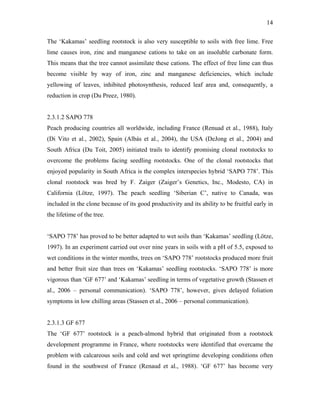
2.3.1.2 SAPO 778
Peach producing countries all worldwide, including France (Renuad et al., 1988), Italy
(Di Vito et al., 2002), Spain (Albás et al., 2004), the USA (DeJong et al., 2004) and
South Africa (Du Toit, 2005) initiated trails to identify promising clonal rootstocks to
overcome the problems facing seedling rootstocks. One of the clonal rootstocks that
enjoyed popularity in South Africa is the complex interspecies hybrid ‘SAPO 778’. This
clonal rootstock was bred by F. Zaiger (Zaiger’s Genetics, Inc., Modesto, CA) in
California (Lötze, 1997). The peach seedling ‘Siberian C’, native to Canada, was
included in the clone because of its good productivity and its ability to be fruitful early in
the lifetime of the tree.
‘SAPO 778’ has proved to be better adapted to wet soils than ‘Kakamas’ seedling (Lötze,
1997). In an experiment carried out over nine years in soils with a pH of 5.5, exposed to
wet conditions in the winter months, trees on ‘SAPO 778’ rootstocks produced more fruit
and better fruit size than trees on ‘Kakamas’ seedling rootstocks. ‘SAPO 778’ is more
vigorous than ‘GF 677’ and ‘Kakamas’ seedling in terms of vegetative growth (Stassen et
al., 2006 – personal communication). ‘SAPO 778’, however, gives delayed foliation
symptoms in low chilling areas (Stassen et al., 2006 – personal communication).
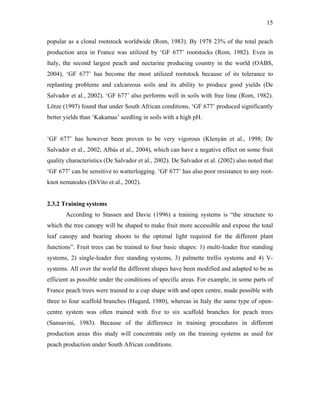
2.3.1.3 GF 677
The ‘GF 677’ rootstock is a peach-almond hybrid that originated from a rootstock
development programme in France, where rootstocks were identified that overcame the
problem with calcareous soils and cold and wet springtime developing conditions often
found in the southwest of France (Renaud et al., 1988). ‘GF 677’ has become very
15
popular as a clonal rootstock worldwide (Rom, 1983). By 1978 23% of the total peach
production area in France was utilized by ‘GF 677’ rootstocks (Rom, 1982). Even in
Italy, the second largest peach and nectarine producing country in the world (OABS,
2004), ‘GF 677’ has become the most utilized rootstock because of its tolerance to
replanting problems and calcareous soils and its ability to produce good yields (De
Salvador et al., 2002). ‘GF 677’ also performs well in soils with free lime (Rom, 1982).
Lötze (1997) found that under South African conditions, ‘GF 677’ produced significantly
better yields than ‘Kakamas’ seedling in soils with a high pH.
‘GF 677’ has however been proven to be very vigorous (Klenyán et al., 1998; De
Salvador et al., 2002; Albás et al., 2004), which can have a negative effect on some fruit
quality characteristics (De Salvador et al., 2002). De Salvador et al. (2002) also noted that
‘GF 677’ can be sensitive to watterlogging. ‘GF 677’ has also poor resistance to any root-
knot nematodes (DiVito et al., 2002).
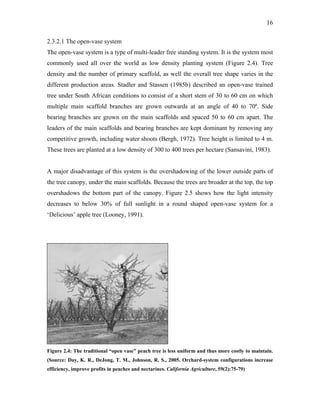
2.3.2 Training systems
According to Stassen and Davie (1996) a training systems is “the structure to
which the tree canopy will be shaped to make fruit more accessible and expose the total
leaf canopy and bearing shoots to the optimal light required for the different plant
functions”. Fruit trees can be trained to four basic shapes: 1) multi-leader free standing
systems, 2) single-leader free standing systems, 3) palmette trellis systems and 4) V-
systems. All over the world the different shapes have been modified and adapted to be as
efficient as possible under the conditions of specific areas. For example, in some parts of
France peach trees were trained to a cup shape with and open centre, made possible with
three to four scaffold branches (Hugard, 1980), whereas in Italy the same type of open-
centre system was often trained with five to six scaffold branches for peach trees
(Sansavini, 1983). Because of the difference in training procedures in different
production areas this study will concentrate only on the training systems as used for
peach production under South African conditions.
16
2.3.2.1 The open-vase system
The open-vase system is a type of multi-leader free standing system. It is the system most
commonly used all over the world as low density planting system (Figure 2.4). Tree
density and the number of primary scaffold, as well the overall tree shape varies in the
different production areas. Stadler and Stassen (1985b) described an open-vase trained
tree under South African conditions to consist of a short stem of 30 to 60 cm on which
multiple main scaffold branches are grown outwards at an angle of 40 to 70º. Side
bearing branches are grown on the main scaffolds and spaced 50 to 60 cm apart. The
leaders of the main scaffolds and bearing branches are kept dominant by removing any
competitive growth, including water shoots (Bergh, 1972). Tree height is limited to 4 m.
These trees are planted at a low density of 300 to 400 trees per hectare (Sansavini, 1983).
A major disadvantage of this system is the overshadowing of the lower outside parts of
the tree canopy, under the main scaffolds. Because the trees are broader at the top, the top
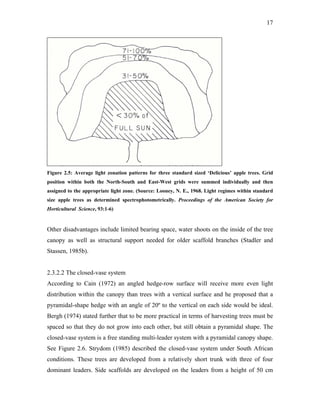
overshadows the bottom part of the canopy. Figure 2.5 shows how the light intensity
decreases to below 30% of full sunlight in a round shaped open-vase system for a
‘Delicious’ apple tree (Looney, 1991).
Figure 2.4: The traditional “open vase” peach tree is less uniform and thus more costly to maintain.
(Source: Day, K. R., DeJong, T. M., Johnson, R. S., 2005. Orchard-system configurations increase
efficiency, improve profits in peaches and nectarines. California Agriculture, 59(2):75-79)
17
Figure 2.5: Average light zonation patterns for three standard sized ‘Delicious’ apple trees. Grid
position within both the North-South and East-West grids were summed individually and then
assigned to the appropriate light zone. (Source: Looney, N. E., 1968. Light regimes within standard
size apple trees as determined spectrophotometrically. Proceedings of the American Society for
Horticultural Science, 93:1-6)
Other disadvantages include limited bearing space, water shoots on the inside of the tree
canopy as well as structural support needed for older scaffold branches (Stadler and
Stassen, 1985b).
2.3.2.2 The closed-vase system
According to Cain (1972) an angled hedge-row surface will receive more even light
distribution within the canopy than trees with a vertical surface and he proposed that a
pyramidal-shape hedge with an angle of 20º to the vertical on each side would be ideal.
Bergh (1974) stated further that to be more practical in terms of harvesting trees must be
spaced so that they do not grow into each other, but still obtain a pyramidal shape. The
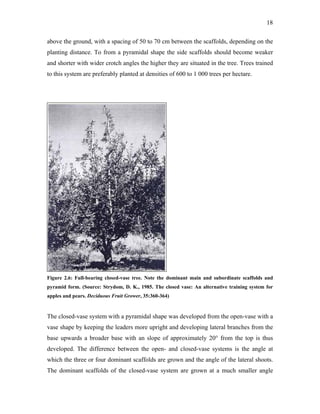
closed-vase system is a free standing multi-leader system with a pyramidal canopy shape.
See Figure 2.6. Strydom (1985) described the closed-vase system under South African
conditions. These trees are developed from a relatively short trunk with three of four
dominant leaders. Side scaffolds are developed on the leaders from a height of 50 cm
18
above the ground, with a spacing of 50 to 70 cm between the scaffolds, depending on the
planting distance. To from a pyramidal shape the side scaffolds should become weaker
and shorter with wider crotch angles the higher they are situated in the tree. Trees trained
to this system are preferably planted at densities of 600 to 1 000 trees per hectare.
Figure 2.6: Full-bearing closed-vase tree. Note the dominant main and subordinate scaffolds and
pyramid form. (Source: Strydom, D. K., 1985. The closed vase: An alternative training system for
apples and pears. Deciduous Fruit Grower, 35:360-364)
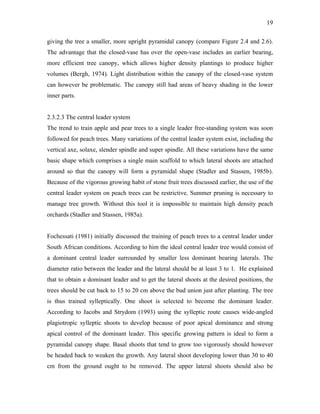
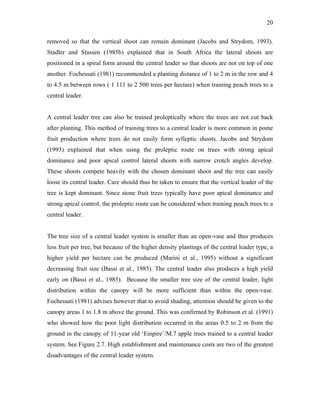
The closed-vase system with a pyramidal shape was developed from the open-vase with a
vase shape by keeping the leaders more upright and developing lateral branches from the
base upwards a broader base with an slope of approximately 20° from the top is thus
developed. The difference between the open- and closed-vase systems is the angle at
which the three or four dominant scaffolds are grown and the angle of the lateral shoots.
The dominant scaffolds of the closed-vase system are grown at a much smaller angle
19
giving the tree a smaller, more upright pyramidal canopy (compare Figure 2.4 and 2.6).
The advantage that the closed-vase has over the open-vase includes an earlier bearing,
more efficient tree canopy, which allows higher density plantings to produce higher
volumes (Bergh, 1974). Light distribution within the canopy of the closed-vase system
can however be problematic. The canopy still had areas of heavy shading in the lower
inner parts.
2.3.2.3 The central leader system
The trend to train apple and pear trees to a single leader free-standing system was soon
followed for peach trees. Many variations of the central leader system exist, including the
vertical axe, solaxe, slender spindle and super spindle. All these variations have the same
basic shape which comprises a single main scaffold to which lateral shoots are attached
around so that the canopy will form a pyramidal shape (Stadler and Stassen, 1985b).
Because of the vigorous growing habit of stone fruit trees discussed earlier, the use of the
central leader system on peach trees can be restrictive. Summer pruning is necessary to
manage tree growth. Without this tool it is impossible to maintain high density peach
orchards (Stadler and Stassen, 1985a).
Fochessati (1981) initially discussed the training of peach trees to a central leader under
South African conditions. According to him the ideal central leader tree would consist of
a dominant central leader surrounded by smaller less dominant bearing laterals. The
diameter ratio between the leader and the lateral should be at least 3 to 1. He explained
that to obtain a dominant leader and to get the lateral shoots at the desired positions, the
trees should be cut back to 15 to 20 cm above the bud union just after planting. The tree
is thus trained sylleptically. One shoot is selected to become the dominant leader.
According to Jacobs and Strydom (1993) using the sylleptic route causes wide-angled
plagiotropic sylleptic shoots to develop because of poor apical dominance and strong
apical control of the dominant leader. This specific growing pattern is ideal to form a
pyramidal canopy shape. Basal shoots that tend to grow too vigorously should however
be headed back to weaken the growth. Any lateral shoot developing lower than 30 to 40
cm from the ground ought to be removed. The upper lateral shoots should also be
20
removed so that the vertical shoot can remain dominant (Jacobs and Strydom, 1993).
Stadler and Stassen (1985b) explained that in South Africa the lateral shoots are
positioned in a spiral form around the central leader so that shoots are not on top of one
another. Fochessati (1981) recommended a planting distance of 1 to 2 m in the row and 4
to 4.5 m between rows ( 1 111 to 2 500 trees per hectare) when training peach trees to a
central leader.
A central leader tree can also be trained proleptically where the trees are not cut back
after planting. This method of training trees to a central leader is more common in pome
fruit production where trees do not easily form sylleptic shoots. Jacobs and Strydom
(1993) explained that when using the proleptic route on trees with strong apical
dominance and poor apical control lateral shoots with narrow crotch angles develop.
These shoots compete heavily with the chosen dominant shoot and the tree can easily
loose its central leader. Care should thus be taken to ensure that the vertical leader of the
tree is kept dominant. Since stone fruit trees typically have poor apical dominance and
strong apical control, the proleptic route can be considered when training peach trees to a
central leader.
The tree size of a central leader system is smaller than an open-vase and thus produces
less fruit per tree, but because of the higher density plantings of the central leader type, a
higher yield per hectare can be produced (Marini et al., 1995) without a significant
decreasing fruit size (Bassi et al., 1985). The central leader also produces a high yield
early on (Bassi et al., 1985). Because the smaller tree size of the central leader, light
distribution within the canopy will be more sufficient than within the open-vase.
Fochessati (1981) advises however that to avoid shading, attention should be given to the
canopy areas 1 to 1.8 m above the ground. This was confirmed by Robinson et al. (1991)
who showed how the poor light distribution occurred in the areas 0.5 to 2 m from the
ground in the canopy of 11-year old ‘Empire’/M.7 apple trees trained to a central leader
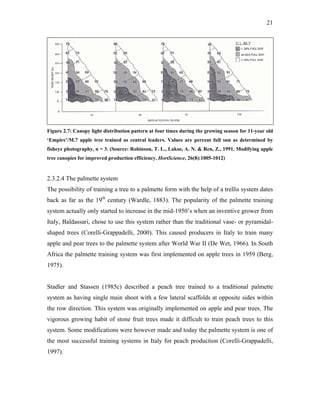
system. See Figure 2.7. High establishment and maintenance costs are two of the greatest
disadvantages of the central leader system.
21
Figure 2.7: Canopy light distribution pattern at four times during the growing season for 11-year old
‘Empire’/M.7 apple tree trained as central leaders. Values are percent full sun as determined by
fisheye photography, n = 3. (Source: Robinson, T. L., Lakso, A. N. & Ren, Z., 1991. Modifying apple
tree canopies for improved production efficiency. HortScience, 26(8):1005-1012)
2.3.2.4 The palmette system
The possibility of training a tree to a palmette form with the help of a trellis system dates
back as far as the 19th
century (Wardle, 1883). The popularity of the palmette training
system actually only started to increase in the mid-1950’s when an inventive grower from
Italy, Baldassari, chose to use this system rather than the traditional vase- or pyramidal-
shaped trees (Corelli-Grappadelli, 2000). This caused producers in Italy to train many
apple and pear trees to the palmette system after World War II (De Wet, 1966). In South
Africa the palmette training system was first implemented on apple trees in 1959 (Berg,
1975).
Stadler and Stassen (1985c) described a peach tree trained to a traditional palmette
system as having single main shoot with a few lateral scaffolds at opposite sides within
the row direction. This system was originally implemented on apple and pear trees. The
vigorous growing habit of stone fruit trees made it difficult to train peach trees to this
system. Some modifications were however made and today the palmette system is one of
the most successful training systems in Italy for peach production (Corelli-Grappadelli,
1997).
22
De Wet (1966) and Bergh (1974) explained the ideal form of the traditional palmette
system under South African conditions. According to them two scaffold branches should
be as far possible be positioned opposite to each other with an angle of 45º to 60º to the
main stem. The bottom scaffold should not be lower than 35 cm from the ground. The
distance between successive scaffolds should be between 45 and 85 cm. The side
scaffolds should decrease in size and length as they are positioned higher up on the main
stem. The width of the bottom scaffolds should not exceed 2 m. The top part of the tree
should not end in a pair of scaffolds, but rather a single vertical extension. Tree height is
preferably restricted to 4 m. To develop the side scaffolds at the desired position, the
main stem is tipped in the winter at the appropriate height and the central leader and two
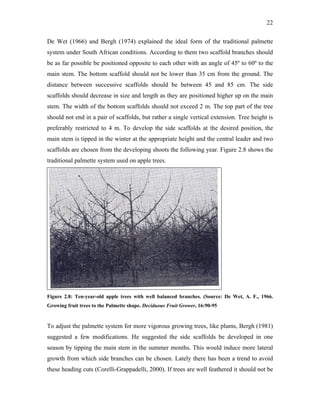
scaffolds are chosen from the developing shoots the following year. Figure 2.8 shows the
traditional palmette system used on apple trees.
Figure 2.8: Ten-year-old apple trees with well balanced branches. (Source: De Wet, A. F., 1966.
Growing fruit trees to the Palmette shape. Deciduous Fruit Grower, 16:90-95
To adjust the palmette system for more vigorous growing trees, like plums, Bergh (1981)
suggested a few modifications. He suggested the side scaffolds be developed in one
season by tipping the main stem in the summer months. This would induce more lateral
growth from which side branches can be chosen. Lately there has been a trend to avoid
these heading cuts (Corelli-Grappadelli, 2000). If trees are well feathered it should not be
23
necessary to cut back the central leader. This would reduce labour cost, reduce unwanted
vegetative growth and accelerate production in the developing years (Corelli-Gappadelli,
2000). Bergh (1981) also suggested that the side scaffolds should rather be developed at
an angle of 90º on the main stem to reduce over-vigorous growth.
The initial aim of the palmette system was to increase orchard efficiency and
profitability. Studies have shown that this system is capable of these requirements.
Because of the narrow canopy shape, light is distributed evenly throughout the whole
canopy (Corelli and Sansavini, 1989). The palmette system is also capable of producing
similar yield to other systems, such as the central leader system (Allison and Overcash,
1987). Because of the ‘flat’ canopy surface of the palmette it can be more efficient in
some agricultural practices, such as pesticide spraying or picking. This system can
however be very expensive to establish when using a trellis system.
2.3.2.5 The ‘Y’-shaped system
Another fairly popular training system used in South African peach production that
requires a trellis system is the Tatura. This system was developed by the Irrigation
Research Institute in Tatura, Australia (Chalmers et al., 1978). This system consists of
two scaffold limbs per tree growing out perpendicular to the row directions. These two
scaffolds are grown at an angle of 60 to 70º from the horizontal level in the direction of
the corresponding scaffolds in the adjacent rows. The scaffolds are limited to a height of
3.5 m and a 2 m gap is kept between the ends of two scaffolds in adjacent rows. Bearing
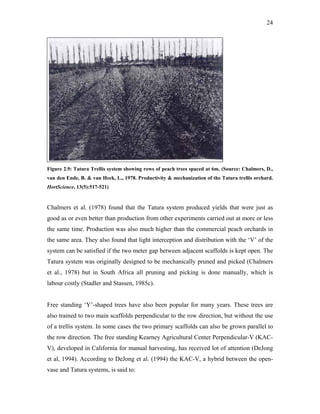
branches are developed on the two main scaffolds. Figure 2.9 shows the ‘Y’-shaped
Tatura system used on peach trees.
24
Figure 2.9: Tatura Trellis system showing rows of peach trees spaced at 6m. (Source: Chalmers, D.,
van den Ende, B. & van Heek, L., 1978. Productivity & mechanization of the Tatura trellis orchard.
HortScience, 13(5):517-521)
Chalmers et al. (1978) found that the Tatura system produced yields that were just as
good as or even better than production from other experiments carried out at more or less
the same time. Production was also much higher than the commercial peach orchards in
the same area. They also found that light interception and distribution with the ‘V’ of the
system can be satisfied if the two meter gap between adjacent scaffolds is kept open. The
Tatura system was originally designed to be mechanically pruned and picked (Chalmers
et al., 1978) but in South Africa all pruning and picking is done manually, which is
labour costly (Stadler and Stassen, 1985c).
Free standing ‘Y’-shaped trees have also been popular for many years. These trees are
also trained to two main scaffolds perpendicular to the row direction, but without the use
of a trellis system. In some cases the two primary scaffolds can also be grown parallel to
the row direction. The free standing Kearney Agricultural Center Perpendicular-V (KAC-
V), developed in California for manual harvesting, has received lot of attention (DeJong
et al, 1994). According to DeJong et al. (1994) the KAC-V, a hybrid between the open-
vase and Tatura systems, is said to:
25
• increase production in the developing years of the orchard,
• produce yield equal to or greater than the open-vase at full bearing and thereafter,
• avoid unnecessary intensive summer pruning to maintain tree size,
• simplify tree structure so that cultural practices such as pruning, thinning and
picking can be carried out more easily,
• and maintain or improve the light distribution characteristics with in the canopy of
an open-vase system.
According to DeJong et al. (1994) the tree consists of two main scaffolds, grown
perpendicular to the row direction, with an ideal angle of 25º to 40º from the vertical.
Bearing branches are developed on the main scaffolds. Tree height is generally restricted
to 3.5 to 4.5 m. The desired tree shape is maintained by keeping the two main scaffolds
dominant and by keeping the inside of the ‘V’ open and free from vigorous watersprouts.
The appropriate planting distances range from 1.5 to 2 m between trees in the row and 4.5
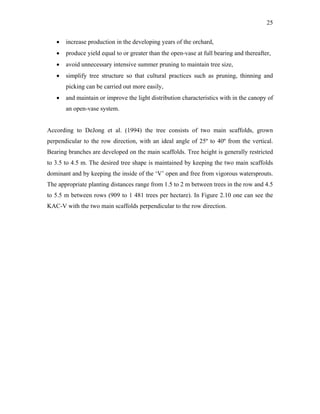
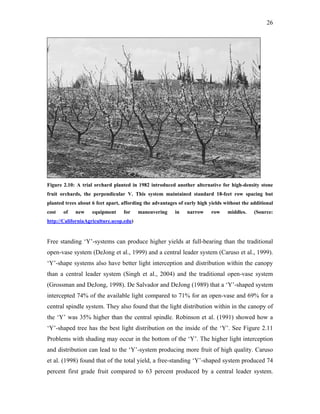
to 5.5 m between rows (909 to 1 481 trees per hectare). In Figure 2.10 one can see the
KAC-V with the two main scaffolds perpendicular to the row direction.
26
Figure 2.10: A trial orchard planted in 1982 introduced another alternative for high-density stone
fruit orchards, the perpendicular V. This system maintained standard 18-feet row spacing but
planted trees about 6 feet apart, affording the advantages of early high yields without the additional
cost of new equipment for maneuvering in narrow row middles. (Source:
http://CaliforniaAgriculture.ucop.edu)
Free standing ‘Y’-systems can produce higher yields at full-bearing than the traditional
open-vase system (DeJong et al., 1999) and a central leader system (Caruso et al., 1999).
‘Y’-shape systems also have better light interception and distribution within the canopy
than a central leader system (Singh et al., 2004) and the traditional open-vase system
(Grossman and DeJong, 1998). De Salvador and DeJong (1989) that a ‘Y’-shaped system
intercepted 74% of the available light compared to 71% for an open-vase and 69% for a
central spindle system. They also found that the light distribution within in the canopy of
the ‘Y’ was 35% higher than the central spindle. Robinson et al. (1991) showed how a
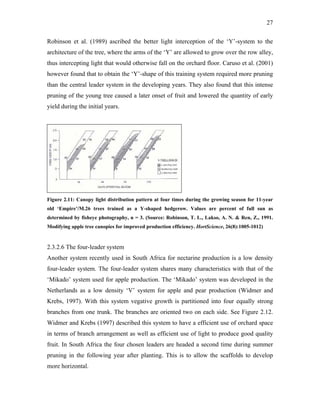
‘Y’-shaped tree has the best light distribution on the inside of the ‘Y’. See Figure 2.11
Problems with shading may occur in the bottom of the ‘Y’. The higher light interception
and distribution can lead to the ‘Y’-system producing more fruit of high quality. Caruso
et al. (1998) found that of the total yield, a free-standing ‘Y’-shaped system produced 74
percent first grade fruit compared to 63 percent produced by a central leader system.
27
Robinson et al. (1989) ascribed the better light interception of the ‘Y’-system to the
architecture of the tree, where the arms of the ‘Y’ are allowed to grow over the row alley,
thus intercepting light that would otherwise fall on the orchard floor. Caruso et al. (2001)
however found that to obtain the ‘Y’-shape of this training system required more pruning
than the central leader system in the developing years. They also found that this intense
pruning of the young tree caused a later onset of fruit and lowered the quantity of early
yield during the initial years.
Figure 2.11: Canopy light distribution pattern at four times during the growing season for 11-year
old ‘Empire’/M.26 trees trained as a Y-shaped hedgerow. Values are percent of full sun as
determined by fisheye photography, n = 3. (Source: Robinson, T. L., Lakso, A. N. & Ren, Z., 1991.
Modifying apple tree canopies for improved production efficiency. HortScience, 26(8):1005-1012)
2.3.2.6 The four-leader system
Another system recently used in South Africa for nectarine production is a low density
four-leader system. The four-leader system shares many characteristics with that of the
‘Mikado’ system used for apple production. The ‘Mikado’ system was developed in the
Netherlands as a low density ‘V’ system for apple and pear production (Widmer and
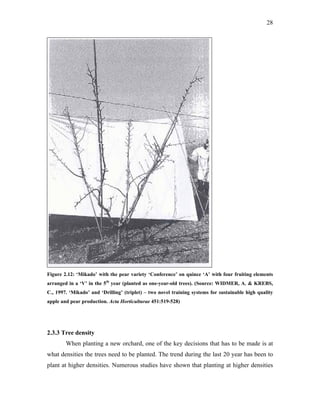
Krebs, 1997). With this system vegative growth is partitioned into four equally strong
branches from one trunk. The branches are oriented two on each side. See Figure 2.12.
Widmer and Krebs (1997) described this system to have a efficient use of orchard space
in terms of branch arrangement as well as efficient use of light to produce good quality
fruit. In South Africa the four chosen leaders are headed a second time during summer
pruning in the following year after planting. This is to allow the scaffolds to develop
more horizontal.
28
Figure 2.12: ‘Mikado’ with the pear variety ‘Conference’ on quince ‘A’ with four fruiting elements
arranged in a ‘V’ in the 5th
year (planted as one-year-old trees). (Source: WIDMER, A. & KREBS,
C., 1997. ‘Mikado’ and ‘Drilling’ (triplet) – two novel training systems for sustainable high quality
apple and pear production. Acta Horticulturae 451:519-528)
2.3.3 Tree density
When planting a new orchard, one of the key decisions that has to be made is at
what densities the trees need to be planted. The trend during the last 20 year has been to
plant at higher densities. Numerous studies have shown that planting at higher densities
29
can increase yield per hectare, not only for apple production (Weber, 2000; Widmer and
Krebs, 2001; Robinson and Hoying, 2004) but for peach production as well (Phillips and
Weaver, 1975; Bargioni et al., 1985; Caruso et al., 1997; Marini and Sowers, 2000).
Another good reason for planting at higher densities is that it increases fruit production
early on. Leuty and Pree (1980) found that with higher planting densities increased yield
by more than 67% during the first four years after planting for three different peach
cultivars.
An increase in tree density does, however, not always mean an increase in fruit
production. Widmer and Krebs (2001) found that when they planted apple trees at
densities of 3 000, 4 000, 5 000 and 6 000 tree per hectare the increase in yield was not
proportional to the increase of tree density. They concluded that the higher input cost of
trees exceeding a density of 3 000 per hectare was not justified by the increase in yield.
Some studies have shown that higher density plantings result in decreased fruit size
(Layne et al., 1981; Caruso et al., 1997; Marini and Sowers, 2000).
Tree density is rather closely associated with the training system used. Trees that are
trained to reach a smaller canopy size can be more conducive to higher densities. Tree
density for a specific training system can also differ under different environmental
conditions. The ideal tree density will therefore depend on the training system used
together with production potential of a specific site.
2.4 FINANCIAL EVALUATION METHODS
To compare the different training systems on a financial basis a method must be
used to identify the training system that would be the most beneficial to an investor in the
long run. This method is called capital budgeting. When doing capital budgeting there are
many techniques to compare and rank different investment opportunities, each with its
own advantages and disadvantages.
One of the main requirements when choosing a training system is that it starts producing
a commercial yield earlier during the lifetime of the orchard so that the investment made
30
in the orchard can be returned as soon as possible. The payback method is a capital
budgeting technique that is commonly used and is easy to understand. It determines the
time it takes to recover the cost of an investment from the cash flow it generates. So the
training system that takes the least time to recover from the initial investment would be
preferred. This method has however a number of disadvantages. One of them is that it
ignores the cash flow after the payback-period (Correia et al., 1993).
To eliminate the problem of ignoring the importance of ‘after-payback-cash-flow’ and to
take in to account the time value of money, a technique is used to determine the net
present value (NPV) of an investment opportunity. The net present value of a project is
defined as “the present value of the project’s future cash flow minus the cost of the
project” (Shapiro, 1990). In other words the net present value of a project is estimating
the future cash flow of that project, discounting the estimated future cash flow at the
required rate of return (cost of capital) and subtracting the initial cost of the project
(Correia et al, 1993). The formula to determine net present value is:
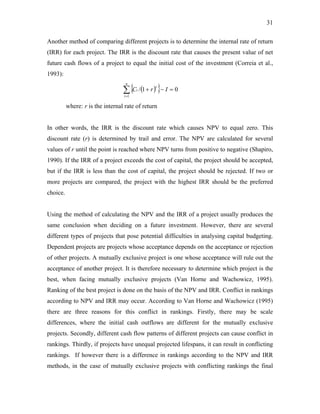
( )
{ }
∑
=
−
+
=
n
t
t
t I
k
C
NPV
1
1
/
where: Ct is the net cash flow at time t
I is the cost of investment
k is the required rate of return (cost of capital)
To decide whether a project is worthwhile investing in, the following rule should be
followed (Vernimmen et al, 2005):
NPV > 0 Invest
NPV < 0 Do not invest
Shapiro (1990) also stated that if the NPV of two or more projects are all greater than
zero, the one with the highest NPV should be preferred.
31
Another method of comparing different projects is to determine the internal rate of return
(IRR) for each project. The IRR is the discount rate that causes the present value of net
future cash flows of a project to equal the initial cost of the investment (Correia et al.,
1993):
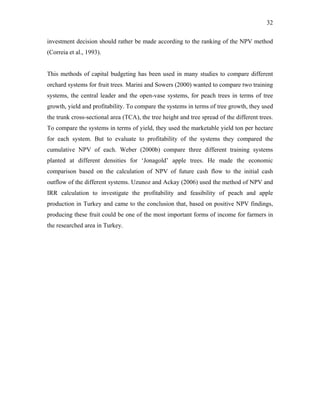
( )
{ }
∑
=
=
−
+
n
t
t
t I
r
C
1
0
1
/
where: r is the internal rate of return
In other words, the IRR is the discount rate which causes NPV to equal zero. This
discount rate (r) is determined by trail and error. The NPV are calculated for several
values of r until the point is reached where NPV turns from positive to negative (Shapiro,
1990). If the IRR of a project exceeds the cost of capital, the project should be accepted,
but if the IRR is less than the cost of capital, the project should be rejected. If two or
more projects are compared, the project with the highest IRR should be the preferred
choice.
Using the method of calculating the NPV and the IRR of a project usually produces the
same conclusion when deciding on a future investment. However, there are several
different types of projects that pose potential difficulties in analysing capital budgeting.
Dependent projects are projects whose acceptance depends on the acceptance or rejection
of other projects. A mutually exclusive project is one whose acceptance will rule out the
acceptance of another project. It is therefore necessary to determine which project is the
best, when facing mutually exclusive projects (Van Horne and Wachowicz, 1995).
Ranking of the best project is done on the basis of the NPV and IRR. Conflict in rankings
according to NPV and IRR may occur. According to Van Horne and Wachowicz (1995)
there are three reasons for this conflict in rankings. Firstly, there may be scale
differences, where the initial cash outflows are different for the mutually exclusive
projects. Secondly, different cash flow patterns of different projects can cause conflict in
rankings. Thirdly, if projects have unequal projected lifespans, it can result in conflicting
rankings. If however there is a difference in rankings according to the NPV and IRR
methods, in the case of mutually exclusive projects with conflicting rankings the final
32
investment decision should rather be made according to the ranking of the NPV method
(Correia et al., 1993).
This methods of capital budgeting has been used in many studies to compare different
orchard systems for fruit trees. Marini and Sowers (2000) wanted to compare two training
systems, the central leader and the open-vase systems, for peach trees in terms of tree
growth, yield and profitability. To compare the systems in terms of tree growth, they used
the trunk cross-sectional area (TCA), the tree height and tree spread of the different trees.
To compare the systems in terms of yield, they used the marketable yield ton per hectare
for each system. But to evaluate to profitability of the systems they compared the
cumulative NPV of each. Weber (2000b) compare three different training systems
planted at different densities for ‘Jonagold’ apple trees. He made the economic
comparison based on the calculation of NPV of future cash flow to the initial cash
outflow of the different systems. Uzunoz and Ackay (2006) used the method of NPV and
IRR calculation to investigate the profitability and feasibility of peach and apple
production in Turkey and came to the conclusion that, based on positive NPV findings,
producing these fruit could be one of the most important forms of income for farmers in
the researched area in Turkey.
33
2.5 REFERENCES
ALBÁS, E. S., JIMÉNEZ, S., APARICIO, J., BETRÁN, J. A. & MORENO, M. A.,
2004. Effect of several peach × almond hybrid rootstocks on fruit quality of peaches.
Acta Horticulturae, 658:321-326
ALLISON, M. L. & OVERCASH, J. P., 1987. Factors affecting hedgerow peach orchard
establishment. Journal of the American Society for Horticultural Science, 112:62-66
BARGIONI, G., LORETI, F. & PISANI, P. L., 1985. Ten years of research on peach &
nectarine in a high density system in the Verona area. Acta Horticulturae, 173:299-309
BASSI, D., BRIGHENTI, G. & NARDI, V., 1985. Training systems of ‘Klamt’ cling
peach: performance after 8 years – IV Contribution. Acta Horticulturae, 173:339-348
BASSI, D., DIMA, A. & SCORZA, R., 1994. Tree structure and pruning response of six
peach growth forms. Journal of the American Society for Horticultural Science,
119(3):378-382
BERGH, O., 1972. Pruning of vase-shaped stone fruit trees. FFTRI Information Bulletin,
No. 85
BERGH, O., 1974. Preliminary results of trials in trellising, spacing and summer-pruning
of canning peaches for a higher production per unit of surface area. The Deciduous Fruit
Grower, 24(6):154-159
BERGH, O., 1981. A proposed palmette system for vigorously growing plum cultivars.
The Deciduous Fruit Grower, 31(8):294-301
34
CAIN, J. C., 1972. Hedgerow orchard design for most efficient interception of solar
radiation. Effects of tree size, shape and row direction. Search Agriculture, 2(7):1-14
CARUSO, T., BARONE, E. & DI VAIO, C., 2001. Factors affecting tree crop efficiency
in young peach trees: rootstock vigor and training system. Acta Horticulturae, 557:193-
197
CARUSO, T., DI VAIO, C., INGLESE, P. & PACE, L. S., 1998. Crop load and fruit
quality distribution within canopy of ‘Spring Lady’ peach trees trained to ‘central leader’
and ‘Y-shape’. Acta Horticulturae, 465:621-628
CARUSO, T., GIOVANNINI, D., MARRA, F. P. & SOTTILE, F., 1997. Two new
planting systems for early ripening peaches (Prunus persica L. Batsch): yield and fruit
quality in four low-chill cultivars. Journal of Horticultural Science, 72:873-883
CARUSO, T., INGLESE, P., SOTTILE, F. & MARRA, F. P., 1999. Effect of planting
system on productivity, dry-matter partitioning and carbohydrate content in above-ground
components of ‘Flordaprince’ peach trees. Journal of the American Society for
Horticultural Science, 124(1):39-45
CHALMERS, D., VAN DEN ENDE, B. & VAN HEEK, L., 1978. Productivity and
mechanization of the Tatura trellis orchard. HortScience, 13(5):517-521
CORELLI, L. & SANSAVINI, S., 1989. Light interception and photosynthesis related to
planting density and canopy management in apple. Acta Horticulturae, 243:159-174
CORELLI-GRAPPADELLI, L., 1997. Peach orchard management in Italy. The Compact
Fruit Tree, 30:73-80
CORELLI-GRAPPADELLI, L., 2000. The palmette training system. Acta Horticulturae,
513:329-336
35
CORREIA, C., FLYNN, D., ULIANA, E. & WORMALD, M., 1998. Financial
Management. 3rd
ed. Kenwyn, South Africa: Juta & Co
DAY, K. R., DEJONG, T. M., JOHNSON, R. S., 2005. Orchard-system configurations
increase efficiency, improve profits in peaches and nectarines. California Agriculture, 59
(2):75-79
DE SALVADOR, F. R. & DEJONG, T. M., 1989. Observation of sunlight interception
and penetration into the canopies for peach trees in different planting densities and
pruning configurations. Acta Horticulturae, 254:341-346
DE SALVADOR, F. R., ONDRADU, G. & SCALAS, B., 2002. Horticultural behaviour
of different species and hybrids as rootstocks for peach. Acta Horticulturae, 592:317-322
DE WET, A. F., 1952. The origin of the Kakamas peach. Farming in South Africa,
July:347-350
DE WET, A. F., 1966. Growing fruit trees to the Palmette shape. The Deciduous Fruit
Grower, 16:90-95
DEJONG, T. M., DAY, K. R., DOYLE, J. F. & JOHNSON, R. S., 1994. The Kearney
Agricultural Center perpendicular "V" (KAC-V) orchard system for peaches and
nectarines. HortTechnology, 4(4):362-367
DEJONG, T. M. & DOYLE, J. F., 1985. Seasonal relationships between leaf nitrogen
content (photosynthetic capacity) and leaf canopy light exposure in peach (Prunus
persica). Plant, Cell and Environment, 8:701-706
36
DEJONG, T. M., JOHNSON, R. S., DOYLE, J. F., BASILE, B., MARSAL, J.,
RAMMING, D. & BRYLA, D., 2004. Growth, yield and physiological behavior of size-
controlling peach rootstocks developed in California. Acta Horticulturae, 658:449-455
DEJONG, T. M., JOHNSON, R. S., DOYLE, J. F. & RAMMING, D., 2005. Labor costs
may be reduced... Research yields size-controlling rootstocks for peach production.
California Agriculture, 59(2):80-83
DEJONG, T. M., TSUJITA, W., DOYLE, J. F. & GROSSMAN, Y. L., 1999.
Comparative economic efficiency of four peach production systems in California.
HortScience, 34(1):73-78
DI VITO, M., BATTISTINI, A. & CATALANO, L., 2002. Response of Prunus
rootstocks to root-knot (Meloidogyne species) and root-lesion (Pratylenchus vulnes)
nematodes. Acta Horticulturae, 592(2):633-668
DU PREEZ, M., 1980. Gewas / grondassosiasie. Sagtevrugteboer, August:286-299
DU TOIT, A., 2005. Steenvrugonderstamme. Oplossing vir die probleme in die
vooruitsig. SA Vrugte Joernaal, Feb/Mrt:14-16
FERREE, D. C., 1988. Role of rootstocks and spur-type scions for controlling vegetative
growth of apple and peach trees. HortScience, 23(3):464-467
FOCHESSATI, A., 1981. High-density peach and nectarine orchards. The Deciduous
Fruit Grower, 31(9):344-353
GÉNARD, M. & BARET F., 1994. Spatial and temporal variation of light inside peach
trees. Journal of the American Society for Horticultural Science, 119:669-677
37
GIULIANI, R., MAGNANINI, E. & CORELLI-GRAPPADELLI, L., 1998. Whole
canopy gas exchange and light interception of three peach training systems. Acta
Horticulturae, 465:309-317
GROSSMAN, Y. L. & DEJONG, T. M., 1998. Training and pruning system effects on
vegetative growth potential, light interception and cropping efficiency in peach trees.
Journal of the American Society for Horticultural Science, 123:1058-1064
HAMPSON, C. R., QUAMME, H. A., KAPPEL, F & BROWNLEE, R. T., 2004.
Varying density with constant rectangularity: I. Effects on apple tree growth and light
interception in three training systems over ten years. HortScience, 39(3):501-506
HUDSON, J. P., 1971. Meadow orchards. Agriculture, 78:157-160
HUGARD, J., 1980. Peach high density planting in French orchards: development and
current achievements. Acta Horticulturae, 114:300-308
HUYSAMER, M., 1997. Integrating cultivar, rootstock and environment in the export
driven South African deciduous fruit industry. Acta Horticulturae, 451:755-760
IGLESIAS, I., MONTSERRAT, R., VILARDELL, P. & BONANY, J., 2004.
Performance of 'Conference' pear in five intensive planting systems in the north east of
Spain. Acta Horticulturae, 636:675-679
JACKSON, J. E., 1980. Light interception and utilization by orchard systems.
Horticultural Reviews, 2:208-267
JACKSON, J. E. & PALMER, J. W., 1972. Interception of light by model hedgerow
orchards in relation to latitude, time of year and hedgerow configuration and orientation.
Journal of Applied Ecology, 9:341-357
38
JACKSON, J. E. & PALMER, J. W., 1977. Effects of shade on the growth and cropping
of apple trees. I. Experimental details and effects on vegetative growth. Journal of
Horticultural Science, 52:245-252
JACKSON, J. E., SHARPLES, R. O. & PALMER, J. W., 1971. The influence of shade
and within tree position on apple size, colour and storage quality. Journal of
Horticultural Science, 46:277-287
JACOBS, G. & STRYDOM, D. K., 1993. Spacing trends of free standing central leader
deciduous fruit trees. Journal of the Southern African Society for Horticultural Science,
3(2):79-80
JOHNSON, R. S. & LAKSO, A. N., 1991. Approach to modeling light interception in
orchards. HortScience, 26(8):1002-1004
KLENYÁN, T., HROTKÓ, K. & TIMON, B., 1998. Effect of rootstocks on growth of
nectarine varieties. Acta Horticulturae, 465:225-228
KSENZHEK, O. S. & VOLKOV, A. G. 1998. Plant Energetics. London, UK: Academic
Press Ltd.
LAYNE, R. E. C., 1974. Breeding peach rootstocks for Canada and Northern United
States. HortScience, 9:364-366
LAYNE, R. E. C., TAN, C. S., HUNTER, D. M. & CLINE, R. A., 1981. Effect of
irrigation and tree density on peach production. Journal of the American Society for
Horticultural Science, 106:151-156
LEUTY, S. J. & PREE, D. J., 1980. The influence of tree population and summer pruning
on productivity, growth and quality of peaches. Journal of the American Society for
Horticultural Science, 105:702-705
39
LOONEY, N. E., 1968. Light regimes within standard size apple trees as determined
spectrophotometrically. Proceedings of the American Society for Horticultural Science,
93:1-6
LÖTZE, G. F. A., 1997. Quest for better rootstocks continues. The Deciduous Fruit
Grower, March 93
MARINI, R. P. & SOWERS, D. S., 2000. Peach tree growth, yield and profitability as
influenced by tree form and tree density. HortScience, 35:837-842
MARINI, R. P., SOWERS, D. S. & MARINI, M. C., 1995. Tree form and heading height
at planting affect peach tree yield and crop value. HortScience, 30:1196-1201
PALMER, J. W., BÜNEMANN, G., SANSAVINI, S., WAGENMAKERS, P. S. &
WINTER, F., 1989. The international planting systems trial. Acta Horticulturae,
243:231-241
PHILLIPS, J. H. H. & WEAVER, G. M., 1975. A high-density peach orchard.
HortScience, 10:580-582
RENAUD, R., BERNHARD, R., GRASSELLY, C. & DOSBA, F., 1988. Diploid plum x
peach hybrid rootstocks for stone fruit trees. HortScience, 23:115-124
ROBINSON, T. L., 1997. Interaction of tree form and rootstock on light interception,
yield and efficiency of ‘Empire’, ‘Delicious’ and ‘Jonagold’ apple trees trained to
different systems. Acta Horticulturae, 451:427-436
ROBINSON, T. L. & LAKSO, A. N., 1989. Light interception, yield and fruit quality of
‘Empire’ and ‘Delicious’ apple trees grown in four orchard systems. Acta Horticulturae,
243:175-184
40
ROBINSON, T. L., LAKSO, A. N. & REN, Z., 1991. Modifying apple tree canopies for
improved production efficiency. HortScience, 26(8):1005-1012
ROM, R. C., 1982. A new philosophy for peach rootstock development. Fruit Varieties
Journal, 36:34-36
ROM, R. C., 1983. The peach rootstock situation: An international perspective. Fruit
Varieties Journal, 37:3-14
ROM, R. C., 1991. Light threshold of apple tree canopy growth and development.
HortScience, 26(8):989-992
ROWE, R. N. & CATLIN, F. B., 1971. Differential sensitivity to waterlogging and
cyanogenesis by peach, apricot and plum roots. Journal of the American Society for
Horticultural Science, 96:305-308
SANSAVINI, S., 1983. Comments on present training systems for peach and nectarine
orchards in Italy. The Deciduous Fruit Grower, 33(5):175-179
SHAPIRO A.C. 1991. Modern Corporate Finance. New York, USA: Macmillan
SINGH, H., KANWAR, J. S. & HUNDAL, S. S., 2004. Radiation regime and fruit
quality of peach trees under different training systems. Journal of Agrometeorology, 6:5-
9
STADLER, J. D. & STASSEN, P. J. C., 1985a. Pruning and training deciduous fruit
trees: 1. Lighting, density and pruning procedures. Information Bulletin 531, Infruitec,
Stellenbosch, South Africa
41
STADLER, J. D. & STASSEN, P. J. C., 1985b. Pruning and training deciduous fruit
trees: 2. Training to free standing trees. Information Bulletin 532, Infruitec, Stellenbosch,
South Africa
STADLER, J. D. & STASSEN, P. J. C., 1985c. Pruning and training deciduous fruit
trees: 3. Training trellis systems. Information Bulletin 533, Infruitec, Stellenbosch, South
Africa
STARGROW NURSERY, 2004. Production information brochure. Stellenbosch, South
Africa
STASSEN, P. J. C., 1996. Aalwurm-infestasie by perskes in die somerreënvalstreek.
Oorsig, Pretoria (May), p14-15
STASSEN, P. J. C. & DAVIE, S. J., 1996. Tree manipulation – its application in the
citrus and subtropical fruit industries. ITSC Information Bulletin, 258:2-10
STASSEN, P. J. C. & VAN ZYL, H. J., 1979. Steenvrugteonderstamme. Boerdery in
Suid-Afrika, Steenvrugte A3
STASSEN, P. J. C. & VAN ZYL, H. J., 1982. Sensitivity of stone fruit rootstocks to
waterlogging. The Deciduous Fruit Grower, 32:270-275
STRYDOM, D. K., 1985. The closed vase: An alternative training system for apples and
pears. The Deciduous Fruit Grower, 35:360-364
STRYDOM, D. K. & COOK, N. C., 2005. Evolution of the pear training model in South
Africa. Acta Horticulturae, 671:37-40
TAN, C. S. & BUTTERY, B. R., 1986. Photosynthesis, stomatal conductance and leaf
water potential in response to temperature and light in peach. HortScience, 21:1180-1182
42
UZUNOZ, M. & AKCAY, Y., 2006. A profitability analysis of investment of peach and
apple growing in Turkey. Journal of Agriculture and Rural Development in the Tropics
and Subtropics, 107(1):11-18
VAN HORNE, J. C. & WACHOWICZ, J. M. 1995. Fundamentals of Financial
Management. 9th
ed. Englewood Cliffs, USA: Prentice-Hall
VERNIMMEN P., QUIRY P., LE FUR Y., DIALLOCCHIO M. & SALVI A. 2005.
Corporate Finance: Theory and Practice. West Sussex, England: John Wiley & Sons
Ltd.
WALLACE, R. 1896. Farming Industries of Cape Colony. South Africa, Cape Town:
Juta & Co.
WARDLE, W. 1883. Fourth edition of translation from the French of The Scientific and
Profitable Culture of Fruit trees by M. du Breul. London, UK: Crossby Lockwood & Co.
WEBER, M. S., 2000a. The super spindle system. Acta Horticulturae, 513:271-277
WEBER, M. S., 2000b. Optimizing tree density in apple orchards. The Compact Fruit
Tree, 33(4):119-122
WEBSTER, A. D., 1997. A review of fruit tree rootstock research and development. Acta
Horticulturae, 451:53-73
WIDMER, A. & KREBS, C., 2001. Influence of planting density and tree form on yield
and fruit quality of ‘Golden Delicious’ and ‘Royal Gala’ apples. Acta Horticulturae,
557:235-241
43
WIDMER, A. & KREBS, C., 1997. ‘Mikado’ and ‘Drilling’ (triplet) – two novel training
systems for sustainable high quality apple and pear production. Acta Horticulturae
451:519-528
YUNUS, M., PATHRE, U. & MOHANTY P. 2000. Probing Photosynthesis:
Mechanisms, Regulation and Adaptation. London, UK: Taylor & Francis
44
CHAPTER III
THE ROLE OF THE TRAINING SYSTEM AND ROOTSTOCK USED FOR
NECTARINES ON PRODUCTION AND LABOUR INPUT DURING THE INITIAL
YEARS AFTER PLANTING A NECTARINE ORCHARD
Abstract
A study was carried out to evaluate different orchard systems for nectarine
(Prunus persica var. nectarina) production in terms of labour inset and yield aspects.
An ‘Alpine’ nectarine orchard was planted in the winter of 2002 at Lushof farm
near Ceres in the Western Cape, South Africa. The trees where trained according
to: a four-leader system (5 x 3 m; 667 trees/ha); a two-leader system (5 x 1.5 m; 1
333 trees/ha); a proleptically trained central leader (5 x 1 m; 2 000 trees/ha) and a
sylleptically trained central leader (5 x 1 m; 2 000 trees/ha). The trees were planted
on three different rootstocks namely GF 677, SAPO 778 and Kakamas seedling.
Time spent per tree for pruning, thinning and picking were recorded. Yield aspects
comprised of number of fruit and mass of fruit per tree. The four-leader took the
longest time to manage per tree but per hectare it took the least time, while the two
central leaders took the longest time per hectare to manage. A significant difference
in production was recorded in the first two years with the four-leader systems
producing the least fruit per hectare. No significant difference between the different
systems was found in the third year of production. Rootstock only played a
significant role when it came to fruit mass, where trees on SAPO 778 produced
heavier fruit with a higher mass than trees on Kakamas seedling and GF 677.
3.1 INTRODUCTION
A radical change in training systems for use on apple and pear trees has been
taking place worldwide over the last 40 years. The use of new training systems for peach
trees has been slower. The open-vase system as described by Bergh (1972), planted at a
distance of 7 × 7 m, was for many years the preferred training system for peaches in
South Africa (Stadler and Stassen, 1985a). Cain (1972) suggested that a pyramidal tree
45
shape would be more efficient and changed from the rounded open-vase shape. Bergh
(1976) recommended and described a pyramidal close-vase system. Fochesatti (1981)
then described the training of peaches to the central leader. These training systems are
discussed by Stadler and Stassen (1985b). The palmette system that was traditionally
designed for apple trees was modified and described by Bergh (1974). Chalmers et al.
(1978) developed a ‘V’ system (Tatura system), as described by Stadler and Stassen
(1985c). Stadler and Stassen (1985b) referred to the results described by Hugard (1980),
Fochessati (1981) and Sansavini (1983), and came to the conclusion that due to the
limited space, no strong scaffold branches must be allowed for the central leader system,
but only bearing branches and shoots that are non-permanent. This developed into a
central leader with bearing shoots arranged spirally around it, without branches and old
wood that would cause overshadowing. The trend has mainly been to train the central
leader sylleptically, where the tree is cut back after planting and the dominant central
leader, with lateral shoots developing during the same season, is chosen from the
developing shoots (Jacobs and Strydom, 1993).
Currently most of the 1 417 hectares (OABS, 2004) of nectarine orchards in South Africa
are planted at a distance of 4 x 1.5 m (Jacobs and Strydom, 1993). These trees are mostly
trained sylleptically to the central leader system described by Stadler and Stassen
(1985b). The main driving force behind the idea of using higher density plantings is to
decrease the number of years required for the orchard to reach maximum light
interception and full crop production. It has been shown that these orchards can produce
relatively high yields, especially in the initial years (Leuty and Pree, 1980; Caruso et al.,
1997; Marini and Sowers, 2000). However, higher densities increase the establishment
cost significantly (Widmer and Krebs, 2001). The lack of a size-controlling rootstock for
stone fruit (Layne, 1974) also causes a problem with higher densities and therefore
summer pruning is important to control vigorous watershoots (Stadler and Stassen,
1985a). Trees require more management which increases labour cost. The Kakamas
seedling rootstock has been the primary rootstock used in South Africa for many years
(De Wet, 1952). This rootstock is however very sensitive to waterlogging (Stassen and
Van Zyl, 1982) and susceptible to root-knot nematode infestation (Stassen and Van Zyl,
46
1982). There are however many questions among producers about lower density
plantings, savings on plant material and labour cost, keeping trees smaller, and using
alternative rootstocks.
The aim of this study is to investigate alternative training systems for peaches and
compare them to the currently used central leader system. Time necessary for winter and
summer pruning, fruit thinning, picking and yield would be recorded as well as yield
efficiency.
The questions that required answering were:
• Should other systems with two of more leaders to fill the space and give more
bearing volume be considered?
• Should a wider spacing and multiple leaders to divide the growth, limit the height
of the trees and reduce planting material cost, but that would take longer to fill the
allocated space and to reach breakeven point be considered?
• Which is best way to train ‘Alpine’ nectarine trees: 1) sylleptically or 2)
proleptically?
• What role does the rootstock play in terms of growth, yield and fruit size?
3.2 MATERIALS AND METHODS
‘Alpine’ nectarines were planted in August 2002 at Lushof near Ceres in the
Western Cape region, South Africa (33º18’S, 19º20’E), in a north-south row direction.
Four different training systems were used and combined with three commercial
rootstocks.
The rootstocks used were GF 677 (GF), Kakamas seedling (K) and SAPO 778 (SAPO).
The training systems used were a sylleptically trained central leader (SS), a proleptically
trained central leader (SP), a two-leader system (2-L) and a four-leader system (4-L). The
trees where planted on a ‘Tukulu’ soil type with a gravel content of 60% and a clay
content of 5 to 8%. Each rootstock was combined with each training system to form 12
rootstock-training system combinations. The two central leader systems were planted at a
47
spacing of 5 x 1 m to give 2 000 trees per hectare. Planting density for the two-leader
system was 5 x 1.5 m to give 1 333 trees per hectare. The four-leader system was planted
at a density of 5 x 3 m to give 667 trees per hectare. All the trees were planted at a
constant distance of five meters between the rows. The layout of the study is a complete
randomized block design. Each combination was planted in plots of five trees with three
repetition blocks. Only the three inside trees of each plot were monitored in the
experiment.
After planting, structural pruning was carried out in the summer of 2002/2003 to train the
trees according to the different systems. Trees that were to be trained sylleptically
according to the central leader, as well as the two-leader and four-leader system, were cut
back to more or less 20 cm from the ground immediately after planting. The trees that
were to be trained proleptically were left untopped. Four shoots, two on each side of the
tree trunk, were chosen for the four-leader system to become dominant. These four shoots
were again cut back during the summer to form a step effect. This four-leader system was
trained according to the instructions given by a French consultant, Mr Alric Charbit, who
was the adviser for this commercial farm. For the two-leader system two shoots parallel
to the row direction were chosen to become the dominant leaders. One shoot was chosen
for the sylleptically trained central leader to become dominant. After the dominant
leaders were chosen, shoots thicker than one third of the leader were removed. Shoots
that formed a narrow crotch angle with the leader were removed. All thin wood on the
frame shoots was removed at a scissor length from the leader. A planting done near
Stellenbosch in the Western Cape, South Africa during 2004 was used to verify the first
year of training. Figures 3.1 – 3.4 (Addendum A) show the four different training
systems, two years after planting.
All the pruning, thinning and picking was done by farm workers of Lushof. The same
techniques and methods were used on the trail trees as used in their commercial orchards.
Training systems on the farm include the four-leader and a proleptically trained central
leader used on older trees. For the pruning three workers were used: one worker per tree.
For the thinning and picking six workers were used: two workers per tree. The purpose of
48
the trial was to determine the most economically efficient system. Minimal pruning was
done and the objective was to ensure that the desired tree shape was maintained.
In the winter of 2003 no pruning was done except for the heading cuts after planting. In
the summer of 2003/2004 fruit was harvested on 9th
and 13th
December. The number and
mass of fruit per tree were recorded. In March 2004 summer pruning was done.
Minimum pruning was done to keep the desired canopy shape and to keep the leaders
dominant. Shoots that competed with the leaders in thickness and position as well as
watersprouts were removed. The inside of the two-leader system and the four-leader
system was kept open in the middle by removing the strong growth in those areas. The
pruning time per tree and mass pruned per tree were recorded.
Trunk circumference was measured in May 2004, using a standard measuring tape. In
August 2004 winter pruning was done for the first time. Pruning included the removal of
strong upright shoots, keeping the scaffolds to a single leader as well as keeping the
overall tree shape as desired. The pruning time per tree and mass pruned per tree were
recorded. In September 2004 thinning was done and only the trees on Kakamas seedlings
rootstock on the different systems were recorded. Fruit were thinned to two fruit per 30
cm shoot and three fruit were left on shoots longer than 30 cm. Time per tree for this
action was recorded. Summer pruning was done on 3rd
November 2004, and the time per
tree as well as the pruning weight per tree were recorded. Picking was done three times in
December 2004. Time involved for picking per tree, the fruit per tree and mass of fruit
per tree were recorded.
Summer pruning was done in April 2005 and the same type of data as for the November
pruning was recorded. Trunk circumference was measured in May 2005 with a standard
measuring tape. Winter pruning was done in July 2005. Tree shape was maintained,
strong upright growth was removed and bearing wood was selected. Pruning time per
tree and mass pruned per tree were recorded. Soil samples for root-knot nematodes were
taken in August 2005.
49
Fruit were thinned in September 2005. Flower thinning was done first by removing the
flowers on the top third of each shoot. After that fruit thinning was done when the fruit
was more or less thumb-size. Two fruit on a 30 cm shoot were left. Three fruit were left
on shoots that were longer than 30 cm. Time taken for fruit thinning per tree was
recorded. No summer pruning was necessary in 2005. Fruit were picked three times in
December 2005. Again the time picked per tree, fruit per tree and mass fruit per tree were
recorded.
Irrigation and fertilization were done by the same pulsating drip system used for the
commercial orchards on the same farm. Packout percentages, prodution prices, labour
and plant materials cost required for any calucaltions were obtained from information
gathered by Lushof farm.
A second trial was planted during 2004. For this trial ‘Alpine’ nectarines were planted in
August 2004 on Kakamas seedling rootstocks at the Welgevallen Experimental farm in
Stellenbosch. The trees were trained according to four different growing systems, namely
a proleptically trained central leader, a sylleptically trained central leader, a two-leader
system, and a KAC-V system. The KAC-V system used in this trail was developed by
DeJong et al. (1994) and was discussed in Chapter 2. The trees that were to be trained
according to the central leader system were planted at a distance of 4 x 1 m (2 500 trees
per hectare) and the two-leader and KAC-V systems were planted at a distance of 4 x 1.5
m (1 667 trees per hectare). All the trees were planted at a distance of four meters
between the rows to keep the row widths constant.
The same structural pruning was applied to the trees planted at Stellenbosch, as for the
trees in the first trial planted at Ceres. After planting, the trees trained proleptically were
left untopped. The trees of the other three training systems were cut back to more or less
15 cm above the ground. One shoot for the sylleptically and proleptically trained central
leaders was chosen from the developing buds to become the dominant vertical leader.
Two opposite shoots parallel to the row direction were chosen for the two-leader system
and two opposite shoots perpendicular to the row for the KAC-V system were chosen to
50
become the dominant scaffolds. After the frame shoots were chosen, more structural
pruning was done in November 2004. All the shoots thicker than one third of the leader
were removed. Shoots that formed a narrow crotch angle with the leader were also
removed. All thin wood on the frame shoots was removed a scissor length from the
leader.
More structural pruning was done in June 2005. Dominant leaders from the two-leader
and KAC-V systems that had an incorrect growing direction were cut back to lateral
shoots that formed a more appropriate angle either within or perpendicular to the row
direction. All shoots thicker than one third of the leader were removed. Shoots that
formed a narrow crotch angle with the scaffold were removed. Shoots that grew within
the “V” of the two-leader and the KAC-V systems were also removed. The time it took to
carry out structural pruning per tree was recorded each time. Figures 3.5 - 3.8 show the
different tree structures for the different training systems after structural pruning.
First thinning was done during winter pruning when the necessary shoots of the correct
length were selected. About ten shoots of 30 cm or longer were selected per tree. Flower
thinning was done in July 2005. The top third flowers on each shoot were stripped
manually when the trees were in full bloom. Fruit thinning was done when the fruit were
thumb-size. One fruit per 30 cm shoot was left and each tree had more or less ten fruit on.
The time it took to carry out flower and fruit thinning per tree was recorded.
The fruit was harvested in December 2005 for the first time. The time it took to pick each
tree was recorded. The volume and weight of fruit on each tree were also recorded.
3.3 RESULTS AND DISCUSSION
Table 3.1 shows that up until 2003 rootstock effects were not significant.
However, in both 2004 and 2005 rootstock played a significant role on fruit weight; fruit
from trees grown on SAPO 778 rootstocks were significantly heavier than fruit from trees
grown on GF 677 or Kakamas seedling rootstocks (Table 3.3).
51
In 2004 trunk circumference of trees on SAPO 778 rootstocks was significantly larger
than trees on GF 677 or Kakamas seedlings (Table 3.3). In November 2004 trees on
SAPO 778 also took significantly longer to prune than trees on the other rootstocks
(Table 3.2). In 2005 trees on GF 677 took significantly longer to thin than trees planted
on the other rootstocks.
Results from soil samples taken showed that root-knot nematode Criconematinae and
Meloidogyne occured in the soil. No trees planted on SAPO 778 rootstock were affected
by the nematodes. Trees planted on GF 677 and Kakamas seedling rootstock showed
visual symptoms and two trees on Kakamas seedling rootstocks died.
From Table 3.4 – 3.6 it is clear that the training system effect were significant. During
2003 time spent on training the four-leader system per tree was significantly longer than
time spent other systems. Because of the less dense planting of 667 trees per hectare,
however, less time was spent per hectare. In 2003 the first commercial yield was picked.
The four-leader system produced less fruit per tree and had fewer trees per hectare. This
reduction in fruit caused the four-leader to have the lowest yield efficiency.
In both 2004 and 2005 the four-leader system took significantly longer per tree for both
summer and winter pruning. Although the two central leaders took the shortest time per
tree to prune there was no significant difference between them in terms of the time spent
in the orchard on any pruning done. In terms of time it took per hectare to prune, the four-
leader system was significantly different. The four-leader system took the least time per
hectare to prune except for the March 2005 summer pruning where there were no
significant difference in time between the systems. Per hectare the two central leaders
took the most time to prune. Again there were no significant differences between the two
central leaders. The four-leader system induced the biggest trunk circumference in both
2004 and 2005 followed by the two-leader and the two central leaders. It took
significantly longer to carry out thinning per tree for the four-leader system, followed by
the two-leader and the central leaders. Per hectare however the results are again inverted
52
and the four-leader took the shortest time took prune and the two central leaders the
longest time.
In 2004 and 2005 the four-leader system took a significantly longer time to pick, but that
is because it produced the most fruit per tree and thus the most fruit weight per tree. It
also gave the best yield efficiency (mass of fruit (kg) per centimeter (cm) trunk
circumference). The two central leaders took the least time to pick per tree and also gave
the least fruit per tree and total fruit weight per tree, as well as the lowest yield efficiency.
The two-leader and the central leader produced more fruit (ton) per hectare than the four-
leader in 2004 by a significant margin. In 2005 however there was no significant
difference in fruit (ton) produced per hectare between the different training systems.
Table 3.7 shows that tree training in 2004 and 2005 took significantly longer per tree for
the two systems with more than one dominant leader on the Welgevallen farm at
Stellenbosch. The two central leader systems took longer to train per hectare, and the
two-leader system took the least time. Thinning the proleptically trained central leader
took significantly longer per tree as well as per hectare than any of the other systems.
Similar results were seen for the winter and summer pruning, where the two central
leader systems took significantly longer per tree and per hectare. The sylleptically trained
central leader and the two-leader system took longer to pick but also gave higher yield
per hectare by a significant margin than the KAC-V and proleptically trained central
leaders.
2.4 CONCLUSIONS
Results showed that fruit weight is influenced by rootstocks. Indications are that
fruit from trees on GF 677 rootstocks were smaller. However, one has to keep in mind
that the amount of fruit per tree also plays a role. Although the difference was not
significant, GF 677 rootstocks produced 143 fruit per tree in 2004 in comparison with
53
SAPO 778 which produced 129 fruit per tree. In 2005 GF 677 produced 176 fruit per tree
and SAPO 778 rootstocks produced 158 fruit per tree. Trees on Kakamas seedling
rootstocks had more or less the same amount of fruit production per tree as SAPO 778
but there was a significant difference in fruit weight between the two rootstocks. It can
thus be said that the SAPO 778 rootstock produced larger fruit than Kakamas seedling
rootstocks, but one has to be careful to presume that GF 677 produces smaller fruit,
because it can be due to the fact that it bore more fruit per tree. These findings are in
accordance with those of Lötze (1997) who found that SAPO 778 as rootstock induces
better fruit size than Kakamas seedling rootstock.
The fact that it took longer to summer prune the trees on SAPO 778 rootstocks in 2004 is
because there were more strong shoots to be removed than in the case of the other two
rootstocks. This, and the fact that SAPO 778 had the biggest trunck circumference, can
be due to the more vigorous growing habit of the SAPO 778 rootstock.
The reason for the overall poor fruit weight might be that the trees bore too much fruit in
their second year of bearing overall. In the first year after planting (2003) the trees had an
average yield of 2.2 ton per hectare. In the second year of bearing the trees produced an
average yield of more than 15 ton per hectare. There might have been too much fruit left
on the trees after thinning in 2004. That might explain the lower yield of 19 ton per
hectare in their third year of bearing.
Thinning and picking costs for 2003 were not recorded and had to be calculated by using
the results from 2004 and multiplying by the factor of yield for 2003 over the yield for
2004 for each specific system.
Tables 3.8 – 3.10 showed the total time needed for training, pruning, thinning and picking
per hectare for the different rootstocks and training systems during each year, as well as
the accumulated yield from 2003 to 2005. Only the initial period of the ‘Alpine’ nectarine
orchard, from planting in 2002 until the third yield, was recorded. Any conclusions are
therefore only focusing on this specific period. Trees planted on GF 677 rootstocks
54
required the most labour accumulated from 2002 to 2005, although the difference
between the rootstocks was not significant. No significant difference was found between
the accumulated yields of the different rootstocks. Significant differences were however
found between the different training systems. Throughout the entire experiment, the four
leader systems required the least labour annually. Thus the total labour required from
2002 to 2005 was also significantly less for the four-leader system than the other systems.
No significant differences were found in the labour required between the other system.
However, the two-leader system required the most total labour accumulated from 2002 to
2005. Accumulated yield for the four-leader system was significantly less than for the
other systems. The two-leader system had the highest accumulated yield from 2003 to
2005, but not by a significant margin. Looking at the results from the labour required
during the first two years after planting for the trees planted at the Welgevallen
Experimental farm in Stellenbocsh, one can see that the proleptically trained central
leader needed the most labour, followed by the sylleptically trained central leader, the
two-leader and the KAC-V system. No significant difference was however found
between the two-leader and the KAC-V.
In conclusion, the four-leader system required the least amount of time spent in the
orchard, but also produced the lowest yield per hectare over the first two years of bearing.
On the other hand the two-leader system required the most time spent in the orchard, but
also produced the highest accumulated yield. Comparing the accumulated yield of the
two-leader system with that of the four-leader system, one can see that the two-leader
system produced 11.17 ton/ha more than the four-leader system over a four year period
from planting. This means that with a packout percentage of 50 percent first class, 35
percent second class and 15 percent third class and with a price of R10 000 per ton for
first class, R4 000 per ton for second class and R500 per ton for third class, the two-
leader system had an income of R72 325 per hectare more than the four-leader system
four years after planting. These packout percentages were taken from the average on the
farm, because trees from the trail were affected by root-knot nematodes and therefore
produced smaller fruit. If labour cost is calculated at R7 per hour then the two-leader
system would have only required R2 733 per hectare more in labour cost than the four-
55
leader system over the first four years after planting. One should however keep in mind
that the two-leader system had a higher planting density, and plant material cost would be
R9 990 per hectare more than for the four-leader system if the cost per tree is calculated
at R7.
The choice of training system and rootstock should however be based on the factors that
are most influential on a specific farm, and all the advantages as well as disadvantages for
a specific training system and rootstock on that farm should be taken in account. For most
producers it is important to get an early return on their investment. On the other hand,
labour cost is becoming a factor to take into account.
56
3.5 REFERENCES
BERGH, O., 1974. Preliminary results of trials in trellising, spacing and summer-pruning
of canning peaches for a higher production per unit of surface area. The Deciduous Fruit
Grower, 24(6):154-159
CAIN, J. C., 1972. Hedgerow orchard design for most efficient interception of solar
radiation. Effects of tree size, shape and row direction. Search Agriculture, 2(7):1-14
CHALMERS, D., VAN DEN ENDE, B. & VAN HEEK, L., 1978. Productivity and
mechanization of the Tatura trellis orchard. HortScience, 13(5):517-521
DE WET, A. F., 1952. The origin of the Kakamas peach. Farming in South Africa,
July:347-350
DEJONG, T. M., DAY, K. R., DOYLE, J. F. & JOHNSON, R. S., 1994. The Kearney
Agricultural Center perpendicular "V" (KAC-V) orchard system for peaches and
nectarines. HortTechnology, 4(4):362-367
FOCHESSATI, A., 1981. High-density peach and nectarine orchards. The Deciduous
Fruit Grower 31(9):344-353
HUGARD, J., 1980. Peach high density planting in French orchards: development and
current achievements. Acta Horticulturae, 114:300-308
JACOBS, G. & STRYDOM, D. K., 1993. Spacing trends of free standing central leader
deciduous fruit trees. Journal of the Southern African Society for Horticultural Science,
3(2):79-80
LAYNE, R. E. C., 1974. Breeding peach rootstocks for Canada and Northern United
States. HortScience, 9:364-366
57
LEUTY, S. J. & PREE, D. J., 1980. The influence of tree population and summer pruning
on productivity, growth and quality of peaches. Journal of the American Society for
Horticultural Science, 105:702-705
LÖTZE, G. F. A., 1997. Quest for better rootstocks continues. The Deciduous Fruit
Grower, March 93
MARINI, R. P. & SOWERS, D. S., 2000. Peach tree growth, yield and profitability as
influenced by tree form and tree density. HortScience, 35:837-842
OABS, 2004. Key deciduous fruit statistics. PO Box 25, Paarl 7620, South Africa
SANSAVINI, S., 1983. Comments on present training systems for peach and nectarine
orchards in Italy, The Deciduous Fruit Grower, 33(5):175-179
STADLER, J. D. & STASSEN, P. J. C., 1985a. Pruning and training deciduous fruit
trees: 1. Lighting, density and pruning procedures. Information Bulletin 531, Infruitec,
Stellenbosch, South Africa
STADLER, J. D. & STASSEN, P. J. C., 1985b. Pruning and training deciduous fruit
trees: 2. Training to free standing trees. Information Bulletin 532, Infruitec, Stellenbosch,
South Africa
STASSEN, P. J. C. & VAN ZYL, H. J., 1982. Sensitivity of stone fruit rootstocks to
waterlogging. The Deciduous Fruit Grower, 32:270-275
WIDMER, A. & KREBS, C., 2001. Influence of planting density and tree form on yield
and fruit quality of ‘Golden Delicious’ and ‘Royal Gala’ apples. Acta Horticulturae,
557:235-241
58
ADDENDUM A
Figure 3.1: A four-leader system planted at Lushof farm near Ceres after structural pruning. Note the two leaders to the left
side and the two leaders to the right side.
Figure 3.2: A two-leader system planted at Lushof farm near Ceres after structural pruning. Note the leaders within the row
direction.
59
Figure 3.3: A proleptically trained central leader system planted at Lushof farm near Ceres after structural pruning.
Figure 3.4: A sylleptically trained central leader system planted at Lushof farm near Ceres after structural pruning.
60
Figure 3.5: A sylleptically trained central leader system planted at Welgevallen Experimental farm in Stellenbosch after
structural pruning.
Figure 3.6: A two-leader system planted at Welgevallen Experimental farm in Stellenbosch after structural pruning.
61
Figure 3.7: A proleptically trained central leader system planted at Welgevallen Experimental farm in Stellenbosch after
structural pruning.
Figure 3.8: A KAC-V system (DeJong, 1999) planted at Welgevallen Experimental farm in Stellenbosch after structural
pruning.
62
ADDENDUM B
Table 3.1: The effect of rootstock on tree training, trunk circumference and yield in 2003 for 'Alpine' nectarines at the Lushof farm near Ceres
Tree TC Yield
Training 2003 2003
Time/tree Time/ha Fruit/tree Kg/tree Efficiency Ton/ha
Rootstock (sec) (hours) (mm) (kg) (kg/cm) (ton)
SAPO 778 74.76 27.26 134.3 26.67 3.03 0.239 2.0546
Kakamas 70.34 24.01 129.7 26.50 2.76 0.237 2.0246
GF 677 68.32 22.81 129.4 22.75 2.63 0.220 2.4851
NS NS NS NS NS NS NS
Source
Rootstock 0.4291 0.1357 0.1402 0.7605 0.8139 0.9214 0.2179
System <0.0001** 0.0062** <0.0001** 0.0024** 0.0013** 0.0002** <0.0001**
Combo 0.2186 0.2354 0.0104* 0.6302 0.5746 0.7625 0.5210
Means within columns with the same letter do not differ significantly at P=0.05 (LSD)
63
Table 3.2: The effect of rootstock on summer pruning and winter pruning in 2004 and 2005 for 'Alpine' nectarines at the Lushof farm near Ceres
Summer pruning Winter pruning Summer pruning
2004 (Mar) 2004 2004 (Nov)
Time/tree Mass/tree Time/ha Time/tree Mass/tree Time/ha Time/tree Mass/tree Time/ha
Rootstock (sec) (kg) (hours) (sec) (kg) (hours) (sec) (kg) (hours)
SAPO 778 220 3.13 85.226 81.94 0.537 35.767 98.39a 0.256 35.409a
Kakamas 202 2.86 72.760 96.58 0.576 33.639 69.96b 0.240 26.355b
GF 677 114 2.64 77.362 104.39 0.531 36.041 80.42ab 0.207 29.950ab
NS NS NS NS NS NS NS
Source
Rootstock 0.3808 0.4420 0.2829 0.3052 0.7956 0.8298 0.0208* 0.1349 0.0301*
System 0.0002** <0.0001** 0.0002** 0.0002** 0.0496* 0.0657 <0.0001** <0.0001** 0.0359*
Combo 0.6745 0.4638 0.2627 0.0601 0.9610 0.0509 0.1252 0.3478 0.7454
Summer pruning Winter pruning
Rootstock 2005 (Mar) 2005
SAPO 778 182.94 2.14 66.669 202.64 1.21 70.605
Kakamas 163.08 1.98 62.635 189.36 1.14 68.386
GF 677 156.78 1.85 58.915 178.64 1.03 71.061
NS NS NS NS NS NS
Source
Rootstock 0.376 0.2114 0.1958 0.5796 0.4012 0.9222
System <0.0001** 0.006** 0.7216 <0.0001** <0.0001** 0.0224*
Combo 0.3682 0.1631 0.4501 0.2753 0.3201 0.2092
Means within columns with the same letter do not differ significantly at P=0.05 (LSD)
64
Table 3.3: The effect of rootstock on trunk circumference (TC), time spent of thinning and yield parameters in 2004 and 2005 for 'Alpine' nectarines at the Lushof farm near Ceres
TC Thinning Yield
2004 2004 2004
Time/tree Time/ha Time/tree Time/ha Fruit/tree Mass/tree Mass/fruit Efficiency Ton/ha
Rootstock (mm) (sec) (hours) (sec) (hours) (kg) (g) (kg/cm)
SAPO 778 214.6a 287.72 111.51 128.94 12.57 97.49a 0.0585 17.230
Kakamas 201.3b 376.1 144.1 244.72 96.01 117.69 11.40 96.86a 0.0573 14.978
GF 677 200.6c 295.97 109.02 142.86 11.80 82.60b 0.0557 15.388
NS NS NS NS NS NS
Source
Rootstock 0.0266* 0.1098 0.3058 0.182 0.4822 0.042* 0.7894 0.2418
System <0.0001** 0.0097** 0.0199* <0.0001** 0.0004** .<0.0001** <0.0001** 0.7239 0.01* 0.002**
Combo 0.0171* 0.5306 0.3581 0.4645 0.8240 0.9582 0.2931 0.6217
TC Thinning Yield
Rootstock 2005 2005 2005
SAPO 778 249.08 192.42 67.231b 483.11 171.58 158 16.088 101.8a 0.0612 19.636
Kakamas 234.22 205.03 76.154ab 444.11 163.02 155 15.319 98.8b 0.0598 19.582
GF 677 227.50 235.61 87.256a 491.67 177.46 176 14.243 80.9b 0.0681 18.387
NS NS NS NS NS NS NS NS
Source
Rootstock 0.1922 0.1415 0.0096** 0.4782 0.6251 0.2886 0.3814 <.0001** 0.4781 0.6087
System <0.0001** <.0001** 0.0027** <.0001** 0.0147* <.0001** <.0001** 0.4623 0.0003 0.2646
Combo 0.1656 0.6077 0.2852 0.2219 0.4419 0.1184 0.1592 0.2388 0.2917 0.2352
Means within columns with the same letter do not differ significantly at P=0.05 (LSD)
65
Table 3.4: The effect of training system on tree training, trunk circumference and yield in 2003 for 'Alpine' nectarines on the Lushof farm
near Ceres
Training Tree TC Yield
system Training 2003 2003
Time/tree Time/ha Fruit/tree Mass/tree Efficiency Ton/ha
(sec) (hours) (mm) (kg) (kg/cm) (ton)
Four leader 134.92a 24.997a 159.1a 7.44b 0.81b 0.05b 0.53b
Two leader 50.49b 18.693b 140.1b 35.56a 3.88a 0.28a 2.52a
Proleptic central leader 49.27b 27.373a 116.1c 26.56a 3.01a 0.26a 3.09a
Sylleptic central leader 49.86b 27.700a 106.0d 31.67a 3.52a 0.35a 2.61a
Means within columns with the same letter do not differ significantly at P=0.05 (LSD)
66
Table 3.5: The effect of training system on summer pruning and winter pruning in 2004 and 2005 for 'Alpine' nectarines at the Lushof farm near Ceres
Training Summer pruning Winter pruning Summer pruning
system 2004 (Mar) 2004 (Aug) 2004 (Nov)
Time/tree Kg/tree Time/ha Time/tree Mass/tree Time/ha Time/tree Mass/tree Time/ha
(sec) (kg) (hours) (sec) (kg) (hours) (sec) (kg) (hours)
Four leader 260a 4.64a 49.131b 145.00a 0.646a 28.635 132.41a 0.351a 24.53b
Two leader 235a 3.02b 83.148a 98.48b 0.588a 36.466 79.10b 0.203b 29.30ab
Proleptic central leader 183b 2.01c 94.897a 76.96c 0.555ab 42.449 52.74c 0.171b 32.90a
Sylleptic central leader 157b 1.85c 86.501a 56.78c 0.404b 33.046 67.44bc 0.212b 35.56a
NS
Training Summer pruning Winter pruning
system 2005 (Apr) 2005 (Jul)
Four leader 241.7a 3.10a 44.78 287.8a 1.32a 53.319b
Two leader 172.7b 2.22b 63.93 194.7b 1.16b 72.081a
Proleptic central leader 128.7b 1.73b 70.76 141.4bc 0.97c 76.111a
Sylleptic central leader 127.4b 1.98b 71.48 137.0c 0.98c 78.559a
Means within columns with the same letter do not differ significantly at P=0.05 (LSD)
67
Table 3.6: The effect of training system on trunk circumference (TC), time spent on thinning and yield parameters in 2004 and 2005 for 'Alpine' nectarines at the Lushof farm near
Ceres
Training TC Thinning Yield
system 2004 2004 2004
Time/tree Time/ha Time/tree Time/ha Fruit/tree Mass/tree g/fruit Efficiency Ton/ha
(mm) (sec) (hours) (sec) (hours) (kg) (g) (kg/cm)
Four leader 267.1a 438.1a 81.2a 361.09a 66.89b 188.59a 17.271a 91.58 0.065a 11.52b
Two leader 220.8b 524.9a 194.4b 315.44a 116.8a 143.70b 13.500b 93.95 0.061a 18.00a
Proleptic central
leader
166.7c
252.9b 140.0b
218.52b 121.4a 84.81c 8.509c 100.33 0.051b 17.02a
Sylleptic central
leader
167.6c
288.5b 160.2b
209.59b 116.96a 92.22c 8.463c 91.77 0.051b 16.93a
NS
Training TC Thinning Yield
system 2005 2005 2005
Four leader 309.5a 326.8a 60.551b 718.8a 133.17b 277.0a 26.13a 94.33 0.089a 17.43
Two leader 247.0b 218.0b 80.735a 496.5b 183.85a 164.7b 15.10b 91.68 0.061b 20.13
Proleptic central
leader
200.2c 161.7c 89.814a 339.0c 187.55a 106.4c 10.20c 95.86 0.053b 20.40
Sylleptic central
leader
191.1c 137.6c 76.420a 337.6c 178.18a 103.9c 9.43c 90.76 0.048b 18.85
NS NS
Means within columns with the same letter do not differ significantly at P=0.05 (LSD)
68
Table 3.7: The effect of training system on tree training, summer and winter pruning, trunk circumference, thinning and yield in 2004 and 2005
for 'Alpine' nectarines at the Welgevallen Experimental farm in Stellenbosch
Tree training Thinning Summer pruning
Training 2004 & 2005 2005 2005
system Time/tree Time/ha Time/tree Time/ha Time/tree Time/ha
(sec) (hours) (sec) (hours) (sec) (hours)
KAC-V 45.5a 21.06 174.9c 80.99c 74.8b 34.64c
Two leader 42.5ab 19.66 198.1bc 91.74c 79.0b 36.60c
Proleptic central leader 35.4bc 24.60 304.3a 211.31a 91.5a 68.16a
Sylleptic central leader 34.1c 23.66 218.6b 151.79b 73.1b 50.79b
NS
P-values 0.0117* 0.0634 <0.0001** <0.0001** 0.0001** <0.0001**
TC Yield
Training 2005 2005
system Time/tree Fruit/tree Mass/tree Mass/fruit Time/ha Ton/ha Efficiency
(mm) (sec) (kg) (g) h/ha (ton) (kg/cm)
KAC-V 86.02 59.0 13 1.469 0.114 27.33b 2.447b 0.0107
Two leader 87.44 55.3 9 1.085 0.117 41.67a 3.094ab 0.0113
Proleptic central leader 86.04 60.0 11 1.239 0.111 24.58b 1.738c 0.0100
Sylleptic central leader 84.88 62.3 11 1.294 0.113 43.24a 3.234a 0.0107
NS NS NS NS NS NS
P-values 0.3853 0.5666 0.0598 0.0549 0.4638 <0.0001** 0.0014* 0.5368
Means within columns with the same letter do not differ significantly at P=0.05 (LSD)
69
Table 3.8: Total training, pruning, thinning and picking time per hectare and accumilated yield from 2002 to2005
for each rootstock used on 'Alpine' nectarines at Lushof farm near Ceres
Year Total Accumulated
2002-2003 2004 2005 2002-2005 Yield
Total labour Total labour Total labour 2003-2005
Rootstock (h/ha) (h/ha) (h/ha) (h/ha) (ton/ha)
SAPO 778 63.43 409.68 376.09 849.2 37.9
Kakamas 61.52 366.52 370.75 831.84 35.45
GF 677 58.23 396.33 402.29 856.85 37.45
NS NS NS NS NS
Source
Rootstock 0.4671 0.9149 0.5664 0.9021 0.5628
System <0.0001** <0.0001** 0.0036* <0.0001** 0.0006**
Combo 0.3135 0.3736 0.5222 0.3624 0.6029
Means within columns with the same letter do not differ significantly at P=0.05 (LSD)
Table 3.9: Total training, pruning, thinning and picking time per hectare and accumilated yield from 2002 to2005
for each training system used on 'Alpine' nectarines at Lushof farm near Ceres
Year Total Accumulated
2002-2003 2004 2005 2002-2005 Yield
Training
Total
labour Total labour Total labour 2003-2005
system (h/ha) (h/ha) (h/ha) (h/ha) (ton/ha)
Four leader 31.81b 250.38b 291.83b 574.02b 29.48b
Two leader 67.35a 496.13a 400.97a 964.46a 40.65a
Proleptic central
leader 74.14a 427.90a 438.27a 940.31a 40.41a
Sylleptic central
leader 71.00a 432.96a 401.11a 905.07a 38.41a
Means within columns with the same letter do not differ significantly at P=0.05 (LSD)
70
Table 3.10: Total training pruning, thinning and picking time per hectare from 2004 to 2005 for each training
system used on 'Alpine' nectarines at Welgevallen Experimental farm in Stellenbosch
Year
2004-2005
Training Total labour
system (h/ha)
KAC-V
139.42c
Two leader 150.45c
Proleptic central leader 308.24a
Sylleptic central leader 230.56b
P-value <0.0001*
Means within columns with the same letter do not differ significantly at P=0.05 (LSD)
71
CHAPTER IV
THE ROLE OF LIGHT DISTRIBUTION IN THE LOWER CANOPY OF FOUR
DIFFERENT TRAINING SYSTEMS USED FOR ‘ALPINE’ NECTARINES
Abstract
Light penetration into the tree canopy was evaluated for four different
training systems for nectarine (Prunus persica var. nectarina) orchards. ‘Alpine’
nectarines were planted in the winter of 2002 and the trees where trained to four
different training systems, namely a four-leader system (5 x 3 m; 667 trees/ha), a
two-leader system (5 x 1.5 m; 1 333 trees/ha), a proleptically trained central leader
(5 x 1 m; 2 000 trees/ha) and a sylleptically trained central leader (5 x 1 m; 2 000
trees/ha). Light measurements where taken with a single point quantum sensor (LI-
189, LI-COR, Nebraska, USA) after summer pruning in 2004 and 2005 at different
heights and at different depths in the canopy. In 2006 an AccuPAR Linear
Ceptometer, Model LP-80 (Decagon Devices, Pullman, Washington USA) was used
to make measurements at different heights at different depths in the canopy. Results
show that poor light penetration occurred at the bottom (0.5 – 1.5 m) in the middle
(0 – 100 cm) of the central leader trees. Because of the open centre of the four-leader
system, poor light penetration occurred at a height of 1.0 to 1.5 m, 60 to 100 cm
vertical from the tree trunk where the dominant leaders stretch out.
4.1 INTRODUCTION
Photosynthesis is the process by which a plant uses water and CO2 to produce
carbohydrates and releases O2. For this process to take place, the plant relies on the
energy of the sun (light). The amount of carbohydrates that the plant produces is thus to
an extent dependent on the amount of light it absorbs (Ksenzhek, 1998). Research has
shown that the amount of fruit per tree is linearly correlated to the amount of light it
intercepts (Robinson and Lakso, 1989). The effect of light on fruit quality is also evident.
It has been shown that a light interception of 70 percent of full sunlight is optimum for a
mature orchard (Jackson and Palmer, 1972). Light penetration into the canopy is just as
vital for a tree to be efficient. Using Beer’s Law of light attenuation, Johnson and Lakso
72
(1991) showed how light levels decreases as light is distributed deeper into the tree
canopy. Cain (1972) stated that the minimum threshold for photosynthesis is 30 percent
of full sunlight. The effect of this decrease in light levels into the tree canopy therefore
has a significant effect on fruit production. Heinicke (1966) found that fruit size and
colour of two apple cultivars were correlated with the degree of exposure of sunlight.
Caruso et al. (1998) found that fruit from the upper part of a ‘Spring Lady’ peach tree
trained to a central leader were larger in size than fruit from the lower part of the same
canopy.
Tree shape and size will determine light interception and penetration. Although the
traditional open-vase system has a high light interception because of the big canopy, light
distribution to the inner and lower parts is often poor (Looney, 1991). Cain (1972)
suggested that a pyramidal tree shape would result in better light interception, with more
even light distribution. Robinson et al. (1991) however pointed out that such a system
also receives insufficient light in the lower inner parts of the canopy if the necessary care
is not taken. Changes in training system design have been made to accommodate better
light penetration within the canopy.
The aim of this study is to examine light interception and distribution of different training
systems used for peach trees. The author would like to observe the uniformity of light
distribution and point out any problem areas regarding shading within the different tree
canopies.
4.2 MATERIALS AND METHODS
An experimental ‘Alpine’ nectarine orchard was planted in August 2002 at
Lushof near Ceres in the Western Cape region, South Africa (33º18’S, 19º20’E), in a
north-south row direction. The trees were trained according to four different orchard
systems. The training systems used were a sylleptically trained central leader (SS), a
proleptically trained central leader (SP), a two-leader system (2-L) and a four-leader
system (4-L). The two central leader systems were planted at a spacing of 5 x 1 m to give
2 000 trees per hectare. Planting density for the two-leader system was 5 x 1.5 m to give
73
1 333 trees per hectare. The four-leader system was planted at a density of 5 x 3 m to give
667 trees per hectare. The trees where planted on a Tukulu soil with a gravel content of
60 percent and a clay content of five to eight percent. All the trees were planted at a
distance of five meters to keep the row widths constant. The layout of the study is a
complete randomized block design. Each training system was planted in plots of five
trees with three replicated blocks. Only the inside three trees planted on Kakamas
seedling rootstock of each plot was monitored in the experiment. Trees planted on other
rootstocks were not monitored during this experiment. This was done to keep the
measuring time as short as possible so that the angle of the sun at the beginning of the
measurements did not differ from the angle at the end of the measurements.
All the necessary pruning was done by the farm workers of Lushof. Pruning was kept to a
minimum and work was mainly done to ensure that the desired tree shape was
maintained. After pruning was done in March 2004, light measurements were taken using
a light meter with a quantum sensor (LI-189, LI-COR, Nebraska, USA). This light meter
uses a single point sensor to measure photosynthetically active radiation (PAR) in
µmol.s-1
.m-2
photon units. The measurements were taken at a height of 0.5 m, vertical
with the tree trunk (0 cm) as well as 30 cm and 60 cm from the trunk. These measuring
points where only used to develop a protocol for future light measurements. An
aluminium frame was used to obtain the exact measuring points in the tree.
Measurements were taken at noon, on a cloudless day. The quantum light meter was held
on the outside, above the tree canopy, to measure the maximum available light.
After the November summer pruning in 2004 light measurements were taken with the
same quantum meter as before. The measurements were taken at three different heights
from the ground, namely 0.5 m, 1.0 m and 1.5 m, at different depths in the tree canopy
namely 0 cm, 20 cm, 40 cm, 60 cm, 80 cm 100 cm and 120 cm vertical from the tree
trunk. An aluminium frame with the marked measuring points was placed in the tree
canopy in an east-west direction in order to mark the exact measuring points.
Measurements were taken at noon, on a cloudless day. The quantum light meter was also
held on the outside, above the tree canopy, to measure the maximum available light.
74
Post-harvest summer pruning was done in April 2005 and light measurements were again
taken with the same quantum meter as before, and the same method was used as in the
November 2004 light measurements.
In February 2006 light measurements were taken after post-harvest summer pruning, only
on trees planted on Kakamas seedling rootstocks. This was to keep the measuring time as
short as possible so that the angle of the sun at the beginning of the measurements did not
differ from the angle at the end of the measurements. The measurements were made by
using an AccuPAR Linear Ceptometer, Model LP-80 (Decagor Devices, Pullman,
Washington USA). The AccuPAR light meter is a linear ceptometer consisting of an
integrated probe and microcontroller. The probe is about 90 cm long and contains 80
photodiodes that are sensitive to the PAR waveband. The microcontroller allows the PAR
to be measured in segments along the length of the probe. The light measurements were
made at three heights, namely 0.5 m, 1.0 m and 1.5 m above the ground and the one end
of the probe was held in the centre of the tree canopy with the other end stretching out to
the east side of the canopy. Measurements were taken at noon, on a cloudless day. The
probe was held on the outside, above the tree canopy, to measure the maximum available
light.
All the measurements were taken in an east-west direction, perpendicular to the row
orientation. Shading from adjacent trees would thus not influence on the measurements.
Only the basal part of the tree canopy, up to 1.5 m from the ground, was measured for
light distribution because that is the section where light penetration and distribution is the
most limited and problematic. The data was not statically analyzed because of the
different methods and instruments used during the measurements. The results should thus
be used to identify different problem areas with in the canopy for each training system
and not to compare the different training systems in terms of light interception and
distribution.
75
4.3 RESULTS AND DISCUSSION
As previously mentioned (in section 4.2), the results gathered from the first light
measurements were not intended to be used to compare the different systems but to
become familiar with the equipment and strategies. Nonetheless, the results that were
obtained did give an indication of the different light regimes within the trees.
Table 4.2 shows that the light penetration of the four-leader system was higher than that
of the other systems at 0 cm. At 60 cm the proleptically and sylleptically trained central
leader had a higher light penetration than the four-leader system. The two-leader system
had a similar light interception pattern to the central leaders, but with less interception to
the outside of the tree.
From the different points of measurement used in the second light measurement (Tables
4.3 and 4.4) the tree could be divided in different quadrants to form a grid system. The
results taken with the point sensor meter provided a very negative view of the light
distribution within the canopy. In 2005 the average maximum available light measured
with the quantum light sensor was more or less 1 800 µmol.s-1
.m-2
PAR. This means that
any part of the tree canopy that received less that 540 µmol.s-1
.m-2
PAR would receive
less that 30 percent of the available light. Thus any position in the tree that received less
than 540 µmol.m-2
.s-1
PAR was not receiving sufficient light. According to the results in
Table 4.4, many parts in the tree received less than 540 µmol.s-1
.m-2
PAR. It seems that
only a small part of the tree canopy received sufficient light for any of the training
systems. This is because the quantum light meter is affected by shaded spots in the tree
canopy. Because the quantum light meter has a single point sensor the measurement can
be influenced if the point of measurement is directly in a shaded spot under a branch or a
leaf. In an attempt to overcome this potential problem, the light measurements for 2006
were taken with a linear ceptometer. Using the different points of measurement taken
with the linear meter, the tree could be divided in to different quadrants to form a grid
system. The different growing systems had different light penetration characteristics
76
within the grid. The layout and distribution of branches for the different systems within
the grid are illustrated in Figures 4.1 – 4.4 (Addendum A).
Because of different layouts, the different systems also had different light interception and
distribution within the grid as illustrated by Figures 4.5 – 4.8 (Addendum B).
The light measurement results for 2006 (Figures 4.5 - 4.8) taken with the linear
ceptometer show that the light penetration patterns correspond with those of the growing
patterns of the different training systems. The four-leader system again had the highest
light penetration in the top part of the tree in the middle of the canopy. The light
penetration decreased towards the outer parts of the tree canopy. The sylleptically trained
central leader had the lowest light penetration at the bottom, in the middle of the tree
canopy. The proleptically trained central leader had overall good light penetration, with
the middle of the tree canopy receiving the least amount of light. The two-leader system
received the highest amount of light at the outer side of the tree canopy. It must be
mentioned that the height of 1.5 m was only the bottom 50% of the two-leader and two
central leader systems.
4.4 CONCLUSIONS
Problems were encountered with the quantum light, hence in 2006 a linear
ceptometer that can continuously measure PAR in segments along the length of the probe
was used instead for the light measurements. The average maximum available light
measured with the ceptometer was approximately 1 000 µmol.m-2
.s-1
PAR. Thus any part
of the tree canopy that receives less than 300 µmol.m-2
.s-1
PAR will receive less than
30% of the maximum available light. In Figures 4.5 - 4.8 the areas in the tree canopy that
receive less than 30% full sunlight are represented by the black ‘spots’. The results show
that very few parts of the tree canopy receive insufficient light, except for the four-leader
system that receives insufficient light in the outer and upper parts of the canopy directly
underneath the leaders of the tree. This is because of the more vertical angle of the
leaders that make it difficult for the incoming light to reach underneath them. Light
penetration is still however possible in the bottom (less than 0.5 m from the ground),
from under the leader, to the inside (75 to 105 cm vertical from the tree trunk) of the
canopy. The two-leader system also receives insufficient light the area 1.0 to 1.5 m from
77
the ground and 0 to 15 cm vertical from the trunk of the tree canopy. This may be
because the middle of the ‘V’ of the two-leader system was not kept open enough during
summer pruning. Light penetration to the lower and inner parts of the canopy underneath
the structural branches is however sufficient. Light penetration for the proleptically
trained central leader seems to be sufficient throughout the whole of the canopy, even in
the basal part of the tree. The sylleptically trained central leader however received
insufficient light in the area 0.5 to 1.0 m from the ground and 0 to 30 cm vertical from the
tree trunk.
The results show that problem areas can occur in the canopy for any of the systems used
in this trail. Caution should be taken when pruning the four-leader system so that the
bearing branches on the angled dominant leaders do not cause overshadowing of the
lower parts of the canopy. The inside of the ‘V’ of the two-leader system should receive
special attention. If excessive growth in this area is not removed it can cause
overshadowing of the inner parts of the canopy. Fochessati (1981) advised that strong
branches must be avoided when training trees to a central leader system as those branches
easily develop at the lower parts (1 to 1.8 m from the ground) of the canopy. This can be
seen in the results from the sylleptically trained central leader. Vigorous shoots in the
basal parts of the canopy should thus be removed as soon as possible before it becomes a
problem.
Each training system has different problem areas regarding light penetration within the
tree canopy because of the different growing habits. Special attention should thus be
given to these areas, especially when doing summer pruning, so that the tree can be fully
efficient when it comes to light utilization.
78
4.5 REFERENCES
CAIN, J. C., 1972. Hedgerow orchard design for most efficient interception of solar
radiation. Effects of tree size, shape and row direction. Search Agriculture, 2(7):1-14
CARUSO, T., DI VAIO, C., INGLESE, P. & PACE, L. S., 1998. Crop load and fruit
quality distribution within canopy of ‘Spring Lady’ peach trees trained to ‘central leader’
and ‘Y-shape’. Acta Horticulturae, 465:621-628
FOCHESSATI, A., 1981. High-density peach and nectarine orchards. The Deciduous
Fruit Grower 31(9):344-353
HEINICKE, D. R., 1966. The effect of natural shade on photosynthesis and light intensity
in ‘Red Delicious’ apple trees. Proceedings of the American Society for Horticultural
Science, 88:1-8
JACKSON, J. E. & PALMER, J. W., 1972. Interception of light by model hedgerow
orchards in relation to latitude, time of year and hedgerow configuration and orientation.
Journal of Applied Ecology, 9:341-357
JOHNSON, R. S. & LAKSO, A. N., 1991. Approach to modeling light interception in
orchards. HortScience, 26(8):1002-1004
KSENZHEK, O. S. & VOLKOV, A. G. 1998. Plant Energetics. London, UK: Academic
Press Ltd.
LOONEY, N. E., 1968. Light regimes within standard size apple trees as determined
spectrophotometrically. Proceedings of the American Society for Horticultural Science,
93:1-6
79
ROBINSON, T. L. & LAKSO, A. N., 1989. Light interception, yield and fruit quality of
‘Empire’ and ‘Delicious’ apple trees grown in four orchard systems. Acta Horticulturae,
243:175-184
ROBINSON, T. L., LAKSO, A. N. & REN, Z., 1991. Modifying apple tree canopies for
improved production efficiency. HortScience, 26(8):1005-1012
80
ADDENDUM A
Figure 4.1: A schematic representation of the grid layout for the four-leader system. The grey lines
represent the lengthening of the leaders from 2004 to 2005, and the thin lines represent the
lengthening from 2005 to 2006.
Figure 4.2: A schematic representation of the grid layout for the two-leader system. The grey lines
represent the lengthening of the leaders from 2004 to 2005, and the thin lines represent the
lengthening from 2005 to 2006.
81
Figure 4.3: A schematic representation of the grid layout for the proleptically trained central leader
system. The grey lines represent the lengthening of the leaders from 2004 to 2005, and the thin lines
represent the lengthening from 2005 to 2006.
Figure 4.4: A schematic representation of the grid layout for the sylleptically trained central leader
system. The grey lines represent the lengthening of the leaders from 2004 to 2005, and the thin lines
represent the lengthening from 2005 to 2006.
82
µ mol.s-1
.m-2
0-200 201-400 401-600 601-800 801-1000
0 15 30 45 60 75 90 105
1.5
1.0
0.5
Figure 4.5: Light penetration within the measuring grid for the four-leader system after
summer pruning for 2006 on 'Alpines' at the Lushof farm in Ceres.
0 15 30 45 60 75 90 105
1.5
1.0
0.5
Figure 4.6: Light penetration within the measuring grid for the two-leader system after
summer pruning for 2006 on 'Alpines' at the Lushof farm in Ceres.
0 15 30 45 60 75 90 105
1.5
1.0
0.5
Figure 4.7: Light penetration within the measuring grid for the proleptic central
leader after summer pruning for 2006 on 'Alpines' at the Lushof farm in Ceres.
0 15 30 45 60 75 90 105
1.5
1.0
0.5
Figure 4.8: Light penetration within the measuring grid for the sylleptic central
leader after summer pruning for 2006 on 'Alpines' at the Lushof farm in Ceres.
83
ADDENDUM B
Table 4.1: Effect of rootstock on light penetration (µ mol.m-2
.s-1
) at a height of 0.5 m above the
ground in May 2004 for ‘Alpine’ nectarines at Lushof farm, Ceres after summer pruning
Distance vertical from the trunk
Rootstock (cm)
0 30 60
SAPO 778 323.5 587.5 939.7
Kakamas 482.0 623.3 935.2
GF 677 489.5 547.4 897.5
Table 4.2: Effect of training system on light penetration (µ mol.m-2
.s-1
) at a height of 0.5m above
the ground in May 2004 for ‘Alpine’ nectarines at Lushof farm, Ceres after summer pruning
Distance vertical from the trunk
Training system (cm)
0 30 60
Four leader 1121.5 624.8 593.1
Two leader 196.1 390.3 743.3
Proleptic central leader 219.0 690.0 1232.9
Sylleptic central leader 190.1 639.3 1127.2
84
Table 4.3: Effect of training systems on light measurements (µmol.m-2
.s-1
) for November 2004 after summer pruning for
‘Alpine’ nectarines at Lushof farm, Ceres
Training Height Distance vertical from the trunk
system
from
ground
(cm)
(m) 0 20 40 60 80 100 120
Four leader 0.5 577.1 295.9 164.1 277.6 439.6 610.4 1005.7
Two leader 0.5 123.5 198.9 284.7 738.6 930.6 1000.4 1051.4
Proleptic central
leader
0.5 84.6 159.3 273.3 694.9 920.4 1189.7 1314.1
Sylleptic central
leader
0.5 121.6 105.9 550.4 758.7 1073.5 1182.2 1345.9
Four leader 1 1330.4 925.4 609.6 279.8 514.2 754.7 979.7
Two leader 1 330.0 411.3 479.2 547.6 905.6 1137.2 1299.9
Proleptic central
leader
1 224.9 302.2 483.5 710.2 988.7 1246.5 1498.2
Sylleptic central
leader
1 261.5 302.3 637.4 985.1 1153.4 1397.9 1525.6
Four leader 1.5 1612.5 1606.9 1321.3 945.7 975.8 930.7 1017.9
Two leader 1.5 418.6 461.7 800.7 920.8 1216.6 1290.2 1473.9
Proleptic central
leader
1.5 145.7 298.1 481.4 999.9 1210.4 1443.0 1600.2
Sylleptic central
leader
1.5 436.3 434.3 938.1 1180.8 1325.8 1534.2 1671.7
85
Table 4.4: Effect of training systems on light measurements (µmol.m-2.s-1 ) for November 2005 after summer pruning for
‘Alpine’ nectarines at Lushof farm, Ceres
Training Height Distance vertical from the trunk
system
from
ground
(cm)
(m) 0 20 40 60 80 100 120
Four leader 0.5 300.8 443.6 123.2 84.3 637.2 856.6 619.1
Two leader 0.5 533.2 213.3 333.9 311.5 332.9 281 372.8
Proleptic central
leader
0.5 67.3 99.5 217.9 347 274.9 253.9 427.6
Sylleptic central
leader
0.5 125.5 269.1 286.4 230.2 472.9 275.2 588.8
Four leader 1 1098.5 1054.5 808 237.3 382.1 493.7 573.4
Two leader 1 467.3 75.3 573.2 228.3 264 521.3 765.6
Proleptic central
leader
1 262.3 206.2 173.4 261.6 585.3 1038 1093
Sylleptic central
leader
1 265.2 160.4 288.7 631.1 705.7 818.9 1063.1
Four leader 1.5 1572.1 1572.1 1252.7 787.1 615.8 683.7 711.5
Two leader 1.5 563.7 100.2 357.8 430.1 634.6 508.7 997.9
Proleptic central
leader
1.5 261.1 596.7 418.4 377.3 612.9 1064.2 1405.3
Sylleptic central
leader
1.5 453.3 345.1 455.2 511.3 860.3 1093.9 1334.1
86
Table 4.5: Effect of training systems on light measurements (µmol.m-2.s-1 ) for February 2006 after summer pruning for ‘Alpine’
nectarines at Lushof farm, Ceres
Training Height Distance vertical from the trunk
system
from
ground
(cm)
(m) 0 15 30 45 60 75 90 105
Four leader 0.5 695.7 563.9 438.2 367.9 367.6 371.7 400.5 426.6
Two leader 0.5 273.3 352.3 549.3 607.2 593.3 697.9 751.7 779.4
Proleptic central
leader
0.5 58.6 119.3 239.9 436.5 450.7 550.4 724 817.8
Sylleptic central
leader
0.5 426.8 474.2 735.8 871.1 795.1 798.3 888.9 859.8
Four leader 1 398.6 284.7 383.4 269.9 182.9 93.8 53.5 51.5
Two leader 1 113.6 241.2 313.3 349.7 298.2 418.2 539.5 621.7
Proleptic central
leader
1 159.6 122.3 137.7 208.7 376.8 419.6 635.5 710.2
Sylleptic central
leader
1 360.3 300.4 302.4 290.4 494.3 671.3 572.9 601.5
Four leader 1.5 785.3 633.8 296.3 127.3 61.5 45.9 64.6 138.9
Two leader 1.5 88.8 296.7 341.8 388.9 541.7 599.8 833.9 932.8
Proleptic central
leader
1.5 218 226.9 275.4 308 624.4 530.5 555.5 740.7
Sylleptic central
leader
1.5 489.9 710.4 811 875.2 885.2 804.4 986.1 902.8
87
CHAPTER V
FINANCIAL EVALUATION OF FOUR DIFFERENT TRAINING SYSTEMS USED
FOR ‘ALPINE’ NECTARINES
Abstract
A financial comparison was made between four different training systems for
nectarine (Prunus persica var. nectarina) orchards. ‘Alpine’ nectarines where
planted in the winter of 2002 and the trees where trained to four different training
systems namely a four-leader system (5 x 3 m; 667 trees/ha), a two-leader system (5
x 1.5 m; 1 333 trees/ha), a proleptically trained central leader (5 x 1 m; 2 000
trees/ha) and a sylleptically trained central leader (5 x 1 m; 2 000 trees/ha). Time
spent per tree for pruning, thinning and picking were recorded from 2002 to 2005.
The quantity of fruit per tree and fruit mass per tree were also recorded during
harvest. The trees were compared in terms of production, value of production as
well as margin above plant material and labour cost. The net present value (NPV)
and internal rate of return (IRR) were calculated for each system. Results from the
NPV and IRR calculations were conflicting in rankings. NPV at a discount rate of
5% indicate that the two-leader system should be preferred. NPV at a discount rate
of 10% indicate that the proleptically trained central leader system should rather be
preferred. This means that if opportunity cost is low, the two-leader system should
be the preferred choice and if opportunity cost is high, the proleptically trained
central leader should be the preferred system.
5.1 INTRODUCTION
Investing in a new orchard or replacing an existing one has become a big decision
issue for fruit producers. Faced with the numerous and complex possibilities of cultivar,
rootstock, training system and planting density combinations, an investor has to make
some crucial choices. Wrong decisions do not come cheaply, because of the large sum of
money required to invest into a new orchard. Investors and growers need to have sound
knowledge of the potential advantages or disadvantages of different orchard systems
available.
88
Comparing different orchard systems can be done by means of capital budgeting.
Goedegebure (1986) showed how the method of calculating each system’s net present
value (NPV) can be used to make a useful comparison. The net present value of a project
is defined as “the present value of the project’s future cash flow minus the cost of the
project” (Shapiro, 1990). In other words the net present value of a project is estimating
the future cash flow of that project, discounting the estimated future cash flow at the
required rate of return (cost of capital) and subtracting the initial cost of the project
(Correia et al, 1993). In order to apply this method the actual annual cash-flow over the
full lifespan of each system should be assessed. To decide whether a project is
worthwhile investing in, the following rule should be followed (Vernimmen et al, 2005):
If NPV > 0 Invest
If NPV < 0 Do not invest
Weber (2000) also used the method of calculating the NPV to make an economic
comparison of three different plantings for ‘Jonagold’ apples. To obtain the required
basic economic data he interviewed more than 20 farmers in the specific area over a
period of three years. In cases where not all the necessary data could be gathered,
projections were made using existing information. Robinson and Hoying (2002) made an
economic analysis of cash flow and profitability of seven different training systems for
apple trees planted at two densities, using actual yields, fruit quality, material cost and
labour inputs during the first nine years of the trail. They then projected the yield, quality
and labour for years 10 to 22 (projected orchard lifespan), using the average yield for
years 7 to 9.
Another method of comparing the profitability of different investments is the calculation
of the internal rate of return (IRR) of each possible investment. The IRR is the discount
rate that causes the present value of net future cash flows of a project to equal the initial
cost of the investment (Correia et al., 1993). In other words, the IRR is the discount rate
which causes NPV to equal zero. This discount rate (r) is determined by trail and error.
The NPV are calculated for several values of r until the point is reached where NPV turns
89
from positive to negative (Shapiro, 1990). If the IRR of a project exceeds the cost of
capital, the project should be accepted, but if the IRR is less than the cost of capital, the
project should be rejected. If two or more projects are compared, the project with the
highest IRR should be the preferred choice. Mielke and Seavert (1998) calculated the
IRR of three different training systems for two pear cultivars to determine the most
economically efficient system. Robinson and Hoying (2002) also used the method of
calculating the IRR to compare the different systems in the experiment mentioned above.
Using the method of calculating the NPV and the IRR of a project usually produces the
same conclusion when deciding on a future investment. However, there are several
different types of projects that pose potential difficulties in analysing capital budgeting.
Dependent projects are projects whose acceptance depends on the acceptance or rejection
of other projects. A mutually exclusive project is one whose acceptance will rule out the
acceptance of another project. It is therefore necessary to determine which project is the
best, when facing mutually exclusive projects (Van Horne and Wachowicz, 1995).
Ranking of the best project is done on the basis of the NPV and IRR. Conflict in rankings
according to NPV and IRR may occur. According to Van Horne and Wachowicz (1995)
there are three reasons for this conflict in rankings. Firstly, there may be scale
differences, where the initial cash outflows are different for the mutually exclusive
projects. Secondly, different cash flow patterns of different projects can cause conflict in
rankings. Thirdly, if projects have unequal projected lifespans, it can result in conflicting
rankings. If however there is a difference in rankings according to the NPV and IRR
methods, in the case of mutually exclusive projects with conflicting rankings the final
investment decision should rather be made according to the ranking of the NPV method
(Correia et al., 1993).
5.2 METHODS AND ASSUMPTIONS
‘Alpine’ nectarines were planted in August 2002 at Lushof farm near Ceres in the
Western Cape region, South Africa (33º18’S, 19º20’E), in a north-south row direction.
The trees were trained according to four different training systems. The training systems
used were a sylleptically trained central leader (SS), a proleptically trained central leader
90
(SP), a two-leader system (2-L) and a four-leader system (4-L). The two central leader
systems were planted at a distance of 5 x 1 m, giving 2 000 trees per hectare. Planting
density for the two-leader system was 5 x 1.5 m or 1 333 trees per hectare. The four-
leader system was planted at a density of 5 x 3 m to give 667 trees per hectare. The trees
where planted on a Tukulu soil with a gravel content of 60 percent and a clay content of
five to eight percent. All the trees were planted at a distance of five meters to keep the
row widths constant. The layout of the study is a complete randomized block design.
Each combination was planted in plots of five trees with three repetition blocks. Only the
inside three trees of each plot were monitored in the experiment. Data regarding time
spent in the orchard for planting, pruning, thinning and picking (labour cost) and yield
aspects for 2002 to 2005 were recorded.
To compare the different systems, only the cost and income of the trees that would differ
depending on the training system were used. This included plant material cost, labour
cost and yield. Because of the different planting densities used in the trail the number of
trees per hectare differed between the training systems. The cost of plant material would
thus differ from training system to training system. The time spent in the orchard for
planting, pruning, thinning and picking differed significantly per hectare for the different
training systems. The cost of labour would thus differ depending on the training system
used. The same applies for yield and income. All the other costs were assumed to be the
same. This is because all the other costs, for example fertilizer cost per hectare and
irrigation cost per hectare, were the same for all the different training systems. As
previously mentioned, the same agricultural practices were applied to all the training
systems. Because the costs other than labour and plant material are the same for all the
training systems they have no effect on the comparison between the different systems.
The entire lifespan of a project should be taken into account when determining the NPV.
Unfortunately only the first four years of the orchard’s performance could be determined
during this study. To determine how the different systems would perform after the four
years, full-bearing commercial orchards trained to the same systems were investigated.
The necessary data regarding production cost and income for a commercial ‘Alpine’
91
orchard trained to a four-leader system in full bearing on the Lushof farm in Ceres was
gathered from answers to a questionnaire completed by the owner of the Lushof farm.
The same questionnaire was completed by several other farmers in the Villiersdorp and
Ceres area in the Western Cape where commercial ‘Alpine’ orchards are trained to a
central leader system. To simulate and project the underprovided information, the
available information and knowledge was adapted with the help Mr Michiel Bester (2006
– personal communication).
Only the above mentioned specified costs and the income were used in the comparison
between the different training systems. The trees were accepted to be at full bearing in
year six. The economic lifespan of the orchards were assumed to be 12 years. Packout
percentages were calculated at 51 percent for export sales, 34 percent for local sales and
15 percent for other uses for all the different training systems. Product prices were
calculated at R10 000 per ton for export, R4 000 per ton for local and R500 per ton for
the other uses for all the training systems. Plant material cost was calculated at R15 per
tree and labour cost at R7 per hour. Labour cost for planting was calculated using a rate
of 7.8 minutes, the time it takes one worker to plant a tree. The NPV and the IRR of each
training system were calculated. The NPV was calculated using the following formula:
( )
{ }
∑
=
−
+
=
n
t
t
t I
k
C
NPV
1
1
/
where: Ct is the net cash flow at time t
I is the cost of investment
k is the required rate of return (cost of capital)
The NPV was determined at a discount rate of 5% and 10%. The IRR was calculated
using the following formula:
( )
{ }
∑
=
=
−
+
n
t
t
t I
r
C
1
0
1
/
where: r is the internal rate of return
92
5.3 RESULTS AND DISCUSSION
Tables 5.1 – 5.4 (Addendum A) shows the annual production, production value,
and specified costs, as well as the NPV and IRR of the different training systems used in
the trial at Lushof farm near Ceres. Figures 5.1 – 5.8 gives a summary of the data in
Tables 5.1 – 5.4 in chart form.
From the results one can see that the four-leader system had the lowest gross production
and therefore also the lowest gross production value during the initial years (1 to 3). This
was due to the lower planting density of the four-leader system. Production increased
however, as leaf area increased to fill the allocated space, and at full bearing the four-
leader had the same gross production value as the other systems. The two-leader system
had the highest production value during the first four years (Figures 5.1 and 5.2). The
establishment cost (plant material) in year 0 was the highest for the two central leaders,
because of the higher density planting. The total specified cost of the two central leaders
was also the highest during the first three years (Figure 5.3). The four-leader system had
the highest total specified cost during year 4. After year 4, until year 12, the two central
leaders had a slightly higher total specified cost than the four-leader and two-leader
systems (Figure 5.4). The margin above the specified cost was higher for the four-leader
system in year 0 (establishment), but margins were the lowest during years 2 to 5. Very
little difference was found in the margin above the specified cost of the different systems
from years 6 to 12, but the four-leader system had a slightly higher margin (Figure 5.4).
Figure 5.5 shows that the four-leader system had the highest cumulative margin above the
specified cost from years 0 to year 2, whereafter it had the lowest cumulative margin. The
two-leader system had the highest cumulative margin above the specified cost from year
3 to year 12. The two-leader system had the highest NPV ranking at a discount rate of
5%, followed by the proleptically trained central leader, the sylleptically trained central
leader and the four-leader system (Figure 5.6). In Figure 5.7 it is clear that the
proleptically trained central leader had the highest NPV ranking at a discount rate of
10%, followed by the sylleptically trained central leader, the four-leader system and the
two-leader system. The IRR was the highest for the four-leader system, followed by the
93
two-leader system, the proleptically trained central leader and the sylleptically trained
central leader. The IRR though, is not seen as a relevant method in this partial analysis.
5.4 CONCLUSIONS
Looking at the results from Tables 5.1 - 5.4, one should keep in mind that only
specific costs were included to compare the different training systems. The margin above
the specified cost should thus not be confused with “profit”. The results from the NPV
calculations are only based on partial analysis. These results are only used to compare the
difference between the training systems, not to estimate the total profitability of each
training system.
Although the four-leader system has a low establishment cost and demands low canopy
maintenance (pruning and thinning) in the initial years, it is slow to produce high yields
in the early years. The central leaders on the other hand has a very high establishment
cost, but produces a relative high yield early on. The two-leader system produces the
highest yield during the initial years, but has a lower maintenance cost than the two
central leaders. At full bearing all the systems produce the same yield and there is very
little difference in maintenance cost between the different systems. The greatest influence
of training system on profitability is thus during the initial years after planting. This
period is thus very important to producers, as, in this case, they prefer to see returns on
the investment as soon as possible.
When looking at the results from the NPV and IRR calculations one can see that there is a
conflict in preference ranking between the two methods. As previously discussed, when
this is the case, one should rather accept the results from the NPV calculations. When
calculating the NPV at a discount rate of 5%, the two-leader was found to be the
preferred system. When calculating the NPV at a discounting rate of 10% however, the
two-leader system was not the most favourable one, the proleptically trained central
leader was. What this implies is that the choice of training systems is sensitive to the
opportunity cost of money. Opportunity cost is described as the ‘cost of the road not
taken’ (Shapiro, 1991). It is the benefits forgone on the next-best-valued alternative when
94
choosing a specific investment. The opportunity cost of funds thus depends on the rate of
interest at which money can be invested (cost of capital) (Shapiro, 1991). If the
opportunity cost is low then the preferred choice of system should be the two-leader
system. When the opportunity cost is higher, in this case double, the proleptically trained
central leader should be the preferred choice. It is thus suggested that in practice the final
decision should be based on a capital budget for the whole farm, with different practices,
and with the relevant after-tax cost of capital according the circumstances prevailing on
that specific farm.
95
5.5 REFERENCES
CORREIA, C., FLYNN, D., ULIANA, E. & WORMALD, M., 1998. Financial
Management. 3rd
ed. Kenwyn, South Africa: Juta & Co
GOEDEGEBEURE, J., 1986. Investment decisions and planting density. Acta
Horticulturae, 160:361-370
MIELKE, E. A. & SEAVERT, C. F. 1998. A ten-year horticultural and economic
comparison of three training systems in the Hood River valley: Horticulture. Acta
Horticulturae, 475:205-212
ROBINSON, T. L. & HOYING, S. A., 2002. What we have learned from our latest
orchard planting systems trial in New York State. The Compact Fruit Tree, 35(4):103-
106
SHAPIRO A.C. 1991. Modern Corporate Finance. New York, USA: Macmillan
VAN HORNE, J. C. & WACHOWICZ, J. M. 1995. Fundamentals of Financial
Management. 9th
ed. Englewood Cliffs, USA: Prentice-Hall
VERNIMMEN P., QUIRY P., LE FUR Y., DIALLOCCHIO M. & SALVI A. 2005.
Corporate Finance: Theory and Practice. West Sussex, England: John Wiley & Sons
Ltd.
WEBER, M. S., 2000. Optimizing tree density in apple orchards. The Compact Fruit
Tree, 33(4):119-122
96
ADDENDUM A
Gros
sproduction per year
0
5
10
15
20
25
30
0 1 2 3 4 5 6 7 8 9 10 11 12
Year
T/ha
4-leader
2-leader
P
ro. central leader
Syl. central leader
Figure 5.1: Gross production per year of an ‘Alpine’ orchard at Lusfhof farm near Ceres
trained to four different training systems from year 0 to year 12.
Gros
sproduction value per year
0
20000
40000
60000
80000
100000
120000
140000
160000
180000
0 1 2 3 4 5 6 7 8 9 10 11 12
Year
Rand
4-leader
2-leader
P
ro. central leader
Syl. central leader
Figure 5.2: Gross production value per year of an ‘Alpine’ orchard at Lushof farm near
Ceres trained to four different training systems from year 0 to year 12.
97
Total s
pecified cos
t per year
0
5000
10000
15000
20000
25000
30000
35000
0 1 2 3 4 5 6 7 8 9 10 11 12
Year
Rand
4-leader
2-leader
P
ro. central leader
Syl. central leader
Figure 5.3: Total specified cost per year of an ‘Alpine’ orchard at Lushof farm near
Ceres trained to four different training systems from year 0 to year 12.
Margin above s
pecified cos
t per year
-50000
0
50000
100000
150000
200000
0 1 2 3 4 5 6 7 8 9 10 11 12
Year
Rand
4-leader
2-leader
P
ro central leader
Syl central leader
Figure 5.4: Margin above specified cost per year of an ‘Alpine’ orchard at Lushof farm
near Ceres trained to four different training systems from year 0 to year 12
98
Cumulative margin above s
pecified cos
t per year
-200000
0
200000
400000
600000
800000
1000000
1200000
1400000
1600000
0 1 2 3 4 5 6 7 8 9 10 11 12
Year
Rand
4-leader
2-leader
P
ro central leader
Syl central leader
Figure 5.5: Cumulative margin above specified cost per year of an ‘Alpine’ orchard at
Lushof farm near Ceres trained to four different training systems from year 0 to year 12.
NPV @5%
910000
920000
930000
940000
950000
960000
970000
980000
990000
1000000
N
PV
Rand
4-leader
2-leader
P
ro central leader
Syl central leader
Figure 5.6: Net present value at 5% discount rate of an ‘Alpine’ orchard at Lushof
farm near Ceres trained to four different training systems from year 0 to year 12.
99
NPV @10%
630000
640000
650000
660000
670000
680000
690000
700000
N
PV
Rand
4-leader
2-leader
P
ro central leader
Syl central leader
Figure 5.7: Net present value at 10% discount rate of an ‘Alpine’ orchard at Lushof
farm near Ceres trained to four different training systems from year 0 to year 12.
IRR
0.00%
20.00%
40.00%
60.00%
80.00%
100.00%
120.00%
140.00%
160.00%
1
IR
R
%
4-leader
2-leader
P
ro central leader
Syl central leader
Figure 5.8: Internal rate of return of an ‘Alpine’ orchard at Lushof farm near Ceres
trained to four different training systems from year 0 to year 12.
100
ADDENDUM B
Table 5.1: Gross production value and specified cost for the 'Alpine' orchard planted at Lushof farm
in Ceres trained to a four-leader system from year 0 (establishment) to year 12
Year 0 Year 1 Year 2 Year 3 Year 4 Year 5 Year 6 Year 7 Year 8 Year 9 Year 10 Year 11 Year 12
Gross production (t/ha) 0.00 0.00 0.53 11.52 17.43 20.00 25.00 25.00 25.00 25.00 25.00 25.00 25.00
Gross production value (R/ha)
Export 0.00 0.00 2709.12 58650.00 88882.80 102000.00 127500.00 127500.00 127500.00 127500.00 127500.00 127500.00 127500.00
Local 0.00 0.00 722.43 15640.00 23702.08 27200.00 34000.00 34000.00 34000.00 34000.00 34000.00 34000.00 34000.00
Other 0.00 0.00 39.84 863.93 1307.10 1500.00 1875.00 1875.00 1875.00 1875.00 1875.00 1875.00 1875.00
Total 0.00 0.00 3471.39 75153.93 113891.98 130700.00 163375.00 163375.00 163375.00 163375.00 163375.00 163375.00 163375.00
Specified cost (R/ha)
Establishment cost
Plant material 10005.00
Contract labour
Planting 588.00
Pruning 0.00 87.49 87.49 716.09 686.69 3000.00 3000.00 3000.00 3000.00 3000.00 3000.00 3000.00 3000.00
Thinning 0.00 0.00 27.02 568.155 423.86 2500.00 2500.00 2500.00 2500.00 2500.00 2500.00 2500.00 2500.00
Picking 0.00 0.00 21.59 468.23 932.19 2400.00 3600.00 3600.00 3600.00 3600.00 3600.00 3600.00 3600.00
Total 10593.00 87.49 136.10 1752.48 2042.74 7900.00 9100.00 9100.00 9100.00 9100.00 9100.00 9100.00 9100.00
Margin above
specified cost (R/ha) -10593.00 -87.49 3335.29 73401.45 111849.24 122800.00 154275.00 154275.00 154275.00 154275.00 154275.00 154275.00 154275.00
Cumulative margin above
specified cost (R/ha) -10593.00 -10680.49 -7345.20 66056.25 177905.49 300705.49 454980.49 609255.49 763530.49 917805.49 1072080.49 1226355.49 1380630.49
NPV @ 5% 943439.61
NPV @ 10% 666233.85
IRR 149%
101
Table 5.2: Gross production value and specified cost for the 'Alpine' orchard planted at Lushof farm
in Ceres trained to a two-leader system from year 0 (establishment) to year 12
Year 0 Year 1 Year 2 Year 3 Year 4 Year 5 Year 6 Year 7 Year 8 Year 9 Year 10 Year 11 Year 12
Gross production (t/ha) 0 0 2.522 17.997 20.13 20 25 25 25 25 25 25 25
Gross production value (R/ha)
Export 0 0.00 12862.20 91800.00 102663.00 102000.00 127500.00 127500.00 127500.00 127500.00 127500.00 127500.00 127500.00
Local 0 0.00 3429.92 24480.00 27376.80 27200.00 34000.00 34000.00 34000.00 34000.00 34000.00 34000.00 34000.00
Other 0 0.00 189.15 1349.78 1509.75 1500.00 1875.00 1875.00 1875.00 1875.00 1875.00 1875.00 1875.00
Total 0 0.00 16481.27 117629.78 131549.55 130700.00 163375.00 163375.00 163375.00 163375.00 163375.00 163375.00 163375.00
Specified cost
Establishment cost
Plant material 19995.00
Contract labour
Planting 1213.03
Pruning 0 65.43 65.43 1042.36 952.08 3000 2800 2800 2800 2800 2800 2800 2800
Thinning 0 0.00 190.65 1360.485 565.15 2700 2900 2900 2900 2900 2900 2900 2900
Picking 0 0.00 114.57 817.60 1286.95 2500 3700 3700 3700 3700 3700 3700 3700
Total 21208.03 65.43 370.65 3220.45 2804.18 8200.00 9400.00 9400.00 9400.00 9400.00 9400.00 9400.00 9400.00
Margin above
specified cost (R/ha) -21208.03 -65.43 16110.62 114409.33 128745.37 122500.00 153975.00 153975.00 153975.00 153975.00 153975.00 153975.00 153975.00
Cumulative margin above
specified cost (R/ha) -21208.03 -21273.46 -5162.83 109246.50 237991.87 360491.87 514466.87 668441.87 822416.87 976391.87 1130366.87 1284341.87 1438316.87
NPV @ 5% 992162.64
NPV @ 10% 658392.79
IRR 129%
102
Table 5.3: Gross production value and specified cost for the 'Alpine' orchard planted at Lushof farm
in Ceres, proleptically trained to a central leader system from year 0 (establishment) to year 12
Year 0 Year 1 Year 2 Year 3 Year 4 Year 5 Year 6 Year 7 Year 8 Year 9 Year 10 Year 11 Year 12
Gross production (t/ha) 0.00 0.00 3.09 17.02 20.40 20.00 25.00 25.00 25.00 25.00 25.00 25.00 25.00
Gross production value (R/ha)
Export 0.00 0.00 15764.61 86751.00 104040.00 102000.00 127500.00 127500.00 127500.00 127500.00 127500.00 127500.00 127500.00
Local 0.00 0.00 4203.90 23133.60 27744.00 27200.00 34000.00 34000.00 34000.00 34000.00 34000.00 34000.00 34000.00
Other 0.00 0.00 231.83 1276.43 1529.85 1500.00 1875.00 1875.00 1875.00 1875.00 1875.00 1875.00 1875.00
Total 0.00 0.00 20200.34 111161.03 133313.85 130700.00 163375.00 163375.00 163375.00 163375.00 163375.00 163375.00 163375.00
Specified cost (R/ha)
Establishment cost
Plant material 30000.00
Contract labour
Planting 1820.00
Pruning 0.00 95.81 95.81 1191.73 1028.10 3100.00 2800.00 2800.00 2800.00 2800.00 2800.00 2800.00 2800.00
Thinning 0.00 0.00 177.99 980.00 628.89 2800.00 3000.00 3000.00 3000.00 3000.00 3000.00 3000.00 3000.00
Picking 0.00 0.00 154.35 849.80 1312.85 3000.00 3750.00 3750.00 3750.00 3750.00 3750.00 3750.00 3750.00
Total 31820.00 95.81 428.14 3021.53 2969.84 8900.00 9550.00 9550.00 9550.00 9550.00 9550.00 9550.00 9550.00
Margin above
specified cost (R/ha) -31820.00 -95.81 19772.20 108139.50 130344.01 121800.00 153825.00 153825.00 153825.00 153825.00 153825.00 153825.00 153825.00
Cumulative margin above
specified cost (R/ha) -31820.00 -31915.81 -12143.61 95995.89 226339.90 348139.90 501964.90 655789.90 809614.90 963439.90 1117264.90 1271089.90 1424914.90
NPV @ 5% 979513.45
NPV @ 10% 695333.67
IRR 105%
103
Table 5.4: Gross production value and specified cost for the 'Alpine' orchard planted at Lushof farm
in Ceres, sylleptically trained to a central leader system from year 0 (establishment) to year 12
Year 0 Year 1 Year 2 Year 3 Year 4 Year 5 Year 6 Year 7 Year 8 Year 9 Year 10 Year 11 Year 12
Gross production value (t/ha) 0.00 0.00 2.61 16.93 18.85 20.00 25.00 25.00 25.00 25.00 25.00 25.00 25.00
Gross production value (R/ha)
Export 0.00 0.00 13300.80 86190.00 96390.00 102000.00 127500.00 127500.00 127500.00 127500.00 127500.00 127500.00 127500.00
Local 0.00 0.00 3546.88 22984.00 25704.00 27200.00 34000.00 34000.00 34000.00 34000.00 34000.00 34000.00 34000.00
Other 0.00 0.00 195.60 1269.45 1413.83 1500.00 1875.00 1875.00 1875.00 1875.00 1875.00 1875.00 1875.00
Total 0.00 0.00 17043.28 110443.45 123507.83 130700.00 163375.00 163375.00 163375.00 163375.00 163375.00 163375.00 163375.00
Specified cost (R/ha)
Establishment cost
Plant material 30000.00
Contract labour
Planting 1820.00
Pruning 0.00 96.95 96.95 1085.72 1050.27 3100.00 2800.00 2800.00 2800.00 2800.00 2800.00 2800.00 2800.00
Thinning 0.00 0.00 172.83 1121.72 534.94 2800.00 3000.00 3000.00 3000.00 3000.00 3000.00 3000.00 3000.00
Picking 0.00 0.00 126.15 818.72 1247.26 3000.00 3750.00 3750.00 3750.00 3750.00 3750.00 3750.00 3750.00
Total 31820.00 96.95 395.93 3026.16 2832.47 8900.00 9550.00 9550.00 9550.00 9550.00 9550.00 9550.00 9550.00
Margin above
specified cost (R/ha) -31820.00 -96.95 16647.35 107417.30 120675.35 121800.00 153825.00 153825.00 153825.00 153825.00 153825.00 153825.00 153825.00
Cumulative margin above
specified cost (R/ha) -31820.00 -31916.95 -15269.60 92147.69 212823.05 334623.05 488448.05 642273.05 796098.05 949923.05 1103748.05 1257573.05 1411398.05
NPV @ 5% 968099.73
NPV @ 10% 685603.68
IRR 103%
104
CHAPTER VI
CONCLUTIONS
The results from Chapter III showed that rootstock only played a significant role when it
came to fruit weight. Trees on SAPO 778 rootstocks induced better fruit size than trees
on Kakamas seedling rootstocks. This means that trees on SAPO 778 rootstocks can
produce a better packout percentage in terms of first class fruit, which makes is the
preferred rootstock. SAPO 778 also seems less susceptible to root-knot nematodes than
GF 677 and Kakamas seedling, because no visual symptoms were found on either root or
vegetative growth in trees planted on SAPO 778 rootstocks. This can also contribute to
better fruit size on SAPO 778.
It was found that the four-leader system produced a lower cumulative yield than the other
systems during the first three years of production because of the lower planting density.
However, there was no significant difference found in production between the different
training systems in the third year of production, when all the systems have filled their
allocated spaces. The four-leader system had the lowest annual labour input of all the
training systems. The two-leader system had the highest cumulative labour input during
the first four years. Very little difference was found between the proleptically trained
central leader and the sylleptically trained central leader.
Different problem areas in terms of light penetration were found for each of the training
systems. Poor light penetration in the four-leader system occurred in the upper and outer
parts of the canopy, directly under the main scaffold branches. This will especially
become a huge problem when the gap between tree rows is not kept open. The inside of
the ‘V’ of the four-leader should also be kept open. The central leader systems had better
light penetration because of the narrower pyramidal canopy shape. However, the
sylleptically trained central leader had poor light penetration in the lower and inner parts
of the tree canopy because of strong growth in the basal part of the tree. The two-leader
system also has a pyramidal canopy shape with a broad base and a narrower top, which
means better light penetration. Light penetration was however poor in the upper parts of
105
the ‘V’ of the two-leader system because the ‘V’ was not kept open properly during
summer pruning. Because the two-leader system consists of two ‘central leaders’ on one
trunk, it can enjoy the benefit of better light interception together with the advantage of
better light penetration because of the pyramidal shape of the two ‘central leaders’.
A conflict in rankings was found according the internal rate of return (IRR) and net
present value (NPV) calculations of the different training systems, hence conclusions was
made according to the NPV calculations. The two-leader systems had the highest NPV at
a discount rate of 5%. The proleptically trained central leader had the highest NPV at a
discount rate of 10%. This implies that if the opportunity cost of capital is low, the two-
leader system should be preferred. If the opportunity cost of capital is high, the
proleptically trained central leader should be preferred, because with this system, relative
high returns on the initial investment are generated early during the first years of
production.
Finally, the low density planted system (four-leader) took longer to fill the allocated
space and therefore was slower to produce high yields during the first three years. As
soon as the trees have filled its space, it produced yields equal to that of the higher
density systems. The high density planted (central leaders) system was early to produce
high yields because the tree could fill its allocated space quickly. However, with the
higher density came higher establishment cost, as well as higher labour requirement. The
two-leader system has advantages of both the high and low density systems, because it
produces high yields during the first three years of production and establishment cost is
lower than the central leader system because of the lower planting density.

Maree comparative 2007

  • 1.
    COMPARATIVE FINANCIAL EFFICIENCYOF TRAINING SYSTEMS AND ROOTSTOCKS FOR ‘ALPINE’ NECTARINES (Prunus persica var. nectarine) Waldo J. Maree Thesis presented in partial fulfillment of the requirements for the degree of Master of Science in Agriculture (Horticulture) at the University of Stellenbosch. Supervisor: Prof. P.J.C. Stassen (Department of Horticultural Science) Co-supervisor: Dr J.P. Lombard (Department of Agricultural Economics) December 2006
  • 2.
    I DECLARATION I, the undersigned,hereby declare that the work contained in this thesis is my own original work and that I have not previously in its entirety or in part submitted it at any university for a degree. __________________ __________________ Signature Date
  • 3.
    II SUMMARY Most nectarine orchardsin South Africa are currently planted at a distance of 4 x 1.5 m (2 500 trees/ha). These trees are mainly sylleptically trained to a central leader, although many producers also use the proleptic route. The former produces relatively high yields early in the lifetime of the orchard. A problem with nectarine production in South Africa is the lack of efficient rootstocks in terms of aspects such as size-control and the use of nematode-resistant rootstocks. The aim of this study is to evaluate different training systems for nectarine production and to investigate the role of three rootstocks that play a dominant role in the peach industry in South Africa. ‘Alpine’ nectarines were planted in the winter of 2002 at Lushof near Ceres, Western Cape, South Africa (33º18’S, 19º20’E). The trees were trained according to four different training systems: a four-leader system (5 x 3 m; 667 trees/ha), a two-leader system (5 x 1.5 m; 1 333 trees/ha), a proleptically trained central leader (5 x 1 m; 2 000 trees/ha), and a sylleptically trained central leader (5 x 1 m; 2 000 trees/ha). The trees were planted on three different rootstocks: GF 667; SAPO 778; Kakamas seedling. The time spent per tree on pruning, thinning and picking was recorded. During harvest, the number of fruit and fruit mass per tree were recorded. Light measurements were recorded annually after summer pruning. The measurements were taken at different heights and at different depths in the canopy. To compare the training systems on an economic basis, the data from the trial together with projected data gathered from farmers and advisors were used to calculate the net present value (NPV) and internal rate of return (IRR) for each training system. The results showed that rootstock only played a significant role when it came to fruit mass (fruit size). Fruit from trees on SAPO 778 were heavier, indicating bigger fruit, than fruit from trees on Kakamas seedling rootstocks and this can play a role in packout percentage and income. In terms of the training system, the four-leader system took the most time to manage per tree. However, this system took the least time to manage per hectare during the initial years.
  • 4.
    III No differences werefound between the two central leaders. They both took the longest time to manage per hectare. The four-leader system produced significantly less fruit than any of the other systems during the first two years of production. In the third year of production, there was no significant difference found between the systems. Light penetration seemed to be the poorest at the middle and bottom of the canopy for trees trained to a central leader. Because of the open centre of the four-leader system, light penetration into the middle of these trees was good, but poor light penetration occurred in the upper and outer parts of the canopy underneath the scaffold branches. Poor light penetration occurred in the parts lower than 1.5 m from the ground for all the systems. This was the area that was measured in this study. The result of an economic comparison showed that according to the IRR rating, the four- leader system should be preferred. The final decision should however be made according to the NPV rating. Results obtained from NPV calculations did not lead to the same conclusions as could be made from the IRR calculations. According to the rating of the NPV at five percent discounting rate, the two-leader should be the preferred system, while the proleptically trained central leader system should be preferred at a ten percent discounting rate. This implies that when the opportunity cost is low, the two-leader system should be preferred, and when the opportunity cost is high, the proleptically trained central leader system should be preferred.
  • 5.
    IV OPSOMMING In Suid-Afrika worddie meeste nektarien boorde tans aangeplant teen ‘n plantafstand van 4 x 1.5 m (2 500 bome per hektaar). Die bome word sillepties opgelei volgens ‘n sentrale leier sisteem, alhoewel baie produsente ook gebruik maak van die proleptiese roete. Die sentrale leier sisteem het wel bewys dat dit redelike hoë produksies vroeg kan lewer. ‘n Probleem met nektarien produksie in Suid-Afrika is die gebrek aan ‘n effektiewe onderstam ten opsige van aspekte soos groei-regulering en bestandheid teen aalwurm. Die doel van hierdie studie is om alternatiewe opleisisteme vir nektariens en die invloed van drie onderstamme wat ’n groot rol speel in perske produksie in Suid Africa te ondersoek. ‘Alpine’ nektarien bome is in die winter van 2002 aangeplant op Lushof naby Ceres, Wes-Kaap, Suid-Afrika (33º18’S, 19º20’E). Die bome is opgelei volgens vier verskillende sisteme: ‘n vier-leier sisteem (5 x 3 m; 667 bome/ha), ‘n twee-leier sisteem (5 x 1.5 m; 1 333 bome/ha), ‘n prolepties opgeleide sentrale leier (5 x 1 m; 2 000 bome/ha), en ‘n sillepties opgeleide sentrale leier (5 x 1 m; 2 000 bome/ha). Die bome is op drie verskillende onderstamme geplant: GF 667; SAPO 778; Kakamas saailing. Die tyd spandeer per boom op snoei, uitdun en pluk is geneem. Tydens pluk is die aantal vrugte en massa vrugte per boom gemeet. Ligmetings is gedoen na elke somersnoei. Die metings is gedoen op verskillende hoogtes en verskillende dieptes in die boom. Die bome is op ‘n ekonomiese basis vergelyk deur die netto huidige waarde (NHW) en die interne opbrengskoers (IOK) van elke sisteem te bepaal deur inligting van die proef te gebruik saam met inligting ontvang van produsente en raadgewers. Die resultate wys dat die onderstam slegs ‘n rol speel by vruggewig. Vrugte van bome op SAPO 778 onderstamme het vrugte produseer wat swaarder is wat dui op groter vrugte as vrugte van bome op Kakamas saailing onderstamme. Die aspek kan egter van belang wees die uitpak persentasie en inkomste verkry. In terme van opleistelsel het die vier- leier sisteem die langste per boom geneem om te bestuur. Per hektaar het die sisteem egter die minste tyd geneem om te bestuur.
  • 6.
    V Daar is geenverskil gevind tussen die twee sentral leiers. Albei het die langste per hektaar gevat om te bestuur. Die vier-leier sisteem het betekenisvol minder vrugte produseer as die ander sisteme in die eerste twee jaar van produksie. In die derde jaar van produksie was daar egter geen verskil tussen die sisteme nie. Lig penetrasie blyk om die swakste te wees vir sentrale leiers aan die onderkant en in die middel van die boom. Lig penetrasie in die middel van die vier-leier bome is goed as gevolg van die oop struktuur van die bome. Swak lig penetrasie kom egter voor in die boonste buitenste dele van die boom aan die onderkant van die raamtakke. Swak lig penetrasie het voorgekom in dele onder 1.5 meter van die grond by al die sisteme. Dit is die gedeelte wat in die studie gemeet is. Die resultate volgens die IOK berekening wys dat die vier-leier sisteem die gunsteling keuse moet wees. Die finale besluit lê egter by die rangorde volgens die NHW berekening. Die resultaat van die NHW rangorde is nie dieselfde as dié van die IOK nie. Volgens die NHW resultate met ‘n verdiskonterings koers van vyf persent is die twee- leier sisteem die gunsteling keuse. Volgens die NHW resultate met ‘n verdiskonterings koers van tien pesent is die prolepties opgeleiede sentral leier sisteem egter die gunsteling keuse. Dit beteken dat met lae geleentheidskoste die twee-leier sisteem voorkeur geniet en met hoë geleentheidskoste die prolepties opgeleide sentrale leier die gunsteling sisteem is.
  • 7.
    VI ACKNOWLEDGEMENTS I wish toexpress my gratitude to the following people and institutions for their contributions to the completion of this study: Prof. Piet Stassen (Dept. of Horticultural Science, University of Stellenbosch) as supervisor, for his guidance, insight and constructive criticism. Dr. Jan Lombard (Dept. of Agricultural Economics, University of Stellenbosch) as co- supervisor, for his technical input and helpful advice. Mardé Booyse, for her valuable help with the statistical analysis. The owner, Robert Graaff, and management, especially Danie Viljoen, of Lushof farm for providing the trial site as well as assistance during the experiment. Marco du Toit, for his help with the trail at Welgevallen Experimental farm. My mom and dad, for their encouragement and patience during my studies at Stellenbosch. My Heavenly Father, for giving me the ability to complete this study.
  • 8.
    VII TABLE OF CONTENTS DeclarationI Summary II Opsomming IV Acknowledgements VI Chapter I: Introduction and objectives 1 1.1 Background 1 1.2 Motivation 1 1.3 Methodology 1 1.4 Objectives 2 1.5 Layout 2 1.6 References 4 Chapter II: Literature study 5 2.1 Introduction 5 2.2 Light environment in an orchard 7 2.3 Orchard systems 11 2.3.1 Rootstocks 11 2.3.1.1 Kakamas seedling 13 2.3.1.2 SAPO 778 14 2.3.1.3 GF 677 14 2.3.2 Training systems 15 2.3.2.1 The open-vase system 16 2.3.2.2 The closed-vase system 17 2.3.2.3 The central leader system 19 2.3.2.4 The palmette system 21 2.3.2.5 The ‘Y’-shaped system 23
  • 9.
    VIII 2.3.2.6 The four-leadersystem 27 2.3.3 Tree density 28 2.4 Financial evaluation methods 29 2.5 References 33 Chapter III: The role of training system and rootstock for nectarines on production and labour input 44 3.1 Introduction 44 3.2 Materials and methods 46 3.3 Results and discussion 50 3.4 Conclusions 52 3.5 References 56 Addendum A 58 Addendum B 62 Chapter IV: The role of light distribution in the lower canopy of four different training systems for ‘Alpine’ nectarines 71 4.1 Introduction 71 4.2 Materials and methods 72 4.3 Results and discussion 75 4.4 Conclusions 76 4.5 References 78 Addendum A 80 Addendum B 83
  • 10.
    IX Chapter V: Financialevaluation of four different training systems for ‘Alpine’ nectarines 87 5.1 Introduction 87 5.2 Methods and assumptions 89 5.3 Results and discussion 92 5.4 Conclusions 93 5.5 References 95 Addendum A 96 Addendum B 100 Chapter VI: Conclusions 104
  • 11.
    1 CHAPTER I INTRODUCTION ANDOBJECTIVES 1.1 BACKGROUND In 2004 South Africa produced 210 000 tons peaches and nectarines, making it the fourth largest producer of peaches and nectarines in the southern hemisphere (OABS, 2004). Seventeen percent of the total 1417 hectares of nectarines planted in South Africa comprise of the cultivar ‘Alpine’ (OABS, 2004). ‘Alpine’ is an early dessert nectarine with a bright red skin colour and a good taste. In the 2003/2004 season a total of 273 740 cartons of ‘Alpine’ was exported mainly to the UK and Europe (OABS, 2004). Currently most nectarine orchards in South Africa are planted at distances of 4 × 1.5 meter and trained sylleptically according to the central leader system (Huysamer, 1997). 1.2 MOTIVATION It has been shown that the central leader system used on nectarines can produce relative high yields. This system does however have certain disadvantages. Light interception with a central leader system is less sufficient than with a multi-leader system or an open-vase system. Gaps are created between the trees in the top parts. If the central leader is trained sylleptically, basal dominance must be managed. If the central leader trained proleptically, strong wood higher up in the tree can develop and give rise to overshadowing. Because all growth is directed into one leader, tree height management is important. Another problem with nectarine production in South Africa is the lack of efficient rootstocks in terms of aspects such as size-control and the use of nematode- resistant rootstocks. The use of multiple-leader trees may have advantages over the problems mentioned above. 1.3 METHODOLOGY An ‘Alpine’ nectarine orchard was planted in August 2002 at Lushof farm near Ceres, Western Cape, South Africa (33º18’S, 19º20’E). The trees were trained according to four different training systems, namely a four-leader system (5 x 3 m; 667 trees/ha), a two-leader system (5 x 1.5 m; 1 333 trees/ha), a proleptically trained central leader (5 x 1
  • 12.
    2 m; 2 000trees/ha), and a sylleptically trained central leader (5 x 1 m; 2 000 trees/ha). The trees were planted on three different rootstocks, namely GF 667, SAPO 778, and Kakamas seedling. The time spent per tree on pruning, thinning and picking was recorded. During harvest, number of fruit and fruit mass per tree were also recorded. Light measurements were recorded annually after summer pruning. The measurements were taken at different heights and at different depths in the canopy. To compare the training systems on an economic basis, the data from the trail together with projected data gather from producers and advisors were used to calculate the net present value (NPV) and internal rate of return (IRR) for each training system. 1.4 OBJECTIVES The aim of this study is to evaluate different training systems for nectarine production and to investigate the role of three rootstocks that play a dominant role in the peach industry in South Africa. The four different training in combination with the three different rootstocks would be compared in terms of time necessary for winter and summer pruning, fruit thinning and picking. Yield would be recorded as well as yield efficiency. Light utilization of the four different training systems will be investigated to identify possible problem areas in terms of light penetration. Using all the available information the different training systems will be compared on an economic basis with the use of capital budgeting methods. The objectives for this study are: • To investigate how rootstock will influence production and labour input. • To compare the four different training systems in terms of production and labour input. • To examine the light penetration into the canopy for the four different training systems. • To make an economic comparison of the four different training systems using capital budgeting methods. 1.5 LAYOUT This thesis is written in ‘publication’ style and consists of a literature overview and three ‘publications’. In the literature study (Chapter II) an overview is given of
  • 13.
    3 nectarine production inSouth Africa, including a description of the different training systems and rootstocks commonly used. Chapter (III) is the first of the ‘publication’ where the different training systems and rootstocks are compared in terms of production and labour input. The second ‘publication’ (Chapter IV) investigates the role of light in the different training systems. The third ‘publication’ (Chapter V) compares the different training systems on an economic basis. Chapter VI is a summary of the conclusions made in the different ‘publications’.
  • 14.
    4 1.6 REFERENCES OABS, 2004.Key deciduous fruit statistics. PO Box 25, Paarl 7620, South Africa HUYSAMER, M., 1997. Integrating cultivar, rootstock and environment in the export driven South African deciduous fruit industry. Acta Horticulturae, 451:755-760
  • 15.
    5 CHAPTER II LITERATURE STUDY 2.1INTRODUCTION In 2004 South Africa was the fourth largest producer of peaches and nectarines in the southern hemisphere, producing 210 000 ton. In 2003 South Africa exported 7 223 tons, making it the fourth biggest exporter of nectarines and peaches in the southern hemisphere after Chile, Argentina and Australia. Worldwide, South Africa was the 14th biggest producer of peaches and nectarines, with China being the biggest, producing 5 782 000 ton in 2004 (OABS, 2004). Peach production in South Africa increased by more than 30% from 2001 to 2004, the biggest increase in production of any deciduous fruit grown in South Africa (OABS, 2004). ‘Alpine’ is the dominant nectarine cultivar produced in South Africa. ‘Alpine’ is an early dessert nectarine and was bred by the ARC Infruitec-Nietvoorbij in South Africa. It was released in 1997. It is a cross between ‘Sunlight’ and ‘May-Glo’ nectarines (http://www.fishercapespan.com/sites/products). ‘Alpine’ nectarines have a bright red skin colour with a good taste. It is harvested middle to late November and has good storage ability for 4 weeks at -0.5ºC (Stargrow, 2004). The 237 hectares of ‘Alpines’ currently planted comprise 17% of the total area under peach and nectarine production on South Africa. In the 2003/2004 season a total of 273 740 cartons of ‘Alpine’ was exported mainly to the UK and Europe (OABS, 2004). It is therefore impossible to ignore the importance of nectarine production in South Africa, especially that of ‘Alpine’. Currently most nectarine orchards are planted at distances of 4 × 1.5 meter and trained sylleptically according to the central leader system (Huysamer, 1997). It has been shown that these orchards can produce relative high yields. This system does however have certain disadvantages. Light interception with a central leader system is less efficient than with a multi-leader system or a open-vase system. A central leader system grows in height because all the energy for growth is channeled into one leader. If trained sylleptically, basal dominance must be managed. If trained proleptically, strong wood higher up in the tree can develop and give rise to
  • 16.
    6 overshadowing. If thecost per tree is high this can be a factor. In South Africa the cost of nursery trees is however still relative affordable. The questions is whether a multiple- leader systems would be more labour and light efficient and still relate to higher income that a central leader system. During the past 40 years there have been remarkable changes in apple production systems to improve the efficiency of apple orchards. Even is South Africa there have been changes in apple production systems. Robinson (1997) showed how size-controlling rootstocks for apples have significantly reduced tree vigour, measured as trunk cross- sectional area, without affecting fruit quality significantly. Worldwide, as well as locally, there has also been a tendency to use more intensive orchard systems such as the ‘Super Spindle’ system to produce high yields earlier in the lifetime of the orchard (Weber, 2000a). The option of a vigor controlling rootstock as well as more intensive training systems have made it possible for producers to plant at increasingly higher densities. Over the years these higher density plantings have shown increased apple production per hectare substantially during the early years (Palmer et al., 1989; Weber 2000b; Widmer and Krebs, 2001; Robinson and Hoying, 2002). In many parts of the world peach and nectarine systems have adjusted much more slowly. The low density ‘Open Vase’’ training system was one of the first systems to be used on peaches and is still used in many parts of the world today as the predominant training system for peaches. One of the reasons that peach tree training was slow to evolve is because of the lack of a effective size-controlling rootstock for stone fruit (Layne, 1974). Only very recently did DeJong et al. (2005) identify three rootstocks for California peach and nectarine production that reduce trunk circumference, reduce pruning and still produce adequate fruit size and crop yields. Only one of these rootstocks is currently being commercially propagated. In South Africa systems for peach and nectarine production developed parallel with that of apples (Stadler and Stassen, 1985a).
  • 17.
    7 2.2 LIGHT ENVIRONMENTIN AN ORCHARD A big influence on the change in production system is the need to utilize the light environment within an orchard as efficiently as possible. One of the most important factors in the design of an efficient orchard system is the interception, penetration and distribution of daily sunlight by and into the tree canopy. Summer pruning is seen as an essential tool to manage growth in higher density peach orchards (Stadler and Stassen, 1985a). The importance of sufficient light interception begins with the photosynthesis. Photosynthesis is the process by which a plant uses water and CO2 to produce O2 and organic compounds (carbohydrates) through a series of integrated chemical reactions. These chemical reactions take place in the chloroplasts, which are situated in leaves of green plants (Ksenzhek, 1998). The energy needed for these chemical reactions is provided through the absorption of sunlight. Sunlight is radiated at different wavelengths from the sun to the earth’s surface. Radiation that can be absorbed by the leaves and be used as energy has wavelengths between 400 and 700 nm and is called photosynthetically active radiation (PAR) (Ksenzhek, 1998). PAR is measured in µmol.s-1 .m-2 . Research has shown that at levels of unlimited PAR, photosynthesis is inhibited by other factors such as the rate of carbon exchange between the leaf and the atmosphere (Yunus, 2000). DeJong and Doyle (1985) found that the carbon exchange rate (CER) of a peach leaf is saturated at more or less 800 µmol.s-1 .m-2 PAR. The whole canopy CER would however be saturated at about 1 600 µmol.s-1 .m-2 PAR (Giuliani et al. 1998). Very few studies have shown whole fruit tree canopies to absorb such high levels of PAR. Another factor that can inhibit photosynthesis under natural conditions is temperature. Tan and Buttery (1986) found an increase in photosynthetic rate as temperature increased at low PAR levels. They also found that an increase in PAR increased the optimum temperature for the photosynthetic rate. It is however very difficult and expensive to increase the temperature in a commercial orchard. It would thus be more appropriate to attempt to increase PAR levels in an orchard to increase the photosynthetic rate.
  • 18.
    8 Higher light interceptionhas been found to increase apple production (Robinson and Lakso, 1989). Robinson and Lakso (1989) reported that the yield of ‘Empire’ and ‘Redchief Delicious’ apples trees increased linearly with an increase in light interception (Figure 1). Figure 2.1 shows the relationship between cumulative yield and PAR interception for four orchard systems. Figure 2.1: Relationship between cumulative yield and PAR intercepted for 4 orchard systems (±S.E.). The solid line is the regression through the origin for the Delicious Central Leaders and the dotted line is for the Empire Y-trellis. A steeper slope indicates greater efficiency. (Source: ROBINSON, T. L. AND LAKSO, A. N., 1989. Light interception, yield and fruit quality of ‘Empire’ and ‘Delicious’ apple trees grown in four orchard systems. Acta Horticulturae 243:175-184) Guiliani et al. (1998) also found a linear relationship for whole-canopy photosynthesis and the amount of light intercepted by a three-year-old ‘Redgold’ nectarine orchard. It is thus important for a tree to intercept a high percentage of the available light to produce high yields. Light intercepted by an orchard is measured as the amount of available light intercepted by the canopy and not striking the orchard floor (Rom, 1991). Jackson and Palmer (1972) have stated that 70% light interception is the optimum for a mature orchard. Light intercepted is a function of the leaf surface area of the tree canopy, measured as the leaf area index (LAI) of a tree. LAI is the ratio of leaf area to ground area on one side of the tree (Jackson, 1980). One way of increasing the LAI and reducing
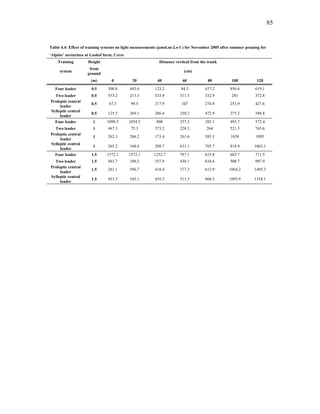
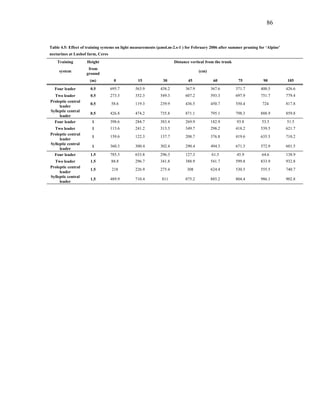
  • 19.
    9 the amount oflight that falls on the orchard floor is by planting at higher densities. Hampson et al. (2004) proved that LAI increased with higher planting density, and hence light interception increased. In an experiment they compared a ‘slender spindle’, ‘tall spindle’ and a ‘Geneva Y’ trellis system and found that to achieve a light interception of at least 50 percent, a planting density of between 1 800 and 2 200 trees/ha was needed for ‘Royal Gala’ and ‘Summerland McIntosh’ apple trees, depending on the system used. Not only is light interception important, but light distribution within the tree canopy plays just as vital role in light utilization. An adequate amount of light is necessary throughout the whole canopy to stimulate reproductive development and fruit quality. The amount of available light decreases towards the centre or the bottom of a tree canopy where the LAI is the highest. Many researchers, including Johnson and Lakso (1991) used Beer’s Law of light attenuation to illustrate how in theory light intensity decreases as it is distributed deeper into the tree canopy. Beer’s Law states that: I / I0 = e-KL where: I is the light intensity below a leaf area index of L I0 is the light intensity above the canopy K is the light extinction coefficient L is the leaf area index Figure 2.2 illustrates how less light is available as the leaf area index increases.
  • 20.
    10 Figure 2.2: Beer’sLaw of light attenuation. Light intensity decreases as an exponential decay function through the canopy. (Source: JOHNSON, R. .S. AND LAKSO, A. N., 1991. Approaches to modeling light interception in orchards. HortScience 26(8):1002-1004) Rom (1991) has shown how light decreases inside the first 0,5 to 1,0 m from the canopy edge in ‘Delicious’ apple tree training to a central leader. See Figure 2.3. Figure 2.3: Light intensity decreases from the top of the tree canopy to the interior bottom of the canopy. Graph represents data collected from six replicate ‘Delicious’ trees in eastern Washington. (Source: ROM, C. R., 1991. Light thresholds for apple tree canopy growth and development. HortScience 26(8):989-992) This reduction in available light has a profound effect of the efficiency of a fruit tree. Jackson et al. (1971) found that “Cox’s Orange Pippin” apples on the outside of the trees were larger in size and better coloured than fruit from the inside of the canopy from the same tree. Jackson and Palmer (1977) also found that by shading “Cox’s Orange Pippin”
  • 21.
    11 apple trees toreceive 11% of full sunlight, shoot growth was significantly influenced. The number of shoots, and total shoot length and weight were significantly reduced compared to trees that were unshaded. They also found a reduction in flower bud formation in the shaded trees, which had residual negative effect on the percentage of flowers which set fruit in the following year. Consequently, fruit set and fruit size were reduced remarkably in the shaded trees. This variation in light levels within a canopy thus has a significant effect on apple production. Génard and Baret (1994) reported a variation in light levels within the canopy of peach trees. Fruit position would therefore also have an effect on fruit quality. This was confirmed experimentally by Caruso et al. (1998). Fruit from the upper part of a ‘Spring Lady’ peach tree trained to a central leader were larger in size than fruit from the lower part of the same canopy. The minimum threshold for photosynthesis is said to be a 30% of full sunlight (Cain, 1972). It is therefore of utmost importance that the whole canopy receives sufficient light and that it is distributed throughout the whole canopy for a tree to perform efficiently. 2.3 ORCHARD SYSTEMS Light interception is a function of canopy size and shape. These factors are influenced by the choice of rootstock, training system and planting density. 2.3.1 Rootstock The choice of rootstock is one of the most effective methods by which to manage tree growth and canopy size. Size-controlling rootstocks reduce vigour and can thus reduce the time spent on pruning and managing the desired tree canopy. As previously mentioned, a size-controlling rootstock for stone fruit is not available. In the past peach trees worldwide were predominately grafted on seedling rootstocks (Rom, 1983). These rootstocks were effective in low density planting as they produced vigorous trees. Because of the high vigour of peach seedling rootstock as well as other limitations such as their susceptibility to nematodes, producers were forced to look at alternative rootstocks as production systems intensified. Clonal rootstocks such as the peach-almond hybrid ‘GF 677’ were developed. The performance of a rootstock is dependent on its
  • 22.
    12 ability to adaptto the local environment. Table 2.1 tabulates various rootstock problems and how the different major peach producing countries are affected by these problems. According to Rom (1982) the three major problems facing rootstocks in South Africa are nematodes, waterlogging and vigour control. The development of a suitable rootstock under South African conditions is thus specific to the problems facing peach production areas in South Africa. The present study will concentrate on three different rootstocks used commonly under South African conditions. Table 2.1: Peach rootstock problems related to nursery and orchard production as reported in the survey. (Source: ROM, R. C., 1982. The peach rootstock situation: an international perspective.)
  • 23.
    13 2.3.1.1 Kakamas seedling: InSouth Africa, as in the rest of the world, the peach seedling was used as the primary rootstock for peach production. Wallace (1896) reported on peach production in South Africa as early as the 19th century. The first production peach in South Africa seems to be the ‘St-Helena’ cling peach. This peach was planted all over South Africa and in some of the more northern parts it adapted so well that it became known as the ‘Transvaal yellow peach’. ‘Kakamas’ is a selection of this ‘Transvaal’ yellow peach (De Wet, 1952). ‘Kakamas’ seedling became the standard for rootstock selection because of its ability to adapt very well to the South African conditions. Over the years, certain limitations have put some pressure on the popularity of this rootstock. As with most peach seedling rootstocks (Rowe and Catlin, 1971), ‘Kakamas seedling’ is very sensitive to wet conditions (Stassen and Van Zyl, 1982). This has limited the use of this rootstock in the south western parts of the country where winter and early spring rainfall create waterlogged conditions. Waterlogged soils are soils in which the water has displaced all the oxygen and anaerobic conditions are created. The sensitivity of peach roots is due to the fact that under anaerobic conditions a toxic hydrogen cyanide (HCN) gas or prussic acid is formed in the plant. This prussic acid is derived from prunasin, a cyanogenic glycoside which is hydrolyzed under anaerobic conditions (Rowe and Catlin, 1971; Du Preez, 1980). Even short periods of waterlogging can cause these toxic concentrations to increase slightly, which causes a quick and irreversible die-back of the plant (Du Preez, 1980). Another disadvantage of the ‘Kakamas’ seedling rootstocks is its susceptibility to nematodes. The root-knot nematode (Meloilogyne spp) and ring nematode (Criconemella xenoplax) are commonly associated with peach tree diseases. Stassen and van Zyl (1979) showed that the ‘Kakamas’ seedling rootstock is very susceptible to root-knot nematode infestation. Symptoms of nematode infestation include dying back of shoot tips, poor differentiation of bearing shoots and a reduction in fruit size and overall fruit production (Stassen, 1996).
  • 24.
    14 The ‘Kakamas’ seedlingrootstock is also very susceptible to soils with free lime. Free lime causes iron, zinc and manganese cations to take on an insoluble carbonate form. This means that the tree cannot assimilate these cations. The effect of free lime can thus become visible by way of iron, zinc and manganese deficiencies, which include yellowing of leaves, inhibited photosynthesis, reduced leaf area and, consequently, a reduction in crop (Du Preez, 1980). 2.3.1.2 SAPO 778 Peach producing countries all worldwide, including France (Renuad et al., 1988), Italy (Di Vito et al., 2002), Spain (Albás et al., 2004), the USA (DeJong et al., 2004) and South Africa (Du Toit, 2005) initiated trails to identify promising clonal rootstocks to overcome the problems facing seedling rootstocks. One of the clonal rootstocks that enjoyed popularity in South Africa is the complex interspecies hybrid ‘SAPO 778’. This clonal rootstock was bred by F. Zaiger (Zaiger’s Genetics, Inc., Modesto, CA) in California (Lötze, 1997). The peach seedling ‘Siberian C’, native to Canada, was included in the clone because of its good productivity and its ability to be fruitful early in the lifetime of the tree. ‘SAPO 778’ has proved to be better adapted to wet soils than ‘Kakamas’ seedling (Lötze, 1997). In an experiment carried out over nine years in soils with a pH of 5.5, exposed to wet conditions in the winter months, trees on ‘SAPO 778’ rootstocks produced more fruit and better fruit size than trees on ‘Kakamas’ seedling rootstocks. ‘SAPO 778’ is more vigorous than ‘GF 677’ and ‘Kakamas’ seedling in terms of vegetative growth (Stassen et al., 2006 – personal communication). ‘SAPO 778’, however, gives delayed foliation symptoms in low chilling areas (Stassen et al., 2006 – personal communication). 2.3.1.3 GF 677 The ‘GF 677’ rootstock is a peach-almond hybrid that originated from a rootstock development programme in France, where rootstocks were identified that overcame the problem with calcareous soils and cold and wet springtime developing conditions often found in the southwest of France (Renaud et al., 1988). ‘GF 677’ has become very
  • 25.
    15 popular as aclonal rootstock worldwide (Rom, 1983). By 1978 23% of the total peach production area in France was utilized by ‘GF 677’ rootstocks (Rom, 1982). Even in Italy, the second largest peach and nectarine producing country in the world (OABS, 2004), ‘GF 677’ has become the most utilized rootstock because of its tolerance to replanting problems and calcareous soils and its ability to produce good yields (De Salvador et al., 2002). ‘GF 677’ also performs well in soils with free lime (Rom, 1982). Lötze (1997) found that under South African conditions, ‘GF 677’ produced significantly better yields than ‘Kakamas’ seedling in soils with a high pH. ‘GF 677’ has however been proven to be very vigorous (Klenyán et al., 1998; De Salvador et al., 2002; Albás et al., 2004), which can have a negative effect on some fruit quality characteristics (De Salvador et al., 2002). De Salvador et al. (2002) also noted that ‘GF 677’ can be sensitive to watterlogging. ‘GF 677’ has also poor resistance to any root- knot nematodes (DiVito et al., 2002). 2.3.2 Training systems According to Stassen and Davie (1996) a training systems is “the structure to which the tree canopy will be shaped to make fruit more accessible and expose the total leaf canopy and bearing shoots to the optimal light required for the different plant functions”. Fruit trees can be trained to four basic shapes: 1) multi-leader free standing systems, 2) single-leader free standing systems, 3) palmette trellis systems and 4) V- systems. All over the world the different shapes have been modified and adapted to be as efficient as possible under the conditions of specific areas. For example, in some parts of France peach trees were trained to a cup shape with and open centre, made possible with three to four scaffold branches (Hugard, 1980), whereas in Italy the same type of open- centre system was often trained with five to six scaffold branches for peach trees (Sansavini, 1983). Because of the difference in training procedures in different production areas this study will concentrate only on the training systems as used for peach production under South African conditions.
  • 26.
    16 2.3.2.1 The open-vasesystem The open-vase system is a type of multi-leader free standing system. It is the system most commonly used all over the world as low density planting system (Figure 2.4). Tree density and the number of primary scaffold, as well the overall tree shape varies in the different production areas. Stadler and Stassen (1985b) described an open-vase trained tree under South African conditions to consist of a short stem of 30 to 60 cm on which multiple main scaffold branches are grown outwards at an angle of 40 to 70º. Side bearing branches are grown on the main scaffolds and spaced 50 to 60 cm apart. The leaders of the main scaffolds and bearing branches are kept dominant by removing any competitive growth, including water shoots (Bergh, 1972). Tree height is limited to 4 m. These trees are planted at a low density of 300 to 400 trees per hectare (Sansavini, 1983). A major disadvantage of this system is the overshadowing of the lower outside parts of the tree canopy, under the main scaffolds. Because the trees are broader at the top, the top overshadows the bottom part of the canopy. Figure 2.5 shows how the light intensity decreases to below 30% of full sunlight in a round shaped open-vase system for a ‘Delicious’ apple tree (Looney, 1991). Figure 2.4: The traditional “open vase” peach tree is less uniform and thus more costly to maintain. (Source: Day, K. R., DeJong, T. M., Johnson, R. S., 2005. Orchard-system configurations increase efficiency, improve profits in peaches and nectarines. California Agriculture, 59(2):75-79)
  • 27.
    17 Figure 2.5: Averagelight zonation patterns for three standard sized ‘Delicious’ apple trees. Grid position within both the North-South and East-West grids were summed individually and then assigned to the appropriate light zone. (Source: Looney, N. E., 1968. Light regimes within standard size apple trees as determined spectrophotometrically. Proceedings of the American Society for Horticultural Science, 93:1-6) Other disadvantages include limited bearing space, water shoots on the inside of the tree canopy as well as structural support needed for older scaffold branches (Stadler and Stassen, 1985b). 2.3.2.2 The closed-vase system According to Cain (1972) an angled hedge-row surface will receive more even light distribution within the canopy than trees with a vertical surface and he proposed that a pyramidal-shape hedge with an angle of 20º to the vertical on each side would be ideal. Bergh (1974) stated further that to be more practical in terms of harvesting trees must be spaced so that they do not grow into each other, but still obtain a pyramidal shape. The closed-vase system is a free standing multi-leader system with a pyramidal canopy shape. See Figure 2.6. Strydom (1985) described the closed-vase system under South African conditions. These trees are developed from a relatively short trunk with three of four dominant leaders. Side scaffolds are developed on the leaders from a height of 50 cm
  • 28.
    18 above the ground,with a spacing of 50 to 70 cm between the scaffolds, depending on the planting distance. To from a pyramidal shape the side scaffolds should become weaker and shorter with wider crotch angles the higher they are situated in the tree. Trees trained to this system are preferably planted at densities of 600 to 1 000 trees per hectare. Figure 2.6: Full-bearing closed-vase tree. Note the dominant main and subordinate scaffolds and pyramid form. (Source: Strydom, D. K., 1985. The closed vase: An alternative training system for apples and pears. Deciduous Fruit Grower, 35:360-364) The closed-vase system with a pyramidal shape was developed from the open-vase with a vase shape by keeping the leaders more upright and developing lateral branches from the base upwards a broader base with an slope of approximately 20° from the top is thus developed. The difference between the open- and closed-vase systems is the angle at which the three or four dominant scaffolds are grown and the angle of the lateral shoots. The dominant scaffolds of the closed-vase system are grown at a much smaller angle
  • 29.
    19 giving the treea smaller, more upright pyramidal canopy (compare Figure 2.4 and 2.6). The advantage that the closed-vase has over the open-vase includes an earlier bearing, more efficient tree canopy, which allows higher density plantings to produce higher volumes (Bergh, 1974). Light distribution within the canopy of the closed-vase system can however be problematic. The canopy still had areas of heavy shading in the lower inner parts. 2.3.2.3 The central leader system The trend to train apple and pear trees to a single leader free-standing system was soon followed for peach trees. Many variations of the central leader system exist, including the vertical axe, solaxe, slender spindle and super spindle. All these variations have the same basic shape which comprises a single main scaffold to which lateral shoots are attached around so that the canopy will form a pyramidal shape (Stadler and Stassen, 1985b). Because of the vigorous growing habit of stone fruit trees discussed earlier, the use of the central leader system on peach trees can be restrictive. Summer pruning is necessary to manage tree growth. Without this tool it is impossible to maintain high density peach orchards (Stadler and Stassen, 1985a). Fochessati (1981) initially discussed the training of peach trees to a central leader under South African conditions. According to him the ideal central leader tree would consist of a dominant central leader surrounded by smaller less dominant bearing laterals. The diameter ratio between the leader and the lateral should be at least 3 to 1. He explained that to obtain a dominant leader and to get the lateral shoots at the desired positions, the trees should be cut back to 15 to 20 cm above the bud union just after planting. The tree is thus trained sylleptically. One shoot is selected to become the dominant leader. According to Jacobs and Strydom (1993) using the sylleptic route causes wide-angled plagiotropic sylleptic shoots to develop because of poor apical dominance and strong apical control of the dominant leader. This specific growing pattern is ideal to form a pyramidal canopy shape. Basal shoots that tend to grow too vigorously should however be headed back to weaken the growth. Any lateral shoot developing lower than 30 to 40 cm from the ground ought to be removed. The upper lateral shoots should also be
  • 30.
    20 removed so thatthe vertical shoot can remain dominant (Jacobs and Strydom, 1993). Stadler and Stassen (1985b) explained that in South Africa the lateral shoots are positioned in a spiral form around the central leader so that shoots are not on top of one another. Fochessati (1981) recommended a planting distance of 1 to 2 m in the row and 4 to 4.5 m between rows ( 1 111 to 2 500 trees per hectare) when training peach trees to a central leader. A central leader tree can also be trained proleptically where the trees are not cut back after planting. This method of training trees to a central leader is more common in pome fruit production where trees do not easily form sylleptic shoots. Jacobs and Strydom (1993) explained that when using the proleptic route on trees with strong apical dominance and poor apical control lateral shoots with narrow crotch angles develop. These shoots compete heavily with the chosen dominant shoot and the tree can easily loose its central leader. Care should thus be taken to ensure that the vertical leader of the tree is kept dominant. Since stone fruit trees typically have poor apical dominance and strong apical control, the proleptic route can be considered when training peach trees to a central leader. The tree size of a central leader system is smaller than an open-vase and thus produces less fruit per tree, but because of the higher density plantings of the central leader type, a higher yield per hectare can be produced (Marini et al., 1995) without a significant decreasing fruit size (Bassi et al., 1985). The central leader also produces a high yield early on (Bassi et al., 1985). Because the smaller tree size of the central leader, light distribution within the canopy will be more sufficient than within the open-vase. Fochessati (1981) advises however that to avoid shading, attention should be given to the canopy areas 1 to 1.8 m above the ground. This was confirmed by Robinson et al. (1991) who showed how the poor light distribution occurred in the areas 0.5 to 2 m from the ground in the canopy of 11-year old ‘Empire’/M.7 apple trees trained to a central leader system. See Figure 2.7. High establishment and maintenance costs are two of the greatest disadvantages of the central leader system.
  • 31.
    21 Figure 2.7: Canopylight distribution pattern at four times during the growing season for 11-year old ‘Empire’/M.7 apple tree trained as central leaders. Values are percent full sun as determined by fisheye photography, n = 3. (Source: Robinson, T. L., Lakso, A. N. & Ren, Z., 1991. Modifying apple tree canopies for improved production efficiency. HortScience, 26(8):1005-1012) 2.3.2.4 The palmette system The possibility of training a tree to a palmette form with the help of a trellis system dates back as far as the 19th century (Wardle, 1883). The popularity of the palmette training system actually only started to increase in the mid-1950’s when an inventive grower from Italy, Baldassari, chose to use this system rather than the traditional vase- or pyramidal- shaped trees (Corelli-Grappadelli, 2000). This caused producers in Italy to train many apple and pear trees to the palmette system after World War II (De Wet, 1966). In South Africa the palmette training system was first implemented on apple trees in 1959 (Berg, 1975). Stadler and Stassen (1985c) described a peach tree trained to a traditional palmette system as having single main shoot with a few lateral scaffolds at opposite sides within the row direction. This system was originally implemented on apple and pear trees. The vigorous growing habit of stone fruit trees made it difficult to train peach trees to this system. Some modifications were however made and today the palmette system is one of the most successful training systems in Italy for peach production (Corelli-Grappadelli, 1997).
  • 32.
    22 De Wet (1966)and Bergh (1974) explained the ideal form of the traditional palmette system under South African conditions. According to them two scaffold branches should be as far possible be positioned opposite to each other with an angle of 45º to 60º to the main stem. The bottom scaffold should not be lower than 35 cm from the ground. The distance between successive scaffolds should be between 45 and 85 cm. The side scaffolds should decrease in size and length as they are positioned higher up on the main stem. The width of the bottom scaffolds should not exceed 2 m. The top part of the tree should not end in a pair of scaffolds, but rather a single vertical extension. Tree height is preferably restricted to 4 m. To develop the side scaffolds at the desired position, the main stem is tipped in the winter at the appropriate height and the central leader and two scaffolds are chosen from the developing shoots the following year. Figure 2.8 shows the traditional palmette system used on apple trees. Figure 2.8: Ten-year-old apple trees with well balanced branches. (Source: De Wet, A. F., 1966. Growing fruit trees to the Palmette shape. Deciduous Fruit Grower, 16:90-95 To adjust the palmette system for more vigorous growing trees, like plums, Bergh (1981) suggested a few modifications. He suggested the side scaffolds be developed in one season by tipping the main stem in the summer months. This would induce more lateral growth from which side branches can be chosen. Lately there has been a trend to avoid these heading cuts (Corelli-Grappadelli, 2000). If trees are well feathered it should not be
  • 33.
    23 necessary to cutback the central leader. This would reduce labour cost, reduce unwanted vegetative growth and accelerate production in the developing years (Corelli-Gappadelli, 2000). Bergh (1981) also suggested that the side scaffolds should rather be developed at an angle of 90º on the main stem to reduce over-vigorous growth. The initial aim of the palmette system was to increase orchard efficiency and profitability. Studies have shown that this system is capable of these requirements. Because of the narrow canopy shape, light is distributed evenly throughout the whole canopy (Corelli and Sansavini, 1989). The palmette system is also capable of producing similar yield to other systems, such as the central leader system (Allison and Overcash, 1987). Because of the ‘flat’ canopy surface of the palmette it can be more efficient in some agricultural practices, such as pesticide spraying or picking. This system can however be very expensive to establish when using a trellis system. 2.3.2.5 The ‘Y’-shaped system Another fairly popular training system used in South African peach production that requires a trellis system is the Tatura. This system was developed by the Irrigation Research Institute in Tatura, Australia (Chalmers et al., 1978). This system consists of two scaffold limbs per tree growing out perpendicular to the row directions. These two scaffolds are grown at an angle of 60 to 70º from the horizontal level in the direction of the corresponding scaffolds in the adjacent rows. The scaffolds are limited to a height of 3.5 m and a 2 m gap is kept between the ends of two scaffolds in adjacent rows. Bearing branches are developed on the two main scaffolds. Figure 2.9 shows the ‘Y’-shaped Tatura system used on peach trees.
  • 34.
    24 Figure 2.9: TaturaTrellis system showing rows of peach trees spaced at 6m. (Source: Chalmers, D., van den Ende, B. & van Heek, L., 1978. Productivity & mechanization of the Tatura trellis orchard. HortScience, 13(5):517-521) Chalmers et al. (1978) found that the Tatura system produced yields that were just as good as or even better than production from other experiments carried out at more or less the same time. Production was also much higher than the commercial peach orchards in the same area. They also found that light interception and distribution with the ‘V’ of the system can be satisfied if the two meter gap between adjacent scaffolds is kept open. The Tatura system was originally designed to be mechanically pruned and picked (Chalmers et al., 1978) but in South Africa all pruning and picking is done manually, which is labour costly (Stadler and Stassen, 1985c). Free standing ‘Y’-shaped trees have also been popular for many years. These trees are also trained to two main scaffolds perpendicular to the row direction, but without the use of a trellis system. In some cases the two primary scaffolds can also be grown parallel to the row direction. The free standing Kearney Agricultural Center Perpendicular-V (KAC- V), developed in California for manual harvesting, has received lot of attention (DeJong et al, 1994). According to DeJong et al. (1994) the KAC-V, a hybrid between the open- vase and Tatura systems, is said to:
  • 35.
    25 • increase productionin the developing years of the orchard, • produce yield equal to or greater than the open-vase at full bearing and thereafter, • avoid unnecessary intensive summer pruning to maintain tree size, • simplify tree structure so that cultural practices such as pruning, thinning and picking can be carried out more easily, • and maintain or improve the light distribution characteristics with in the canopy of an open-vase system. According to DeJong et al. (1994) the tree consists of two main scaffolds, grown perpendicular to the row direction, with an ideal angle of 25º to 40º from the vertical. Bearing branches are developed on the main scaffolds. Tree height is generally restricted to 3.5 to 4.5 m. The desired tree shape is maintained by keeping the two main scaffolds dominant and by keeping the inside of the ‘V’ open and free from vigorous watersprouts. The appropriate planting distances range from 1.5 to 2 m between trees in the row and 4.5 to 5.5 m between rows (909 to 1 481 trees per hectare). In Figure 2.10 one can see the KAC-V with the two main scaffolds perpendicular to the row direction.
  • 36.
    26 Figure 2.10: Atrial orchard planted in 1982 introduced another alternative for high-density stone fruit orchards, the perpendicular V. This system maintained standard 18-feet row spacing but planted trees about 6 feet apart, affording the advantages of early high yields without the additional cost of new equipment for maneuvering in narrow row middles. (Source: http://CaliforniaAgriculture.ucop.edu) Free standing ‘Y’-systems can produce higher yields at full-bearing than the traditional open-vase system (DeJong et al., 1999) and a central leader system (Caruso et al., 1999). ‘Y’-shape systems also have better light interception and distribution within the canopy than a central leader system (Singh et al., 2004) and the traditional open-vase system (Grossman and DeJong, 1998). De Salvador and DeJong (1989) that a ‘Y’-shaped system intercepted 74% of the available light compared to 71% for an open-vase and 69% for a central spindle system. They also found that the light distribution within in the canopy of the ‘Y’ was 35% higher than the central spindle. Robinson et al. (1991) showed how a ‘Y’-shaped tree has the best light distribution on the inside of the ‘Y’. See Figure 2.11 Problems with shading may occur in the bottom of the ‘Y’. The higher light interception and distribution can lead to the ‘Y’-system producing more fruit of high quality. Caruso et al. (1998) found that of the total yield, a free-standing ‘Y’-shaped system produced 74 percent first grade fruit compared to 63 percent produced by a central leader system.
  • 37.
    27 Robinson et al.(1989) ascribed the better light interception of the ‘Y’-system to the architecture of the tree, where the arms of the ‘Y’ are allowed to grow over the row alley, thus intercepting light that would otherwise fall on the orchard floor. Caruso et al. (2001) however found that to obtain the ‘Y’-shape of this training system required more pruning than the central leader system in the developing years. They also found that this intense pruning of the young tree caused a later onset of fruit and lowered the quantity of early yield during the initial years. Figure 2.11: Canopy light distribution pattern at four times during the growing season for 11-year old ‘Empire’/M.26 trees trained as a Y-shaped hedgerow. Values are percent of full sun as determined by fisheye photography, n = 3. (Source: Robinson, T. L., Lakso, A. N. & Ren, Z., 1991. Modifying apple tree canopies for improved production efficiency. HortScience, 26(8):1005-1012) 2.3.2.6 The four-leader system Another system recently used in South Africa for nectarine production is a low density four-leader system. The four-leader system shares many characteristics with that of the ‘Mikado’ system used for apple production. The ‘Mikado’ system was developed in the Netherlands as a low density ‘V’ system for apple and pear production (Widmer and Krebs, 1997). With this system vegative growth is partitioned into four equally strong branches from one trunk. The branches are oriented two on each side. See Figure 2.12. Widmer and Krebs (1997) described this system to have a efficient use of orchard space in terms of branch arrangement as well as efficient use of light to produce good quality fruit. In South Africa the four chosen leaders are headed a second time during summer pruning in the following year after planting. This is to allow the scaffolds to develop more horizontal.
  • 38.
    28 Figure 2.12: ‘Mikado’with the pear variety ‘Conference’ on quince ‘A’ with four fruiting elements arranged in a ‘V’ in the 5th year (planted as one-year-old trees). (Source: WIDMER, A. & KREBS, C., 1997. ‘Mikado’ and ‘Drilling’ (triplet) – two novel training systems for sustainable high quality apple and pear production. Acta Horticulturae 451:519-528) 2.3.3 Tree density When planting a new orchard, one of the key decisions that has to be made is at what densities the trees need to be planted. The trend during the last 20 year has been to plant at higher densities. Numerous studies have shown that planting at higher densities
  • 39.
    29 can increase yieldper hectare, not only for apple production (Weber, 2000; Widmer and Krebs, 2001; Robinson and Hoying, 2004) but for peach production as well (Phillips and Weaver, 1975; Bargioni et al., 1985; Caruso et al., 1997; Marini and Sowers, 2000). Another good reason for planting at higher densities is that it increases fruit production early on. Leuty and Pree (1980) found that with higher planting densities increased yield by more than 67% during the first four years after planting for three different peach cultivars. An increase in tree density does, however, not always mean an increase in fruit production. Widmer and Krebs (2001) found that when they planted apple trees at densities of 3 000, 4 000, 5 000 and 6 000 tree per hectare the increase in yield was not proportional to the increase of tree density. They concluded that the higher input cost of trees exceeding a density of 3 000 per hectare was not justified by the increase in yield. Some studies have shown that higher density plantings result in decreased fruit size (Layne et al., 1981; Caruso et al., 1997; Marini and Sowers, 2000). Tree density is rather closely associated with the training system used. Trees that are trained to reach a smaller canopy size can be more conducive to higher densities. Tree density for a specific training system can also differ under different environmental conditions. The ideal tree density will therefore depend on the training system used together with production potential of a specific site. 2.4 FINANCIAL EVALUATION METHODS To compare the different training systems on a financial basis a method must be used to identify the training system that would be the most beneficial to an investor in the long run. This method is called capital budgeting. When doing capital budgeting there are many techniques to compare and rank different investment opportunities, each with its own advantages and disadvantages. One of the main requirements when choosing a training system is that it starts producing a commercial yield earlier during the lifetime of the orchard so that the investment made
  • 40.
    30 in the orchardcan be returned as soon as possible. The payback method is a capital budgeting technique that is commonly used and is easy to understand. It determines the time it takes to recover the cost of an investment from the cash flow it generates. So the training system that takes the least time to recover from the initial investment would be preferred. This method has however a number of disadvantages. One of them is that it ignores the cash flow after the payback-period (Correia et al., 1993). To eliminate the problem of ignoring the importance of ‘after-payback-cash-flow’ and to take in to account the time value of money, a technique is used to determine the net present value (NPV) of an investment opportunity. The net present value of a project is defined as “the present value of the project’s future cash flow minus the cost of the project” (Shapiro, 1990). In other words the net present value of a project is estimating the future cash flow of that project, discounting the estimated future cash flow at the required rate of return (cost of capital) and subtracting the initial cost of the project (Correia et al, 1993). The formula to determine net present value is: ( ) { } ∑ = − + = n t t t I k C NPV 1 1 / where: Ct is the net cash flow at time t I is the cost of investment k is the required rate of return (cost of capital) To decide whether a project is worthwhile investing in, the following rule should be followed (Vernimmen et al, 2005): NPV > 0 Invest NPV < 0 Do not invest Shapiro (1990) also stated that if the NPV of two or more projects are all greater than zero, the one with the highest NPV should be preferred.
  • 41.
    31 Another method ofcomparing different projects is to determine the internal rate of return (IRR) for each project. The IRR is the discount rate that causes the present value of net future cash flows of a project to equal the initial cost of the investment (Correia et al., 1993): ( ) { } ∑ = = − + n t t t I r C 1 0 1 / where: r is the internal rate of return In other words, the IRR is the discount rate which causes NPV to equal zero. This discount rate (r) is determined by trail and error. The NPV are calculated for several values of r until the point is reached where NPV turns from positive to negative (Shapiro, 1990). If the IRR of a project exceeds the cost of capital, the project should be accepted, but if the IRR is less than the cost of capital, the project should be rejected. If two or more projects are compared, the project with the highest IRR should be the preferred choice. Using the method of calculating the NPV and the IRR of a project usually produces the same conclusion when deciding on a future investment. However, there are several different types of projects that pose potential difficulties in analysing capital budgeting. Dependent projects are projects whose acceptance depends on the acceptance or rejection of other projects. A mutually exclusive project is one whose acceptance will rule out the acceptance of another project. It is therefore necessary to determine which project is the best, when facing mutually exclusive projects (Van Horne and Wachowicz, 1995). Ranking of the best project is done on the basis of the NPV and IRR. Conflict in rankings according to NPV and IRR may occur. According to Van Horne and Wachowicz (1995) there are three reasons for this conflict in rankings. Firstly, there may be scale differences, where the initial cash outflows are different for the mutually exclusive projects. Secondly, different cash flow patterns of different projects can cause conflict in rankings. Thirdly, if projects have unequal projected lifespans, it can result in conflicting rankings. If however there is a difference in rankings according to the NPV and IRR methods, in the case of mutually exclusive projects with conflicting rankings the final
  • 42.
    32 investment decision shouldrather be made according to the ranking of the NPV method (Correia et al., 1993). This methods of capital budgeting has been used in many studies to compare different orchard systems for fruit trees. Marini and Sowers (2000) wanted to compare two training systems, the central leader and the open-vase systems, for peach trees in terms of tree growth, yield and profitability. To compare the systems in terms of tree growth, they used the trunk cross-sectional area (TCA), the tree height and tree spread of the different trees. To compare the systems in terms of yield, they used the marketable yield ton per hectare for each system. But to evaluate to profitability of the systems they compared the cumulative NPV of each. Weber (2000b) compare three different training systems planted at different densities for ‘Jonagold’ apple trees. He made the economic comparison based on the calculation of NPV of future cash flow to the initial cash outflow of the different systems. Uzunoz and Ackay (2006) used the method of NPV and IRR calculation to investigate the profitability and feasibility of peach and apple production in Turkey and came to the conclusion that, based on positive NPV findings, producing these fruit could be one of the most important forms of income for farmers in the researched area in Turkey.
  • 43.
    33 2.5 REFERENCES ALBÁS, E.S., JIMÉNEZ, S., APARICIO, J., BETRÁN, J. A. & MORENO, M. A., 2004. Effect of several peach × almond hybrid rootstocks on fruit quality of peaches. Acta Horticulturae, 658:321-326 ALLISON, M. L. & OVERCASH, J. P., 1987. Factors affecting hedgerow peach orchard establishment. Journal of the American Society for Horticultural Science, 112:62-66 BARGIONI, G., LORETI, F. & PISANI, P. L., 1985. Ten years of research on peach & nectarine in a high density system in the Verona area. Acta Horticulturae, 173:299-309 BASSI, D., BRIGHENTI, G. & NARDI, V., 1985. Training systems of ‘Klamt’ cling peach: performance after 8 years – IV Contribution. Acta Horticulturae, 173:339-348 BASSI, D., DIMA, A. & SCORZA, R., 1994. Tree structure and pruning response of six peach growth forms. Journal of the American Society for Horticultural Science, 119(3):378-382 BERGH, O., 1972. Pruning of vase-shaped stone fruit trees. FFTRI Information Bulletin, No. 85 BERGH, O., 1974. Preliminary results of trials in trellising, spacing and summer-pruning of canning peaches for a higher production per unit of surface area. The Deciduous Fruit Grower, 24(6):154-159 BERGH, O., 1981. A proposed palmette system for vigorously growing plum cultivars. The Deciduous Fruit Grower, 31(8):294-301
  • 44.
    34 CAIN, J. C.,1972. Hedgerow orchard design for most efficient interception of solar radiation. Effects of tree size, shape and row direction. Search Agriculture, 2(7):1-14 CARUSO, T., BARONE, E. & DI VAIO, C., 2001. Factors affecting tree crop efficiency in young peach trees: rootstock vigor and training system. Acta Horticulturae, 557:193- 197 CARUSO, T., DI VAIO, C., INGLESE, P. & PACE, L. S., 1998. Crop load and fruit quality distribution within canopy of ‘Spring Lady’ peach trees trained to ‘central leader’ and ‘Y-shape’. Acta Horticulturae, 465:621-628 CARUSO, T., GIOVANNINI, D., MARRA, F. P. & SOTTILE, F., 1997. Two new planting systems for early ripening peaches (Prunus persica L. Batsch): yield and fruit quality in four low-chill cultivars. Journal of Horticultural Science, 72:873-883 CARUSO, T., INGLESE, P., SOTTILE, F. & MARRA, F. P., 1999. Effect of planting system on productivity, dry-matter partitioning and carbohydrate content in above-ground components of ‘Flordaprince’ peach trees. Journal of the American Society for Horticultural Science, 124(1):39-45 CHALMERS, D., VAN DEN ENDE, B. & VAN HEEK, L., 1978. Productivity and mechanization of the Tatura trellis orchard. HortScience, 13(5):517-521 CORELLI, L. & SANSAVINI, S., 1989. Light interception and photosynthesis related to planting density and canopy management in apple. Acta Horticulturae, 243:159-174 CORELLI-GRAPPADELLI, L., 1997. Peach orchard management in Italy. The Compact Fruit Tree, 30:73-80 CORELLI-GRAPPADELLI, L., 2000. The palmette training system. Acta Horticulturae, 513:329-336
  • 45.
    35 CORREIA, C., FLYNN,D., ULIANA, E. & WORMALD, M., 1998. Financial Management. 3rd ed. Kenwyn, South Africa: Juta & Co DAY, K. R., DEJONG, T. M., JOHNSON, R. S., 2005. Orchard-system configurations increase efficiency, improve profits in peaches and nectarines. California Agriculture, 59 (2):75-79 DE SALVADOR, F. R. & DEJONG, T. M., 1989. Observation of sunlight interception and penetration into the canopies for peach trees in different planting densities and pruning configurations. Acta Horticulturae, 254:341-346 DE SALVADOR, F. R., ONDRADU, G. & SCALAS, B., 2002. Horticultural behaviour of different species and hybrids as rootstocks for peach. Acta Horticulturae, 592:317-322 DE WET, A. F., 1952. The origin of the Kakamas peach. Farming in South Africa, July:347-350 DE WET, A. F., 1966. Growing fruit trees to the Palmette shape. The Deciduous Fruit Grower, 16:90-95 DEJONG, T. M., DAY, K. R., DOYLE, J. F. & JOHNSON, R. S., 1994. The Kearney Agricultural Center perpendicular "V" (KAC-V) orchard system for peaches and nectarines. HortTechnology, 4(4):362-367 DEJONG, T. M. & DOYLE, J. F., 1985. Seasonal relationships between leaf nitrogen content (photosynthetic capacity) and leaf canopy light exposure in peach (Prunus persica). Plant, Cell and Environment, 8:701-706
  • 46.
    36 DEJONG, T. M.,JOHNSON, R. S., DOYLE, J. F., BASILE, B., MARSAL, J., RAMMING, D. & BRYLA, D., 2004. Growth, yield and physiological behavior of size- controlling peach rootstocks developed in California. Acta Horticulturae, 658:449-455 DEJONG, T. M., JOHNSON, R. S., DOYLE, J. F. & RAMMING, D., 2005. Labor costs may be reduced... Research yields size-controlling rootstocks for peach production. California Agriculture, 59(2):80-83 DEJONG, T. M., TSUJITA, W., DOYLE, J. F. & GROSSMAN, Y. L., 1999. Comparative economic efficiency of four peach production systems in California. HortScience, 34(1):73-78 DI VITO, M., BATTISTINI, A. & CATALANO, L., 2002. Response of Prunus rootstocks to root-knot (Meloidogyne species) and root-lesion (Pratylenchus vulnes) nematodes. Acta Horticulturae, 592(2):633-668 DU PREEZ, M., 1980. Gewas / grondassosiasie. Sagtevrugteboer, August:286-299 DU TOIT, A., 2005. Steenvrugonderstamme. Oplossing vir die probleme in die vooruitsig. SA Vrugte Joernaal, Feb/Mrt:14-16 FERREE, D. C., 1988. Role of rootstocks and spur-type scions for controlling vegetative growth of apple and peach trees. HortScience, 23(3):464-467 FOCHESSATI, A., 1981. High-density peach and nectarine orchards. The Deciduous Fruit Grower, 31(9):344-353 GÉNARD, M. & BARET F., 1994. Spatial and temporal variation of light inside peach trees. Journal of the American Society for Horticultural Science, 119:669-677
  • 47.
    37 GIULIANI, R., MAGNANINI,E. & CORELLI-GRAPPADELLI, L., 1998. Whole canopy gas exchange and light interception of three peach training systems. Acta Horticulturae, 465:309-317 GROSSMAN, Y. L. & DEJONG, T. M., 1998. Training and pruning system effects on vegetative growth potential, light interception and cropping efficiency in peach trees. Journal of the American Society for Horticultural Science, 123:1058-1064 HAMPSON, C. R., QUAMME, H. A., KAPPEL, F & BROWNLEE, R. T., 2004. Varying density with constant rectangularity: I. Effects on apple tree growth and light interception in three training systems over ten years. HortScience, 39(3):501-506 HUDSON, J. P., 1971. Meadow orchards. Agriculture, 78:157-160 HUGARD, J., 1980. Peach high density planting in French orchards: development and current achievements. Acta Horticulturae, 114:300-308 HUYSAMER, M., 1997. Integrating cultivar, rootstock and environment in the export driven South African deciduous fruit industry. Acta Horticulturae, 451:755-760 IGLESIAS, I., MONTSERRAT, R., VILARDELL, P. & BONANY, J., 2004. Performance of 'Conference' pear in five intensive planting systems in the north east of Spain. Acta Horticulturae, 636:675-679 JACKSON, J. E., 1980. Light interception and utilization by orchard systems. Horticultural Reviews, 2:208-267 JACKSON, J. E. & PALMER, J. W., 1972. Interception of light by model hedgerow orchards in relation to latitude, time of year and hedgerow configuration and orientation. Journal of Applied Ecology, 9:341-357
  • 48.
    38 JACKSON, J. E.& PALMER, J. W., 1977. Effects of shade on the growth and cropping of apple trees. I. Experimental details and effects on vegetative growth. Journal of Horticultural Science, 52:245-252 JACKSON, J. E., SHARPLES, R. O. & PALMER, J. W., 1971. The influence of shade and within tree position on apple size, colour and storage quality. Journal of Horticultural Science, 46:277-287 JACOBS, G. & STRYDOM, D. K., 1993. Spacing trends of free standing central leader deciduous fruit trees. Journal of the Southern African Society for Horticultural Science, 3(2):79-80 JOHNSON, R. S. & LAKSO, A. N., 1991. Approach to modeling light interception in orchards. HortScience, 26(8):1002-1004 KLENYÁN, T., HROTKÓ, K. & TIMON, B., 1998. Effect of rootstocks on growth of nectarine varieties. Acta Horticulturae, 465:225-228 KSENZHEK, O. S. & VOLKOV, A. G. 1998. Plant Energetics. London, UK: Academic Press Ltd. LAYNE, R. E. C., 1974. Breeding peach rootstocks for Canada and Northern United States. HortScience, 9:364-366 LAYNE, R. E. C., TAN, C. S., HUNTER, D. M. & CLINE, R. A., 1981. Effect of irrigation and tree density on peach production. Journal of the American Society for Horticultural Science, 106:151-156 LEUTY, S. J. & PREE, D. J., 1980. The influence of tree population and summer pruning on productivity, growth and quality of peaches. Journal of the American Society for Horticultural Science, 105:702-705
  • 49.
    39 LOONEY, N. E.,1968. Light regimes within standard size apple trees as determined spectrophotometrically. Proceedings of the American Society for Horticultural Science, 93:1-6 LÖTZE, G. F. A., 1997. Quest for better rootstocks continues. The Deciduous Fruit Grower, March 93 MARINI, R. P. & SOWERS, D. S., 2000. Peach tree growth, yield and profitability as influenced by tree form and tree density. HortScience, 35:837-842 MARINI, R. P., SOWERS, D. S. & MARINI, M. C., 1995. Tree form and heading height at planting affect peach tree yield and crop value. HortScience, 30:1196-1201 PALMER, J. W., BÜNEMANN, G., SANSAVINI, S., WAGENMAKERS, P. S. & WINTER, F., 1989. The international planting systems trial. Acta Horticulturae, 243:231-241 PHILLIPS, J. H. H. & WEAVER, G. M., 1975. A high-density peach orchard. HortScience, 10:580-582 RENAUD, R., BERNHARD, R., GRASSELLY, C. & DOSBA, F., 1988. Diploid plum x peach hybrid rootstocks for stone fruit trees. HortScience, 23:115-124 ROBINSON, T. L., 1997. Interaction of tree form and rootstock on light interception, yield and efficiency of ‘Empire’, ‘Delicious’ and ‘Jonagold’ apple trees trained to different systems. Acta Horticulturae, 451:427-436 ROBINSON, T. L. & LAKSO, A. N., 1989. Light interception, yield and fruit quality of ‘Empire’ and ‘Delicious’ apple trees grown in four orchard systems. Acta Horticulturae, 243:175-184
  • 50.
    40 ROBINSON, T. L.,LAKSO, A. N. & REN, Z., 1991. Modifying apple tree canopies for improved production efficiency. HortScience, 26(8):1005-1012 ROM, R. C., 1982. A new philosophy for peach rootstock development. Fruit Varieties Journal, 36:34-36 ROM, R. C., 1983. The peach rootstock situation: An international perspective. Fruit Varieties Journal, 37:3-14 ROM, R. C., 1991. Light threshold of apple tree canopy growth and development. HortScience, 26(8):989-992 ROWE, R. N. & CATLIN, F. B., 1971. Differential sensitivity to waterlogging and cyanogenesis by peach, apricot and plum roots. Journal of the American Society for Horticultural Science, 96:305-308 SANSAVINI, S., 1983. Comments on present training systems for peach and nectarine orchards in Italy. The Deciduous Fruit Grower, 33(5):175-179 SHAPIRO A.C. 1991. Modern Corporate Finance. New York, USA: Macmillan SINGH, H., KANWAR, J. S. & HUNDAL, S. S., 2004. Radiation regime and fruit quality of peach trees under different training systems. Journal of Agrometeorology, 6:5- 9 STADLER, J. D. & STASSEN, P. J. C., 1985a. Pruning and training deciduous fruit trees: 1. Lighting, density and pruning procedures. Information Bulletin 531, Infruitec, Stellenbosch, South Africa
  • 51.
    41 STADLER, J. D.& STASSEN, P. J. C., 1985b. Pruning and training deciduous fruit trees: 2. Training to free standing trees. Information Bulletin 532, Infruitec, Stellenbosch, South Africa STADLER, J. D. & STASSEN, P. J. C., 1985c. Pruning and training deciduous fruit trees: 3. Training trellis systems. Information Bulletin 533, Infruitec, Stellenbosch, South Africa STARGROW NURSERY, 2004. Production information brochure. Stellenbosch, South Africa STASSEN, P. J. C., 1996. Aalwurm-infestasie by perskes in die somerreënvalstreek. Oorsig, Pretoria (May), p14-15 STASSEN, P. J. C. & DAVIE, S. J., 1996. Tree manipulation – its application in the citrus and subtropical fruit industries. ITSC Information Bulletin, 258:2-10 STASSEN, P. J. C. & VAN ZYL, H. J., 1979. Steenvrugteonderstamme. Boerdery in Suid-Afrika, Steenvrugte A3 STASSEN, P. J. C. & VAN ZYL, H. J., 1982. Sensitivity of stone fruit rootstocks to waterlogging. The Deciduous Fruit Grower, 32:270-275 STRYDOM, D. K., 1985. The closed vase: An alternative training system for apples and pears. The Deciduous Fruit Grower, 35:360-364 STRYDOM, D. K. & COOK, N. C., 2005. Evolution of the pear training model in South Africa. Acta Horticulturae, 671:37-40 TAN, C. S. & BUTTERY, B. R., 1986. Photosynthesis, stomatal conductance and leaf water potential in response to temperature and light in peach. HortScience, 21:1180-1182
  • 52.
    42 UZUNOZ, M. &AKCAY, Y., 2006. A profitability analysis of investment of peach and apple growing in Turkey. Journal of Agriculture and Rural Development in the Tropics and Subtropics, 107(1):11-18 VAN HORNE, J. C. & WACHOWICZ, J. M. 1995. Fundamentals of Financial Management. 9th ed. Englewood Cliffs, USA: Prentice-Hall VERNIMMEN P., QUIRY P., LE FUR Y., DIALLOCCHIO M. & SALVI A. 2005. Corporate Finance: Theory and Practice. West Sussex, England: John Wiley & Sons Ltd. WALLACE, R. 1896. Farming Industries of Cape Colony. South Africa, Cape Town: Juta & Co. WARDLE, W. 1883. Fourth edition of translation from the French of The Scientific and Profitable Culture of Fruit trees by M. du Breul. London, UK: Crossby Lockwood & Co. WEBER, M. S., 2000a. The super spindle system. Acta Horticulturae, 513:271-277 WEBER, M. S., 2000b. Optimizing tree density in apple orchards. The Compact Fruit Tree, 33(4):119-122 WEBSTER, A. D., 1997. A review of fruit tree rootstock research and development. Acta Horticulturae, 451:53-73 WIDMER, A. & KREBS, C., 2001. Influence of planting density and tree form on yield and fruit quality of ‘Golden Delicious’ and ‘Royal Gala’ apples. Acta Horticulturae, 557:235-241
  • 53.
    43 WIDMER, A. &KREBS, C., 1997. ‘Mikado’ and ‘Drilling’ (triplet) – two novel training systems for sustainable high quality apple and pear production. Acta Horticulturae 451:519-528 YUNUS, M., PATHRE, U. & MOHANTY P. 2000. Probing Photosynthesis: Mechanisms, Regulation and Adaptation. London, UK: Taylor & Francis
  • 54.
    44 CHAPTER III THE ROLEOF THE TRAINING SYSTEM AND ROOTSTOCK USED FOR NECTARINES ON PRODUCTION AND LABOUR INPUT DURING THE INITIAL YEARS AFTER PLANTING A NECTARINE ORCHARD Abstract A study was carried out to evaluate different orchard systems for nectarine (Prunus persica var. nectarina) production in terms of labour inset and yield aspects. An ‘Alpine’ nectarine orchard was planted in the winter of 2002 at Lushof farm near Ceres in the Western Cape, South Africa. The trees where trained according to: a four-leader system (5 x 3 m; 667 trees/ha); a two-leader system (5 x 1.5 m; 1 333 trees/ha); a proleptically trained central leader (5 x 1 m; 2 000 trees/ha) and a sylleptically trained central leader (5 x 1 m; 2 000 trees/ha). The trees were planted on three different rootstocks namely GF 677, SAPO 778 and Kakamas seedling. Time spent per tree for pruning, thinning and picking were recorded. Yield aspects comprised of number of fruit and mass of fruit per tree. The four-leader took the longest time to manage per tree but per hectare it took the least time, while the two central leaders took the longest time per hectare to manage. A significant difference in production was recorded in the first two years with the four-leader systems producing the least fruit per hectare. No significant difference between the different systems was found in the third year of production. Rootstock only played a significant role when it came to fruit mass, where trees on SAPO 778 produced heavier fruit with a higher mass than trees on Kakamas seedling and GF 677. 3.1 INTRODUCTION A radical change in training systems for use on apple and pear trees has been taking place worldwide over the last 40 years. The use of new training systems for peach trees has been slower. The open-vase system as described by Bergh (1972), planted at a distance of 7 × 7 m, was for many years the preferred training system for peaches in South Africa (Stadler and Stassen, 1985a). Cain (1972) suggested that a pyramidal tree
  • 55.
    45 shape would bemore efficient and changed from the rounded open-vase shape. Bergh (1976) recommended and described a pyramidal close-vase system. Fochesatti (1981) then described the training of peaches to the central leader. These training systems are discussed by Stadler and Stassen (1985b). The palmette system that was traditionally designed for apple trees was modified and described by Bergh (1974). Chalmers et al. (1978) developed a ‘V’ system (Tatura system), as described by Stadler and Stassen (1985c). Stadler and Stassen (1985b) referred to the results described by Hugard (1980), Fochessati (1981) and Sansavini (1983), and came to the conclusion that due to the limited space, no strong scaffold branches must be allowed for the central leader system, but only bearing branches and shoots that are non-permanent. This developed into a central leader with bearing shoots arranged spirally around it, without branches and old wood that would cause overshadowing. The trend has mainly been to train the central leader sylleptically, where the tree is cut back after planting and the dominant central leader, with lateral shoots developing during the same season, is chosen from the developing shoots (Jacobs and Strydom, 1993). Currently most of the 1 417 hectares (OABS, 2004) of nectarine orchards in South Africa are planted at a distance of 4 x 1.5 m (Jacobs and Strydom, 1993). These trees are mostly trained sylleptically to the central leader system described by Stadler and Stassen (1985b). The main driving force behind the idea of using higher density plantings is to decrease the number of years required for the orchard to reach maximum light interception and full crop production. It has been shown that these orchards can produce relatively high yields, especially in the initial years (Leuty and Pree, 1980; Caruso et al., 1997; Marini and Sowers, 2000). However, higher densities increase the establishment cost significantly (Widmer and Krebs, 2001). The lack of a size-controlling rootstock for stone fruit (Layne, 1974) also causes a problem with higher densities and therefore summer pruning is important to control vigorous watershoots (Stadler and Stassen, 1985a). Trees require more management which increases labour cost. The Kakamas seedling rootstock has been the primary rootstock used in South Africa for many years (De Wet, 1952). This rootstock is however very sensitive to waterlogging (Stassen and Van Zyl, 1982) and susceptible to root-knot nematode infestation (Stassen and Van Zyl,
  • 56.
    46 1982). There arehowever many questions among producers about lower density plantings, savings on plant material and labour cost, keeping trees smaller, and using alternative rootstocks. The aim of this study is to investigate alternative training systems for peaches and compare them to the currently used central leader system. Time necessary for winter and summer pruning, fruit thinning, picking and yield would be recorded as well as yield efficiency. The questions that required answering were: • Should other systems with two of more leaders to fill the space and give more bearing volume be considered? • Should a wider spacing and multiple leaders to divide the growth, limit the height of the trees and reduce planting material cost, but that would take longer to fill the allocated space and to reach breakeven point be considered? • Which is best way to train ‘Alpine’ nectarine trees: 1) sylleptically or 2) proleptically? • What role does the rootstock play in terms of growth, yield and fruit size? 3.2 MATERIALS AND METHODS ‘Alpine’ nectarines were planted in August 2002 at Lushof near Ceres in the Western Cape region, South Africa (33º18’S, 19º20’E), in a north-south row direction. Four different training systems were used and combined with three commercial rootstocks. The rootstocks used were GF 677 (GF), Kakamas seedling (K) and SAPO 778 (SAPO). The training systems used were a sylleptically trained central leader (SS), a proleptically trained central leader (SP), a two-leader system (2-L) and a four-leader system (4-L). The trees where planted on a ‘Tukulu’ soil type with a gravel content of 60% and a clay content of 5 to 8%. Each rootstock was combined with each training system to form 12 rootstock-training system combinations. The two central leader systems were planted at a
  • 57.
    47 spacing of 5x 1 m to give 2 000 trees per hectare. Planting density for the two-leader system was 5 x 1.5 m to give 1 333 trees per hectare. The four-leader system was planted at a density of 5 x 3 m to give 667 trees per hectare. All the trees were planted at a constant distance of five meters between the rows. The layout of the study is a complete randomized block design. Each combination was planted in plots of five trees with three repetition blocks. Only the three inside trees of each plot were monitored in the experiment. After planting, structural pruning was carried out in the summer of 2002/2003 to train the trees according to the different systems. Trees that were to be trained sylleptically according to the central leader, as well as the two-leader and four-leader system, were cut back to more or less 20 cm from the ground immediately after planting. The trees that were to be trained proleptically were left untopped. Four shoots, two on each side of the tree trunk, were chosen for the four-leader system to become dominant. These four shoots were again cut back during the summer to form a step effect. This four-leader system was trained according to the instructions given by a French consultant, Mr Alric Charbit, who was the adviser for this commercial farm. For the two-leader system two shoots parallel to the row direction were chosen to become the dominant leaders. One shoot was chosen for the sylleptically trained central leader to become dominant. After the dominant leaders were chosen, shoots thicker than one third of the leader were removed. Shoots that formed a narrow crotch angle with the leader were removed. All thin wood on the frame shoots was removed at a scissor length from the leader. A planting done near Stellenbosch in the Western Cape, South Africa during 2004 was used to verify the first year of training. Figures 3.1 – 3.4 (Addendum A) show the four different training systems, two years after planting. All the pruning, thinning and picking was done by farm workers of Lushof. The same techniques and methods were used on the trail trees as used in their commercial orchards. Training systems on the farm include the four-leader and a proleptically trained central leader used on older trees. For the pruning three workers were used: one worker per tree. For the thinning and picking six workers were used: two workers per tree. The purpose of
  • 58.
    48 the trial wasto determine the most economically efficient system. Minimal pruning was done and the objective was to ensure that the desired tree shape was maintained. In the winter of 2003 no pruning was done except for the heading cuts after planting. In the summer of 2003/2004 fruit was harvested on 9th and 13th December. The number and mass of fruit per tree were recorded. In March 2004 summer pruning was done. Minimum pruning was done to keep the desired canopy shape and to keep the leaders dominant. Shoots that competed with the leaders in thickness and position as well as watersprouts were removed. The inside of the two-leader system and the four-leader system was kept open in the middle by removing the strong growth in those areas. The pruning time per tree and mass pruned per tree were recorded. Trunk circumference was measured in May 2004, using a standard measuring tape. In August 2004 winter pruning was done for the first time. Pruning included the removal of strong upright shoots, keeping the scaffolds to a single leader as well as keeping the overall tree shape as desired. The pruning time per tree and mass pruned per tree were recorded. In September 2004 thinning was done and only the trees on Kakamas seedlings rootstock on the different systems were recorded. Fruit were thinned to two fruit per 30 cm shoot and three fruit were left on shoots longer than 30 cm. Time per tree for this action was recorded. Summer pruning was done on 3rd November 2004, and the time per tree as well as the pruning weight per tree were recorded. Picking was done three times in December 2004. Time involved for picking per tree, the fruit per tree and mass of fruit per tree were recorded. Summer pruning was done in April 2005 and the same type of data as for the November pruning was recorded. Trunk circumference was measured in May 2005 with a standard measuring tape. Winter pruning was done in July 2005. Tree shape was maintained, strong upright growth was removed and bearing wood was selected. Pruning time per tree and mass pruned per tree were recorded. Soil samples for root-knot nematodes were taken in August 2005.
  • 59.
    49 Fruit were thinnedin September 2005. Flower thinning was done first by removing the flowers on the top third of each shoot. After that fruit thinning was done when the fruit was more or less thumb-size. Two fruit on a 30 cm shoot were left. Three fruit were left on shoots that were longer than 30 cm. Time taken for fruit thinning per tree was recorded. No summer pruning was necessary in 2005. Fruit were picked three times in December 2005. Again the time picked per tree, fruit per tree and mass fruit per tree were recorded. Irrigation and fertilization were done by the same pulsating drip system used for the commercial orchards on the same farm. Packout percentages, prodution prices, labour and plant materials cost required for any calucaltions were obtained from information gathered by Lushof farm. A second trial was planted during 2004. For this trial ‘Alpine’ nectarines were planted in August 2004 on Kakamas seedling rootstocks at the Welgevallen Experimental farm in Stellenbosch. The trees were trained according to four different growing systems, namely a proleptically trained central leader, a sylleptically trained central leader, a two-leader system, and a KAC-V system. The KAC-V system used in this trail was developed by DeJong et al. (1994) and was discussed in Chapter 2. The trees that were to be trained according to the central leader system were planted at a distance of 4 x 1 m (2 500 trees per hectare) and the two-leader and KAC-V systems were planted at a distance of 4 x 1.5 m (1 667 trees per hectare). All the trees were planted at a distance of four meters between the rows to keep the row widths constant. The same structural pruning was applied to the trees planted at Stellenbosch, as for the trees in the first trial planted at Ceres. After planting, the trees trained proleptically were left untopped. The trees of the other three training systems were cut back to more or less 15 cm above the ground. One shoot for the sylleptically and proleptically trained central leaders was chosen from the developing buds to become the dominant vertical leader. Two opposite shoots parallel to the row direction were chosen for the two-leader system and two opposite shoots perpendicular to the row for the KAC-V system were chosen to
  • 60.
    50 become the dominantscaffolds. After the frame shoots were chosen, more structural pruning was done in November 2004. All the shoots thicker than one third of the leader were removed. Shoots that formed a narrow crotch angle with the leader were also removed. All thin wood on the frame shoots was removed a scissor length from the leader. More structural pruning was done in June 2005. Dominant leaders from the two-leader and KAC-V systems that had an incorrect growing direction were cut back to lateral shoots that formed a more appropriate angle either within or perpendicular to the row direction. All shoots thicker than one third of the leader were removed. Shoots that formed a narrow crotch angle with the scaffold were removed. Shoots that grew within the “V” of the two-leader and the KAC-V systems were also removed. The time it took to carry out structural pruning per tree was recorded each time. Figures 3.5 - 3.8 show the different tree structures for the different training systems after structural pruning. First thinning was done during winter pruning when the necessary shoots of the correct length were selected. About ten shoots of 30 cm or longer were selected per tree. Flower thinning was done in July 2005. The top third flowers on each shoot were stripped manually when the trees were in full bloom. Fruit thinning was done when the fruit were thumb-size. One fruit per 30 cm shoot was left and each tree had more or less ten fruit on. The time it took to carry out flower and fruit thinning per tree was recorded. The fruit was harvested in December 2005 for the first time. The time it took to pick each tree was recorded. The volume and weight of fruit on each tree were also recorded. 3.3 RESULTS AND DISCUSSION Table 3.1 shows that up until 2003 rootstock effects were not significant. However, in both 2004 and 2005 rootstock played a significant role on fruit weight; fruit from trees grown on SAPO 778 rootstocks were significantly heavier than fruit from trees grown on GF 677 or Kakamas seedling rootstocks (Table 3.3).
  • 61.
    51 In 2004 trunkcircumference of trees on SAPO 778 rootstocks was significantly larger than trees on GF 677 or Kakamas seedlings (Table 3.3). In November 2004 trees on SAPO 778 also took significantly longer to prune than trees on the other rootstocks (Table 3.2). In 2005 trees on GF 677 took significantly longer to thin than trees planted on the other rootstocks. Results from soil samples taken showed that root-knot nematode Criconematinae and Meloidogyne occured in the soil. No trees planted on SAPO 778 rootstock were affected by the nematodes. Trees planted on GF 677 and Kakamas seedling rootstock showed visual symptoms and two trees on Kakamas seedling rootstocks died. From Table 3.4 – 3.6 it is clear that the training system effect were significant. During 2003 time spent on training the four-leader system per tree was significantly longer than time spent other systems. Because of the less dense planting of 667 trees per hectare, however, less time was spent per hectare. In 2003 the first commercial yield was picked. The four-leader system produced less fruit per tree and had fewer trees per hectare. This reduction in fruit caused the four-leader to have the lowest yield efficiency. In both 2004 and 2005 the four-leader system took significantly longer per tree for both summer and winter pruning. Although the two central leaders took the shortest time per tree to prune there was no significant difference between them in terms of the time spent in the orchard on any pruning done. In terms of time it took per hectare to prune, the four- leader system was significantly different. The four-leader system took the least time per hectare to prune except for the March 2005 summer pruning where there were no significant difference in time between the systems. Per hectare the two central leaders took the most time to prune. Again there were no significant differences between the two central leaders. The four-leader system induced the biggest trunk circumference in both 2004 and 2005 followed by the two-leader and the two central leaders. It took significantly longer to carry out thinning per tree for the four-leader system, followed by the two-leader and the central leaders. Per hectare however the results are again inverted
  • 62.
    52 and the four-leadertook the shortest time took prune and the two central leaders the longest time. In 2004 and 2005 the four-leader system took a significantly longer time to pick, but that is because it produced the most fruit per tree and thus the most fruit weight per tree. It also gave the best yield efficiency (mass of fruit (kg) per centimeter (cm) trunk circumference). The two central leaders took the least time to pick per tree and also gave the least fruit per tree and total fruit weight per tree, as well as the lowest yield efficiency. The two-leader and the central leader produced more fruit (ton) per hectare than the four- leader in 2004 by a significant margin. In 2005 however there was no significant difference in fruit (ton) produced per hectare between the different training systems. Table 3.7 shows that tree training in 2004 and 2005 took significantly longer per tree for the two systems with more than one dominant leader on the Welgevallen farm at Stellenbosch. The two central leader systems took longer to train per hectare, and the two-leader system took the least time. Thinning the proleptically trained central leader took significantly longer per tree as well as per hectare than any of the other systems. Similar results were seen for the winter and summer pruning, where the two central leader systems took significantly longer per tree and per hectare. The sylleptically trained central leader and the two-leader system took longer to pick but also gave higher yield per hectare by a significant margin than the KAC-V and proleptically trained central leaders. 2.4 CONCLUSIONS Results showed that fruit weight is influenced by rootstocks. Indications are that fruit from trees on GF 677 rootstocks were smaller. However, one has to keep in mind that the amount of fruit per tree also plays a role. Although the difference was not significant, GF 677 rootstocks produced 143 fruit per tree in 2004 in comparison with
  • 63.
    53 SAPO 778 whichproduced 129 fruit per tree. In 2005 GF 677 produced 176 fruit per tree and SAPO 778 rootstocks produced 158 fruit per tree. Trees on Kakamas seedling rootstocks had more or less the same amount of fruit production per tree as SAPO 778 but there was a significant difference in fruit weight between the two rootstocks. It can thus be said that the SAPO 778 rootstock produced larger fruit than Kakamas seedling rootstocks, but one has to be careful to presume that GF 677 produces smaller fruit, because it can be due to the fact that it bore more fruit per tree. These findings are in accordance with those of Lötze (1997) who found that SAPO 778 as rootstock induces better fruit size than Kakamas seedling rootstock. The fact that it took longer to summer prune the trees on SAPO 778 rootstocks in 2004 is because there were more strong shoots to be removed than in the case of the other two rootstocks. This, and the fact that SAPO 778 had the biggest trunck circumference, can be due to the more vigorous growing habit of the SAPO 778 rootstock. The reason for the overall poor fruit weight might be that the trees bore too much fruit in their second year of bearing overall. In the first year after planting (2003) the trees had an average yield of 2.2 ton per hectare. In the second year of bearing the trees produced an average yield of more than 15 ton per hectare. There might have been too much fruit left on the trees after thinning in 2004. That might explain the lower yield of 19 ton per hectare in their third year of bearing. Thinning and picking costs for 2003 were not recorded and had to be calculated by using the results from 2004 and multiplying by the factor of yield for 2003 over the yield for 2004 for each specific system. Tables 3.8 – 3.10 showed the total time needed for training, pruning, thinning and picking per hectare for the different rootstocks and training systems during each year, as well as the accumulated yield from 2003 to 2005. Only the initial period of the ‘Alpine’ nectarine orchard, from planting in 2002 until the third yield, was recorded. Any conclusions are therefore only focusing on this specific period. Trees planted on GF 677 rootstocks
  • 64.
    54 required the mostlabour accumulated from 2002 to 2005, although the difference between the rootstocks was not significant. No significant difference was found between the accumulated yields of the different rootstocks. Significant differences were however found between the different training systems. Throughout the entire experiment, the four leader systems required the least labour annually. Thus the total labour required from 2002 to 2005 was also significantly less for the four-leader system than the other systems. No significant differences were found in the labour required between the other system. However, the two-leader system required the most total labour accumulated from 2002 to 2005. Accumulated yield for the four-leader system was significantly less than for the other systems. The two-leader system had the highest accumulated yield from 2003 to 2005, but not by a significant margin. Looking at the results from the labour required during the first two years after planting for the trees planted at the Welgevallen Experimental farm in Stellenbocsh, one can see that the proleptically trained central leader needed the most labour, followed by the sylleptically trained central leader, the two-leader and the KAC-V system. No significant difference was however found between the two-leader and the KAC-V. In conclusion, the four-leader system required the least amount of time spent in the orchard, but also produced the lowest yield per hectare over the first two years of bearing. On the other hand the two-leader system required the most time spent in the orchard, but also produced the highest accumulated yield. Comparing the accumulated yield of the two-leader system with that of the four-leader system, one can see that the two-leader system produced 11.17 ton/ha more than the four-leader system over a four year period from planting. This means that with a packout percentage of 50 percent first class, 35 percent second class and 15 percent third class and with a price of R10 000 per ton for first class, R4 000 per ton for second class and R500 per ton for third class, the two- leader system had an income of R72 325 per hectare more than the four-leader system four years after planting. These packout percentages were taken from the average on the farm, because trees from the trail were affected by root-knot nematodes and therefore produced smaller fruit. If labour cost is calculated at R7 per hour then the two-leader system would have only required R2 733 per hectare more in labour cost than the four-
  • 65.
    55 leader system overthe first four years after planting. One should however keep in mind that the two-leader system had a higher planting density, and plant material cost would be R9 990 per hectare more than for the four-leader system if the cost per tree is calculated at R7. The choice of training system and rootstock should however be based on the factors that are most influential on a specific farm, and all the advantages as well as disadvantages for a specific training system and rootstock on that farm should be taken in account. For most producers it is important to get an early return on their investment. On the other hand, labour cost is becoming a factor to take into account.
  • 66.
    56 3.5 REFERENCES BERGH, O.,1974. Preliminary results of trials in trellising, spacing and summer-pruning of canning peaches for a higher production per unit of surface area. The Deciduous Fruit Grower, 24(6):154-159 CAIN, J. C., 1972. Hedgerow orchard design for most efficient interception of solar radiation. Effects of tree size, shape and row direction. Search Agriculture, 2(7):1-14 CHALMERS, D., VAN DEN ENDE, B. & VAN HEEK, L., 1978. Productivity and mechanization of the Tatura trellis orchard. HortScience, 13(5):517-521 DE WET, A. F., 1952. The origin of the Kakamas peach. Farming in South Africa, July:347-350 DEJONG, T. M., DAY, K. R., DOYLE, J. F. & JOHNSON, R. S., 1994. The Kearney Agricultural Center perpendicular "V" (KAC-V) orchard system for peaches and nectarines. HortTechnology, 4(4):362-367 FOCHESSATI, A., 1981. High-density peach and nectarine orchards. The Deciduous Fruit Grower 31(9):344-353 HUGARD, J., 1980. Peach high density planting in French orchards: development and current achievements. Acta Horticulturae, 114:300-308 JACOBS, G. & STRYDOM, D. K., 1993. Spacing trends of free standing central leader deciduous fruit trees. Journal of the Southern African Society for Horticultural Science, 3(2):79-80 LAYNE, R. E. C., 1974. Breeding peach rootstocks for Canada and Northern United States. HortScience, 9:364-366
  • 67.
    57 LEUTY, S. J.& PREE, D. J., 1980. The influence of tree population and summer pruning on productivity, growth and quality of peaches. Journal of the American Society for Horticultural Science, 105:702-705 LÖTZE, G. F. A., 1997. Quest for better rootstocks continues. The Deciduous Fruit Grower, March 93 MARINI, R. P. & SOWERS, D. S., 2000. Peach tree growth, yield and profitability as influenced by tree form and tree density. HortScience, 35:837-842 OABS, 2004. Key deciduous fruit statistics. PO Box 25, Paarl 7620, South Africa SANSAVINI, S., 1983. Comments on present training systems for peach and nectarine orchards in Italy, The Deciduous Fruit Grower, 33(5):175-179 STADLER, J. D. & STASSEN, P. J. C., 1985a. Pruning and training deciduous fruit trees: 1. Lighting, density and pruning procedures. Information Bulletin 531, Infruitec, Stellenbosch, South Africa STADLER, J. D. & STASSEN, P. J. C., 1985b. Pruning and training deciduous fruit trees: 2. Training to free standing trees. Information Bulletin 532, Infruitec, Stellenbosch, South Africa STASSEN, P. J. C. & VAN ZYL, H. J., 1982. Sensitivity of stone fruit rootstocks to waterlogging. The Deciduous Fruit Grower, 32:270-275 WIDMER, A. & KREBS, C., 2001. Influence of planting density and tree form on yield and fruit quality of ‘Golden Delicious’ and ‘Royal Gala’ apples. Acta Horticulturae, 557:235-241
  • 68.
    58 ADDENDUM A Figure 3.1:A four-leader system planted at Lushof farm near Ceres after structural pruning. Note the two leaders to the left side and the two leaders to the right side. Figure 3.2: A two-leader system planted at Lushof farm near Ceres after structural pruning. Note the leaders within the row direction.
  • 69.
    59 Figure 3.3: Aproleptically trained central leader system planted at Lushof farm near Ceres after structural pruning. Figure 3.4: A sylleptically trained central leader system planted at Lushof farm near Ceres after structural pruning.
  • 70.
    60 Figure 3.5: Asylleptically trained central leader system planted at Welgevallen Experimental farm in Stellenbosch after structural pruning. Figure 3.6: A two-leader system planted at Welgevallen Experimental farm in Stellenbosch after structural pruning.
  • 71.
    61 Figure 3.7: Aproleptically trained central leader system planted at Welgevallen Experimental farm in Stellenbosch after structural pruning. Figure 3.8: A KAC-V system (DeJong, 1999) planted at Welgevallen Experimental farm in Stellenbosch after structural pruning.
  • 72.
    62 ADDENDUM B Table 3.1:The effect of rootstock on tree training, trunk circumference and yield in 2003 for 'Alpine' nectarines at the Lushof farm near Ceres Tree TC Yield Training 2003 2003 Time/tree Time/ha Fruit/tree Kg/tree Efficiency Ton/ha Rootstock (sec) (hours) (mm) (kg) (kg/cm) (ton) SAPO 778 74.76 27.26 134.3 26.67 3.03 0.239 2.0546 Kakamas 70.34 24.01 129.7 26.50 2.76 0.237 2.0246 GF 677 68.32 22.81 129.4 22.75 2.63 0.220 2.4851 NS NS NS NS NS NS NS Source Rootstock 0.4291 0.1357 0.1402 0.7605 0.8139 0.9214 0.2179 System <0.0001** 0.0062** <0.0001** 0.0024** 0.0013** 0.0002** <0.0001** Combo 0.2186 0.2354 0.0104* 0.6302 0.5746 0.7625 0.5210 Means within columns with the same letter do not differ significantly at P=0.05 (LSD)
  • 73.
    63 Table 3.2: Theeffect of rootstock on summer pruning and winter pruning in 2004 and 2005 for 'Alpine' nectarines at the Lushof farm near Ceres Summer pruning Winter pruning Summer pruning 2004 (Mar) 2004 2004 (Nov) Time/tree Mass/tree Time/ha Time/tree Mass/tree Time/ha Time/tree Mass/tree Time/ha Rootstock (sec) (kg) (hours) (sec) (kg) (hours) (sec) (kg) (hours) SAPO 778 220 3.13 85.226 81.94 0.537 35.767 98.39a 0.256 35.409a Kakamas 202 2.86 72.760 96.58 0.576 33.639 69.96b 0.240 26.355b GF 677 114 2.64 77.362 104.39 0.531 36.041 80.42ab 0.207 29.950ab NS NS NS NS NS NS NS Source Rootstock 0.3808 0.4420 0.2829 0.3052 0.7956 0.8298 0.0208* 0.1349 0.0301* System 0.0002** <0.0001** 0.0002** 0.0002** 0.0496* 0.0657 <0.0001** <0.0001** 0.0359* Combo 0.6745 0.4638 0.2627 0.0601 0.9610 0.0509 0.1252 0.3478 0.7454 Summer pruning Winter pruning Rootstock 2005 (Mar) 2005 SAPO 778 182.94 2.14 66.669 202.64 1.21 70.605 Kakamas 163.08 1.98 62.635 189.36 1.14 68.386 GF 677 156.78 1.85 58.915 178.64 1.03 71.061 NS NS NS NS NS NS Source Rootstock 0.376 0.2114 0.1958 0.5796 0.4012 0.9222 System <0.0001** 0.006** 0.7216 <0.0001** <0.0001** 0.0224* Combo 0.3682 0.1631 0.4501 0.2753 0.3201 0.2092 Means within columns with the same letter do not differ significantly at P=0.05 (LSD)
  • 74.
    64 Table 3.3: Theeffect of rootstock on trunk circumference (TC), time spent of thinning and yield parameters in 2004 and 2005 for 'Alpine' nectarines at the Lushof farm near Ceres TC Thinning Yield 2004 2004 2004 Time/tree Time/ha Time/tree Time/ha Fruit/tree Mass/tree Mass/fruit Efficiency Ton/ha Rootstock (mm) (sec) (hours) (sec) (hours) (kg) (g) (kg/cm) SAPO 778 214.6a 287.72 111.51 128.94 12.57 97.49a 0.0585 17.230 Kakamas 201.3b 376.1 144.1 244.72 96.01 117.69 11.40 96.86a 0.0573 14.978 GF 677 200.6c 295.97 109.02 142.86 11.80 82.60b 0.0557 15.388 NS NS NS NS NS NS Source Rootstock 0.0266* 0.1098 0.3058 0.182 0.4822 0.042* 0.7894 0.2418 System <0.0001** 0.0097** 0.0199* <0.0001** 0.0004** .<0.0001** <0.0001** 0.7239 0.01* 0.002** Combo 0.0171* 0.5306 0.3581 0.4645 0.8240 0.9582 0.2931 0.6217 TC Thinning Yield Rootstock 2005 2005 2005 SAPO 778 249.08 192.42 67.231b 483.11 171.58 158 16.088 101.8a 0.0612 19.636 Kakamas 234.22 205.03 76.154ab 444.11 163.02 155 15.319 98.8b 0.0598 19.582 GF 677 227.50 235.61 87.256a 491.67 177.46 176 14.243 80.9b 0.0681 18.387 NS NS NS NS NS NS NS NS Source Rootstock 0.1922 0.1415 0.0096** 0.4782 0.6251 0.2886 0.3814 <.0001** 0.4781 0.6087 System <0.0001** <.0001** 0.0027** <.0001** 0.0147* <.0001** <.0001** 0.4623 0.0003 0.2646 Combo 0.1656 0.6077 0.2852 0.2219 0.4419 0.1184 0.1592 0.2388 0.2917 0.2352 Means within columns with the same letter do not differ significantly at P=0.05 (LSD)
  • 75.
    65 Table 3.4: Theeffect of training system on tree training, trunk circumference and yield in 2003 for 'Alpine' nectarines on the Lushof farm near Ceres Training Tree TC Yield system Training 2003 2003 Time/tree Time/ha Fruit/tree Mass/tree Efficiency Ton/ha (sec) (hours) (mm) (kg) (kg/cm) (ton) Four leader 134.92a 24.997a 159.1a 7.44b 0.81b 0.05b 0.53b Two leader 50.49b 18.693b 140.1b 35.56a 3.88a 0.28a 2.52a Proleptic central leader 49.27b 27.373a 116.1c 26.56a 3.01a 0.26a 3.09a Sylleptic central leader 49.86b 27.700a 106.0d 31.67a 3.52a 0.35a 2.61a Means within columns with the same letter do not differ significantly at P=0.05 (LSD)
  • 76.
    66 Table 3.5: Theeffect of training system on summer pruning and winter pruning in 2004 and 2005 for 'Alpine' nectarines at the Lushof farm near Ceres Training Summer pruning Winter pruning Summer pruning system 2004 (Mar) 2004 (Aug) 2004 (Nov) Time/tree Kg/tree Time/ha Time/tree Mass/tree Time/ha Time/tree Mass/tree Time/ha (sec) (kg) (hours) (sec) (kg) (hours) (sec) (kg) (hours) Four leader 260a 4.64a 49.131b 145.00a 0.646a 28.635 132.41a 0.351a 24.53b Two leader 235a 3.02b 83.148a 98.48b 0.588a 36.466 79.10b 0.203b 29.30ab Proleptic central leader 183b 2.01c 94.897a 76.96c 0.555ab 42.449 52.74c 0.171b 32.90a Sylleptic central leader 157b 1.85c 86.501a 56.78c 0.404b 33.046 67.44bc 0.212b 35.56a NS Training Summer pruning Winter pruning system 2005 (Apr) 2005 (Jul) Four leader 241.7a 3.10a 44.78 287.8a 1.32a 53.319b Two leader 172.7b 2.22b 63.93 194.7b 1.16b 72.081a Proleptic central leader 128.7b 1.73b 70.76 141.4bc 0.97c 76.111a Sylleptic central leader 127.4b 1.98b 71.48 137.0c 0.98c 78.559a Means within columns with the same letter do not differ significantly at P=0.05 (LSD)
  • 77.
    67 Table 3.6: Theeffect of training system on trunk circumference (TC), time spent on thinning and yield parameters in 2004 and 2005 for 'Alpine' nectarines at the Lushof farm near Ceres Training TC Thinning Yield system 2004 2004 2004 Time/tree Time/ha Time/tree Time/ha Fruit/tree Mass/tree g/fruit Efficiency Ton/ha (mm) (sec) (hours) (sec) (hours) (kg) (g) (kg/cm) Four leader 267.1a 438.1a 81.2a 361.09a 66.89b 188.59a 17.271a 91.58 0.065a 11.52b Two leader 220.8b 524.9a 194.4b 315.44a 116.8a 143.70b 13.500b 93.95 0.061a 18.00a Proleptic central leader 166.7c 252.9b 140.0b 218.52b 121.4a 84.81c 8.509c 100.33 0.051b 17.02a Sylleptic central leader 167.6c 288.5b 160.2b 209.59b 116.96a 92.22c 8.463c 91.77 0.051b 16.93a NS Training TC Thinning Yield system 2005 2005 2005 Four leader 309.5a 326.8a 60.551b 718.8a 133.17b 277.0a 26.13a 94.33 0.089a 17.43 Two leader 247.0b 218.0b 80.735a 496.5b 183.85a 164.7b 15.10b 91.68 0.061b 20.13 Proleptic central leader 200.2c 161.7c 89.814a 339.0c 187.55a 106.4c 10.20c 95.86 0.053b 20.40 Sylleptic central leader 191.1c 137.6c 76.420a 337.6c 178.18a 103.9c 9.43c 90.76 0.048b 18.85 NS NS Means within columns with the same letter do not differ significantly at P=0.05 (LSD)
  • 78.
    68 Table 3.7: Theeffect of training system on tree training, summer and winter pruning, trunk circumference, thinning and yield in 2004 and 2005 for 'Alpine' nectarines at the Welgevallen Experimental farm in Stellenbosch Tree training Thinning Summer pruning Training 2004 & 2005 2005 2005 system Time/tree Time/ha Time/tree Time/ha Time/tree Time/ha (sec) (hours) (sec) (hours) (sec) (hours) KAC-V 45.5a 21.06 174.9c 80.99c 74.8b 34.64c Two leader 42.5ab 19.66 198.1bc 91.74c 79.0b 36.60c Proleptic central leader 35.4bc 24.60 304.3a 211.31a 91.5a 68.16a Sylleptic central leader 34.1c 23.66 218.6b 151.79b 73.1b 50.79b NS P-values 0.0117* 0.0634 <0.0001** <0.0001** 0.0001** <0.0001** TC Yield Training 2005 2005 system Time/tree Fruit/tree Mass/tree Mass/fruit Time/ha Ton/ha Efficiency (mm) (sec) (kg) (g) h/ha (ton) (kg/cm) KAC-V 86.02 59.0 13 1.469 0.114 27.33b 2.447b 0.0107 Two leader 87.44 55.3 9 1.085 0.117 41.67a 3.094ab 0.0113 Proleptic central leader 86.04 60.0 11 1.239 0.111 24.58b 1.738c 0.0100 Sylleptic central leader 84.88 62.3 11 1.294 0.113 43.24a 3.234a 0.0107 NS NS NS NS NS NS P-values 0.3853 0.5666 0.0598 0.0549 0.4638 <0.0001** 0.0014* 0.5368 Means within columns with the same letter do not differ significantly at P=0.05 (LSD)
  • 79.
    69 Table 3.8: Totaltraining, pruning, thinning and picking time per hectare and accumilated yield from 2002 to2005 for each rootstock used on 'Alpine' nectarines at Lushof farm near Ceres Year Total Accumulated 2002-2003 2004 2005 2002-2005 Yield Total labour Total labour Total labour 2003-2005 Rootstock (h/ha) (h/ha) (h/ha) (h/ha) (ton/ha) SAPO 778 63.43 409.68 376.09 849.2 37.9 Kakamas 61.52 366.52 370.75 831.84 35.45 GF 677 58.23 396.33 402.29 856.85 37.45 NS NS NS NS NS Source Rootstock 0.4671 0.9149 0.5664 0.9021 0.5628 System <0.0001** <0.0001** 0.0036* <0.0001** 0.0006** Combo 0.3135 0.3736 0.5222 0.3624 0.6029 Means within columns with the same letter do not differ significantly at P=0.05 (LSD) Table 3.9: Total training, pruning, thinning and picking time per hectare and accumilated yield from 2002 to2005 for each training system used on 'Alpine' nectarines at Lushof farm near Ceres Year Total Accumulated 2002-2003 2004 2005 2002-2005 Yield Training Total labour Total labour Total labour 2003-2005 system (h/ha) (h/ha) (h/ha) (h/ha) (ton/ha) Four leader 31.81b 250.38b 291.83b 574.02b 29.48b Two leader 67.35a 496.13a 400.97a 964.46a 40.65a Proleptic central leader 74.14a 427.90a 438.27a 940.31a 40.41a Sylleptic central leader 71.00a 432.96a 401.11a 905.07a 38.41a Means within columns with the same letter do not differ significantly at P=0.05 (LSD)
  • 80.
    70 Table 3.10: Totaltraining pruning, thinning and picking time per hectare from 2004 to 2005 for each training system used on 'Alpine' nectarines at Welgevallen Experimental farm in Stellenbosch Year 2004-2005 Training Total labour system (h/ha) KAC-V 139.42c Two leader 150.45c Proleptic central leader 308.24a Sylleptic central leader 230.56b P-value <0.0001* Means within columns with the same letter do not differ significantly at P=0.05 (LSD)
  • 81.
    71 CHAPTER IV THE ROLEOF LIGHT DISTRIBUTION IN THE LOWER CANOPY OF FOUR DIFFERENT TRAINING SYSTEMS USED FOR ‘ALPINE’ NECTARINES Abstract Light penetration into the tree canopy was evaluated for four different training systems for nectarine (Prunus persica var. nectarina) orchards. ‘Alpine’ nectarines were planted in the winter of 2002 and the trees where trained to four different training systems, namely a four-leader system (5 x 3 m; 667 trees/ha), a two-leader system (5 x 1.5 m; 1 333 trees/ha), a proleptically trained central leader (5 x 1 m; 2 000 trees/ha) and a sylleptically trained central leader (5 x 1 m; 2 000 trees/ha). Light measurements where taken with a single point quantum sensor (LI- 189, LI-COR, Nebraska, USA) after summer pruning in 2004 and 2005 at different heights and at different depths in the canopy. In 2006 an AccuPAR Linear Ceptometer, Model LP-80 (Decagon Devices, Pullman, Washington USA) was used to make measurements at different heights at different depths in the canopy. Results show that poor light penetration occurred at the bottom (0.5 – 1.5 m) in the middle (0 – 100 cm) of the central leader trees. Because of the open centre of the four-leader system, poor light penetration occurred at a height of 1.0 to 1.5 m, 60 to 100 cm vertical from the tree trunk where the dominant leaders stretch out. 4.1 INTRODUCTION Photosynthesis is the process by which a plant uses water and CO2 to produce carbohydrates and releases O2. For this process to take place, the plant relies on the energy of the sun (light). The amount of carbohydrates that the plant produces is thus to an extent dependent on the amount of light it absorbs (Ksenzhek, 1998). Research has shown that the amount of fruit per tree is linearly correlated to the amount of light it intercepts (Robinson and Lakso, 1989). The effect of light on fruit quality is also evident. It has been shown that a light interception of 70 percent of full sunlight is optimum for a mature orchard (Jackson and Palmer, 1972). Light penetration into the canopy is just as vital for a tree to be efficient. Using Beer’s Law of light attenuation, Johnson and Lakso
  • 82.
    72 (1991) showed howlight levels decreases as light is distributed deeper into the tree canopy. Cain (1972) stated that the minimum threshold for photosynthesis is 30 percent of full sunlight. The effect of this decrease in light levels into the tree canopy therefore has a significant effect on fruit production. Heinicke (1966) found that fruit size and colour of two apple cultivars were correlated with the degree of exposure of sunlight. Caruso et al. (1998) found that fruit from the upper part of a ‘Spring Lady’ peach tree trained to a central leader were larger in size than fruit from the lower part of the same canopy. Tree shape and size will determine light interception and penetration. Although the traditional open-vase system has a high light interception because of the big canopy, light distribution to the inner and lower parts is often poor (Looney, 1991). Cain (1972) suggested that a pyramidal tree shape would result in better light interception, with more even light distribution. Robinson et al. (1991) however pointed out that such a system also receives insufficient light in the lower inner parts of the canopy if the necessary care is not taken. Changes in training system design have been made to accommodate better light penetration within the canopy. The aim of this study is to examine light interception and distribution of different training systems used for peach trees. The author would like to observe the uniformity of light distribution and point out any problem areas regarding shading within the different tree canopies. 4.2 MATERIALS AND METHODS An experimental ‘Alpine’ nectarine orchard was planted in August 2002 at Lushof near Ceres in the Western Cape region, South Africa (33º18’S, 19º20’E), in a north-south row direction. The trees were trained according to four different orchard systems. The training systems used were a sylleptically trained central leader (SS), a proleptically trained central leader (SP), a two-leader system (2-L) and a four-leader system (4-L). The two central leader systems were planted at a spacing of 5 x 1 m to give 2 000 trees per hectare. Planting density for the two-leader system was 5 x 1.5 m to give
  • 83.
    73 1 333 treesper hectare. The four-leader system was planted at a density of 5 x 3 m to give 667 trees per hectare. The trees where planted on a Tukulu soil with a gravel content of 60 percent and a clay content of five to eight percent. All the trees were planted at a distance of five meters to keep the row widths constant. The layout of the study is a complete randomized block design. Each training system was planted in plots of five trees with three replicated blocks. Only the inside three trees planted on Kakamas seedling rootstock of each plot was monitored in the experiment. Trees planted on other rootstocks were not monitored during this experiment. This was done to keep the measuring time as short as possible so that the angle of the sun at the beginning of the measurements did not differ from the angle at the end of the measurements. All the necessary pruning was done by the farm workers of Lushof. Pruning was kept to a minimum and work was mainly done to ensure that the desired tree shape was maintained. After pruning was done in March 2004, light measurements were taken using a light meter with a quantum sensor (LI-189, LI-COR, Nebraska, USA). This light meter uses a single point sensor to measure photosynthetically active radiation (PAR) in µmol.s-1 .m-2 photon units. The measurements were taken at a height of 0.5 m, vertical with the tree trunk (0 cm) as well as 30 cm and 60 cm from the trunk. These measuring points where only used to develop a protocol for future light measurements. An aluminium frame was used to obtain the exact measuring points in the tree. Measurements were taken at noon, on a cloudless day. The quantum light meter was held on the outside, above the tree canopy, to measure the maximum available light. After the November summer pruning in 2004 light measurements were taken with the same quantum meter as before. The measurements were taken at three different heights from the ground, namely 0.5 m, 1.0 m and 1.5 m, at different depths in the tree canopy namely 0 cm, 20 cm, 40 cm, 60 cm, 80 cm 100 cm and 120 cm vertical from the tree trunk. An aluminium frame with the marked measuring points was placed in the tree canopy in an east-west direction in order to mark the exact measuring points. Measurements were taken at noon, on a cloudless day. The quantum light meter was also held on the outside, above the tree canopy, to measure the maximum available light.
  • 84.
    74 Post-harvest summer pruningwas done in April 2005 and light measurements were again taken with the same quantum meter as before, and the same method was used as in the November 2004 light measurements. In February 2006 light measurements were taken after post-harvest summer pruning, only on trees planted on Kakamas seedling rootstocks. This was to keep the measuring time as short as possible so that the angle of the sun at the beginning of the measurements did not differ from the angle at the end of the measurements. The measurements were made by using an AccuPAR Linear Ceptometer, Model LP-80 (Decagor Devices, Pullman, Washington USA). The AccuPAR light meter is a linear ceptometer consisting of an integrated probe and microcontroller. The probe is about 90 cm long and contains 80 photodiodes that are sensitive to the PAR waveband. The microcontroller allows the PAR to be measured in segments along the length of the probe. The light measurements were made at three heights, namely 0.5 m, 1.0 m and 1.5 m above the ground and the one end of the probe was held in the centre of the tree canopy with the other end stretching out to the east side of the canopy. Measurements were taken at noon, on a cloudless day. The probe was held on the outside, above the tree canopy, to measure the maximum available light. All the measurements were taken in an east-west direction, perpendicular to the row orientation. Shading from adjacent trees would thus not influence on the measurements. Only the basal part of the tree canopy, up to 1.5 m from the ground, was measured for light distribution because that is the section where light penetration and distribution is the most limited and problematic. The data was not statically analyzed because of the different methods and instruments used during the measurements. The results should thus be used to identify different problem areas with in the canopy for each training system and not to compare the different training systems in terms of light interception and distribution.
  • 85.
    75 4.3 RESULTS ANDDISCUSSION As previously mentioned (in section 4.2), the results gathered from the first light measurements were not intended to be used to compare the different systems but to become familiar with the equipment and strategies. Nonetheless, the results that were obtained did give an indication of the different light regimes within the trees. Table 4.2 shows that the light penetration of the four-leader system was higher than that of the other systems at 0 cm. At 60 cm the proleptically and sylleptically trained central leader had a higher light penetration than the four-leader system. The two-leader system had a similar light interception pattern to the central leaders, but with less interception to the outside of the tree. From the different points of measurement used in the second light measurement (Tables 4.3 and 4.4) the tree could be divided in different quadrants to form a grid system. The results taken with the point sensor meter provided a very negative view of the light distribution within the canopy. In 2005 the average maximum available light measured with the quantum light sensor was more or less 1 800 µmol.s-1 .m-2 PAR. This means that any part of the tree canopy that received less that 540 µmol.s-1 .m-2 PAR would receive less that 30 percent of the available light. Thus any position in the tree that received less than 540 µmol.m-2 .s-1 PAR was not receiving sufficient light. According to the results in Table 4.4, many parts in the tree received less than 540 µmol.s-1 .m-2 PAR. It seems that only a small part of the tree canopy received sufficient light for any of the training systems. This is because the quantum light meter is affected by shaded spots in the tree canopy. Because the quantum light meter has a single point sensor the measurement can be influenced if the point of measurement is directly in a shaded spot under a branch or a leaf. In an attempt to overcome this potential problem, the light measurements for 2006 were taken with a linear ceptometer. Using the different points of measurement taken with the linear meter, the tree could be divided in to different quadrants to form a grid system. The different growing systems had different light penetration characteristics
  • 86.
    76 within the grid.The layout and distribution of branches for the different systems within the grid are illustrated in Figures 4.1 – 4.4 (Addendum A). Because of different layouts, the different systems also had different light interception and distribution within the grid as illustrated by Figures 4.5 – 4.8 (Addendum B). The light measurement results for 2006 (Figures 4.5 - 4.8) taken with the linear ceptometer show that the light penetration patterns correspond with those of the growing patterns of the different training systems. The four-leader system again had the highest light penetration in the top part of the tree in the middle of the canopy. The light penetration decreased towards the outer parts of the tree canopy. The sylleptically trained central leader had the lowest light penetration at the bottom, in the middle of the tree canopy. The proleptically trained central leader had overall good light penetration, with the middle of the tree canopy receiving the least amount of light. The two-leader system received the highest amount of light at the outer side of the tree canopy. It must be mentioned that the height of 1.5 m was only the bottom 50% of the two-leader and two central leader systems. 4.4 CONCLUSIONS Problems were encountered with the quantum light, hence in 2006 a linear ceptometer that can continuously measure PAR in segments along the length of the probe was used instead for the light measurements. The average maximum available light measured with the ceptometer was approximately 1 000 µmol.m-2 .s-1 PAR. Thus any part of the tree canopy that receives less than 300 µmol.m-2 .s-1 PAR will receive less than 30% of the maximum available light. In Figures 4.5 - 4.8 the areas in the tree canopy that receive less than 30% full sunlight are represented by the black ‘spots’. The results show that very few parts of the tree canopy receive insufficient light, except for the four-leader system that receives insufficient light in the outer and upper parts of the canopy directly underneath the leaders of the tree. This is because of the more vertical angle of the leaders that make it difficult for the incoming light to reach underneath them. Light penetration is still however possible in the bottom (less than 0.5 m from the ground), from under the leader, to the inside (75 to 105 cm vertical from the tree trunk) of the canopy. The two-leader system also receives insufficient light the area 1.0 to 1.5 m from
  • 87.
    77 the ground and0 to 15 cm vertical from the trunk of the tree canopy. This may be because the middle of the ‘V’ of the two-leader system was not kept open enough during summer pruning. Light penetration to the lower and inner parts of the canopy underneath the structural branches is however sufficient. Light penetration for the proleptically trained central leader seems to be sufficient throughout the whole of the canopy, even in the basal part of the tree. The sylleptically trained central leader however received insufficient light in the area 0.5 to 1.0 m from the ground and 0 to 30 cm vertical from the tree trunk. The results show that problem areas can occur in the canopy for any of the systems used in this trail. Caution should be taken when pruning the four-leader system so that the bearing branches on the angled dominant leaders do not cause overshadowing of the lower parts of the canopy. The inside of the ‘V’ of the two-leader system should receive special attention. If excessive growth in this area is not removed it can cause overshadowing of the inner parts of the canopy. Fochessati (1981) advised that strong branches must be avoided when training trees to a central leader system as those branches easily develop at the lower parts (1 to 1.8 m from the ground) of the canopy. This can be seen in the results from the sylleptically trained central leader. Vigorous shoots in the basal parts of the canopy should thus be removed as soon as possible before it becomes a problem. Each training system has different problem areas regarding light penetration within the tree canopy because of the different growing habits. Special attention should thus be given to these areas, especially when doing summer pruning, so that the tree can be fully efficient when it comes to light utilization.
  • 88.
    78 4.5 REFERENCES CAIN, J.C., 1972. Hedgerow orchard design for most efficient interception of solar radiation. Effects of tree size, shape and row direction. Search Agriculture, 2(7):1-14 CARUSO, T., DI VAIO, C., INGLESE, P. & PACE, L. S., 1998. Crop load and fruit quality distribution within canopy of ‘Spring Lady’ peach trees trained to ‘central leader’ and ‘Y-shape’. Acta Horticulturae, 465:621-628 FOCHESSATI, A., 1981. High-density peach and nectarine orchards. The Deciduous Fruit Grower 31(9):344-353 HEINICKE, D. R., 1966. The effect of natural shade on photosynthesis and light intensity in ‘Red Delicious’ apple trees. Proceedings of the American Society for Horticultural Science, 88:1-8 JACKSON, J. E. & PALMER, J. W., 1972. Interception of light by model hedgerow orchards in relation to latitude, time of year and hedgerow configuration and orientation. Journal of Applied Ecology, 9:341-357 JOHNSON, R. S. & LAKSO, A. N., 1991. Approach to modeling light interception in orchards. HortScience, 26(8):1002-1004 KSENZHEK, O. S. & VOLKOV, A. G. 1998. Plant Energetics. London, UK: Academic Press Ltd. LOONEY, N. E., 1968. Light regimes within standard size apple trees as determined spectrophotometrically. Proceedings of the American Society for Horticultural Science, 93:1-6
  • 89.
    79 ROBINSON, T. L.& LAKSO, A. N., 1989. Light interception, yield and fruit quality of ‘Empire’ and ‘Delicious’ apple trees grown in four orchard systems. Acta Horticulturae, 243:175-184 ROBINSON, T. L., LAKSO, A. N. & REN, Z., 1991. Modifying apple tree canopies for improved production efficiency. HortScience, 26(8):1005-1012
  • 90.
    80 ADDENDUM A Figure 4.1:A schematic representation of the grid layout for the four-leader system. The grey lines represent the lengthening of the leaders from 2004 to 2005, and the thin lines represent the lengthening from 2005 to 2006. Figure 4.2: A schematic representation of the grid layout for the two-leader system. The grey lines represent the lengthening of the leaders from 2004 to 2005, and the thin lines represent the lengthening from 2005 to 2006.
  • 91.
    81 Figure 4.3: Aschematic representation of the grid layout for the proleptically trained central leader system. The grey lines represent the lengthening of the leaders from 2004 to 2005, and the thin lines represent the lengthening from 2005 to 2006. Figure 4.4: A schematic representation of the grid layout for the sylleptically trained central leader system. The grey lines represent the lengthening of the leaders from 2004 to 2005, and the thin lines represent the lengthening from 2005 to 2006.
  • 92.
    82 µ mol.s-1 .m-2 0-200 201-400401-600 601-800 801-1000 0 15 30 45 60 75 90 105 1.5 1.0 0.5 Figure 4.5: Light penetration within the measuring grid for the four-leader system after summer pruning for 2006 on 'Alpines' at the Lushof farm in Ceres. 0 15 30 45 60 75 90 105 1.5 1.0 0.5 Figure 4.6: Light penetration within the measuring grid for the two-leader system after summer pruning for 2006 on 'Alpines' at the Lushof farm in Ceres. 0 15 30 45 60 75 90 105 1.5 1.0 0.5 Figure 4.7: Light penetration within the measuring grid for the proleptic central leader after summer pruning for 2006 on 'Alpines' at the Lushof farm in Ceres. 0 15 30 45 60 75 90 105 1.5 1.0 0.5 Figure 4.8: Light penetration within the measuring grid for the sylleptic central leader after summer pruning for 2006 on 'Alpines' at the Lushof farm in Ceres.
  • 93.
    83 ADDENDUM B Table 4.1:Effect of rootstock on light penetration (µ mol.m-2 .s-1 ) at a height of 0.5 m above the ground in May 2004 for ‘Alpine’ nectarines at Lushof farm, Ceres after summer pruning Distance vertical from the trunk Rootstock (cm) 0 30 60 SAPO 778 323.5 587.5 939.7 Kakamas 482.0 623.3 935.2 GF 677 489.5 547.4 897.5 Table 4.2: Effect of training system on light penetration (µ mol.m-2 .s-1 ) at a height of 0.5m above the ground in May 2004 for ‘Alpine’ nectarines at Lushof farm, Ceres after summer pruning Distance vertical from the trunk Training system (cm) 0 30 60 Four leader 1121.5 624.8 593.1 Two leader 196.1 390.3 743.3 Proleptic central leader 219.0 690.0 1232.9 Sylleptic central leader 190.1 639.3 1127.2
  • 94.
    84 Table 4.3: Effectof training systems on light measurements (µmol.m-2 .s-1 ) for November 2004 after summer pruning for ‘Alpine’ nectarines at Lushof farm, Ceres Training Height Distance vertical from the trunk system from ground (cm) (m) 0 20 40 60 80 100 120 Four leader 0.5 577.1 295.9 164.1 277.6 439.6 610.4 1005.7 Two leader 0.5 123.5 198.9 284.7 738.6 930.6 1000.4 1051.4 Proleptic central leader 0.5 84.6 159.3 273.3 694.9 920.4 1189.7 1314.1 Sylleptic central leader 0.5 121.6 105.9 550.4 758.7 1073.5 1182.2 1345.9 Four leader 1 1330.4 925.4 609.6 279.8 514.2 754.7 979.7 Two leader 1 330.0 411.3 479.2 547.6 905.6 1137.2 1299.9 Proleptic central leader 1 224.9 302.2 483.5 710.2 988.7 1246.5 1498.2 Sylleptic central leader 1 261.5 302.3 637.4 985.1 1153.4 1397.9 1525.6 Four leader 1.5 1612.5 1606.9 1321.3 945.7 975.8 930.7 1017.9 Two leader 1.5 418.6 461.7 800.7 920.8 1216.6 1290.2 1473.9 Proleptic central leader 1.5 145.7 298.1 481.4 999.9 1210.4 1443.0 1600.2 Sylleptic central leader 1.5 436.3 434.3 938.1 1180.8 1325.8 1534.2 1671.7
  • 95.
    85 Table 4.4: Effectof training systems on light measurements (µmol.m-2.s-1 ) for November 2005 after summer pruning for ‘Alpine’ nectarines at Lushof farm, Ceres Training Height Distance vertical from the trunk system from ground (cm) (m) 0 20 40 60 80 100 120 Four leader 0.5 300.8 443.6 123.2 84.3 637.2 856.6 619.1 Two leader 0.5 533.2 213.3 333.9 311.5 332.9 281 372.8 Proleptic central leader 0.5 67.3 99.5 217.9 347 274.9 253.9 427.6 Sylleptic central leader 0.5 125.5 269.1 286.4 230.2 472.9 275.2 588.8 Four leader 1 1098.5 1054.5 808 237.3 382.1 493.7 573.4 Two leader 1 467.3 75.3 573.2 228.3 264 521.3 765.6 Proleptic central leader 1 262.3 206.2 173.4 261.6 585.3 1038 1093 Sylleptic central leader 1 265.2 160.4 288.7 631.1 705.7 818.9 1063.1 Four leader 1.5 1572.1 1572.1 1252.7 787.1 615.8 683.7 711.5 Two leader 1.5 563.7 100.2 357.8 430.1 634.6 508.7 997.9 Proleptic central leader 1.5 261.1 596.7 418.4 377.3 612.9 1064.2 1405.3 Sylleptic central leader 1.5 453.3 345.1 455.2 511.3 860.3 1093.9 1334.1
  • 96.
    86 Table 4.5: Effectof training systems on light measurements (µmol.m-2.s-1 ) for February 2006 after summer pruning for ‘Alpine’ nectarines at Lushof farm, Ceres Training Height Distance vertical from the trunk system from ground (cm) (m) 0 15 30 45 60 75 90 105 Four leader 0.5 695.7 563.9 438.2 367.9 367.6 371.7 400.5 426.6 Two leader 0.5 273.3 352.3 549.3 607.2 593.3 697.9 751.7 779.4 Proleptic central leader 0.5 58.6 119.3 239.9 436.5 450.7 550.4 724 817.8 Sylleptic central leader 0.5 426.8 474.2 735.8 871.1 795.1 798.3 888.9 859.8 Four leader 1 398.6 284.7 383.4 269.9 182.9 93.8 53.5 51.5 Two leader 1 113.6 241.2 313.3 349.7 298.2 418.2 539.5 621.7 Proleptic central leader 1 159.6 122.3 137.7 208.7 376.8 419.6 635.5 710.2 Sylleptic central leader 1 360.3 300.4 302.4 290.4 494.3 671.3 572.9 601.5 Four leader 1.5 785.3 633.8 296.3 127.3 61.5 45.9 64.6 138.9 Two leader 1.5 88.8 296.7 341.8 388.9 541.7 599.8 833.9 932.8 Proleptic central leader 1.5 218 226.9 275.4 308 624.4 530.5 555.5 740.7 Sylleptic central leader 1.5 489.9 710.4 811 875.2 885.2 804.4 986.1 902.8
  • 97.
    87 CHAPTER V FINANCIAL EVALUATIONOF FOUR DIFFERENT TRAINING SYSTEMS USED FOR ‘ALPINE’ NECTARINES Abstract A financial comparison was made between four different training systems for nectarine (Prunus persica var. nectarina) orchards. ‘Alpine’ nectarines where planted in the winter of 2002 and the trees where trained to four different training systems namely a four-leader system (5 x 3 m; 667 trees/ha), a two-leader system (5 x 1.5 m; 1 333 trees/ha), a proleptically trained central leader (5 x 1 m; 2 000 trees/ha) and a sylleptically trained central leader (5 x 1 m; 2 000 trees/ha). Time spent per tree for pruning, thinning and picking were recorded from 2002 to 2005. The quantity of fruit per tree and fruit mass per tree were also recorded during harvest. The trees were compared in terms of production, value of production as well as margin above plant material and labour cost. The net present value (NPV) and internal rate of return (IRR) were calculated for each system. Results from the NPV and IRR calculations were conflicting in rankings. NPV at a discount rate of 5% indicate that the two-leader system should be preferred. NPV at a discount rate of 10% indicate that the proleptically trained central leader system should rather be preferred. This means that if opportunity cost is low, the two-leader system should be the preferred choice and if opportunity cost is high, the proleptically trained central leader should be the preferred system. 5.1 INTRODUCTION Investing in a new orchard or replacing an existing one has become a big decision issue for fruit producers. Faced with the numerous and complex possibilities of cultivar, rootstock, training system and planting density combinations, an investor has to make some crucial choices. Wrong decisions do not come cheaply, because of the large sum of money required to invest into a new orchard. Investors and growers need to have sound knowledge of the potential advantages or disadvantages of different orchard systems available.
  • 98.
    88 Comparing different orchardsystems can be done by means of capital budgeting. Goedegebure (1986) showed how the method of calculating each system’s net present value (NPV) can be used to make a useful comparison. The net present value of a project is defined as “the present value of the project’s future cash flow minus the cost of the project” (Shapiro, 1990). In other words the net present value of a project is estimating the future cash flow of that project, discounting the estimated future cash flow at the required rate of return (cost of capital) and subtracting the initial cost of the project (Correia et al, 1993). In order to apply this method the actual annual cash-flow over the full lifespan of each system should be assessed. To decide whether a project is worthwhile investing in, the following rule should be followed (Vernimmen et al, 2005): If NPV > 0 Invest If NPV < 0 Do not invest Weber (2000) also used the method of calculating the NPV to make an economic comparison of three different plantings for ‘Jonagold’ apples. To obtain the required basic economic data he interviewed more than 20 farmers in the specific area over a period of three years. In cases where not all the necessary data could be gathered, projections were made using existing information. Robinson and Hoying (2002) made an economic analysis of cash flow and profitability of seven different training systems for apple trees planted at two densities, using actual yields, fruit quality, material cost and labour inputs during the first nine years of the trail. They then projected the yield, quality and labour for years 10 to 22 (projected orchard lifespan), using the average yield for years 7 to 9. Another method of comparing the profitability of different investments is the calculation of the internal rate of return (IRR) of each possible investment. The IRR is the discount rate that causes the present value of net future cash flows of a project to equal the initial cost of the investment (Correia et al., 1993). In other words, the IRR is the discount rate which causes NPV to equal zero. This discount rate (r) is determined by trail and error. The NPV are calculated for several values of r until the point is reached where NPV turns
  • 99.
    89 from positive tonegative (Shapiro, 1990). If the IRR of a project exceeds the cost of capital, the project should be accepted, but if the IRR is less than the cost of capital, the project should be rejected. If two or more projects are compared, the project with the highest IRR should be the preferred choice. Mielke and Seavert (1998) calculated the IRR of three different training systems for two pear cultivars to determine the most economically efficient system. Robinson and Hoying (2002) also used the method of calculating the IRR to compare the different systems in the experiment mentioned above. Using the method of calculating the NPV and the IRR of a project usually produces the same conclusion when deciding on a future investment. However, there are several different types of projects that pose potential difficulties in analysing capital budgeting. Dependent projects are projects whose acceptance depends on the acceptance or rejection of other projects. A mutually exclusive project is one whose acceptance will rule out the acceptance of another project. It is therefore necessary to determine which project is the best, when facing mutually exclusive projects (Van Horne and Wachowicz, 1995). Ranking of the best project is done on the basis of the NPV and IRR. Conflict in rankings according to NPV and IRR may occur. According to Van Horne and Wachowicz (1995) there are three reasons for this conflict in rankings. Firstly, there may be scale differences, where the initial cash outflows are different for the mutually exclusive projects. Secondly, different cash flow patterns of different projects can cause conflict in rankings. Thirdly, if projects have unequal projected lifespans, it can result in conflicting rankings. If however there is a difference in rankings according to the NPV and IRR methods, in the case of mutually exclusive projects with conflicting rankings the final investment decision should rather be made according to the ranking of the NPV method (Correia et al., 1993). 5.2 METHODS AND ASSUMPTIONS ‘Alpine’ nectarines were planted in August 2002 at Lushof farm near Ceres in the Western Cape region, South Africa (33º18’S, 19º20’E), in a north-south row direction. The trees were trained according to four different training systems. The training systems used were a sylleptically trained central leader (SS), a proleptically trained central leader
  • 100.
    90 (SP), a two-leadersystem (2-L) and a four-leader system (4-L). The two central leader systems were planted at a distance of 5 x 1 m, giving 2 000 trees per hectare. Planting density for the two-leader system was 5 x 1.5 m or 1 333 trees per hectare. The four- leader system was planted at a density of 5 x 3 m to give 667 trees per hectare. The trees where planted on a Tukulu soil with a gravel content of 60 percent and a clay content of five to eight percent. All the trees were planted at a distance of five meters to keep the row widths constant. The layout of the study is a complete randomized block design. Each combination was planted in plots of five trees with three repetition blocks. Only the inside three trees of each plot were monitored in the experiment. Data regarding time spent in the orchard for planting, pruning, thinning and picking (labour cost) and yield aspects for 2002 to 2005 were recorded. To compare the different systems, only the cost and income of the trees that would differ depending on the training system were used. This included plant material cost, labour cost and yield. Because of the different planting densities used in the trail the number of trees per hectare differed between the training systems. The cost of plant material would thus differ from training system to training system. The time spent in the orchard for planting, pruning, thinning and picking differed significantly per hectare for the different training systems. The cost of labour would thus differ depending on the training system used. The same applies for yield and income. All the other costs were assumed to be the same. This is because all the other costs, for example fertilizer cost per hectare and irrigation cost per hectare, were the same for all the different training systems. As previously mentioned, the same agricultural practices were applied to all the training systems. Because the costs other than labour and plant material are the same for all the training systems they have no effect on the comparison between the different systems. The entire lifespan of a project should be taken into account when determining the NPV. Unfortunately only the first four years of the orchard’s performance could be determined during this study. To determine how the different systems would perform after the four years, full-bearing commercial orchards trained to the same systems were investigated. The necessary data regarding production cost and income for a commercial ‘Alpine’
  • 101.
    91 orchard trained toa four-leader system in full bearing on the Lushof farm in Ceres was gathered from answers to a questionnaire completed by the owner of the Lushof farm. The same questionnaire was completed by several other farmers in the Villiersdorp and Ceres area in the Western Cape where commercial ‘Alpine’ orchards are trained to a central leader system. To simulate and project the underprovided information, the available information and knowledge was adapted with the help Mr Michiel Bester (2006 – personal communication). Only the above mentioned specified costs and the income were used in the comparison between the different training systems. The trees were accepted to be at full bearing in year six. The economic lifespan of the orchards were assumed to be 12 years. Packout percentages were calculated at 51 percent for export sales, 34 percent for local sales and 15 percent for other uses for all the different training systems. Product prices were calculated at R10 000 per ton for export, R4 000 per ton for local and R500 per ton for the other uses for all the training systems. Plant material cost was calculated at R15 per tree and labour cost at R7 per hour. Labour cost for planting was calculated using a rate of 7.8 minutes, the time it takes one worker to plant a tree. The NPV and the IRR of each training system were calculated. The NPV was calculated using the following formula: ( ) { } ∑ = − + = n t t t I k C NPV 1 1 / where: Ct is the net cash flow at time t I is the cost of investment k is the required rate of return (cost of capital) The NPV was determined at a discount rate of 5% and 10%. The IRR was calculated using the following formula: ( ) { } ∑ = = − + n t t t I r C 1 0 1 / where: r is the internal rate of return
  • 102.
    92 5.3 RESULTS ANDDISCUSSION Tables 5.1 – 5.4 (Addendum A) shows the annual production, production value, and specified costs, as well as the NPV and IRR of the different training systems used in the trial at Lushof farm near Ceres. Figures 5.1 – 5.8 gives a summary of the data in Tables 5.1 – 5.4 in chart form. From the results one can see that the four-leader system had the lowest gross production and therefore also the lowest gross production value during the initial years (1 to 3). This was due to the lower planting density of the four-leader system. Production increased however, as leaf area increased to fill the allocated space, and at full bearing the four- leader had the same gross production value as the other systems. The two-leader system had the highest production value during the first four years (Figures 5.1 and 5.2). The establishment cost (plant material) in year 0 was the highest for the two central leaders, because of the higher density planting. The total specified cost of the two central leaders was also the highest during the first three years (Figure 5.3). The four-leader system had the highest total specified cost during year 4. After year 4, until year 12, the two central leaders had a slightly higher total specified cost than the four-leader and two-leader systems (Figure 5.4). The margin above the specified cost was higher for the four-leader system in year 0 (establishment), but margins were the lowest during years 2 to 5. Very little difference was found in the margin above the specified cost of the different systems from years 6 to 12, but the four-leader system had a slightly higher margin (Figure 5.4). Figure 5.5 shows that the four-leader system had the highest cumulative margin above the specified cost from years 0 to year 2, whereafter it had the lowest cumulative margin. The two-leader system had the highest cumulative margin above the specified cost from year 3 to year 12. The two-leader system had the highest NPV ranking at a discount rate of 5%, followed by the proleptically trained central leader, the sylleptically trained central leader and the four-leader system (Figure 5.6). In Figure 5.7 it is clear that the proleptically trained central leader had the highest NPV ranking at a discount rate of 10%, followed by the sylleptically trained central leader, the four-leader system and the two-leader system. The IRR was the highest for the four-leader system, followed by the
  • 103.
    93 two-leader system, theproleptically trained central leader and the sylleptically trained central leader. The IRR though, is not seen as a relevant method in this partial analysis. 5.4 CONCLUSIONS Looking at the results from Tables 5.1 - 5.4, one should keep in mind that only specific costs were included to compare the different training systems. The margin above the specified cost should thus not be confused with “profit”. The results from the NPV calculations are only based on partial analysis. These results are only used to compare the difference between the training systems, not to estimate the total profitability of each training system. Although the four-leader system has a low establishment cost and demands low canopy maintenance (pruning and thinning) in the initial years, it is slow to produce high yields in the early years. The central leaders on the other hand has a very high establishment cost, but produces a relative high yield early on. The two-leader system produces the highest yield during the initial years, but has a lower maintenance cost than the two central leaders. At full bearing all the systems produce the same yield and there is very little difference in maintenance cost between the different systems. The greatest influence of training system on profitability is thus during the initial years after planting. This period is thus very important to producers, as, in this case, they prefer to see returns on the investment as soon as possible. When looking at the results from the NPV and IRR calculations one can see that there is a conflict in preference ranking between the two methods. As previously discussed, when this is the case, one should rather accept the results from the NPV calculations. When calculating the NPV at a discount rate of 5%, the two-leader was found to be the preferred system. When calculating the NPV at a discounting rate of 10% however, the two-leader system was not the most favourable one, the proleptically trained central leader was. What this implies is that the choice of training systems is sensitive to the opportunity cost of money. Opportunity cost is described as the ‘cost of the road not taken’ (Shapiro, 1991). It is the benefits forgone on the next-best-valued alternative when
  • 104.
    94 choosing a specificinvestment. The opportunity cost of funds thus depends on the rate of interest at which money can be invested (cost of capital) (Shapiro, 1991). If the opportunity cost is low then the preferred choice of system should be the two-leader system. When the opportunity cost is higher, in this case double, the proleptically trained central leader should be the preferred choice. It is thus suggested that in practice the final decision should be based on a capital budget for the whole farm, with different practices, and with the relevant after-tax cost of capital according the circumstances prevailing on that specific farm.
  • 105.
    95 5.5 REFERENCES CORREIA, C.,FLYNN, D., ULIANA, E. & WORMALD, M., 1998. Financial Management. 3rd ed. Kenwyn, South Africa: Juta & Co GOEDEGEBEURE, J., 1986. Investment decisions and planting density. Acta Horticulturae, 160:361-370 MIELKE, E. A. & SEAVERT, C. F. 1998. A ten-year horticultural and economic comparison of three training systems in the Hood River valley: Horticulture. Acta Horticulturae, 475:205-212 ROBINSON, T. L. & HOYING, S. A., 2002. What we have learned from our latest orchard planting systems trial in New York State. The Compact Fruit Tree, 35(4):103- 106 SHAPIRO A.C. 1991. Modern Corporate Finance. New York, USA: Macmillan VAN HORNE, J. C. & WACHOWICZ, J. M. 1995. Fundamentals of Financial Management. 9th ed. Englewood Cliffs, USA: Prentice-Hall VERNIMMEN P., QUIRY P., LE FUR Y., DIALLOCCHIO M. & SALVI A. 2005. Corporate Finance: Theory and Practice. West Sussex, England: John Wiley & Sons Ltd. WEBER, M. S., 2000. Optimizing tree density in apple orchards. The Compact Fruit Tree, 33(4):119-122
  • 106.
    96 ADDENDUM A Gros sproduction peryear 0 5 10 15 20 25 30 0 1 2 3 4 5 6 7 8 9 10 11 12 Year T/ha 4-leader 2-leader P ro. central leader Syl. central leader Figure 5.1: Gross production per year of an ‘Alpine’ orchard at Lusfhof farm near Ceres trained to four different training systems from year 0 to year 12. Gros sproduction value per year 0 20000 40000 60000 80000 100000 120000 140000 160000 180000 0 1 2 3 4 5 6 7 8 9 10 11 12 Year Rand 4-leader 2-leader P ro. central leader Syl. central leader Figure 5.2: Gross production value per year of an ‘Alpine’ orchard at Lushof farm near Ceres trained to four different training systems from year 0 to year 12.
  • 107.
    97 Total s pecified cos tper year 0 5000 10000 15000 20000 25000 30000 35000 0 1 2 3 4 5 6 7 8 9 10 11 12 Year Rand 4-leader 2-leader P ro. central leader Syl. central leader Figure 5.3: Total specified cost per year of an ‘Alpine’ orchard at Lushof farm near Ceres trained to four different training systems from year 0 to year 12. Margin above s pecified cos t per year -50000 0 50000 100000 150000 200000 0 1 2 3 4 5 6 7 8 9 10 11 12 Year Rand 4-leader 2-leader P ro central leader Syl central leader Figure 5.4: Margin above specified cost per year of an ‘Alpine’ orchard at Lushof farm near Ceres trained to four different training systems from year 0 to year 12
  • 108.
    98 Cumulative margin aboves pecified cos t per year -200000 0 200000 400000 600000 800000 1000000 1200000 1400000 1600000 0 1 2 3 4 5 6 7 8 9 10 11 12 Year Rand 4-leader 2-leader P ro central leader Syl central leader Figure 5.5: Cumulative margin above specified cost per year of an ‘Alpine’ orchard at Lushof farm near Ceres trained to four different training systems from year 0 to year 12. NPV @5% 910000 920000 930000 940000 950000 960000 970000 980000 990000 1000000 N PV Rand 4-leader 2-leader P ro central leader Syl central leader Figure 5.6: Net present value at 5% discount rate of an ‘Alpine’ orchard at Lushof farm near Ceres trained to four different training systems from year 0 to year 12.
  • 109.
    99 NPV @10% 630000 640000 650000 660000 670000 680000 690000 700000 N PV Rand 4-leader 2-leader P ro centralleader Syl central leader Figure 5.7: Net present value at 10% discount rate of an ‘Alpine’ orchard at Lushof farm near Ceres trained to four different training systems from year 0 to year 12. IRR 0.00% 20.00% 40.00% 60.00% 80.00% 100.00% 120.00% 140.00% 160.00% 1 IR R % 4-leader 2-leader P ro central leader Syl central leader Figure 5.8: Internal rate of return of an ‘Alpine’ orchard at Lushof farm near Ceres trained to four different training systems from year 0 to year 12.
  • 110.
    100 ADDENDUM B Table 5.1:Gross production value and specified cost for the 'Alpine' orchard planted at Lushof farm in Ceres trained to a four-leader system from year 0 (establishment) to year 12 Year 0 Year 1 Year 2 Year 3 Year 4 Year 5 Year 6 Year 7 Year 8 Year 9 Year 10 Year 11 Year 12 Gross production (t/ha) 0.00 0.00 0.53 11.52 17.43 20.00 25.00 25.00 25.00 25.00 25.00 25.00 25.00 Gross production value (R/ha) Export 0.00 0.00 2709.12 58650.00 88882.80 102000.00 127500.00 127500.00 127500.00 127500.00 127500.00 127500.00 127500.00 Local 0.00 0.00 722.43 15640.00 23702.08 27200.00 34000.00 34000.00 34000.00 34000.00 34000.00 34000.00 34000.00 Other 0.00 0.00 39.84 863.93 1307.10 1500.00 1875.00 1875.00 1875.00 1875.00 1875.00 1875.00 1875.00 Total 0.00 0.00 3471.39 75153.93 113891.98 130700.00 163375.00 163375.00 163375.00 163375.00 163375.00 163375.00 163375.00 Specified cost (R/ha) Establishment cost Plant material 10005.00 Contract labour Planting 588.00 Pruning 0.00 87.49 87.49 716.09 686.69 3000.00 3000.00 3000.00 3000.00 3000.00 3000.00 3000.00 3000.00 Thinning 0.00 0.00 27.02 568.155 423.86 2500.00 2500.00 2500.00 2500.00 2500.00 2500.00 2500.00 2500.00 Picking 0.00 0.00 21.59 468.23 932.19 2400.00 3600.00 3600.00 3600.00 3600.00 3600.00 3600.00 3600.00 Total 10593.00 87.49 136.10 1752.48 2042.74 7900.00 9100.00 9100.00 9100.00 9100.00 9100.00 9100.00 9100.00 Margin above specified cost (R/ha) -10593.00 -87.49 3335.29 73401.45 111849.24 122800.00 154275.00 154275.00 154275.00 154275.00 154275.00 154275.00 154275.00 Cumulative margin above specified cost (R/ha) -10593.00 -10680.49 -7345.20 66056.25 177905.49 300705.49 454980.49 609255.49 763530.49 917805.49 1072080.49 1226355.49 1380630.49 NPV @ 5% 943439.61 NPV @ 10% 666233.85 IRR 149%
  • 111.
    101 Table 5.2: Grossproduction value and specified cost for the 'Alpine' orchard planted at Lushof farm in Ceres trained to a two-leader system from year 0 (establishment) to year 12 Year 0 Year 1 Year 2 Year 3 Year 4 Year 5 Year 6 Year 7 Year 8 Year 9 Year 10 Year 11 Year 12 Gross production (t/ha) 0 0 2.522 17.997 20.13 20 25 25 25 25 25 25 25 Gross production value (R/ha) Export 0 0.00 12862.20 91800.00 102663.00 102000.00 127500.00 127500.00 127500.00 127500.00 127500.00 127500.00 127500.00 Local 0 0.00 3429.92 24480.00 27376.80 27200.00 34000.00 34000.00 34000.00 34000.00 34000.00 34000.00 34000.00 Other 0 0.00 189.15 1349.78 1509.75 1500.00 1875.00 1875.00 1875.00 1875.00 1875.00 1875.00 1875.00 Total 0 0.00 16481.27 117629.78 131549.55 130700.00 163375.00 163375.00 163375.00 163375.00 163375.00 163375.00 163375.00 Specified cost Establishment cost Plant material 19995.00 Contract labour Planting 1213.03 Pruning 0 65.43 65.43 1042.36 952.08 3000 2800 2800 2800 2800 2800 2800 2800 Thinning 0 0.00 190.65 1360.485 565.15 2700 2900 2900 2900 2900 2900 2900 2900 Picking 0 0.00 114.57 817.60 1286.95 2500 3700 3700 3700 3700 3700 3700 3700 Total 21208.03 65.43 370.65 3220.45 2804.18 8200.00 9400.00 9400.00 9400.00 9400.00 9400.00 9400.00 9400.00 Margin above specified cost (R/ha) -21208.03 -65.43 16110.62 114409.33 128745.37 122500.00 153975.00 153975.00 153975.00 153975.00 153975.00 153975.00 153975.00 Cumulative margin above specified cost (R/ha) -21208.03 -21273.46 -5162.83 109246.50 237991.87 360491.87 514466.87 668441.87 822416.87 976391.87 1130366.87 1284341.87 1438316.87 NPV @ 5% 992162.64 NPV @ 10% 658392.79 IRR 129%
  • 112.
    102 Table 5.3: Grossproduction value and specified cost for the 'Alpine' orchard planted at Lushof farm in Ceres, proleptically trained to a central leader system from year 0 (establishment) to year 12 Year 0 Year 1 Year 2 Year 3 Year 4 Year 5 Year 6 Year 7 Year 8 Year 9 Year 10 Year 11 Year 12 Gross production (t/ha) 0.00 0.00 3.09 17.02 20.40 20.00 25.00 25.00 25.00 25.00 25.00 25.00 25.00 Gross production value (R/ha) Export 0.00 0.00 15764.61 86751.00 104040.00 102000.00 127500.00 127500.00 127500.00 127500.00 127500.00 127500.00 127500.00 Local 0.00 0.00 4203.90 23133.60 27744.00 27200.00 34000.00 34000.00 34000.00 34000.00 34000.00 34000.00 34000.00 Other 0.00 0.00 231.83 1276.43 1529.85 1500.00 1875.00 1875.00 1875.00 1875.00 1875.00 1875.00 1875.00 Total 0.00 0.00 20200.34 111161.03 133313.85 130700.00 163375.00 163375.00 163375.00 163375.00 163375.00 163375.00 163375.00 Specified cost (R/ha) Establishment cost Plant material 30000.00 Contract labour Planting 1820.00 Pruning 0.00 95.81 95.81 1191.73 1028.10 3100.00 2800.00 2800.00 2800.00 2800.00 2800.00 2800.00 2800.00 Thinning 0.00 0.00 177.99 980.00 628.89 2800.00 3000.00 3000.00 3000.00 3000.00 3000.00 3000.00 3000.00 Picking 0.00 0.00 154.35 849.80 1312.85 3000.00 3750.00 3750.00 3750.00 3750.00 3750.00 3750.00 3750.00 Total 31820.00 95.81 428.14 3021.53 2969.84 8900.00 9550.00 9550.00 9550.00 9550.00 9550.00 9550.00 9550.00 Margin above specified cost (R/ha) -31820.00 -95.81 19772.20 108139.50 130344.01 121800.00 153825.00 153825.00 153825.00 153825.00 153825.00 153825.00 153825.00 Cumulative margin above specified cost (R/ha) -31820.00 -31915.81 -12143.61 95995.89 226339.90 348139.90 501964.90 655789.90 809614.90 963439.90 1117264.90 1271089.90 1424914.90 NPV @ 5% 979513.45 NPV @ 10% 695333.67 IRR 105%
  • 113.
    103 Table 5.4: Grossproduction value and specified cost for the 'Alpine' orchard planted at Lushof farm in Ceres, sylleptically trained to a central leader system from year 0 (establishment) to year 12 Year 0 Year 1 Year 2 Year 3 Year 4 Year 5 Year 6 Year 7 Year 8 Year 9 Year 10 Year 11 Year 12 Gross production value (t/ha) 0.00 0.00 2.61 16.93 18.85 20.00 25.00 25.00 25.00 25.00 25.00 25.00 25.00 Gross production value (R/ha) Export 0.00 0.00 13300.80 86190.00 96390.00 102000.00 127500.00 127500.00 127500.00 127500.00 127500.00 127500.00 127500.00 Local 0.00 0.00 3546.88 22984.00 25704.00 27200.00 34000.00 34000.00 34000.00 34000.00 34000.00 34000.00 34000.00 Other 0.00 0.00 195.60 1269.45 1413.83 1500.00 1875.00 1875.00 1875.00 1875.00 1875.00 1875.00 1875.00 Total 0.00 0.00 17043.28 110443.45 123507.83 130700.00 163375.00 163375.00 163375.00 163375.00 163375.00 163375.00 163375.00 Specified cost (R/ha) Establishment cost Plant material 30000.00 Contract labour Planting 1820.00 Pruning 0.00 96.95 96.95 1085.72 1050.27 3100.00 2800.00 2800.00 2800.00 2800.00 2800.00 2800.00 2800.00 Thinning 0.00 0.00 172.83 1121.72 534.94 2800.00 3000.00 3000.00 3000.00 3000.00 3000.00 3000.00 3000.00 Picking 0.00 0.00 126.15 818.72 1247.26 3000.00 3750.00 3750.00 3750.00 3750.00 3750.00 3750.00 3750.00 Total 31820.00 96.95 395.93 3026.16 2832.47 8900.00 9550.00 9550.00 9550.00 9550.00 9550.00 9550.00 9550.00 Margin above specified cost (R/ha) -31820.00 -96.95 16647.35 107417.30 120675.35 121800.00 153825.00 153825.00 153825.00 153825.00 153825.00 153825.00 153825.00 Cumulative margin above specified cost (R/ha) -31820.00 -31916.95 -15269.60 92147.69 212823.05 334623.05 488448.05 642273.05 796098.05 949923.05 1103748.05 1257573.05 1411398.05 NPV @ 5% 968099.73 NPV @ 10% 685603.68 IRR 103%
  • 114.
    104 CHAPTER VI CONCLUTIONS The resultsfrom Chapter III showed that rootstock only played a significant role when it came to fruit weight. Trees on SAPO 778 rootstocks induced better fruit size than trees on Kakamas seedling rootstocks. This means that trees on SAPO 778 rootstocks can produce a better packout percentage in terms of first class fruit, which makes is the preferred rootstock. SAPO 778 also seems less susceptible to root-knot nematodes than GF 677 and Kakamas seedling, because no visual symptoms were found on either root or vegetative growth in trees planted on SAPO 778 rootstocks. This can also contribute to better fruit size on SAPO 778. It was found that the four-leader system produced a lower cumulative yield than the other systems during the first three years of production because of the lower planting density. However, there was no significant difference found in production between the different training systems in the third year of production, when all the systems have filled their allocated spaces. The four-leader system had the lowest annual labour input of all the training systems. The two-leader system had the highest cumulative labour input during the first four years. Very little difference was found between the proleptically trained central leader and the sylleptically trained central leader. Different problem areas in terms of light penetration were found for each of the training systems. Poor light penetration in the four-leader system occurred in the upper and outer parts of the canopy, directly under the main scaffold branches. This will especially become a huge problem when the gap between tree rows is not kept open. The inside of the ‘V’ of the four-leader should also be kept open. The central leader systems had better light penetration because of the narrower pyramidal canopy shape. However, the sylleptically trained central leader had poor light penetration in the lower and inner parts of the tree canopy because of strong growth in the basal part of the tree. The two-leader system also has a pyramidal canopy shape with a broad base and a narrower top, which means better light penetration. Light penetration was however poor in the upper parts of
  • 115.
    105 the ‘V’ ofthe two-leader system because the ‘V’ was not kept open properly during summer pruning. Because the two-leader system consists of two ‘central leaders’ on one trunk, it can enjoy the benefit of better light interception together with the advantage of better light penetration because of the pyramidal shape of the two ‘central leaders’. A conflict in rankings was found according the internal rate of return (IRR) and net present value (NPV) calculations of the different training systems, hence conclusions was made according to the NPV calculations. The two-leader systems had the highest NPV at a discount rate of 5%. The proleptically trained central leader had the highest NPV at a discount rate of 10%. This implies that if the opportunity cost of capital is low, the two- leader system should be preferred. If the opportunity cost of capital is high, the proleptically trained central leader should be preferred, because with this system, relative high returns on the initial investment are generated early during the first years of production. Finally, the low density planted system (four-leader) took longer to fill the allocated space and therefore was slower to produce high yields during the first three years. As soon as the trees have filled its space, it produced yields equal to that of the higher density systems. The high density planted (central leaders) system was early to produce high yields because the tree could fill its allocated space quickly. However, with the higher density came higher establishment cost, as well as higher labour requirement. The two-leader system has advantages of both the high and low density systems, because it produces high yields during the first three years of production and establishment cost is lower than the central leader system because of the lower planting density.