Faculty Liaisons Meeting October 10, 2008
Open access opportunities
October 22, session on Writing to Learn Dr. Derrick Virgil 12.30pm November  12, Session on Global Understanding Project Study abroad group – Chile 12.30pm
One topic every other week 1pm to 2pm  R.J. Reynolds Center, room 138 Will start October 23 rd , 2008 Topics will include: Active learning with discussion boards, blogs and wikis Keeping your students informed with Bb Monitoring your class success with Bb statistics Learning units / stepping students through the process
 
Funding opportunities for full time faculty  who want to attend or present at TLC in USA Preference will be given to presenters and first-time TLC attendees.  Up to 2 out-of-state, or 2regional + 1national TLC Registration fee + hotel + travel Attendee/department pays all other expenses Department should support funding request Attendee should post lessons learned in TLC blog, socialize knowledge with colleagues, and deliver copy of travel documents to CETL
Will be a blended course over a year spam Develops competence for  Use of Blackboard for teaching  Active learning syllabus redesign Face-to-face interaction Electronic resources Teaching strategies Learning Assessment skills Instructional design skills Web 2.0 for teaching Other topics as needed
Develops competence for: Setting up and facilitating “from the side” online pragmatic dialogues. Selecting and integrating technologies into teaching Revising course syllabi for active learning with support of technology Seven week blended training Introductory face-to-face session Six week of online discussions and reflections Personalized advise for course syllabus redesign Offered three times per year.
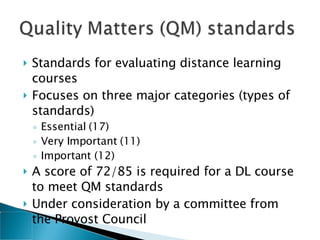
Standards for evaluating distance learning courses Focuses on three major categories (types of standards) Essential (17) Very Important (11) Important (12) A score of 72/85 is required for a DL course to meet QM standards Under consideration by a committee from the Provost Council
 
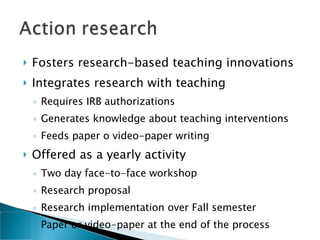
Fosters research-based teaching innovations Integrates research with teaching  Requires IRB authorizations Generates knowledge about teaching interventions Feeds paper o video-paper writing  Offered as a yearly activity Two day face-to-face workshop Research proposal Research implementation over Fall semester Paper or video-paper at the end of the process
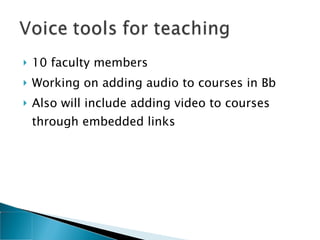
10 faculty members Working on adding audio to courses in Bb Also will include adding video to courses through embedded links
Purpose:  To improve classroom interaction Immediate feedback Attendance call On the way surveys / quizzes Priorities: High DFW courses Hard to teach  courses/ hard to learn units Pilot experiences
Purposes:  To support collaborative, experiential and inquiry-based learning in Anatomy and Physiology classes  To learn from one-on-one computing in classroom setting Technology provided Tablet PC machines Simulators DyKnow collaborative and course management software
Ensures books + digital manipulative for every student Includes models and simulators to promote reflective inquiry Includes clickers to promote active classroom participation Will produce a digital portfolio and a final report Teaching strategies + reflection Students’ learning + reflections Lessons learned + action lines
Global understanding curriculum  Goal: to share cultural and discipline-specific knowledge and experiences in a real-time virtual classroom Participants: business schools from universities located in the following countries: Sweden, Turkey, Greece, Spain, England, Italy, and France Rationale: WSSU students will gain culturally-relevant knowledge about conducting business in other countries without incurring the cost of traveling abroad. Students will be better equipped with the tools to adapt to an ever-changing world
 
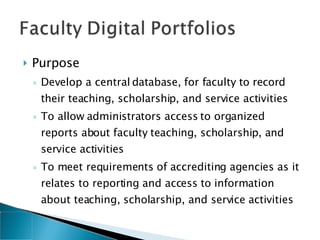
Purpose Develop a central database, for faculty to record their teaching, scholarship, and service activities To allow administrators access to organized reports about faculty teaching, scholarship, and service activities To meet requirements of accrediting agencies as it relates to reporting and access to information about teaching, scholarship, and service activities
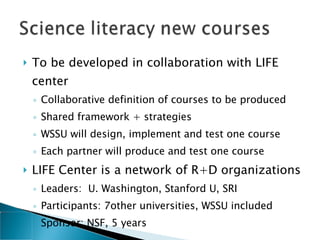
To be developed in collaboration with LIFE center  Collaborative definition of courses to be produced Shared framework + strategies WSSU will design, implement and test one course Each partner will produce and test one course LIFE Center is a network of R+D organizations Leaders:  U. Washington, Stanford U, SRI Participants: 7other universities, WSSU included Sponsor: NSF, 5 years
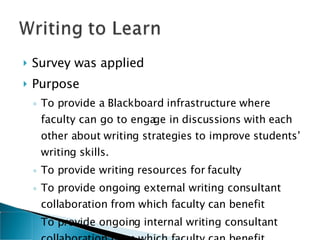
Survey was applied Purpose To provide a Blackboard infrastructure where faculty can go to engage in discussions with each other about writing strategies to improve students’ writing skills.  To provide writing resources for faculty To provide ongoing external writing consultant collaboration from which faculty can benefit To provide ongoing internal writing consultant collaboration from which faculty can benefit
Have a great fall break

Cetl Faculty Liaison Meeting, October 10, 2008

  • 1.
    Faculty Liaisons MeetingOctober 10, 2008
  • 2.
  • 3.
    October 22, sessionon Writing to Learn Dr. Derrick Virgil 12.30pm November 12, Session on Global Understanding Project Study abroad group – Chile 12.30pm
  • 4.
    One topic everyother week 1pm to 2pm R.J. Reynolds Center, room 138 Will start October 23 rd , 2008 Topics will include: Active learning with discussion boards, blogs and wikis Keeping your students informed with Bb Monitoring your class success with Bb statistics Learning units / stepping students through the process
  • 5.
  • 6.
    Funding opportunities forfull time faculty who want to attend or present at TLC in USA Preference will be given to presenters and first-time TLC attendees. Up to 2 out-of-state, or 2regional + 1national TLC Registration fee + hotel + travel Attendee/department pays all other expenses Department should support funding request Attendee should post lessons learned in TLC blog, socialize knowledge with colleagues, and deliver copy of travel documents to CETL
  • 7.
    Will be ablended course over a year spam Develops competence for Use of Blackboard for teaching Active learning syllabus redesign Face-to-face interaction Electronic resources Teaching strategies Learning Assessment skills Instructional design skills Web 2.0 for teaching Other topics as needed
  • 8.
    Develops competence for:Setting up and facilitating “from the side” online pragmatic dialogues. Selecting and integrating technologies into teaching Revising course syllabi for active learning with support of technology Seven week blended training Introductory face-to-face session Six week of online discussions and reflections Personalized advise for course syllabus redesign Offered three times per year.
  • 9.
    Standards for evaluatingdistance learning courses Focuses on three major categories (types of standards) Essential (17) Very Important (11) Important (12) A score of 72/85 is required for a DL course to meet QM standards Under consideration by a committee from the Provost Council
  • 10.
  • 11.
    Fosters research-based teachinginnovations Integrates research with teaching Requires IRB authorizations Generates knowledge about teaching interventions Feeds paper o video-paper writing Offered as a yearly activity Two day face-to-face workshop Research proposal Research implementation over Fall semester Paper or video-paper at the end of the process
  • 12.
    10 faculty membersWorking on adding audio to courses in Bb Also will include adding video to courses through embedded links
  • 13.
    Purpose: Toimprove classroom interaction Immediate feedback Attendance call On the way surveys / quizzes Priorities: High DFW courses Hard to teach courses/ hard to learn units Pilot experiences
  • 14.
    Purposes: Tosupport collaborative, experiential and inquiry-based learning in Anatomy and Physiology classes To learn from one-on-one computing in classroom setting Technology provided Tablet PC machines Simulators DyKnow collaborative and course management software
  • 15.
    Ensures books +digital manipulative for every student Includes models and simulators to promote reflective inquiry Includes clickers to promote active classroom participation Will produce a digital portfolio and a final report Teaching strategies + reflection Students’ learning + reflections Lessons learned + action lines
  • 16.
    Global understanding curriculum Goal: to share cultural and discipline-specific knowledge and experiences in a real-time virtual classroom Participants: business schools from universities located in the following countries: Sweden, Turkey, Greece, Spain, England, Italy, and France Rationale: WSSU students will gain culturally-relevant knowledge about conducting business in other countries without incurring the cost of traveling abroad. Students will be better equipped with the tools to adapt to an ever-changing world
  • 17.
  • 18.
    Purpose Develop acentral database, for faculty to record their teaching, scholarship, and service activities To allow administrators access to organized reports about faculty teaching, scholarship, and service activities To meet requirements of accrediting agencies as it relates to reporting and access to information about teaching, scholarship, and service activities
  • 19.
    To be developedin collaboration with LIFE center Collaborative definition of courses to be produced Shared framework + strategies WSSU will design, implement and test one course Each partner will produce and test one course LIFE Center is a network of R+D organizations Leaders: U. Washington, Stanford U, SRI Participants: 7other universities, WSSU included Sponsor: NSF, 5 years
  • 20.
    Survey was appliedPurpose To provide a Blackboard infrastructure where faculty can go to engage in discussions with each other about writing strategies to improve students’ writing skills. To provide writing resources for faculty To provide ongoing external writing consultant collaboration from which faculty can benefit To provide ongoing internal writing consultant collaboration from which faculty can benefit
  • 21.
    Have a greatfall break