7 Things you need to know:
           Things 4, 5, & 6
               Content Delivery
So far…
}    We’ve discussed
      }    The difference between traditional in-seat and
            online/hybrid course delivery.
      }    Planning your course and introduced some of the
            technology tools that you might use
      }    The importance of thinking through and
            communicating with detail
Content Delivery


 How do we actually teach our content?


 Some of this should sound familiar…
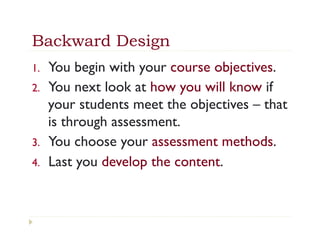
Backward Design
1.    You begin with your course objectives.
2.    You next look at how you will know if
      your students meet the objectives – that
      is through assessment.
3.    You choose your assessment methods.
4.    Last you develop the content.
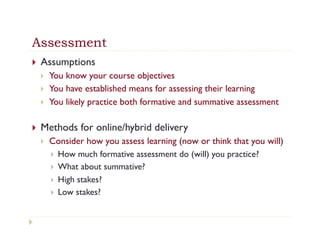
Assessment
}    Assumptions
      }    You know your course objectives
      }    You have established means for assessing their learning
      }    You likely practice both formative and summative assessment

}    Methods for online/hybrid delivery
      }    Consider how you assess learning (now or think that you will)
            }  How much formative assessment do (will) you practice?
            }  What about summative?
            }  High stakes?
            }  Low stakes?
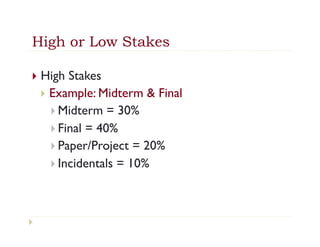
High or Low Stakes

}  High    Stakes
  }  Example: Midterm & Final
      }  Midterm = 30%
      }  Final = 40%
      }  Paper/Project = 20%
      }  Incidentals = 10%
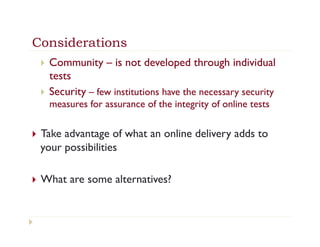
Considerations
      }  Community – is not developed through individual
          tests
      }  Security – few institutions have the necessary security
            measures for assurance of the integrity of online tests

}    Take advantage of what an online delivery adds to
      your possibilities

}    What are some alternatives?
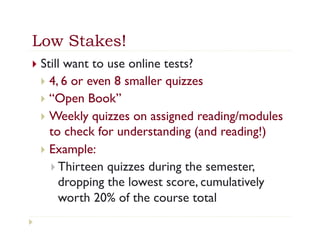
Low Stakes!
}  Still  want to use online tests?
  }  4, 6 or even 8 smaller quizzes
  }  “Open Book”
  }  Weekly quizzes on assigned reading/modules
      to check for understanding (and reading!)
  }  Example:
      }  Thirteen quizzes during the semester,
          dropping the lowest score, cumulatively
          worth 20% of the course total
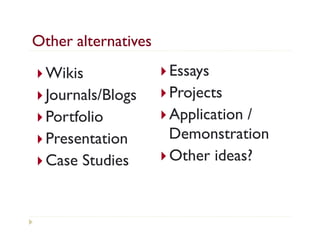
Other alternatives
}  Wikis            }  Essays
}  Journals/Blogs   }  Projects
}  Portfolio        }  Application/
}  Presentation         Demonstration
}  Case   Studies   }  Other ideas?
Thing 4 and Thing 6

Content Delivery & Building Community
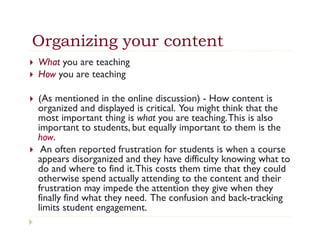
Organizing your content
}    What you are teaching
}    How you are teaching

}    (As mentioned in the online discussion) - How content is
      organized and displayed is critical. You might think that the
      most important thing is what you are teaching. This is also
      important to students, but equally important to them is the
      how.
}     An often reported frustration for students is when a course
      appears disorganized and they have difficulty knowing what to
      do and where to find it. This costs them time that they could
      otherwise spend actually attending to the content and their
      frustration may impede the attention they give when they
      finally find what they need. The confusion and back-tracking
      limits student engagement.
Suggestions
}  Structured and Consistent
 }  Into Learning Modules


 }  By Theme


 }  By Week
Considerations
 } Chunking
  }  (more   on this in the learning module)


 } Readability
  }  (seethe handout on readability
    statistics)
Interaction

}  between   the student and the content
    material; 
}  between the student and you; and
}  among students in the class.
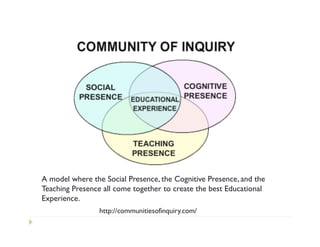
A model where the Social Presence, the Cognitive Presence, and the
Teaching Presence all come together to create the best Educational
Experience.
                 http://communitiesofinquiry.com/
Community of Inquiry

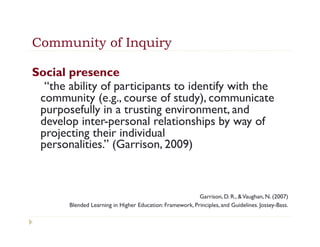
Social presence 
  “the ability of participants to identify with the
 community (e.g., course of study), communicate
 purposefully in a trusting environment, and
 develop inter-personal relationships by way of
 projecting their individual
 personalities.” (Garrison, 2009)


                                                          Garrison, D. R., & Vaughan, N. (2007)
       Blended Learning in Higher Education: Framework, Principles, and Guidelines. Jossey-Bass.
Community of Inquiry

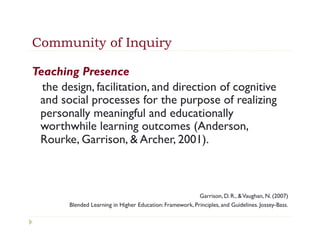
Teaching Presence
  the design, facilitation, and direction of cognitive
 and social processes for the purpose of realizing
 personally meaningful and educationally
 worthwhile learning outcomes (Anderson,
 Rourke, Garrison, & Archer, 2001).


                                                           Garrison, D. R., & Vaughan, N. (2007)
        Blended Learning in Higher Education: Framework, Principles, and Guidelines. Jossey-Bass.
Community of Inquiry
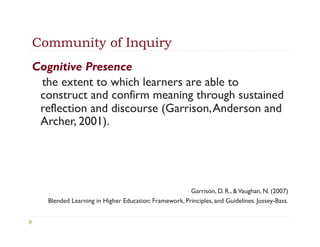
Cognitive Presence 
 the extent to which learners are able to
 construct and confirm meaning through sustained
 reflection and discourse (Garrison, Anderson and
 Archer, 2001).


                                                      Garrison, D. R., & Vaughan, N. (2007)
   Blended Learning in Higher Education: Framework, Principles, and Guidelines. Jossey-Bass.
What are some ways that you can
facilitate the development of
community in your course?
Develop Community through:
}  Active interaction
}  Collaborative learning
}  Socially constructed meaning evidenced by questioning,
    reflection and agreement
}  Sharing of resources among students


For community to develop, faculty and students have to
  sense the presence of each other and build trust.


                                           Palloff and Pratt (2007)
Methods
 }    Lecturing
       }    Text
       }    Podcast
       }    Video
       }    Synchronous
 }    Learning Objects
 }    Web sites
 }    Video
 }    Problem Based Learning/ Case Study / Critical Incident
 }    Discussion / Dialogue / Discourse / Debate
 }    What else??
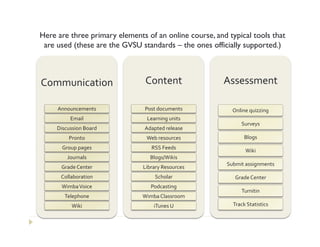
Here are three primary elements of an online course, and typical tools that
 are used (these are the GVSU standards – the ones officially supported.)


Communication                   Content	
                 Assessment	


     Announcements	
            Post	
  documents	
         Online	
  quizzing	
  
            Email	
              Learning	
  units	
  
                                                                  Surveys	
  
     Discussion	
  Board	
      Adapted	
  release	
  
           Pronto	
              Web	
  resources	
                 Blogs	
  
       Group	
  pages	
            RSS	
  Feeds	
  
                                                                    Wiki	
  
          Journals	
               Blogs/Wikis	
  
                                                          Submit	
  assignments	
  
       Grade	
  Center	
       Library	
  Resources	
  
       Collaboration	
               Scholar	
                Grade	
  Center	
  
       Wimba	
  Voice	
            Podcasting	
  
                                                                  Turnitin	
  
         Telephone	
           Wimba	
  Classroom	
  
             Wiki	
                  iTunes	
  U	
           Track	
  Statistics	
  
Next:
}  Please go through the (re)Designing Content learning
    unit.
}  Following the learning unit are some additional
    documents, some of which you have already seen. There
    are also some examples posted that are from my
    EDH648, Adult Learner course.
}  Instead of developing an outline for an online module, I
    will post a general discussion board question that will
    hopefully require some thought and reflection, but not be
    as demanding as preparing an outline.

Foundations presentation 3

  • 1.
    7 Things youneed to know: Things 4, 5, & 6 Content Delivery
  • 2.
    So far… }  We’ve discussed }  The difference between traditional in-seat and online/hybrid course delivery. }  Planning your course and introduced some of the technology tools that you might use }  The importance of thinking through and communicating with detail
  • 3.
    Content Delivery Howdo we actually teach our content? Some of this should sound familiar…
  • 4.
    Backward Design 1.  You begin with your course objectives. 2.  You next look at how you will know if your students meet the objectives – that is through assessment. 3.  You choose your assessment methods. 4.  Last you develop the content.
  • 5.
    Assessment }  Assumptions }  You know your course objectives }  You have established means for assessing their learning }  You likely practice both formative and summative assessment }  Methods for online/hybrid delivery }  Consider how you assess learning (now or think that you will) }  How much formative assessment do (will) you practice? }  What about summative? }  High stakes? }  Low stakes?
  • 6.
    High or LowStakes }  High Stakes }  Example: Midterm & Final }  Midterm = 30% }  Final = 40% }  Paper/Project = 20% }  Incidentals = 10%
  • 7.
    Considerations }  Community – is not developed through individual tests }  Security – few institutions have the necessary security measures for assurance of the integrity of online tests }  Take advantage of what an online delivery adds to your possibilities }  What are some alternatives?
  • 8.
    Low Stakes! }  Still want to use online tests? }  4, 6 or even 8 smaller quizzes }  “Open Book” }  Weekly quizzes on assigned reading/modules to check for understanding (and reading!) }  Example: }  Thirteen quizzes during the semester, dropping the lowest score, cumulatively worth 20% of the course total
  • 9.
    Other alternatives }  Wikis }  Essays }  Journals/Blogs }  Projects }  Portfolio }  Application/ }  Presentation Demonstration }  Case Studies }  Other ideas?
  • 10.
    Thing 4 andThing 6 Content Delivery & Building Community
  • 11.
    Organizing your content }  What you are teaching }  How you are teaching }  (As mentioned in the online discussion) - How content is organized and displayed is critical. You might think that the most important thing is what you are teaching. This is also important to students, but equally important to them is the how. }  An often reported frustration for students is when a course appears disorganized and they have difficulty knowing what to do and where to find it. This costs them time that they could otherwise spend actually attending to the content and their frustration may impede the attention they give when they finally find what they need. The confusion and back-tracking limits student engagement.
  • 12.
    Suggestions }  Structured andConsistent }  Into Learning Modules }  By Theme }  By Week
  • 13.
    Considerations } Chunking }  (more on this in the learning module) } Readability }  (seethe handout on readability statistics)
  • 14.
    Interaction }  between the student and the content material;  }  between the student and you; and }  among students in the class.
  • 15.
    A model wherethe Social Presence, the Cognitive Presence, and the Teaching Presence all come together to create the best Educational Experience. http://communitiesofinquiry.com/
  • 16.
    Community of Inquiry Socialpresence  “the ability of participants to identify with the community (e.g., course of study), communicate purposefully in a trusting environment, and develop inter-personal relationships by way of projecting their individual personalities.” (Garrison, 2009) Garrison, D. R., & Vaughan, N. (2007) Blended Learning in Higher Education: Framework, Principles, and Guidelines. Jossey-Bass.
  • 17.
    Community of Inquiry TeachingPresence the design, facilitation, and direction of cognitive and social processes for the purpose of realizing personally meaningful and educationally worthwhile learning outcomes (Anderson, Rourke, Garrison, & Archer, 2001). Garrison, D. R., & Vaughan, N. (2007) Blended Learning in Higher Education: Framework, Principles, and Guidelines. Jossey-Bass.
  • 18.
    Community of Inquiry CognitivePresence  the extent to which learners are able to construct and confirm meaning through sustained reflection and discourse (Garrison, Anderson and Archer, 2001). Garrison, D. R., & Vaughan, N. (2007) Blended Learning in Higher Education: Framework, Principles, and Guidelines. Jossey-Bass.
  • 19.
    What are someways that you can facilitate the development of community in your course?
  • 20.
    Develop Community through: } Active interaction }  Collaborative learning }  Socially constructed meaning evidenced by questioning, reflection and agreement }  Sharing of resources among students For community to develop, faculty and students have to sense the presence of each other and build trust. Palloff and Pratt (2007)
  • 21.
    Methods }  Lecturing }  Text }  Podcast }  Video }  Synchronous }  Learning Objects }  Web sites }  Video }  Problem Based Learning/ Case Study / Critical Incident }  Discussion / Dialogue / Discourse / Debate }  What else??
  • 22.
    Here are threeprimary elements of an online course, and typical tools that are used (these are the GVSU standards – the ones officially supported.) Communication Content   Assessment     Announcements   Post  documents   Online  quizzing   Email   Learning  units   Surveys   Discussion  Board   Adapted  release   Pronto   Web  resources   Blogs   Group  pages   RSS  Feeds   Wiki   Journals   Blogs/Wikis   Submit  assignments   Grade  Center   Library  Resources   Collaboration   Scholar   Grade  Center   Wimba  Voice   Podcasting   Turnitin   Telephone   Wimba  Classroom   Wiki   iTunes  U   Track  Statistics  
  • 23.
    Next: }  Please gothrough the (re)Designing Content learning unit. }  Following the learning unit are some additional documents, some of which you have already seen. There are also some examples posted that are from my EDH648, Adult Learner course. }  Instead of developing an outline for an online module, I will post a general discussion board question that will hopefully require some thought and reflection, but not be as demanding as preparing an outline.