























10 things every CEO
needs to know about UX
Eric Reiss
@elreiss
Keikendo UX Summit
August 28, 2013
Buenos Aires, Argentina
Why do you have a website?
“Because everyone has one.”
Why do you have a telephone?
“Because everyone has one.”
“Because we can’t do business without one”
Why do you have a website?
“Because we can’t do business without one”
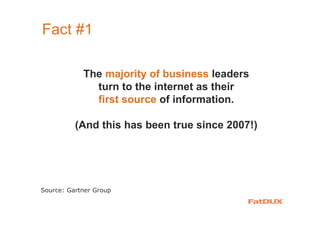
Fact #1
The majority of business leaders
turn to the internet as their
first source of information.
(And this has been true since 2007!)
Source: Gartner Group
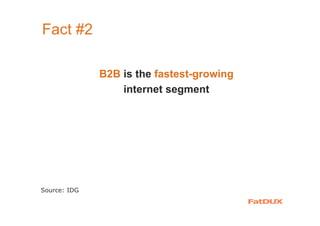
Fact #2
B2B is the fastest-growing
internet segment
Source: IDG
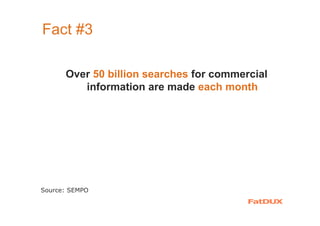
Fact #3
Over 50 billion searches for commercial
information are made each month
Source: SEMPO
Fact #4
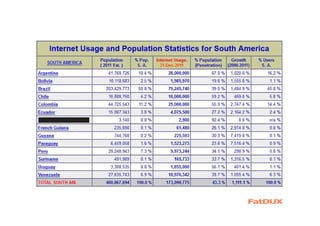
Argentina has the highest rate of
internet penetration in South America
(even higher than Spain)
Source: Internet World Statistics
So, what is UX?
us·er
noun
1: a person who makes use of a thing;
someone who uses or employs something
2: a person who uses something or
someone selfishly or unethically
3: a person who takes drugs
ex·per·i·ence
noun
1: having been affected by or learned
through observation or participation
2: the length of such participation
Eric’s 1st Law of UX:
If a site does not solve your
user’s problems, it will not
solve your company’s either.
So, let’s start with the user
When would you use (simultaneously):
An ergonomic seat designed for one person
Optical lenses invented by Benjamin Franklin
Alcoholic mixture invented by Dr. Iain Marshall
Incandescent device invented by Thomas Edison
Fabric made on a loom invented by JM Jacquard
Rouge Royale (marble)
Baskerville Light (typography)
Domesticated mammal
(This is often how our clients look at their content)
When would you use (in simpler terms):
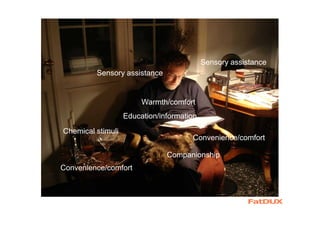
Armchair
Bifocal eyeglasses
Manhattan Cocktail
Lightbulb
Wool pullover
Tabletop
Book
Cat
(This is an easier way to look at content)
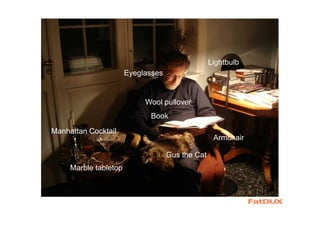
Eyeglasses
Wool pullover
Lightbulb
Marble tabletop
Armchair
Book
Gus the Cat
Manhattan Cocktail
Sensory assistance
Warmth/comfort
Sensory assistance
Convenience/comfort
Convenience/comfort
Education/information
Companionship
Chemical stimuli
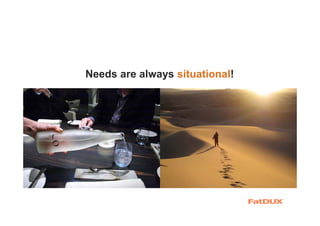
Needs are always situational!
Eric’s 2nd Law of UX:
User experience is the sum of
a series of interactions between
people, devices, and events.
Eric’s 3rd Law of UX:
There are three types of interaction:
active, passive and secondary
Eric’s 4th Law of UX:
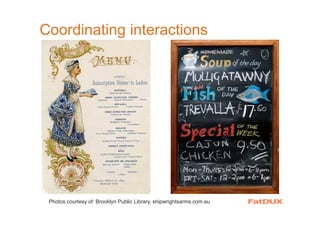
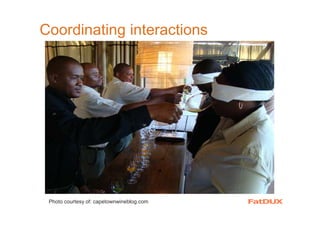
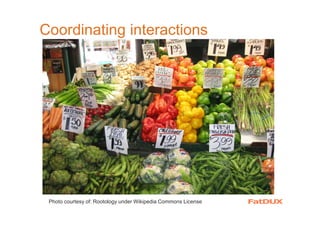
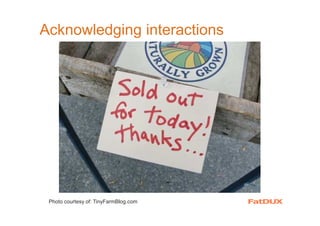
UX design represents the conscious
act of coordinating interactions,
acknowledging interactions, and
reducing negative interactions.
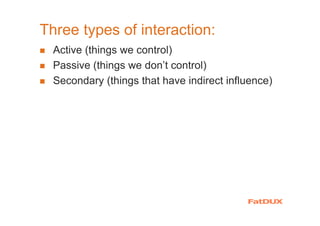
Three types of interaction:
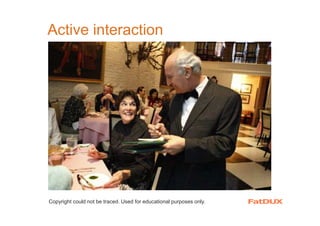
Active (things we control)
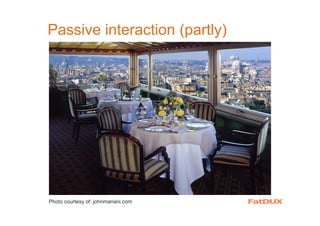
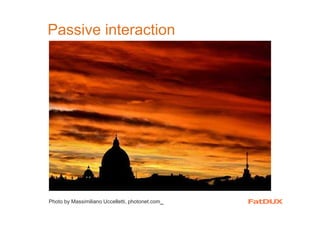
Passive (things we don’t control)
Secondary (things that have indirect influence)
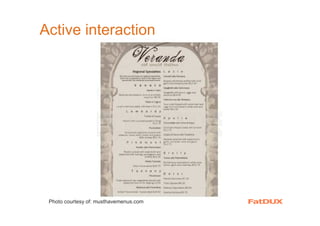
Active interaction
Photo courtesy of: musthavemenus.com
Active interaction
Copyright could not be traced. Used for educational purposes only.
Passive interaction (partly)
Photo courtesy of: johnmariani.com
Passive interaction
Photo by Massimiliano Uccelletti, photonet.com
Secondary interaction
Photo courtesy of: koit.radiotown.com
Secondary interaction
Photo courtesy of: tomatolover.com
UX design combines all three activites
Coordinating interactions that we can control
Acknowledging interactions beyond our control
Reducing negative interactions
Coordinating interactions
Photos courtesy of: Brooklyn Public Library, shipwrightsarms.com.au
Coordinating interactions
Photo courtesy of: capetownwineblog.com
Coordinating interactions
Photo courtesy of: Rootology under Wikipedia Commons License
Acknowledging interactions
Photo courtesy of: TinyFarmBlog.com
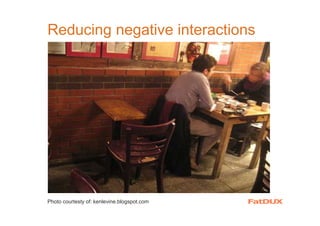
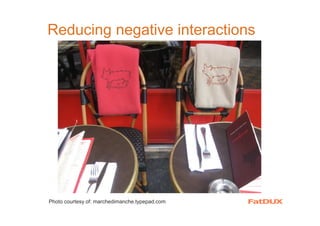
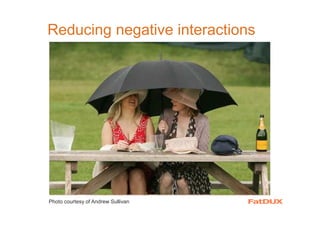
Reducing negative interactions
Photo courtesty of: kenlevine.blogspot.com
Reducing negative interactions
Photo courtesy of: marchedimanche.typepad.com
Reducing negative interactions
Photo courtesy of Andrew Sullivan
Now, let’s talk with those CEOs
1. Don’t confuse marketing
with communication.
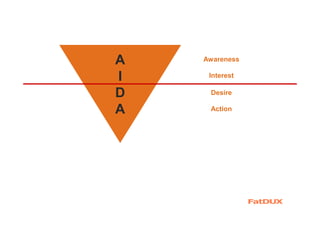
1.
Awareness
Interest
Desire
Action
A
I
D
A
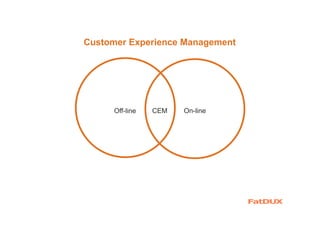
Make your online presence part of your
total customer-service package
Off-line On-lineCEM
Customer Experience Management
10 things customers will tell you
1. Don’t tell me how great you are. BE great!
2. Go the extra mile.
3. Don’t get in my way when I’m trying to shop.
4. If I know what I’m looking for, help me find it.
5. If I have questions, I want straight answers, not a salestalk.
6. Tell me if you’re going off to look for my size. Don’t just turn and leave.
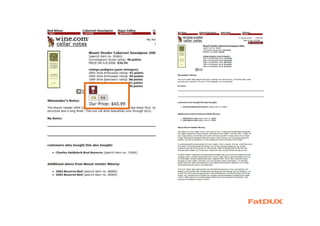
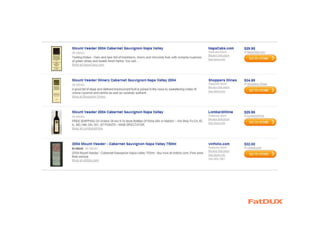
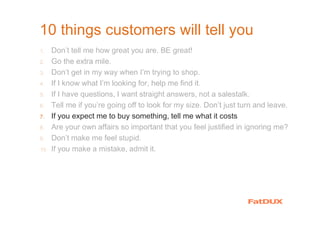
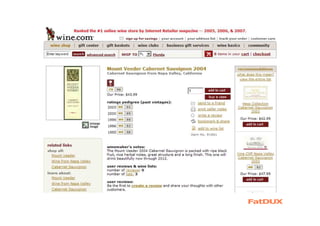
7. If you expect me to buy something, tell me what it costs
8. Are your own affairs so important that you feel justified in ignoring me?
9. Don’t make me feel stupid.
10. If you make a mistake, admit it.
Sources: Paco Underhill, Eric Reiss
10 things customers will tell you
1. Don’t tell me how great you are. BE great!
2. Go the extra mile.
3. Don’t get in my way when I’m trying to shop.
4. If I know what I’m looking for, help me find it.
5. If I have questions, I want straight answers, not a salestalk.
6. Tell me if you’re going off to look for my size. Don’t just turn and leave.
7. If you expect me to buy something, tell me what it costs
8. Are your own affairs so important that you feel justified in ignoring me?
9. Don’t make me feel stupid.
10. If you make a mistake, admit it.
10 things customers will tell you
1. Don’t tell me how great you are. BE great!
2. Go the extra mile.
3. Don’t get in my way when I’m trying to shop.
4. If I know what I’m looking for, help me find it.
5. If I have questions, I want straight answers, not a salestalk.
6. Tell me if you’re going off to look for my size. Don’t just turn and leave.
7. If you expect me to buy something, tell me what it costs
8. Are your own affairs so important that you feel justified in ignoring me?
9. Don’t make me feel stupid.
10. If you make a mistake, admit it.
10 things customers will tell you
1. Don’t tell me how great you are. BE great!
2. Go the extra mile.
3. Don’t get in my way when I’m trying to shop.
4. If I know what I’m looking for, help me find it.
5. If I have questions, I want straight answers, not a salestalk.
6. Tell me if you’re going off to look for my size. Don’t just turn and leave.
7. If you expect me to buy something, tell me what it costs
8. Are your own affairs so important that you feel justified in ignoring me?
9. Don’t make me feel stupid.
10. If you make a mistake, admit it.
10 things customers will tell you
1. Don’t tell me how great you are. BE great!
2. Go the extra mile.
3. Don’t get in my way when I’m trying to shop.
4. If I know what I’m looking for, help me find it.
5. If I have questions, I want straight answers, not a salestalk.
6. Tell me if you’re going off to look for my size. Don’t just turn and leave.
7. If you expect me to buy something, tell me what it costs
8. Are your own affairs so important that you feel justified in ignoring me?
9. Don’t make me feel stupid.
10. If you make a mistake, admit it.
10 things customers will tell you
1. Don’t tell me how great you are. BE great!
2. Go the extra mile.
3. Don’t get in my way when I’m trying to shop.
4. If I know what I’m looking for, help me find it.
5. If I have questions, I want straight answers, not a salestalk.
6. Tell me if you’re going off to look for my size. Don’t just turn and leave.
7. If you expect me to buy something, tell me what it costs
8. Are your own affairs so important that you feel justified in ignoring me?
9. Don’t make me feel stupid.
10. If you make a mistake, admit it.
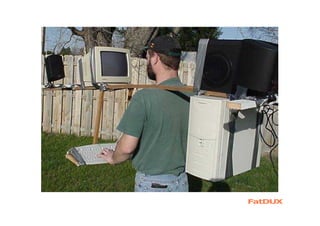
1. Don’t view your website as a
software development project.
2.
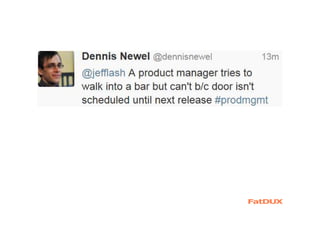
Click to add man-walks-into-bar joke
Click to add punch line
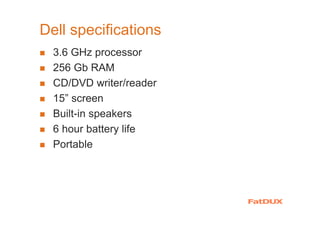
Dell specifications
3.6 GHz processor
256 Gb RAM
CD/DVD writer/reader
15” screen
Built-in speakers
6 hour battery life
Portable
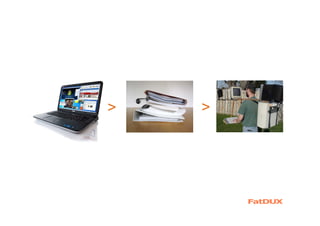
> >
Whenever possible, purchase software
from single-focus vendors
1. Don’t couple unrelated
initiatives.
3.
CMS
CRM
ERP
DM
KM
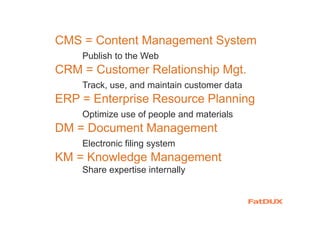
CMS = Content Management System
Publish to the Web
CRM = Customer Relationship Mgt.
Track, use, and maintain customer data
ERP = Enterprise Resource Planning
Optimize use of people and materials
DM = Document Management
Electronic filing system
KM = Knowledge Management
Share expertise internally
Deal with just one project
(and just your project).
Then take care of the other stuff.
(and stick to single-focus vendors)
1. Don’t be afraid to set
measurable goals for your
UX initiatives.
4.
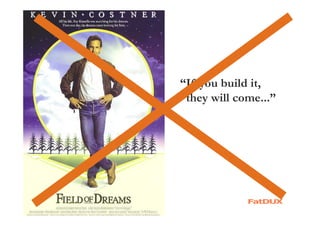
“If you build it,
they will come...”
What are the
customer service metrics
for an airline?
“Flying on time.”
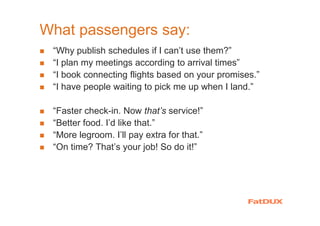
What passengers say:
“Why publish schedules if I can’t use them?”
“I plan my meetings according to arrival times”
“I book connecting flights based on your promises.”
“I have people waiting to pick me up when I land.”
“Faster check-in. Now that’s service!”
“Better food. I’d like that.”
“More legroom. I’ll pay extra for that.”
“On time? That’s your job! So do it!”
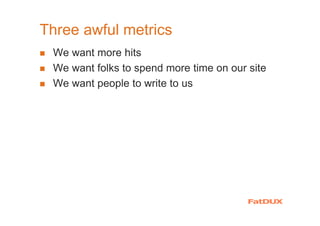
Three awful metrics
We want more hits
We want folks to spend more time on our site
We want people to write to us
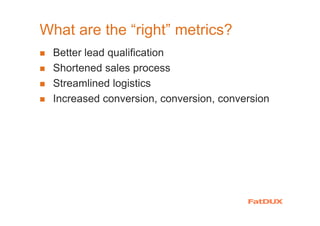
What are the “right” metrics?
Better lead qualification
Shortened sales process
Streamlined logistics
Increased conversion, conversion, conversion
Insist that UX becomes an
integrated part of your company’s
business activities
1. Don’t confuse your personal
needs with those of your
visitors.
5.
Five common errors
“We need pictures of ducks. I like ducks.”
(Executive ego)
“Look what they just did”’
(Competitor envy)
“We should talk about ‘innovation’”
(Strategy by buzzword)
“We need an app”
(Tech over tactics)
“That change doesn’t fit our standard design”
(Form over function)
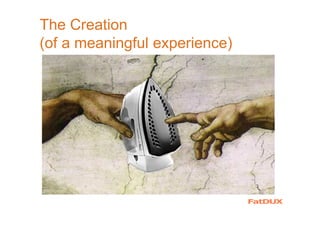
The Creation
(of a meaningful experience)
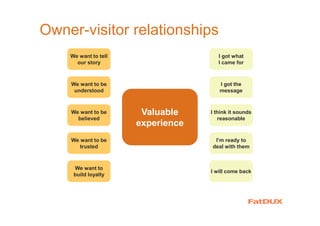
Owner-visitor relationships
We want to
build loyalty
We want to tell
our story
I got what
I came for
I got the
message
I think it sounds
reasonable
I’m ready to
deal with them
I will come back
We want to be
understood
We want to be
believed
We want to be
trusted
Valuable
experience
Fact #5
If you do not meet the needs of your visitors,
you will never meet your own business needs.
Encourage research. Accept surprises that
go against your basic assumptions.
1. Don’t view UX as a
fixed-term project.
6.
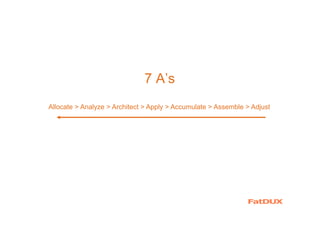
Allocate > Analyze > Architect > Apply > Accumulate > Assemble > Adjust
7 A’s
Once you start the process,
make sure to keep it going.
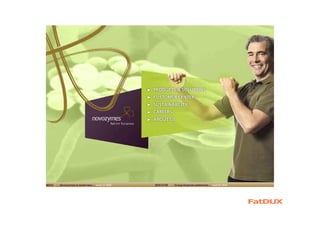
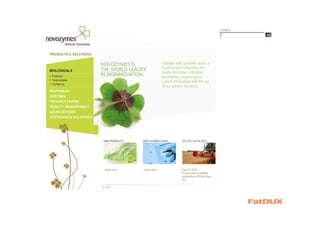
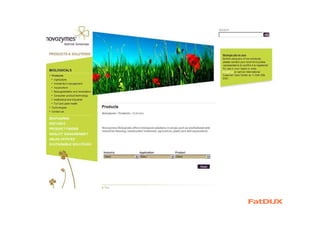
1. Don’t confuse print design
with online design.
7.
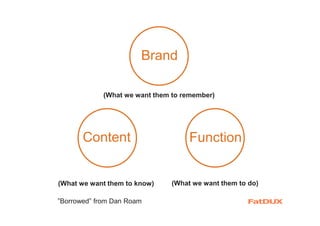
Brand
Content Function
(What we want them to remember)
(What we want them to know) (What we want them to do)
”Borrowed” from Dan Roam
“Do you want art?
Or do you want your
sales to go up?”
Rosser Reeves
Acknowledge and embrace best-practices
that run counter to your design guide.
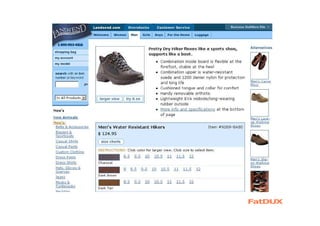
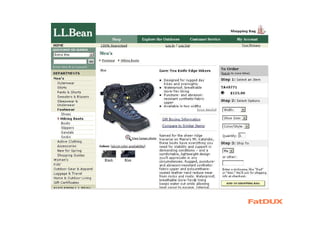
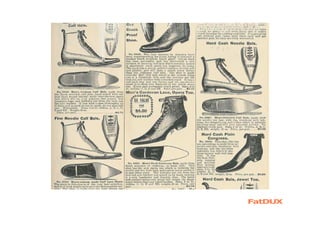
1. Don’t let your personal
opinion cloud your focus.
8.
Seek out proven experts and
support their work.
1. Don’t be afraid to ask
stupid questions.
9.
Fact #6
There are no stupid questions...
the first time you ask them.
Fact #7
But there are lots of stupid answers...
the ones you don’t understand.
„Es hört jeder doch nur,
was er versteht.“
Goethe
“He hears only that
which he understands”
Goethe
XML
„Es hört jeder doch nur,
was er versteht.“
Goethe
CMS UX
UCD
CMUxD
CSS
Fact #8
Two-way communication
must work two ways.
“He hears only that
which he understands”
IRRGoethe
TCO PP
DFD
COQBPR
EBIT
If in doubt, ask. Always.
1. Don’t hide in your office.10.
Lord Marshall of Knightsbridge
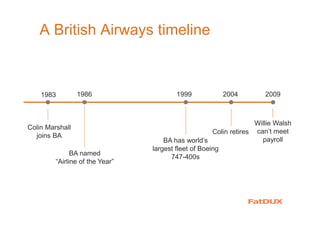
A British Airways timeline
Colin Marshall
joins BA
1983 1986
BA named
“Airline of the Year”
2004
Colin retires
2009
Willie Walsh
can’t meet
payroll
1999
BA has world’s
largest fleet of Boeing
747-400s
Demonstrate your
active support for the project.
Keep the whole team inspired.
Forever.
Muchas gracias!
You can (usually) find Eric at:
The FatDUX Group ApS
Strandøre 15
DK-2100 Copenhagen
Denmark
www.fatdux.com
Office: (+45) 39 29 67 77
Mobil: (+45) 20 12 88 44
er@fatdux.com
skype: ericreiss
twitter: @elreiss

10 things every CEO needs to know about UX

  • 1.
    10 things everyCEO needs to know about UX Eric Reiss @elreiss Keikendo UX Summit August 28, 2013 Buenos Aires, Argentina
  • 2.
    Why do youhave a website? “Because everyone has one.”
  • 3.
    Why do youhave a telephone? “Because everyone has one.” “Because we can’t do business without one”
  • 4.
    Why do youhave a website? “Because we can’t do business without one”
  • 5.
    Fact #1 The majorityof business leaders turn to the internet as their first source of information. (And this has been true since 2007!) Source: Gartner Group
  • 6.
    Fact #2 B2B isthe fastest-growing internet segment Source: IDG
  • 7.
    Fact #3 Over 50billion searches for commercial information are made each month Source: SEMPO
  • 8.
    Fact #4 Argentina hasthe highest rate of internet penetration in South America (even higher than Spain) Source: Internet World Statistics
  • 10.
  • 11.
    us·er noun 1: a personwho makes use of a thing; someone who uses or employs something 2: a person who uses something or someone selfishly or unethically 3: a person who takes drugs
  • 12.
    ex·per·i·ence noun 1: having beenaffected by or learned through observation or participation 2: the length of such participation
  • 13.
    Eric’s 1st Lawof UX: If a site does not solve your user’s problems, it will not solve your company’s either.
  • 14.
    So, let’s startwith the user
  • 15.
    When would youuse (simultaneously): An ergonomic seat designed for one person Optical lenses invented by Benjamin Franklin Alcoholic mixture invented by Dr. Iain Marshall Incandescent device invented by Thomas Edison Fabric made on a loom invented by JM Jacquard Rouge Royale (marble) Baskerville Light (typography) Domesticated mammal (This is often how our clients look at their content)
  • 16.
    When would youuse (in simpler terms): Armchair Bifocal eyeglasses Manhattan Cocktail Lightbulb Wool pullover Tabletop Book Cat (This is an easier way to look at content)
  • 18.
  • 19.
  • 20.
    Needs are alwayssituational!
  • 22.
    Eric’s 2nd Lawof UX: User experience is the sum of a series of interactions between people, devices, and events.
  • 23.
    Eric’s 3rd Lawof UX: There are three types of interaction: active, passive and secondary
  • 24.
    Eric’s 4th Lawof UX: UX design represents the conscious act of coordinating interactions, acknowledging interactions, and reducing negative interactions.
  • 25.
    Three types ofinteraction: Active (things we control) Passive (things we don’t control) Secondary (things that have indirect influence)
  • 26.
    Active interaction Photo courtesyof: musthavemenus.com
  • 27.
    Active interaction Copyright couldnot be traced. Used for educational purposes only.
  • 28.
    Passive interaction (partly) Photocourtesy of: johnmariani.com
  • 29.
    Passive interaction Photo byMassimiliano Uccelletti, photonet.com
  • 30.
  • 31.
  • 32.
    UX design combinesall three activites Coordinating interactions that we can control Acknowledging interactions beyond our control Reducing negative interactions
  • 33.
    Coordinating interactions Photos courtesyof: Brooklyn Public Library, shipwrightsarms.com.au
  • 34.
  • 35.
    Coordinating interactions Photo courtesyof: Rootology under Wikipedia Commons License
  • 36.
  • 37.
    Reducing negative interactions Photocourtesty of: kenlevine.blogspot.com
  • 38.
    Reducing negative interactions Photocourtesy of: marchedimanche.typepad.com
  • 39.
    Reducing negative interactions Photocourtesy of Andrew Sullivan
  • 40.
    Now, let’s talkwith those CEOs
  • 41.
    1. Don’t confusemarketing with communication. 1.
  • 42.
  • 43.
    Make your onlinepresence part of your total customer-service package
  • 44.
  • 45.
    10 things customerswill tell you 1. Don’t tell me how great you are. BE great! 2. Go the extra mile. 3. Don’t get in my way when I’m trying to shop. 4. If I know what I’m looking for, help me find it. 5. If I have questions, I want straight answers, not a salestalk. 6. Tell me if you’re going off to look for my size. Don’t just turn and leave. 7. If you expect me to buy something, tell me what it costs 8. Are your own affairs so important that you feel justified in ignoring me? 9. Don’t make me feel stupid. 10. If you make a mistake, admit it. Sources: Paco Underhill, Eric Reiss
  • 52.
    10 things customerswill tell you 1. Don’t tell me how great you are. BE great! 2. Go the extra mile. 3. Don’t get in my way when I’m trying to shop. 4. If I know what I’m looking for, help me find it. 5. If I have questions, I want straight answers, not a salestalk. 6. Tell me if you’re going off to look for my size. Don’t just turn and leave. 7. If you expect me to buy something, tell me what it costs 8. Are your own affairs so important that you feel justified in ignoring me? 9. Don’t make me feel stupid. 10. If you make a mistake, admit it.
  • 54.
    10 things customerswill tell you 1. Don’t tell me how great you are. BE great! 2. Go the extra mile. 3. Don’t get in my way when I’m trying to shop. 4. If I know what I’m looking for, help me find it. 5. If I have questions, I want straight answers, not a salestalk. 6. Tell me if you’re going off to look for my size. Don’t just turn and leave. 7. If you expect me to buy something, tell me what it costs 8. Are your own affairs so important that you feel justified in ignoring me? 9. Don’t make me feel stupid. 10. If you make a mistake, admit it.
  • 58.
    10 things customerswill tell you 1. Don’t tell me how great you are. BE great! 2. Go the extra mile. 3. Don’t get in my way when I’m trying to shop. 4. If I know what I’m looking for, help me find it. 5. If I have questions, I want straight answers, not a salestalk. 6. Tell me if you’re going off to look for my size. Don’t just turn and leave. 7. If you expect me to buy something, tell me what it costs 8. Are your own affairs so important that you feel justified in ignoring me? 9. Don’t make me feel stupid. 10. If you make a mistake, admit it.
  • 60.
    10 things customerswill tell you 1. Don’t tell me how great you are. BE great! 2. Go the extra mile. 3. Don’t get in my way when I’m trying to shop. 4. If I know what I’m looking for, help me find it. 5. If I have questions, I want straight answers, not a salestalk. 6. Tell me if you’re going off to look for my size. Don’t just turn and leave. 7. If you expect me to buy something, tell me what it costs 8. Are your own affairs so important that you feel justified in ignoring me? 9. Don’t make me feel stupid. 10. If you make a mistake, admit it.
  • 65.
    10 things customerswill tell you 1. Don’t tell me how great you are. BE great! 2. Go the extra mile. 3. Don’t get in my way when I’m trying to shop. 4. If I know what I’m looking for, help me find it. 5. If I have questions, I want straight answers, not a salestalk. 6. Tell me if you’re going off to look for my size. Don’t just turn and leave. 7. If you expect me to buy something, tell me what it costs 8. Are your own affairs so important that you feel justified in ignoring me? 9. Don’t make me feel stupid. 10. If you make a mistake, admit it.
  • 73.
    1. Don’t viewyour website as a software development project. 2.
  • 74.
    Click to addman-walks-into-bar joke Click to add punch line
  • 78.
    Dell specifications 3.6 GHzprocessor 256 Gb RAM CD/DVD writer/reader 15” screen Built-in speakers 6 hour battery life Portable
  • 80.
  • 85.
    Whenever possible, purchasesoftware from single-focus vendors
  • 86.
    1. Don’t coupleunrelated initiatives. 3.
  • 87.
  • 88.
    CMS = ContentManagement System Publish to the Web CRM = Customer Relationship Mgt. Track, use, and maintain customer data ERP = Enterprise Resource Planning Optimize use of people and materials DM = Document Management Electronic filing system KM = Knowledge Management Share expertise internally
  • 90.
    Deal with justone project (and just your project). Then take care of the other stuff. (and stick to single-focus vendors)
  • 91.
    1. Don’t beafraid to set measurable goals for your UX initiatives. 4.
  • 92.
    “If you buildit, they will come...”
  • 93.
    What are the customerservice metrics for an airline? “Flying on time.”
  • 94.
    What passengers say: “Whypublish schedules if I can’t use them?” “I plan my meetings according to arrival times” “I book connecting flights based on your promises.” “I have people waiting to pick me up when I land.” “Faster check-in. Now that’s service!” “Better food. I’d like that.” “More legroom. I’ll pay extra for that.” “On time? That’s your job! So do it!”
  • 95.
    Three awful metrics Wewant more hits We want folks to spend more time on our site We want people to write to us
  • 96.
    What are the“right” metrics? Better lead qualification Shortened sales process Streamlined logistics Increased conversion, conversion, conversion
  • 97.
    Insist that UXbecomes an integrated part of your company’s business activities
  • 98.
    1. Don’t confuseyour personal needs with those of your visitors. 5.
  • 99.
    Five common errors “Weneed pictures of ducks. I like ducks.” (Executive ego) “Look what they just did”’ (Competitor envy) “We should talk about ‘innovation’” (Strategy by buzzword) “We need an app” (Tech over tactics) “That change doesn’t fit our standard design” (Form over function)
  • 100.
    The Creation (of ameaningful experience)
  • 101.
    Owner-visitor relationships We wantto build loyalty We want to tell our story I got what I came for I got the message I think it sounds reasonable I’m ready to deal with them I will come back We want to be understood We want to be believed We want to be trusted Valuable experience
  • 102.
    Fact #5 If youdo not meet the needs of your visitors, you will never meet your own business needs.
  • 103.
    Encourage research. Acceptsurprises that go against your basic assumptions.
  • 104.
    1. Don’t viewUX as a fixed-term project. 6.
  • 105.
    Allocate > Analyze> Architect > Apply > Accumulate > Assemble > Adjust 7 A’s
  • 106.
    Once you startthe process, make sure to keep it going.
  • 107.
    1. Don’t confuseprint design with online design. 7.
  • 115.
    Brand Content Function (What wewant them to remember) (What we want them to know) (What we want them to do) ”Borrowed” from Dan Roam
  • 116.
    “Do you wantart? Or do you want your sales to go up?” Rosser Reeves
  • 117.
    Acknowledge and embracebest-practices that run counter to your design guide.
  • 118.
    1. Don’t letyour personal opinion cloud your focus. 8.
  • 122.
    Seek out provenexperts and support their work.
  • 123.
    1. Don’t beafraid to ask stupid questions. 9.
  • 124.
    Fact #6 There areno stupid questions... the first time you ask them.
  • 125.
    Fact #7 But thereare lots of stupid answers... the ones you don’t understand.
  • 126.
    „Es hört jederdoch nur, was er versteht.“ Goethe
  • 127.
    “He hears onlythat which he understands” Goethe
  • 128.
    XML „Es hört jederdoch nur, was er versteht.“ Goethe CMS UX UCD CMUxD CSS
  • 129.
  • 130.
    “He hears onlythat which he understands” IRRGoethe TCO PP DFD COQBPR EBIT
  • 131.
    If in doubt,ask. Always.
  • 132.
    1. Don’t hidein your office.10.
  • 133.
    Lord Marshall ofKnightsbridge
  • 134.
    A British Airwaystimeline Colin Marshall joins BA 1983 1986 BA named “Airline of the Year” 2004 Colin retires 2009 Willie Walsh can’t meet payroll 1999 BA has world’s largest fleet of Boeing 747-400s
  • 135.
    Demonstrate your active supportfor the project. Keep the whole team inspired. Forever.
  • 136.
  • 137.
    You can (usually)find Eric at: The FatDUX Group ApS Strandøre 15 DK-2100 Copenhagen Denmark www.fatdux.com Office: (+45) 39 29 67 77 Mobil: (+45) 20 12 88 44 er@fatdux.com skype: ericreiss twitter: @elreiss