1
Outlines of Lecture
 Introduction
 Definition
 Causes of Solid Waste Pollution
 The Functional Elements of Solid Waste
 Effect of Solid Waste Pollution
 Environmental impacts
 Health hazards
 Control of Solid Waste Pollution Disposal
 Summary
Introduction
Modern societies are characterized by a life style of
excessive patterns of consumption, and this does not
depend on the rich countries only. Rather, this infection
has spread to many developing countries, so their
consumption exceeds their production and thus
disrupts their economic balance.
This huge increase in consumption is accompanied by a
steady increase in the volume of waste that must be
disposed of every day, especially in large, crowded cities.
All countries suffer from this problem due to the increase
in the quantities of these wastes and wastes day after day.
In a country like the United States, which is one of the
largest consumer countries in the world, the amount of
this waste generated from factories, stores and building
materials, in addition to household garbage, reaches an
enormous extent, reaching about one million tons per
day, at a rate of four kilograms per person per day.
These wastes represent a great burden, as these wastes
must be disposed of every day in the interest of public
health. The amount of solid waste that is evacuated daily
from the city of Cairo, for example, is more than 15,000
tons, and is much more than that in some other capitals.
Man did not care much about disposing of waste in the
old time, because he was constantly on the move and on
the move, and for this he used to throw his waste
everywhere, and the problem of pollution did not occur
to him. Instead of getting rid of this waste, he would
leave the place and move to another place, leaving
behind this waste.
Definition
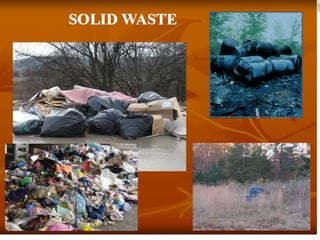
Wastes are the material that are not needed and are not
usable economically with further processing. It may be
in the form of solid, liquid, and gas. They originate from
the human activities such as agriculture, industry,
domestic activities etc. According to origin, waste is
classified as domestic, industrial, commercial, clinical,
construction, nuclear, and agricultural.
According to properties waste is classified as inert,
toxic, and inflammable. If these wastes remain
untreated, it leads to air, water, soil or solid waste
pollution. Hence, solid waste management is very
essential.
Solid waste management issue is the biggest
challenge to the authorities of both small and large
cities’ in developing countries.
This is mainly due to the increasing generation of
such solid waste and the burden posed on the
municipal budget. In addition to the high costs, the
solid waste management is associated lack of
understanding over different factors that affect the
entire handling system.
Population increase, rapid urbanization,
booming economy, and the rise in the
standard of living in developing countries
have greatly accelerated the rate, amount and
quality of the municipal solid waste
generation.
Causes of Solid Waste Pollution
Solid wastes are categorized as municipal waste,
industrial waste, and hazardous wastes. Municipal
waste arises from domestic activities of human
beings. Industrial waste arises from industrial
activities and hazardous wastes are the substances
which causes hazard to plants, animals and human
beings. Few of the common hazardous waste is
radioactive substances, chemicals, biological wastes,
flammable wastes and explosives.
1. Over population
Is a Great Factoring Which Influence the Rise in
Pollution.
2. Urbanization
Solid waste is an urban problem where people have
the habit of using of variety of commodities and
discarding them afterwards.
3. Affluence
In an affluent society, the per capita consumption is
very high and people discard many items regularly,
which increase solid waste to a large extent.
4. Technology
It has changed the culture of using things. It is
distinctly apparent in package industry for most
economic goods. There is a shift in technology from
the returnable packaging to non-returnable
packaging. For example, the returnable glass
container or bottles are being replaced by non-
returnable cans, plastic containers, plastic bottles
etc. Since packaging materials like those made from
plastic and non-biodegradable, they are largely
responsible for causing solid waste pollution.
Generally, solid waste from sources is highly;
heterogeneous in nature.
Thus, they have variable physical and chemical
characteristics depending on their original sources.
Their composition are yard waste, food waste,
plastics, wood, metals, papers, rubbers, leather,
batteries, inert materials, textiles, paint containers,
demolishing and construction materials as well as
many others that would be difficult to classify.
THE FUNCTIONAL ELEMENTS OF SOLID WASTE
Waste generation - encompasses activities in which
materials are identified as no longer being of value and
are either thrown out or gathered together for
disposal.
Collection - the functional element of collection
includes not only the gathering of solid waste and
recyclable materials, but also the transport of these
materials, after collection, to the location where the
collection vehicle is emptied. This location may be a
materials processing facility, a transfer station or a
landfill disposal site.
Waste handling and separation, storage and
processing at the source – involves activities associated
with waste management until the waste is placed in storage
containers for collection. Handling also encompasses the
movement of loaded containers to the point of collection.
Separating different types of waste components is an important
step in the handling and storage of solid waste at the source.
Separation and processing and transformation of
solid wastes - the types of means and facilities that are now
used for the recovery of waste materials that have been
separated at the source include curbside collection, drop off
and buy back centers. The separation and processing of wastes
that have been separated at the source and the separation of
commingled wastes usually occur at a materials recovery
facility, transfer stations, combustion facilities and disposal
sites.
Transfer and transport - this element involves two
main steps. First, the waste is transferred from a
smaller collection vehicle to larger transport
equipment. The waste is then transported, usually over
long distances, to a processing or disposal site.
Disposal - today, the disposal of wastes by land filling
or land spreading is the ultimate fate of all solid
wastes, whether they are residential wastes collected
and transported directly to a landfill site, residual
materials from material recovery facilities, residue
from the combustion of solid waste, compost, or other
substances from various solid waste processing
facilities.
A modern sanitary landfill is not a dump; it is an
engineered facility used for disposing of solid wastes
on land without creating nuisances or hazards to
public health or safety, such as the breeding of insects
and the contamination of ground water.
Energy generation - municipal solid waste can be
used to generate energy. Several technologies have
been developed that make the processing for energy
generation cleaner and more economical than ever
before, including landfill gas capture, combustion,
pyrolysis, gasification.
Effect of Solid Waste Pollution
Solid waste can pollute air, water and soil, and leave
various environmental impacts, and cause health
hazard, due to improper handling and transportation
.These adverse effects are seen on health and
environment, some of them are as follows:
Environmental impacts
1. Leachates from refuge dumps percolates into the soil
and contaminate underground water.
2. Scavengers and stray animals invade the roadside
garbage and litter the waste over large area causing much
aesthetic damage to the atmosphere.
3. Waste products when burnt like plastic and rubber
pollute the atmosphere with noxious fumes.
4. Organic solid wastes emits obnoxious odor on their
decomposition and make the environment polluted.
Health hazards
1. Vectors like rats and insects invade refuse dumps and
spread various diseases.
2. During handling and transfer of hospital and clinic
wastes, disease transmission may take place.
3. Water and food contamination through flies causes
various diseases in humans as dysentery, diarrhea and
amoebic dysentery.
4. Rats dwelling with infectious solid wastes may spread
diseases like plague, salmonellosis, endemic typhus etc.
5. Water supply, if gets contaminated with pathogens
present in solid wastes, may result in cholera, jaundice,
hepatitis, gastro enteric diseases etc.
6. Choking of drains and gully pits by the solid wastes
results in water logging which facilitates breeding of
mosquitoes and results in the spread of diseases like
malaria and plague.
7. Minimart-It is a case of human mercury poisoning
which occurred in minimart bay in japan. A large plastic
plants located near the minamata bay used mercury to
produce vinyl chloride, the left over mercury was
dumped into bay which entered in tissues of fish, which
in turn were consumed by people living in that area. The
contaminated fish thus caused an outbreak of poisoning,
killing and affecting several people.
Control of Solid Waste Pollution Disposal
An appropriate selection of disposal method of
solid waste:
1. Can save and avoid future problems.
2. The method should also provide opportunities
for recycling of materials if
possible
3. Should not pollute the air, the ground water,
the surface water or the land.
Control of Solid Waste Pollution Disposal
It is done most commonly through a sanitary
landfill or through incineration. Landfills- a
modern sanitary landfill is a depression in an
impermeable soil layer that is lined with an
impermeable membrane. In it solid waste is
placed in a suitably selected and prepared
landfill site in a prescribed manner. The waste
material is spread out and compacted with
appropriate heavy machinery. The waste is
covered each day with a layer of compacted soil.
Control of Solid Waste Pollution Disposal
Several disposal methods are being used in the
various parts of the world and the most
prominent of these are:
1. Open dumping
2. Sanitary landfill
3. Incineration
4. Composting
1. Open dumping
• Open dumping is practiced in many cities because it
is cheap and requires no planning.
• The open dumps cause public health problems by
encouraging the breeding of flies, rats, mosquitoes
and other pests.
• They also become source of objectionable odors and
cause air pollution when the wastes are burned in
order to reduce their volume and conserve space.
2. Sanitary landfill
Sanitary landfilling is an engineering operation,
designed and operated according to acceptable
standards. It may be defined as a method of
disposing refuse on land without creating
nuisances or hazards to public health or safety.
In sanitary landfill operation, refuse is spread
and compacted in thin layers within a small
area. This layered structure is usually referred to
as a cell.
The cell is then covered with a layer of soil which
is spread uniformly and then compacted. To
provide an adequate seal the cover should
normally be at least 20 cm thick. When a
number of cells reach the final desired elevation,
a final cover of about one meter of earth is
placed and it is again compacted. The final cover
is necessary to prevent rodents from burrowing
into refuse.
3. Incineration
Incineration involves burning of solid wastes at
high temperature, leftover ashes, glass, metals
and unburned combustible amount to perhaps
25% of the original waste.
Incineration leads to air pollution unless the
plant is designed, equipped and operated to
comply with air pollution standards. Typical air
pollution from incineration is fly ash, SO2,
hydrogen chloride, and organic acid.
Incineration is an economic method for solid
waste disposal because useful material and
energy can be recovered from the process.
Heat can be recovered by putting a waste heat
boiler or some other recovery device on an
existing waste incinerator. The solid waste has
about one-third the heating value of coal with
very low sulfur content.
The advantages of incineration include wide
range ability for handling varying loads and
small space requirement for ultimate disposal.
However, the method requires fairly high level of
maintenance and the operating costs are higher
than those for operating of a sanitary landfill.
4. Composting
Composting of refuse is an aerobic method of
decomposing solid waste. Many types of
microorganisms already present in the waste
stabilize the organic matter in the waste to
produce a soil conditioner.
Initially, the process starts with the mesophilic
bacteria which oxidize the organic matter in the
refuse to carbon dioxide and liberate heat. The
temperature rise to about 45 oC and at this point
the thermophilic bacteria take over and continue
to decomposition.
During this phase, the temperature further rise
to about 60 oC . The refuse is periodically turned
over to allow sufficient oxygen to penetrate to all
parts of the material to support aerobic life.
After about three week, the compost is
stabilized. The end point of operation can be
measured by noting a drop in temperature. The
compost should have an earthy smell and a dark
brown color.
5. Source recovery (pyrolysis)
it is a kind of destructive distillation in which
the solid wastes are heated in pyrolysis reactor at
650-1000 degree centigrade in oxygen depleted
environment. By this process, the chemical
constituents and chemical energy of some
organic wastes are recovered. The organic
constituents split up into gaseous liquid and
gaseous fractions like carbon dioxide, carbon
monoxide, tar, methane, charred carbon etc.
Summary
From the above study it is concluded that it is the immense need of
present times to get rid from solid waste pollution. It can be
controlled effectively through solid waste management. As it is a
difficult task, its main objectives are to reduce the harmful effects
and find ways for their utilization. Solid waste is harmful for the
environment whether it exists in solid, liquid or gaseous form. Solid
waste pollution is caused mainly through urbanization and through
industrial waste. It causes various diseases in human as bacillary
dysentery, diarrhea and amoebic dysentery, plague, salmonellosis,
trichinosis, endemic typhus, cholera, jaundice, hepatitis, gastro
enteric diseases etc. Hence, management of solid waste is very
essential, it helps in reducing solid waste pollution and creates
pollution free and clean environment. Various methods are
practiced to control solid waste pollution as composting, recycling,
incineration, pyrolysis, disposal, landfills etc. Hence, solid waste
management reduces or controls the solid waste pollution and its
hazardous effects.
Thank you
For listening

10. solid waste pollution.pdf pollution waste solid

  • 1.
  • 2.
    Outlines of Lecture Introduction  Definition  Causes of Solid Waste Pollution  The Functional Elements of Solid Waste  Effect of Solid Waste Pollution  Environmental impacts  Health hazards  Control of Solid Waste Pollution Disposal  Summary
  • 3.
    Introduction Modern societies arecharacterized by a life style of excessive patterns of consumption, and this does not depend on the rich countries only. Rather, this infection has spread to many developing countries, so their consumption exceeds their production and thus disrupts their economic balance. This huge increase in consumption is accompanied by a steady increase in the volume of waste that must be disposed of every day, especially in large, crowded cities.
  • 4.
    All countries sufferfrom this problem due to the increase in the quantities of these wastes and wastes day after day. In a country like the United States, which is one of the largest consumer countries in the world, the amount of this waste generated from factories, stores and building materials, in addition to household garbage, reaches an enormous extent, reaching about one million tons per day, at a rate of four kilograms per person per day. These wastes represent a great burden, as these wastes must be disposed of every day in the interest of public health. The amount of solid waste that is evacuated daily from the city of Cairo, for example, is more than 15,000 tons, and is much more than that in some other capitals.
  • 5.
    Man did notcare much about disposing of waste in the old time, because he was constantly on the move and on the move, and for this he used to throw his waste everywhere, and the problem of pollution did not occur to him. Instead of getting rid of this waste, he would leave the place and move to another place, leaving behind this waste.
  • 6.
    Definition Wastes are thematerial that are not needed and are not usable economically with further processing. It may be in the form of solid, liquid, and gas. They originate from the human activities such as agriculture, industry, domestic activities etc. According to origin, waste is classified as domestic, industrial, commercial, clinical, construction, nuclear, and agricultural. According to properties waste is classified as inert, toxic, and inflammable. If these wastes remain untreated, it leads to air, water, soil or solid waste pollution. Hence, solid waste management is very essential.
  • 7.
    Solid waste managementissue is the biggest challenge to the authorities of both small and large cities’ in developing countries. This is mainly due to the increasing generation of such solid waste and the burden posed on the municipal budget. In addition to the high costs, the solid waste management is associated lack of understanding over different factors that affect the entire handling system.
  • 9.
    Population increase, rapidurbanization, booming economy, and the rise in the standard of living in developing countries have greatly accelerated the rate, amount and quality of the municipal solid waste generation.
  • 10.
    Causes of SolidWaste Pollution Solid wastes are categorized as municipal waste, industrial waste, and hazardous wastes. Municipal waste arises from domestic activities of human beings. Industrial waste arises from industrial activities and hazardous wastes are the substances which causes hazard to plants, animals and human beings. Few of the common hazardous waste is radioactive substances, chemicals, biological wastes, flammable wastes and explosives.
  • 11.
    1. Over population Isa Great Factoring Which Influence the Rise in Pollution. 2. Urbanization Solid waste is an urban problem where people have the habit of using of variety of commodities and discarding them afterwards. 3. Affluence In an affluent society, the per capita consumption is very high and people discard many items regularly, which increase solid waste to a large extent.
  • 12.
    4. Technology It haschanged the culture of using things. It is distinctly apparent in package industry for most economic goods. There is a shift in technology from the returnable packaging to non-returnable packaging. For example, the returnable glass container or bottles are being replaced by non- returnable cans, plastic containers, plastic bottles etc. Since packaging materials like those made from plastic and non-biodegradable, they are largely responsible for causing solid waste pollution.
  • 13.
    Generally, solid wastefrom sources is highly; heterogeneous in nature. Thus, they have variable physical and chemical characteristics depending on their original sources. Their composition are yard waste, food waste, plastics, wood, metals, papers, rubbers, leather, batteries, inert materials, textiles, paint containers, demolishing and construction materials as well as many others that would be difficult to classify.
  • 14.
    THE FUNCTIONAL ELEMENTSOF SOLID WASTE Waste generation - encompasses activities in which materials are identified as no longer being of value and are either thrown out or gathered together for disposal. Collection - the functional element of collection includes not only the gathering of solid waste and recyclable materials, but also the transport of these materials, after collection, to the location where the collection vehicle is emptied. This location may be a materials processing facility, a transfer station or a landfill disposal site.
  • 15.
    Waste handling andseparation, storage and processing at the source – involves activities associated with waste management until the waste is placed in storage containers for collection. Handling also encompasses the movement of loaded containers to the point of collection. Separating different types of waste components is an important step in the handling and storage of solid waste at the source. Separation and processing and transformation of solid wastes - the types of means and facilities that are now used for the recovery of waste materials that have been separated at the source include curbside collection, drop off and buy back centers. The separation and processing of wastes that have been separated at the source and the separation of commingled wastes usually occur at a materials recovery facility, transfer stations, combustion facilities and disposal sites.
  • 16.
    Transfer and transport- this element involves two main steps. First, the waste is transferred from a smaller collection vehicle to larger transport equipment. The waste is then transported, usually over long distances, to a processing or disposal site. Disposal - today, the disposal of wastes by land filling or land spreading is the ultimate fate of all solid wastes, whether they are residential wastes collected and transported directly to a landfill site, residual materials from material recovery facilities, residue from the combustion of solid waste, compost, or other substances from various solid waste processing facilities.
  • 17.
    A modern sanitarylandfill is not a dump; it is an engineered facility used for disposing of solid wastes on land without creating nuisances or hazards to public health or safety, such as the breeding of insects and the contamination of ground water. Energy generation - municipal solid waste can be used to generate energy. Several technologies have been developed that make the processing for energy generation cleaner and more economical than ever before, including landfill gas capture, combustion, pyrolysis, gasification.
  • 18.
    Effect of SolidWaste Pollution Solid waste can pollute air, water and soil, and leave various environmental impacts, and cause health hazard, due to improper handling and transportation .These adverse effects are seen on health and environment, some of them are as follows: Environmental impacts 1. Leachates from refuge dumps percolates into the soil and contaminate underground water. 2. Scavengers and stray animals invade the roadside garbage and litter the waste over large area causing much aesthetic damage to the atmosphere. 3. Waste products when burnt like plastic and rubber pollute the atmosphere with noxious fumes. 4. Organic solid wastes emits obnoxious odor on their decomposition and make the environment polluted.
  • 19.
    Health hazards 1. Vectorslike rats and insects invade refuse dumps and spread various diseases. 2. During handling and transfer of hospital and clinic wastes, disease transmission may take place. 3. Water and food contamination through flies causes various diseases in humans as dysentery, diarrhea and amoebic dysentery. 4. Rats dwelling with infectious solid wastes may spread diseases like plague, salmonellosis, endemic typhus etc. 5. Water supply, if gets contaminated with pathogens present in solid wastes, may result in cholera, jaundice, hepatitis, gastro enteric diseases etc.
  • 20.
    6. Choking ofdrains and gully pits by the solid wastes results in water logging which facilitates breeding of mosquitoes and results in the spread of diseases like malaria and plague. 7. Minimart-It is a case of human mercury poisoning which occurred in minimart bay in japan. A large plastic plants located near the minamata bay used mercury to produce vinyl chloride, the left over mercury was dumped into bay which entered in tissues of fish, which in turn were consumed by people living in that area. The contaminated fish thus caused an outbreak of poisoning, killing and affecting several people.
  • 21.
    Control of SolidWaste Pollution Disposal An appropriate selection of disposal method of solid waste: 1. Can save and avoid future problems. 2. The method should also provide opportunities for recycling of materials if possible 3. Should not pollute the air, the ground water, the surface water or the land.
  • 22.
    Control of SolidWaste Pollution Disposal It is done most commonly through a sanitary landfill or through incineration. Landfills- a modern sanitary landfill is a depression in an impermeable soil layer that is lined with an impermeable membrane. In it solid waste is placed in a suitably selected and prepared landfill site in a prescribed manner. The waste material is spread out and compacted with appropriate heavy machinery. The waste is covered each day with a layer of compacted soil.
  • 23.
    Control of SolidWaste Pollution Disposal Several disposal methods are being used in the various parts of the world and the most prominent of these are: 1. Open dumping 2. Sanitary landfill 3. Incineration 4. Composting
  • 24.
    1. Open dumping •Open dumping is practiced in many cities because it is cheap and requires no planning. • The open dumps cause public health problems by encouraging the breeding of flies, rats, mosquitoes and other pests. • They also become source of objectionable odors and cause air pollution when the wastes are burned in order to reduce their volume and conserve space.
  • 25.
    2. Sanitary landfill Sanitarylandfilling is an engineering operation, designed and operated according to acceptable standards. It may be defined as a method of disposing refuse on land without creating nuisances or hazards to public health or safety. In sanitary landfill operation, refuse is spread and compacted in thin layers within a small area. This layered structure is usually referred to as a cell.
  • 26.
    The cell isthen covered with a layer of soil which is spread uniformly and then compacted. To provide an adequate seal the cover should normally be at least 20 cm thick. When a number of cells reach the final desired elevation, a final cover of about one meter of earth is placed and it is again compacted. The final cover is necessary to prevent rodents from burrowing into refuse.
  • 27.
    3. Incineration Incineration involvesburning of solid wastes at high temperature, leftover ashes, glass, metals and unburned combustible amount to perhaps 25% of the original waste. Incineration leads to air pollution unless the plant is designed, equipped and operated to comply with air pollution standards. Typical air pollution from incineration is fly ash, SO2, hydrogen chloride, and organic acid.
  • 28.
    Incineration is aneconomic method for solid waste disposal because useful material and energy can be recovered from the process. Heat can be recovered by putting a waste heat boiler or some other recovery device on an existing waste incinerator. The solid waste has about one-third the heating value of coal with very low sulfur content. The advantages of incineration include wide range ability for handling varying loads and small space requirement for ultimate disposal. However, the method requires fairly high level of maintenance and the operating costs are higher than those for operating of a sanitary landfill.
  • 29.
    4. Composting Composting ofrefuse is an aerobic method of decomposing solid waste. Many types of microorganisms already present in the waste stabilize the organic matter in the waste to produce a soil conditioner. Initially, the process starts with the mesophilic bacteria which oxidize the organic matter in the refuse to carbon dioxide and liberate heat. The temperature rise to about 45 oC and at this point the thermophilic bacteria take over and continue to decomposition.
  • 30.
    During this phase,the temperature further rise to about 60 oC . The refuse is periodically turned over to allow sufficient oxygen to penetrate to all parts of the material to support aerobic life. After about three week, the compost is stabilized. The end point of operation can be measured by noting a drop in temperature. The compost should have an earthy smell and a dark brown color.
  • 31.
    5. Source recovery(pyrolysis) it is a kind of destructive distillation in which the solid wastes are heated in pyrolysis reactor at 650-1000 degree centigrade in oxygen depleted environment. By this process, the chemical constituents and chemical energy of some organic wastes are recovered. The organic constituents split up into gaseous liquid and gaseous fractions like carbon dioxide, carbon monoxide, tar, methane, charred carbon etc.
  • 32.
    Summary From the abovestudy it is concluded that it is the immense need of present times to get rid from solid waste pollution. It can be controlled effectively through solid waste management. As it is a difficult task, its main objectives are to reduce the harmful effects and find ways for their utilization. Solid waste is harmful for the environment whether it exists in solid, liquid or gaseous form. Solid waste pollution is caused mainly through urbanization and through industrial waste. It causes various diseases in human as bacillary dysentery, diarrhea and amoebic dysentery, plague, salmonellosis, trichinosis, endemic typhus, cholera, jaundice, hepatitis, gastro enteric diseases etc. Hence, management of solid waste is very essential, it helps in reducing solid waste pollution and creates pollution free and clean environment. Various methods are practiced to control solid waste pollution as composting, recycling, incineration, pyrolysis, disposal, landfills etc. Hence, solid waste management reduces or controls the solid waste pollution and its hazardous effects.
  • 33.