AIR
POLLUTION
By:
Tawsif Ibne Yousuf
Tamanna Sharmin
Anupam Saha
Sayma Asha
Tuhin Islam
What is Air Pollution?
 The condition in which the air is
contaminated by foreign
substantences or the substances
themselves.
 This contamination of air causes harm
or discomfort to humans, animals,
plants and the whole environment
itself.
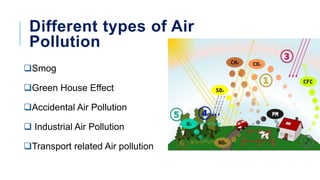
Different types of Air
Pollution
Smog
Green House Effect
Accidental Air Pollution
 Industrial Air Pollution
Transport related Air pollution
AIR POLLUTION IN
BANGLADESH
 Thousands of people in Bangladesh’s capital, Dhaka,
are dying prematurely because of air pollution.
 An estimated 15,000 deaths, as well as several
million cases of pulmonary, respiratory and
neurological illness are attributed to poor air quality.
 According to WHO vehicular air pollution is a major
cause of respiratory distress in urban Bangladesh.
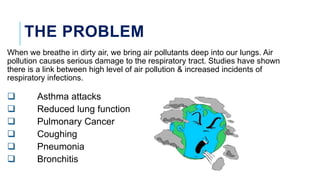
THE PROBLEM
When we breathe in dirty air, we bring air pollutants deep into our lungs. Air
pollution causes serious damage to the respiratory tract. Studies have shown
there is a link between high level of air pollution & increased incidents of
respiratory infections.
 Asthma attacks
 Reduced lung function
 Pulmonary Cancer
 Coughing
 Pneumonia
 Bronchitis
THE RISKS DEPEND ON:
>HOW TOXIC THE POLLUTANTS ARE
>HOW LONG & AT WHAT CONCENTRATION EXPOSURE OCCURS
>ADEQUACY OF VENTILATION
High risk groups: The higher the level of pollution, the greater the risk to vulnerable
individuals. These usually include:
•Children
•The elderly
•Others who already have compromised their immune systems.
Children are particularly vulnerable for three reasons:
•Their lungs, respiratory defenses & immune systems are not fully developed
•They breathe in more in proportion to their body size and
•They are likely to spend more time out of doors, particularly in the afternoon & during the
summer months when ozone and other pollutant levels are at their highest.
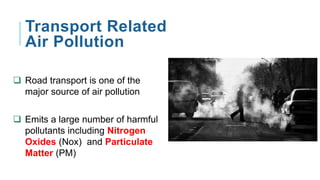
Transport Related
Air Pollution
 Road transport is one of the
major source of air pollution
 Emits a large number of harmful
pollutants including Nitrogen
Oxides (Nox) and Particulate
Matter (PM)
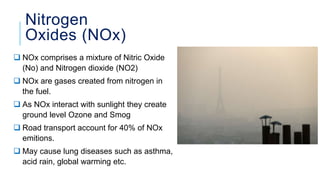
Nitrogen
Oxides (NOx)
 NOx comprises a mixture of Nitric Oxide
(No) and Nitrogen dioxide (NO2)
 NOx are gases created from nitrogen in
the fuel.
 As NOx interact with sunlight they create
ground level Ozone and Smog
 Road transport account for 40% of NOx
emitions.
 May cause lung diseases such as asthma,
acid rain, global warming etc.
OBJECTIVES
• To create public awareness on Air
pollution & it’s effects.
• To help the community
• To save people are from different
complex diseases, including
tuberculosis, asthma, bronchitis and
other skin diseases.
• To improve our own health
Solutions
 Use of Public Transportations
 Walking
 Bicycles
 Hybrids vehicles
 Hydrogen fuel cells
 Change the way we live and think
RECOMMENDATION
• Completely ban on (which are more than 20 years)
old vehicles.
• Immediate relocate/ shift the Industries (such as
Tanneries, Battery, Pharmaceutical, Tobacco) away
from Dhaka city.
• Create Public awareness on Air pollution through
media materials.
• We need to save the forest and promote plantation
inside the cities to maintain or restore the ecological
balance
CONCLUSION
 Severe air pollution is threatening public health in the Dhaka City.
Due to the excessive dust in Dhaka’s air, people are falling victim to
different complex diseases, including tuberculosis, asthma,
respiratory complications, bronchitis and other skin diseases.
 The only way to enhance the accountability of public administration
is Bangladesh Government should immediately translate its
National Environmental Policy, transport policy into action to benefit
the people of this country. Other wise this country will be in limbo.
Air pollution
Air pollution

Air pollution

  • 1.
    AIR POLLUTION By: Tawsif Ibne Yousuf TamannaSharmin Anupam Saha Sayma Asha Tuhin Islam
  • 2.
    What is AirPollution?  The condition in which the air is contaminated by foreign substantences or the substances themselves.  This contamination of air causes harm or discomfort to humans, animals, plants and the whole environment itself.
  • 3.
    Different types ofAir Pollution Smog Green House Effect Accidental Air Pollution  Industrial Air Pollution Transport related Air pollution
  • 4.
    AIR POLLUTION IN BANGLADESH Thousands of people in Bangladesh’s capital, Dhaka, are dying prematurely because of air pollution.  An estimated 15,000 deaths, as well as several million cases of pulmonary, respiratory and neurological illness are attributed to poor air quality.  According to WHO vehicular air pollution is a major cause of respiratory distress in urban Bangladesh.
  • 5.
    THE PROBLEM When webreathe in dirty air, we bring air pollutants deep into our lungs. Air pollution causes serious damage to the respiratory tract. Studies have shown there is a link between high level of air pollution & increased incidents of respiratory infections.  Asthma attacks  Reduced lung function  Pulmonary Cancer  Coughing  Pneumonia  Bronchitis
  • 6.
    THE RISKS DEPENDON: >HOW TOXIC THE POLLUTANTS ARE >HOW LONG & AT WHAT CONCENTRATION EXPOSURE OCCURS >ADEQUACY OF VENTILATION High risk groups: The higher the level of pollution, the greater the risk to vulnerable individuals. These usually include: •Children •The elderly •Others who already have compromised their immune systems. Children are particularly vulnerable for three reasons: •Their lungs, respiratory defenses & immune systems are not fully developed •They breathe in more in proportion to their body size and •They are likely to spend more time out of doors, particularly in the afternoon & during the summer months when ozone and other pollutant levels are at their highest.
  • 7.
    Transport Related Air Pollution Road transport is one of the major source of air pollution  Emits a large number of harmful pollutants including Nitrogen Oxides (Nox) and Particulate Matter (PM)
  • 8.
    Nitrogen Oxides (NOx)  NOxcomprises a mixture of Nitric Oxide (No) and Nitrogen dioxide (NO2)  NOx are gases created from nitrogen in the fuel.  As NOx interact with sunlight they create ground level Ozone and Smog  Road transport account for 40% of NOx emitions.  May cause lung diseases such as asthma, acid rain, global warming etc.
  • 9.
    OBJECTIVES • To createpublic awareness on Air pollution & it’s effects. • To help the community • To save people are from different complex diseases, including tuberculosis, asthma, bronchitis and other skin diseases. • To improve our own health
  • 10.
    Solutions  Use ofPublic Transportations  Walking  Bicycles  Hybrids vehicles  Hydrogen fuel cells  Change the way we live and think
  • 11.
    RECOMMENDATION • Completely banon (which are more than 20 years) old vehicles. • Immediate relocate/ shift the Industries (such as Tanneries, Battery, Pharmaceutical, Tobacco) away from Dhaka city. • Create Public awareness on Air pollution through media materials. • We need to save the forest and promote plantation inside the cities to maintain or restore the ecological balance
  • 12.
    CONCLUSION  Severe airpollution is threatening public health in the Dhaka City. Due to the excessive dust in Dhaka’s air, people are falling victim to different complex diseases, including tuberculosis, asthma, respiratory complications, bronchitis and other skin diseases.  The only way to enhance the accountability of public administration is Bangladesh Government should immediately translate its National Environmental Policy, transport policy into action to benefit the people of this country. Other wise this country will be in limbo.