For many of us Greeks the most important aspect of Greek history is
Greek warfare, because Greece was invaded by the Persian Empire (in
492 and in 480 BC), and if Greece had lost, it would not have had the
development it had and Democracy would have stopped in its tracks
and everything else related to Classical Greece (499-323 BC) would
not have developed. And we beat them mainly thanks to the
Spartans, who were the best soldiers on land, and also thanks to the
Athenians who had the best navy.
Major battles: Battle of Marathon (490 BC), Battle of Thermopylae
(480 BC), Naval battle of Salamis (480 BC), Battle of Platea (479 BC),
Battle of Mycale (479 BC)
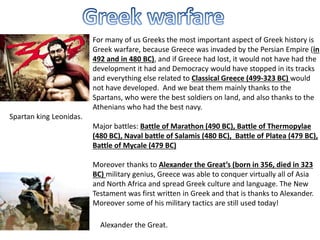
Moreover thanks to Alexander the Great’s (born in 356, died in 323
BC) military genius, Greece was able to conquer virtually all of Asia
and North Africa and spread Greek culture and language. The New
Testament was first written in Greek and that is thanks to Alexander.
Moreover some of his military tactics are still used today!
Spartan king Leonidas.
Alexander the Great.
(Δήμος: dimos, people. Κράτειν, kratin, to rule)
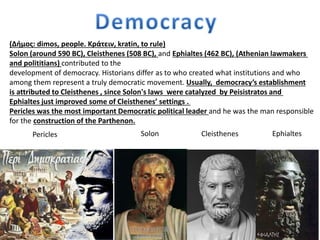
Solon (around 590 BC), Cleisthenes (508 BC), and Ephialtes (462 BC), (Athenian lawmakers
and polititians) contributed to the
development of democracy. Historians differ as to who created what institutions and who
among them represent a truly democratic movement. Usually, democracy’s establishment
is attributed to Cleisthenes , since Solon's laws were catalyzed by Peisistratos and
Ephialtes just improved some of Cleisthenes’ settings .
Pericles was the most important Democratic political leader and he was the man responsible
for the construction of the Parthenon.
CleisthenesSolonPericles Ephialtes
When speaking about Greece and athletics , people normally think of the
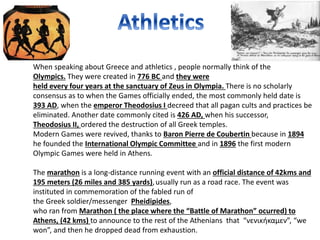
Olympics. They were created in 776 BC and they were
held every four years at the sanctuary of Zeus in Olympia. There is no scholarly
consensus as to when the Games officially ended, the most commonly held date is
393 AD, when the emperor Theodosius I decreed that all pagan cults and practices be
eliminated. Another date commonly cited is 426 AD, when his successor,
Theodosius II, ordered the destruction of all Greek temples.
Modern Games were revived, thanks to Baron Pierre de Coubertin because in 1894
he founded the International Olympic Committee and in 1896 the first modern
Olympic Games were held in Athens.
The marathon is a long-distance running event with an official distance of 42kms and
195 meters (26 miles and 385 yards),usually run as a road race. The event was
instituted in commemoration of the fabled run of
the Greek soldier/messenger Pheidipides,
who ran from Marathon ( the place where the “Battle of Marathon” ocurred) to
Athens, (42 kms) to announce to the rest of the Athenians that “νενικήκαμεν”, “we
won”, and then he dropped dead from exhaustion.
Like stated before, Alexander the Great spread Greek culture (and that includes language
too) when he conquered almost all of Asia and the north of Africa.
Consequently, all European languages have thousands of Greek words.
For example, English has approximately 45.000 Greek words and Spanish is
a mix of Arabic, Greek and Latin.
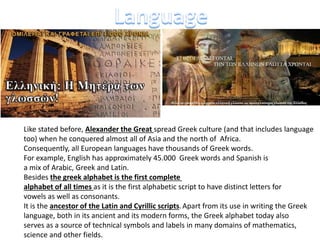
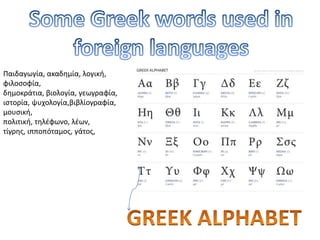
Besides the greek alphabet is the first complete
alphabet of all times as it is the first alphabetic script to have distinct letters for
vowels as well as consonants.
It is the ancestor of the Latin and Cyrillic scripts.Apart from its use in writing the Greek
language, both in its ancient and its modern forms, the Greek alphabet today also
serves as a source of technical symbols and labels in many domains of mathematics,
science and other fields.
Παιδαγωγία, ακαδημία, λογική,
φιλοσοφία,
δημοκράτια, βιολογία, γεωγραφία,
ιστορία, ψυχολογία,βιβλίογραφία,
μουσική,
πολιτική, τηλέφωνο, λέων,
τίγρης, ιπποπόταμος, γάτος,
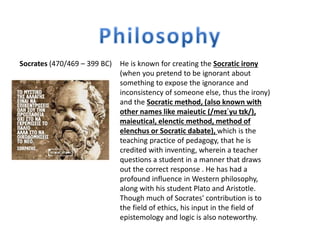
Socrates (470/469 – 399 BC) He is known for creating the Socratic irony
(when you pretend to be ignorant about
something to expose the ignorance and
inconsistency of someone else, thus the irony)
and the Socratic method, (also known with
other names like maieutic (/meɪˈyu tɪk/),
maieutical, elenctic method, method of
elenchus or Socratic dabate), which is the
teaching practice of pedagogy, that he is
credited with inventing, wherein a teacher
questions a student in a manner that draws
out the correct response . He has had a
profound influence in Western philosophy,
along with his student Plato and Aristotle.
Though much of Socrates' contribution is to
the field of ethics, his input in the field of
epistemology and logic is also noteworthy.
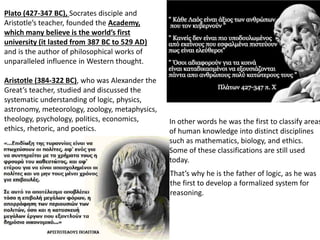
Plato (427-347 BC), Socrates disciple and
Aristotle’s teacher, founded the Academy,
which many believe is the world’s first
university (it lasted from 387 BC to 529 AD)
and is the author of philosophical works of
unparalleled influence in Western thought.
Aristotle (384-322 BC), who was Alexander the
Great’s teacher, studied and discussed the
systematic understanding of logic, physics,
astronomy, meteorology, zoology, metaphysics,
theology, psychology, politics, economics,
ethics, rhetoric, and poetics.
In other words he was the first to classify areas
of human knowledge into distinct disciplines
such as mathematics, biology, and ethics.
Some of these classifications are still used
today.
That’s why he is the father of logic, as he was
the first to develop a formalized system for
reasoning.
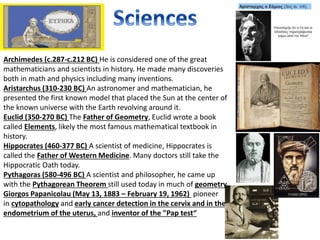
Archimedes (c.287-c.212 BC) He is considered one of the great
mathematicians and scientists in history. He made many discoveries
both in math and physics including many inventions.
Aristarchus (310-230 BC) An astronomer and mathematician, he
presented the first known model that placed the Sun at the center of
the known universe with the Earth revolving around it.
Euclid (350-270 BC) The Father of Geometry, Euclid wrote a book
called Elements, likely the most famous mathematical textbook in
history.
Hippocrates (460-377 BC) A scientist of medicine, Hippocrates is
called the Father of Western Medicine. Many doctors still take the
Hippocratic Oath today.
Pythagoras (580-496 BC) A scientist and philosopher, he came up
with the Pythagorean Theorem still used today in much of geometry.
Giorgos Papanicolau (May 13, 1883 – February 19, 1962) pioneer
in cytopathology and early cancer detection in the cervix and in the
endometrium of the uterus, and inventor of the "Pap test“
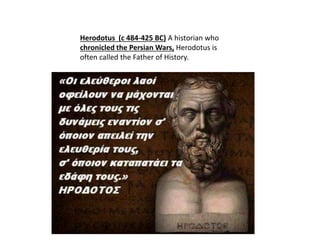
Herodotus (c 484-425 BC) A historian who
chronicled the Persian Wars, Herodotus is
often called the Father of History.
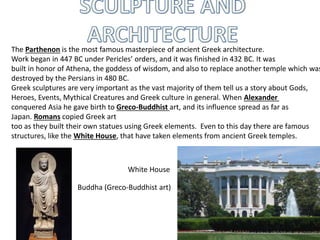
The Parthenon is the most famous masterpiece of ancient Greek architecture.
Work began in 447 BC under Pericles’ orders, and it was finished in 432 BC. It was
built in honor of Athena, the goddess of wisdom, and also to replace another temple which was
destroyed by the Persians in 480 BC.
Greek sculptures are very important as the vast majority of them tell us a story about Gods,
Heroes, Events, Mythical Creatures and Greek culture in general. When Alexander
conquered Asia he gave birth to Greco-Buddhist art, and its influence spread as far as
Japan. Romans copied Greek art
too as they built their own statues using Greek elements. Even to this day there are famous
structures, like the White House, that have taken elements from ancient Greek temples.
Buddha (Greco-Buddhist art)
White House
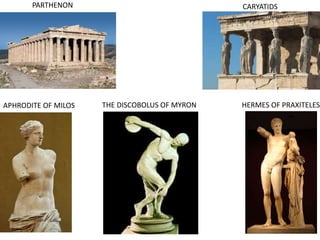
PARTHENON CARYATIDS
APHRODITE OF MILOS THE DISCOBOLUS OF MYRON HERMES OF PRAXITELES
8 Surprising Facts about Alexander the Great
— HISTORY Lists. (n.d.). Retrieved from
http://www.history.com/news/history-
lists/eight-surprising-facts-about-alexander-
the-great
Ancient Greece for Kids: 25 Famous People of
Ancient Greece. (n.d.). Retrieved from
http://www.ducksters.com/history/ancient_gr
eek_famous_people.php
Περσικοί Πόλεμοι - Βικιπαίδεια. (n.d.).
Retrieved from
https://el.wikipedia.org/wiki/%CE%A0%CE%B5
%CF%81%CF%83%CE%B9%CE%BA%CE%BF%CE
%AF_%CE%A0%CF%8C%CE%BB%CE%B5%CE%
BC%CE%BF%CE%B9
Greco-Persian wars
Αθηναϊκή δημοκρατία - Βικιπαίδεια. (n.d.).
Retrieved from
https://el.wikipedia.org/wiki/%CE%91%CE%B8
%CE%B7%CE%BD%CE%B1%CF%8A%CE%BA%C
E%AE_%CE%B4%CE%B7%CE%BC%CE%BF%CE%
BA%CF%81%CE%B1%CF%84%CE%AF%CE%B1
Athenean Democracy
Περικλής - Βικιπαίδεια. (n.d.). Retrieved from
https://el.wikipedia.org/wiki/%CE%A0%CE%B5
%CF%81%CE%B9%CE%BA%CE%BB%CE%AE%C
F%82
Pericles
Ολυμπιακοί αγώνες στην αρχαιότητα -
Βικιπαίδεια. (n.d.). Retrieved from
https://el.wikipedia.org/wiki/%CE%9F%CE%BB
%CF%85%CE%BC%CF%80%CE%B9%CE%B1%CE
%BA%CE%BF%CE%AF_%CE%B1%CE%B3%CF%8
E%CE%BD%CE%B5%CF%82_%CF%83%CF%84%
CE%B7%CE%BD_%CE%B1%CF%81%CF%87%CE
%B1%CE%B9%CF%8C%CF%84%CE%B7%CF%84
%CE%B1
Olympic games in Ancient Greece.
Marathon - Wikipedia, the free encyclopedia.
(n.d.). Retrieved July 13, 2015, from
https://en.wikipedia.org/wiki/Marathon
Marathon
Greek alphabet - Wikipedia, the free
encyclopedia. (n.d.). Retrieved July 13, 2015,
from
https://en.wikipedia.org/wiki/Greek_alphabet
Η Ελληνική, μητέρα όλων των Ευρωπαϊκών
γλωσσών! | ΕΛΛΑΣ. (n.d.). Retrieved from
https://ellas2.wordpress.com/2011/01/11/%C
E%B7-
%CE%B5%CE%BB%CE%BB%CE%B7%CE%BD%C
E%B9%CE%BA%CE%AE-
%CE%BC%CE%B7%CF%84%CE%AD%CF%81%C
E%B1-%CF%8C%CE%BB%CF%89%CE%BD-
%CF%84%CF%89%CE%BD-
%CE%B5%CF%85%CF%81%CF%89%CF%80%CE
%B1%CF%8A%CE%BA%CF%8E%CE%BD/
Greek language, mother of all
European languages.
Greek alphabet
Socratic irony - Dictionary Definition :
Vocabulary.com. (n.d.). Retrieved from
http://www.vocabulary.com/dictionary/Socrati
c%20irony
Σωκράτης - Βικιπαίδεια. (n.d.). Retrieved from
https://el.wikipedia.org/wiki/%CE%A3%CF%89
%CE%BA%CF%81%CE%AC%CF%84%CE%B7%C
F%82
Socrates
Πλάτων - Βικιπαίδεια. (n.d.). Retrieved from
https://el.wikipedia.org/wiki/%CE%A0%CE%BB
%CE%AC%CF%84%CF%89%CE%BD
Socratic irony
Plato
Αριστοτέλης - Βικιπαίδεια. (n.d.). Retrieved
from
https://el.wikipedia.org/wiki/%CE%91%CF%81
%CE%B9%CF%83%CF%84%CE%BF%CF%84%CE
%AD%CE%BB%CE%B7%CF%82
Aristotle
.
Aristotle | Internet Encyclopedia of Philosophy.
(n.d.). Retrieved from
http://www.iep.utm.edu/aristotl/
Αρχιμήδης - Βικιπαίδεια. (n.d.). Retrieved from
https://el.wikipedia.org/wiki/%CE%91%CF%81
%CF%87%CE%B9%CE%BC%CE%AE%CE%B4%C
E%B7%CF%82
Archimedes
Αρίσταρχος ο Σάμιος - Βικιπαίδεια. (n.d.).
Retrieved from
https://el.wikipedia.org/wiki/%CE%91%CF%81
%CE%AF%CF%83%CF%84%CE%B1%CF%81%CF
%87%CE%BF%CF%82_%CE%BF_%CE%A3%CE%
AC%CE%BC%CE%B9%CE%BF%CF%82
Aristarchus
Ευκλείδης - Βικιπαίδεια. (n.d.). Retrieved from
https://el.wikipedia.org/wiki/%CE%95%CF%85
%CE%BA%CE%BB%CE%B5%CE%AF%CE%B4%C
E%B7%CF%82
Euclid
Ιπποκράτης - Βικιπαίδεια. (n.d.). Retrieved
from
https://el.wikipedia.org/wiki/%CE%99%CF%80
%CF%80%CE%BF%CE%BA%CF%81%CE%AC%CF
%84%CE%B7%CF%82
Hippocrates
Πυθαγόρας - Βικιπαίδεια. (n.d.). Retrieved
from
https://el.wikipedia.org/wiki/%CE%A0%CF%85
%CE%B8%CE%B1%CE%B3%CF%8C%CF%81%CE
%B1%CF%82
Pythagoras
Georgios Papanikolaou - Wikipedia, the free
encyclopedia. (n.d.). Retrieved July 13, 2015,
from
https://en.wikipedia.org/wiki/Georgios_Papani
kolaou
Georgios Papanikolaou
Παρθενώνας - Βικιπαίδεια. (n.d.). Retrieved
from
https://el.wikipedia.org/wiki/%CE%A0%CE%B1
%CF%81%CE%B8%CE%B5%CE%BD%CF%8E%C
E%BD%CE%B1%CF%82
Herodotus - Wikipedia, the free encyclopedia.
(n.d.). Retrieved July 13, 2015, from
https://en.wikipedia.org/wiki/Herodotus
Herodotus
Greco-Buddhism - Wikipedia, the free
encyclopedia. (n.d.). Retrieved July 13, 2015,
from https://en.wikipedia.org/wiki/Greco-
Buddhism
Parthenon
Greco-Buddhism
Spartans! Prepare for glory! [Video file]. (n.d.).
Retrieved from
https://www.youtube.com/watch?v=V1QidirAT
Fc
THE STORY OF A MIRACLE, GREEKS-Atlantic
Productions in association with PBS and
Devillier Donegan Enterprises (full
documentary) [Video file]. (n.d.). Retrieved
from
https://www.youtube.com/watch?v=UEC-
MhPi5M8
ULITMATE BATTLES - ALEXANDER THE GREAT -
Discovery History Military War (full
documentary)[Video file]. (n.d.). Retrieved
from
https://www.youtube.com/watch?v=iTAuU3DP
tzQ
ANCIENT GREEKS - HOW DID THEY HELP US?
(Documentary) History/Culture/Discovery
[Video file]. (n.d.). Retrieved from
https://www.youtube.com/watch?v=sKdolzRah
4E
ARISTOTLE-SKAI-GREAT GREEKS 2009 (HQ)
[Video file]. (n.d.). Retrieved from
https://www.youtube.com/watch?v=Lou8eEw
o4Lg
PLEVRIS’ (GREEK HISTORIAN) ANSWER TO
REPUSI (GREEK POLITITIAN) ABOUT ANCIENT
GREEK[Video file]. (n.d.). Retrieved from
https://www.youtube.com/watch?v=5-
1K44P7-us

Legacy of classical Greece

  • 4.
    For many ofus Greeks the most important aspect of Greek history is Greek warfare, because Greece was invaded by the Persian Empire (in 492 and in 480 BC), and if Greece had lost, it would not have had the development it had and Democracy would have stopped in its tracks and everything else related to Classical Greece (499-323 BC) would not have developed. And we beat them mainly thanks to the Spartans, who were the best soldiers on land, and also thanks to the Athenians who had the best navy. Major battles: Battle of Marathon (490 BC), Battle of Thermopylae (480 BC), Naval battle of Salamis (480 BC), Battle of Platea (479 BC), Battle of Mycale (479 BC) Moreover thanks to Alexander the Great’s (born in 356, died in 323 BC) military genius, Greece was able to conquer virtually all of Asia and North Africa and spread Greek culture and language. The New Testament was first written in Greek and that is thanks to Alexander. Moreover some of his military tactics are still used today! Spartan king Leonidas. Alexander the Great.
  • 5.
    (Δήμος: dimos, people.Κράτειν, kratin, to rule) Solon (around 590 BC), Cleisthenes (508 BC), and Ephialtes (462 BC), (Athenian lawmakers and polititians) contributed to the development of democracy. Historians differ as to who created what institutions and who among them represent a truly democratic movement. Usually, democracy’s establishment is attributed to Cleisthenes , since Solon's laws were catalyzed by Peisistratos and Ephialtes just improved some of Cleisthenes’ settings . Pericles was the most important Democratic political leader and he was the man responsible for the construction of the Parthenon. CleisthenesSolonPericles Ephialtes
  • 6.
    When speaking aboutGreece and athletics , people normally think of the Olympics. They were created in 776 BC and they were held every four years at the sanctuary of Zeus in Olympia. There is no scholarly consensus as to when the Games officially ended, the most commonly held date is 393 AD, when the emperor Theodosius I decreed that all pagan cults and practices be eliminated. Another date commonly cited is 426 AD, when his successor, Theodosius II, ordered the destruction of all Greek temples. Modern Games were revived, thanks to Baron Pierre de Coubertin because in 1894 he founded the International Olympic Committee and in 1896 the first modern Olympic Games were held in Athens. The marathon is a long-distance running event with an official distance of 42kms and 195 meters (26 miles and 385 yards),usually run as a road race. The event was instituted in commemoration of the fabled run of the Greek soldier/messenger Pheidipides, who ran from Marathon ( the place where the “Battle of Marathon” ocurred) to Athens, (42 kms) to announce to the rest of the Athenians that “νενικήκαμεν”, “we won”, and then he dropped dead from exhaustion.
  • 7.
    Like stated before,Alexander the Great spread Greek culture (and that includes language too) when he conquered almost all of Asia and the north of Africa. Consequently, all European languages have thousands of Greek words. For example, English has approximately 45.000 Greek words and Spanish is a mix of Arabic, Greek and Latin. Besides the greek alphabet is the first complete alphabet of all times as it is the first alphabetic script to have distinct letters for vowels as well as consonants. It is the ancestor of the Latin and Cyrillic scripts.Apart from its use in writing the Greek language, both in its ancient and its modern forms, the Greek alphabet today also serves as a source of technical symbols and labels in many domains of mathematics, science and other fields.
  • 8.
    Παιδαγωγία, ακαδημία, λογική, φιλοσοφία, δημοκράτια,βιολογία, γεωγραφία, ιστορία, ψυχολογία,βιβλίογραφία, μουσική, πολιτική, τηλέφωνο, λέων, τίγρης, ιπποπόταμος, γάτος,
  • 9.
    Socrates (470/469 –399 BC) He is known for creating the Socratic irony (when you pretend to be ignorant about something to expose the ignorance and inconsistency of someone else, thus the irony) and the Socratic method, (also known with other names like maieutic (/meɪˈyu tɪk/), maieutical, elenctic method, method of elenchus or Socratic dabate), which is the teaching practice of pedagogy, that he is credited with inventing, wherein a teacher questions a student in a manner that draws out the correct response . He has had a profound influence in Western philosophy, along with his student Plato and Aristotle. Though much of Socrates' contribution is to the field of ethics, his input in the field of epistemology and logic is also noteworthy.
  • 10.
    Plato (427-347 BC),Socrates disciple and Aristotle’s teacher, founded the Academy, which many believe is the world’s first university (it lasted from 387 BC to 529 AD) and is the author of philosophical works of unparalleled influence in Western thought. Aristotle (384-322 BC), who was Alexander the Great’s teacher, studied and discussed the systematic understanding of logic, physics, astronomy, meteorology, zoology, metaphysics, theology, psychology, politics, economics, ethics, rhetoric, and poetics. In other words he was the first to classify areas of human knowledge into distinct disciplines such as mathematics, biology, and ethics. Some of these classifications are still used today. That’s why he is the father of logic, as he was the first to develop a formalized system for reasoning.
  • 11.
    Archimedes (c.287-c.212 BC)He is considered one of the great mathematicians and scientists in history. He made many discoveries both in math and physics including many inventions. Aristarchus (310-230 BC) An astronomer and mathematician, he presented the first known model that placed the Sun at the center of the known universe with the Earth revolving around it. Euclid (350-270 BC) The Father of Geometry, Euclid wrote a book called Elements, likely the most famous mathematical textbook in history. Hippocrates (460-377 BC) A scientist of medicine, Hippocrates is called the Father of Western Medicine. Many doctors still take the Hippocratic Oath today. Pythagoras (580-496 BC) A scientist and philosopher, he came up with the Pythagorean Theorem still used today in much of geometry. Giorgos Papanicolau (May 13, 1883 – February 19, 1962) pioneer in cytopathology and early cancer detection in the cervix and in the endometrium of the uterus, and inventor of the "Pap test“
  • 12.
    Herodotus (c 484-425BC) A historian who chronicled the Persian Wars, Herodotus is often called the Father of History.
  • 13.
    The Parthenon isthe most famous masterpiece of ancient Greek architecture. Work began in 447 BC under Pericles’ orders, and it was finished in 432 BC. It was built in honor of Athena, the goddess of wisdom, and also to replace another temple which was destroyed by the Persians in 480 BC. Greek sculptures are very important as the vast majority of them tell us a story about Gods, Heroes, Events, Mythical Creatures and Greek culture in general. When Alexander conquered Asia he gave birth to Greco-Buddhist art, and its influence spread as far as Japan. Romans copied Greek art too as they built their own statues using Greek elements. Even to this day there are famous structures, like the White House, that have taken elements from ancient Greek temples. Buddha (Greco-Buddhist art) White House
  • 14.
    PARTHENON CARYATIDS APHRODITE OFMILOS THE DISCOBOLUS OF MYRON HERMES OF PRAXITELES
  • 16.
    8 Surprising Factsabout Alexander the Great — HISTORY Lists. (n.d.). Retrieved from http://www.history.com/news/history- lists/eight-surprising-facts-about-alexander- the-great Ancient Greece for Kids: 25 Famous People of Ancient Greece. (n.d.). Retrieved from http://www.ducksters.com/history/ancient_gr eek_famous_people.php Περσικοί Πόλεμοι - Βικιπαίδεια. (n.d.). Retrieved from https://el.wikipedia.org/wiki/%CE%A0%CE%B5 %CF%81%CF%83%CE%B9%CE%BA%CE%BF%CE %AF_%CE%A0%CF%8C%CE%BB%CE%B5%CE% BC%CE%BF%CE%B9 Greco-Persian wars
  • 17.
    Αθηναϊκή δημοκρατία -Βικιπαίδεια. (n.d.). Retrieved from https://el.wikipedia.org/wiki/%CE%91%CE%B8 %CE%B7%CE%BD%CE%B1%CF%8A%CE%BA%C E%AE_%CE%B4%CE%B7%CE%BC%CE%BF%CE% BA%CF%81%CE%B1%CF%84%CE%AF%CE%B1 Athenean Democracy Περικλής - Βικιπαίδεια. (n.d.). Retrieved from https://el.wikipedia.org/wiki/%CE%A0%CE%B5 %CF%81%CE%B9%CE%BA%CE%BB%CE%AE%C F%82 Pericles Ολυμπιακοί αγώνες στην αρχαιότητα - Βικιπαίδεια. (n.d.). Retrieved from https://el.wikipedia.org/wiki/%CE%9F%CE%BB %CF%85%CE%BC%CF%80%CE%B9%CE%B1%CE %BA%CE%BF%CE%AF_%CE%B1%CE%B3%CF%8 E%CE%BD%CE%B5%CF%82_%CF%83%CF%84% CE%B7%CE%BD_%CE%B1%CF%81%CF%87%CE %B1%CE%B9%CF%8C%CF%84%CE%B7%CF%84 %CE%B1 Olympic games in Ancient Greece.
  • 18.
    Marathon - Wikipedia,the free encyclopedia. (n.d.). Retrieved July 13, 2015, from https://en.wikipedia.org/wiki/Marathon Marathon Greek alphabet - Wikipedia, the free encyclopedia. (n.d.). Retrieved July 13, 2015, from https://en.wikipedia.org/wiki/Greek_alphabet Η Ελληνική, μητέρα όλων των Ευρωπαϊκών γλωσσών! | ΕΛΛΑΣ. (n.d.). Retrieved from https://ellas2.wordpress.com/2011/01/11/%C E%B7- %CE%B5%CE%BB%CE%BB%CE%B7%CE%BD%C E%B9%CE%BA%CE%AE- %CE%BC%CE%B7%CF%84%CE%AD%CF%81%C E%B1-%CF%8C%CE%BB%CF%89%CE%BD- %CF%84%CF%89%CE%BD- %CE%B5%CF%85%CF%81%CF%89%CF%80%CE %B1%CF%8A%CE%BA%CF%8E%CE%BD/ Greek language, mother of all European languages. Greek alphabet
  • 19.
    Socratic irony -Dictionary Definition : Vocabulary.com. (n.d.). Retrieved from http://www.vocabulary.com/dictionary/Socrati c%20irony Σωκράτης - Βικιπαίδεια. (n.d.). Retrieved from https://el.wikipedia.org/wiki/%CE%A3%CF%89 %CE%BA%CF%81%CE%AC%CF%84%CE%B7%C F%82 Socrates Πλάτων - Βικιπαίδεια. (n.d.). Retrieved from https://el.wikipedia.org/wiki/%CE%A0%CE%BB %CE%AC%CF%84%CF%89%CE%BD Socratic irony Plato Αριστοτέλης - Βικιπαίδεια. (n.d.). Retrieved from https://el.wikipedia.org/wiki/%CE%91%CF%81 %CE%B9%CF%83%CF%84%CE%BF%CF%84%CE %AD%CE%BB%CE%B7%CF%82 Aristotle
  • 20.
    . Aristotle | InternetEncyclopedia of Philosophy. (n.d.). Retrieved from http://www.iep.utm.edu/aristotl/ Αρχιμήδης - Βικιπαίδεια. (n.d.). Retrieved from https://el.wikipedia.org/wiki/%CE%91%CF%81 %CF%87%CE%B9%CE%BC%CE%AE%CE%B4%C E%B7%CF%82 Archimedes Αρίσταρχος ο Σάμιος - Βικιπαίδεια. (n.d.). Retrieved from https://el.wikipedia.org/wiki/%CE%91%CF%81 %CE%AF%CF%83%CF%84%CE%B1%CF%81%CF %87%CE%BF%CF%82_%CE%BF_%CE%A3%CE% AC%CE%BC%CE%B9%CE%BF%CF%82 Aristarchus Ευκλείδης - Βικιπαίδεια. (n.d.). Retrieved from https://el.wikipedia.org/wiki/%CE%95%CF%85 %CE%BA%CE%BB%CE%B5%CE%AF%CE%B4%C E%B7%CF%82 Euclid
  • 21.
    Ιπποκράτης - Βικιπαίδεια.(n.d.). Retrieved from https://el.wikipedia.org/wiki/%CE%99%CF%80 %CF%80%CE%BF%CE%BA%CF%81%CE%AC%CF %84%CE%B7%CF%82 Hippocrates Πυθαγόρας - Βικιπαίδεια. (n.d.). Retrieved from https://el.wikipedia.org/wiki/%CE%A0%CF%85 %CE%B8%CE%B1%CE%B3%CF%8C%CF%81%CE %B1%CF%82 Pythagoras Georgios Papanikolaou - Wikipedia, the free encyclopedia. (n.d.). Retrieved July 13, 2015, from https://en.wikipedia.org/wiki/Georgios_Papani kolaou Georgios Papanikolaou
  • 22.
    Παρθενώνας - Βικιπαίδεια.(n.d.). Retrieved from https://el.wikipedia.org/wiki/%CE%A0%CE%B1 %CF%81%CE%B8%CE%B5%CE%BD%CF%8E%C E%BD%CE%B1%CF%82 Herodotus - Wikipedia, the free encyclopedia. (n.d.). Retrieved July 13, 2015, from https://en.wikipedia.org/wiki/Herodotus Herodotus Greco-Buddhism - Wikipedia, the free encyclopedia. (n.d.). Retrieved July 13, 2015, from https://en.wikipedia.org/wiki/Greco- Buddhism Parthenon Greco-Buddhism
  • 23.
    Spartans! Prepare forglory! [Video file]. (n.d.). Retrieved from https://www.youtube.com/watch?v=V1QidirAT Fc THE STORY OF A MIRACLE, GREEKS-Atlantic Productions in association with PBS and Devillier Donegan Enterprises (full documentary) [Video file]. (n.d.). Retrieved from https://www.youtube.com/watch?v=UEC- MhPi5M8 ULITMATE BATTLES - ALEXANDER THE GREAT - Discovery History Military War (full documentary)[Video file]. (n.d.). Retrieved from https://www.youtube.com/watch?v=iTAuU3DP tzQ
  • 24.
    ANCIENT GREEKS -HOW DID THEY HELP US? (Documentary) History/Culture/Discovery [Video file]. (n.d.). Retrieved from https://www.youtube.com/watch?v=sKdolzRah 4E ARISTOTLE-SKAI-GREAT GREEKS 2009 (HQ) [Video file]. (n.d.). Retrieved from https://www.youtube.com/watch?v=Lou8eEw o4Lg PLEVRIS’ (GREEK HISTORIAN) ANSWER TO REPUSI (GREEK POLITITIAN) ABOUT ANCIENT GREEK[Video file]. (n.d.). Retrieved from https://www.youtube.com/watch?v=5- 1K44P7-us