

10 Common Errors in Valuations
Sean Saari, CPA/ABV, CVA, MBA
Robert A. Ranallo, CPA/ABV, CVA, CFF, JD
June 26, 2014
And How to Effectively Cross-Examine These Issues
After completing the session, participants
will be able to…
• Identify 10 common errors in valuations
• Understand how to correctly approach
the 10 common errors in valuations
• Effectively cross-examine opposing
experts on 10 common errors in
valuations
“In the long run, men hit only what they aim at.” – Henry David Thoreau
LEARNING OBJECTIVES
“There is no such thing as an absolute
value in this world. You can only estimate
what a thing is worth to you.”
Charles Dudley Warner 1829-1900, American Writer
QUOTE OF THE DAY
A QUICK PRIMER
ON VALUATION
• Asset approach
 Adjusted Net Asset Method
• Income approach
 Capitalization of Cash
Flow/Earnings Method
 Discounted Cash Flow Method
• Market approach
 Guideline Transaction Method
 Guideline Public Company Method
There are three valuation approaches that are required to
be considered in every valuation analysis, each with its own
commonly-used valuation methodologies
1. Confusion of equity value and enterprise value
2. Failure to properly consider normalizing adjustments
3. Assumption that net income = net cash flow
4. Unsustainable relationship of capital expenditures to depreciation
5. Unsupportable long-term growth rate
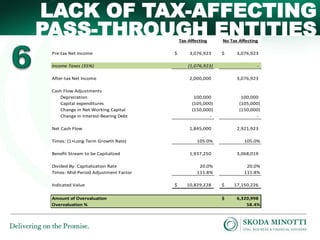
6. Lack of tax-affecting for pass-through entities
7. No consideration of adjustments to guideline public
company multiples
8. No consideration given to market approach
9. Improper reconciliation of multiple valuation approaches
10. Misapplication of marketability discount studies
VALUATION ERRORS
10 COMMON
Equity Value = Value of Equity Ownership
Enterprise Value = Equity Value + Debt – Cash
Equity Value = Enterprise Value – Debt + Cash
CONFUSING EQUITY VALUE
WITH ENTERPRISE VALUE
• If the income or market approach applied uses a
benefit stream to determine value that is before
interest expense (EBIT, EBITDA, Revenue, etc.), it will
result in an enterprise value, not an equity value
• The market approach is often based on enterprise
values expressed as a multiple of EBITDA or revenue,
so adjustments to the enterprise value to reach an
equity value are required
• Misinterpreting an enterprise value as an equity value
will result in an inflated value
CONFUSING EQUITY VALUE
WITH ENTERPRISE VALUE
Furnishings
House
Value
Debt
Value
Equity
Value
Total Value
of Home
and
Furnishings
How the Value of Your Home is an
Enterprise Value
CONFUSING EQUITY VALUE
WITH ENTERPRISE VALUE
Cash
Enterprise
Value
Debt
Value
Equity
Value
Market
Value of
Invested
Capital
Reconciling Equity Value to Enterprise Value
• Normalizing adjustments are made to a company’s
historical income statements for non-recurring or
discretionary items in order to reflect the true
underlying economics of the business
• Common normalizing adjustments include
 Officer compensation (over or undercompensation)
 Personal/discretionary expenses
 Related-party transactions at amounts other than FMV
 Non-operating income or expenses
 Non-recurring income or expenses
• Determining normalizing adjustments requires
professional judgment. Failure to properly consider
normalizing adjustments can lead to the over or
undervaluation of a company
NOT CONSIDERING
NORMALIZING ADJUSTMENTS
• Capitalization/discounting of net income instead of net
cash flow can lead to overvaluation
• Capitalization/discount rates are for net cash flow, not
net income
• Net income does not consider the impact of:
 Capital expenditures
 Changes in net working capital
 Changes in interest-bearing debt
NET INCOME =/=
NET CASH FLOW
NET INCOME =/=
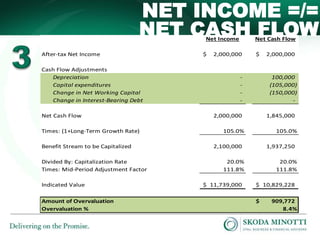
NET CASH FLOWNet Income Net Cash Flow
After-tax Net Income 2,000,000$ 2,000,000$
Cash Flow Adjustments
Depreciation - 100,000
Capital expenditures - (105,000)
Change in Net Working Capital - (150,000)
Change in Interest-Bearing Debt - -
Net Cash Flow 2,000,000 1,845,000
Times: (1+Long-Term Growth Rate) 105.0% 105.0%
Benefit Stream to be Capitalized 2,100,000 1,937,250
Divided By: Capitalization Rate 20.0% 20.0%
Times: Mid-Period Adjustment Factor 111.8% 111.8%
Indicated Value 11,739,000$ 10,829,228$
Amount of Overvaluation 909,772$
Overvaluation % 8.4%
• In a capitalization of cash flow analysis, or in the
terminal year of a discounted cash flow analysis,
projected capital expenditures and depreciation
expense should directly correlate
• In many cases, capital expenditures are projected to
exceed depreciation by the long-term growth rate
• When there is not a supportable relationship between
capital expenditures and depreciation expense, it will
result in overvaluation or undervaluation
CAPITAL EXPENDITURES &
DEPRECIATION
Reasonable Excess Excess
Relationship Depreciation CapEx
After-tax Net Income 2,000,000$ 2,000,000$ 2,000,000$
Cash Flow Adjustments
Depreciation 100,000 300,000 100,000
Capital expenditures (105,000) (105,000) (300,000)
Change in Net Working Capital (150,000) (150,000) (150,000)
Change in Interest-Bearing Debt - - -
Net Cash Flow 1,845,000 2,045,000 1,650,000
Times: (1+Long-Term Growth Rate) 105.0% 105.0% 105.0%
Benefit Stream to be Capitalized 1,937,250 2,147,250 1,732,500
Divided By: Capitalization Rate 20.0% 20.0% 20.0%
Times: Mid-Period Adjustment Factor 111.8% 111.8% 111.8%
Indicated Value 10,829,228$ 12,003,128$ 9,684,675$
Amount of Overvaluation (Undervaluation) 1,173,900$ (1,144,553)$
Overvaluation (Undervaluation) % 10.8% (10.6%)
CAPITAL EXPENDITURES &
DEPRECIATION
• The long-term growth rate used in the
income approach can have a material
impact on value
• Long-term growth rates typically
should not exceed 5%-6%
 2%-3% Inflation
 2%-3% Real GDP growth
• Long-term growth rates in excess of
5%-6% imply that the company will
actually grow to be larger than the
economy as a whole into perpetuity,
which is not supportable and results
in overvaluation
UNSUPPORTABLE
LONG-TERM GROWTH RATE
UNSUPPORTABLE
LONG-TERM GROWTH RATEReasonable Inflated
Growth Rate Growth Rate
After-tax Net Income 2,000,000$ 2,000,000$
Cash Flow Adjustments
Depreciation 100,000 100,000
Capital expenditures (105,000) (105,000)
Change in Net Working Capital (150,000) (150,000)
Change in Interest-Bearing Debt - -
Net Cash Flow 1,845,000 1,845,000
Times: (1+Long-Term Growth Rate) 105.0% 110.0%
Benefit Stream to be Capitalized 1,937,250 2,029,500
Divided By: Capitalization Rate 20.0% 15.0%
Times: Mid-Period Adjustment Factor 111.8% 111.8%
Indicated Value 10,829,228$ 15,126,540$
Amount of Overvaluation 4,297,312$
Overvaluation % 39.7%
• Although pass-through entities do not pay
income taxes at the company level, income
taxes are still levied on the company’s
earnings, just at the owner level
• The data used to support the discount rate
utilized in the income approach is based on
after-tax cash flow
LACK OF TAX-AFFECTING
PASS-THROUGH ENTITIES
• Typically, distributions are made to at least cover the
owners’ flow-through tax liability, similar to a C
corporation paying taxes at the entity level
• If the impact of income taxes is not considered for
flow-through entities, it will result in a
significant overvaluation
LACK OF TAX-AFFECTING
PASS-THROUGH ENTITIES
Tax-Affecting No Tax Affecting
Pre-tax Net Income 3,076,923$ 3,076,923$
Income Taxes (35%) (1,076,923) -
After-tax Net Income 2,000,000 3,076,923
Cash Flow Adjustments
Depreciation 100,000 100,000
Capital expenditures (105,000) (105,000)
Change in Net Working Capital (150,000) (150,000)
Change in Interest-Bearing Debt - -
Net Cash Flow 1,845,000 2,921,923
Times: (1+Long-Term Growth Rate) 105.0% 105.0%
Benefit Stream to be Capitalized 1,937,250 3,068,019
Divided By: Capitalization Rate 20.0% 20.0%
Times: Mid-Period Adjustment Factor 111.8% 111.8%
Indicated Value 10,829,228$ 17,150,226$
Amount of Overvaluation 6,320,998$
Overvaluation % 58.4%
LACK OF TAX-AFFECTING
PASS-THROUGH ENTITIES
• Guideline public companies are often
significantly larger and less risky than
the subject company being valued
• It is important to consider
adjustments to the guideline public
company multiples for differences in
size, risk and projected growth rates
compared to the company
being valued
• If adjustments are not made to the
guideline public company multiples,
there is a significant likelihood
of overvaluation
GUIDELINE PUBLIC
COMPANY MULTIPLES
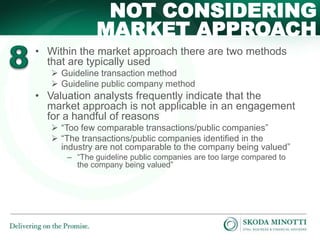
• Within the market approach there are two methods
that are typically used
 Guideline transaction method
 Guideline public company method
• Valuation analysts frequently indicate that the
market approach is not applicable in an engagement
for a handful of reasons
 “Too few comparable transactions/public companies”
 “The transactions/public companies identified in the
industry are not comparable to the company being valued”
‒ “The guideline public companies are too large compared to
the company being valued”
NOT CONSIDERING
MARKET APPROACH
• Some valuation analysts do not use the market approach
because they do not know how to apply the approach or
do not have access to the requisite data (it can be
expensive for subscriptions to the necessary databases)
• In many cases the market approach can be applied, even
if it is simply as a cross-check if the available data is
not robust
• If the market approach is not applied, there is no check
on the income approach value, so it leaves more
opportunity for manipulation of the concluded value
• Sometimes the market approach really cannot be
applied, but this should be the exception rather than
the rule
NOT CONSIDERING
MARKET APPROACH
Debunking excuses for not applying the market approach:
• “Too few comparable transactions/public companies”
 The following data sources are often relied upon to provide the
data necessary to apply the market approach
‒ Pratt’s Stats
‒ Mergerstat
‒ Pitchbook
‒ Capital IQ
‒ Fetch XL
 We have been involved in engagements in which opposing
experts say that there are no comparable transactions, but we
found in excess of 50 transactions to use in the market approach
NOT CONSIDERING
MARKET APPROACH
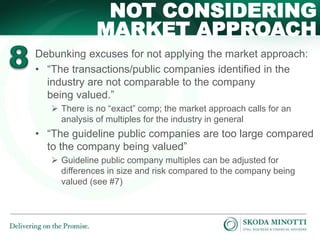
Debunking excuses for not applying the market approach:
• “The transactions/public companies identified in the
industry are not comparable to the company
being valued.”
 There is no “exact” comp; the market approach calls for an
analysis of multiples for the industry in general
• “The guideline public companies are too large compared
to the company being valued”
 Guideline public company multiples can be adjusted for
differences in size and risk compared to the company being
valued (see #7)
NOT CONSIDERING
MARKET APPROACH
• Value conclusions are typically more
supportable when the values
indicated by both the income and
market approach are consistent
• It is typically not appropriate to give
any weight to an asset approach
value if both the income and market
approaches are higher
• Giving weight to the asset approach
when the income and market
approach values are both higher will
result in undervaluation
• The reconciliation process requires
professional judgment
IMPROPERLY RECONCILING
VALUATION APPROACHES
Inclusion of Asset Approach in Weighting
Adjusted Capitalization of Guideline Guideline Public
Net Asset Method Cash Flow Method Transaction Method Company Method
Value of the Company's Equity 5,000,000$ 55,000,000$ 45,000,000$ 60,000,000$
Weighting 25.0% 25.0% 25.0% 25.0%
Weighted-Average Value of the Company's Equity 41,250,000$
Exclusion of Asset Approach in Weighting
Adjusted Capitalization of Guideline Guideline Public
Net Asset Method Cash Flow Method Transaction Method Company Method
Value of the Company's Equity 5,000,000$ 55,000,000$ 45,000,000$ 60,000,000$
Weighting 0.0% 50.0% 25.0% 25.0%
Weighted-Average Value of the Company's Equity 53,750,000$
Inclusion vs. Exclusion of Asset Approach Value Comparison
Indicated Value (Including Asset Approach Weighting) 41,250,000$
Indicated Value (Excluding Asset Approach Weighting) 53,750,000
Amount of Undervaluation (12,500,000)$
Undervaluation % (23.3%)
IMPROPERLY RECONCILING
VALUATION APPROACHES
• Restricted stock and pre-IPO studies are
often used to support lack of marketability
discounts for non-controlling, non-
marketable ownership interests
• The level of control impacts the applicable
lack of marketability discount
• Using the restricted stock and pre-IPO
studies to support a marketability discount
for a controlling ownership interest is
inappropriate/unsupportable and will result
in an undervaluation of the
ownership interest
• If a lack of marketability discount is being
applied to a controlling ownership interest,
it is often supported by cost of
flotation studies
MISAPPLIED MARKETABILITY
DISCOUNT STUDIES
After completing the session, participants
will be able to…
• Identify 10 common errors in valuations
• Understand how to correctly approach
the 10 common errors in valuations
• Effectively cross-examine opposing
experts on 10 common errors in
valuations
SUMMING IT UP
“It’s the little details that
are vital. Little things
make big things happen.”
– John Wooden
CLOSING QUOTE
QUESTIONS?
Bob Ranallo, CPA/ABV, CVA, CFF, JD
Partner
Phone: 440-449-6800 x7131
Email: branallo@skodaminotti.com
Sean Saari, CPA/ABV, CVA, MBA
Principal
Phone: 440-449-6800 x7221
Email: ssaari@skodaminotti.com

10 Common Errors in Valuations and How to Effectively Cross-Examine These Issues

  • 1.
    10 Common Errorsin Valuations Sean Saari, CPA/ABV, CVA, MBA Robert A. Ranallo, CPA/ABV, CVA, CFF, JD June 26, 2014 And How to Effectively Cross-Examine These Issues
  • 2.
    After completing thesession, participants will be able to… • Identify 10 common errors in valuations • Understand how to correctly approach the 10 common errors in valuations • Effectively cross-examine opposing experts on 10 common errors in valuations “In the long run, men hit only what they aim at.” – Henry David Thoreau LEARNING OBJECTIVES
  • 3.
    “There is nosuch thing as an absolute value in this world. You can only estimate what a thing is worth to you.” Charles Dudley Warner 1829-1900, American Writer QUOTE OF THE DAY
  • 4.
    A QUICK PRIMER ONVALUATION • Asset approach  Adjusted Net Asset Method • Income approach  Capitalization of Cash Flow/Earnings Method  Discounted Cash Flow Method • Market approach  Guideline Transaction Method  Guideline Public Company Method There are three valuation approaches that are required to be considered in every valuation analysis, each with its own commonly-used valuation methodologies
  • 5.
    1. Confusion ofequity value and enterprise value 2. Failure to properly consider normalizing adjustments 3. Assumption that net income = net cash flow 4. Unsustainable relationship of capital expenditures to depreciation 5. Unsupportable long-term growth rate 6. Lack of tax-affecting for pass-through entities 7. No consideration of adjustments to guideline public company multiples 8. No consideration given to market approach 9. Improper reconciliation of multiple valuation approaches 10. Misapplication of marketability discount studies VALUATION ERRORS 10 COMMON
  • 6.
    Equity Value =Value of Equity Ownership Enterprise Value = Equity Value + Debt – Cash Equity Value = Enterprise Value – Debt + Cash CONFUSING EQUITY VALUE WITH ENTERPRISE VALUE • If the income or market approach applied uses a benefit stream to determine value that is before interest expense (EBIT, EBITDA, Revenue, etc.), it will result in an enterprise value, not an equity value • The market approach is often based on enterprise values expressed as a multiple of EBITDA or revenue, so adjustments to the enterprise value to reach an equity value are required • Misinterpreting an enterprise value as an equity value will result in an inflated value
  • 7.
    CONFUSING EQUITY VALUE WITHENTERPRISE VALUE Furnishings House Value Debt Value Equity Value Total Value of Home and Furnishings How the Value of Your Home is an Enterprise Value
  • 8.
    CONFUSING EQUITY VALUE WITHENTERPRISE VALUE Cash Enterprise Value Debt Value Equity Value Market Value of Invested Capital Reconciling Equity Value to Enterprise Value
  • 9.
    • Normalizing adjustmentsare made to a company’s historical income statements for non-recurring or discretionary items in order to reflect the true underlying economics of the business • Common normalizing adjustments include  Officer compensation (over or undercompensation)  Personal/discretionary expenses  Related-party transactions at amounts other than FMV  Non-operating income or expenses  Non-recurring income or expenses • Determining normalizing adjustments requires professional judgment. Failure to properly consider normalizing adjustments can lead to the over or undervaluation of a company NOT CONSIDERING NORMALIZING ADJUSTMENTS
  • 10.
    • Capitalization/discounting ofnet income instead of net cash flow can lead to overvaluation • Capitalization/discount rates are for net cash flow, not net income • Net income does not consider the impact of:  Capital expenditures  Changes in net working capital  Changes in interest-bearing debt NET INCOME =/= NET CASH FLOW
  • 11.
    NET INCOME =/= NETCASH FLOWNet Income Net Cash Flow After-tax Net Income 2,000,000$ 2,000,000$ Cash Flow Adjustments Depreciation - 100,000 Capital expenditures - (105,000) Change in Net Working Capital - (150,000) Change in Interest-Bearing Debt - - Net Cash Flow 2,000,000 1,845,000 Times: (1+Long-Term Growth Rate) 105.0% 105.0% Benefit Stream to be Capitalized 2,100,000 1,937,250 Divided By: Capitalization Rate 20.0% 20.0% Times: Mid-Period Adjustment Factor 111.8% 111.8% Indicated Value 11,739,000$ 10,829,228$ Amount of Overvaluation 909,772$ Overvaluation % 8.4%
  • 12.
    • In acapitalization of cash flow analysis, or in the terminal year of a discounted cash flow analysis, projected capital expenditures and depreciation expense should directly correlate • In many cases, capital expenditures are projected to exceed depreciation by the long-term growth rate • When there is not a supportable relationship between capital expenditures and depreciation expense, it will result in overvaluation or undervaluation CAPITAL EXPENDITURES & DEPRECIATION
  • 13.
    Reasonable Excess Excess RelationshipDepreciation CapEx After-tax Net Income 2,000,000$ 2,000,000$ 2,000,000$ Cash Flow Adjustments Depreciation 100,000 300,000 100,000 Capital expenditures (105,000) (105,000) (300,000) Change in Net Working Capital (150,000) (150,000) (150,000) Change in Interest-Bearing Debt - - - Net Cash Flow 1,845,000 2,045,000 1,650,000 Times: (1+Long-Term Growth Rate) 105.0% 105.0% 105.0% Benefit Stream to be Capitalized 1,937,250 2,147,250 1,732,500 Divided By: Capitalization Rate 20.0% 20.0% 20.0% Times: Mid-Period Adjustment Factor 111.8% 111.8% 111.8% Indicated Value 10,829,228$ 12,003,128$ 9,684,675$ Amount of Overvaluation (Undervaluation) 1,173,900$ (1,144,553)$ Overvaluation (Undervaluation) % 10.8% (10.6%) CAPITAL EXPENDITURES & DEPRECIATION
  • 14.
    • The long-termgrowth rate used in the income approach can have a material impact on value • Long-term growth rates typically should not exceed 5%-6%  2%-3% Inflation  2%-3% Real GDP growth • Long-term growth rates in excess of 5%-6% imply that the company will actually grow to be larger than the economy as a whole into perpetuity, which is not supportable and results in overvaluation UNSUPPORTABLE LONG-TERM GROWTH RATE
  • 15.
    UNSUPPORTABLE LONG-TERM GROWTH RATEReasonableInflated Growth Rate Growth Rate After-tax Net Income 2,000,000$ 2,000,000$ Cash Flow Adjustments Depreciation 100,000 100,000 Capital expenditures (105,000) (105,000) Change in Net Working Capital (150,000) (150,000) Change in Interest-Bearing Debt - - Net Cash Flow 1,845,000 1,845,000 Times: (1+Long-Term Growth Rate) 105.0% 110.0% Benefit Stream to be Capitalized 1,937,250 2,029,500 Divided By: Capitalization Rate 20.0% 15.0% Times: Mid-Period Adjustment Factor 111.8% 111.8% Indicated Value 10,829,228$ 15,126,540$ Amount of Overvaluation 4,297,312$ Overvaluation % 39.7%
  • 16.
    • Although pass-throughentities do not pay income taxes at the company level, income taxes are still levied on the company’s earnings, just at the owner level • The data used to support the discount rate utilized in the income approach is based on after-tax cash flow LACK OF TAX-AFFECTING PASS-THROUGH ENTITIES
  • 17.
    • Typically, distributionsare made to at least cover the owners’ flow-through tax liability, similar to a C corporation paying taxes at the entity level • If the impact of income taxes is not considered for flow-through entities, it will result in a significant overvaluation LACK OF TAX-AFFECTING PASS-THROUGH ENTITIES
  • 18.
    Tax-Affecting No TaxAffecting Pre-tax Net Income 3,076,923$ 3,076,923$ Income Taxes (35%) (1,076,923) - After-tax Net Income 2,000,000 3,076,923 Cash Flow Adjustments Depreciation 100,000 100,000 Capital expenditures (105,000) (105,000) Change in Net Working Capital (150,000) (150,000) Change in Interest-Bearing Debt - - Net Cash Flow 1,845,000 2,921,923 Times: (1+Long-Term Growth Rate) 105.0% 105.0% Benefit Stream to be Capitalized 1,937,250 3,068,019 Divided By: Capitalization Rate 20.0% 20.0% Times: Mid-Period Adjustment Factor 111.8% 111.8% Indicated Value 10,829,228$ 17,150,226$ Amount of Overvaluation 6,320,998$ Overvaluation % 58.4% LACK OF TAX-AFFECTING PASS-THROUGH ENTITIES
  • 19.
    • Guideline publiccompanies are often significantly larger and less risky than the subject company being valued • It is important to consider adjustments to the guideline public company multiples for differences in size, risk and projected growth rates compared to the company being valued • If adjustments are not made to the guideline public company multiples, there is a significant likelihood of overvaluation GUIDELINE PUBLIC COMPANY MULTIPLES
  • 20.
    • Within themarket approach there are two methods that are typically used  Guideline transaction method  Guideline public company method • Valuation analysts frequently indicate that the market approach is not applicable in an engagement for a handful of reasons  “Too few comparable transactions/public companies”  “The transactions/public companies identified in the industry are not comparable to the company being valued” ‒ “The guideline public companies are too large compared to the company being valued” NOT CONSIDERING MARKET APPROACH
  • 21.
    • Some valuationanalysts do not use the market approach because they do not know how to apply the approach or do not have access to the requisite data (it can be expensive for subscriptions to the necessary databases) • In many cases the market approach can be applied, even if it is simply as a cross-check if the available data is not robust • If the market approach is not applied, there is no check on the income approach value, so it leaves more opportunity for manipulation of the concluded value • Sometimes the market approach really cannot be applied, but this should be the exception rather than the rule NOT CONSIDERING MARKET APPROACH
  • 22.
    Debunking excuses fornot applying the market approach: • “Too few comparable transactions/public companies”  The following data sources are often relied upon to provide the data necessary to apply the market approach ‒ Pratt’s Stats ‒ Mergerstat ‒ Pitchbook ‒ Capital IQ ‒ Fetch XL  We have been involved in engagements in which opposing experts say that there are no comparable transactions, but we found in excess of 50 transactions to use in the market approach NOT CONSIDERING MARKET APPROACH
  • 23.
    Debunking excuses fornot applying the market approach: • “The transactions/public companies identified in the industry are not comparable to the company being valued.”  There is no “exact” comp; the market approach calls for an analysis of multiples for the industry in general • “The guideline public companies are too large compared to the company being valued”  Guideline public company multiples can be adjusted for differences in size and risk compared to the company being valued (see #7) NOT CONSIDERING MARKET APPROACH
  • 24.
    • Value conclusionsare typically more supportable when the values indicated by both the income and market approach are consistent • It is typically not appropriate to give any weight to an asset approach value if both the income and market approaches are higher • Giving weight to the asset approach when the income and market approach values are both higher will result in undervaluation • The reconciliation process requires professional judgment IMPROPERLY RECONCILING VALUATION APPROACHES
  • 25.
    Inclusion of AssetApproach in Weighting Adjusted Capitalization of Guideline Guideline Public Net Asset Method Cash Flow Method Transaction Method Company Method Value of the Company's Equity 5,000,000$ 55,000,000$ 45,000,000$ 60,000,000$ Weighting 25.0% 25.0% 25.0% 25.0% Weighted-Average Value of the Company's Equity 41,250,000$ Exclusion of Asset Approach in Weighting Adjusted Capitalization of Guideline Guideline Public Net Asset Method Cash Flow Method Transaction Method Company Method Value of the Company's Equity 5,000,000$ 55,000,000$ 45,000,000$ 60,000,000$ Weighting 0.0% 50.0% 25.0% 25.0% Weighted-Average Value of the Company's Equity 53,750,000$ Inclusion vs. Exclusion of Asset Approach Value Comparison Indicated Value (Including Asset Approach Weighting) 41,250,000$ Indicated Value (Excluding Asset Approach Weighting) 53,750,000 Amount of Undervaluation (12,500,000)$ Undervaluation % (23.3%) IMPROPERLY RECONCILING VALUATION APPROACHES
  • 26.
    • Restricted stockand pre-IPO studies are often used to support lack of marketability discounts for non-controlling, non- marketable ownership interests • The level of control impacts the applicable lack of marketability discount • Using the restricted stock and pre-IPO studies to support a marketability discount for a controlling ownership interest is inappropriate/unsupportable and will result in an undervaluation of the ownership interest • If a lack of marketability discount is being applied to a controlling ownership interest, it is often supported by cost of flotation studies MISAPPLIED MARKETABILITY DISCOUNT STUDIES
  • 27.
    After completing thesession, participants will be able to… • Identify 10 common errors in valuations • Understand how to correctly approach the 10 common errors in valuations • Effectively cross-examine opposing experts on 10 common errors in valuations SUMMING IT UP
  • 28.
    “It’s the littledetails that are vital. Little things make big things happen.” – John Wooden CLOSING QUOTE
  • 29.
    QUESTIONS? Bob Ranallo, CPA/ABV,CVA, CFF, JD Partner Phone: 440-449-6800 x7131 Email: branallo@skodaminotti.com Sean Saari, CPA/ABV, CVA, MBA Principal Phone: 440-449-6800 x7221 Email: ssaari@skodaminotti.com

Editor's Notes

  • #5 We will discuss common errors associated with these three approaches, with most of the focus on the income and market-based approaches
  • #8 Use sale of home example Equity – Your equity in the home EV – Sale price of the home MVIC – Sale price of the home plus furniture included as separate purchase
  • #9 Use sale of home example Equity – Your equity in the home EV – Sale price of the home MVIC – Sale price of the home plus furniture included as separate purchase