BUSINE VAL
      SS  UATION

 AP ROACH S AND M T ODS
   P     E       EH
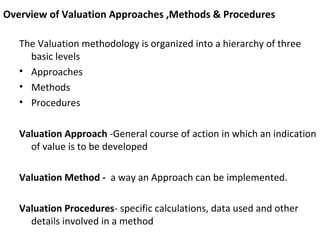
Overview of Valuation Approaches ,Methods & Procedures

   The Valuation methodology is organized into a hierarchy of three
     basic levels
   • Approaches
   • Methods
   • Procedures

   Valuation Approach -General course of action in which an indication
     of value is to be developed

   Valuation Method - a way an Approach can be implemented.

   Valuation Procedures- specific calculations, data used and other
     details involved in a method
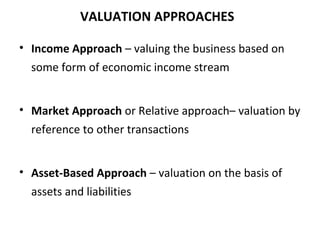
VALUATION APPROACHES

• Income Approach – valuing the business based on
  some form of economic income stream


• Market Approach or Relative approach– valuation by
  reference to other transactions


• Asset-Based Approach – valuation on the basis of
  assets and liabilities
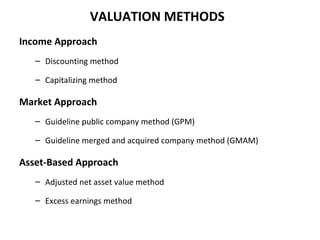
VALUATION METHODS
Income Approach
   – Discounting method

   – Capitalizing method

Market Approach
   – Guideline public company method (GPM)

   – Guideline merged and acquired company method (GMAM)

Asset-Based Approach
   – Adjusted net asset value method

   – Excess earnings method
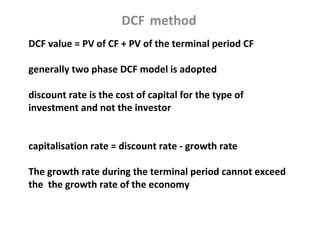
DCF method
DCF value = PV of CF + PV of the terminal period CF

generally two phase DCF model is adopted

discount rate is the cost of capital for the type of
investment and not the investor


capitalisation rate = discount rate - growth rate

The growth rate during the terminal period cannot exceed
the the growth rate of the economy
DCF method


  • NPV (Net Present value under free cash flow approach is called
    ‘firm value ‘ or ‘enterprise value’)
  • NPV (Net Present value under Equity cash flow approach called
    ‘equity value’)
  • Gordon Model or DDGM

  • Adjusted present value (APV)

  • Real option
DCF method
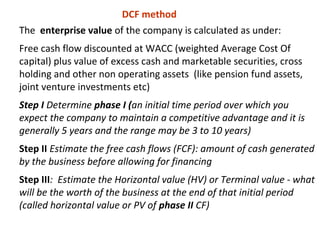
The enterprise value of the company is calculated as under:
Free cash flow discounted at WACC (weighted Average Cost Of
capital) plus value of excess cash and marketable securities, cross
holding and other non operating assets (like pension fund assets,
joint venture investments etc)
Step I Determine phase I (an initial time period over which you
expect the company to maintain a competitive advantage and it is
generally 5 years and the range may be 3 to 10 years)
Step II Estimate the free cash flows (FCF): amount of cash generated
by the business before allowing for financing
Step III: Estimate the Horizontal value (HV) or Terminal value - what
will be the worth of the business at the end of that initial period
(called horizontal value or PV of phase II CF)
DCF method
How to Calculate Horizontal value?
It could be :
• HV = earning of the last year of the forecast period x suitable
    multiple
HV = Constant perpetuity or growing perpetuity
Step IV Determine a suitable WACC (discount rate) for the
    investment
Step V Discount the FCF using the WACC
Step VI Add the value of excess cash and marketable securities,
    cross holding and other non operating assets.
Step VII In order to calculate the value of the equity of the company,
    deduct the current amount of debt from the enterprise value
    Step VI value is called the value of status quo (that is value
    under existing management
VCP is the value of control premium that is the difference
  between the value of an optimally managed firm and the
  value resulting from Status Quo Valuation:

Control Premium (CP) = Value of an optimally managed firm –
  VSQ
VSP is the positive added-value from combining two firms and
includes diversification premium. Theoretically, synergy
premium (SP) is synergy Premium (SP) = Value of the
combined firms -Value of the target firm -Value of the
Acquiring Firm
DCF METHOD“TEN CIRCLES OF HELL by DAMODARAN

Current year numbers: “It’s amazing how wedded we are to that one-
year, baseline number.”


Cash flows. “You can’t stop forecasting cash flows until you’re willing
to make an extraordinary assumption: that your cash flows are going to
grow at a constant rate into perpetuity,” “It’s the tail that wags every
valuation dog.”

Taxes:“We double count some, add some, ignore some.”


 Growth. “We want all our businesses to grow, but ask the wrong
 people—the owners and managers—and you’ll get ‘30% growth rate for
 as far as the eye can see.” Don’t ever let the growth rate exceed the
 risk-free rate,
DCF METHOD“TEN CIRCLES OF HELL by DAMODARAN


    ,
Discount rate. “I think we spend far too much time talking about cost of equity,
cost of capital, cost of debt—and not enough on cash flows.” Analysts
“outsource” so many of the elements of the calculation (to Ibbotson’s data,
Bloomberg data, Duff & Phelps, etc.), “that it’s frightening.”


Growth rate revisited. To grow a business, owners have to put money back
into the business, and that’s a cost of growth analysts may overlook. Instead,
the focus should be on the quality of the business’ growth.


Debt ratio revisited. “We spend a lot of time trying to get the discount rate
right,” “But given your own assumptions about the company, you should expect
the discount rate to change [over time].” Instead, “the discussion should be
about the discount rates.”
DCF METHOD“TEN CIRCLES OF HELL by DAMODARAN

Garnishing valuations : “The practice of garnishing defeats the entire point of the
 ,
valuation,” “It puts you back to…trying to get the number that you want and puts all of
our biases into play.”


Per-share value. An issue primarily for public company valuations, which questions the
“easy” practice of determining per-share value by dividing the company’s market value
by the number of shares—but often overlooks stock options, liquid/illiquid shares, etc.


I-bankers inferno. The “darkest, deepest” layer of hell is reserved for those investment
bankers who have forgotten the “purpose of a valuation,” and in pricing an M&A deal,
will often pick the wrong company (the target company instead of the acquirer) and the
wrong discount rate (cost of debt instead of cost of equity) to arrive at the number (fees)
they want
Determinants of the value of a business
    • History of stable growth and profits
    • Product Cycle point
    • Size Market share
    • Industry
    • Customer base -diversification
    • Growth potential-topline and bottom line trends
    • Competitive positioning
    • Product mix
    • Uniqueness
    • The value of similar companies
    • Strategy for continued growth and profitability
    • Timing
Steps for business Valuation

Step I: Pre-engagement Procedures

Step II: Data Gathering

Step III: Valuation Analysis

Step IV: Selection of Valuation Methods

Step V: Determining Final Value

Step VI: Report Preparation

Step VII: Wrap-up Procedures
Concept of cash flow
Free cash flows (FCF)

•    equal to its after tax cash flows from operations less incremental
    investments made in the firm’s operating assets

• Cash flow to the firm as if there is no debt in the firm

Equity cash flow

• Cash flow to the equity shareholders

The major differences in computation of cash flows are due to
  computation of taxes and treatment of debt.
Concept of cash flow


 The other difference may arise due to extra ordinary items or
   non operating items that affect ‘ PAT’ but not the
   operating Income.
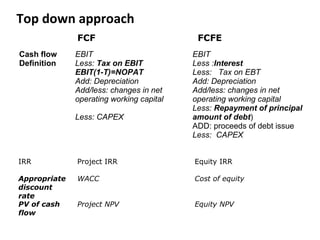
Top down approach
              FCF                          FCFE
Cash flow     EBIT                        EBIT
Definition    Less: Tax on EBIT           Less :Interest
              EBIT(1-T)=NOPAT             Less: Tax on EBT
              Add: Depreciation           Add: Depreciation
              Add/less: changes in net    Add/less: changes in net
              operating working capital   operating working capital
                                          Less: Repayment of principal
              Less: CAPEX                 amount of debt)
                                          ADD: proceeds of debt issue
                                          Less: CAPEX


IRR           Project IRR                 Equity IRR

Appropriate   WACC                        Cost of equity
discount
rate
PV of cash    Project NPV                 Equity NPV
flow
RELATIVE VALUATION (MULTIPLES) APPROACH

• Relative valuation is more about market perception
  and mood
• Under lying concept of the relative valuation is the
  law of one price-similar asset should command
  similar price
• A multiple is the ratio of market price variable to a
  particular value driver of the firm
• This approach is relevant as it uses observable factual
  evidence of “COMPS”
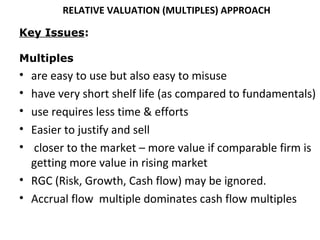
RELATIVE VALUATION (MULTIPLES) APPROACH

Key Issues:

Multiples
• are easy to use but also easy to misuse
• have very short shelf life (as compared to fundamentals)
• use requires less time & efforts
• Easier to justify and sell
• closer to the market – more value if comparable firm is
  getting more value in rising market
• RGC (Risk, Growth, Cash flow) may be ignored.
• Accrual flow multiple dominates cash flow multiples
Types of Multiples
  • Equity based multiples

  • Entity or MVIC (Market Value of Invested Capital) multiples

    MVIC = no. of shares x MPS
  • Equity based multiples either give value of equity on market
    basis or book basis
  • MVIC based multiples either give value of firm on market
    basis or book basis
  • Must make adjustment for non-operating assets under
    MVIC method
HOW TO USE MULTIPLES IN VALUATION

Step I: selection of value relevant measure and value
drivers

Step II: Identification of “COMPS”
Step III: Select and calculate appropriate multiple –aggregation
of multiple into single number through analysis of “COMPS” multiple


Step IV: Apply to the company

Step V: Make final adjustments for non-operating assets,

Contingent liabilities and convertibles.
Selection of value relevant measure

• Equity multiple or entity multiple ?

• Which value driver/ multiple to use?

• Trailing multiple or forward looking multiple?

• More number of multiples vs. less multiples- purpose
  relevant multiple vs. sanity check multiples
Selection of value relevant measure

• Matching principle – numerator and denominator
  should have consistent definition
• Capital structure – equity multiple is greatly
  affected by the capital structure than entity multiple
• Difference in earning guidance and investment and
  payout policy
• Stage of business life cycle
• Empirical research supports forward looking
  multiples processing two years analysts forecast
Criteria for identification of comparable firm
• Use industry classification system or at least list
  firm’s competitors
    SIC: Standard Industrial classification
     GICS: Global industry classification benchmark)
   Go up to 3 or 4 digits classification (more
  homogeneous) rather than 1 or 2 digits (broad
  industry group)
  Size and region
  Number of comparables- 4 to 8 ideal size( plus or
  minus 2
Criteria for selection of multiple

 Select comparable companies or transactions – how?
•Management Style
•Size
•Product & Customer diversification
•Technology
•Key Financial trends
•Strategic & operational strategies
•Market positioning & maturity of operation
•Geographical consideration
•Trading volume of selected companies
•Price volatility (σ)
•Distribution of multiples – across the sector & market
Equity Multiples
  • P/E (Price Earning Ratio)

  • P/B (Price to Book Ratio)

  • Equity / Sales

  • Equity / Cash flow

  • Equity / PAT

  • Equity / Book value of share
MVIC ( Market value of invested capital)


• MVIC / Sales

• MVIC / EBITDA

• MVIC / EBIT

• MVIC / Book value of invested capital

• MVIC/TA
Equity multiple
 Price Earning Ratio – most commonly used multiples
 • Make sure definition is consistent & uniform
   PER = MPS / EPS
 • Variant of PER
   Current PER = Current MPS / Current EPS
 Some analyst may use average price over last 6m or a year
 • Trailing PER = Current MPS / EPS based on last 4 quarters.
                              [or, LTM: Last twelve months]
 • Forward PER = Current MPS / expected EPS during next F/Y
 • EPS may further be based on fully diluted basis or primary basis
 • EPS may include or exclude extraordinary items
Equity multiple - PER
• For Growth Company forward PER will consistently give low value
  than trailing PER
• Bullish valuer use forward PER to conclude that stock is
  undervalued.
• Bearish valuer will consider Current PER to justify that Stock is
  overvalued.
• Full Impact of dilution may not occur during next year leading to
  lower EPS.
• While using industry PER be careful about outliers
• MLF (money loosing firm) creates a bias in selection
• Equity value is calculated based on existing outstanding shares but
  EPS is on fully diluted basis.
Equity multiple – PEG            (Price Earning growth)

   PEG = PER / expected growth in EPS
 • One mistake analyst will make to consider growth in operating
   income rather than EPS
 • Growth should be consistent with PER calculation
 • Never use forward PER for peg as it amounts to double counting of
   growth
 • Lower the PEG better the stock
 • If PER is high without growth prospect, PEG will be high – risky firm
 • PEG does not consider risk taken in growth and sustainability of
   growth.
Equity multiple
   P/B ratio = market value of equity / book value of equity
 • Book value is computed from the Financial Statement
 • Price of book ratio near to 4 is highly priced stock [mean P/B ratio
   of all listed firm in USA during 2006 was 2.4]
 Price to Sales ratio
 (Revenue multiple) = market value of equity
                             Revenue
 • The larger the revenue multiple better it is.
 • Generally there is no sectoral Revenue multiple.
MVIC multiple vs Equity multiple

 • MVIC multiple look at market value of operating assets of the firm
   (and not only for equity invested).


 • MVIC multiple is not affected by Finance leverage.


 • If firms under comparison are differing in their financial leverage,
   put more reliance on MVIC multiple.
ASSET BASED APPROACH


 determining a value indication of a
 business, business ownership interest, or
security using one or more methods based
 on the value of the assets net of liabilities

Method 1: Adjusted Net Value Method

Method2: Excess Earnings Method
ASSET BASED APPROACH

Adjusted Net Value Method
• Identify all assets & liabilities (recorded and unrecorded
  tangible and intangible assets, liabilities & contingents)
• Determine which assets and liabilities on the balance sheet
  require valuation
• Value the items identified
• Construct a value-based balance sheet using the adjusted
  values
• Value of assets = adjusted value of assets - outside liabilities
ASSET BASED APPROACH

Excess Earnings Method Steps:
• Estimate a normalized level of operating earnings, the
  operating tangible asset value, and a reasonable rate of
  return to support the tangible assets
• Multiply the reasonable rate of return by the value of tangible
  assets to arrive at the reasonable money return on tangible
  assets
• Determine excess earnings by subtracting the return on
  tangible assets from normalized earnings- if it is negative then
  there is no intangible value
ASSET BASED APPROACH
Excess Earnings Method Steps (continued):

• Determine the capitalization rate appropriate for the
  excess earnings
• Determine the value of intangible assets by dividing
  the capitalization rate into the excess earnings
• Add the value of tangible assets to the value of
  intangible assets
ASSET BASED APPROACH
Apply this approach generally where
• Company is going in liquidation

• Asset intensive companies -Significant value of assets for going
  concern
• For control valuation

• Real estate companies

• Investment companies

• Finance companies

• Startup stage company

• Distressed companies
Valuation

Valuation

  • 1.
    BUSINE VAL SS UATION AP ROACH S AND M T ODS P E EH
  • 2.
    Overview of ValuationApproaches ,Methods & Procedures The Valuation methodology is organized into a hierarchy of three basic levels • Approaches • Methods • Procedures Valuation Approach -General course of action in which an indication of value is to be developed Valuation Method - a way an Approach can be implemented. Valuation Procedures- specific calculations, data used and other details involved in a method
  • 3.
    VALUATION APPROACHES • IncomeApproach – valuing the business based on some form of economic income stream • Market Approach or Relative approach– valuation by reference to other transactions • Asset-Based Approach – valuation on the basis of assets and liabilities
  • 4.
    VALUATION METHODS Income Approach – Discounting method – Capitalizing method Market Approach – Guideline public company method (GPM) – Guideline merged and acquired company method (GMAM) Asset-Based Approach – Adjusted net asset value method – Excess earnings method
  • 5.
    DCF method DCF value= PV of CF + PV of the terminal period CF generally two phase DCF model is adopted discount rate is the cost of capital for the type of investment and not the investor capitalisation rate = discount rate - growth rate The growth rate during the terminal period cannot exceed the the growth rate of the economy
  • 6.
    DCF method • NPV (Net Present value under free cash flow approach is called ‘firm value ‘ or ‘enterprise value’) • NPV (Net Present value under Equity cash flow approach called ‘equity value’) • Gordon Model or DDGM • Adjusted present value (APV) • Real option
  • 7.
    DCF method The enterprisevalue of the company is calculated as under: Free cash flow discounted at WACC (weighted Average Cost Of capital) plus value of excess cash and marketable securities, cross holding and other non operating assets (like pension fund assets, joint venture investments etc) Step I Determine phase I (an initial time period over which you expect the company to maintain a competitive advantage and it is generally 5 years and the range may be 3 to 10 years) Step II Estimate the free cash flows (FCF): amount of cash generated by the business before allowing for financing Step III: Estimate the Horizontal value (HV) or Terminal value - what will be the worth of the business at the end of that initial period (called horizontal value or PV of phase II CF)
  • 8.
    DCF method How toCalculate Horizontal value? It could be : • HV = earning of the last year of the forecast period x suitable multiple HV = Constant perpetuity or growing perpetuity Step IV Determine a suitable WACC (discount rate) for the investment Step V Discount the FCF using the WACC Step VI Add the value of excess cash and marketable securities, cross holding and other non operating assets. Step VII In order to calculate the value of the equity of the company, deduct the current amount of debt from the enterprise value Step VI value is called the value of status quo (that is value under existing management
  • 9.
    VCP is thevalue of control premium that is the difference between the value of an optimally managed firm and the value resulting from Status Quo Valuation: Control Premium (CP) = Value of an optimally managed firm – VSQ
  • 10.
    VSP is thepositive added-value from combining two firms and includes diversification premium. Theoretically, synergy premium (SP) is synergy Premium (SP) = Value of the combined firms -Value of the target firm -Value of the Acquiring Firm
  • 11.
    DCF METHOD“TEN CIRCLESOF HELL by DAMODARAN Current year numbers: “It’s amazing how wedded we are to that one- year, baseline number.” Cash flows. “You can’t stop forecasting cash flows until you’re willing to make an extraordinary assumption: that your cash flows are going to grow at a constant rate into perpetuity,” “It’s the tail that wags every valuation dog.” Taxes:“We double count some, add some, ignore some.” Growth. “We want all our businesses to grow, but ask the wrong people—the owners and managers—and you’ll get ‘30% growth rate for as far as the eye can see.” Don’t ever let the growth rate exceed the risk-free rate,
  • 12.
    DCF METHOD“TEN CIRCLESOF HELL by DAMODARAN , Discount rate. “I think we spend far too much time talking about cost of equity, cost of capital, cost of debt—and not enough on cash flows.” Analysts “outsource” so many of the elements of the calculation (to Ibbotson’s data, Bloomberg data, Duff & Phelps, etc.), “that it’s frightening.” Growth rate revisited. To grow a business, owners have to put money back into the business, and that’s a cost of growth analysts may overlook. Instead, the focus should be on the quality of the business’ growth. Debt ratio revisited. “We spend a lot of time trying to get the discount rate right,” “But given your own assumptions about the company, you should expect the discount rate to change [over time].” Instead, “the discussion should be about the discount rates.”
  • 13.
    DCF METHOD“TEN CIRCLESOF HELL by DAMODARAN Garnishing valuations : “The practice of garnishing defeats the entire point of the , valuation,” “It puts you back to…trying to get the number that you want and puts all of our biases into play.” Per-share value. An issue primarily for public company valuations, which questions the “easy” practice of determining per-share value by dividing the company’s market value by the number of shares—but often overlooks stock options, liquid/illiquid shares, etc. I-bankers inferno. The “darkest, deepest” layer of hell is reserved for those investment bankers who have forgotten the “purpose of a valuation,” and in pricing an M&A deal, will often pick the wrong company (the target company instead of the acquirer) and the wrong discount rate (cost of debt instead of cost of equity) to arrive at the number (fees) they want
  • 14.
    Determinants of thevalue of a business • History of stable growth and profits • Product Cycle point • Size Market share • Industry • Customer base -diversification • Growth potential-topline and bottom line trends • Competitive positioning • Product mix • Uniqueness • The value of similar companies • Strategy for continued growth and profitability • Timing
  • 15.
    Steps for businessValuation Step I: Pre-engagement Procedures Step II: Data Gathering Step III: Valuation Analysis Step IV: Selection of Valuation Methods Step V: Determining Final Value Step VI: Report Preparation Step VII: Wrap-up Procedures
  • 16.
    Concept of cashflow Free cash flows (FCF) • equal to its after tax cash flows from operations less incremental investments made in the firm’s operating assets • Cash flow to the firm as if there is no debt in the firm Equity cash flow • Cash flow to the equity shareholders The major differences in computation of cash flows are due to computation of taxes and treatment of debt.
  • 17.
    Concept of cashflow The other difference may arise due to extra ordinary items or non operating items that affect ‘ PAT’ but not the operating Income.
  • 18.
    Top down approach FCF FCFE Cash flow EBIT EBIT Definition Less: Tax on EBIT Less :Interest EBIT(1-T)=NOPAT Less: Tax on EBT Add: Depreciation Add: Depreciation Add/less: changes in net Add/less: changes in net operating working capital operating working capital Less: Repayment of principal Less: CAPEX amount of debt) ADD: proceeds of debt issue Less: CAPEX IRR Project IRR Equity IRR Appropriate WACC Cost of equity discount rate PV of cash Project NPV Equity NPV flow
  • 19.
    RELATIVE VALUATION (MULTIPLES)APPROACH • Relative valuation is more about market perception and mood • Under lying concept of the relative valuation is the law of one price-similar asset should command similar price • A multiple is the ratio of market price variable to a particular value driver of the firm • This approach is relevant as it uses observable factual evidence of “COMPS”
  • 20.
    RELATIVE VALUATION (MULTIPLES)APPROACH Key Issues: Multiples • are easy to use but also easy to misuse • have very short shelf life (as compared to fundamentals) • use requires less time & efforts • Easier to justify and sell • closer to the market – more value if comparable firm is getting more value in rising market • RGC (Risk, Growth, Cash flow) may be ignored. • Accrual flow multiple dominates cash flow multiples
  • 21.
    Types of Multiples • Equity based multiples • Entity or MVIC (Market Value of Invested Capital) multiples MVIC = no. of shares x MPS • Equity based multiples either give value of equity on market basis or book basis • MVIC based multiples either give value of firm on market basis or book basis • Must make adjustment for non-operating assets under MVIC method
  • 22.
    HOW TO USEMULTIPLES IN VALUATION Step I: selection of value relevant measure and value drivers Step II: Identification of “COMPS” Step III: Select and calculate appropriate multiple –aggregation of multiple into single number through analysis of “COMPS” multiple Step IV: Apply to the company Step V: Make final adjustments for non-operating assets, Contingent liabilities and convertibles.
  • 23.
    Selection of valuerelevant measure • Equity multiple or entity multiple ? • Which value driver/ multiple to use? • Trailing multiple or forward looking multiple? • More number of multiples vs. less multiples- purpose relevant multiple vs. sanity check multiples
  • 24.
    Selection of valuerelevant measure • Matching principle – numerator and denominator should have consistent definition • Capital structure – equity multiple is greatly affected by the capital structure than entity multiple • Difference in earning guidance and investment and payout policy • Stage of business life cycle • Empirical research supports forward looking multiples processing two years analysts forecast
  • 25.
    Criteria for identificationof comparable firm • Use industry classification system or at least list firm’s competitors SIC: Standard Industrial classification GICS: Global industry classification benchmark) Go up to 3 or 4 digits classification (more homogeneous) rather than 1 or 2 digits (broad industry group) Size and region Number of comparables- 4 to 8 ideal size( plus or minus 2
  • 26.
    Criteria for selectionof multiple Select comparable companies or transactions – how? •Management Style •Size •Product & Customer diversification •Technology •Key Financial trends •Strategic & operational strategies •Market positioning & maturity of operation •Geographical consideration •Trading volume of selected companies •Price volatility (σ) •Distribution of multiples – across the sector & market
  • 27.
    Equity Multiples • P/E (Price Earning Ratio) • P/B (Price to Book Ratio) • Equity / Sales • Equity / Cash flow • Equity / PAT • Equity / Book value of share
  • 28.
    MVIC ( Marketvalue of invested capital) • MVIC / Sales • MVIC / EBITDA • MVIC / EBIT • MVIC / Book value of invested capital • MVIC/TA
  • 29.
    Equity multiple PriceEarning Ratio – most commonly used multiples • Make sure definition is consistent & uniform PER = MPS / EPS • Variant of PER Current PER = Current MPS / Current EPS Some analyst may use average price over last 6m or a year • Trailing PER = Current MPS / EPS based on last 4 quarters. [or, LTM: Last twelve months] • Forward PER = Current MPS / expected EPS during next F/Y • EPS may further be based on fully diluted basis or primary basis • EPS may include or exclude extraordinary items
  • 30.
    Equity multiple -PER • For Growth Company forward PER will consistently give low value than trailing PER • Bullish valuer use forward PER to conclude that stock is undervalued. • Bearish valuer will consider Current PER to justify that Stock is overvalued. • Full Impact of dilution may not occur during next year leading to lower EPS. • While using industry PER be careful about outliers • MLF (money loosing firm) creates a bias in selection • Equity value is calculated based on existing outstanding shares but EPS is on fully diluted basis.
  • 31.
    Equity multiple –PEG (Price Earning growth) PEG = PER / expected growth in EPS • One mistake analyst will make to consider growth in operating income rather than EPS • Growth should be consistent with PER calculation • Never use forward PER for peg as it amounts to double counting of growth • Lower the PEG better the stock • If PER is high without growth prospect, PEG will be high – risky firm • PEG does not consider risk taken in growth and sustainability of growth.
  • 32.
    Equity multiple P/B ratio = market value of equity / book value of equity • Book value is computed from the Financial Statement • Price of book ratio near to 4 is highly priced stock [mean P/B ratio of all listed firm in USA during 2006 was 2.4] Price to Sales ratio (Revenue multiple) = market value of equity Revenue • The larger the revenue multiple better it is. • Generally there is no sectoral Revenue multiple.
  • 33.
    MVIC multiple vsEquity multiple • MVIC multiple look at market value of operating assets of the firm (and not only for equity invested). • MVIC multiple is not affected by Finance leverage. • If firms under comparison are differing in their financial leverage, put more reliance on MVIC multiple.
  • 34.
    ASSET BASED APPROACH determining a value indication of a business, business ownership interest, or security using one or more methods based on the value of the assets net of liabilities Method 1: Adjusted Net Value Method Method2: Excess Earnings Method
  • 35.
    ASSET BASED APPROACH AdjustedNet Value Method • Identify all assets & liabilities (recorded and unrecorded tangible and intangible assets, liabilities & contingents) • Determine which assets and liabilities on the balance sheet require valuation • Value the items identified • Construct a value-based balance sheet using the adjusted values • Value of assets = adjusted value of assets - outside liabilities
  • 36.
    ASSET BASED APPROACH ExcessEarnings Method Steps: • Estimate a normalized level of operating earnings, the operating tangible asset value, and a reasonable rate of return to support the tangible assets • Multiply the reasonable rate of return by the value of tangible assets to arrive at the reasonable money return on tangible assets • Determine excess earnings by subtracting the return on tangible assets from normalized earnings- if it is negative then there is no intangible value
  • 37.
    ASSET BASED APPROACH ExcessEarnings Method Steps (continued): • Determine the capitalization rate appropriate for the excess earnings • Determine the value of intangible assets by dividing the capitalization rate into the excess earnings • Add the value of tangible assets to the value of intangible assets
  • 38.
    ASSET BASED APPROACH Applythis approach generally where • Company is going in liquidation • Asset intensive companies -Significant value of assets for going concern • For control valuation • Real estate companies • Investment companies • Finance companies • Startup stage company • Distressed companies