International Journal of Trend in Scientific Research and Development
Volume 3 Issue 5, August 2019
@ IJTSRD | Unique Paper ID – IJTSRD26571
Heat Load Calculation
Junaid Hussain
1Student
1Muffakham Jah College of Engineering
2HRO Education Director & CEO, Managing Director
How to cite this paper: Junaid Hussain |
Syed Abdul Gaffar "HeatLoadCalculation"
Published in
International Journal
of Trend in Scientific
Research and
Development
(ijtsrd), ISSN: 2456-
6470, Volume-3 |
Issue-5, August
2019, pp.1233-1235,
https://doi.org/10.31142/ijtsrd26571
Copyright © 2019 by author(s) and
International Journal ofTrend inScientific
Research and Development Journal. This
is an Open Access article distributed
under the terms of
the Creative
Commons Attribution
License (CC BY 4.0)
(http://creativecommons.org/licenses/by
/4.0)
To produce cooling, heat must be removed from a substance
by transferring the heat to another substance. Heat energy
naturally flows from a higher-temperature substance to a
lower temperature substance, in other words from hot to
cold. Heat cannot be naturally flow from a cold substance to
a hot substance.
METHODS OF HEAT TRANSFER
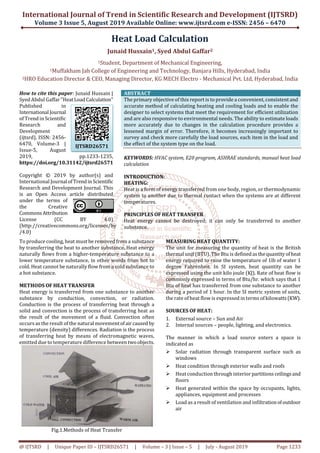
Heat energy is transferred from one substance to another
substance by conduction, convection, or radiation.
Conduction is the process of transferring heat through a
solid and convection is the process of transferring heat as
the result of the movement of a fluid. Convection often
occurs as the result of the natural movementofaircausedby
temperature (density) differences. Radiation is the process
of transferring heat by means of electromagnetic waves,
emitted due to temperature difference between twoobjects
Fig.1.Methods of Heat Transfer
IJTSRD26571
International Journal of Trend in Scientific Research and Development
Volume 3 Issue 5, August 2019 Available Online: www.ijtsrd.com e-
26571 | Volume – 3 | Issue – 5 | July - August 2019
Heat Load Calculation
Junaid Hussain1, Syed Abdul Gaffar2
tudent, Department of Mechanical Engineering,
f Engineering and Technology, Banjara Hills, Hyderabad, India
, Managing Director, KG MECH Electro - Mechanical Pvt.
(http://creativecommons.org/licenses/by
ABSTRACT
The primary objective of this report is to provide a convenient, consistentand
accurate method of calculating heating and cooling
designer to select systems that meet the requirement for efficient utilization
and are also responsive to environmental needs. The ability to estimate loads
more accurately due to changes in the calculation procedure provides a
lessened margin of error. Therefore, it becomes increasingly important to
survey and check more carefully the load sources, each item in the load and
the effect of the system type on the load.
KEYWORDS: HVAC system, E20 program, ASHRAE standards, manual
calculation
INTRODUCTION:
HEATING:
Heat is a form of energy transferred from one body, region, or thermodynamic
system to another due to thermal contact when the systems are at different
temperatures.
PRINCIPLES OF HEAT TRANSFER
Heat energy cannot be destroyed; it can only be transferred to another
substance.
To produce cooling, heat must be removed from a substance
by transferring the heat to another substance. Heat energy
temperature substance to a
lower temperature substance, in other words from hot to
Heat cannot be naturally flow from a cold substance to
energy is transferred from one substance to another
substance by conduction, convection, or radiation.
Conduction is the process of transferring heat through a
solid and convection is the process of transferring heat as
id. Convection often
occurs as the result of the natural movementofaircausedby
temperature (density) differences. Radiation is the process
of transferring heat by means of electromagnetic waves,
emitted due to temperature difference between twoobjects.
Fig.1.Methods of Heat Transfer
MEASURING HEAT QUANTITY:
The unit for measuring the quantity of heat is the British
thermal unit (BTU). The Btu is definedas thequantity ofheat
energy required to raise the temperature of 1lb of water 1
degree Fahrenheit. In SI system, heat quantity can be
expressed using the unit kilo joule (KJ). Rate of heat flow is
commonly expressed in terms of Btu/hr. which says that 1
Btu of heat has transferred from one substance to another
during a period of 1 hour. In the SI m
the rate of heat flow is expressed in terms of kilowatts (KW).
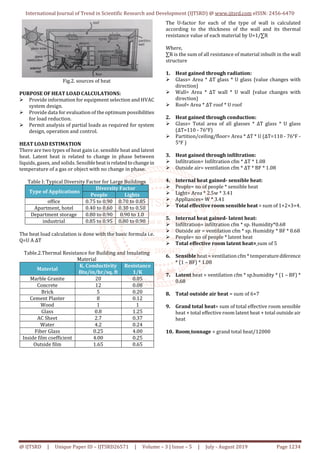
SOURCES OF HEAT:
1. External source – Sun and Air
2. Internal sources – people, lighting, and electronics.
The manner in which a load source enters a space is
indicated as
 Solar radiation through transparent surface such as
windows
 Heat condition through exterior walls and roofs
 Heat conduction through interior partitions ceilings and
floors
 Heat generated within the space by occupants, lights,
appliances, equipment and pro
 Load as a result of ventilation and infiltrationofoutdoor
air
International Journal of Trend in Scientific Research and Development (IJTSRD)
-ISSN: 2456 – 6470
August 2019 Page 1233
Hills, Hyderabad, India
Mechanical Pvt. Ltd, Hyderabad, India
The primary objective of this report is to provide a convenient, consistentand
accurate method of calculating heating and cooling loads and to enable the
designer to select systems that meet the requirement for efficient utilization
and are also responsive to environmental needs. The ability to estimate loads
more accurately due to changes in the calculation procedure provides a
sened margin of error. Therefore, it becomes increasingly important to
survey and check more carefully the load sources, each item in the load and
HVAC system, E20 program, ASHRAE standards, manual heat load
Heat is a form of energy transferred from one body, region, or thermodynamic
system to another due to thermal contact when the systems are at different
Heat energy cannot be destroyed; it can only be transferred to another
QUANTITY:
The unit for measuring the quantity of heat is the British
thermal unit (BTU). The Btu is definedas thequantity ofheat
energy required to raise the temperature of 1lb of water 1
eit. In SI system, heat quantity can be
expressed using the unit kilo joule (KJ). Rate of heat flow is
commonly expressed in terms of Btu/hr. which says that 1
Btu of heat has transferred from one substance to another
during a period of 1 hour. In the SI metric system of units,
the rate of heat flow is expressed in terms of kilowatts (KW).
Sun and Air
people, lighting, and electronics.
The manner in which a load source enters a space is
olar radiation through transparent surface such as
Heat condition through exterior walls and roofs
Heat conduction through interior partitions ceilings and
Heat generated within the space by occupants, lights,
appliances, equipment and processes
Load as a result of ventilation and infiltrationofoutdoor
International Journal of Trend in Scientific Research and Development (IJTSRD) @ www.ijtsrd.com eISSN: 2456-6470
@ IJTSRD | Unique Paper ID – IJTSRD26571 | Volume – 3 | Issue – 5 | July - August 2019 Page 1234
Fig.2. sources of heat
PURPOSE OF HEAT LOAD CALCULATIONS:
 Provide information for equipment selection and HVAC
system design.
 Provide data for evaluation of the optimum possibilities
for load reduction.
 Permit analysis of partial loads as required for system
design, operation and control.
HEAT LOAD ESTIMATION
There are two types of heat gain i.e. sensible heat and latent
heat. Latent heat is related to change in phase between
liquids, gases, and solids. Sensibleheatisrelated tochangein
temperature of a gas or object with no change in phase.
Table I: Typical Diversity Factor for Large Buildings
Type of Applications
Diversity Factor
People Lights
office 0.75 to 0.90 0.70 to 0.85
Apartment, hotel 0.40 to 0.60 0.30 to 0.50
Department storage 0.80 to 0.90 0.90 to 1.0
industrial 0.85 to 0.95 0.80 to 0.90
The heat load calculation is done with the basic formula i.e.
Q=U A ΔT
Table.2.Thermal Resistance for Building and Insulating
Material
Material
K. Conductivity
Btu/in/hr/sq. ft
Resistance
1/K
Marble Granite 20 0.05
Concrete 12 0.08
Brick 5 0.20
Cement Plaster 8 0.12
Wood 1 1
Glass 0.8 1.25
AC Sheet 2.7 0.37
Water 4.2 0.24
Fiber Glass 0.25 4.00
Inside film coefficient 4.00 0.25
Outside film 1.65 0.65
The U-factor for each of the type of wall is calculated
according to the thickness of the wall and its thermal
resistance value of each material by U=1/∑R
Where,
∑R is the sum of all resistance of material inbuilt in the wall
structure
1. Heat gained through radiation:
 Glass= Area * ΔT glass * U glass {value changes with
direction}
 Wall= Area * ΔT wall * U wall {value changes with
direction}
 Roof= Area * ΔT roof * U roof
2. Heat gained through conduction:
 Glass= Total area of all glasses * ΔT glass * U glass
(ΔT=110 - 76°F)
 Partition/ceiling/floor= Area * ΔT * U (ΔT=110 - 76°F -
5°F )
3. Heat gained through infiltration:
 Infiltration= Infiltration cfm * ΔT * 1.08
 Outside air= ventilation cfm * ΔT * BF * 1.08
4. Internal heat gained- sensible heat:
 People= no of people * sensible heat
 Light= Area * 2.5w * 3.41
 Appliances= W * 3.41
 Total effective room sensible heat = sum of 1+2+3+4.
5. Internal heat gained- latent heat:
 Infiltration= infiltration cfm * sp. Humidity*0.68
 Outside air = ventilation cfm * sp. Humidity * BF * 0.68
 People= no of people * latent heat
 Total effective room latent heat= sum of 5
6. Sensible heat = ventilation cfm * temperaturediference
* (1 – BF) * 1.08
7. Latent heat = ventilation cfm * sp.humidity * (1 – BF) *
0.68
8. Total outside air heat = sum of 6+7
9. Grand total heat= sum of total effective room sensible
heat + total effective room latent heat + total outside air
heat
10. Room tonnage = grand total heat/12000
International Journal of Trend in Scientific Research and Development (IJTSRD)
@ IJTSRD | Unique Paper ID – IJTSRD26571
Fig.3. Heat Load Calculation using E20 sheet
CONCLUSION
1. Heat gained through radiation changes with direction.
2. Radiated heat doesn’t heat the air between the
sources and the object it contacts; it only heats the
object itself.
3. Considering the roof till its false ceiling while
calculating the heat load decreases the load on
machines.
4. E20 program reduces human errors and provides
accurate heat loads.
5. Ducted return air duct reducdes the load on machines
International Journal of Trend in Scientific Research and Development (IJTSRD) @ www.ijtsrd.com
26571 | Volume – 3 | Issue – 5 | July - August 2019
Fig.3. Heat Load Calculation using E20 sheet
gained through radiation changes with direction.
Radiated heat doesn’t heat the air between the
object it contacts; it only heats the
Considering the roof till its false ceiling while
calculating the heat load decreases the load on
E20 program reduces human errors and provides
cdes the load on machines
REFERENCES
[1] W. Larsen angel (2011) HVAC Design Sourcebook,
Hill Education; First edition.
[2] Mcquiston, parker, spitler (2011) Heating, Ventilation
and Air Conditioning: Analysis and Design, Wiley; Sixth
edition.
[3] Arora (2017) Refrigeration
McGraw Hill Education; 3
www.ijtsrd.com eISSN: 2456-6470
August 2019 Page 1235
W. Larsen angel (2011) HVAC Design Sourcebook,
Hill Education; First edition.
Mcquiston, parker, spitler (2011) Heating, Ventilation
and Air Conditioning: Analysis and Design, Wiley; Sixth
ration and Air Conditioning
McGraw Hill Education; 3 editions.

Heat Load Calculation

  • 1.
    International Journal ofTrend in Scientific Research and Development Volume 3 Issue 5, August 2019 @ IJTSRD | Unique Paper ID – IJTSRD26571 Heat Load Calculation Junaid Hussain 1Student 1Muffakham Jah College of Engineering 2HRO Education Director & CEO, Managing Director How to cite this paper: Junaid Hussain | Syed Abdul Gaffar "HeatLoadCalculation" Published in International Journal of Trend in Scientific Research and Development (ijtsrd), ISSN: 2456- 6470, Volume-3 | Issue-5, August 2019, pp.1233-1235, https://doi.org/10.31142/ijtsrd26571 Copyright © 2019 by author(s) and International Journal ofTrend inScientific Research and Development Journal. This is an Open Access article distributed under the terms of the Creative Commons Attribution License (CC BY 4.0) (http://creativecommons.org/licenses/by /4.0) To produce cooling, heat must be removed from a substance by transferring the heat to another substance. Heat energy naturally flows from a higher-temperature substance to a lower temperature substance, in other words from hot to cold. Heat cannot be naturally flow from a cold substance to a hot substance. METHODS OF HEAT TRANSFER Heat energy is transferred from one substance to another substance by conduction, convection, or radiation. Conduction is the process of transferring heat through a solid and convection is the process of transferring heat as the result of the movement of a fluid. Convection often occurs as the result of the natural movementofaircausedby temperature (density) differences. Radiation is the process of transferring heat by means of electromagnetic waves, emitted due to temperature difference between twoobjects Fig.1.Methods of Heat Transfer IJTSRD26571 International Journal of Trend in Scientific Research and Development Volume 3 Issue 5, August 2019 Available Online: www.ijtsrd.com e- 26571 | Volume – 3 | Issue – 5 | July - August 2019 Heat Load Calculation Junaid Hussain1, Syed Abdul Gaffar2 tudent, Department of Mechanical Engineering, f Engineering and Technology, Banjara Hills, Hyderabad, India , Managing Director, KG MECH Electro - Mechanical Pvt. (http://creativecommons.org/licenses/by ABSTRACT The primary objective of this report is to provide a convenient, consistentand accurate method of calculating heating and cooling designer to select systems that meet the requirement for efficient utilization and are also responsive to environmental needs. The ability to estimate loads more accurately due to changes in the calculation procedure provides a lessened margin of error. Therefore, it becomes increasingly important to survey and check more carefully the load sources, each item in the load and the effect of the system type on the load. KEYWORDS: HVAC system, E20 program, ASHRAE standards, manual calculation INTRODUCTION: HEATING: Heat is a form of energy transferred from one body, region, or thermodynamic system to another due to thermal contact when the systems are at different temperatures. PRINCIPLES OF HEAT TRANSFER Heat energy cannot be destroyed; it can only be transferred to another substance. To produce cooling, heat must be removed from a substance by transferring the heat to another substance. Heat energy temperature substance to a lower temperature substance, in other words from hot to Heat cannot be naturally flow from a cold substance to energy is transferred from one substance to another substance by conduction, convection, or radiation. Conduction is the process of transferring heat through a solid and convection is the process of transferring heat as id. Convection often occurs as the result of the natural movementofaircausedby temperature (density) differences. Radiation is the process of transferring heat by means of electromagnetic waves, emitted due to temperature difference between twoobjects. Fig.1.Methods of Heat Transfer MEASURING HEAT QUANTITY: The unit for measuring the quantity of heat is the British thermal unit (BTU). The Btu is definedas thequantity ofheat energy required to raise the temperature of 1lb of water 1 degree Fahrenheit. In SI system, heat quantity can be expressed using the unit kilo joule (KJ). Rate of heat flow is commonly expressed in terms of Btu/hr. which says that 1 Btu of heat has transferred from one substance to another during a period of 1 hour. In the SI m the rate of heat flow is expressed in terms of kilowatts (KW). SOURCES OF HEAT: 1. External source – Sun and Air 2. Internal sources – people, lighting, and electronics. The manner in which a load source enters a space is indicated as  Solar radiation through transparent surface such as windows  Heat condition through exterior walls and roofs  Heat conduction through interior partitions ceilings and floors  Heat generated within the space by occupants, lights, appliances, equipment and pro  Load as a result of ventilation and infiltrationofoutdoor air International Journal of Trend in Scientific Research and Development (IJTSRD) -ISSN: 2456 – 6470 August 2019 Page 1233 Hills, Hyderabad, India Mechanical Pvt. Ltd, Hyderabad, India The primary objective of this report is to provide a convenient, consistentand accurate method of calculating heating and cooling loads and to enable the designer to select systems that meet the requirement for efficient utilization and are also responsive to environmental needs. The ability to estimate loads more accurately due to changes in the calculation procedure provides a sened margin of error. Therefore, it becomes increasingly important to survey and check more carefully the load sources, each item in the load and HVAC system, E20 program, ASHRAE standards, manual heat load Heat is a form of energy transferred from one body, region, or thermodynamic system to another due to thermal contact when the systems are at different Heat energy cannot be destroyed; it can only be transferred to another QUANTITY: The unit for measuring the quantity of heat is the British thermal unit (BTU). The Btu is definedas thequantity ofheat energy required to raise the temperature of 1lb of water 1 eit. In SI system, heat quantity can be expressed using the unit kilo joule (KJ). Rate of heat flow is commonly expressed in terms of Btu/hr. which says that 1 Btu of heat has transferred from one substance to another during a period of 1 hour. In the SI metric system of units, the rate of heat flow is expressed in terms of kilowatts (KW). Sun and Air people, lighting, and electronics. The manner in which a load source enters a space is olar radiation through transparent surface such as Heat condition through exterior walls and roofs Heat conduction through interior partitions ceilings and Heat generated within the space by occupants, lights, appliances, equipment and processes Load as a result of ventilation and infiltrationofoutdoor
  • 2.
    International Journal ofTrend in Scientific Research and Development (IJTSRD) @ www.ijtsrd.com eISSN: 2456-6470 @ IJTSRD | Unique Paper ID – IJTSRD26571 | Volume – 3 | Issue – 5 | July - August 2019 Page 1234 Fig.2. sources of heat PURPOSE OF HEAT LOAD CALCULATIONS:  Provide information for equipment selection and HVAC system design.  Provide data for evaluation of the optimum possibilities for load reduction.  Permit analysis of partial loads as required for system design, operation and control. HEAT LOAD ESTIMATION There are two types of heat gain i.e. sensible heat and latent heat. Latent heat is related to change in phase between liquids, gases, and solids. Sensibleheatisrelated tochangein temperature of a gas or object with no change in phase. Table I: Typical Diversity Factor for Large Buildings Type of Applications Diversity Factor People Lights office 0.75 to 0.90 0.70 to 0.85 Apartment, hotel 0.40 to 0.60 0.30 to 0.50 Department storage 0.80 to 0.90 0.90 to 1.0 industrial 0.85 to 0.95 0.80 to 0.90 The heat load calculation is done with the basic formula i.e. Q=U A ΔT Table.2.Thermal Resistance for Building and Insulating Material Material K. Conductivity Btu/in/hr/sq. ft Resistance 1/K Marble Granite 20 0.05 Concrete 12 0.08 Brick 5 0.20 Cement Plaster 8 0.12 Wood 1 1 Glass 0.8 1.25 AC Sheet 2.7 0.37 Water 4.2 0.24 Fiber Glass 0.25 4.00 Inside film coefficient 4.00 0.25 Outside film 1.65 0.65 The U-factor for each of the type of wall is calculated according to the thickness of the wall and its thermal resistance value of each material by U=1/∑R Where, ∑R is the sum of all resistance of material inbuilt in the wall structure 1. Heat gained through radiation:  Glass= Area * ΔT glass * U glass {value changes with direction}  Wall= Area * ΔT wall * U wall {value changes with direction}  Roof= Area * ΔT roof * U roof 2. Heat gained through conduction:  Glass= Total area of all glasses * ΔT glass * U glass (ΔT=110 - 76°F)  Partition/ceiling/floor= Area * ΔT * U (ΔT=110 - 76°F - 5°F ) 3. Heat gained through infiltration:  Infiltration= Infiltration cfm * ΔT * 1.08  Outside air= ventilation cfm * ΔT * BF * 1.08 4. Internal heat gained- sensible heat:  People= no of people * sensible heat  Light= Area * 2.5w * 3.41  Appliances= W * 3.41  Total effective room sensible heat = sum of 1+2+3+4. 5. Internal heat gained- latent heat:  Infiltration= infiltration cfm * sp. Humidity*0.68  Outside air = ventilation cfm * sp. Humidity * BF * 0.68  People= no of people * latent heat  Total effective room latent heat= sum of 5 6. Sensible heat = ventilation cfm * temperaturediference * (1 – BF) * 1.08 7. Latent heat = ventilation cfm * sp.humidity * (1 – BF) * 0.68 8. Total outside air heat = sum of 6+7 9. Grand total heat= sum of total effective room sensible heat + total effective room latent heat + total outside air heat 10. Room tonnage = grand total heat/12000
  • 3.
    International Journal ofTrend in Scientific Research and Development (IJTSRD) @ IJTSRD | Unique Paper ID – IJTSRD26571 Fig.3. Heat Load Calculation using E20 sheet CONCLUSION 1. Heat gained through radiation changes with direction. 2. Radiated heat doesn’t heat the air between the sources and the object it contacts; it only heats the object itself. 3. Considering the roof till its false ceiling while calculating the heat load decreases the load on machines. 4. E20 program reduces human errors and provides accurate heat loads. 5. Ducted return air duct reducdes the load on machines International Journal of Trend in Scientific Research and Development (IJTSRD) @ www.ijtsrd.com 26571 | Volume – 3 | Issue – 5 | July - August 2019 Fig.3. Heat Load Calculation using E20 sheet gained through radiation changes with direction. Radiated heat doesn’t heat the air between the object it contacts; it only heats the Considering the roof till its false ceiling while calculating the heat load decreases the load on E20 program reduces human errors and provides cdes the load on machines REFERENCES [1] W. Larsen angel (2011) HVAC Design Sourcebook, Hill Education; First edition. [2] Mcquiston, parker, spitler (2011) Heating, Ventilation and Air Conditioning: Analysis and Design, Wiley; Sixth edition. [3] Arora (2017) Refrigeration McGraw Hill Education; 3 www.ijtsrd.com eISSN: 2456-6470 August 2019 Page 1235 W. Larsen angel (2011) HVAC Design Sourcebook, Hill Education; First edition. Mcquiston, parker, spitler (2011) Heating, Ventilation and Air Conditioning: Analysis and Design, Wiley; Sixth ration and Air Conditioning McGraw Hill Education; 3 editions.