Horticulture Propagation
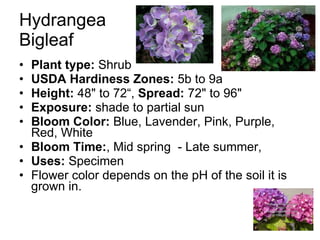
Hydrangea  Bigleaf Plant type:  Shrub  USDA Hardiness Zones:  5b to 9a  Height:  48" to 72“,  Spread:  72" to 96"  Exposure:  shade to partial sun  Bloom Color:  Blue, Lavender, Pink, Purple, Red, White  Bloom Time: , Mid spring  - Late summer,  Uses:  Specimen  Flower color depends on the pH of the soil it is grown in.
Scarification Cutting the seed coat using acid, sand paper, or a knife to encourage germination Redbud tree seeds require scarification
Stratification Requirement of some seeds to go through a cold period before they will sprout Walnuts
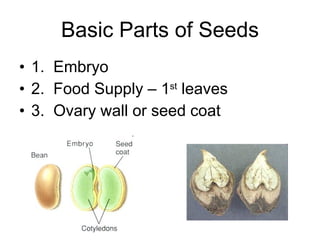
Basic Parts of Seeds 1.  Embryo 2.  Food Supply – 1 st  leaves 3.  Ovary wall or seed coat
Germination Needed for Germination 1.  Temperature 2.  Moisture 3.  Air 4.  Light or absence of it
Germination Process 1.  Seed absorbs water 2.  Seeds proteins activated 3.  Radicle (root) emerges 4.  Plumule or embryonic shoot emerges 5.  Leaves form and food production begins
Monocot Seeds 1.  Seed coat-protection 2.  Endosperm- a source of energy 3.  Embryo-miniature plant that has Epicotyle-shoot above cotyledon Hypocotyl-part of stem below the cotyledon Radicle- primary root, supports seedling
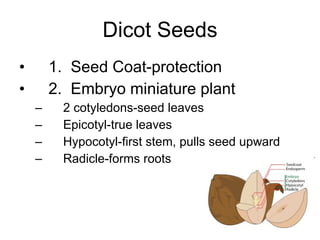
Dicot Seeds 1.  Seed Coat-protection 2.  Embryo miniature plant 2 cotyledons-seed leaves Epicotyl-true leaves Hypocotyl-first stem, pulls seed upward Radicle-forms roots
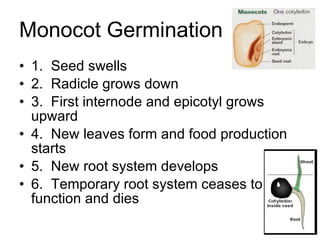
Monocot Germination 1.  Seed swells 2.  Radicle grows down 3.  First internode and epicotyl grows upward 4.  New leaves form and food production starts 5.  New root system develops 6.  Temporary root system ceases to function and dies
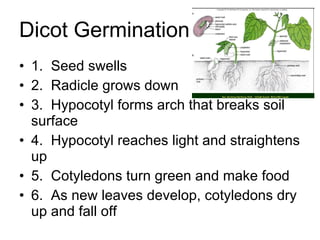
Dicot Germination 1.  Seed swells 2.  Radicle grows down 3.  Hypocotyl forms arch that breaks soil surface 4.  Hypocotyl reaches light and straightens up 5.  Cotyledons turn green and make food 6.  As new leaves develop, cotyledons dry up and fall off
Seedlings Sow in soil – direct seeding Grass Covercrops Sow in growing mix Transplant after developed 1 st  or second set of leaves Only use sterile mix
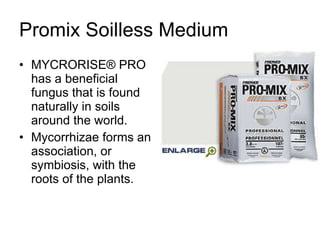
Promix Soilless Medium MYCRORISE® PRO has a beneficial fungus that is found naturally in soils around the world.  Mycorrhizae forms an association, or symbiosis, with the roots of the plants.
Promix BX Canadian Sphagnum Peat Moss  (75-85 % / vol.)  Dolomitic & Calcitic Limestone  (pH adjuster)  Endomycorrhize (Mycorise® Pro)   Macronutrients Perlite — horticultural grade   Micronutrients Vermiculite   Wetting Agent   
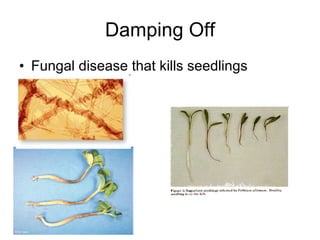
Damping Off Fungal disease that kills seedlings
Today Start tree seeds Walnut Redbud Chestnut Oak Walk down to irrigation project

10 5 Scarification & Stratification

  • 1.
  • 2.
    Hydrangea BigleafPlant type: Shrub USDA Hardiness Zones: 5b to 9a Height: 48" to 72“, Spread: 72" to 96" Exposure: shade to partial sun Bloom Color: Blue, Lavender, Pink, Purple, Red, White Bloom Time: , Mid spring - Late summer, Uses: Specimen Flower color depends on the pH of the soil it is grown in.
  • 3.
    Scarification Cutting theseed coat using acid, sand paper, or a knife to encourage germination Redbud tree seeds require scarification
  • 4.
    Stratification Requirement ofsome seeds to go through a cold period before they will sprout Walnuts
  • 5.
    Basic Parts ofSeeds 1. Embryo 2. Food Supply – 1 st leaves 3. Ovary wall or seed coat
  • 6.
    Germination Needed forGermination 1. Temperature 2. Moisture 3. Air 4. Light or absence of it
  • 7.
    Germination Process 1. Seed absorbs water 2. Seeds proteins activated 3. Radicle (root) emerges 4. Plumule or embryonic shoot emerges 5. Leaves form and food production begins
  • 8.
    Monocot Seeds 1. Seed coat-protection 2. Endosperm- a source of energy 3. Embryo-miniature plant that has Epicotyle-shoot above cotyledon Hypocotyl-part of stem below the cotyledon Radicle- primary root, supports seedling
  • 9.
    Dicot Seeds 1. Seed Coat-protection 2. Embryo miniature plant 2 cotyledons-seed leaves Epicotyl-true leaves Hypocotyl-first stem, pulls seed upward Radicle-forms roots
  • 10.
    Monocot Germination 1. Seed swells 2. Radicle grows down 3. First internode and epicotyl grows upward 4. New leaves form and food production starts 5. New root system develops 6. Temporary root system ceases to function and dies
  • 11.
    Dicot Germination 1. Seed swells 2. Radicle grows down 3. Hypocotyl forms arch that breaks soil surface 4. Hypocotyl reaches light and straightens up 5. Cotyledons turn green and make food 6. As new leaves develop, cotyledons dry up and fall off
  • 12.
    Seedlings Sow insoil – direct seeding Grass Covercrops Sow in growing mix Transplant after developed 1 st or second set of leaves Only use sterile mix
  • 13.
    Promix Soilless MediumMYCRORISE® PRO has a beneficial fungus that is found naturally in soils around the world. Mycorrhizae forms an association, or symbiosis, with the roots of the plants.
  • 14.
    Promix BX CanadianSphagnum Peat Moss (75-85 % / vol.) Dolomitic & Calcitic Limestone (pH adjuster) Endomycorrhize (Mycorise® Pro)   Macronutrients Perlite — horticultural grade   Micronutrients Vermiculite   Wetting Agent   
  • 15.
    Damping Off Fungaldisease that kills seedlings
  • 16.
    Today Start treeseeds Walnut Redbud Chestnut Oak Walk down to irrigation project