GFCS and NAPs
Climate information Products in the NAP process in
Malawi
Fred Kossam
Head of Climate Change and Research Services
Technical Lead for NAPs in Malawi
Department of Climate Change and Meteorological
Services
Climate Services
• A climate product is the result of a process of synthesizing climate
data and information.
• Noting that climate services depend critically on predictions of time-
evolving regional climate on timescales from seasonal-to-interannual,
multi-decadal, century and beyond, it is necessary that climate
prediction science must be accorded an important part in organizing
beneficial climate services
• To improve the delivery of tailored climate information products and
services, it is imperative that an inventory of the users and providers
of climate information is made for future collaboration and
partnership.
Assessment of Climate Services
• Institutions involved should be open to clients, flexible enough to adjust or
develop requirement based new services and adopt advanced quality
management systems including new procedures, standards and best practices.
• the users request for timely dissemination of climate information for effective
planning.
• Meteorological observing network is poor and there is need for rehabilitation of
surface and upper-air stations, installation of Automatic Weather Stations and
Radar to improve weather and climate forecasting and severe storm tracking.
• Inadequate observational network is an impediment to provision of climate
information products and services especially where some localized information is
needed.
• The performance of meteorology depends on the collaboration with national,
regional and international organizations to facilitate data exchange, Research and
Development and also share meteorological prediction products and lessons
learnt from various users of climate data and information
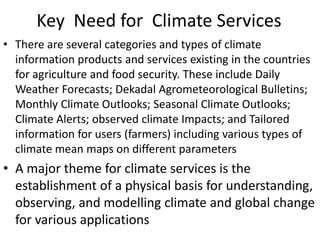
Key Need for Climate Services
• There are several categories and types of climate
information products and services existing in the countries
for agriculture and food security. These include Daily
Weather Forecasts; Dekadal Agrometeorological Bulletins;
Monthly Climate Outlooks; Seasonal Climate Outlooks;
Climate Alerts; observed climate Impacts; and Tailored
information for users (farmers) including various types of
climate mean maps on different parameters
• A major theme for climate services is the
establishment of a physical basis for understanding,
observing, and modelling climate and global change
for various applications
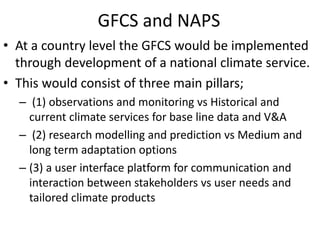
GFCS and NAPS
• At a country level the GFCS would be implemented
through development of a national climate service.
• This would consist of three main pillars;
– (1) observations and monitoring vs Historical and
current climate services for base line data and V&A
– (2) research modelling and prediction vs Medium and
long term adaptation options
– (3) a user interface platform for communication and
interaction between stakeholders vs user needs and
tailored climate products
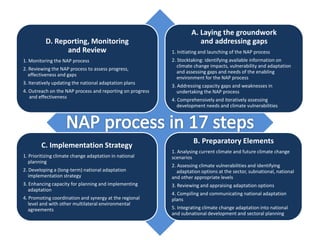
D. Reporting, Monitoring
and Review
1. Monitoring the NAP process
2. Reviewing the NAP process to assess progress,
effectiveness and gaps
3. Iteratively updating the national adaptation plans
4. Outreach on the NAP process and reporting on progress
and effectiveness
A. Laying the groundwork
and addressing gaps
1. Initiating and launching of the NAP process
2. Stocktaking: identifying available information on
climate change impacts, vulnerability and adaptation
and assessing gaps and needs of the enabling
environment for the NAP process
3. Addressing capacity gaps and weaknesses in
undertaking the NAP process
4. Comprehensively and iteratively assessing
development needs and climate vulnerabilities
C. Implementation Strategy
1. Prioritizing climate change adaptation in national
planning
2. Developing a (long-term) national adaptation
implementation strategy
3. Enhancing capacity for planning and implementing
adaptation
4. Promoting coordination and synergy at the regional
level and with other multilateral environmental
agreements
B. Preparatory Elements
1. Analysing current climate and future climate change
scenarios
2. Assessing climate vulnerabilities and identifying
adaptation options at the sector, subnational, national
and other appropriate levels
3. Reviewing and appraising adaptation options
4. Compiling and communicating national adaptation
plans
5. Integrating climate change adaptation into national
and subnational development and sectoral planning
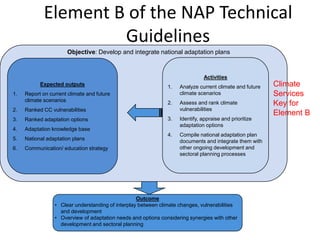
Element B of the NAP Technical
Guidelines
Objective: Develop and integrate national adaptation plans
Expected outputs
1. Report on current climate and future
climate scenarios
2. Ranked CC vulnerabilities
3. Ranked adaptation options
4. Adaptation knowledge base
5. National adaptation plans
6. Communication/ education strategy
Activities
1. Analyze current climate and future
climate scenarios
2. Assess and rank climate
vulnerabilities
3. Identify, appraise and prioritize
adaptation options
4. Compile national adaptation plan
documents and integrate them with
other ongoing development and
sectoral planning processes
Outcome
• Clear understanding of interplay between climate changes, vulnerabilities
and development
• Overview of adaptation needs and options considering synergies with other
development and sectoral planning
Climate
Services
Key for
Element B
Climate Products for NAPs
Related to V&A
• Improving historical climate data bases. In terms of meteorological
records, investing in data may include efforts at data recovery,
digitalization, and cleaning in order to assure that countries are
forecasting and monitoring
• Improve data accessibility
• Weather and climate risks based on the best available historic datasets
• capacity to analyse historical and current climatic data
• Application of impacts on various sectors
• Climate is changing , better data and fine scale models are needed
Related to Medium and Long Term Scenario Building
• Climate Projection and associated impacts
• Availability of tools and models for downscaling
• Uncertainty analysis
• Potential links with regional climate service centres
Knowledge gaps
• The onset and cessation of the rains and its
inter-annual variability,
• Improvement of our understanding of rainfall
mechanisms, prediction and verifications,
Calibration, use of climate indices to Predict
Droughts and Floods and Validation of Satellite-
Derived Data and Products for improved
environmental monitoring for sustainable
development
• Integration of indigenous knowledge into the NAP
process
END

Session ii ii gfcs and nap_malawi case

  • 1.
    GFCS and NAPs Climateinformation Products in the NAP process in Malawi Fred Kossam Head of Climate Change and Research Services Technical Lead for NAPs in Malawi Department of Climate Change and Meteorological Services
  • 2.
    Climate Services • Aclimate product is the result of a process of synthesizing climate data and information. • Noting that climate services depend critically on predictions of time- evolving regional climate on timescales from seasonal-to-interannual, multi-decadal, century and beyond, it is necessary that climate prediction science must be accorded an important part in organizing beneficial climate services • To improve the delivery of tailored climate information products and services, it is imperative that an inventory of the users and providers of climate information is made for future collaboration and partnership.
  • 3.
    Assessment of ClimateServices • Institutions involved should be open to clients, flexible enough to adjust or develop requirement based new services and adopt advanced quality management systems including new procedures, standards and best practices. • the users request for timely dissemination of climate information for effective planning. • Meteorological observing network is poor and there is need for rehabilitation of surface and upper-air stations, installation of Automatic Weather Stations and Radar to improve weather and climate forecasting and severe storm tracking. • Inadequate observational network is an impediment to provision of climate information products and services especially where some localized information is needed. • The performance of meteorology depends on the collaboration with national, regional and international organizations to facilitate data exchange, Research and Development and also share meteorological prediction products and lessons learnt from various users of climate data and information
  • 4.
    Key Need forClimate Services • There are several categories and types of climate information products and services existing in the countries for agriculture and food security. These include Daily Weather Forecasts; Dekadal Agrometeorological Bulletins; Monthly Climate Outlooks; Seasonal Climate Outlooks; Climate Alerts; observed climate Impacts; and Tailored information for users (farmers) including various types of climate mean maps on different parameters • A major theme for climate services is the establishment of a physical basis for understanding, observing, and modelling climate and global change for various applications
  • 5.
    GFCS and NAPS •At a country level the GFCS would be implemented through development of a national climate service. • This would consist of three main pillars; – (1) observations and monitoring vs Historical and current climate services for base line data and V&A – (2) research modelling and prediction vs Medium and long term adaptation options – (3) a user interface platform for communication and interaction between stakeholders vs user needs and tailored climate products
  • 6.
    D. Reporting, Monitoring andReview 1. Monitoring the NAP process 2. Reviewing the NAP process to assess progress, effectiveness and gaps 3. Iteratively updating the national adaptation plans 4. Outreach on the NAP process and reporting on progress and effectiveness A. Laying the groundwork and addressing gaps 1. Initiating and launching of the NAP process 2. Stocktaking: identifying available information on climate change impacts, vulnerability and adaptation and assessing gaps and needs of the enabling environment for the NAP process 3. Addressing capacity gaps and weaknesses in undertaking the NAP process 4. Comprehensively and iteratively assessing development needs and climate vulnerabilities C. Implementation Strategy 1. Prioritizing climate change adaptation in national planning 2. Developing a (long-term) national adaptation implementation strategy 3. Enhancing capacity for planning and implementing adaptation 4. Promoting coordination and synergy at the regional level and with other multilateral environmental agreements B. Preparatory Elements 1. Analysing current climate and future climate change scenarios 2. Assessing climate vulnerabilities and identifying adaptation options at the sector, subnational, national and other appropriate levels 3. Reviewing and appraising adaptation options 4. Compiling and communicating national adaptation plans 5. Integrating climate change adaptation into national and subnational development and sectoral planning
  • 7.
    Element B ofthe NAP Technical Guidelines Objective: Develop and integrate national adaptation plans Expected outputs 1. Report on current climate and future climate scenarios 2. Ranked CC vulnerabilities 3. Ranked adaptation options 4. Adaptation knowledge base 5. National adaptation plans 6. Communication/ education strategy Activities 1. Analyze current climate and future climate scenarios 2. Assess and rank climate vulnerabilities 3. Identify, appraise and prioritize adaptation options 4. Compile national adaptation plan documents and integrate them with other ongoing development and sectoral planning processes Outcome • Clear understanding of interplay between climate changes, vulnerabilities and development • Overview of adaptation needs and options considering synergies with other development and sectoral planning Climate Services Key for Element B
  • 8.
    Climate Products forNAPs Related to V&A • Improving historical climate data bases. In terms of meteorological records, investing in data may include efforts at data recovery, digitalization, and cleaning in order to assure that countries are forecasting and monitoring • Improve data accessibility • Weather and climate risks based on the best available historic datasets • capacity to analyse historical and current climatic data • Application of impacts on various sectors • Climate is changing , better data and fine scale models are needed Related to Medium and Long Term Scenario Building • Climate Projection and associated impacts • Availability of tools and models for downscaling • Uncertainty analysis • Potential links with regional climate service centres
  • 9.
    Knowledge gaps • Theonset and cessation of the rains and its inter-annual variability, • Improvement of our understanding of rainfall mechanisms, prediction and verifications, Calibration, use of climate indices to Predict Droughts and Floods and Validation of Satellite- Derived Data and Products for improved environmental monitoring for sustainable development • Integration of indigenous knowledge into the NAP process
  • 10.