
Recognizing Human Capital as a Competitive Asset The New Balance Sheet By Frank Pacheco
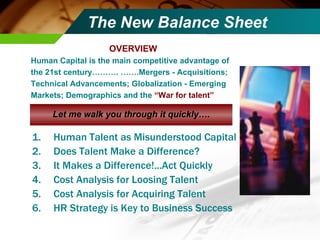
The New Balance Sheet Human Talent as Misunderstood Capital Does Talent Make a Difference? It Makes a Difference!...Act Quickly Cost Analysis for Loosing Talent Cost Analysis for Acquiring Talent HR Strategy is Key to Business Success OVERVIEW Human Capital is the main competitive advantage of the 21st century………. …….Mergers - Acquisitions; Technical Advancements; Globalization - Emerging Markets; Demographics and the  “War for talent” Let me walk you through it quickly….
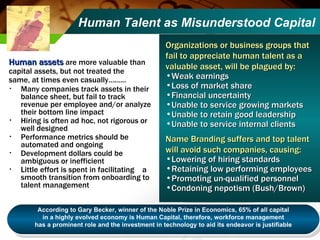
Human Talent as Misunderstood Capital Human assets  are more valuable than  capital assets, but not treated the  same, at times even casually……… Many companies track assets in their balance sheet, but fail to track revenue per employee and/or analyze their bottom line impact  Hiring is often ad hoc, not rigorous or well designed Performance metrics should be automated and ongoing Development dollars could be ambiguous or inefficient Little effort is spent in facilitating  a smooth transition from onboarding to  talent management Organizations or business groups that fail to appreciate human talent as a valuable asset, will be plagued by:   Weak earnings Loss of market share Financial uncertainty Unable to service growing markets Unable to retain good leadership Unable to service internal clients Name Branding suffers and top talent will avoid such companies, causing: Lowering of hiring standards Retaining low performing employees Promoting un-qualified personnel Condoning nepotism (Bush/Brown) According to Gary Becker, winner of the Noble Prize in Economics, 65% of all capital in a highly evolved economy is Human Capital, therefore, workforce management  has a prominent role and the investment in technology to aid its endeavor is justifiable
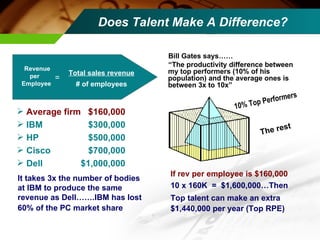
Does Talent Make A Difference? Bill Gates says……  “ The productivity difference between my top performers (10% of his population) and the average ones is between 3x to 10x” Average firm  $160,000 IBM   $300,000  HP   $500,000  Cisco   $700,000  Dell   $1,000,000  It takes 3x the number of bodies at IBM to produce the same revenue as Dell…….IBM has lost 60% of the PC market share   Revenue  per  Employee  Total sales revenue # of employees If rev per employee is $160,000 10 x 160K  =  $1,600,000…Then Top talent can make   an extra   $1,440,000   per year (Top RPE) 10% Top Performers The rest =
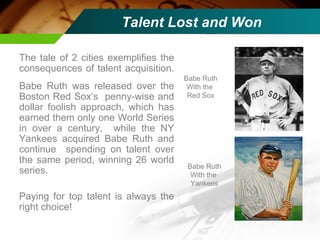
Talent Lost and Won The tale of 2 cities exemplifies the consequences of talent acquisition.  Babe Ruth was released over the Boston Red Sox’s  penny-wise and dollar foolish approach, which has earned them only one World Series in over a century,  while the NY Yankees acquired Babe Ruth and continue  spending on talent over the same period, winning 26 world series. Paying for top talent is always the right choice! Babe Ruth With the  Red Sox Babe Ruth With the  Yankees
If   Ally Mc Beal   walked in…. Why would you feel the need to also   interview  Rosanne   to check if Ally was really skinny? It Makes A Difference!.....Act Quickly He was given an offer within 24 hours  Michael Jordan (s) are gone in one day Within 10 days…the top 10% are gone Quality of hire decreases over time Top candidates hate delays Just Do It ! Kai-Fu Lee  Looses lawsuit to Over hiring their Top Talent Google’s stock is up 200%  since Mr. Lee’s arrival  Set fixed standards Set fixed standards  Set fixed Standards Expedite your hiring practice
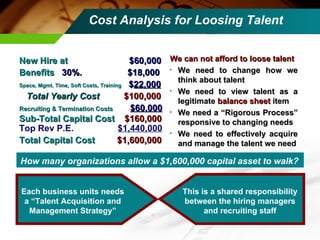
Cost Analysis for Loosing Talent New Hire at  $60,000 Benefits  30%.   $18,000 Space, Mgmt. Time, Soft Costs, Training   $ 22,000 Total Yearly Cost   $100,000 Recruiting & Termination Costs   $60,000 Sub-Total Capital Cost  $160,000 Top Rev P.E.  $1,440,000   Total Capital Cost  $1,600,000 How many organizations allow a $1,600,000 capital asset to walk? We can not afford to loose talent We need to change how we think about talent We need to view talent as a legitimate  balance sheet  item We need a “Rigorous Process” responsive to changing needs We need to effectively acquire and manage the talent we need This is a shared responsibility between the hiring managers and recruiting staff Each business units needs a “Talent Acquisition and Management Strategy”
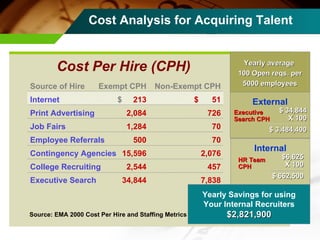
Cost Per Hire (CPH) Yearly average  100 Open reqs. per 5000 employees External $ 34,844 X 100 --------------------------------- $ 3,484,400 Internal $6,625 X 100 ----------------------------- $ 662,500 Executive  Search CPH HR Team  CPH Yearly Savings for using Your Internal Recruiters $2,821,900 Cost Analysis for Acquiring Talent Source of Hire Internet Print Advertising Job Fairs Employee Referrals Contingency Agencies College Recruiting Executive Search Exempt CPH $  213 2,084 1,284 500 15,596 2,544 34,844 Non-Exempt CPH $  51 726 70 70 2,076 457 7,838 Source: EMA 2000 Cost Per Hire and Staffing Metrics Survey
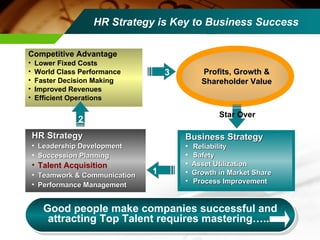
HR Strategy is Key to Business Success Business Strategy   Reliability   Safety  Asset Utilization Growth in Market Share   Process Improvement HR Strategy   Leadership Development Succession Planning Talent Acquisition   Teamwork & Communication Performance Management   Competitive Advantage Lower Fixed Costs World Class Performance  Faster Decision Making Improved Revenues Efficient Operations Profits, Growth & Shareholder Value 1 2 3 Star Over Good people make companies successful and attracting Top Talent requires mastering…..
Client-Candidate Relations, Power Sourcing, Metrics and Reporting By Frank Pacheco The  Art  of  War  Talent Acquisition
The Art of Talent Acquisition Talent Acquisition Management Strategy Phase 1 -  Understand Your Organization Understanding Talent Types  Phase 2 – Understand What You Are Seeking Attracting Top Talent (Beyond $$$) Phase 3 – Recruit Aggressively Process Drives Talent Acquisition
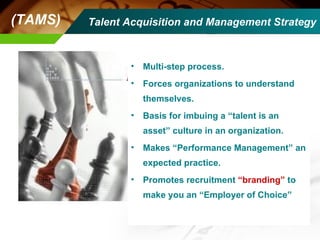
Talent Acquisition and Management Strategy Multi-step process. Forces organizations to understand themselves. Basis for imbuing a “talent is an asset” culture in an organization. Makes “Performance Management” an expected practice. Promotes recruitment  “branding”  to make you an “Employer of Choice” (TAMS)
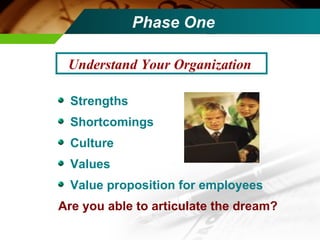
Phase One Strengths Shortcomings Culture Values Value proposition for employees Are you able to articulate the dream? Understand Your Organization
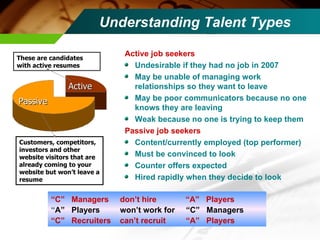
Understanding Talent Types Active job seekers   Undesirable if they had no job in 2007 May be unable of managing work relationships so they want to leave May be poor communicators because no one knows they are leaving Weak because no one is trying to keep them Passive job seekers Content/currently employed (top performer) Must be convinced to look Counter offers expected Hired rapidly when they decide to look Customers, competitors, investors and other website visitors that are already coming to your website but won’t leave a resume Passive Active These are candidates with active resumes “ C”  Managers  don’t hire  “A”  Players   “ A”  Players  won’t work for  “C”  Managers “ C”  Recruiters  can’t recruit  “A”  Players
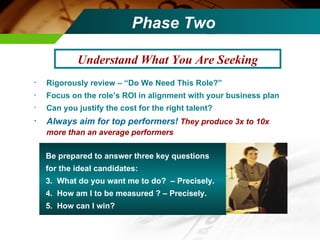
Phase Two Rigorously review – “Do We Need This Role?” Focus on the role’s ROI in alignment with your business plan Can you justify the cost for the right talent? Always aim for top performers!  They produce 3x to 10x more than an average performers Understand  What You Are Seeking Be prepared to answer three key questions  for the ideal candidates: What do you want me to do?  – Precisely. How am I to be measured ? – Precisely. How can I win?
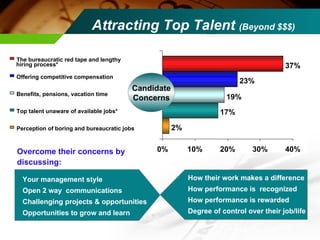
Attracting Top Talent  (Beyond $$$)   Your management style  Open 2 way  communications Challenging projects & opportunities Opportunities to grow and learn  Overcome their concerns by discussing: How their work makes a difference How performance is  recognized  How performance is rewarded Degree of control over their job/life Candidate Concerns 2% 17% 19% 23% 37% 0% 10% 20% 30% 40% The bureaucratic red tape and lengthy hiring process* Offering competitive compensation Benefits, pensions, vacation time Top talent unaware of available jobs* Perception of boring and bureaucratic jobs
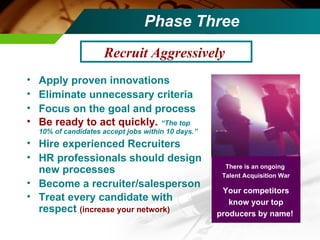
Phase Three Apply proven innovations Eliminate unnecessary criteria Focus on the goal and process Be ready to act quickly.  “The top 10% of candidates accept jobs within 10 days.” Hire experienced Recruiters  HR professionals should design new processes Become a recruiter/salesperson Treat every candidate with respect  (increase your network) Recruit Aggressively   There is an ongoing  Talent Acquisition War Your competitors know your top producers by name!
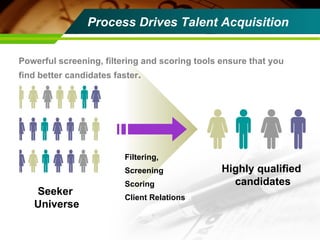
Process Drives Talent Acquisition  Powerful screening, filtering and scoring tools ensure that you find better candidates faster . Seeker  Universe Filtering,  Screening  Scoring  Client Relations Highly qualified  candidates
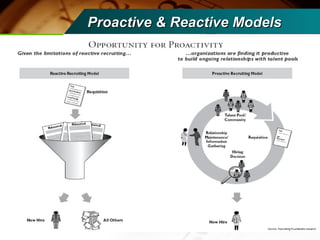
Proactive & Reactive Models
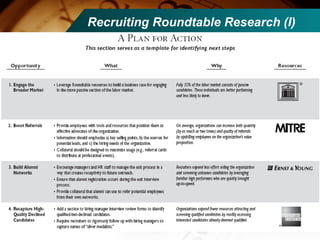
Recruiting Roundtable Research   (I)
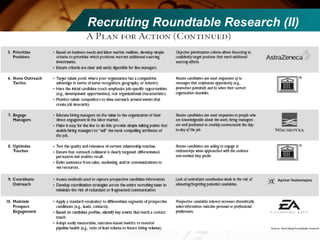
Recruiting Roundtable Research (II)

1 The New Balance Sheet

  • 1.
    Recognizing Human Capitalas a Competitive Asset The New Balance Sheet By Frank Pacheco
  • 2.
    The New BalanceSheet Human Talent as Misunderstood Capital Does Talent Make a Difference? It Makes a Difference!...Act Quickly Cost Analysis for Loosing Talent Cost Analysis for Acquiring Talent HR Strategy is Key to Business Success OVERVIEW Human Capital is the main competitive advantage of the 21st century………. …….Mergers - Acquisitions; Technical Advancements; Globalization - Emerging Markets; Demographics and the “War for talent” Let me walk you through it quickly….
  • 3.
    Human Talent asMisunderstood Capital Human assets are more valuable than capital assets, but not treated the same, at times even casually……… Many companies track assets in their balance sheet, but fail to track revenue per employee and/or analyze their bottom line impact Hiring is often ad hoc, not rigorous or well designed Performance metrics should be automated and ongoing Development dollars could be ambiguous or inefficient Little effort is spent in facilitating a smooth transition from onboarding to talent management Organizations or business groups that fail to appreciate human talent as a valuable asset, will be plagued by: Weak earnings Loss of market share Financial uncertainty Unable to service growing markets Unable to retain good leadership Unable to service internal clients Name Branding suffers and top talent will avoid such companies, causing: Lowering of hiring standards Retaining low performing employees Promoting un-qualified personnel Condoning nepotism (Bush/Brown) According to Gary Becker, winner of the Noble Prize in Economics, 65% of all capital in a highly evolved economy is Human Capital, therefore, workforce management has a prominent role and the investment in technology to aid its endeavor is justifiable
  • 4.
    Does Talent MakeA Difference? Bill Gates says…… “ The productivity difference between my top performers (10% of his population) and the average ones is between 3x to 10x” Average firm $160,000 IBM $300,000 HP $500,000 Cisco $700,000 Dell $1,000,000 It takes 3x the number of bodies at IBM to produce the same revenue as Dell…….IBM has lost 60% of the PC market share Revenue per Employee Total sales revenue # of employees If rev per employee is $160,000 10 x 160K = $1,600,000…Then Top talent can make an extra $1,440,000 per year (Top RPE) 10% Top Performers The rest =
  • 5.
    Talent Lost andWon The tale of 2 cities exemplifies the consequences of talent acquisition. Babe Ruth was released over the Boston Red Sox’s penny-wise and dollar foolish approach, which has earned them only one World Series in over a century, while the NY Yankees acquired Babe Ruth and continue spending on talent over the same period, winning 26 world series. Paying for top talent is always the right choice! Babe Ruth With the Red Sox Babe Ruth With the Yankees
  • 6.
    If Ally Mc Beal walked in…. Why would you feel the need to also interview Rosanne to check if Ally was really skinny? It Makes A Difference!.....Act Quickly He was given an offer within 24 hours Michael Jordan (s) are gone in one day Within 10 days…the top 10% are gone Quality of hire decreases over time Top candidates hate delays Just Do It ! Kai-Fu Lee Looses lawsuit to Over hiring their Top Talent Google’s stock is up 200% since Mr. Lee’s arrival Set fixed standards Set fixed standards Set fixed Standards Expedite your hiring practice
  • 7.
    Cost Analysis forLoosing Talent New Hire at $60,000 Benefits 30%. $18,000 Space, Mgmt. Time, Soft Costs, Training $ 22,000 Total Yearly Cost $100,000 Recruiting & Termination Costs $60,000 Sub-Total Capital Cost $160,000 Top Rev P.E. $1,440,000 Total Capital Cost $1,600,000 How many organizations allow a $1,600,000 capital asset to walk? We can not afford to loose talent We need to change how we think about talent We need to view talent as a legitimate balance sheet item We need a “Rigorous Process” responsive to changing needs We need to effectively acquire and manage the talent we need This is a shared responsibility between the hiring managers and recruiting staff Each business units needs a “Talent Acquisition and Management Strategy”
  • 8.
    Cost Per Hire(CPH) Yearly average 100 Open reqs. per 5000 employees External $ 34,844 X 100 --------------------------------- $ 3,484,400 Internal $6,625 X 100 ----------------------------- $ 662,500 Executive Search CPH HR Team CPH Yearly Savings for using Your Internal Recruiters $2,821,900 Cost Analysis for Acquiring Talent Source of Hire Internet Print Advertising Job Fairs Employee Referrals Contingency Agencies College Recruiting Executive Search Exempt CPH $ 213 2,084 1,284 500 15,596 2,544 34,844 Non-Exempt CPH $ 51 726 70 70 2,076 457 7,838 Source: EMA 2000 Cost Per Hire and Staffing Metrics Survey
  • 9.
    HR Strategy isKey to Business Success Business Strategy Reliability Safety Asset Utilization Growth in Market Share Process Improvement HR Strategy Leadership Development Succession Planning Talent Acquisition Teamwork & Communication Performance Management Competitive Advantage Lower Fixed Costs World Class Performance Faster Decision Making Improved Revenues Efficient Operations Profits, Growth & Shareholder Value 1 2 3 Star Over Good people make companies successful and attracting Top Talent requires mastering…..
  • 10.
    Client-Candidate Relations, PowerSourcing, Metrics and Reporting By Frank Pacheco The Art of War Talent Acquisition
  • 11.
    The Art ofTalent Acquisition Talent Acquisition Management Strategy Phase 1 - Understand Your Organization Understanding Talent Types Phase 2 – Understand What You Are Seeking Attracting Top Talent (Beyond $$$) Phase 3 – Recruit Aggressively Process Drives Talent Acquisition
  • 12.
    Talent Acquisition andManagement Strategy Multi-step process. Forces organizations to understand themselves. Basis for imbuing a “talent is an asset” culture in an organization. Makes “Performance Management” an expected practice. Promotes recruitment “branding” to make you an “Employer of Choice” (TAMS)
  • 13.
    Phase One StrengthsShortcomings Culture Values Value proposition for employees Are you able to articulate the dream? Understand Your Organization
  • 14.
    Understanding Talent TypesActive job seekers Undesirable if they had no job in 2007 May be unable of managing work relationships so they want to leave May be poor communicators because no one knows they are leaving Weak because no one is trying to keep them Passive job seekers Content/currently employed (top performer) Must be convinced to look Counter offers expected Hired rapidly when they decide to look Customers, competitors, investors and other website visitors that are already coming to your website but won’t leave a resume Passive Active These are candidates with active resumes “ C” Managers don’t hire “A” Players “ A” Players won’t work for “C” Managers “ C” Recruiters can’t recruit “A” Players
  • 15.
    Phase Two Rigorouslyreview – “Do We Need This Role?” Focus on the role’s ROI in alignment with your business plan Can you justify the cost for the right talent? Always aim for top performers! They produce 3x to 10x more than an average performers Understand What You Are Seeking Be prepared to answer three key questions for the ideal candidates: What do you want me to do? – Precisely. How am I to be measured ? – Precisely. How can I win?
  • 16.
    Attracting Top Talent (Beyond $$$) Your management style Open 2 way communications Challenging projects & opportunities Opportunities to grow and learn Overcome their concerns by discussing: How their work makes a difference How performance is recognized How performance is rewarded Degree of control over their job/life Candidate Concerns 2% 17% 19% 23% 37% 0% 10% 20% 30% 40% The bureaucratic red tape and lengthy hiring process* Offering competitive compensation Benefits, pensions, vacation time Top talent unaware of available jobs* Perception of boring and bureaucratic jobs
  • 17.
    Phase Three Applyproven innovations Eliminate unnecessary criteria Focus on the goal and process Be ready to act quickly. “The top 10% of candidates accept jobs within 10 days.” Hire experienced Recruiters HR professionals should design new processes Become a recruiter/salesperson Treat every candidate with respect (increase your network) Recruit Aggressively There is an ongoing Talent Acquisition War Your competitors know your top producers by name!
  • 18.
    Process Drives TalentAcquisition Powerful screening, filtering and scoring tools ensure that you find better candidates faster . Seeker Universe Filtering, Screening Scoring Client Relations Highly qualified candidates
  • 19.
  • 20.
  • 21.