Information security:
• It protects sensitive information from unauthorised
activities
Security:
• The quality of being secure to be free from danger
Multiple layers of security:
1.Physical security(objects)
2.Personnel security (individual or group)
3.Operations security(series of activities)
4.communication security(media or content)
5.Network security(network &components)
6.Information security(data)
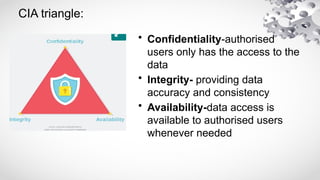
CIA triangle:
• Confidentiality-authorised
users only has the access to the
data
• Integrity- providing data
accuracy and consistency
• Availability-data access is
available to authorised users
whenever needed
History of Information Security:
• 1960s Offline sites security
• 1970s Evolution of PC’s and hackers
• 1980s Evolution of cybercrime
• 1990s Hacking becoming an organised crime
• 2000s cybercrime becoming a serious issue
• 2010s Information security
Critical characteristics of Info.
• Availability
• Accuracy
• Authenticity
• Confidentiality
• Integrity
• Utility
• Possession
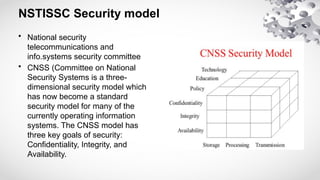
NSTISSC Security model
• National security
telecommunications and
info.systems security committee
• CNSS (Committee on National
Security Systems is a three-
dimensional security model which
has now become a standard
security model for many of the
currently operating information
systems. The CNSS model has
three key goals of security:
Confidentiality, Integrity, and
Availability.
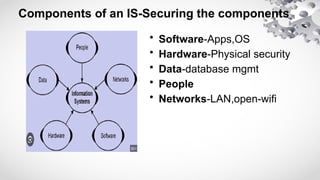
Components of an IS-Securing the components
• Software-Apps,OS
• Hardware-Physical security
• Data-database mgmt
• People
• Networks-LAN,open-wifi
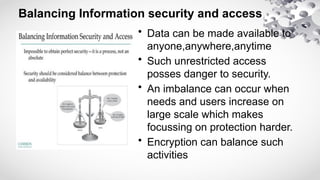
Balancing Information security and access
• Data can be made available to
anyone,anywhere,anytime
• Such unrestricted access
posses danger to security.
• An imbalance can occur when
needs and users increase on
large scale which makes
focussing on protection harder.
• Encryption can balance such
activities
Need for security
Business Needs:
1.Protecting functionality of an organisation
2.Enabling safe operations of applications
3.Protecting data that organizations collect and use
4.Safeguarding technology assets in organisations
Systems development life cycle
• Investigation
• Analysis
• Logical design
• Physical design
• Implementation
• Maintenance and change
The security SDLC
1.Investigation/analysis phases
• Security categorisation
• Preliminary risk assessment
2.Logical/Physical design phases
• Risk assessment
• Security functional requirements analysis
• Security assurance requirements analysis
• Cost considerations and reporting
• Security planning
• Security control development
• Developmental security test and evaluation
• Other planning components
3.Implementation phase
• Inspection and acceptance
• Security certification
• Security accreditation
4.Maintenace and change phase
• Configuration management and control
• Continuous monitoring
• Information preservation
• Media sanitization
• Hardware and software disposal
Need for security
• Information security defines protecting information and
information systems from unauthorized access, use,
acknowledgment, disruption, alteration or destruction.
Governments, military, financial institutions, hospitals, and
private businesses amass a big deal of confidential data
about their employees, users, products, research and
monetary status.
Business Needs
It performs four important functions for an organisation
1. Protecting functionality of an organisation
2. Enabling safe operation of applications
3. Protecting data that Organisations collect and use
4. Safeguarding technology assets in Organisations
Threats:
1.Compromises to intellectual property
2.Deviations in Quality of services
• Power irregularities
• Communication & other service providers
• Internet service issues
3.Deliberate of software attacks
4.Espionage
5.Forces of Nature
6.Human errors
7.Information Extortion(insider)
8.Hardware failures and errors
9.Software failures and errors
Attacks:
• Malicious code
• Hoaxes
• Back doors
• Password crack
• Brute Force(try every possible password)
• Dictionary
• DDOS
• Spoofing
• Man in the middle
• Spam
• Mail bombing
UNIT-II
Legal,Ethical and professional issues
Laws and Ethics in IS
Law and ethics play crucial roles in information security, ensuring that
individuals and organizations adhere to standards that protect data and privacy.
We need to follow:
1. Legal Frameworks
2. Intellectual Property Laws
3. Cybersecurity Laws
4. Ethical Considerations
5. Professional Codes of Conduct
Law Vs Policy
• Laws are rules and regulations
established by a governing authority, such
as a legislature or regulatory agency. They
are enforceable and binding, with legal
consequences for non-compliance.
• Laws are enforceable through the legal
system. Violating laws can lead to
penalties, such as fines, imprisonment, or
civil lawsuits.
• Policies are guidelines or principles
adopted by organizations, institutions, or
government agencies to achieve specific
goals. While policies may be influenced by
laws, they are not inherently enforceable in
the same way.
• Policies are typically not enforceable in
the same manner as laws. Instead,
compliance with policies is usually a
condition of employment, membership, or
participation in an organization or program.
Violating policies may result in disciplinary
action or consequences within the
organization, but not necessarily legal
penalties.
Policy:
• Dissemination(distribution)-hard or soft copy
• Review(reading)
• comprehension(understanding)
• compilance(agreement)
• Uniform enforcement
Types of Law:
• Civil law-governs nation or state
• Criminal Law-harmful to society
• Private law-family law,commercial law,labor law
• Public law-criminal,administrative and constitutional laws
U.S laws that apply to information security
• General computer crime laws(CFA & NIIP)
• Privacy
• Export and Espionage laws
• U.S copyright law
• Financial reporting
• Freedom of Information Act of 1966
International laws and legal bodies:
• Council of Europe Convention on Cybercrime
• Agreement on Trade related aspects of Intellectual
property rights
• Digital Millennium Copyright Act(DMCA)
Ethics and Information security
• Ethical differences across cultures
1.Software license infringement
2.Illicit use
3.Misuse of corporate resources
• Ethics and education
Causes of unethical and illegal behavior
1.Ignorance
2.Accident
3.Intent
How to overcome
1.Fear of penalty
2.Probability of being caught
3.Probability of penalty being administered
Risk management
• Information security risk management, or ISRM, is the process of
managing risks associated with the use of information technology.
It involves identifying, assessing, and treating risks to the
confidentiality, integrity, and availability of an organization's
assets.
• Types of risks
1.Project risks(budget,schedule,personnel)
2.Technical risks(implementation,interfacing,testing,maintenance
3.Business risks(budget,building resources that no one requires)
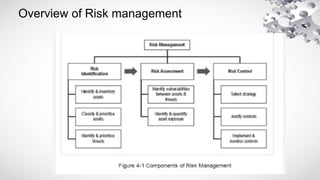
Overview of Risk management
Risk identification
• Plan and organise the process
• Asset Identification and inventory
• Classifying and prioritizing information assets
• Information asset valuation
• Identifying and prioritizing threats
• Vulnerability identification
Risk assessment
1.Likelihood
2.Risk determination
3.Identify possible controls
4.Documenting the results of risk assessment
Risk control strategies
• Defend
• Transfer
• Mitigate
1. Incident Response Plan
2. Disaster Recovery Plan
3. Business Continuity Plan
• Accept
• Terminate
Selecting a Risk Control Strategy
• Rules for selecting a Risk Control Strategy
1.Vulnerability exists
2.Vulnerability exploited
3.Potential gain
4.Potential loss
Cost Benefit Analysis(CBA)
• Organsiations must consider the economic feasibility of
implementing information security controls and
safeguards.
• Some of the items that effect cost of a control are:
1.Cost of development or acquisition (purchase cost)
2.Training fees
3.Cost of implementation
4.Service costs
5.Cost of maintenance
Cost Benefit Analysis Formula:
CBA=ALE(prior)-ALE(post)-ACS
ALE-Annual Loss Expectancy
ACS-Annual Cost of the Safeguard
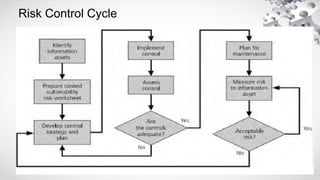
Risk Control Cycle
• It involves identifying, assessing, and treating risks to the
confidentiality, integrity, and availability of an
organization's assets.
• The end goal of this process is to treat risks in
accordance with an organization's overall risk tolerance.
• There is no exit from this cycle,it is a process that
continues for as long as the organisation continues to
function.
Risk Control Cycle
Quantities versus Qualitative Risk control
Practices
• Qualitative risk analysis is quick but subjective.
• On the other hand, quantitative risk analysis is objective
and has more detail, contingency(possible events)
reserves and go/no go decisions, but it takes more time
and is more complex.
• Quantitative data are difficult to collect and can be
prohibitively expensive
Q Vs Q risk control practices
1.Benchmarking and best practices
2.Other feasibility studies
1.Benchmarking and best practices
• Benchmarking is the process of seeking out and studying practices used in
other organisations that produce results you would like to duplicate in your
organisation.
• Metrics based measures:
1.Number of successful attacks
2.Staff-hours spent on system protection
3.Dollars spent on protection
4.Numbers of security personnel
5.Estimated value in dollars of info.lost in successful attacks
6.Loss in productivity hours associated with successful attacks
Problems with application of benchmarking and best
practices:
• The two organisations do not talk to each other
• No two organisations are identical
• Best practices are moving target
• Only research will not help a practitioner for what to do
next
2.Other Feasibility studies
1. Organisational Feasibility
2. Operational feasibility
3. Technical feasibility
4. Political feasibility
Risk management discussion points
1.Risk appetite:
Risk appetite refers to the level of risk that an organization is willing to accept or tolerate in
pursuit of its objectives. It reflects the organization's willingness to take on risk in order to
achieve its goals, and it influences decision-making processes throughout the organization.
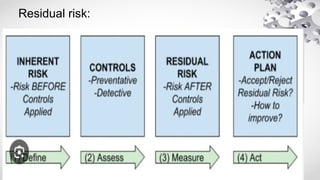
2.Residual risk:
Residual risk refers to the risk level after implementing control processes to mitigate the
inherent risk. The level of residual risk depends on the effectiveness of the implemented
controls. Consider the examples from before. The risk of choking on your breakfast is lessened
by chewing well.
3.Documenting results
Documenting results in risk assessment is crucial for ensuring clarity, accountability, and
effective decision-making within an organization.
Residual risk:
Recommended risk control practices
• By making ALE calculations
• By using control strategies
• By continuous monitoring
• By providing integrity and specific controls
• By port scanning to avvoid extrenal threats or attacks
• By using firewalls
• By protecting the assets and vulnerabilities
UNIT-III PLANNING FOR SECURITY
Planning for security
• Planning for information security involves a structured
approach to protecting sensitive data and systems from
unauthorized access, use, disclosure, disruption,
modification, or destruction.
• An organisations security efforts succeeds only it it
operates in conjunction with organisation’s information
security policy
• Security program begins with policy,standards and
practices which are foundation for information security
architecture and blueprint
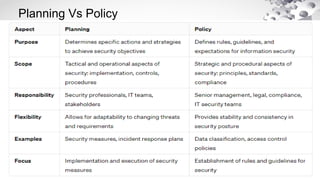
Planning Vs Policy
Information security policy,standards and practices
• Information security policy, standards, and practices are key components of
an organization's overall approach to protecting its sensitive data and
systems.
• These three components work together to create a comprehensive
information security framework within an organization.
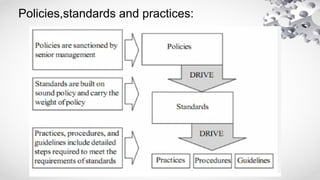
• The policy sets the overall direction and priorities, the standards provide
detailed requirements for implementation, and the practices ensure that
security measures are effectively executed and maintained over time.
• By integrating policy, standards, and practices, organizations can establish a
strong security posture to safeguard their critical assets from potential threats
and vulnerabilities.
Policies,standards and practices:
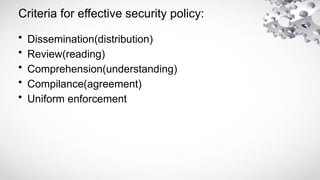
Criteria for effective security policy:
• Dissemination(distribution)
• Review(reading)
• Comprehension(understanding)
• Compilance(agreement)
• Uniform enforcement
Types of security policy
• Enterprise information security policies
• Issue specific security policies
• Systems-specific security policies
Policy mangement
• Policy management refers to the systematic process of
developing, implementing, communicating, enforcing, and
maintaining policies within an organization.
• Effective policy management is essential for ensuring
compliance with regulations, mitigating risks, and
promoting consistency in decision-making and behavior
across the organization.
Security Blueprint
• A security blueprint is a comprehensive plan or framework that
outlines an organization's approach to information security.
• It serves as a roadmap for designing, implementing, and
managing security measures to protect the organization's
sensitive data, systems, and assets from various threats and
vulnerabilities.
• By developing and implementing a comprehensive security
blueprint, organizations can better protect their information assets,
mitigate risks, and maintain the trust and confidence of
customers, partners, and stakeholders.
ISO 27000 series
• The ISO 27000 series is a set of international standards that
provide guidelines and best practices for information security
management systems (ISMS).
• These standards are developed and published by the
International Organization for Standardization (ISO) and the
International Electrotechnical Commission (IEC).
• The ISO 27000 series is designed to help organizations establish,
implement, maintain, and continually improve their information
security management systems to protect their sensitive
information and assets.
NIST security models
• The National Institute of Standards and Technology
(NIST) is a U.S. federal agency that develops and
promotes measurement standards.
• In the realm of cybersecurity, NIST has created several
security models and frameworks to help organizations
manage and improve their security posture.
• NIST Special Publication 800-14, titled "Generally Accepted Principles and
Practices for Securing Information Technology Systems," provides guidance
on fundamental security principles and practices for securing information
technology (IT) systems. Although it is an older publication, first released in
1996, many of its principles remain relevant today
• NIST Special Publication 800-18, titled "Guide for Developing Security Plans
for Federal Information Systems," provides guidance for federal agencies and
organizations in developing security plans to protect their information
systems
IETF security architecture
• The Internet Engineering Task Force (IETF) Security Architecture
encompasses various protocols, standards, and practices
designed to ensure the security and integrity of internet
communications and infrastructure
• RFC(Requests for comment)
• RFC 2196 is titled "Site Security Handbook." It's a document
published by the Internet Engineering Task Force (IETF) in
September 1997. The RFC is aimed at administrators and
managers responsible for the security of computer systems and
networks within organizations.
Baselining and best business practices
• Baselining refers to the process of establishing a standard or baseline
against which future measurements or comparisons can be made. This
concept is particularly relevant in the context of cybersecurity and business
practices
• Before implementing best business practices, it's crucial to establish
baselines to understand the current state of affairs. This could involve
assessing factors such as current security measures, employee productivity,
financial performance, customer satisfaction levels, and more.
• Federal agencies adhere to regulatory frameworks and standards mandated
by government bodies. These regulations often include requirements for data
protection, privacy, cybersecurity, and compliance with industry standards
such as NIST (National Institute of Standards and Technology) guidelines in
the United States.
Design of Security architecture
• Designing a security architecture involves creating a
structured framework of security controls, policies,
procedures, and technologies to protect an organization's
assets and information from unauthorized access, data
breaches, and other security threats.
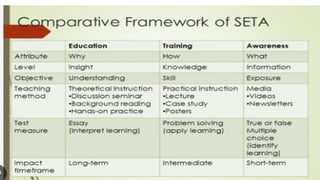
SETA Program
• Security Education,Training and Awareness program
• Security Education Training and Awareness (SETA) is a
vital component of any organization's security strategy.
SETA aims to empower employees with the knowledge
and skills necessary to identify and mitigate security risks.
The primary objective of SETA is to create a security-
conscious culture within an organization
Continuity strategies
• Continuity strategies, often referred to as business
continuity strategies, are plans and procedures developed
to ensure that an organization can continue operating and
delivering its products or services in the event of
disruptive incidents or disasters. These strategies are
crucial for maintaining business resilience and minimizing
the impact of disruptions on operations.
• IR plan,DR plan,BC plan already discussed
Major steps in contingency palnning
• Contingency refers to a plan, strategy, or course of action put in place to
address potential unforeseen events or circumstances that may disrupt
normal operations or threaten the achievement of objectives. Contingency
planning involves identifying risks, developing responses, and establishing
protocols to mitigate the impact of unexpected events.
1.Business Impact Analysis
2.Incident Response Planning
3.DR Planning
4.Business continuity planning
.Business Impact Analysis
• Business Impact Analysis (BIA) is a systematic process used to assess the
potential impact of disruptions on an organization's critical business
functions, processes, and resources. The primary purpose of conducting a
BIA is to identify and prioritize business activities and resources that are
essential for the organization's continued operation and to develop strategies
for minimizing the impact of disruptions.
• Threat attack identification and prioritization
• Business unit analysis
• Attack success scenario development
• Potential damage assessment
• Sub ordinate plan classification
Incident response planning
• Incident response planning involves establishing procedures and protocols to
effectively detect, respond to, contain, and recover from security incidents or
breaches within an organization. The goal is to minimize the impact of
incidents on business operations, mitigate risks, and maintain the
confidentiality, integrity, and availability of critical systems and data
• Incident planning
• Incident detection
• Incident reaction
• Incident recovery
Disaster Recovery Planning
• A disaster recovery plan (DRP) in information security is a structured
approach to responding to and recovering from events that could potentially
disrupt or damage an organization's IT infrastructure, systems, or data. It's a
crucial component of an organization's overall business continuity strategy,
focused specifically on mitigating the impact of IT-related disasters.
• Plan for disaster recovery
• crisis management
• Recovery operations
Business continuity planning
Business continuity planning (BCP) is a proactive approach taken by
organizations to ensure that essential business functions can continue during
and after a disaster or disruptive event. Unlike disaster recovery planning, which
focuses primarily on IT systems and data, business continuity planning
encompasses a broader scope, including people, processes, facilities, and
external dependencies. The goal is to minimize the impact of disruptions on the
organization's operations, reputation, and ability to deliver products or services
to customers.
• Establish continuity strategies
• Plan for continuity of operations
• Continuity management
Security technology
Access control:
• Acess control is the method by which systems determine
whether and how to admit a user into a trusted area of
organistions such as restricted areas ..etc
• It can be achieved by means of a combination of
policies,programs,technologies
• It can be mandatory,disretionary,non-discretionary
Mandatory access control:
• In computer security, mandatory access control refers to a
type of access control by which the operating system or
database constrains the ability of a subject or initiator to
access or generally perform some sort of operation on an
object or target
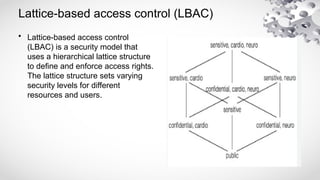
Lattice-based access control (LBAC)
• Lattice-based access control
(LBAC) is a security model that
uses a hierarchical lattice structure
to define and enforce access rights.
The lattice structure sets varying
security levels for different
resources and users.
Apporaches to access controls
• Identification
• Authentication
• Authorization
• Accountability
Physical Design
Physical design is DBMS-specific whereas logical design by
contrast is DBMS-independent. Logical design is concerned
with the what; physical database design is concerned with
the how. In short, physical design is a process of
implementing a database on secondary storage with a
specific DBMS.
parts of physical design:
1.Security technologies
2.Physical security
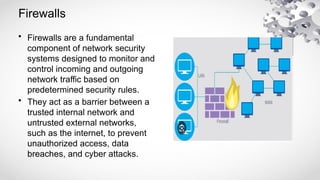
Firewalls
• Firewalls are a fundamental
component of network security
systems designed to monitor and
control incoming and outgoing
network traffic based on
predetermined security rules.
• They act as a barrier between a
trusted internal network and
untrusted external networks,
such as the internet, to prevent
unauthorized access, data
breaches, and cyber attacks.
Firewall Processing Modes
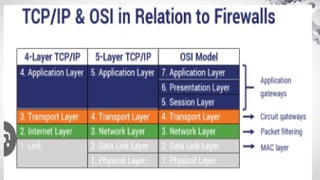
• Packet filtering firewalls
• Application gateways
• Circuit gateways
• MAC layer firewalls
• Hybrid firewalls
Packet filtering firewalls
• A packet filtering firewall is the most basic type of firewall. It acts like a
management program that monitors network traffic and filters incoming
packets based on configured security rules. These firewalls are designed to
block network traffic IP protocols, an IP address, and a port number if a data
packet does not match the established rule-set.
Circuit-level gateways
• Circuit-level gateways are another simplified type of
firewall that can be easily configured to allow or block
traffic without consuming significant computing resources.
These types of firewalls typically operate at the session-
level of the OSI model by verifying TCP (Transmission
Control Protocol) connections and sessions. Circuit-level
gateways are designed to ensure that the established
sessions are protected.
Application-level Gateways
• Proxy firewalls operate at the application layer as an
intermediate device to filter incoming traffic between two
end systems (e.g., network and traffic systems). That is
why these firewalls are called 'Application-level
Gateways'.
MAC layer firewalls
• The MAC layer firewall, or what's known as the media
access control layer firewall, operates within one of two
sublayers within the second layer of the OSI model (the
data link layer). The two sublayers — logical link control
(LLC) and MAC — fall between the network and physical
layers of the OSI model.
Hybrid firewalls
• Hybrid firewalls consist of multiple firewalls, each
providing a specified set of functions. For instance, you
can use one firewall to execute packet filtering while
another firewall acts as a proxy.
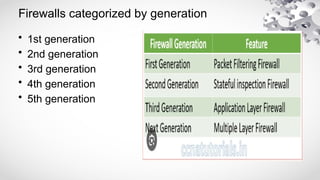
Firewalls categorized by generation
• 1st generation
• 2nd generation
• 3rd generation
• 4th generation
• 5th generation
first-generation firewalls
• The first-generation firewalls were packet filter firewalls
that examined limited parameters, such as source and
destination network addresses, protocols, and port
numbers. Firewall rules used these attributes to define
which packets were allowed through.
The Second Generation
• The Second Generation are application level or proxy
servers i.e dedicated systems that are seperated from
filtering router and that provide intermediate services for
requestors
Third generation firewalls
• These are stateful inspection firewalls,which as described
monitors network connections between internal and
external systems using state tables
Fourth generation firewalls
• Also known as dynamic packet filtering firewalls,allow
only a particular packet with a particular
source,destination,and port address to enter
Fifth generation firewalls
• These include kernel proxy that works under Windows NT
executive which is kernal of windows NT(Windows New
Technology)
Firewalls categorised by structure
• Commercial grade firewall appliances
• Commercial grade firewall systems
• Small office/Home office firewall appliances
• Residential grade firewall software
Firewalls architecture
• Packet filtering routers
• Screened host firewalls
• Dual homed host firewalls
• Screened subnet firewalls
Packet filtering routers
• A packet-filtering router either blocks or passes packets
presented to it according to a set of filtering rules.
• Filtering rules are based on various features of the
service or protocols involved, including: the packet header
information, e.g. IP source and destination addresses.
Screened host firewalls
• A screened host firewall utilizes one screening router to
create two subnets.
• A third party would need to bypass the DMZ host only to
reach the internal network hosts, making it the less
secure alternative.
Dual homed host firewalls
• A dual-homed host is an application-based firewall and
first line of defense/protection technology between a
trusted network, such as a corporate network, and an
untrusted network, such as the Internet. Dual-homed host
is a common term used to describe any gateways,
firewalls or proxies that directly provide secure
applications and services to any untrusted network.
Screened subnet firewalls
• A screened subnet, or triple-homed firewall, refers to a
network architecture where a single firewall is used with
three network interfaces. It provides additional protection
from outside cyber attacks by adding a perimeter network
to isolate or separate the internal network from the public-
facing internet.
• A DMZ or demilitarized zone is a perimeter network that
protects and adds an extra layer of security to an
organization's internal local-area network from untrusted
traffic.
Selecting the right firewall
• Selecting the right firewall depends on several factors,
including your network architecture, security
requirements, budget, and scalability needs.
• Which type?
• What features?
• How easy to setup and configure?
• Can it be adaptable?
Configuring and managing firewalls
Access Control Policies:
Define and implement access control policies based on your organization's
security requirements.
Rule Configuration:
Create firewall rules that enforce your access control policies.
Network Zones:
Segment your network into zones based on trust levels (e.g., LAN, DMZ, WAN).
Apply different access control policies and firewall rules to each zone based on
its security requirements.
Logging and Monitoring:
Enable logging for firewall events and traffic.
Updates and Patches:
Keep the firewall firmware/software up to date with the latest security patches
and updates.
Intrusion Detection/Prevention:
Configure intrusion detection/prevention systems (IDS/IPS) to detect and block
suspicious or malicious network traffic.
VPN Configuration:
Configure virtual private network (VPN) connections to secure remote access
and site-to-site communications.
User Authentication and Authorization:
Implement user authentication mechanisms, such as user accounts logins
Protecting remote connections
• Use strong passwords. ...
• Update your software. ...
• Limit access using firewalls. ...
• Enable Network Level Verification. ...
• Limit users who can log in using remote desktop. ...
• Use two-factor authentication on highly sensitive systems.
VPN
• A virtual private network, or VPN, is an encrypted
connection over the Internet from a device to a network.
• The encrypted connection helps ensure that sensitive
data is safely transmitted.
• It prevents unauthorized people from eavesdropping on
the traffic and allows the user to conduct work remotely.
Transparent mode
• In transparent mode, the VPN operates without modifying the network traffic's
IP addresses or headers. It is also known as "bridge mode" or "NAT traversal
mode."
• The VPN gateway acts as an intermediary between two networks,
transparently encrypting and decrypting data as it passes through.
• Transparent mode is often used in scenarios where the VPN should integrate
seamlessly with existing network infrastructure without requiring changes to
IP addressing or routing configurations.
• It is commonly used in site-to-site VPN deployments where the VPN gateway
is placed at the network perimeter and encrypts traffic between two private
networks.
Tunnel mode
• In tunnel mode, the VPN encapsulates the entire IP packet within another
packet, adding an additional header that contains routing information and
encryption details.
• The original IP packet becomes the payload of the encapsulating packet,
making it invisible to intermediate network devices.
• Tunnel mode is typically used for remote access VPNs, where individual
users or devices establish secure connections to a central VPN gateway over
untrusted networks such as the internet.
• It provides end-to-end encryption and privacy for the entire communication
session between the client and the VPN gateway.
UNIT-IV
Security technology:Intrusion Detection,Access Control &
Other Security Tools
Intrusion Detection and Prevention Systems
• An intrusion detection and prevention system is defined
as a system that monitors a network and scans it for
possible threats to alert the administrator and prevent
potential attacks
Terminologies:
1.Alert(audible signals,email messages)
2.Evasion(changing format by an attacker)
3.False negative
4.False attack stimulus
5.False positive
6.Noise
7.Site policy
8.Site policy awareness
9.True attack stimulus
10.Tuning
11.Confidence value
12.Alarm filtering
13.Alarm clustering and compaction
Types of Intrusion Detection Systems
1.Network intrusion detection system(NIDS)
2.Host based intrusion detection system(HIDS)
3.Perimeter intrusion detection system(PIDS)
IDPS detection methods
1.Signature based detection
2.Statistical anamoly based detection
3.Stateful protocol analysis detection
IDPS Response behaviour
1.IDPS response options
2.Reporting and archiving capabilities
3.Failsafe considerations for IDPS response
Selecting IDPS approaches and products
1.Technical and policy considerations
2.Organisational requirements and constraints
3.IDPSs product features and quality
Strengths of IDPS
• Monitoring and analysis of system
• Testing security states
• Baselining security state
• Recognizing patterns of system events
• Recognizing patterns of activity
• Managing OS audit & logging mechanisms
• Alerting appropriate staff
• Providing default info
Limitations of IDPS
• Compensating for weak or missing security mechanisms
such as firewalls
• Instantaneously detecting,reporting and responding to an
attack
• Detecting newly published attacks
• Automatically investigating attacks
• Compensating for problems
• Dealing effectively with switched networks
Deployment and implementation of an IDPS
• IDPS Control strategies
• IDPS Deployment
Measuring the effectiveness of IDPS
Four measures of comparative effectiveness:
• Thresholds
• Backlists and whitelists
• Alert settings
• Code viewing and editing
Scanning and analysis tools
Types of scanning and analysis tools:
1.Port scanners
2.Firewall analysis tools
3.Operating system detection tools
4.Vulnerability scanners
5.Packet sniffers
6.Wireless security tools
Biometric Access controls devices
• Biometric access control is based on the use of some
measurable human characteristic or trait to authenticate
identity of a proposed systems user
• Fingerprint
• Palm print
• Hand geometry
• Facial recognition
• Retinal print
• Iris pattern
Signature and Voice recognition technologies
• A biometric approach for electronic document signing,
which is the functional equivalent of a traditional
handwritten signature is signature recognition .
• Voice recognition uses a combination of voice recognition
and verification technology, public key encryption, and
symmetric key encryption.
Effectiveness of Biometrics
• False reject rate
Probability that the system fails to detect a match between the input fingerprint
template and a matching template in the database. It measures the percent of
valid inputs which are incorrectly rejected.
• False accept rate
False Accept Rate (FAR) is a statistical measure used to determine the
probability of a biometric security system allowing unauthorized user access.
• Crossover error rate
The crossover error rate describes the point where the false reject rate (FRR)
and false accept rate (FAR) are equal. CER is also known as the equal error
rate (EER). The crossover error rate describes the overall accuracy of a
biometric system.
Cryptography
• Cryptography is the process of hiding or coding
information so that only the person a message was
intended for can read it.
• Encryption (Encipher)-plain text to cipher text
• Decryption(Decipher)-cipher text to plain text
• Algorithm-programatic steps used to convert an
unencrypted message into encrypted sequence of bits
• Cipher text- encoded text
• Key- a series of bits used with algorithm

Introduction to Information security ppt

  • 1.
    Information security: • Itprotects sensitive information from unauthorised activities Security: • The quality of being secure to be free from danger Multiple layers of security: 1.Physical security(objects) 2.Personnel security (individual or group) 3.Operations security(series of activities) 4.communication security(media or content) 5.Network security(network &components) 6.Information security(data)
  • 2.
    CIA triangle: • Confidentiality-authorised usersonly has the access to the data • Integrity- providing data accuracy and consistency • Availability-data access is available to authorised users whenever needed
  • 3.
    History of InformationSecurity: • 1960s Offline sites security • 1970s Evolution of PC’s and hackers • 1980s Evolution of cybercrime • 1990s Hacking becoming an organised crime • 2000s cybercrime becoming a serious issue • 2010s Information security
  • 4.
    Critical characteristics ofInfo. • Availability • Accuracy • Authenticity • Confidentiality • Integrity • Utility • Possession
  • 5.
    NSTISSC Security model •National security telecommunications and info.systems security committee • CNSS (Committee on National Security Systems is a three- dimensional security model which has now become a standard security model for many of the currently operating information systems. The CNSS model has three key goals of security: Confidentiality, Integrity, and Availability.
  • 6.
    Components of anIS-Securing the components • Software-Apps,OS • Hardware-Physical security • Data-database mgmt • People • Networks-LAN,open-wifi
  • 7.
    Balancing Information securityand access • Data can be made available to anyone,anywhere,anytime • Such unrestricted access posses danger to security. • An imbalance can occur when needs and users increase on large scale which makes focussing on protection harder. • Encryption can balance such activities
  • 8.
    Need for security BusinessNeeds: 1.Protecting functionality of an organisation 2.Enabling safe operations of applications 3.Protecting data that organizations collect and use 4.Safeguarding technology assets in organisations
  • 9.
    Systems development lifecycle • Investigation • Analysis • Logical design • Physical design • Implementation • Maintenance and change
  • 10.
    The security SDLC 1.Investigation/analysisphases • Security categorisation • Preliminary risk assessment
  • 11.
    2.Logical/Physical design phases •Risk assessment • Security functional requirements analysis • Security assurance requirements analysis • Cost considerations and reporting • Security planning • Security control development • Developmental security test and evaluation • Other planning components
  • 12.
    3.Implementation phase • Inspectionand acceptance • Security certification • Security accreditation
  • 13.
    4.Maintenace and changephase • Configuration management and control • Continuous monitoring • Information preservation • Media sanitization • Hardware and software disposal
  • 14.
    Need for security •Information security defines protecting information and information systems from unauthorized access, use, acknowledgment, disruption, alteration or destruction. Governments, military, financial institutions, hospitals, and private businesses amass a big deal of confidential data about their employees, users, products, research and monetary status.
  • 15.
    Business Needs It performsfour important functions for an organisation 1. Protecting functionality of an organisation 2. Enabling safe operation of applications 3. Protecting data that Organisations collect and use 4. Safeguarding technology assets in Organisations
  • 16.
    Threats: 1.Compromises to intellectualproperty 2.Deviations in Quality of services • Power irregularities • Communication & other service providers • Internet service issues 3.Deliberate of software attacks 4.Espionage 5.Forces of Nature 6.Human errors 7.Information Extortion(insider) 8.Hardware failures and errors 9.Software failures and errors
  • 17.
    Attacks: • Malicious code •Hoaxes • Back doors • Password crack • Brute Force(try every possible password) • Dictionary • DDOS • Spoofing • Man in the middle • Spam • Mail bombing
  • 18.
  • 19.
    Laws and Ethicsin IS Law and ethics play crucial roles in information security, ensuring that individuals and organizations adhere to standards that protect data and privacy. We need to follow: 1. Legal Frameworks 2. Intellectual Property Laws 3. Cybersecurity Laws 4. Ethical Considerations 5. Professional Codes of Conduct
  • 20.
    Law Vs Policy •Laws are rules and regulations established by a governing authority, such as a legislature or regulatory agency. They are enforceable and binding, with legal consequences for non-compliance. • Laws are enforceable through the legal system. Violating laws can lead to penalties, such as fines, imprisonment, or civil lawsuits. • Policies are guidelines or principles adopted by organizations, institutions, or government agencies to achieve specific goals. While policies may be influenced by laws, they are not inherently enforceable in the same way. • Policies are typically not enforceable in the same manner as laws. Instead, compliance with policies is usually a condition of employment, membership, or participation in an organization or program. Violating policies may result in disciplinary action or consequences within the organization, but not necessarily legal penalties.
  • 21.
    Policy: • Dissemination(distribution)-hard orsoft copy • Review(reading) • comprehension(understanding) • compilance(agreement) • Uniform enforcement
  • 22.
    Types of Law: •Civil law-governs nation or state • Criminal Law-harmful to society • Private law-family law,commercial law,labor law • Public law-criminal,administrative and constitutional laws
  • 23.
    U.S laws thatapply to information security • General computer crime laws(CFA & NIIP) • Privacy • Export and Espionage laws • U.S copyright law • Financial reporting • Freedom of Information Act of 1966
  • 24.
    International laws andlegal bodies: • Council of Europe Convention on Cybercrime • Agreement on Trade related aspects of Intellectual property rights • Digital Millennium Copyright Act(DMCA)
  • 25.
    Ethics and Informationsecurity • Ethical differences across cultures 1.Software license infringement 2.Illicit use 3.Misuse of corporate resources • Ethics and education
  • 26.
    Causes of unethicaland illegal behavior 1.Ignorance 2.Accident 3.Intent How to overcome 1.Fear of penalty 2.Probability of being caught 3.Probability of penalty being administered
  • 27.
    Risk management • Informationsecurity risk management, or ISRM, is the process of managing risks associated with the use of information technology. It involves identifying, assessing, and treating risks to the confidentiality, integrity, and availability of an organization's assets. • Types of risks 1.Project risks(budget,schedule,personnel) 2.Technical risks(implementation,interfacing,testing,maintenance 3.Business risks(budget,building resources that no one requires)
  • 28.
    Overview of Riskmanagement
  • 29.
    Risk identification • Planand organise the process • Asset Identification and inventory • Classifying and prioritizing information assets • Information asset valuation • Identifying and prioritizing threats • Vulnerability identification
  • 30.
    Risk assessment 1.Likelihood 2.Risk determination 3.Identifypossible controls 4.Documenting the results of risk assessment
  • 31.
    Risk control strategies •Defend • Transfer • Mitigate 1. Incident Response Plan 2. Disaster Recovery Plan 3. Business Continuity Plan • Accept • Terminate
  • 32.
    Selecting a RiskControl Strategy • Rules for selecting a Risk Control Strategy 1.Vulnerability exists 2.Vulnerability exploited 3.Potential gain 4.Potential loss
  • 33.
    Cost Benefit Analysis(CBA) •Organsiations must consider the economic feasibility of implementing information security controls and safeguards. • Some of the items that effect cost of a control are: 1.Cost of development or acquisition (purchase cost) 2.Training fees 3.Cost of implementation 4.Service costs 5.Cost of maintenance
  • 34.
    Cost Benefit AnalysisFormula: CBA=ALE(prior)-ALE(post)-ACS ALE-Annual Loss Expectancy ACS-Annual Cost of the Safeguard
  • 35.
    Risk Control Cycle •It involves identifying, assessing, and treating risks to the confidentiality, integrity, and availability of an organization's assets. • The end goal of this process is to treat risks in accordance with an organization's overall risk tolerance. • There is no exit from this cycle,it is a process that continues for as long as the organisation continues to function.
  • 36.
  • 37.
    Quantities versus QualitativeRisk control Practices • Qualitative risk analysis is quick but subjective. • On the other hand, quantitative risk analysis is objective and has more detail, contingency(possible events) reserves and go/no go decisions, but it takes more time and is more complex. • Quantitative data are difficult to collect and can be prohibitively expensive
  • 38.
    Q Vs Qrisk control practices 1.Benchmarking and best practices 2.Other feasibility studies
  • 39.
    1.Benchmarking and bestpractices • Benchmarking is the process of seeking out and studying practices used in other organisations that produce results you would like to duplicate in your organisation. • Metrics based measures: 1.Number of successful attacks 2.Staff-hours spent on system protection 3.Dollars spent on protection 4.Numbers of security personnel 5.Estimated value in dollars of info.lost in successful attacks 6.Loss in productivity hours associated with successful attacks
  • 40.
    Problems with applicationof benchmarking and best practices: • The two organisations do not talk to each other • No two organisations are identical • Best practices are moving target • Only research will not help a practitioner for what to do next
  • 41.
    2.Other Feasibility studies 1.Organisational Feasibility 2. Operational feasibility 3. Technical feasibility 4. Political feasibility
  • 42.
    Risk management discussionpoints 1.Risk appetite: Risk appetite refers to the level of risk that an organization is willing to accept or tolerate in pursuit of its objectives. It reflects the organization's willingness to take on risk in order to achieve its goals, and it influences decision-making processes throughout the organization. 2.Residual risk: Residual risk refers to the risk level after implementing control processes to mitigate the inherent risk. The level of residual risk depends on the effectiveness of the implemented controls. Consider the examples from before. The risk of choking on your breakfast is lessened by chewing well. 3.Documenting results Documenting results in risk assessment is crucial for ensuring clarity, accountability, and effective decision-making within an organization.
  • 43.
  • 44.
    Recommended risk controlpractices • By making ALE calculations • By using control strategies • By continuous monitoring • By providing integrity and specific controls • By port scanning to avvoid extrenal threats or attacks • By using firewalls • By protecting the assets and vulnerabilities
  • 45.
  • 46.
    Planning for security •Planning for information security involves a structured approach to protecting sensitive data and systems from unauthorized access, use, disclosure, disruption, modification, or destruction. • An organisations security efforts succeeds only it it operates in conjunction with organisation’s information security policy • Security program begins with policy,standards and practices which are foundation for information security architecture and blueprint
  • 47.
  • 48.
    Information security policy,standardsand practices • Information security policy, standards, and practices are key components of an organization's overall approach to protecting its sensitive data and systems. • These three components work together to create a comprehensive information security framework within an organization. • The policy sets the overall direction and priorities, the standards provide detailed requirements for implementation, and the practices ensure that security measures are effectively executed and maintained over time. • By integrating policy, standards, and practices, organizations can establish a strong security posture to safeguard their critical assets from potential threats and vulnerabilities.
  • 49.
  • 50.
    Criteria for effectivesecurity policy: • Dissemination(distribution) • Review(reading) • Comprehension(understanding) • Compilance(agreement) • Uniform enforcement
  • 51.
    Types of securitypolicy • Enterprise information security policies • Issue specific security policies • Systems-specific security policies
  • 52.
    Policy mangement • Policymanagement refers to the systematic process of developing, implementing, communicating, enforcing, and maintaining policies within an organization. • Effective policy management is essential for ensuring compliance with regulations, mitigating risks, and promoting consistency in decision-making and behavior across the organization.
  • 53.
    Security Blueprint • Asecurity blueprint is a comprehensive plan or framework that outlines an organization's approach to information security. • It serves as a roadmap for designing, implementing, and managing security measures to protect the organization's sensitive data, systems, and assets from various threats and vulnerabilities. • By developing and implementing a comprehensive security blueprint, organizations can better protect their information assets, mitigate risks, and maintain the trust and confidence of customers, partners, and stakeholders.
  • 54.
    ISO 27000 series •The ISO 27000 series is a set of international standards that provide guidelines and best practices for information security management systems (ISMS). • These standards are developed and published by the International Organization for Standardization (ISO) and the International Electrotechnical Commission (IEC). • The ISO 27000 series is designed to help organizations establish, implement, maintain, and continually improve their information security management systems to protect their sensitive information and assets.
  • 55.
    NIST security models •The National Institute of Standards and Technology (NIST) is a U.S. federal agency that develops and promotes measurement standards. • In the realm of cybersecurity, NIST has created several security models and frameworks to help organizations manage and improve their security posture.
  • 56.
    • NIST SpecialPublication 800-14, titled "Generally Accepted Principles and Practices for Securing Information Technology Systems," provides guidance on fundamental security principles and practices for securing information technology (IT) systems. Although it is an older publication, first released in 1996, many of its principles remain relevant today • NIST Special Publication 800-18, titled "Guide for Developing Security Plans for Federal Information Systems," provides guidance for federal agencies and organizations in developing security plans to protect their information systems
  • 57.
    IETF security architecture •The Internet Engineering Task Force (IETF) Security Architecture encompasses various protocols, standards, and practices designed to ensure the security and integrity of internet communications and infrastructure • RFC(Requests for comment) • RFC 2196 is titled "Site Security Handbook." It's a document published by the Internet Engineering Task Force (IETF) in September 1997. The RFC is aimed at administrators and managers responsible for the security of computer systems and networks within organizations.
  • 58.
    Baselining and bestbusiness practices • Baselining refers to the process of establishing a standard or baseline against which future measurements or comparisons can be made. This concept is particularly relevant in the context of cybersecurity and business practices • Before implementing best business practices, it's crucial to establish baselines to understand the current state of affairs. This could involve assessing factors such as current security measures, employee productivity, financial performance, customer satisfaction levels, and more. • Federal agencies adhere to regulatory frameworks and standards mandated by government bodies. These regulations often include requirements for data protection, privacy, cybersecurity, and compliance with industry standards such as NIST (National Institute of Standards and Technology) guidelines in the United States.
  • 59.
    Design of Securityarchitecture • Designing a security architecture involves creating a structured framework of security controls, policies, procedures, and technologies to protect an organization's assets and information from unauthorized access, data breaches, and other security threats.
  • 60.
    SETA Program • SecurityEducation,Training and Awareness program • Security Education Training and Awareness (SETA) is a vital component of any organization's security strategy. SETA aims to empower employees with the knowledge and skills necessary to identify and mitigate security risks. The primary objective of SETA is to create a security- conscious culture within an organization
  • 62.
    Continuity strategies • Continuitystrategies, often referred to as business continuity strategies, are plans and procedures developed to ensure that an organization can continue operating and delivering its products or services in the event of disruptive incidents or disasters. These strategies are crucial for maintaining business resilience and minimizing the impact of disruptions on operations. • IR plan,DR plan,BC plan already discussed
  • 63.
    Major steps incontingency palnning • Contingency refers to a plan, strategy, or course of action put in place to address potential unforeseen events or circumstances that may disrupt normal operations or threaten the achievement of objectives. Contingency planning involves identifying risks, developing responses, and establishing protocols to mitigate the impact of unexpected events. 1.Business Impact Analysis 2.Incident Response Planning 3.DR Planning 4.Business continuity planning
  • 64.
    .Business Impact Analysis •Business Impact Analysis (BIA) is a systematic process used to assess the potential impact of disruptions on an organization's critical business functions, processes, and resources. The primary purpose of conducting a BIA is to identify and prioritize business activities and resources that are essential for the organization's continued operation and to develop strategies for minimizing the impact of disruptions. • Threat attack identification and prioritization • Business unit analysis • Attack success scenario development • Potential damage assessment • Sub ordinate plan classification
  • 65.
    Incident response planning •Incident response planning involves establishing procedures and protocols to effectively detect, respond to, contain, and recover from security incidents or breaches within an organization. The goal is to minimize the impact of incidents on business operations, mitigate risks, and maintain the confidentiality, integrity, and availability of critical systems and data • Incident planning • Incident detection • Incident reaction • Incident recovery
  • 66.
    Disaster Recovery Planning •A disaster recovery plan (DRP) in information security is a structured approach to responding to and recovering from events that could potentially disrupt or damage an organization's IT infrastructure, systems, or data. It's a crucial component of an organization's overall business continuity strategy, focused specifically on mitigating the impact of IT-related disasters. • Plan for disaster recovery • crisis management • Recovery operations
  • 67.
    Business continuity planning Businesscontinuity planning (BCP) is a proactive approach taken by organizations to ensure that essential business functions can continue during and after a disaster or disruptive event. Unlike disaster recovery planning, which focuses primarily on IT systems and data, business continuity planning encompasses a broader scope, including people, processes, facilities, and external dependencies. The goal is to minimize the impact of disruptions on the organization's operations, reputation, and ability to deliver products or services to customers. • Establish continuity strategies • Plan for continuity of operations • Continuity management
  • 68.
    Security technology Access control: •Acess control is the method by which systems determine whether and how to admit a user into a trusted area of organistions such as restricted areas ..etc • It can be achieved by means of a combination of policies,programs,technologies • It can be mandatory,disretionary,non-discretionary
  • 69.
    Mandatory access control: •In computer security, mandatory access control refers to a type of access control by which the operating system or database constrains the ability of a subject or initiator to access or generally perform some sort of operation on an object or target
  • 70.
    Lattice-based access control(LBAC) • Lattice-based access control (LBAC) is a security model that uses a hierarchical lattice structure to define and enforce access rights. The lattice structure sets varying security levels for different resources and users.
  • 71.
    Apporaches to accesscontrols • Identification • Authentication • Authorization • Accountability
  • 72.
    Physical Design Physical designis DBMS-specific whereas logical design by contrast is DBMS-independent. Logical design is concerned with the what; physical database design is concerned with the how. In short, physical design is a process of implementing a database on secondary storage with a specific DBMS. parts of physical design: 1.Security technologies 2.Physical security
  • 73.
    Firewalls • Firewalls area fundamental component of network security systems designed to monitor and control incoming and outgoing network traffic based on predetermined security rules. • They act as a barrier between a trusted internal network and untrusted external networks, such as the internet, to prevent unauthorized access, data breaches, and cyber attacks.
  • 74.
    Firewall Processing Modes •Packet filtering firewalls • Application gateways • Circuit gateways • MAC layer firewalls • Hybrid firewalls
  • 75.
    Packet filtering firewalls •A packet filtering firewall is the most basic type of firewall. It acts like a management program that monitors network traffic and filters incoming packets based on configured security rules. These firewalls are designed to block network traffic IP protocols, an IP address, and a port number if a data packet does not match the established rule-set.
  • 76.
    Circuit-level gateways • Circuit-levelgateways are another simplified type of firewall that can be easily configured to allow or block traffic without consuming significant computing resources. These types of firewalls typically operate at the session- level of the OSI model by verifying TCP (Transmission Control Protocol) connections and sessions. Circuit-level gateways are designed to ensure that the established sessions are protected.
  • 77.
    Application-level Gateways • Proxyfirewalls operate at the application layer as an intermediate device to filter incoming traffic between two end systems (e.g., network and traffic systems). That is why these firewalls are called 'Application-level Gateways'.
  • 78.
    MAC layer firewalls •The MAC layer firewall, or what's known as the media access control layer firewall, operates within one of two sublayers within the second layer of the OSI model (the data link layer). The two sublayers — logical link control (LLC) and MAC — fall between the network and physical layers of the OSI model.
  • 80.
    Hybrid firewalls • Hybridfirewalls consist of multiple firewalls, each providing a specified set of functions. For instance, you can use one firewall to execute packet filtering while another firewall acts as a proxy.
  • 81.
    Firewalls categorized bygeneration • 1st generation • 2nd generation • 3rd generation • 4th generation • 5th generation
  • 82.
    first-generation firewalls • Thefirst-generation firewalls were packet filter firewalls that examined limited parameters, such as source and destination network addresses, protocols, and port numbers. Firewall rules used these attributes to define which packets were allowed through.
  • 83.
    The Second Generation •The Second Generation are application level or proxy servers i.e dedicated systems that are seperated from filtering router and that provide intermediate services for requestors
  • 84.
    Third generation firewalls •These are stateful inspection firewalls,which as described monitors network connections between internal and external systems using state tables
  • 85.
    Fourth generation firewalls •Also known as dynamic packet filtering firewalls,allow only a particular packet with a particular source,destination,and port address to enter Fifth generation firewalls • These include kernel proxy that works under Windows NT executive which is kernal of windows NT(Windows New Technology)
  • 86.
    Firewalls categorised bystructure • Commercial grade firewall appliances • Commercial grade firewall systems • Small office/Home office firewall appliances • Residential grade firewall software
  • 87.
    Firewalls architecture • Packetfiltering routers • Screened host firewalls • Dual homed host firewalls • Screened subnet firewalls
  • 88.
    Packet filtering routers •A packet-filtering router either blocks or passes packets presented to it according to a set of filtering rules. • Filtering rules are based on various features of the service or protocols involved, including: the packet header information, e.g. IP source and destination addresses.
  • 89.
    Screened host firewalls •A screened host firewall utilizes one screening router to create two subnets. • A third party would need to bypass the DMZ host only to reach the internal network hosts, making it the less secure alternative.
  • 90.
    Dual homed hostfirewalls • A dual-homed host is an application-based firewall and first line of defense/protection technology between a trusted network, such as a corporate network, and an untrusted network, such as the Internet. Dual-homed host is a common term used to describe any gateways, firewalls or proxies that directly provide secure applications and services to any untrusted network.
  • 91.
    Screened subnet firewalls •A screened subnet, or triple-homed firewall, refers to a network architecture where a single firewall is used with three network interfaces. It provides additional protection from outside cyber attacks by adding a perimeter network to isolate or separate the internal network from the public- facing internet. • A DMZ or demilitarized zone is a perimeter network that protects and adds an extra layer of security to an organization's internal local-area network from untrusted traffic.
  • 92.
    Selecting the rightfirewall • Selecting the right firewall depends on several factors, including your network architecture, security requirements, budget, and scalability needs. • Which type? • What features? • How easy to setup and configure? • Can it be adaptable?
  • 93.
    Configuring and managingfirewalls Access Control Policies: Define and implement access control policies based on your organization's security requirements. Rule Configuration: Create firewall rules that enforce your access control policies. Network Zones: Segment your network into zones based on trust levels (e.g., LAN, DMZ, WAN). Apply different access control policies and firewall rules to each zone based on its security requirements.
  • 94.
    Logging and Monitoring: Enablelogging for firewall events and traffic. Updates and Patches: Keep the firewall firmware/software up to date with the latest security patches and updates. Intrusion Detection/Prevention: Configure intrusion detection/prevention systems (IDS/IPS) to detect and block suspicious or malicious network traffic.
  • 95.
    VPN Configuration: Configure virtualprivate network (VPN) connections to secure remote access and site-to-site communications. User Authentication and Authorization: Implement user authentication mechanisms, such as user accounts logins
  • 96.
    Protecting remote connections •Use strong passwords. ... • Update your software. ... • Limit access using firewalls. ... • Enable Network Level Verification. ... • Limit users who can log in using remote desktop. ... • Use two-factor authentication on highly sensitive systems.
  • 97.
    VPN • A virtualprivate network, or VPN, is an encrypted connection over the Internet from a device to a network. • The encrypted connection helps ensure that sensitive data is safely transmitted. • It prevents unauthorized people from eavesdropping on the traffic and allows the user to conduct work remotely.
  • 98.
    Transparent mode • Intransparent mode, the VPN operates without modifying the network traffic's IP addresses or headers. It is also known as "bridge mode" or "NAT traversal mode." • The VPN gateway acts as an intermediary between two networks, transparently encrypting and decrypting data as it passes through. • Transparent mode is often used in scenarios where the VPN should integrate seamlessly with existing network infrastructure without requiring changes to IP addressing or routing configurations. • It is commonly used in site-to-site VPN deployments where the VPN gateway is placed at the network perimeter and encrypts traffic between two private networks.
  • 99.
    Tunnel mode • Intunnel mode, the VPN encapsulates the entire IP packet within another packet, adding an additional header that contains routing information and encryption details. • The original IP packet becomes the payload of the encapsulating packet, making it invisible to intermediate network devices. • Tunnel mode is typically used for remote access VPNs, where individual users or devices establish secure connections to a central VPN gateway over untrusted networks such as the internet. • It provides end-to-end encryption and privacy for the entire communication session between the client and the VPN gateway.
  • 100.
  • 101.
    Intrusion Detection andPrevention Systems • An intrusion detection and prevention system is defined as a system that monitors a network and scans it for possible threats to alert the administrator and prevent potential attacks Terminologies: 1.Alert(audible signals,email messages) 2.Evasion(changing format by an attacker) 3.False negative 4.False attack stimulus
  • 102.
    5.False positive 6.Noise 7.Site policy 8.Sitepolicy awareness 9.True attack stimulus 10.Tuning 11.Confidence value 12.Alarm filtering 13.Alarm clustering and compaction
  • 103.
    Types of IntrusionDetection Systems 1.Network intrusion detection system(NIDS) 2.Host based intrusion detection system(HIDS) 3.Perimeter intrusion detection system(PIDS)
  • 104.
    IDPS detection methods 1.Signaturebased detection 2.Statistical anamoly based detection 3.Stateful protocol analysis detection
  • 105.
    IDPS Response behaviour 1.IDPSresponse options 2.Reporting and archiving capabilities 3.Failsafe considerations for IDPS response
  • 106.
    Selecting IDPS approachesand products 1.Technical and policy considerations 2.Organisational requirements and constraints 3.IDPSs product features and quality
  • 107.
    Strengths of IDPS •Monitoring and analysis of system • Testing security states • Baselining security state • Recognizing patterns of system events • Recognizing patterns of activity • Managing OS audit & logging mechanisms • Alerting appropriate staff • Providing default info
  • 108.
    Limitations of IDPS •Compensating for weak or missing security mechanisms such as firewalls • Instantaneously detecting,reporting and responding to an attack • Detecting newly published attacks • Automatically investigating attacks • Compensating for problems • Dealing effectively with switched networks
  • 109.
    Deployment and implementationof an IDPS • IDPS Control strategies • IDPS Deployment
  • 110.
    Measuring the effectivenessof IDPS Four measures of comparative effectiveness: • Thresholds • Backlists and whitelists • Alert settings • Code viewing and editing
  • 111.
    Scanning and analysistools Types of scanning and analysis tools: 1.Port scanners 2.Firewall analysis tools 3.Operating system detection tools 4.Vulnerability scanners 5.Packet sniffers 6.Wireless security tools
  • 112.
    Biometric Access controlsdevices • Biometric access control is based on the use of some measurable human characteristic or trait to authenticate identity of a proposed systems user • Fingerprint • Palm print • Hand geometry • Facial recognition • Retinal print • Iris pattern
  • 113.
    Signature and Voicerecognition technologies • A biometric approach for electronic document signing, which is the functional equivalent of a traditional handwritten signature is signature recognition . • Voice recognition uses a combination of voice recognition and verification technology, public key encryption, and symmetric key encryption.
  • 114.
    Effectiveness of Biometrics •False reject rate Probability that the system fails to detect a match between the input fingerprint template and a matching template in the database. It measures the percent of valid inputs which are incorrectly rejected. • False accept rate False Accept Rate (FAR) is a statistical measure used to determine the probability of a biometric security system allowing unauthorized user access. • Crossover error rate The crossover error rate describes the point where the false reject rate (FRR) and false accept rate (FAR) are equal. CER is also known as the equal error rate (EER). The crossover error rate describes the overall accuracy of a biometric system.
  • 115.
    Cryptography • Cryptography isthe process of hiding or coding information so that only the person a message was intended for can read it. • Encryption (Encipher)-plain text to cipher text • Decryption(Decipher)-cipher text to plain text • Algorithm-programatic steps used to convert an unencrypted message into encrypted sequence of bits • Cipher text- encoded text • Key- a series of bits used with algorithm