| Charlotte Chapter
Cybersecurity Risk Management 101
Srinivasan (Mali) Vanamali, CISSP
Principal - Olympus Infotech
November 13, 2019
| Charlotte Chapter
➢ 20+ years practicing information system security
➢ CISSP (Since 2001)
➢ Technical and Management Roles - Developer, Systems Security Engineer,
Security Architect, Solution Manager
➢ SME - Identity and Access Management, RBAC
➢ SME - Cybersecurity Risk Assessment (NIST, HIPAA, PCI, ISO 27005)
➢ Trusted Adviser, Virtual CISO
➢ Published Author
✓ Identity Management Framework: Delivering Value for Business (ISACA Journal - 2004)
✓ Role Engineering: Cornerstone of RBAC (ISACA Journal - 2008)
Short Bio
| Charlotte Chapter
| Charlotte Chapter
What is Cybersecurity?
Cybersecurity
noun cy·ber·se·cu·ri·ty -si-ˌkyu̇ r-ə-tē
measures taken to protect a computer or computer system (as on the Internet)
against unauthorized access or attack
merriam-webster.com
| Charlotte Chapter
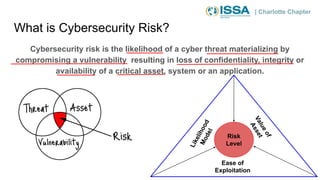
What is Cybersecurity Risk?
Cybersecurity risk is the likelihood of a cyber threat materializing by
compromising a vulnerability resulting in loss of confidentiality, integrity or
availability of a critical asset, system or an application.
Risk
Level
Likelihood
Model
Ease of
Exploitation
Valueof
Asset
| Charlotte Chapter
Key Definitions
➢ Asset is anything that has value and therefore requires protection
✧ Asset Classification - Public, Internal, Confidential, Restricted
✧ Asset Category - Software, Hardware, IP, Data, People, Process, Intangible
➢ Threat has the potential to harm an asset
✧ Natural (e.g., floods, earthquakes, storms, tornados);
✧ Human (e.g., intentional such as identity thieves, hackers, spyware authors; unintentional such
as user error, accidental deletions); or
✧ Environmental (e.g., power surges and spikes, hazmat contamination, environmental pollution)
➢ Vulnerabilities is a weakness that can be exploited by a threat to cause harm
to an asset
| Charlotte Chapter
Key Definitions Continued
➢ Impact is a negative quantitative and/or qualitative assessment of a
vulnerability compromising the confidentiality, integrity, and availability of an
asset
➢ Likelihood is the probability of occurrence in terms of frequency that a threat
exploiting a known or unknown vulnerability.
➢ Controls are existing process, policy, systems, applications, practice or other
action that mitigate risks or enhance security of an asset.
| Charlotte Chapter
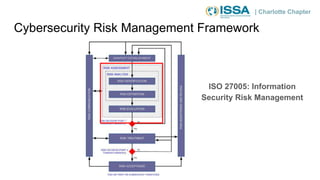
Cybersecurity Risk Management Framework
ISO 27005: Information
Security Risk Management
| Charlotte Chapter
Risk Assessment
➢ Risk Identification
✧ Asset Register
✧ Identification of Threat
✧ Identification of Vulnerabilities
✧ Identification of Controls
Risk Assessment is a well defined process to determine value of critical assets, applicable
threats, vulnerabilities that exists or could exist, identifies controls and their effectiveness on
identified risks and help prioritize a risk treatment plan to mitigate residual risks.
| Charlotte Chapter
Risk Assessment ...Contd.
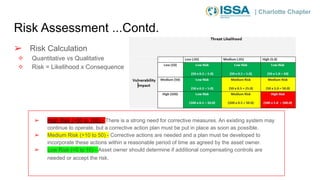
➢ Risk Calculation
✧ Quantitative vs Qualitative
✧ Risk = Likelihood x Consequence
➢ High Risk (>50 to 100) - There is a strong need for corrective measures. An existing system may
continue to operate, but a corrective action plan must be put in place as soon as possible.
➢ Medium Risk (>10 to 50) - Corrective actions are needed and a plan must be developed to
incorporate these actions within a reasonable period of time as agreed by the asset owner.
➢ Low Risk (>0 to 10) - Asset owner should determine if additional compensating controls are
needed or accept the risk.
| Charlotte Chapter
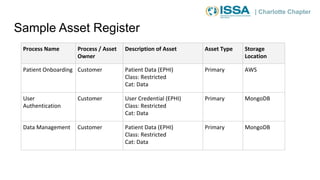
Sample Asset Register
Process Name Process / Asset
Owner
Description of Asset Asset Type Storage
Location
Patient Onboarding Customer Patient Data (EPHI)
Class: Restricted
Cat: Data
Primary AWS
User
Authentication
Customer User Credential (EPHI)
Class: Restricted
Cat: Data
Primary MongoDB
Data Management Customer Patient Data (EPHI)
Class: Restricted
Cat: Data
Primary MongoDB
| Charlotte Chapter
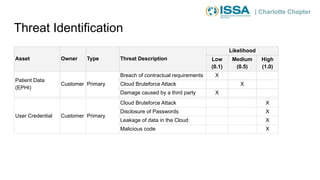
Threat Identification
Asset Owner Type Threat Description
Likelihood
Low
(0.1)
Medium
(0.5)
High
(1.0)
Patient Data
(EPHI)
Customer Primary
Breach of contractual requirements X
Cloud Bruteforce Attack X
Damage caused by a third party X
User Credential Customer Primary
Cloud Bruteforce Attack X
Disclosure of Passwords X
Leakage of data in the Cloud X
Malicious code X
| Charlotte Chapter
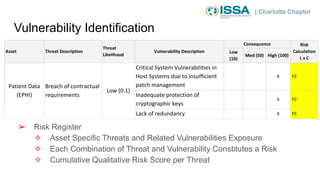
Vulnerability Identification
Asset Threat Description
Threat
Likelihood
Vulnerability Description
Consequence Risk
Calculation
L x C
Low
(10)
Med (50) High (100)
Patient Data
(EPHI)
Breach of contractual
requirements
Low (0.1)
Critical System Vulnerabilities in
Host Systems due to insufficient
patch management
X 10
Inadequate protection of
cryptographic keys
X 10
Lack of redundancy X 10
➢ Risk Register
✧ Asset Specific Threats and Related Vulnerabilities Exposure
✧ Each Combination of Threat and Vulnerability Constitutes a Risk
✧ Cumulative Qualitative Risk Score per Threat
| Charlotte Chapter
Control Identification
Asset
Risk
Score
Control Description
Control
Factor
Residual Risk
Patient Data
(EPHI)
30
Addressing security within supplier
agreements
27 3Identification of applicable legislation
and contractual requirements
Encryption Key management
| Charlotte Chapter
Risk Evaluation Criteria
➢ Strategic Importance to Business
➢ Criticality of the Asset
➢ Compliance, Legal, Contractual Obligation
➢ Impact on Confidentiality, Integrity and Availability
➢ Impact on Brand and Reputation
| Charlotte Chapter
Risk Treatment
➢ Risk Reduction
✧ Additional Controls to Further Mitigate Risks
✧ Cost Vs Benefits Analysis
➢ Risk Acceptance
✧ May be Conditional
✧ Management buy-in
✧ Decision Criteria
➢ Risk Avoidance
✧ Unable to Accept or Mitigate Risks
✧ *PANIC MODE*
➢ Risk Transfer
✧ Share Risks
✧ Transfer to Third-Party (Insurance)
| Charlotte Chapter
Why Risk Management?
➢ Resources are limited ($$)
➢ Challenges in Prioritizing Risks
➢ Control Driven Approach is Insufficient
➢ Compliance (SEC, NY DFS Cybersecurity Regulation)
| Charlotte Chapter
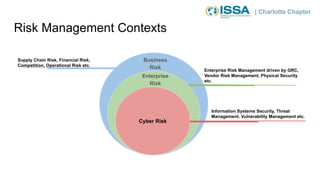
Risk Management Contexts
Business
Risk
Enterprise
Risk
Cyber Risk
Supply Chain Risk, Financial Risk,
Competition, Operational Risk etc.
Enterprise Risk Management driven by GRC,
Vendor Risk Management, Physical Security
etc.
Information Systems Security, Threat
Management. Vulnerability Management etc.
| Charlotte Chapter
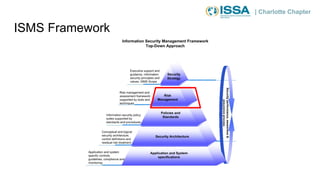
ISMS Framework
| Charlotte Chapter
Questions?
| Charlotte Chapter
mali@olympus-infotech.com
www.olympus-infotech.com

Cybersecurity risk management 101

  • 1.
    | Charlotte Chapter CybersecurityRisk Management 101 Srinivasan (Mali) Vanamali, CISSP Principal - Olympus Infotech November 13, 2019
  • 2.
    | Charlotte Chapter ➢20+ years practicing information system security ➢ CISSP (Since 2001) ➢ Technical and Management Roles - Developer, Systems Security Engineer, Security Architect, Solution Manager ➢ SME - Identity and Access Management, RBAC ➢ SME - Cybersecurity Risk Assessment (NIST, HIPAA, PCI, ISO 27005) ➢ Trusted Adviser, Virtual CISO ➢ Published Author ✓ Identity Management Framework: Delivering Value for Business (ISACA Journal - 2004) ✓ Role Engineering: Cornerstone of RBAC (ISACA Journal - 2008) Short Bio
  • 3.
  • 4.
    | Charlotte Chapter Whatis Cybersecurity? Cybersecurity noun cy·ber·se·cu·ri·ty -si-ˌkyu̇ r-ə-tē measures taken to protect a computer or computer system (as on the Internet) against unauthorized access or attack merriam-webster.com
  • 5.
    | Charlotte Chapter Whatis Cybersecurity Risk? Cybersecurity risk is the likelihood of a cyber threat materializing by compromising a vulnerability resulting in loss of confidentiality, integrity or availability of a critical asset, system or an application. Risk Level Likelihood Model Ease of Exploitation Valueof Asset
  • 6.
    | Charlotte Chapter KeyDefinitions ➢ Asset is anything that has value and therefore requires protection ✧ Asset Classification - Public, Internal, Confidential, Restricted ✧ Asset Category - Software, Hardware, IP, Data, People, Process, Intangible ➢ Threat has the potential to harm an asset ✧ Natural (e.g., floods, earthquakes, storms, tornados); ✧ Human (e.g., intentional such as identity thieves, hackers, spyware authors; unintentional such as user error, accidental deletions); or ✧ Environmental (e.g., power surges and spikes, hazmat contamination, environmental pollution) ➢ Vulnerabilities is a weakness that can be exploited by a threat to cause harm to an asset
  • 7.
    | Charlotte Chapter KeyDefinitions Continued ➢ Impact is a negative quantitative and/or qualitative assessment of a vulnerability compromising the confidentiality, integrity, and availability of an asset ➢ Likelihood is the probability of occurrence in terms of frequency that a threat exploiting a known or unknown vulnerability. ➢ Controls are existing process, policy, systems, applications, practice or other action that mitigate risks or enhance security of an asset.
  • 8.
    | Charlotte Chapter CybersecurityRisk Management Framework ISO 27005: Information Security Risk Management
  • 9.
    | Charlotte Chapter RiskAssessment ➢ Risk Identification ✧ Asset Register ✧ Identification of Threat ✧ Identification of Vulnerabilities ✧ Identification of Controls Risk Assessment is a well defined process to determine value of critical assets, applicable threats, vulnerabilities that exists or could exist, identifies controls and their effectiveness on identified risks and help prioritize a risk treatment plan to mitigate residual risks.
  • 10.
    | Charlotte Chapter RiskAssessment ...Contd. ➢ Risk Calculation ✧ Quantitative vs Qualitative ✧ Risk = Likelihood x Consequence ➢ High Risk (>50 to 100) - There is a strong need for corrective measures. An existing system may continue to operate, but a corrective action plan must be put in place as soon as possible. ➢ Medium Risk (>10 to 50) - Corrective actions are needed and a plan must be developed to incorporate these actions within a reasonable period of time as agreed by the asset owner. ➢ Low Risk (>0 to 10) - Asset owner should determine if additional compensating controls are needed or accept the risk.
  • 11.
    | Charlotte Chapter SampleAsset Register Process Name Process / Asset Owner Description of Asset Asset Type Storage Location Patient Onboarding Customer Patient Data (EPHI) Class: Restricted Cat: Data Primary AWS User Authentication Customer User Credential (EPHI) Class: Restricted Cat: Data Primary MongoDB Data Management Customer Patient Data (EPHI) Class: Restricted Cat: Data Primary MongoDB
  • 12.
    | Charlotte Chapter ThreatIdentification Asset Owner Type Threat Description Likelihood Low (0.1) Medium (0.5) High (1.0) Patient Data (EPHI) Customer Primary Breach of contractual requirements X Cloud Bruteforce Attack X Damage caused by a third party X User Credential Customer Primary Cloud Bruteforce Attack X Disclosure of Passwords X Leakage of data in the Cloud X Malicious code X
  • 13.
    | Charlotte Chapter VulnerabilityIdentification Asset Threat Description Threat Likelihood Vulnerability Description Consequence Risk Calculation L x C Low (10) Med (50) High (100) Patient Data (EPHI) Breach of contractual requirements Low (0.1) Critical System Vulnerabilities in Host Systems due to insufficient patch management X 10 Inadequate protection of cryptographic keys X 10 Lack of redundancy X 10 ➢ Risk Register ✧ Asset Specific Threats and Related Vulnerabilities Exposure ✧ Each Combination of Threat and Vulnerability Constitutes a Risk ✧ Cumulative Qualitative Risk Score per Threat
  • 14.
    | Charlotte Chapter ControlIdentification Asset Risk Score Control Description Control Factor Residual Risk Patient Data (EPHI) 30 Addressing security within supplier agreements 27 3Identification of applicable legislation and contractual requirements Encryption Key management
  • 15.
    | Charlotte Chapter RiskEvaluation Criteria ➢ Strategic Importance to Business ➢ Criticality of the Asset ➢ Compliance, Legal, Contractual Obligation ➢ Impact on Confidentiality, Integrity and Availability ➢ Impact on Brand and Reputation
  • 16.
    | Charlotte Chapter RiskTreatment ➢ Risk Reduction ✧ Additional Controls to Further Mitigate Risks ✧ Cost Vs Benefits Analysis ➢ Risk Acceptance ✧ May be Conditional ✧ Management buy-in ✧ Decision Criteria ➢ Risk Avoidance ✧ Unable to Accept or Mitigate Risks ✧ *PANIC MODE* ➢ Risk Transfer ✧ Share Risks ✧ Transfer to Third-Party (Insurance)
  • 17.
    | Charlotte Chapter WhyRisk Management? ➢ Resources are limited ($$) ➢ Challenges in Prioritizing Risks ➢ Control Driven Approach is Insufficient ➢ Compliance (SEC, NY DFS Cybersecurity Regulation)
  • 18.
    | Charlotte Chapter RiskManagement Contexts Business Risk Enterprise Risk Cyber Risk Supply Chain Risk, Financial Risk, Competition, Operational Risk etc. Enterprise Risk Management driven by GRC, Vendor Risk Management, Physical Security etc. Information Systems Security, Threat Management. Vulnerability Management etc.
  • 19.
  • 20.
  • 21.