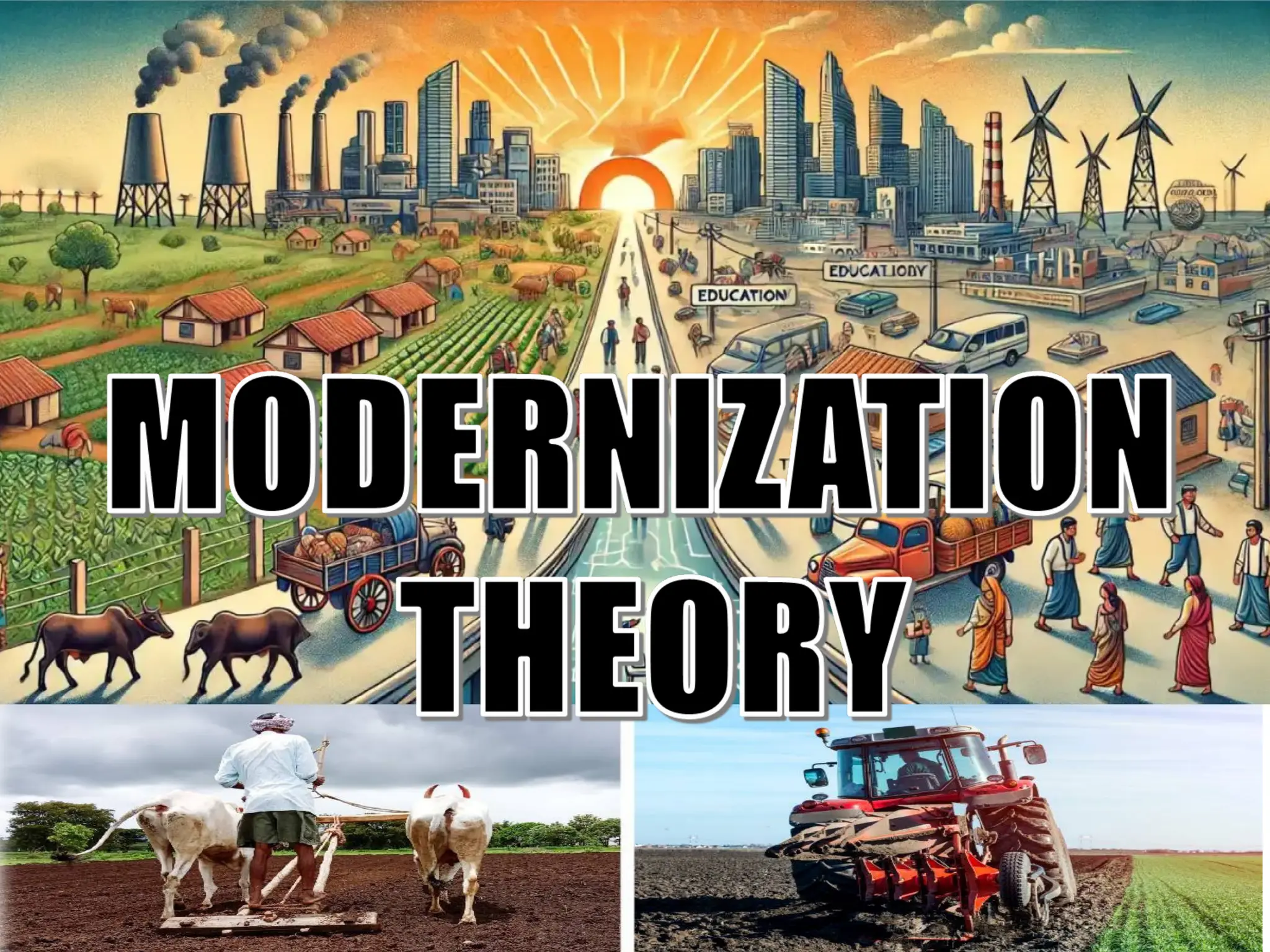
Modernization Theory
-Social, economic,and political theory
that explains how societies progress
from traditional to modern systems.
-It became popular in the 1950’s and
1960’s, after World War II in United
States when many scholars studied how
developing nations achieve the same
economic growth and social
development as Western countries.
3.
Core Concepts
•Traditional vsModern Societies
- Modernization theory describes
societies moving from traditional ways
—characterized by subsistence
agriculture, close family ties, and
fatalism—to modern structures with
industrial economies, formal
education, and urbanization.
4.
•Diffusion of Technologyand Ideas
- Modernization is believed to occur
through the spread of modern
technology, democratic institutions,
and Western cultural values like
meritocracy and universalism.
5.
•Linear Progress
- Akey aspect of the theory is the
idea that modernization is a linear
and inevitable process, with
countries progressing through a series
of stages toward a highly developed,
industrialized state.
6.
WALT ROSTOW
- Aneconomist known for his "stages
of economic growth," a model
outlining five sequential phases of
development that societies must
pass through to become
modernized.
7.
- Walt Rostow’smodernization theory
describes economic development as
a linear, five-stage process that all
societies must pass through to
achieve modernization.
9.
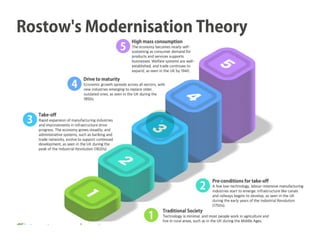
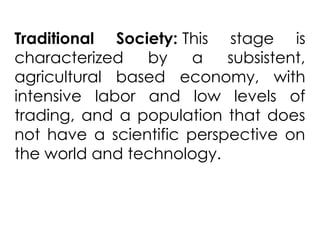
Traditional Society: Thisstage is
characterized by a subsistent,
agricultural based economy, with
intensive labor and low levels of
trading, and a population that does
not have a scientific perspective on
the world and technology.
10.
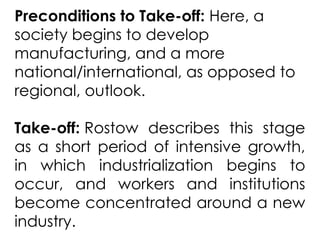
Preconditions to Take-off:Here, a
society begins to develop
manufacturing, and a more
national/international, as opposed to
regional, outlook.
Take-off: Rostow describes this stage
as a short period of intensive growth,
in which industrialization begins to
occur, and workers and institutions
become concentrated around a new
industry.
11.
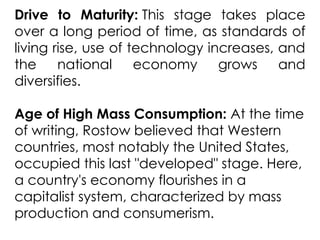
Drive to Maturity:This stage takes place
over a long period of time, as standards of
living rise, use of technology increases, and
the national economy grows and
diversifies.
Age of High Mass Consumption: At the time
of writing, Rostow believed that Western
countries, most notably the United States,
occupied this last "developed" stage. Here,
a country's economy flourishes in a
capitalist system, characterized by mass
production and consumerism.