

Dr. Parveen Nagpal
INTRODUCTION TO HRM
Dr. Parveen Nagpal
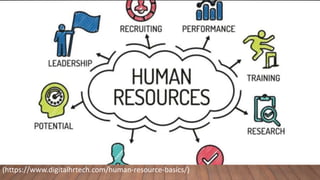
(https://www.digitalhrtech.com/human-resource-basics/)
Dr. Parveen Nagpal
HUMAN RESOURCE MANAGEMENT
❖Organizational resources are all the assets and resources that are available
to a firm for use and are combined and transformed into finished products.
❖Amongst the various types of resources viz. physical/ material resource,
financial resource and human resource, human resource is said to be the
most important resource as:
• It is the only resource that has feelings and sentiments.
• It is that resource which can put the other resources in the best possible
use.
Dr. Parveen Nagpal
HUMAN RESOURCE MANAGEMENT
❖The term Personnel Management (PM) is replaced now by Human
Resource Management (HRM).
❖HRM differs from PM both in scope and orientation. PM is essentially
“workforce” centered whereas HRM is “resource” centered.
❖HRM views people as an important source or asset to be used for the
benefit of the organizations, employees and the society.
Dr. Parveen Nagpal
HUMAN RESOURCE MANAGEMENT
❖HRM is a management function concerned with hiring, motivating and
maintaining people in an organization. It focuses on people in organizations.
It is designing management systems to ensure that human talent is used
effectively and efficiently to accomplish organizational goals.
❖Edwin Flippo states that Personnel/ HR management is the planning,
organizing, directing, and controlling of the procurement, development,
compensation, integration, maintenance and separation of human
resources to the end that individual, organizational and societal goals are
accomplished.
Dr. Parveen Nagpal
FEATURES OF HRM
• Comprehensive function
• People - oriented
• Action – oriented
• Pervasive
• Continuous
• Interdisciplinary
• Future – oriented
• Integrated
• Art as well as science
• Development of team spirit
• Increase Employee as well as Organizational Effectiveness
Dr. Parveen Nagpal
OBJECTIVES OF HRM
• Procurement of Human Capital
• Developing Organizational Climate
• Effective Use of Manpower
• Motivation of Manpower
• Maintain Performance Standards
• Maintain Harmonious Relationship
• Employee Retention
• Competitive Advantage
• Meet Legal Compliance
• Societal Objectives
• Corporate Image
Dr. Parveen Nagpal
STRATEGIC HUMAN RESOURCE MANAGEMENT (SHRM)
❖SHRM is a discipline that covers the concepts and practices that guide and
align the HRM philosophy, skillful planning and practice with the strategic
and long term goals of the organization.
❖"SHRM means formulating and executing HR policies and practices that
produce the employee competencies and behaviors that the company
needs to achieve its strategic aims." – Gary Dessler
❖“SHRM is an approach to making decisions on the intentions and plans of
the organization concerning the employment relationship and the
organization's recruitment, training, development, performance
management and the organization's strategies, policies and practices." –
Michael Armstrong
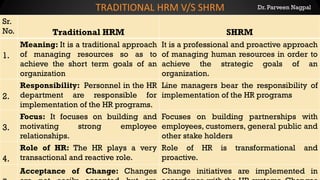
Dr. Parveen NagpalTRADITIONAL HRM V/S SHRM
Sr.
No. Traditional HRM SHRM
1.
Meaning: It is a traditional approach
of managing resources so as to
achieve the short term goals of an
organization
It is a professional and proactive approach
of managing human resources in order to
achieve the strategic goals of an
organization.
2.
Responsibility: Personnel in the HR
department are responsible for
implementation of the HR programs.
Line managers bear the responsibility of
implementation of the HR programs
3.
Focus: It focuses on building and
motivating strong employee
relationships.
Focuses on building partnerships with
employees, customers, general public and
other stake holders
4.
Role of HR: The HR plays a very
transactional and reactive role.
Role of HR is transformational and
proactive.
Acceptance of Change: Changes Change initiatives are implemented in
Dr. Parveen NagpalTRADITIONAL HRM V/S SHRM
Sr.
No. Traditional HRM SHRM
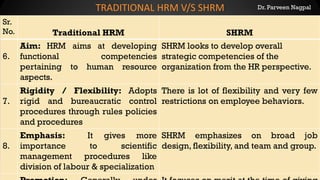
6.
Aim: HRM aims at developing
functional competencies
pertaining to human resource
aspects.
SHRM looks to develop overall
strategic competencies of the
organization from the HR perspective.
7.
Rigidity / Flexibility: Adopts
rigid and bureaucratic control
procedures through rules policies
and procedures
There is lot of flexibility and very few
restrictions on employee behaviors.
8.
Emphasis: It gives more
importance to scientific
management procedures like
division of labour & specialization
SHRM emphasizes on broad job
design, flexibility, and team and group.
Dr. Parveen Nagpal
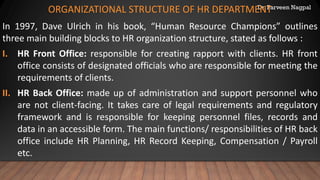
ORGANIZATIONAL STRUCTURE OF HR DEPARTMENT
In 1997, Dave Ulrich in his book, “Human Resource Champions” outlines
three main building blocks to HR organization structure, stated as follows :
I. HR Front Office: responsible for creating rapport with clients. HR front
office consists of designated officials who are responsible for meeting the
requirements of clients.
II. HR Back Office: made up of administration and support personnel who
are not client-facing. It takes care of legal requirements and regulatory
framework and is responsible for keeping personnel files, records and
data in an accessible form. The main functions/ responsibilities of HR back
office include HR Planning, HR Record Keeping, Compensation / Payroll
etc.
Dr. Parveen Nagpal
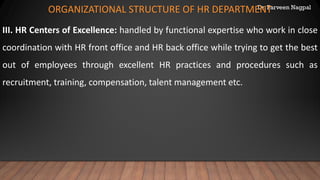
ORGANIZATIONAL STRUCTURE OF HR DEPARTMENT
III. HR Centers of Excellence: handled by functional expertise who work in close
coordination with HR front office and HR back office while trying to get the best
out of employees through excellent HR practices and procedures such as
recruitment, training, compensation, talent management etc.
Dr. Parveen Nagpal
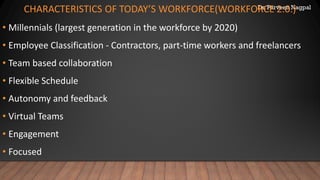
CHARACTERISTICS OF TODAY’S WORKFORCE(WORKFORCE 2.0.)
• Millennials (largest generation in the workforce by 2020)
• Employee Classification - Contractors, part-time workers and freelancers
• Team based collaboration
• Flexible Schedule
• Autonomy and feedback
• Virtual Teams
• Engagement
• Focused
Dr. Parveen Nagpal
CHARACTERISTICS OF TODAY’S WORKFORCE(WORKFORCE 2.0.)
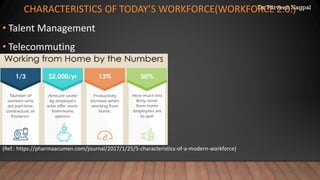
• Talent Management
• Telecommuting
(Ref.: https://pharmaacumen.com/journal/2017/1/25/5-characteristics-of-a-modern-workforce)
Dr. Parveen Nagpal
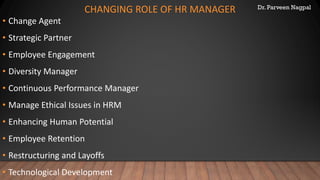
CHANGING ROLE OF HR MANAGER
• Change Agent
• Strategic Partner
• Employee Engagement
• Diversity Manager
• Continuous Performance Manager
• Manage Ethical Issues in HRM
• Enhancing Human Potential
• Employee Retention
• Restructuring and Layoffs
• Technological Development
Dr. Parveen Nagpal
CASE STUDY
“Human Resources are like natural resources, they are often buried deep.
One has to go looking out for them. HR Managers need to create
circumstances where they need to show themselves.” as said by Ken
Robinson.
a. Elucidate the statement in the multifaceted role to be played by the HR
Manager.
b. Explain the traits that the HR manager should possess.
c. Explain the challenges faced by HR Managers in organizations today
Dr. Parveen Nagpal
CLASS ASSIGNMENT
Gemco Limited is a subsidiary of Indian company located in Australia. The
management has ethnocentric approach. Mr. Rahul, an Indian is the HR
Manager. There are Parent Country Nationals (PCNs), Third Country Nationals
(TCNs) and Host Country Nationals (HCNs) who are appointed to work at
various levels of the hierarchy.
• What strategies should be used by the HR Manager (Mr. Ram) to maintain
workforce diversity?
Dr. Parveen Nagpal
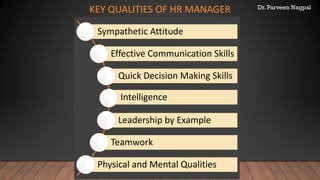
KEY QUALITIES OF HR MANAGER
Sympathetic Attitude
Effective Communication Skills
Quick Decision Making Skills
Intelligence
Leadership by Example
Teamwork
Physical and Mental Qualities
Dr. Parveen Nagpal
HUMAN RESOURCE PLANNING/ MANPOWER PLANNING
• HR strategies are designed in tune with the overall business strategy of the
organization.
• First part of the human resource strategy is Human Resource Planning
(HRP). All other HR activities like employee hiring, training and
development, remuneration, appraisal and labor relations are derived from
HRP.
❖According to Beach, “HRP is a process of determining and assuming that
the organization will have an adequate number of qualified persons,
available at proper times, performing jobs which meet the needs of the
enterprise and which provides satisfaction for the individuals involved.”
Dr. Parveen Nagpal
HUMAN RESOURCE PLANNING/ MANPOWER PLANNING
❖G. Stainer defines HRP as “A strategy for the acquisition, utilization,
improvement and preservation of organizations human resources.”
• HRP make the organization as well as employees better equipped for facing
the present and future.
• The basic purpose of HRP is to ensure the right kind of people in the right
quality and right quantity at the right place.
• Effective HRP ensures the best fit between employees and jobs, while
avoiding shortages and surplus.
Dr. Parveen Nagpal
OBJECTIVES OF HRP/ MPP
• Forecasting Human Resources Requirements
• Effective Utilization of HR
• Effective Management of Change
• Realizing the Organizational Goals
• Promoting Employees
• Cope up with Technological Change
• Organizational Development
Dr. Parveen Nagpal
TYPES OF HRP
I. SHORT TERM
• Approaches to matching a weak individual and a job
• Optimum utilization of the strong incumbent.
II. LONG TERM
• Projecting manpower requirements.
• Taking stock of existing manpower
• Recruitment & Selection
• HR development
Dr. Parveen Nagpal
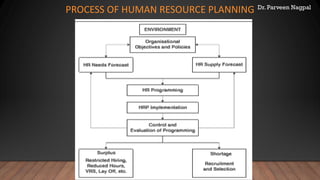
PROCESS OF HUMAN RESOURCE PLANNING
Dr. Parveen Nagpal
FACTORS AFFECTING HRP
• Type and Strategy of the Organization . Legal Requirements
• Management Philosophy . Availability of Funds
• Corporate Image
• Organizational Growth Cycles and Planning
• Environmental Uncertainties
• Competition
• Time Horizons
• Type and Quality of Information
• Nature of Jobs Being Filled
• Labour Market
• Outsourcing
• Technological Development
Dr. Parveen Nagpal
ADVANTAGES OF HRP
• Meeting organizational goals and objectives
• Coping with change and technological advancements
• Increasing investment in HR
• Adjusting manpower requirements
• Scientific selection
• Placement of manpower
• Enhancing goodwill
• Expansion and diversification needs of the organization
Dr. Parveen Nagpal
CHALLENGES FOR HRP
• Time consuming
• Globalization
• Handling Diverse Workforce
• Employee selection
• Training & Development
• Retaining Talents
• Conflict Managing
• Conflicts between short term and long term HR needs
• Trade unions
Dr. Parveen Nagpal
LIMITATIONS OF HRP
• Future manpower needs are uncertain
• Surplus manpower may lead additional cost
• Time consuming
• Expensive
• Shortage of skilled manpower
• High labour turnover
• Emphasis on quantitative aspect
• Lack of support from top management
• Inadequate HR information system
Dr. Parveen Nagpal
PSYCHOLOGICAL AND BEHAVIORAL ISSUES IN HRP
• Mismatch between Applicants and Skills
• Work Environment Issues
• Group Dynamics
• Leadership Issues
• Recruitment and Selection Issues
• Training and Development Issues
• Compensation Issues
• Promotions and Transfer Issues
• Issues relating to Performance Appraisal
• Career Development Issue
Dr. Parveen Nagpal
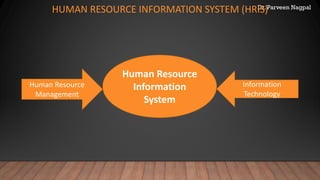
HUMAN RESOURCE INFORMATION SYSTEM (HRIS)
Human Resource
Information
System
Human Resource
Management
Information
Technology
Dr. Parveen Nagpal
HUMAN RESOURCE INFORMATION SYSTEM (HRIS)
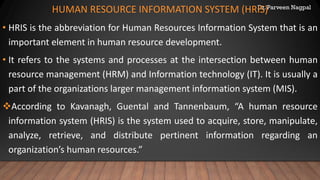
• HRIS is the abbreviation for Human Resources Information System that is an
important element in human resource development.
• It refers to the systems and processes at the intersection between human
resource management (HRM) and Information technology (IT). It is usually a
part of the organizations larger management information system (MIS).
❖According to Kavanagh, Guental and Tannenbaum, “A human resource
information system (HRIS) is the system used to acquire, store, manipulate,
analyze, retrieve, and distribute pertinent information regarding an
organization’s human resources.”
Dr. Parveen Nagpal
HRIS (HUMAN RESOURCE INFORMATION SYSTEM)
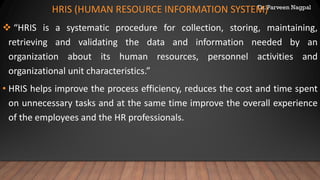
❖ “HRIS is a systematic procedure for collection, storing, maintaining,
retrieving and validating the data and information needed by an
organization about its human resources, personnel activities and
organizational unit characteristics.”
• HRIS helps improve the process efficiency, reduces the cost and time spent
on unnecessary tasks and at the same time improve the overall experience
of the employees and the HR professionals.
Dr. Parveen Nagpal
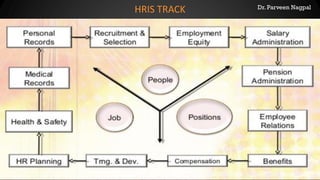
HRIS TRACK
Dr. Parveen Nagpal
IMPORTANCE OF HRIS
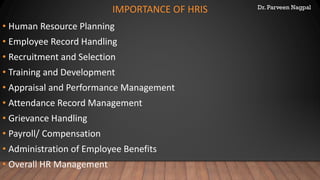
• Human Resource Planning
• Employee Record Handling
• Recruitment and Selection
• Training and Development
• Appraisal and Performance Management
• Attendance Record Management
• Grievance Handling
• Payroll/ Compensation
• Administration of Employee Benefits
• Overall HR Management
Dr. Parveen Nagpal
LIMITATIONS OF HRIS
• HRIS can be a problematic for small businesses as it may be difficult to have
a dedicated human resources technology specialist within the organization.
• It is an expensive affair. The cost to hire an HRIS specialist as well as set up
the system may be very high.
• Existing staff may find it difficult to adopt and adapt to a new system, which
is actually a new business process for them.
• Getting HR staff and employee active involvement early in the HRIS
development process is essential to successful implementation.
• HRIS may involve human error during information input, costly technology
to update the system and malfunctions or insufficient applications.
Dr. Parveen Nagpal
JOB ANALYSIS
• In order to achieve effective HRP, the duties involved and the skills required
for performing all the jobs in an organization have been taken care of. This
information can be obtained through the analysis of work, known as ‘Job
Analysis’.
• A job is a bundle of related tasks and responsibilities assigned to individual
employees. Job Analysis is a process to identify and determine in detail the
particular job duties and requirements and the relative importance of these
duties for a given job.
• Flippo has offered a more comprehensive definition of job analysis as, “Job
analysis is the process of studying and collecting information relating to the
operations and responsibilities of a specific job. The immediate products of
the analysis are job descriptions and job specifications”.
Dr. Parveen Nagpal
JOB ANALYSIS
• Job Analysis is therefore a detailed examination of :
i) tasks (performance elements) that make up a job.
ii) conditions under which they are performed, and
iii) what the job requires in terms of aptitudes, attitudes, knowledge, skills
etc. of the employee
Dr. Parveen Nagpal
COMPONENTS OF JOB ANALYSIS
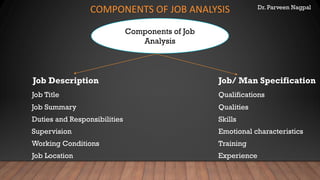
Job Description Job/ Man Specification
Job Title Qualifications
Job Summary Qualities
Duties and Responsibilities Skills
Supervision Emotional characteristics
Working Conditions Training
Job Location Experience
Components of Job
Analysis
Dr. Parveen Nagpal
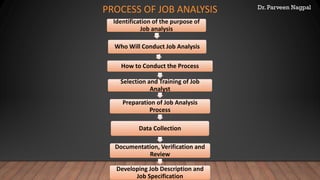
PROCESS OF JOB ANALYSIS
Identification of the purpose of
Job analysis
Who Will Conduct Job Analysis
How to Conduct the Process
Selection and Training of Job
Analyst
Preparation of Job Analysis
Process
Data Collection
Documentation, Verification and
Review
Developing Job Description and
Job Specification
Dr. Parveen Nagpal
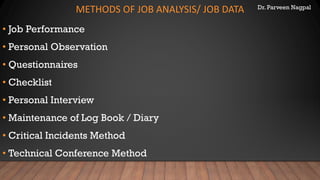
METHODS OF JOB ANALYSIS/ JOB DATA
• Job Performance
• Personal Observation
• Questionnaires
• Checklist
• Personal Interview
• Maintenance of Log Book / Diary
• Critical Incidents Method
• Technical Conference Method
Dr. Parveen Nagpal
CASE STUDY
Safety (India) Pvt. Ltd. is a passenger transport company plying more than 500
passenger buses in Bangalore on different routes. There are more than 5,000
employees working in the company. Out of these about 300 crewmen, are working
on the routes. The behaviour of these crewmen while dealing with daily
commuters in not satisfactory. So far as salary structure of these crewmen is
concerned they are paid reasonably well. In spite of it they have become lethargic,
lazy and careless. Their productivity level is also very low as compared to the
crewmen of other transport company. After having surveyed their behavioural
pattern it came to light that they are little interested in their job.
a. As a manager of this company how would you motivate the crewmen
b. Is it possible to modify their behaviour by imparting training to them?
Justify.
c. In general, discuss the characteristics of todays workforce
Dr. Parveen NagpalREFERENCES
1. Aswathappa, K., Human resource management: Text and cases. Delhi: Tata
McGraw-. Hill Publishing Company Limited, 2008
2. Gary Dessler, “A Framework for Human Resource Management”, Pearson
3. Nagpal, Human Resource Management, M. Com Part II, Sem 3, Sheth
Publishers
4. Nagpal, Sharma, OB & HRM, BMS, Vipul Prakashan
Dr. Parveen Nagpal
Thank You
www.linkedin.com/in/dr-parveen-kaur-nagpal-82965b15

1 Introduction to HRM

  • 1.
  • 2.
  • 3.
    Dr. Parveen Nagpal HUMANRESOURCE MANAGEMENT ❖Organizational resources are all the assets and resources that are available to a firm for use and are combined and transformed into finished products. ❖Amongst the various types of resources viz. physical/ material resource, financial resource and human resource, human resource is said to be the most important resource as: • It is the only resource that has feelings and sentiments. • It is that resource which can put the other resources in the best possible use.
  • 4.
    Dr. Parveen Nagpal HUMANRESOURCE MANAGEMENT ❖The term Personnel Management (PM) is replaced now by Human Resource Management (HRM). ❖HRM differs from PM both in scope and orientation. PM is essentially “workforce” centered whereas HRM is “resource” centered. ❖HRM views people as an important source or asset to be used for the benefit of the organizations, employees and the society.
  • 5.
    Dr. Parveen Nagpal HUMANRESOURCE MANAGEMENT ❖HRM is a management function concerned with hiring, motivating and maintaining people in an organization. It focuses on people in organizations. It is designing management systems to ensure that human talent is used effectively and efficiently to accomplish organizational goals. ❖Edwin Flippo states that Personnel/ HR management is the planning, organizing, directing, and controlling of the procurement, development, compensation, integration, maintenance and separation of human resources to the end that individual, organizational and societal goals are accomplished.
  • 6.
    Dr. Parveen Nagpal FEATURESOF HRM • Comprehensive function • People - oriented • Action – oriented • Pervasive • Continuous • Interdisciplinary • Future – oriented • Integrated • Art as well as science • Development of team spirit • Increase Employee as well as Organizational Effectiveness
  • 7.
    Dr. Parveen Nagpal OBJECTIVESOF HRM • Procurement of Human Capital • Developing Organizational Climate • Effective Use of Manpower • Motivation of Manpower • Maintain Performance Standards • Maintain Harmonious Relationship • Employee Retention • Competitive Advantage • Meet Legal Compliance • Societal Objectives • Corporate Image
  • 8.
    Dr. Parveen Nagpal STRATEGICHUMAN RESOURCE MANAGEMENT (SHRM) ❖SHRM is a discipline that covers the concepts and practices that guide and align the HRM philosophy, skillful planning and practice with the strategic and long term goals of the organization. ❖"SHRM means formulating and executing HR policies and practices that produce the employee competencies and behaviors that the company needs to achieve its strategic aims." – Gary Dessler ❖“SHRM is an approach to making decisions on the intentions and plans of the organization concerning the employment relationship and the organization's recruitment, training, development, performance management and the organization's strategies, policies and practices." – Michael Armstrong
  • 9.
    Dr. Parveen NagpalTRADITIONALHRM V/S SHRM Sr. No. Traditional HRM SHRM 1. Meaning: It is a traditional approach of managing resources so as to achieve the short term goals of an organization It is a professional and proactive approach of managing human resources in order to achieve the strategic goals of an organization. 2. Responsibility: Personnel in the HR department are responsible for implementation of the HR programs. Line managers bear the responsibility of implementation of the HR programs 3. Focus: It focuses on building and motivating strong employee relationships. Focuses on building partnerships with employees, customers, general public and other stake holders 4. Role of HR: The HR plays a very transactional and reactive role. Role of HR is transformational and proactive. Acceptance of Change: Changes Change initiatives are implemented in
  • 10.
    Dr. Parveen NagpalTRADITIONALHRM V/S SHRM Sr. No. Traditional HRM SHRM 6. Aim: HRM aims at developing functional competencies pertaining to human resource aspects. SHRM looks to develop overall strategic competencies of the organization from the HR perspective. 7. Rigidity / Flexibility: Adopts rigid and bureaucratic control procedures through rules policies and procedures There is lot of flexibility and very few restrictions on employee behaviors. 8. Emphasis: It gives more importance to scientific management procedures like division of labour & specialization SHRM emphasizes on broad job design, flexibility, and team and group.
  • 11.
    Dr. Parveen Nagpal ORGANIZATIONALSTRUCTURE OF HR DEPARTMENT In 1997, Dave Ulrich in his book, “Human Resource Champions” outlines three main building blocks to HR organization structure, stated as follows : I. HR Front Office: responsible for creating rapport with clients. HR front office consists of designated officials who are responsible for meeting the requirements of clients. II. HR Back Office: made up of administration and support personnel who are not client-facing. It takes care of legal requirements and regulatory framework and is responsible for keeping personnel files, records and data in an accessible form. The main functions/ responsibilities of HR back office include HR Planning, HR Record Keeping, Compensation / Payroll etc.
  • 12.
    Dr. Parveen Nagpal ORGANIZATIONALSTRUCTURE OF HR DEPARTMENT III. HR Centers of Excellence: handled by functional expertise who work in close coordination with HR front office and HR back office while trying to get the best out of employees through excellent HR practices and procedures such as recruitment, training, compensation, talent management etc.
  • 13.
    Dr. Parveen Nagpal CHARACTERISTICSOF TODAY’S WORKFORCE(WORKFORCE 2.0.) • Millennials (largest generation in the workforce by 2020) • Employee Classification - Contractors, part-time workers and freelancers • Team based collaboration • Flexible Schedule • Autonomy and feedback • Virtual Teams • Engagement • Focused
  • 14.
    Dr. Parveen Nagpal CHARACTERISTICSOF TODAY’S WORKFORCE(WORKFORCE 2.0.) • Talent Management • Telecommuting (Ref.: https://pharmaacumen.com/journal/2017/1/25/5-characteristics-of-a-modern-workforce)
  • 15.
    Dr. Parveen Nagpal CHANGINGROLE OF HR MANAGER • Change Agent • Strategic Partner • Employee Engagement • Diversity Manager • Continuous Performance Manager • Manage Ethical Issues in HRM • Enhancing Human Potential • Employee Retention • Restructuring and Layoffs • Technological Development
  • 16.
    Dr. Parveen Nagpal CASESTUDY “Human Resources are like natural resources, they are often buried deep. One has to go looking out for them. HR Managers need to create circumstances where they need to show themselves.” as said by Ken Robinson. a. Elucidate the statement in the multifaceted role to be played by the HR Manager. b. Explain the traits that the HR manager should possess. c. Explain the challenges faced by HR Managers in organizations today
  • 17.
    Dr. Parveen Nagpal CLASSASSIGNMENT Gemco Limited is a subsidiary of Indian company located in Australia. The management has ethnocentric approach. Mr. Rahul, an Indian is the HR Manager. There are Parent Country Nationals (PCNs), Third Country Nationals (TCNs) and Host Country Nationals (HCNs) who are appointed to work at various levels of the hierarchy. • What strategies should be used by the HR Manager (Mr. Ram) to maintain workforce diversity?
  • 18.
    Dr. Parveen Nagpal KEYQUALITIES OF HR MANAGER Sympathetic Attitude Effective Communication Skills Quick Decision Making Skills Intelligence Leadership by Example Teamwork Physical and Mental Qualities
  • 19.
    Dr. Parveen Nagpal HUMANRESOURCE PLANNING/ MANPOWER PLANNING • HR strategies are designed in tune with the overall business strategy of the organization. • First part of the human resource strategy is Human Resource Planning (HRP). All other HR activities like employee hiring, training and development, remuneration, appraisal and labor relations are derived from HRP. ❖According to Beach, “HRP is a process of determining and assuming that the organization will have an adequate number of qualified persons, available at proper times, performing jobs which meet the needs of the enterprise and which provides satisfaction for the individuals involved.”
  • 20.
    Dr. Parveen Nagpal HUMANRESOURCE PLANNING/ MANPOWER PLANNING ❖G. Stainer defines HRP as “A strategy for the acquisition, utilization, improvement and preservation of organizations human resources.” • HRP make the organization as well as employees better equipped for facing the present and future. • The basic purpose of HRP is to ensure the right kind of people in the right quality and right quantity at the right place. • Effective HRP ensures the best fit between employees and jobs, while avoiding shortages and surplus.
  • 21.
    Dr. Parveen Nagpal OBJECTIVESOF HRP/ MPP • Forecasting Human Resources Requirements • Effective Utilization of HR • Effective Management of Change • Realizing the Organizational Goals • Promoting Employees • Cope up with Technological Change • Organizational Development
  • 22.
    Dr. Parveen Nagpal TYPESOF HRP I. SHORT TERM • Approaches to matching a weak individual and a job • Optimum utilization of the strong incumbent. II. LONG TERM • Projecting manpower requirements. • Taking stock of existing manpower • Recruitment & Selection • HR development
  • 23.
    Dr. Parveen Nagpal PROCESSOF HUMAN RESOURCE PLANNING
  • 24.
    Dr. Parveen Nagpal FACTORSAFFECTING HRP • Type and Strategy of the Organization . Legal Requirements • Management Philosophy . Availability of Funds • Corporate Image • Organizational Growth Cycles and Planning • Environmental Uncertainties • Competition • Time Horizons • Type and Quality of Information • Nature of Jobs Being Filled • Labour Market • Outsourcing • Technological Development
  • 25.
    Dr. Parveen Nagpal ADVANTAGESOF HRP • Meeting organizational goals and objectives • Coping with change and technological advancements • Increasing investment in HR • Adjusting manpower requirements • Scientific selection • Placement of manpower • Enhancing goodwill • Expansion and diversification needs of the organization
  • 26.
    Dr. Parveen Nagpal CHALLENGESFOR HRP • Time consuming • Globalization • Handling Diverse Workforce • Employee selection • Training & Development • Retaining Talents • Conflict Managing • Conflicts between short term and long term HR needs • Trade unions
  • 27.
    Dr. Parveen Nagpal LIMITATIONSOF HRP • Future manpower needs are uncertain • Surplus manpower may lead additional cost • Time consuming • Expensive • Shortage of skilled manpower • High labour turnover • Emphasis on quantitative aspect • Lack of support from top management • Inadequate HR information system
  • 28.
    Dr. Parveen Nagpal PSYCHOLOGICALAND BEHAVIORAL ISSUES IN HRP • Mismatch between Applicants and Skills • Work Environment Issues • Group Dynamics • Leadership Issues • Recruitment and Selection Issues • Training and Development Issues • Compensation Issues • Promotions and Transfer Issues • Issues relating to Performance Appraisal • Career Development Issue
  • 29.
    Dr. Parveen Nagpal HUMANRESOURCE INFORMATION SYSTEM (HRIS) Human Resource Information System Human Resource Management Information Technology
  • 30.
    Dr. Parveen Nagpal HUMANRESOURCE INFORMATION SYSTEM (HRIS) • HRIS is the abbreviation for Human Resources Information System that is an important element in human resource development. • It refers to the systems and processes at the intersection between human resource management (HRM) and Information technology (IT). It is usually a part of the organizations larger management information system (MIS). ❖According to Kavanagh, Guental and Tannenbaum, “A human resource information system (HRIS) is the system used to acquire, store, manipulate, analyze, retrieve, and distribute pertinent information regarding an organization’s human resources.”
  • 31.
    Dr. Parveen Nagpal HRIS(HUMAN RESOURCE INFORMATION SYSTEM) ❖ “HRIS is a systematic procedure for collection, storing, maintaining, retrieving and validating the data and information needed by an organization about its human resources, personnel activities and organizational unit characteristics.” • HRIS helps improve the process efficiency, reduces the cost and time spent on unnecessary tasks and at the same time improve the overall experience of the employees and the HR professionals.
  • 32.
  • 33.
    Dr. Parveen Nagpal IMPORTANCEOF HRIS • Human Resource Planning • Employee Record Handling • Recruitment and Selection • Training and Development • Appraisal and Performance Management • Attendance Record Management • Grievance Handling • Payroll/ Compensation • Administration of Employee Benefits • Overall HR Management
  • 34.
    Dr. Parveen Nagpal LIMITATIONSOF HRIS • HRIS can be a problematic for small businesses as it may be difficult to have a dedicated human resources technology specialist within the organization. • It is an expensive affair. The cost to hire an HRIS specialist as well as set up the system may be very high. • Existing staff may find it difficult to adopt and adapt to a new system, which is actually a new business process for them. • Getting HR staff and employee active involvement early in the HRIS development process is essential to successful implementation. • HRIS may involve human error during information input, costly technology to update the system and malfunctions or insufficient applications.
  • 35.
    Dr. Parveen Nagpal JOBANALYSIS • In order to achieve effective HRP, the duties involved and the skills required for performing all the jobs in an organization have been taken care of. This information can be obtained through the analysis of work, known as ‘Job Analysis’. • A job is a bundle of related tasks and responsibilities assigned to individual employees. Job Analysis is a process to identify and determine in detail the particular job duties and requirements and the relative importance of these duties for a given job. • Flippo has offered a more comprehensive definition of job analysis as, “Job analysis is the process of studying and collecting information relating to the operations and responsibilities of a specific job. The immediate products of the analysis are job descriptions and job specifications”.
  • 36.
    Dr. Parveen Nagpal JOBANALYSIS • Job Analysis is therefore a detailed examination of : i) tasks (performance elements) that make up a job. ii) conditions under which they are performed, and iii) what the job requires in terms of aptitudes, attitudes, knowledge, skills etc. of the employee
  • 37.
    Dr. Parveen Nagpal COMPONENTSOF JOB ANALYSIS Job Description Job/ Man Specification Job Title Qualifications Job Summary Qualities Duties and Responsibilities Skills Supervision Emotional characteristics Working Conditions Training Job Location Experience Components of Job Analysis
  • 38.
    Dr. Parveen Nagpal PROCESSOF JOB ANALYSIS Identification of the purpose of Job analysis Who Will Conduct Job Analysis How to Conduct the Process Selection and Training of Job Analyst Preparation of Job Analysis Process Data Collection Documentation, Verification and Review Developing Job Description and Job Specification
  • 39.
    Dr. Parveen Nagpal METHODSOF JOB ANALYSIS/ JOB DATA • Job Performance • Personal Observation • Questionnaires • Checklist • Personal Interview • Maintenance of Log Book / Diary • Critical Incidents Method • Technical Conference Method
  • 40.
    Dr. Parveen Nagpal CASESTUDY Safety (India) Pvt. Ltd. is a passenger transport company plying more than 500 passenger buses in Bangalore on different routes. There are more than 5,000 employees working in the company. Out of these about 300 crewmen, are working on the routes. The behaviour of these crewmen while dealing with daily commuters in not satisfactory. So far as salary structure of these crewmen is concerned they are paid reasonably well. In spite of it they have become lethargic, lazy and careless. Their productivity level is also very low as compared to the crewmen of other transport company. After having surveyed their behavioural pattern it came to light that they are little interested in their job. a. As a manager of this company how would you motivate the crewmen b. Is it possible to modify their behaviour by imparting training to them? Justify. c. In general, discuss the characteristics of todays workforce
  • 41.
    Dr. Parveen NagpalREFERENCES 1.Aswathappa, K., Human resource management: Text and cases. Delhi: Tata McGraw-. Hill Publishing Company Limited, 2008 2. Gary Dessler, “A Framework for Human Resource Management”, Pearson 3. Nagpal, Human Resource Management, M. Com Part II, Sem 3, Sheth Publishers 4. Nagpal, Sharma, OB & HRM, BMS, Vipul Prakashan
  • 42.
    Dr. Parveen Nagpal ThankYou www.linkedin.com/in/dr-parveen-kaur-nagpal-82965b15