Environmental Hydrology &
Hydraulics
Dr. Ishraga Sokrab
• Objective of the course:
To understand the principals of hydrology and
hydraulics as it relates to design and operation
of environmental engineering systems.
Environmental Hydrology
The hydrology has two specific goals:
(i) To introduce students to basic
concepts of:
 ( Surface Water Hydrology)
‫هايدرولوجيا‬
‫السطحية‬ ‫المياه‬
 ( Ground Water Hydrology)
‫هايدرولوجيا‬
‫الجوفية‬ ‫المياه‬
(ii)To develop analytical skills relevant
to the areas mentioned in (i) above.
1. Rainfall Estimations
2. Infiltration Estimations
3. Rainfall-Runoff Relationships:
a) The Rational Method
b) The Hydrograph Method
c) Unit Hydrograph Method
iSurface Water Hydrology
t4. Flood Routing
a) Reservoir Routing Method
b) Channel Routing Method
References :
1- V.T. Chow, D. R. Maidment, Mays :
“Applied Hydrology”
2- E.M. Wilson, "Engineering Hydrology,"
3- Elizabeth , " Hydrology for Engineers"
Defining Hydrology

‫الهايدرولوجيا؟‬ ‫تعريف‬

‫أبسطها‬ ‫تعريفات‬ ‫عدة‬ ‫هناك‬
:
.1
”
‫المياه‬ ‫علم‬ ‫هي‬ ‫الهايدرولوجيا‬
“
.2
”
‫وتحت‬ ‫على‬ ‫و‬ ‫فوق‬ ‫المياه‬ ‫دراسة‬ ‫هي‬ ‫الهايدرولوجيا‬
‫األرض‬
“
.3
”
‫إستغالل‬ ‫و‬ ‫المائية‬ ‫الموارد‬ ‫دراسة‬ ‫هي‬ ‫الهايدرولوجيا‬
‫ها‬
‫األمثل‬ ‫اإلستغالل‬
“
“The study of the waters of the Earth”
Defining Hydrology
 Water in solid, liquid and vapour forms
 Water’s origins and destinations
 Availability, distribution, utilisation of
water
 Chemical and physical properties
 Interaction with the physical, biological
and human environment
“The study of the water of the Earth
Applications of Hydrology
• Water supply design and operation for industrial
uses
• Provision of drinking water supply of adequate
quantity and quality
• Hydropower generation
• Irrigation and drainage design
• Hydraulic structures (dams, irrigation structures,
road culverts and bridges)
• Navigation
• Water quality aspects
• Waste water management
Applications of Hydrology
 Conservation of wetland and other habitats
 Anticipating effects of changes to the use of land
 understanding of Earth System including climate
Applications related to water problems
• Flood early warning and flood management
• Drought prediction and management
• Erosion and Sedimentation
• Pollution control
• Trans-boundary Conflicts
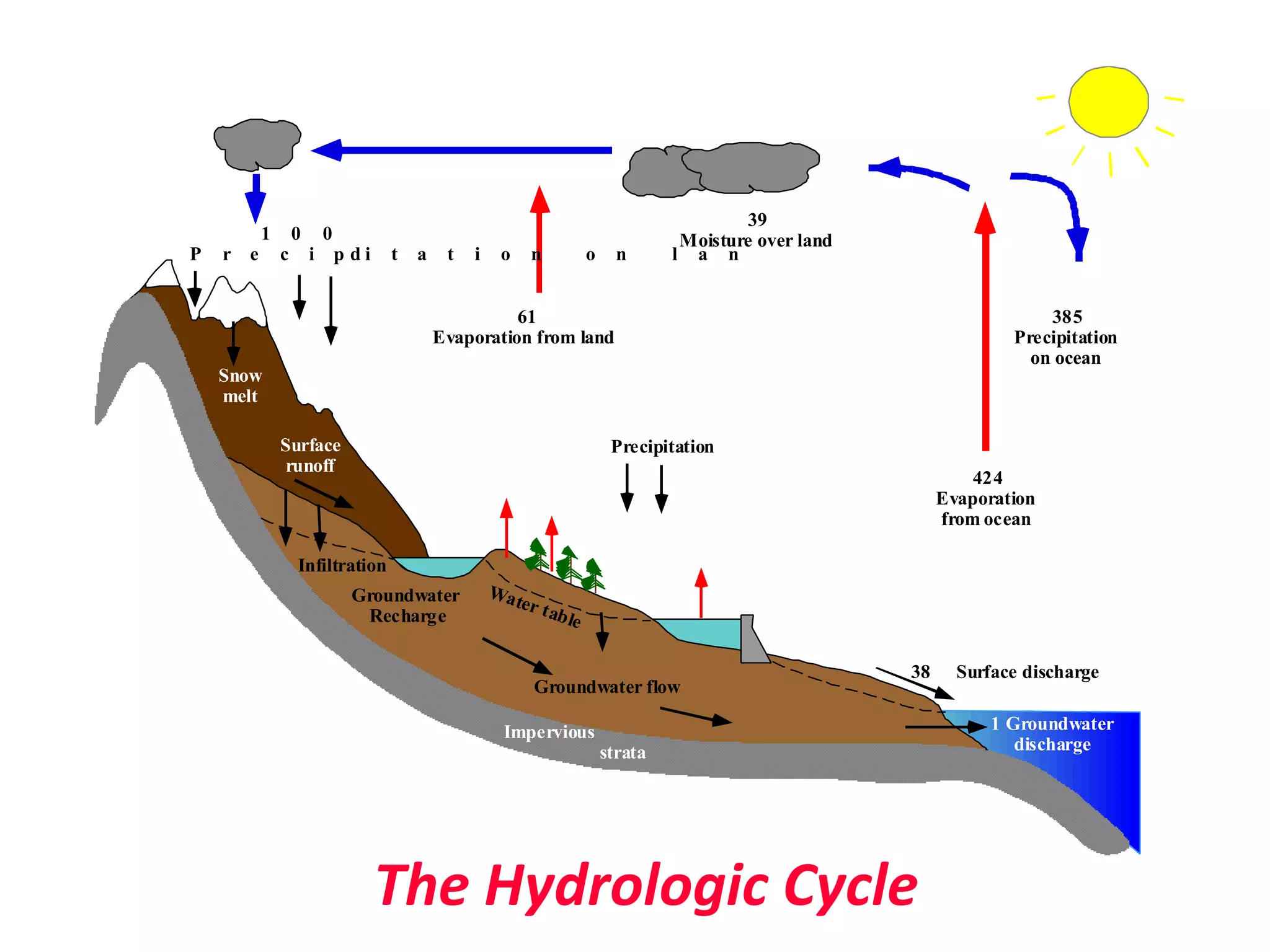
The Hydrologic Cycle
1 0 0
P r e c i p i t a t i o n o n l a n
d
Infiltration
Water table
Groundwater flow
1 Groundwater
discharge
38 Surface discharge
61
Evaporation from land
39
Moisture over land
385
Precipitation
on ocean
424
Evaporation
from ocean
Surface
runoff
Impervious
strata
Groundwater
Recharge
Precipitation
Snow
melt
Precipitation
Water on Surface Overland Flow
Channel
Flow
The Hydrologic Cycle
Ground Water Ground
Water
Flow
Ocean
Reservoir
Atmosphere
Evaporation
Evapotranspiration
Evaporation
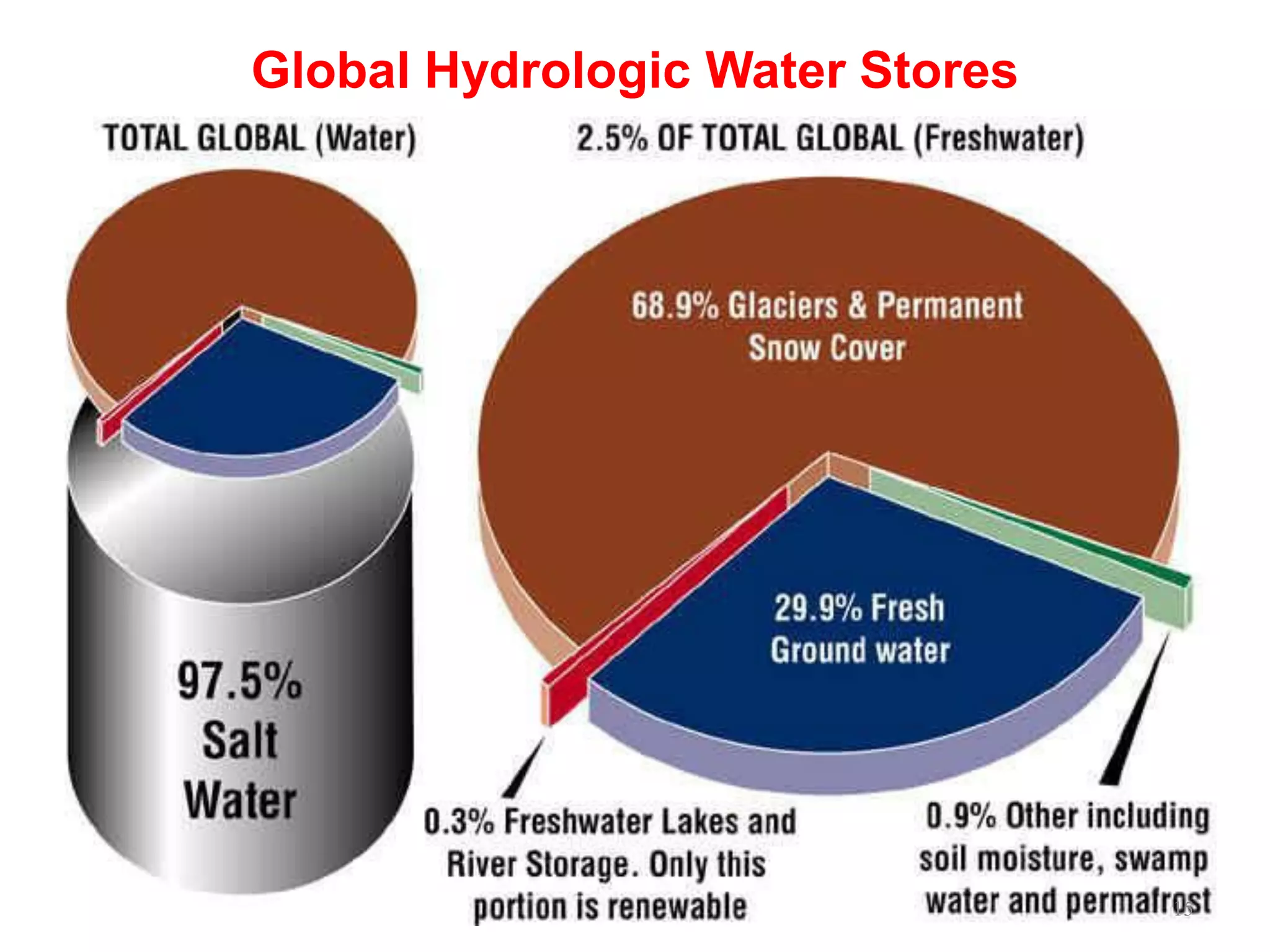
Global Hydrologic Water Stores
15
Bedrock
Confined groundwater Confined aquifer
Aquiclude
Unconfined aquifer
Unconfined groundwater
Groundwater table
Stream
(discharge area)
Spring
(discharge area)
Flowing well
Hydrological Processes Focusing on
Groundwater flow system
Recharge dominant
area Recharge dominant
area
Recharge  Flow / Storage / Quality  Discharge
(residence time)
Interaction between groundwater
and surface water
‫السطحية‬ ‫المياه‬ ‫و‬ ‫الجوفية‬ ‫المياه‬ ‫بين‬ ‫التفاعل‬
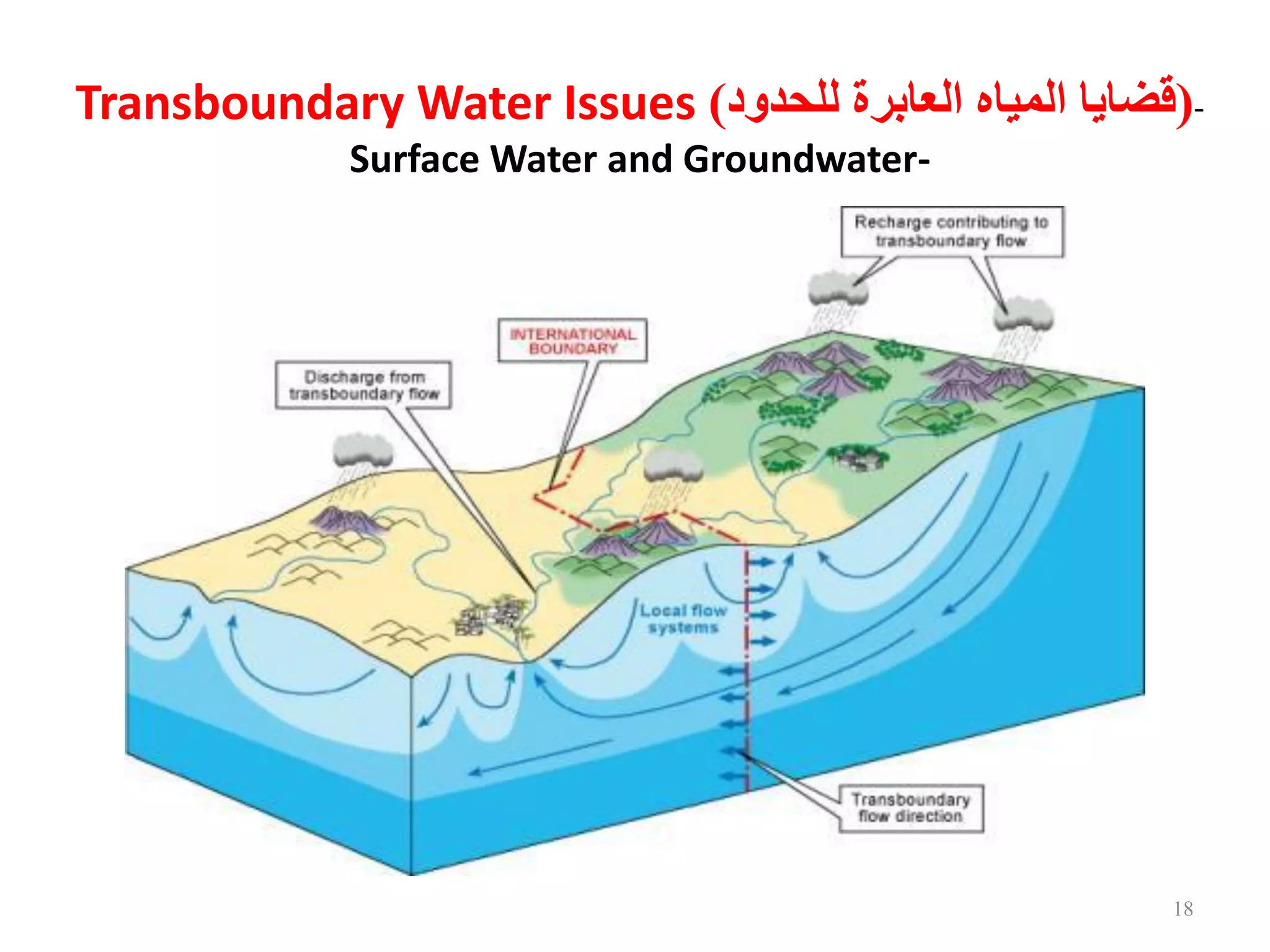
Transboundary Water Issues (
‫للحدود‬ ‫العابرة‬ ‫المياه‬ ‫قضايا‬
) -
Surface Water and Groundwater-
18
• Integrated river basin management is an
indispensable approach and highly needed to
satisfy the demand of D/S countries
20
Runoff
Rainfall
Time
Rainfall
Hyetograph
Evapotranspiration
Groundwater flow
Runoff
Time
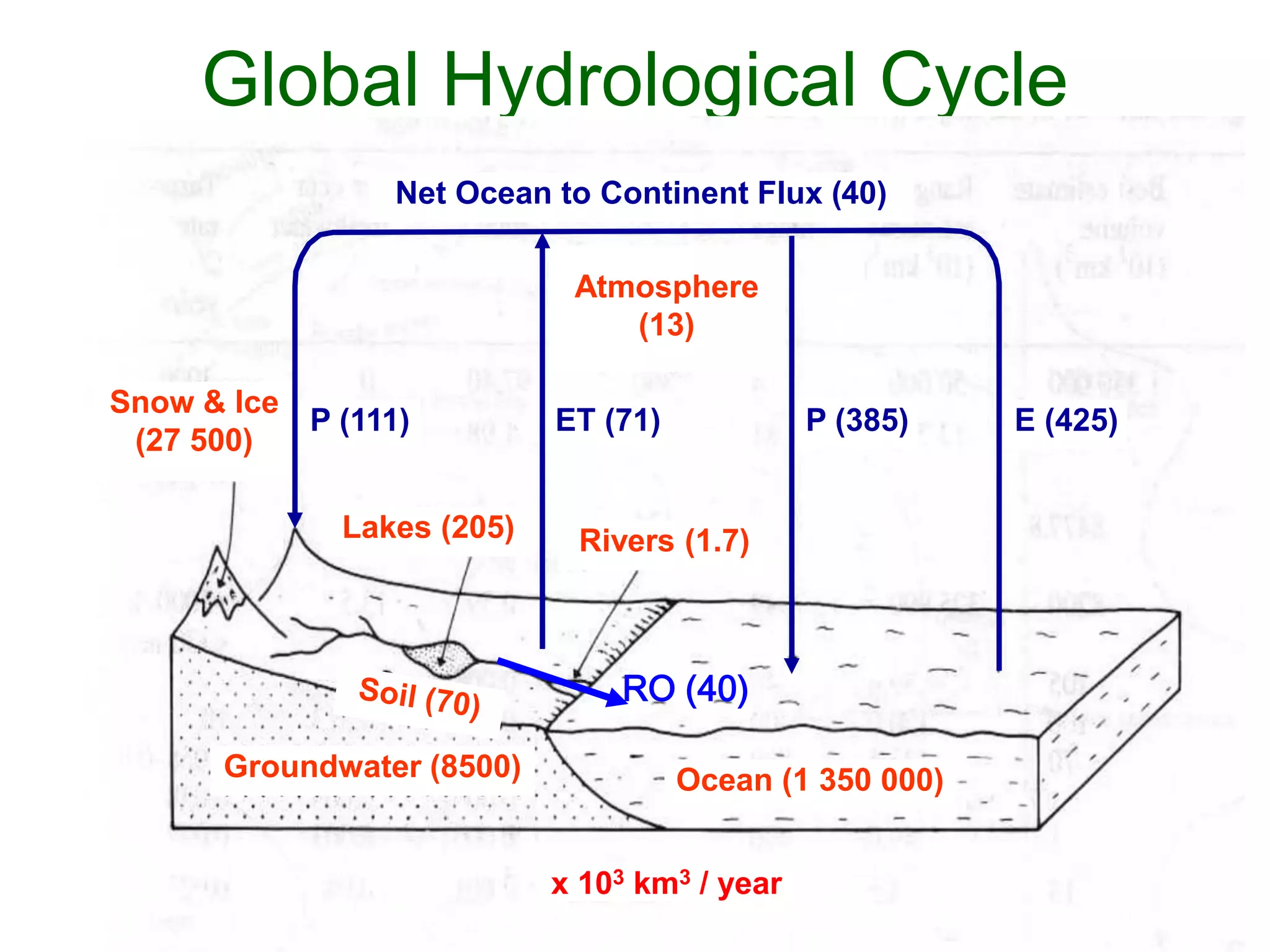
Global Hydrological Cycle
P (111) ET (71) P (385) E (425)
Atmosphere
(13)
Net Ocean to Continent Flux (40)
x 103 km3 / year
Ocean (1 350 000)
Groundwater (8500)
Snow & Ice
(27 500)
Lakes (205) Rivers (1.7)
RO (40)
Major Hydrologic Processes
• Precipitation (radar or rain gage)
• Evaporation or ET (loss to atmosphere)
• Infiltration (loss to subsurface soils)
• Overland flow (sheet flow toward nearest
stream)
• Streamflow (measured flow at stream gage)
• Ground water flow in wells
• Water quality and contaminant transport
Africa – Arid and Semi Arid Zones
Climatic
Regions
of Sudan
Mean
Annual
Rainfall
Isohyets
800 – 0
mm
Mean Annual
Potential
Evaporation
2800 – 1600
mm
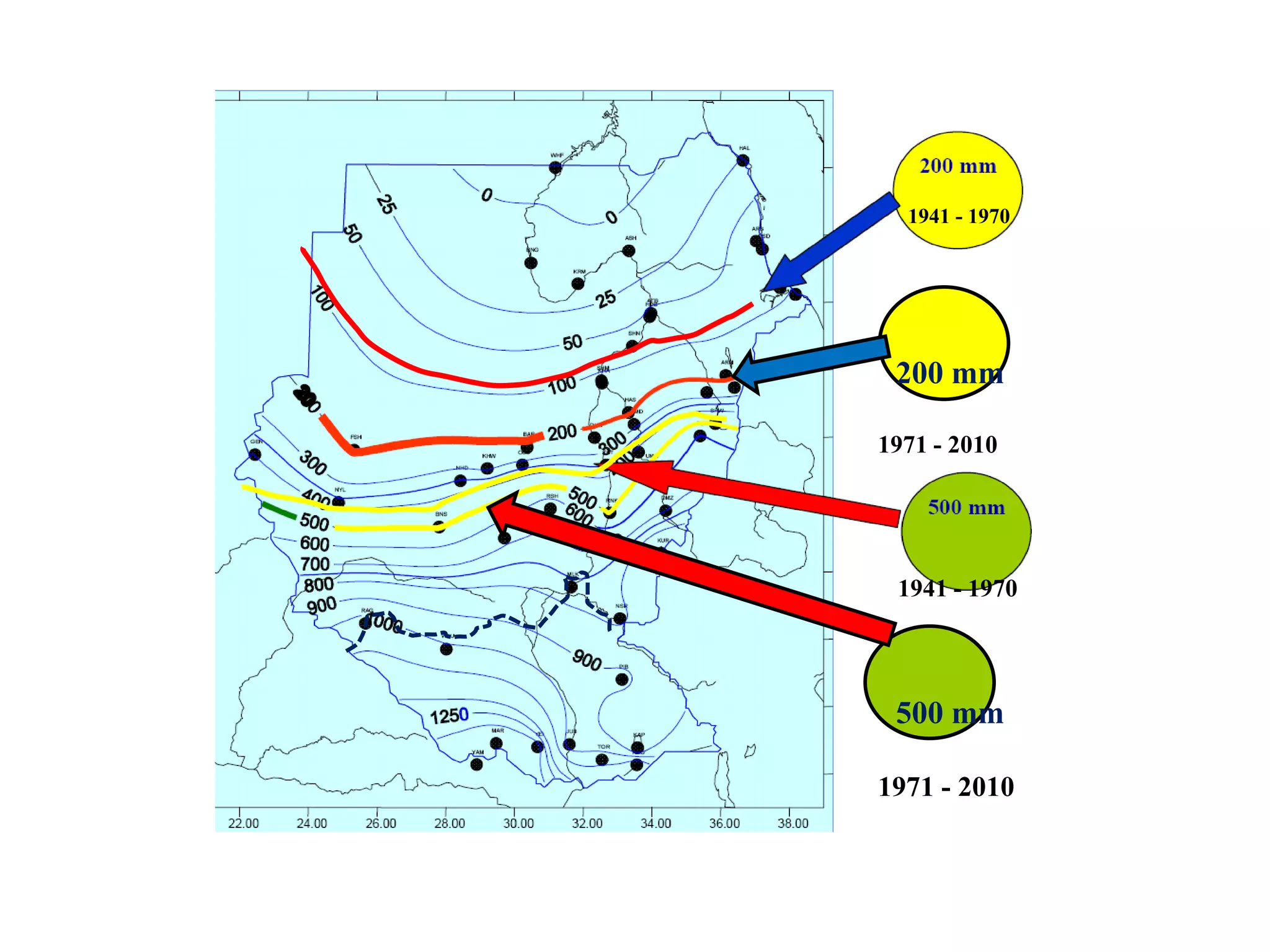
1941 - 1970
200 mm
1971 - 2010
500 mm
1971 - 2010
1941 - 1970
Climate change
Annual Rainfall (mm) in Sinkat
0
50
100
150
200
250
300
50 51 52 53 54 55 56 57 58 59 60 61 62 63 64 65 66 67 68 69 70 71 72 73 74 75 76 77 80 81 82
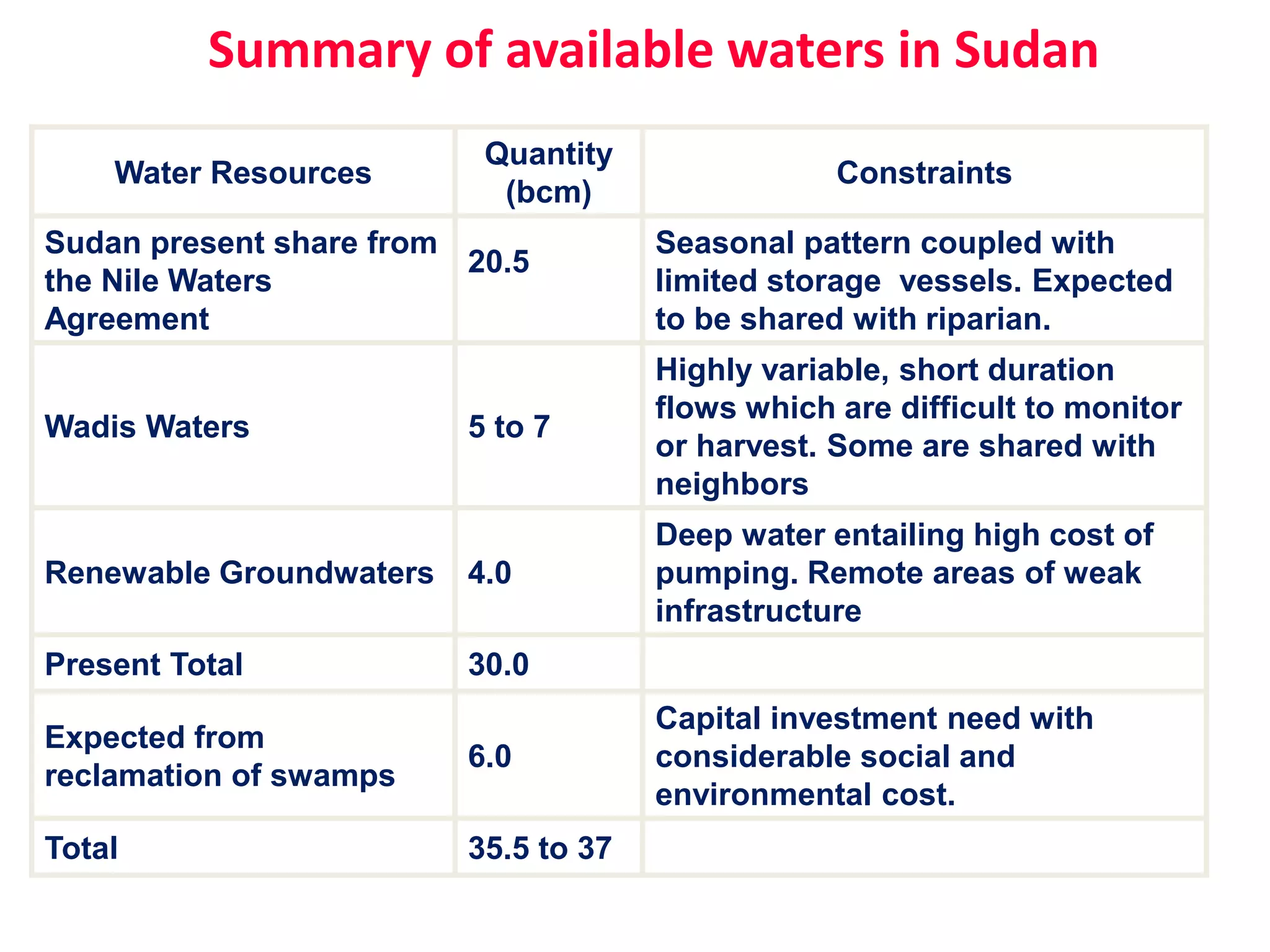
Summary of available waters in Sudan
Water Resources
Quantity
(bcm)
Constraints
Sudan present share from
the Nile Waters
Agreement
20.5
Seasonal pattern coupled with
limited storage vessels. Expected
to be shared with riparian.
Wadis Waters 5 to 7
Highly variable, short duration
flows which are difficult to monitor
or harvest. Some are shared with
neighbors
Renewable Groundwaters 4.0
Deep water entailing high cost of
pumping. Remote areas of weak
infrastructure
Present Total 30.0
Expected from
reclamation of swamps
6.0
Capital investment need with
considerable social and
environmental cost.
Total 35.5 to 37
Multi-purpose water resources
projects
‫اإلنشاء‬ ‫عند‬ ‫الكلي‬ ‫التخزين‬
=
1300
‫مكعب‬ ‫متر‬ ‫مليون‬
‫الحالي‬ ‫الكلي‬ ‫التخزين‬
=
600
‫تقريبا‬ ‫مكعب‬ ‫متر‬ ‫مليون‬
‫القربة‬ ‫خشم‬ ‫خزان‬
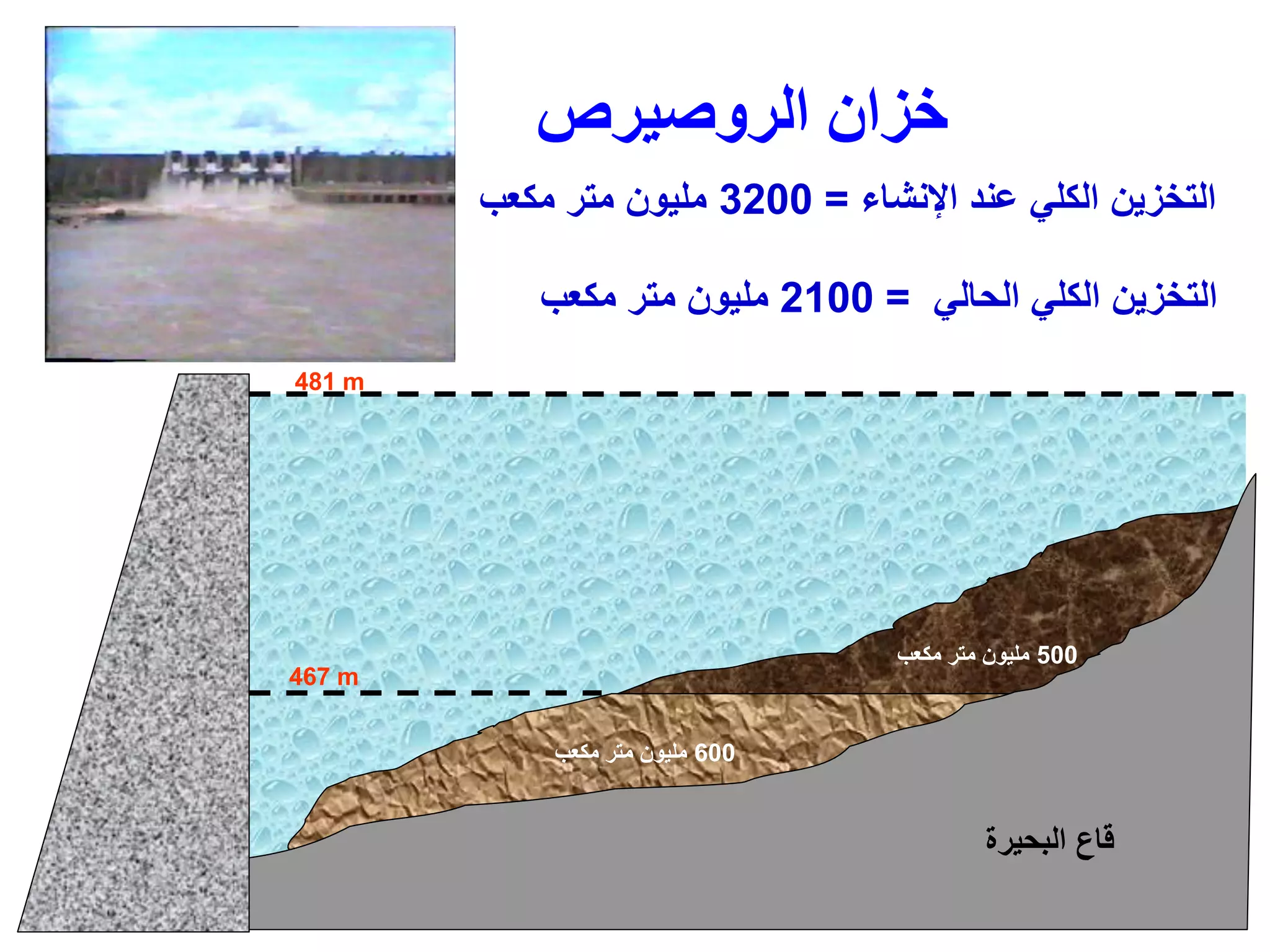
Sedimentation and Erosion
‫اإلنشاء‬ ‫عند‬ ‫الكلي‬ ‫التخزين‬
=
3200
‫مكعب‬ ‫متر‬ ‫مليون‬
‫الحالي‬ ‫الكلي‬ ‫التخزين‬
=
2100
‫مكعب‬ ‫متر‬ ‫مليون‬
‫الروصيرص‬ ‫خزان‬
481 m
467 m
‫مكعب‬ ‫متر‬ ‫مليون‬ 600
‫مكعب‬ ‫متر‬ ‫مليون‬ 500
‫البحيرة‬ ‫قاع‬
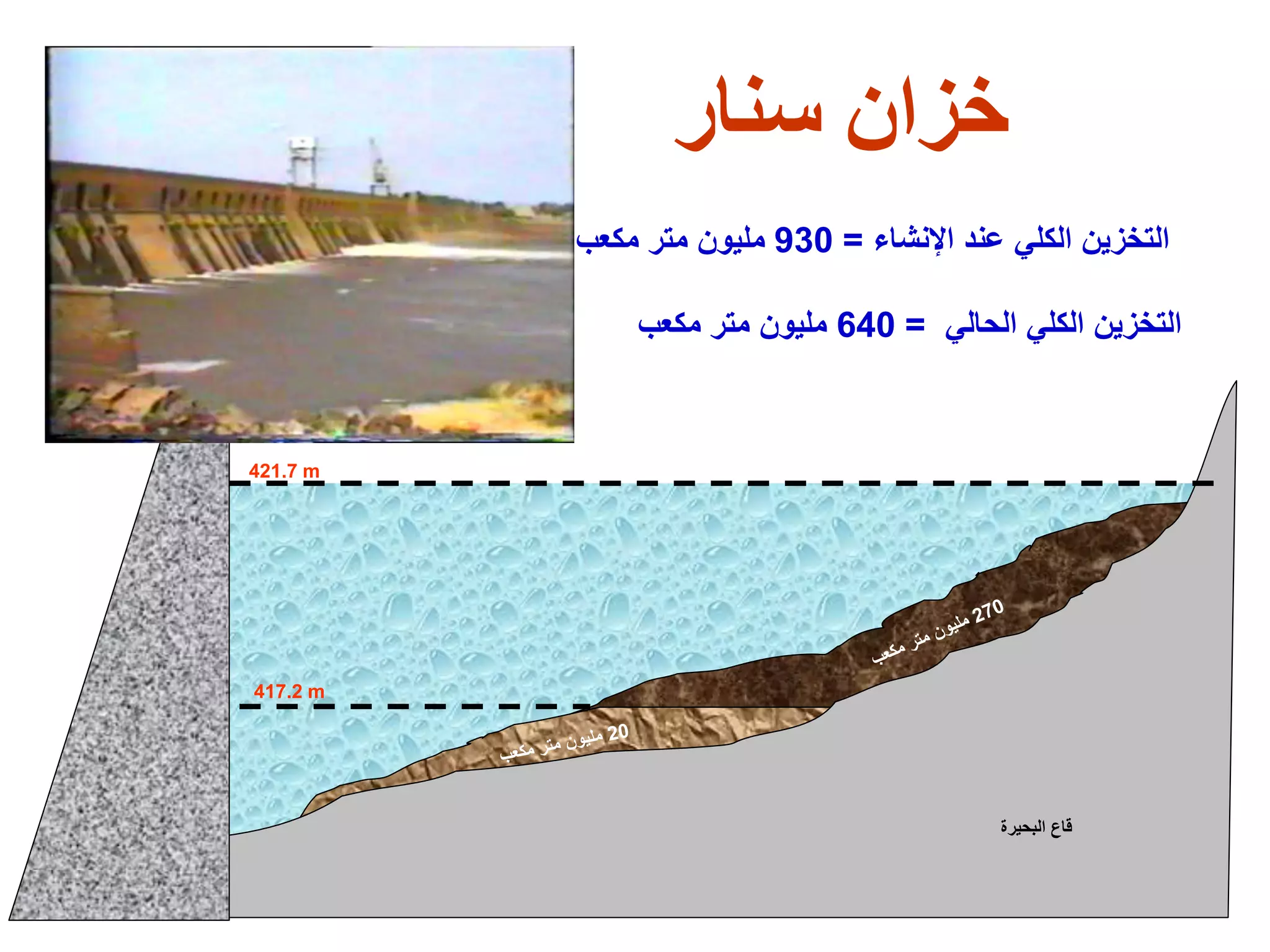
‫اإلنشاء‬ ‫عند‬ ‫الكلي‬ ‫التخزين‬
=
930
‫مكعب‬ ‫متر‬ ‫مليون‬
‫الحالي‬ ‫الكلي‬ ‫التخزين‬
=
640
‫مكعب‬ ‫متر‬ ‫مليون‬
‫سنار‬ ‫خزان‬
421.7 m
417.2 m
‫البحيرة‬ ‫قاع‬
Sedimentation problems in irrigation canals
Sediment load and water release in Gezira Main Canal
Sediment load and water release at the off-take of
Gezira Main Canal at Sennar between July and October
for the last 16 years
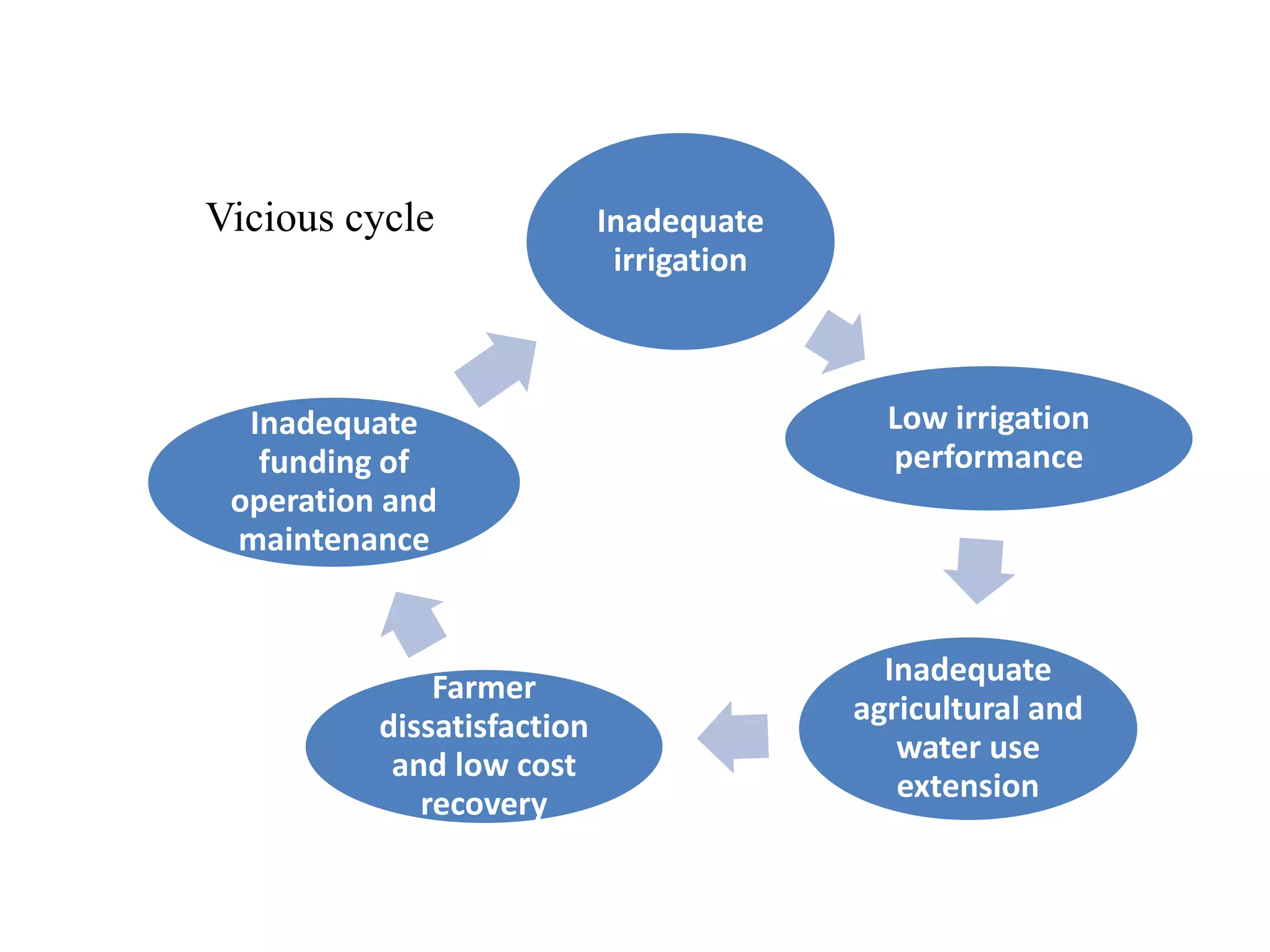
Inadequate
irrigation
Low irrigation
performance
Inadequate
agricultural and
water use
extension
Farmer
dissatisfaction
and low cost
recovery
Inadequate
funding of
operation and
maintenance
Vicious cycle
‫المياه‬ ‫ونوعية‬ ‫كمية‬ ‫تواجة‬ ‫التي‬ ‫التحديات‬
•
‫المياه‬ ‫مصادر‬ ‫بقاء‬ ‫مع‬ ‫االرضية‬ ‫الكرة‬ ‫سكان‬ ‫عدد‬ ‫ارتفاع‬
‫محدود‬
•
‫مصادر‬ ‫تلوث‬
‫المياه‬
:

‫التلوث‬
‫الطبيعي‬

‫التلوث‬
‫ال‬
‫كيميائي‬

‫ال‬ ‫التلوث‬
‫حراري‬

‫االشعاعي‬ ‫التلوث‬
•
‫المناخية‬ ‫التغيرات‬
‫المناخية‬ ‫التغييرات‬
.1
‫الحرارة‬ ‫درجات‬ ‫إرتفاع‬
.2
‫الكربون‬ ‫أكسيد‬ ‫ثاني‬ ‫إرتفاع‬
.3
‫الجفاف‬
.4
‫السيول‬ ‫و‬ ‫الفيضانات‬
.5
‫األعاصير‬
(Hurricanes)
.6
‫الحرائق‬
.7
‫البحار‬ ‫مناسيب‬ ‫وإرتفاع‬ ‫الثلوج‬ ‫ذوبان‬
Flash Floods in the Western Sudan
Flash Floods in the Northern Sudan (2010)
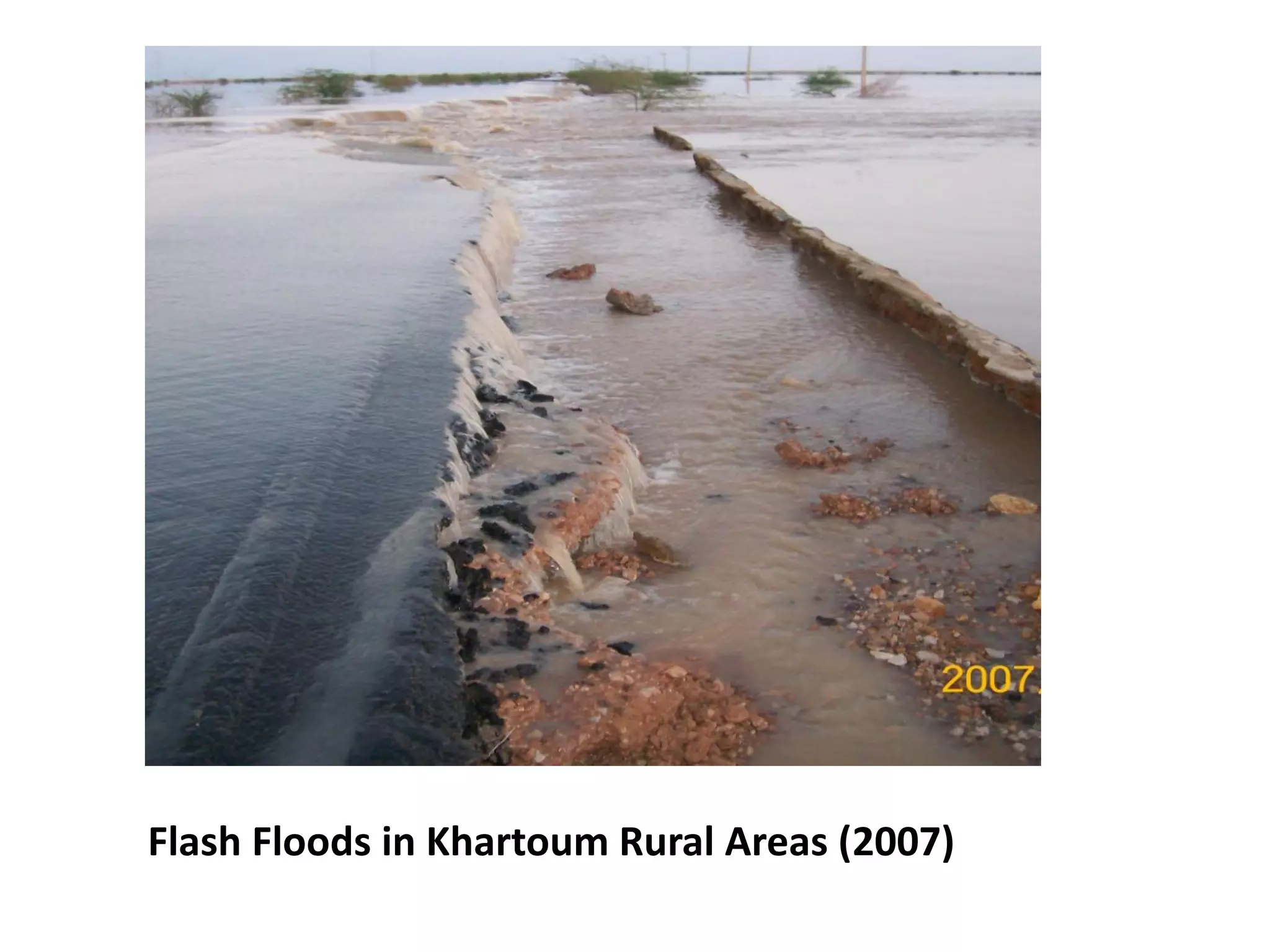
Flash Floods in Khartoum Rural Areas (2007)
47
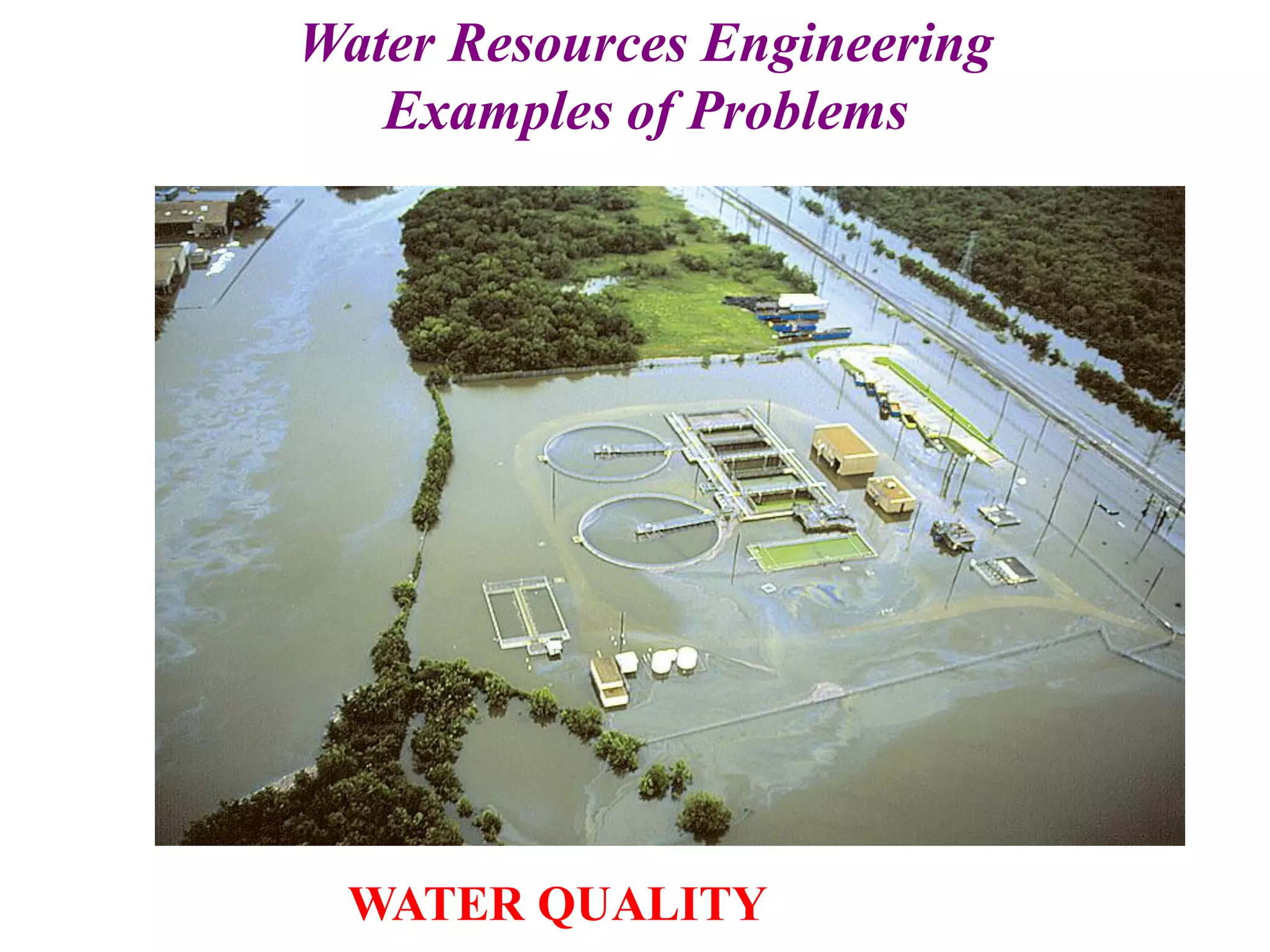
Water Resources Engineering
Examples of Problems
WATER QUALITY
Hurricanes
‫األعاصير‬
Drought
and
Famine
Erosion
Sand Intrusion in the Nile
1. Introduction Environmental Hydrology & Hydraulics.pdf

1. Introduction Environmental Hydrology & Hydraulics.pdf

  • 1.
  • 2.
    • Objective ofthe course: To understand the principals of hydrology and hydraulics as it relates to design and operation of environmental engineering systems.
  • 3.
  • 4.
    The hydrology hastwo specific goals: (i) To introduce students to basic concepts of:  ( Surface Water Hydrology) ‫هايدرولوجيا‬ ‫السطحية‬ ‫المياه‬  ( Ground Water Hydrology) ‫هايدرولوجيا‬ ‫الجوفية‬ ‫المياه‬ (ii)To develop analytical skills relevant to the areas mentioned in (i) above.
  • 5.
    1. Rainfall Estimations 2.Infiltration Estimations 3. Rainfall-Runoff Relationships: a) The Rational Method b) The Hydrograph Method c) Unit Hydrograph Method iSurface Water Hydrology
  • 6.
    t4. Flood Routing a)Reservoir Routing Method b) Channel Routing Method
  • 7.
    References : 1- V.T.Chow, D. R. Maidment, Mays : “Applied Hydrology” 2- E.M. Wilson, "Engineering Hydrology," 3- Elizabeth , " Hydrology for Engineers"
  • 8.
    Defining Hydrology  ‫الهايدرولوجيا؟‬ ‫تعريف‬  ‫أبسطها‬‫تعريفات‬ ‫عدة‬ ‫هناك‬ : .1 ” ‫المياه‬ ‫علم‬ ‫هي‬ ‫الهايدرولوجيا‬ “ .2 ” ‫وتحت‬ ‫على‬ ‫و‬ ‫فوق‬ ‫المياه‬ ‫دراسة‬ ‫هي‬ ‫الهايدرولوجيا‬ ‫األرض‬ “ .3 ” ‫إستغالل‬ ‫و‬ ‫المائية‬ ‫الموارد‬ ‫دراسة‬ ‫هي‬ ‫الهايدرولوجيا‬ ‫ها‬ ‫األمثل‬ ‫اإلستغالل‬ “ “The study of the waters of the Earth”
  • 9.
    Defining Hydrology  Waterin solid, liquid and vapour forms  Water’s origins and destinations  Availability, distribution, utilisation of water  Chemical and physical properties  Interaction with the physical, biological and human environment “The study of the water of the Earth
  • 10.
    Applications of Hydrology •Water supply design and operation for industrial uses • Provision of drinking water supply of adequate quantity and quality • Hydropower generation • Irrigation and drainage design • Hydraulic structures (dams, irrigation structures, road culverts and bridges) • Navigation • Water quality aspects • Waste water management
  • 11.
    Applications of Hydrology Conservation of wetland and other habitats  Anticipating effects of changes to the use of land  understanding of Earth System including climate
  • 12.
    Applications related towater problems • Flood early warning and flood management • Drought prediction and management • Erosion and Sedimentation • Pollution control • Trans-boundary Conflicts
  • 13.
    The Hydrologic Cycle 10 0 P r e c i p i t a t i o n o n l a n d Infiltration Water table Groundwater flow 1 Groundwater discharge 38 Surface discharge 61 Evaporation from land 39 Moisture over land 385 Precipitation on ocean 424 Evaporation from ocean Surface runoff Impervious strata Groundwater Recharge Precipitation Snow melt
  • 14.
    Precipitation Water on SurfaceOverland Flow Channel Flow The Hydrologic Cycle Ground Water Ground Water Flow Ocean Reservoir Atmosphere Evaporation Evapotranspiration Evaporation
  • 15.
  • 16.
    Bedrock Confined groundwater Confinedaquifer Aquiclude Unconfined aquifer Unconfined groundwater Groundwater table Stream (discharge area) Spring (discharge area) Flowing well Hydrological Processes Focusing on Groundwater flow system Recharge dominant area Recharge dominant area Recharge  Flow / Storage / Quality  Discharge (residence time)
  • 17.
    Interaction between groundwater andsurface water ‫السطحية‬ ‫المياه‬ ‫و‬ ‫الجوفية‬ ‫المياه‬ ‫بين‬ ‫التفاعل‬
  • 18.
    Transboundary Water Issues( ‫للحدود‬ ‫العابرة‬ ‫المياه‬ ‫قضايا‬ ) - Surface Water and Groundwater- 18
  • 19.
    • Integrated riverbasin management is an indispensable approach and highly needed to satisfy the demand of D/S countries
  • 20.
  • 21.
    Global Hydrological Cycle P(111) ET (71) P (385) E (425) Atmosphere (13) Net Ocean to Continent Flux (40) x 103 km3 / year Ocean (1 350 000) Groundwater (8500) Snow & Ice (27 500) Lakes (205) Rivers (1.7) RO (40)
  • 22.
    Major Hydrologic Processes •Precipitation (radar or rain gage) • Evaporation or ET (loss to atmosphere) • Infiltration (loss to subsurface soils) • Overland flow (sheet flow toward nearest stream) • Streamflow (measured flow at stream gage) • Ground water flow in wells • Water quality and contaminant transport
  • 24.
    Africa – Aridand Semi Arid Zones
  • 25.
  • 26.
  • 27.
  • 28.
    1941 - 1970 200mm 1971 - 2010 500 mm 1971 - 2010 1941 - 1970
  • 29.
    Climate change Annual Rainfall(mm) in Sinkat 0 50 100 150 200 250 300 50 51 52 53 54 55 56 57 58 59 60 61 62 63 64 65 66 67 68 69 70 71 72 73 74 75 76 77 80 81 82
  • 30.
    Summary of availablewaters in Sudan Water Resources Quantity (bcm) Constraints Sudan present share from the Nile Waters Agreement 20.5 Seasonal pattern coupled with limited storage vessels. Expected to be shared with riparian. Wadis Waters 5 to 7 Highly variable, short duration flows which are difficult to monitor or harvest. Some are shared with neighbors Renewable Groundwaters 4.0 Deep water entailing high cost of pumping. Remote areas of weak infrastructure Present Total 30.0 Expected from reclamation of swamps 6.0 Capital investment need with considerable social and environmental cost. Total 35.5 to 37
  • 31.
  • 32.
    ‫اإلنشاء‬ ‫عند‬ ‫الكلي‬‫التخزين‬ = 1300 ‫مكعب‬ ‫متر‬ ‫مليون‬ ‫الحالي‬ ‫الكلي‬ ‫التخزين‬ = 600 ‫تقريبا‬ ‫مكعب‬ ‫متر‬ ‫مليون‬ ‫القربة‬ ‫خشم‬ ‫خزان‬ Sedimentation and Erosion
  • 33.
    ‫اإلنشاء‬ ‫عند‬ ‫الكلي‬‫التخزين‬ = 3200 ‫مكعب‬ ‫متر‬ ‫مليون‬ ‫الحالي‬ ‫الكلي‬ ‫التخزين‬ = 2100 ‫مكعب‬ ‫متر‬ ‫مليون‬ ‫الروصيرص‬ ‫خزان‬ 481 m 467 m ‫مكعب‬ ‫متر‬ ‫مليون‬ 600 ‫مكعب‬ ‫متر‬ ‫مليون‬ 500 ‫البحيرة‬ ‫قاع‬
  • 34.
    ‫اإلنشاء‬ ‫عند‬ ‫الكلي‬‫التخزين‬ = 930 ‫مكعب‬ ‫متر‬ ‫مليون‬ ‫الحالي‬ ‫الكلي‬ ‫التخزين‬ = 640 ‫مكعب‬ ‫متر‬ ‫مليون‬ ‫سنار‬ ‫خزان‬ 421.7 m 417.2 m ‫البحيرة‬ ‫قاع‬
  • 35.
    Sedimentation problems inirrigation canals
  • 36.
    Sediment load andwater release in Gezira Main Canal Sediment load and water release at the off-take of Gezira Main Canal at Sennar between July and October for the last 16 years
  • 37.
    Inadequate irrigation Low irrigation performance Inadequate agricultural and wateruse extension Farmer dissatisfaction and low cost recovery Inadequate funding of operation and maintenance Vicious cycle
  • 38.
    ‫المياه‬ ‫ونوعية‬ ‫كمية‬‫تواجة‬ ‫التي‬ ‫التحديات‬ • ‫المياه‬ ‫مصادر‬ ‫بقاء‬ ‫مع‬ ‫االرضية‬ ‫الكرة‬ ‫سكان‬ ‫عدد‬ ‫ارتفاع‬ ‫محدود‬ • ‫مصادر‬ ‫تلوث‬ ‫المياه‬ :  ‫التلوث‬ ‫الطبيعي‬  ‫التلوث‬ ‫ال‬ ‫كيميائي‬  ‫ال‬ ‫التلوث‬ ‫حراري‬  ‫االشعاعي‬ ‫التلوث‬ • ‫المناخية‬ ‫التغيرات‬
  • 39.
    ‫المناخية‬ ‫التغييرات‬ .1 ‫الحرارة‬ ‫درجات‬‫إرتفاع‬ .2 ‫الكربون‬ ‫أكسيد‬ ‫ثاني‬ ‫إرتفاع‬ .3 ‫الجفاف‬ .4 ‫السيول‬ ‫و‬ ‫الفيضانات‬ .5 ‫األعاصير‬ (Hurricanes) .6 ‫الحرائق‬ .7 ‫البحار‬ ‫مناسيب‬ ‫وإرتفاع‬ ‫الثلوج‬ ‫ذوبان‬
  • 40.
    Flash Floods inthe Western Sudan
  • 41.
    Flash Floods inthe Northern Sudan (2010)
  • 42.
    Flash Floods inKhartoum Rural Areas (2007)
  • 43.
    Flash Floods inKhartoum Rural Areas (2007)
  • 44.
    Flash Floods inKhartoum Rural Areas (2007)
  • 45.
    Flash Floods inKhartoum Rural Areas (2007)
  • 47.
  • 48.
    Water Resources Engineering Examplesof Problems WATER QUALITY
  • 49.
  • 52.
  • 53.
  • 54.