Md. I. A. Ansari
Department of Agricultural Engineering
(e-mail: irfan26200@yahoo.com)
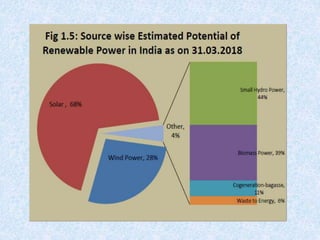
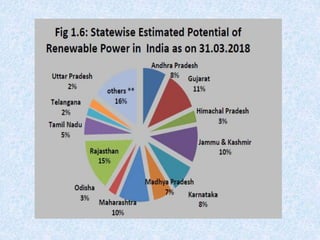
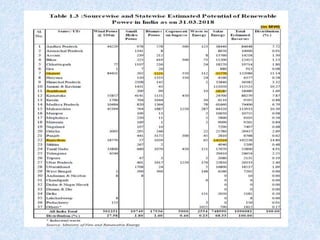
• The geographic distribution of the
estimated potential of renewable power as
on31.03.2018 reveals that Rajasthan has
the highest share of about 15%
(162238MW), followed by Gujarat with
11% share 122086 MW) and Maharashtra
with10% share (113933MW), mainly on
account of solar power potential.
•
• Solar energy is the energy of the future as it is practically
inexhaustible and it is green and clean source of energy.
• There are about 300 clear sunny days in a year in most
parts of the country.
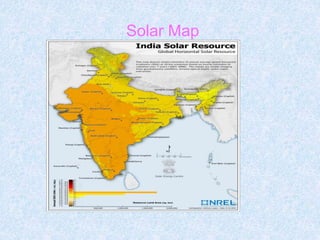
• Most parts of India receive good solar radiation 4- 7
kWh/sq. m/day
• The average solar radiation incident over India is about
5.5 kWh / sq. meter/day over a horizontal surface.
• Rajasthan receives maximum solar radiation intensity in
India.
• Rajasthan has more than 325 sunny days in a year with
solar radiation of about 6-7Kwh/sq-m/day.
• Gujarat receives second largest amount of solar
radiation in India.
• Gujarat receives 5.5 to 6 Kwh/sq.m/day with 300 sunny
days/year.
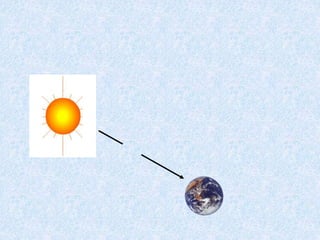
• The amount of solar energy coming to the
surface of earth is 1000 watts per square
meter, which is about 32.8 million MW
every second on the Indian land mass.
• Gujarat is a leader in solar power
generation in the country.
• The State of Gujarat has commissioned
Asia’s largest solar park at Charanka
village for power generation (1100 MW ).
• The State of Jharkhand is endowed with
high solar radiation with around 300 days of
clear sun.
• The state offers good sites having potential
of more than 4.5 to 5.5 kwh/m2/day solar
insolation which is enough for installation of
solar based power projects and other
activities.
Annual Average value of Solar Irradiation in
Ranchi : 4.78 (kWh/m2/day)
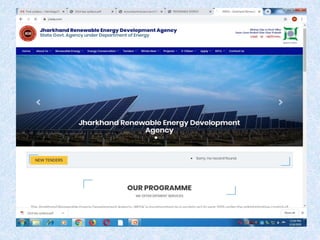
The Jharkhand Renewable Energy Development Agency
(JREDA) has been appointed as the nodal agency to
implement the policy that aims at taping solar power
potential in the state.
Solar Map
Solar Energy conversion
1. Solar energy into electricity (Direct)
2. Solar energy into heat energy (Indirect)
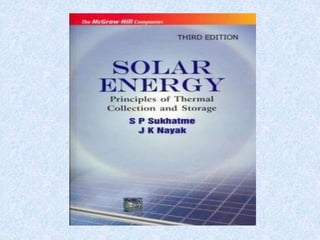
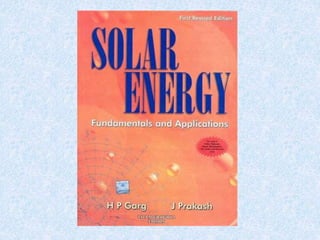
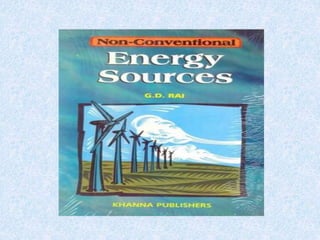
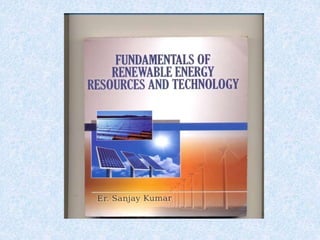
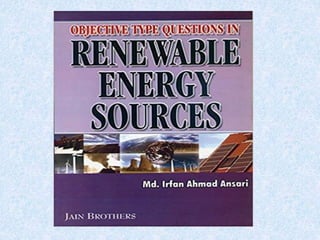
Suggested Books
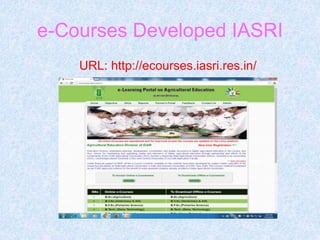
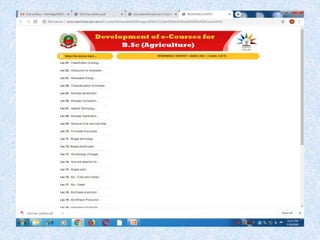
e-Courses Developed IASRI
URL: http://ecourses.iasri.res.in/
Related Journals
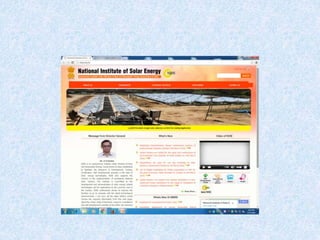
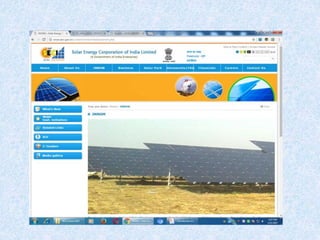
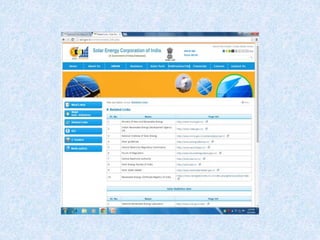
Related Ministry/R&D
Institutes/Organizations
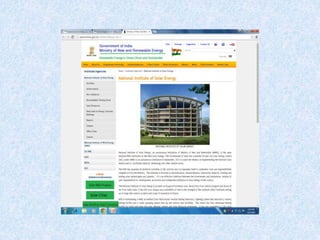
• Jawaharlal Nehru National Solar Mission
Tata Energy Research Institute
1 introduction
1 introduction
1 introduction
1 introduction
1 introduction
1 introduction
1 introduction
1 introduction
1 introduction
1 introduction
1 introduction

1 introduction

  • 1.
    Md. I. A.Ansari Department of Agricultural Engineering (e-mail: irfan26200@yahoo.com)
  • 3.
    • The geographicdistribution of the estimated potential of renewable power as on31.03.2018 reveals that Rajasthan has the highest share of about 15% (162238MW), followed by Gujarat with 11% share 122086 MW) and Maharashtra with10% share (113933MW), mainly on account of solar power potential. •
  • 9.
    • Solar energyis the energy of the future as it is practically inexhaustible and it is green and clean source of energy. • There are about 300 clear sunny days in a year in most parts of the country. • Most parts of India receive good solar radiation 4- 7 kWh/sq. m/day • The average solar radiation incident over India is about 5.5 kWh / sq. meter/day over a horizontal surface. • Rajasthan receives maximum solar radiation intensity in India. • Rajasthan has more than 325 sunny days in a year with solar radiation of about 6-7Kwh/sq-m/day. • Gujarat receives second largest amount of solar radiation in India. • Gujarat receives 5.5 to 6 Kwh/sq.m/day with 300 sunny days/year.
  • 10.
    • The amountof solar energy coming to the surface of earth is 1000 watts per square meter, which is about 32.8 million MW every second on the Indian land mass. • Gujarat is a leader in solar power generation in the country. • The State of Gujarat has commissioned Asia’s largest solar park at Charanka village for power generation (1100 MW ).
  • 11.
    • The Stateof Jharkhand is endowed with high solar radiation with around 300 days of clear sun. • The state offers good sites having potential of more than 4.5 to 5.5 kwh/m2/day solar insolation which is enough for installation of solar based power projects and other activities. Annual Average value of Solar Irradiation in Ranchi : 4.78 (kWh/m2/day) The Jharkhand Renewable Energy Development Agency (JREDA) has been appointed as the nodal agency to implement the policy that aims at taping solar power potential in the state.
  • 12.
  • 13.
    Solar Energy conversion 1.Solar energy into electricity (Direct) 2. Solar energy into heat energy (Indirect)
  • 14.
  • 20.
    e-Courses Developed IASRI URL:http://ecourses.iasri.res.in/
  • 23.
  • 28.
  • 29.
    • Jawaharlal NehruNational Solar Mission
  • 42.