Course Name- Production Technology for Ornamental Crops, MAP
and Landscaping
Course Code- 20014400
B.Sc. (Ag.) IV Sem. (Production Technology for Ornamental Crops, MAP and Landscaping)
Presented By- Dr. Mahendra Kr. Yadav
 Identify different types of ornamental and medicinal crops.
 Examine various principles of landscaping, uses of landscape trees,
shrubs and climbers, production technology of important
ornamental crops, etc.
 Determine about Demonstrate various Package of practices for loose
flowers and their transportation, storage house and required
condition for cut and loose flower.
 Construct about the various problems with the production
technology of medicinal and aromatic plants.
 Importance of Processing and value addition in ornamental crops
and MAPs produce.
Course Objectives
B.Sc. (Ag.) IV Sem. (Production Technology for Ornamental Crops, MAP and Landscaping)
Processing and value addition in ornamental crops and
MAPs produce.
B.Sc. (Ag.) IV Sem. (Production Technology for Ornamental Crops, MAP and Landscaping)
A) DRY FLOWERS
Processes in dry flower making
A) DRYING
i. Air drying
 Tie the flowers in loose bunches and hang upside down until they are dry in a room with
good ventilation and darkness. It is the ideal method for seedpods, grasses and many flowers
having more cellulose material. Crisp textured flowers like Helipterum, Helichrysum and
Limonium could easily be dried either by hanging or positioning them erect in containers for
1-2 weeks. Gomphrena flowers from half to full bloom maturity take 7-9 days for air drying
and roses take 5-10 days.
 Acacia, amaranths, castor flowers, citrus leaves, cockscomb, corn flower, fennel, fern,
golden rod, gypsophila, grasses, herbs, ear heads of wheat, oat and rye, hydrangea, lavender,
protea, marigold, poppy seed pods, physalis, peppers, roses, statice, thistle, yarrow and
yucca can be dried by this method.
B.Sc. (Ag.) IV Sem. (Production Technology for Ornamental Crops, MAP and Landscaping)
ii. Sun drying
 Plant material is embedded in drying medium (sand) in a container and exposed to the sun
daily to facilitate rapid dehydration. In India, open sun drying is followed for drying many
flowers. Flowers like small zinnias, marigolds, pansies, and pompon chrysanthemum
embedded in sand upside down fashion and kept in the Sun would dry in a day or two. For
Gomphrena, Zinnia and French marigold it would take 3-4 days. Open sun drying is followed
for corn flowers, custard apple (small), Casuarina pods, mini coconut, eucalyptus, evergreen
cones, gomphrena, gourds, pomegranates, poppy pods, lotus pods, typha heads, palm leaves,
grass ear heads.
iii. Oven drying
 Electrically operated hot air oven at a controlled temperature of 40-50 oC is used for drying
flowers in an embedded condition. Chrysanthemum, dombeya, gerbera, and limonium take 48
hours at 45-49 C, French marigold takes 72 hours, African marigold takes 96 hours and

Nymphaea takes 120 hours for drying. China aster, delphinium, rose buds and small flowers,
and zinnia take 48 hours at 40 - 44 oC, medium and large roses take 72 hours and very large
flowers take 96 hours in 40 - 44 oc.
B.Sc. (Ag.) IV Sem. (Production Technology for Ornamental Crops, MAP and Landscaping)
iv. Embedding method
Embedding the flowers in a granular, desiccating material is probably the most
commonly used method and many consider it the best all around method. Several
materials may be used, and they vary in cost and the results that they produce.
v. Microwave oven drying
Electronically produced microwaves liberate moisture from organic substances by
agitating the water molecule. It is fast and the results are good. The flowers has to be
embedded in silica gel medium in a microwave safe open container along with a small
cup with water nearby. Standing time of 10 minutes to few hours is needed after the
drying for best results.
B.Sc. (Ag.) IV Sem. (Production Technology for Ornamental Crops, MAP and Landscaping)
vi. Glycerin drying (glycerinization)
‘Glycerinizing’ is the term used in the ornamental cut flowers and foliage industry to
describe the treatment of fresh plant materials with a hygroscopic (water attracting)
chemical with the objective of retaining the suppleness of the plant materials. Foliage
treated with glycerin keeps almost indefinitely and remains pliable. Glycerin preserves
foliage by replacing the natural moisture present in the leaf with a substance that
maintains the leaf form, texture and sometimes the colour. Fresh and fairly matured
foliage is ideal for glycerining. About 50 per cent of most plant fresh weight is water,
but brittleness is usually only a problem if the water content falls below 10 per cent.
B.Sc. (Ag.) IV Sem. (Production Technology for Ornamental Crops, MAP and Landscaping)
vii. Freeze drying
Freeze dried flowers are fresh flowers that have been specially dried to preserve their
natural shape, colour and beauty. Freeze drying is accomplished by a process called
sublimation. It requires a special freeze-drying machine. It involves first freezing the
flowers at (-) 10 oC for at least 12 hours. A vacuum pump slowly pulls the water out
of the flowers as a vapor in one chamber, and then the vapor condenses as ice in
another chamber. Because of this process, the shape and natural color of the flower is
maintained. For Roses it takes 15 – 17 days and for other flowers normally 10 – 12
days. Major flowers dried by this method are roses, carnation, bridal bouquets etc.
B.Sc. (Ag.) IV Sem. (Production Technology for Ornamental Crops, MAP and Landscaping)
viii. Press drying
Flowers and foliage are placed in-between two folds of newspaper sheets or blotting
paper and these sheets are kept one over other and corrugated boards of the same size
are placed in between the folded sheets so as to allow the water vapour to escape. The
whole bundle is then placed in the plant press, its screws tightened. After 24 hours the
bundle is removed to an electric hot air oven for 24 hours at 40-45 oC. The following
flowers and foliage are dried by this method. Flowers: Candytuft, Chrysanthemum,
Euphorbia, Lantana, Larkspur, Mussaenda, Pansy, Pentas, Rose and Verbena, and
Foliage: Thuja, Taxodium, Marigold, Grevillea, Rose, Ferns, Casuarina, Silver oak and
Grasses
B.Sc. (Ag.) IV Sem. (Production Technology for Ornamental Crops, MAP and Landscaping)
(B) Bleaching
Bleached ornamental plant material provides a striking contrast when arranged with
dried or dyed flowers. Bleaching also allows the use of dyes for colouring. Oxidative
(Hypochlorite, Chlorite and Peroxide) and reductive bleaching chemicals (Sulphite
and Borohydride) are used for bleaching ornamental flowers and foliage. Profitability
is depended upon attainment of high white quality and on cost efficient utilization of
expensive bleaching chemicals. Sodium Chlorite is an excellent bleaching agent
because it is relatively selective for lignin without damaging fibre. Optimum pH (4.5-
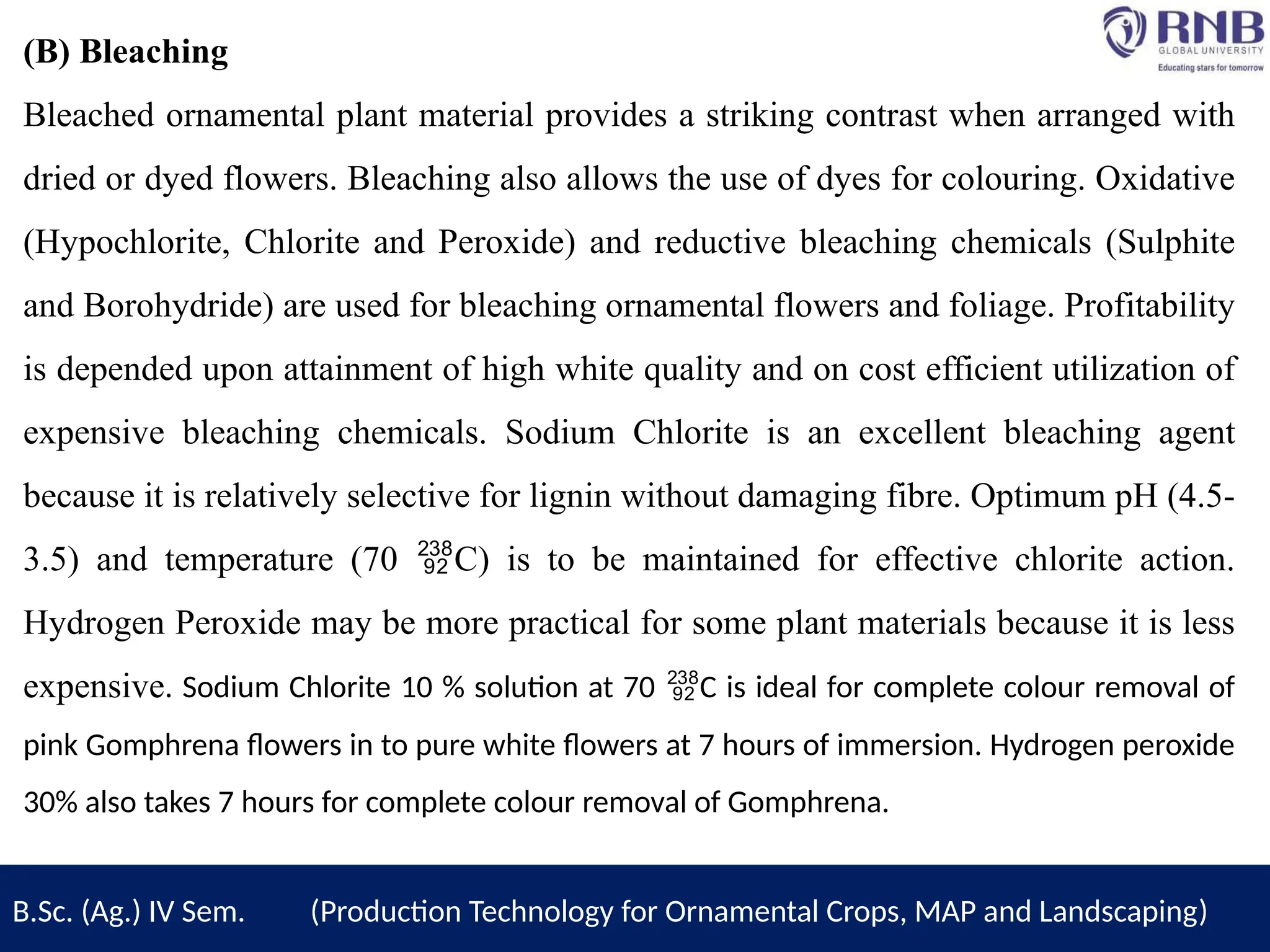
3.5) and temperature (70 C) is to be maintained for effective chlorite action.

Hydrogen Peroxide may be more practical for some plant materials because it is less
expensive. Sodium Chlorite 10 % solution at 70 C is ideal for complete colour removal of

pink Gomphrena flowers in to pure white flowers at 7 hours of immersion. Hydrogen peroxide
30% also takes 7 hours for complete colour removal of Gomphrena.
B.Sc. (Ag.) IV Sem. (Production Technology for Ornamental Crops, MAP and Landscaping)
(3) Dyeing
Though preserving flowers with their natural colour is more appealing, some plant
parts need artificial dyeing to improve the colour. Systemic dyes are available for use.
They are acidic-anionic dyes, which are combined with water and glycerin to form a
preservation solution that is absorbed by fresh cut flowers and foliage through the
stem of the plant. As the water evaporates, it leaves behind the dye and glycerin for
our desired colour. Normally 1.5 ml to 5 ml dye/l of solution is prepared. Colour take
and preservation will take 2-8 days.
B.Sc. (Ag.) IV Sem. (Production Technology for Ornamental Crops, MAP and Landscaping)
Distillation of Essential Oil
1. WATER DISTILLATION
 This is simple method in which plant material is distilled comes in direct contact
with boiling water in a distillation unit. This method is advantageous for certain
material when they are in powered form. But this method is not good for material
containing saponifiable or high boiling point constituents.
 Delicate flowers such as roses and orange blossoms would clump together when
introduced to steam in the distillation process. The water protects the extracted oil
from overheating. The condensed liquids cool down and separate from each other.
The remaining water, which can sometimes be fragrant, is referred to by several
names including hydrolate, hydrosol, herbal water, essential water, floral water, or
herbal distillate.
B.Sc. (Ag.) IV Sem. (Production Technology for Ornamental Crops, MAP and Landscaping)
2. STEAM DISTILLATION PROCESS
A large container called a Still, which is usually made of stainless steel, containing the plant
material has steam added to it. Through an inlet, steam is injected through the plant material
containing the desired oils, releasing the plant’s aromatic molecules and turning them into
vapor. In this method steam does not penetrate the cell membranes and the essential oil i
vapouried only after diffusing out as an aqueous solution through the cell membrane. The
vaporized plant compounds travel to the condensation flask or the Condenser. Here, two
separate pipes make it possible for hot water to exit and for cold water to enter the
Condenser. This makes the vapor cool back into liquid form. The aromatic liquid by-product
drops from the Condenser and collects inside a receptacle underneath it, which is called a
Separator. Because water and oil do not mix, the essential oil floats on top of the water.
From here, it is siphoned off. Quality of oil is also good in this method. (Some essential oils
are heavier than water, such as clove essential oil, so they are found at the bottom of the
Separator.)
B.Sc. (Ag.) IV Sem. (Production Technology for Ornamental Crops, MAP and Landscaping)
1. Solvent extraction
 This method employs food grade solvents like hexane and ethanol to isolate
essential oils from plant material. It is best suited for plant materials that yield low
amounts of essential oil, that are largely resinous, or that are delicate aromatics
unable to withstand the pressure and distress of steam distillation. This method also
produces a finer fragrance than any type of distillation method.
 Through this process, the non-volatile plant material such as waxes and pigments,
are also extracted and sometimes removed through other processes. Once the plant
material has been treated with the solvent, it produces a waxy aromatic compound
called a "concrete." When this concrete substance is mixed with alcohol, the oil
particles are released. The aforementioned chemicals used in the process then
remain in the oil and the oil is used in perfumes by the perfume industry or for
aromatherapy purposes.

Processing and value addition in ornamental crops and MAPs produce.pptx

  • 1.
    Course Name- ProductionTechnology for Ornamental Crops, MAP and Landscaping Course Code- 20014400 B.Sc. (Ag.) IV Sem. (Production Technology for Ornamental Crops, MAP and Landscaping) Presented By- Dr. Mahendra Kr. Yadav
  • 2.
     Identify differenttypes of ornamental and medicinal crops.  Examine various principles of landscaping, uses of landscape trees, shrubs and climbers, production technology of important ornamental crops, etc.  Determine about Demonstrate various Package of practices for loose flowers and their transportation, storage house and required condition for cut and loose flower.  Construct about the various problems with the production technology of medicinal and aromatic plants.  Importance of Processing and value addition in ornamental crops and MAPs produce. Course Objectives B.Sc. (Ag.) IV Sem. (Production Technology for Ornamental Crops, MAP and Landscaping)
  • 3.
    Processing and valueaddition in ornamental crops and MAPs produce. B.Sc. (Ag.) IV Sem. (Production Technology for Ornamental Crops, MAP and Landscaping)
  • 4.
    A) DRY FLOWERS Processesin dry flower making A) DRYING i. Air drying  Tie the flowers in loose bunches and hang upside down until they are dry in a room with good ventilation and darkness. It is the ideal method for seedpods, grasses and many flowers having more cellulose material. Crisp textured flowers like Helipterum, Helichrysum and Limonium could easily be dried either by hanging or positioning them erect in containers for 1-2 weeks. Gomphrena flowers from half to full bloom maturity take 7-9 days for air drying and roses take 5-10 days.  Acacia, amaranths, castor flowers, citrus leaves, cockscomb, corn flower, fennel, fern, golden rod, gypsophila, grasses, herbs, ear heads of wheat, oat and rye, hydrangea, lavender, protea, marigold, poppy seed pods, physalis, peppers, roses, statice, thistle, yarrow and yucca can be dried by this method. B.Sc. (Ag.) IV Sem. (Production Technology for Ornamental Crops, MAP and Landscaping)
  • 5.
    ii. Sun drying Plant material is embedded in drying medium (sand) in a container and exposed to the sun daily to facilitate rapid dehydration. In India, open sun drying is followed for drying many flowers. Flowers like small zinnias, marigolds, pansies, and pompon chrysanthemum embedded in sand upside down fashion and kept in the Sun would dry in a day or two. For Gomphrena, Zinnia and French marigold it would take 3-4 days. Open sun drying is followed for corn flowers, custard apple (small), Casuarina pods, mini coconut, eucalyptus, evergreen cones, gomphrena, gourds, pomegranates, poppy pods, lotus pods, typha heads, palm leaves, grass ear heads. iii. Oven drying  Electrically operated hot air oven at a controlled temperature of 40-50 oC is used for drying flowers in an embedded condition. Chrysanthemum, dombeya, gerbera, and limonium take 48 hours at 45-49 C, French marigold takes 72 hours, African marigold takes 96 hours and  Nymphaea takes 120 hours for drying. China aster, delphinium, rose buds and small flowers, and zinnia take 48 hours at 40 - 44 oC, medium and large roses take 72 hours and very large flowers take 96 hours in 40 - 44 oc. B.Sc. (Ag.) IV Sem. (Production Technology for Ornamental Crops, MAP and Landscaping)
  • 6.
    iv. Embedding method Embeddingthe flowers in a granular, desiccating material is probably the most commonly used method and many consider it the best all around method. Several materials may be used, and they vary in cost and the results that they produce. v. Microwave oven drying Electronically produced microwaves liberate moisture from organic substances by agitating the water molecule. It is fast and the results are good. The flowers has to be embedded in silica gel medium in a microwave safe open container along with a small cup with water nearby. Standing time of 10 minutes to few hours is needed after the drying for best results. B.Sc. (Ag.) IV Sem. (Production Technology for Ornamental Crops, MAP and Landscaping)
  • 7.
    vi. Glycerin drying(glycerinization) ‘Glycerinizing’ is the term used in the ornamental cut flowers and foliage industry to describe the treatment of fresh plant materials with a hygroscopic (water attracting) chemical with the objective of retaining the suppleness of the plant materials. Foliage treated with glycerin keeps almost indefinitely and remains pliable. Glycerin preserves foliage by replacing the natural moisture present in the leaf with a substance that maintains the leaf form, texture and sometimes the colour. Fresh and fairly matured foliage is ideal for glycerining. About 50 per cent of most plant fresh weight is water, but brittleness is usually only a problem if the water content falls below 10 per cent. B.Sc. (Ag.) IV Sem. (Production Technology for Ornamental Crops, MAP and Landscaping)
  • 8.
    vii. Freeze drying Freezedried flowers are fresh flowers that have been specially dried to preserve their natural shape, colour and beauty. Freeze drying is accomplished by a process called sublimation. It requires a special freeze-drying machine. It involves first freezing the flowers at (-) 10 oC for at least 12 hours. A vacuum pump slowly pulls the water out of the flowers as a vapor in one chamber, and then the vapor condenses as ice in another chamber. Because of this process, the shape and natural color of the flower is maintained. For Roses it takes 15 – 17 days and for other flowers normally 10 – 12 days. Major flowers dried by this method are roses, carnation, bridal bouquets etc. B.Sc. (Ag.) IV Sem. (Production Technology for Ornamental Crops, MAP and Landscaping)
  • 9.
    viii. Press drying Flowersand foliage are placed in-between two folds of newspaper sheets or blotting paper and these sheets are kept one over other and corrugated boards of the same size are placed in between the folded sheets so as to allow the water vapour to escape. The whole bundle is then placed in the plant press, its screws tightened. After 24 hours the bundle is removed to an electric hot air oven for 24 hours at 40-45 oC. The following flowers and foliage are dried by this method. Flowers: Candytuft, Chrysanthemum, Euphorbia, Lantana, Larkspur, Mussaenda, Pansy, Pentas, Rose and Verbena, and Foliage: Thuja, Taxodium, Marigold, Grevillea, Rose, Ferns, Casuarina, Silver oak and Grasses B.Sc. (Ag.) IV Sem. (Production Technology for Ornamental Crops, MAP and Landscaping)
  • 10.
    (B) Bleaching Bleached ornamentalplant material provides a striking contrast when arranged with dried or dyed flowers. Bleaching also allows the use of dyes for colouring. Oxidative (Hypochlorite, Chlorite and Peroxide) and reductive bleaching chemicals (Sulphite and Borohydride) are used for bleaching ornamental flowers and foliage. Profitability is depended upon attainment of high white quality and on cost efficient utilization of expensive bleaching chemicals. Sodium Chlorite is an excellent bleaching agent because it is relatively selective for lignin without damaging fibre. Optimum pH (4.5- 3.5) and temperature (70 C) is to be maintained for effective chlorite action.  Hydrogen Peroxide may be more practical for some plant materials because it is less expensive. Sodium Chlorite 10 % solution at 70 C is ideal for complete colour removal of  pink Gomphrena flowers in to pure white flowers at 7 hours of immersion. Hydrogen peroxide 30% also takes 7 hours for complete colour removal of Gomphrena. B.Sc. (Ag.) IV Sem. (Production Technology for Ornamental Crops, MAP and Landscaping)
  • 11.
    (3) Dyeing Though preservingflowers with their natural colour is more appealing, some plant parts need artificial dyeing to improve the colour. Systemic dyes are available for use. They are acidic-anionic dyes, which are combined with water and glycerin to form a preservation solution that is absorbed by fresh cut flowers and foliage through the stem of the plant. As the water evaporates, it leaves behind the dye and glycerin for our desired colour. Normally 1.5 ml to 5 ml dye/l of solution is prepared. Colour take and preservation will take 2-8 days. B.Sc. (Ag.) IV Sem. (Production Technology for Ornamental Crops, MAP and Landscaping)
  • 12.
    B.Sc. (Ag.) IVSem. (Production Technology for Ornamental Crops, MAP and Landscaping) Distillation of Essential Oil 1. WATER DISTILLATION  This is simple method in which plant material is distilled comes in direct contact with boiling water in a distillation unit. This method is advantageous for certain material when they are in powered form. But this method is not good for material containing saponifiable or high boiling point constituents.  Delicate flowers such as roses and orange blossoms would clump together when introduced to steam in the distillation process. The water protects the extracted oil from overheating. The condensed liquids cool down and separate from each other. The remaining water, which can sometimes be fragrant, is referred to by several names including hydrolate, hydrosol, herbal water, essential water, floral water, or herbal distillate.
  • 13.
    B.Sc. (Ag.) IVSem. (Production Technology for Ornamental Crops, MAP and Landscaping) 2. STEAM DISTILLATION PROCESS A large container called a Still, which is usually made of stainless steel, containing the plant material has steam added to it. Through an inlet, steam is injected through the plant material containing the desired oils, releasing the plant’s aromatic molecules and turning them into vapor. In this method steam does not penetrate the cell membranes and the essential oil i vapouried only after diffusing out as an aqueous solution through the cell membrane. The vaporized plant compounds travel to the condensation flask or the Condenser. Here, two separate pipes make it possible for hot water to exit and for cold water to enter the Condenser. This makes the vapor cool back into liquid form. The aromatic liquid by-product drops from the Condenser and collects inside a receptacle underneath it, which is called a Separator. Because water and oil do not mix, the essential oil floats on top of the water. From here, it is siphoned off. Quality of oil is also good in this method. (Some essential oils are heavier than water, such as clove essential oil, so they are found at the bottom of the Separator.)
  • 14.
    B.Sc. (Ag.) IVSem. (Production Technology for Ornamental Crops, MAP and Landscaping) 1. Solvent extraction  This method employs food grade solvents like hexane and ethanol to isolate essential oils from plant material. It is best suited for plant materials that yield low amounts of essential oil, that are largely resinous, or that are delicate aromatics unable to withstand the pressure and distress of steam distillation. This method also produces a finer fragrance than any type of distillation method.  Through this process, the non-volatile plant material such as waxes and pigments, are also extracted and sometimes removed through other processes. Once the plant material has been treated with the solvent, it produces a waxy aromatic compound called a "concrete." When this concrete substance is mixed with alcohol, the oil particles are released. The aforementioned chemicals used in the process then remain in the oil and the oil is used in perfumes by the perfume industry or for aromatherapy purposes.