© LANCO Group, All Rights Reserved
SPV Power Technology in India
Satyendra Kumar
Lanco Solar, India
satyen.kumar@lancogroup.com
ASEAN-India
Workshop on Cooperation in New and Renewable Energy
05-06 Nov., 2012
Vigyan Bhawan, New Delhi
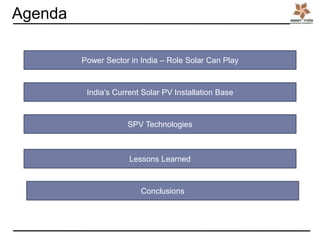
Power Sector in India – Role Solar Can Play
India’s Current Solar PV Installation Base
Agenda
SPV Technologies
Lessons Learned
Conclusions
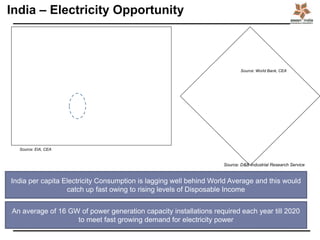
Source: World Bank, CEA
Source: EIA, CEA
India – Electricity Opportunity
India per capita Electricity Consumption is lagging well behind World Average and this would
catch up fast owing to rising levels of Disposable Income
An average of 16 GW of power generation capacity installations required each year till 2020
to meet fast growing demand for electricity power
Source: D&B Industrial Research Service
India has huge potential for solar power deployment
Source: MNRE, Edelweiss Research (As at June30, 2012
Solar Power Density in India
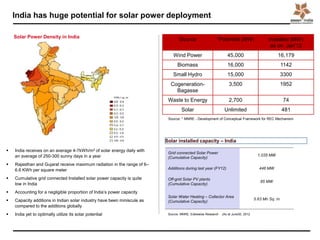
 India receives on an average 4-7kWh/m2 of solar energy daily with
an average of 250-300 sunny days in a year
 Rajasthan and Gujarat receive maximum radiation in the range of 6–
6.6 KWh per square meter
 Cumulative grid connected Installed solar power capacity is quite
low in India
 Accounting for a negligible proportion of India’s power capacity
 Capacity additions in Indian solar industry have been miniscule as
compared to the additions globally
 India yet to optimally utilize its solar potential
Grid connected Solar Power
(Cumulative Capacity)
1,035 MW
Additions during last year (FY12) 446 MW
Off-grid Solar PV plants
(Cumulative Capacity)
85 MW
Solar Water Heating – Collector Area
(Cumulative Capacity)
5.63 Mn Sq. m
Solar installed capacity – India
Source *Potential (MW) Installed (MW)
as on Jan’12
Wind Power 45,000 16,179
Biomass 16,000 1142
Small Hydro 15,000 3300
Cogeneration-
Bagasse
3,500 1952
Waste to Energy 2,700 74
Solar Unlimited 481
Source: * MNRE - Development of Conceptual Framework for REC Mechanism
India Poised to be a Major Global Contributor
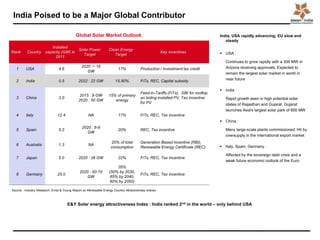
E&Y Solar energy attractiveness Index : India ranked 2nd in the world – only behind USA
Rank Country
Installed
capacity (GW) in
2011
Solar Power
Target
Clean Energy
Target
Key incentives
1 USA 4.6
2020 :~ 16
GW
17% Production / Investment tax credit
2 India 0.5 2022 : 22 GW 15.90% FiTs, REC, Capital subsidy
3 China 3.0
2015 : 9 GW
2020 : 50 GW
15% of primary
energy
Feed-in-Tariffs (FiTs), GBI for rooftop
an biding installed PV, Tax incentive
for PV
4 Italy 12.4 NA 17% FiTs, REC, Tax incentive
5 Spain 5.3
2020 : 8-9
GW
20% REC, Tax incentive
6 Australia 1.3 NA
20% of total
consumption
Generation Based Incentive (RBI),
Renewable Energy Certificate (REC)
7 Japan 5.0 2020 : 28 GW 22% FiTs, REC, Tax incentive
8 Germany 25.0
2020 : 50-70
GW
35%
(50% by 2030,
65% by 2040,
80% by 2050)
FiTs, REC, Tax incentive
India, USA rapidly advancing; EU slow and
steady
 USA :
Continues to grow rapidly with a 300 MW in
Arizona receiving approvals. Expected to
remain the largest solar market in world in
near future
 India :
Rapid growth seen in high potential solar
states of Rajasthan and Gujarat. Gujarat
launches Asia's largest solar park of 600 MW
 China :
Many large-scale plants commissioned. Hit by
oversupply in the international export market
 Italy, Spain, Germany :
Affected by the sovereign debt crisis and a
weak future economic outlook of the Euro
Global Solar Market Outlook
Source : Industry Research, Ernst & Young Report on Renewable Energy Country Attractiveness indices
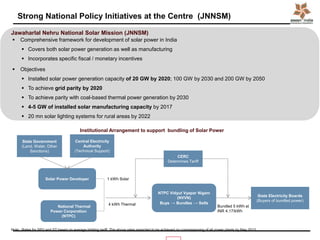
Institutional Arrangement to support bundling of Solar Power
Strong National Policy Initiatives at the Centre (JNNSM)
State Government
(Land, Water, Other
Sanctions)
Solar Power Developer
Central Electricity
Authority
(Technical Support)
National Thermal
Power Corporation
(NTPC)
NTPC Vidyut Vyapar Nigam
(NVVN)
Buys → Bundles → Sells
State Electricity Boards
(Buyers of bundled power)
CERC
Determines Tariff
1 kWh Solar
4 kWh Thermal Bundled 5 kWh at
INR 4.17/kWh
 Comprehensive framework for development of solar power in India
 Covers both solar power generation as well as manufacturing
 Incorporates specific fiscal / monetary incentives
 Objectives
 Installed solar power generation capacity of 20 GW by 2020; 100 GW by 2030 and 200 GW by 2050
 To achieve grid parity by 2020
 To achieve parity with coal-based thermal power generation by 2030
 4-5 GW of installed solar manufacturing capacity by 2017
 20 mn solar lighting systems for rural areas by 2022
Note : Rates for SPV and ST based on average bidding tariff. The above rates expected to be achieved on commissioning of all power plants by May 2013
Jawaharlal Nehru National Solar Mission (JNNSM)
Among the states, Gujarat – Leading the Way
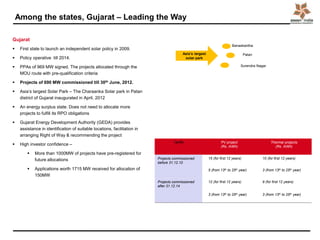
Tariffs PV project
(Rs. /kWh)
Thermal projects
(Rs. /kWh)
Projects commissioned
before 31.12.10
15 (for first 12 years) 10 (for first 12 years)
5 (from 13th to 25th year) 3 (from 13th to 25th year)
Projects commissioned
after 31.12.14
12 (for first 12 years) 9 (for first 12 years)
3 (from 13th to 25th year) 3 (from 13th to 25th year)
Gujarat
 First state to launch an independent solar policy in 2009.
 Policy operative till 2014.
 PPAs of 969 MW signed. The projects allocated through the
MOU route with pre-qualification criteria
 Projects of 690 MW commissioned till 30th June, 2012.
 Asia’s largest Solar Park – The Charaanka Solar park in Patan
district of Gujarat inaugurated in April, 2012
 An energy surplus state. Does not need to allocate more
projects to fulfill its RPO obligations
 Gujarat Energy Development Authority (GEDA) provides
assistance in identification of suitable locations, facilitation in
arranging Right of Way & recommending the project
 High investor confidence –
 More than 1000MW of projects have pre-registered for
future allocations
 Applications worth 1715 MW received for allocation of
150MW
Banaskantha
Patan
Surendra Nagar
Asia’s largest
solar park
…And other states following suit
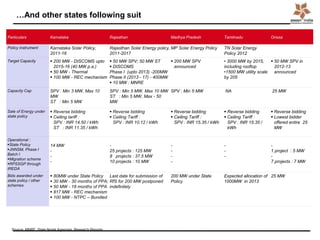
Particulars Karnataka Rajasthan Madhya Pradesh Tamilnadu Orissa
Policy instrument Karnataka Solar Policy,
2011-16
Rajasthan Solar Energy policy,
2011-2017
MP Solar Energy Policy TN Solar Energy
Policy 2012
Target Capacity  200 MW - DISCOMS upto
2015-16 (40 MW p.a.)
 50 MW - Thermal
 100 MW - REC mechanism
 50 MW SPV; 50 MW ST
 DISCOMS
Phase I (upto 2013) -200MW
Phase II (2013 - 17) - 400MW
 10 MW : MNRE
 200 MW SPV
announced
• 3000 MW by 2015,
including rooftop
•1500 MW utility scale
by 205
 50 MW SPV in
2012-13
announced
Capacity Cap SPV : Min 3 MW, Max 10
MW
ST : Min 5 MW
SPV : Min 5 MW, Max 10 MW
ST : Min 5 MW, Max - 50
MW
SPV : Min 5 MW NA 25 MW
Sale of Energy under
state policy
 Reverse bidding
 Ceiling tariff :
SPV : INR 14.50 / kWh
ST : INR 11.35 / kWh
 Reverse bidding
 Ceiling Tariff :
SPV : INR 10.12 / kWh
 Reverse bidding
 Ceiling Tariff :
SPV : INR 15.35 / kWh
 Reverse bidding
 Ceiling Tariff :
SPV : INR 15.35 /
kWh
 Reverse bidding
 Lowest bidder
offered entire 25
MW
Operational :
State Policy
JNNSM, Phase I
Batch I
Migration scheme
RPSSGP through
IREDA
14 MW
-
-
-
-
25 projects : 125 MW
8 projects : 37.5 MW
10 projects : 10 MW
-
-
-
-
-
-
-
-
1 project : 5 MW
-
7 projects : 7 MW
Bids awarded under
state policy / other
schemes
 80MW under State Policy
 30 MW - 30 months of PPA;
 50 MW - 18 months of PPA
 817 MW - REC mechanism
 100 MW - NTPC – Bundled
Last date for submission of
RfS for 200 MW postponed
indefinitely
200 MW under State
Policy
Expected allocation of
1000MW in 2013
25 MW
Source: MNRE, State Nodal Agencies, Research Reports
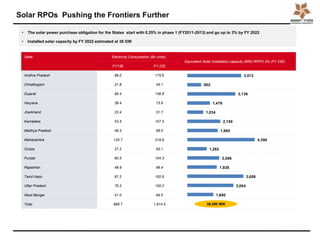
3,512
902
3,136
1,476
1,034
2,150
1,980
4,398
1,262
2,086
1,928
3,656
3,004
1,690
State Electricity Consumption (Bn units)
Equivalent Solar Installation capacity (MW) RPPO 3% (FY 22E)
FY13E FY 22E
Andhra Pradesh 89.0 175.6
Chhattisgarh 21.8 45.1
Gujarat 85.4 156.8
Haryana 38.4 73.8
Jharkhand 23.4 51.7
Karnataka 53.5 107.5
Madhya Pradesh 49.3 99.0
Maharashtra 125.7 219.9
Orissa 27.2 63.1
Punjab 60.5 104.3
Rajasthan 48.9 96.4
Tamil Nadu 87.2 182.8
Uttar Pradesh 79.3 150.2
West Bengal 41.0 84.5
Total 968.7 1,914.5
Solar RPOs Pushing the Frontiers Further
38,290 MW
• The solar power purchase obligation for the States start with 0.25% in phase 1 (FY2011-2013) and go up to 3% by FY 2022
• Installed solar capacity by FY 2022 estimated at 38 GW
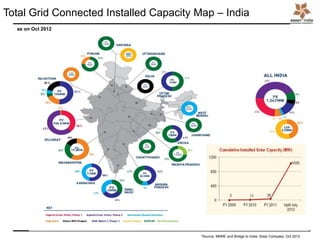
*Source: MNRE and Bridge to India: Solar Compass: Oct 2012
as on Oct 2012
Total Grid Connected Installed Capacity Map – India
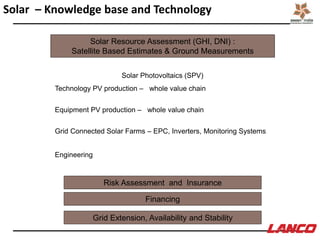
Solar – Knowledge base and Technology
Grid Extension, Availability and Stability
Solar Photovoltaics (SPV)
Technology PV production – whole value chain
Equipment PV production – whole value chain
Grid Connected Solar Farms – EPC, Inverters, Monitoring Systems
Engineering
Risk Assessment and Insurance
Solar Resource Assessment (GHI, DNI) :
Satellite Based Estimates & Ground Measurements
Financing
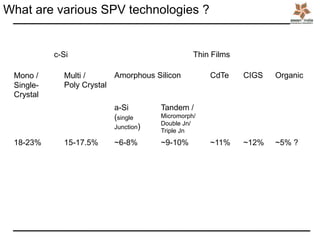
What are various SPV technologies ?
c-Si Thin Films
Mono /
Single-
Crystal
Multi /
Poly Crystal
Amorphous Silicon CdTe CIGS Organic
a-Si
(single
Junction)
Tandem /
Micromorph/
Double Jn/
Triple Jn
18-23% 15-17.5% ~6-8% ~9-10% ~11% ~12% ~5% ?
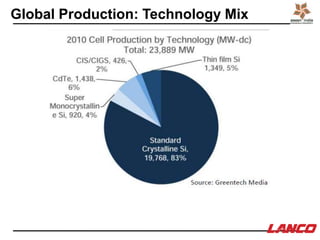
Global Production: Technology Mix
© LANCO Group, All Rights Reserved
Polysilicon
Ingot/
Wafer
Cells Modules
System
Integration
Decentralised
Application
Sand
Upstream Mid Stream Down Stream
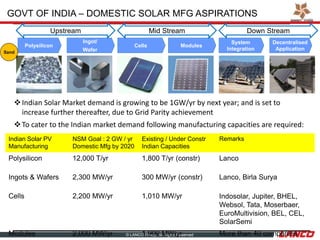
GOVT OF INDIA – DOMESTIC SOLAR MFG ASPIRATIONS
Indian Solar Market demand is growing to be 1GW/yr by next year; and is set to
increase further thereafter, due to Grid Parity achievement
To cater to the Indian market demand following manufacturing capacities are required:
Indian Solar PV
Manufacturing
NSM Goal : 2 GW / yr
Domestic Mfg by 2020
Existing / Under Constr
Indian Capacities
Remarks
Polysilicon 12,000 T/yr 1,800 T/yr (constr) Lanco
Ingots & Wafers 2,300 MW/yr 300 MW/yr (constr) Lanco, Birla Surya
Cells 2,200 MW/yr 1,010 MW/yr Indosolar, Jupiter, BHEL,
Websol, Tata, Moserbaer,
EuroMultivision, BEL, CEL,
SolarSemi
Modules 2,000 MW/yr 1,900 MW/yr More than 40 companies
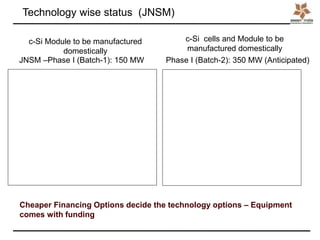
PV Technology wise status (JNSM)
JNSM –Phase I (Batch-1): 150 MW Phase I (Batch-2): 350 MW (Anticipated)
Cheaper Financing Options decide the technology options – Equipment
comes with funding
c-Si Module to be manufactured
domestically
c-Si cells and Module to be
manufactured domestically
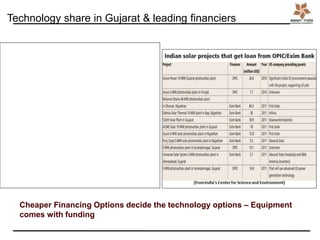
Technology share in Gujarat & leading financiers
Cheaper Financing Options decide the technology options – Equipment
comes with funding
Technology Vision for the PV Future
• What technology is needed
• What is needed to develop that technology
• What challenges it would involve to get commercialized
 Who needs the PV technology
 For what?
 Where/When does one need it
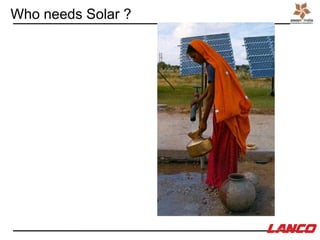
Who needs Solar ?
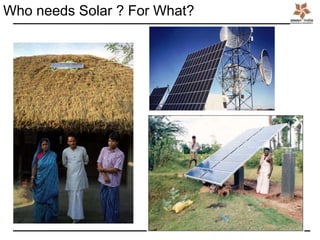
Who needs Solar ? For What?
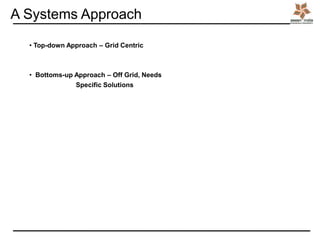
A Systems Approach
• Top-down Approach – Grid Centric
• Bottoms-up Approach – Off Grid, Needs
Specific Solutions
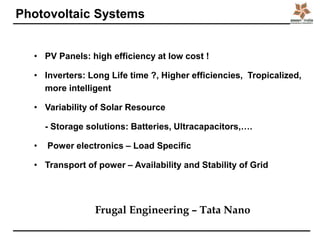
Photovoltaic Systems
• PV Panels: high efficiency at low cost !
• Inverters: Long Life time ?, Higher efficiencies, Tropicalized,
more intelligent
• Variability of Solar Resource
- Storage solutions: Batteries, Ultracapacitors,….
• Power electronics – Load Specific
• Transport of power – Availability and Stability of Grid
Frugal Engineering – Tata Nano
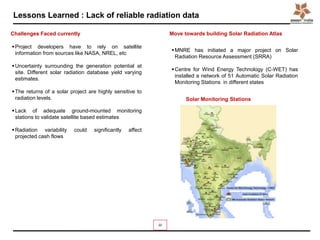
Lessons Learned : Lack of reliable radiation data
22
Solar Monitoring Stations
MNRE has initiated a major project on Solar
Radiation Resource Assessment (SRRA)
Centre for Wind Energy Technology (C‐WET) has
installed a network of 51 Automatic Solar Radiation
Monitoring Stations in different states
Project developers have to rely on satellite
information from sources like NASA, NREL, etc
Uncertainty surrounding the generation potential at
site. Different solar radiation database yield varying
estimates.
The returns of a solar project are highly sensitive to
radiation levels.
Lack of adequate ground-mounted monitoring
stations to validate satellite based estimates
Radiation variability could significantly affect
projected cash flows
Challenges Faced currently Move towards building Solar Radiation Atlas
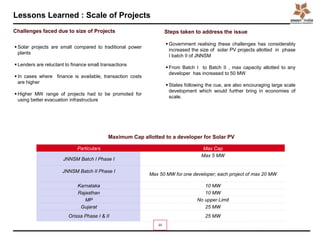
Lessons Learned : Scale of Projects
23
 Solar projects are small compared to traditional power
plants
 Lenders are reluctant to finance small transactions
 In cases where finance is available, transaction costs
are higher
 Higher MW range of projects had to be promoted for
using better evacuation infrastructure
 Government realising these challenges has considerably
increased the size of solar PV projects allotted in phase
I batch II of JNNSM
 From Batch I to Batch II , max capacity allotted to any
developer has increased to 50 MW
 States following the cue, are also encouraging large scale
development which would further bring in economies of
scale.
Particulars Max Cap
JNNSM Batch I Phase I
Max 5 MW
JNNSM Batch II Phase I
Max 50 MW for one developer; each project of max 20 MW
Karnataka 10 MW
Rajasthan 10 MW
MP No upper Limit
Gujarat 25 MW
Orissa Phase I & II 25 MW
Maximum Cap allotted to a developer for Solar PV
Challenges faced due to size of Projects Steps taken to address the issue
SPV Challenge:
The Grid Parity ?
Or
Grid Substitute / Support
Socket Parity
25
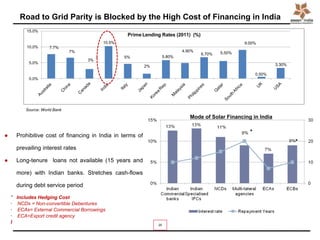
Road to Grid Parity is Blocked by the High Cost of Financing in India
● Prohibitive cost of financing in India in terms of
prevailing interest rates
● Long-tenure loans not available (15 years and
more) with Indian banks. Stretches cash-flows
during debt service period
* Includes Hedging Cost
• NCDs = Non-convertible Debentures
• ECAs= External Commercial Borrowings
• ECA=Export credit agency
l
7.7%
7%
3%
10.5%
5%
2%
5.80%
4.90%
6.70% 5.50%
9.00%
0.50%
3.30%
0.0%
5.0%
10.0%
15.0%
Prime Lending Rates (2011) (%)
Mode of Solar Financing in India
Source: World Bank
*
*
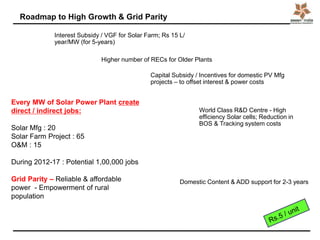
Roadmap to High Growth & Grid Parity
Interest Subsidy / VGF for Solar Farm; Rs 15 L/
year/MW (for 5-years)
Higher number of RECs for Older Plants
World Class R&D Centre - High
efficiency Solar cells; Reduction in
BOS & Tracking system costs
Capital Subsidy / Incentives for domestic PV Mfg
projects – to offset interest & power costs
Domestic Content & ADD support for 2-3 years
Every MW of Solar Power Plant create
direct / indirect jobs:
Solar Mfg : 20
Solar Farm Project : 65
O&M : 15
During 2012-17 : Potential 1,00,000 jobs
Grid Parity – Reliable & affordable
power - Empowerment of rural
population
THANK YOU!

Solar Power Technology in India by S Kumar

  • 1.
    © LANCO Group,All Rights Reserved SPV Power Technology in India Satyendra Kumar Lanco Solar, India satyen.kumar@lancogroup.com ASEAN-India Workshop on Cooperation in New and Renewable Energy 05-06 Nov., 2012 Vigyan Bhawan, New Delhi
  • 2.
    Power Sector inIndia – Role Solar Can Play India’s Current Solar PV Installation Base Agenda SPV Technologies Lessons Learned Conclusions
  • 3.
    Source: World Bank,CEA Source: EIA, CEA India – Electricity Opportunity India per capita Electricity Consumption is lagging well behind World Average and this would catch up fast owing to rising levels of Disposable Income An average of 16 GW of power generation capacity installations required each year till 2020 to meet fast growing demand for electricity power Source: D&B Industrial Research Service
  • 4.
    India has hugepotential for solar power deployment Source: MNRE, Edelweiss Research (As at June30, 2012 Solar Power Density in India  India receives on an average 4-7kWh/m2 of solar energy daily with an average of 250-300 sunny days in a year  Rajasthan and Gujarat receive maximum radiation in the range of 6– 6.6 KWh per square meter  Cumulative grid connected Installed solar power capacity is quite low in India  Accounting for a negligible proportion of India’s power capacity  Capacity additions in Indian solar industry have been miniscule as compared to the additions globally  India yet to optimally utilize its solar potential Grid connected Solar Power (Cumulative Capacity) 1,035 MW Additions during last year (FY12) 446 MW Off-grid Solar PV plants (Cumulative Capacity) 85 MW Solar Water Heating – Collector Area (Cumulative Capacity) 5.63 Mn Sq. m Solar installed capacity – India Source *Potential (MW) Installed (MW) as on Jan’12 Wind Power 45,000 16,179 Biomass 16,000 1142 Small Hydro 15,000 3300 Cogeneration- Bagasse 3,500 1952 Waste to Energy 2,700 74 Solar Unlimited 481 Source: * MNRE - Development of Conceptual Framework for REC Mechanism
  • 5.
    India Poised tobe a Major Global Contributor E&Y Solar energy attractiveness Index : India ranked 2nd in the world – only behind USA Rank Country Installed capacity (GW) in 2011 Solar Power Target Clean Energy Target Key incentives 1 USA 4.6 2020 :~ 16 GW 17% Production / Investment tax credit 2 India 0.5 2022 : 22 GW 15.90% FiTs, REC, Capital subsidy 3 China 3.0 2015 : 9 GW 2020 : 50 GW 15% of primary energy Feed-in-Tariffs (FiTs), GBI for rooftop an biding installed PV, Tax incentive for PV 4 Italy 12.4 NA 17% FiTs, REC, Tax incentive 5 Spain 5.3 2020 : 8-9 GW 20% REC, Tax incentive 6 Australia 1.3 NA 20% of total consumption Generation Based Incentive (RBI), Renewable Energy Certificate (REC) 7 Japan 5.0 2020 : 28 GW 22% FiTs, REC, Tax incentive 8 Germany 25.0 2020 : 50-70 GW 35% (50% by 2030, 65% by 2040, 80% by 2050) FiTs, REC, Tax incentive India, USA rapidly advancing; EU slow and steady  USA : Continues to grow rapidly with a 300 MW in Arizona receiving approvals. Expected to remain the largest solar market in world in near future  India : Rapid growth seen in high potential solar states of Rajasthan and Gujarat. Gujarat launches Asia's largest solar park of 600 MW  China : Many large-scale plants commissioned. Hit by oversupply in the international export market  Italy, Spain, Germany : Affected by the sovereign debt crisis and a weak future economic outlook of the Euro Global Solar Market Outlook Source : Industry Research, Ernst & Young Report on Renewable Energy Country Attractiveness indices
  • 6.
    Institutional Arrangement tosupport bundling of Solar Power Strong National Policy Initiatives at the Centre (JNNSM) State Government (Land, Water, Other Sanctions) Solar Power Developer Central Electricity Authority (Technical Support) National Thermal Power Corporation (NTPC) NTPC Vidyut Vyapar Nigam (NVVN) Buys → Bundles → Sells State Electricity Boards (Buyers of bundled power) CERC Determines Tariff 1 kWh Solar 4 kWh Thermal Bundled 5 kWh at INR 4.17/kWh  Comprehensive framework for development of solar power in India  Covers both solar power generation as well as manufacturing  Incorporates specific fiscal / monetary incentives  Objectives  Installed solar power generation capacity of 20 GW by 2020; 100 GW by 2030 and 200 GW by 2050  To achieve grid parity by 2020  To achieve parity with coal-based thermal power generation by 2030  4-5 GW of installed solar manufacturing capacity by 2017  20 mn solar lighting systems for rural areas by 2022 Note : Rates for SPV and ST based on average bidding tariff. The above rates expected to be achieved on commissioning of all power plants by May 2013 Jawaharlal Nehru National Solar Mission (JNNSM)
  • 7.
    Among the states,Gujarat – Leading the Way Tariffs PV project (Rs. /kWh) Thermal projects (Rs. /kWh) Projects commissioned before 31.12.10 15 (for first 12 years) 10 (for first 12 years) 5 (from 13th to 25th year) 3 (from 13th to 25th year) Projects commissioned after 31.12.14 12 (for first 12 years) 9 (for first 12 years) 3 (from 13th to 25th year) 3 (from 13th to 25th year) Gujarat  First state to launch an independent solar policy in 2009.  Policy operative till 2014.  PPAs of 969 MW signed. The projects allocated through the MOU route with pre-qualification criteria  Projects of 690 MW commissioned till 30th June, 2012.  Asia’s largest Solar Park – The Charaanka Solar park in Patan district of Gujarat inaugurated in April, 2012  An energy surplus state. Does not need to allocate more projects to fulfill its RPO obligations  Gujarat Energy Development Authority (GEDA) provides assistance in identification of suitable locations, facilitation in arranging Right of Way & recommending the project  High investor confidence –  More than 1000MW of projects have pre-registered for future allocations  Applications worth 1715 MW received for allocation of 150MW Banaskantha Patan Surendra Nagar Asia’s largest solar park
  • 8.
    …And other statesfollowing suit Particulars Karnataka Rajasthan Madhya Pradesh Tamilnadu Orissa Policy instrument Karnataka Solar Policy, 2011-16 Rajasthan Solar Energy policy, 2011-2017 MP Solar Energy Policy TN Solar Energy Policy 2012 Target Capacity  200 MW - DISCOMS upto 2015-16 (40 MW p.a.)  50 MW - Thermal  100 MW - REC mechanism  50 MW SPV; 50 MW ST  DISCOMS Phase I (upto 2013) -200MW Phase II (2013 - 17) - 400MW  10 MW : MNRE  200 MW SPV announced • 3000 MW by 2015, including rooftop •1500 MW utility scale by 205  50 MW SPV in 2012-13 announced Capacity Cap SPV : Min 3 MW, Max 10 MW ST : Min 5 MW SPV : Min 5 MW, Max 10 MW ST : Min 5 MW, Max - 50 MW SPV : Min 5 MW NA 25 MW Sale of Energy under state policy  Reverse bidding  Ceiling tariff : SPV : INR 14.50 / kWh ST : INR 11.35 / kWh  Reverse bidding  Ceiling Tariff : SPV : INR 10.12 / kWh  Reverse bidding  Ceiling Tariff : SPV : INR 15.35 / kWh  Reverse bidding  Ceiling Tariff : SPV : INR 15.35 / kWh  Reverse bidding  Lowest bidder offered entire 25 MW Operational : State Policy JNNSM, Phase I Batch I Migration scheme RPSSGP through IREDA 14 MW - - - - 25 projects : 125 MW 8 projects : 37.5 MW 10 projects : 10 MW - - - - - - - - 1 project : 5 MW - 7 projects : 7 MW Bids awarded under state policy / other schemes  80MW under State Policy  30 MW - 30 months of PPA;  50 MW - 18 months of PPA  817 MW - REC mechanism  100 MW - NTPC – Bundled Last date for submission of RfS for 200 MW postponed indefinitely 200 MW under State Policy Expected allocation of 1000MW in 2013 25 MW Source: MNRE, State Nodal Agencies, Research Reports
  • 9.
    3,512 902 3,136 1,476 1,034 2,150 1,980 4,398 1,262 2,086 1,928 3,656 3,004 1,690 State Electricity Consumption(Bn units) Equivalent Solar Installation capacity (MW) RPPO 3% (FY 22E) FY13E FY 22E Andhra Pradesh 89.0 175.6 Chhattisgarh 21.8 45.1 Gujarat 85.4 156.8 Haryana 38.4 73.8 Jharkhand 23.4 51.7 Karnataka 53.5 107.5 Madhya Pradesh 49.3 99.0 Maharashtra 125.7 219.9 Orissa 27.2 63.1 Punjab 60.5 104.3 Rajasthan 48.9 96.4 Tamil Nadu 87.2 182.8 Uttar Pradesh 79.3 150.2 West Bengal 41.0 84.5 Total 968.7 1,914.5 Solar RPOs Pushing the Frontiers Further 38,290 MW • The solar power purchase obligation for the States start with 0.25% in phase 1 (FY2011-2013) and go up to 3% by FY 2022 • Installed solar capacity by FY 2022 estimated at 38 GW
  • 10.
    *Source: MNRE andBridge to India: Solar Compass: Oct 2012 as on Oct 2012 Total Grid Connected Installed Capacity Map – India
  • 11.
    Solar – Knowledgebase and Technology Grid Extension, Availability and Stability Solar Photovoltaics (SPV) Technology PV production – whole value chain Equipment PV production – whole value chain Grid Connected Solar Farms – EPC, Inverters, Monitoring Systems Engineering Risk Assessment and Insurance Solar Resource Assessment (GHI, DNI) : Satellite Based Estimates & Ground Measurements Financing
  • 12.
    What are variousSPV technologies ? c-Si Thin Films Mono / Single- Crystal Multi / Poly Crystal Amorphous Silicon CdTe CIGS Organic a-Si (single Junction) Tandem / Micromorph/ Double Jn/ Triple Jn 18-23% 15-17.5% ~6-8% ~9-10% ~11% ~12% ~5% ?
  • 13.
  • 14.
    © LANCO Group,All Rights Reserved Polysilicon Ingot/ Wafer Cells Modules System Integration Decentralised Application Sand Upstream Mid Stream Down Stream GOVT OF INDIA – DOMESTIC SOLAR MFG ASPIRATIONS Indian Solar Market demand is growing to be 1GW/yr by next year; and is set to increase further thereafter, due to Grid Parity achievement To cater to the Indian market demand following manufacturing capacities are required: Indian Solar PV Manufacturing NSM Goal : 2 GW / yr Domestic Mfg by 2020 Existing / Under Constr Indian Capacities Remarks Polysilicon 12,000 T/yr 1,800 T/yr (constr) Lanco Ingots & Wafers 2,300 MW/yr 300 MW/yr (constr) Lanco, Birla Surya Cells 2,200 MW/yr 1,010 MW/yr Indosolar, Jupiter, BHEL, Websol, Tata, Moserbaer, EuroMultivision, BEL, CEL, SolarSemi Modules 2,000 MW/yr 1,900 MW/yr More than 40 companies
  • 15.
    PV Technology wisestatus (JNSM) JNSM –Phase I (Batch-1): 150 MW Phase I (Batch-2): 350 MW (Anticipated) Cheaper Financing Options decide the technology options – Equipment comes with funding c-Si Module to be manufactured domestically c-Si cells and Module to be manufactured domestically
  • 16.
    Technology share inGujarat & leading financiers Cheaper Financing Options decide the technology options – Equipment comes with funding
  • 17.
    Technology Vision forthe PV Future • What technology is needed • What is needed to develop that technology • What challenges it would involve to get commercialized  Who needs the PV technology  For what?  Where/When does one need it
  • 18.
  • 19.
    Who needs Solar? For What?
  • 20.
    A Systems Approach •Top-down Approach – Grid Centric • Bottoms-up Approach – Off Grid, Needs Specific Solutions
  • 21.
    Photovoltaic Systems • PVPanels: high efficiency at low cost ! • Inverters: Long Life time ?, Higher efficiencies, Tropicalized, more intelligent • Variability of Solar Resource - Storage solutions: Batteries, Ultracapacitors,…. • Power electronics – Load Specific • Transport of power – Availability and Stability of Grid Frugal Engineering – Tata Nano
  • 22.
    Lessons Learned :Lack of reliable radiation data 22 Solar Monitoring Stations MNRE has initiated a major project on Solar Radiation Resource Assessment (SRRA) Centre for Wind Energy Technology (C‐WET) has installed a network of 51 Automatic Solar Radiation Monitoring Stations in different states Project developers have to rely on satellite information from sources like NASA, NREL, etc Uncertainty surrounding the generation potential at site. Different solar radiation database yield varying estimates. The returns of a solar project are highly sensitive to radiation levels. Lack of adequate ground-mounted monitoring stations to validate satellite based estimates Radiation variability could significantly affect projected cash flows Challenges Faced currently Move towards building Solar Radiation Atlas
  • 23.
    Lessons Learned :Scale of Projects 23  Solar projects are small compared to traditional power plants  Lenders are reluctant to finance small transactions  In cases where finance is available, transaction costs are higher  Higher MW range of projects had to be promoted for using better evacuation infrastructure  Government realising these challenges has considerably increased the size of solar PV projects allotted in phase I batch II of JNNSM  From Batch I to Batch II , max capacity allotted to any developer has increased to 50 MW  States following the cue, are also encouraging large scale development which would further bring in economies of scale. Particulars Max Cap JNNSM Batch I Phase I Max 5 MW JNNSM Batch II Phase I Max 50 MW for one developer; each project of max 20 MW Karnataka 10 MW Rajasthan 10 MW MP No upper Limit Gujarat 25 MW Orissa Phase I & II 25 MW Maximum Cap allotted to a developer for Solar PV Challenges faced due to size of Projects Steps taken to address the issue
  • 24.
    SPV Challenge: The GridParity ? Or Grid Substitute / Support Socket Parity
  • 25.
    25 Road to GridParity is Blocked by the High Cost of Financing in India ● Prohibitive cost of financing in India in terms of prevailing interest rates ● Long-tenure loans not available (15 years and more) with Indian banks. Stretches cash-flows during debt service period * Includes Hedging Cost • NCDs = Non-convertible Debentures • ECAs= External Commercial Borrowings • ECA=Export credit agency l 7.7% 7% 3% 10.5% 5% 2% 5.80% 4.90% 6.70% 5.50% 9.00% 0.50% 3.30% 0.0% 5.0% 10.0% 15.0% Prime Lending Rates (2011) (%) Mode of Solar Financing in India Source: World Bank * *
  • 26.
    Roadmap to HighGrowth & Grid Parity Interest Subsidy / VGF for Solar Farm; Rs 15 L/ year/MW (for 5-years) Higher number of RECs for Older Plants World Class R&D Centre - High efficiency Solar cells; Reduction in BOS & Tracking system costs Capital Subsidy / Incentives for domestic PV Mfg projects – to offset interest & power costs Domestic Content & ADD support for 2-3 years Every MW of Solar Power Plant create direct / indirect jobs: Solar Mfg : 20 Solar Farm Project : 65 O&M : 15 During 2012-17 : Potential 1,00,000 jobs Grid Parity – Reliable & affordable power - Empowerment of rural population
  • 27.

Editor's Notes

  • #4 India has a huge gap to fill in terms of capacity installations to cater to demand by 2020 India records very low levels of Energy per capita globally and this will change dramatically, very fast. Disposable Income / GDP is a good indicator to rise in energy demand