Information in Games
Games with complete information
each player knows the strategy set of all opponents
each player knows the payoff of every opponent for
every possible (joint) outcome of the game
Strong assumption
Information in Games
Games with complete information
each player knows the strategy set of all opponents
each player knows the payoff of every opponent for
every possible (joint) outcome of the game
Strong assumption
Does not happen often in real world
e.g. 1: competing sellers don’t know payoffs for each
other
e.g. 2: corporation bargaining with union members
don’t know the (dis)utility of a month’s strike for the
union
Incomplete Information
Games in real world scenarios have incomplete
information
How do we model incomplete information?
Incomplete Information
Games in real world scenarios have incomplete
information
How do we model incomplete information?
Consider a player’s beliefs about other players’
preferences, his beliefs about their beliefs about his
preferences, …
Modeling Games with
Incomplete Information
Harsanyi’s approach:
Each player’s preferences are determined by a random
variable
The exact value of the random variable is observed by
the player alone
But…
Modeling Games with
Incomplete Information
Harsanyi’s approach:
Each player’s preferences are determined by a random
variable
The exact value of the random variable is observed by
the player alone
But…the prior probability distribution of the random
variable is common knowledge among all players
Modeling Games with
Incomplete Information
Incomplete information now becomes imperfect
information
Who determines the value of the random variable for
each player?
Modeling Games with
Incomplete Information
Incomplete information now becomes imperfect
information
Who determines the value of the random variable for
each player?
Nature
 background/culture/external effects on each player
Example: Modified DA’s
Brother
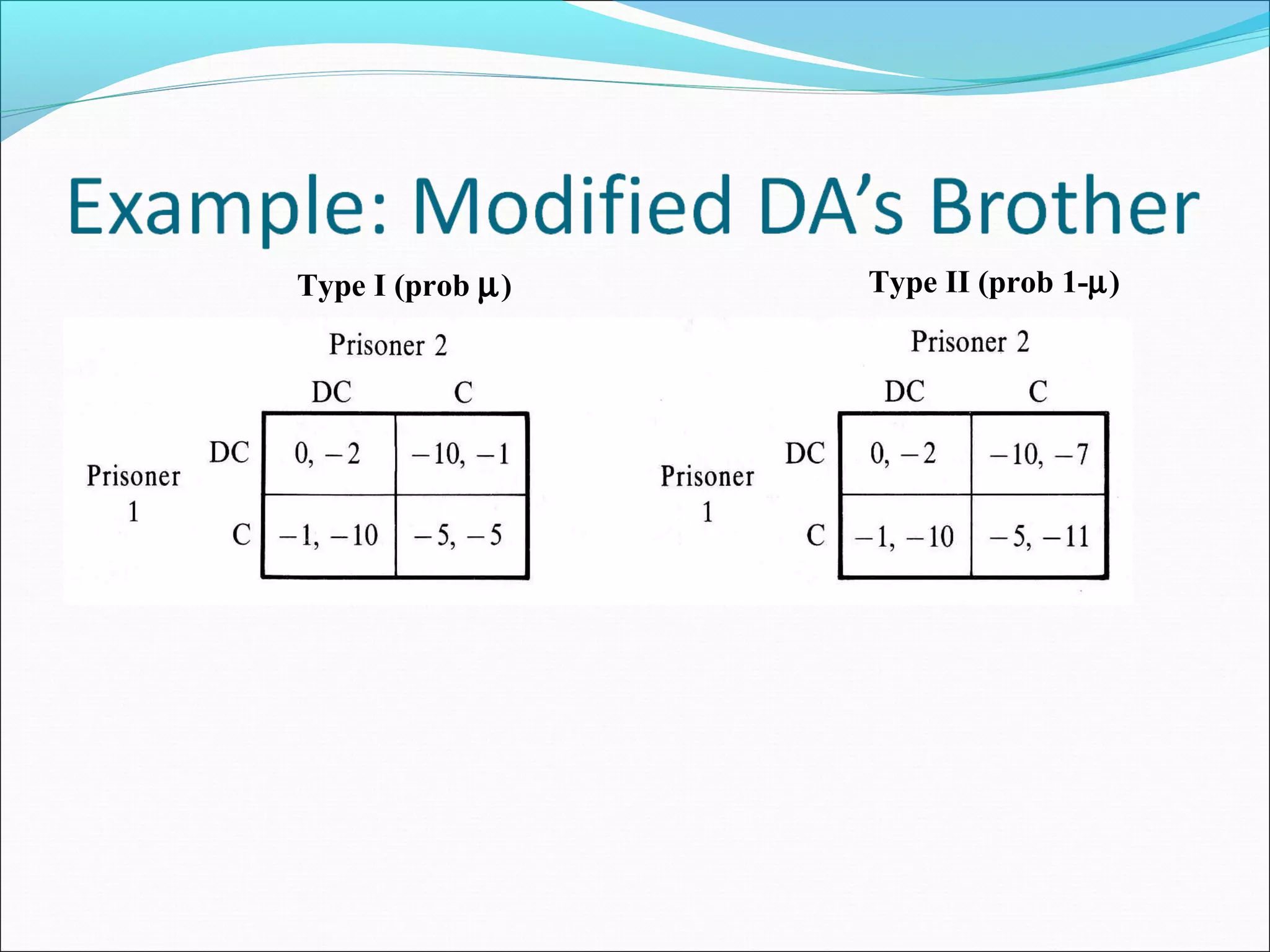
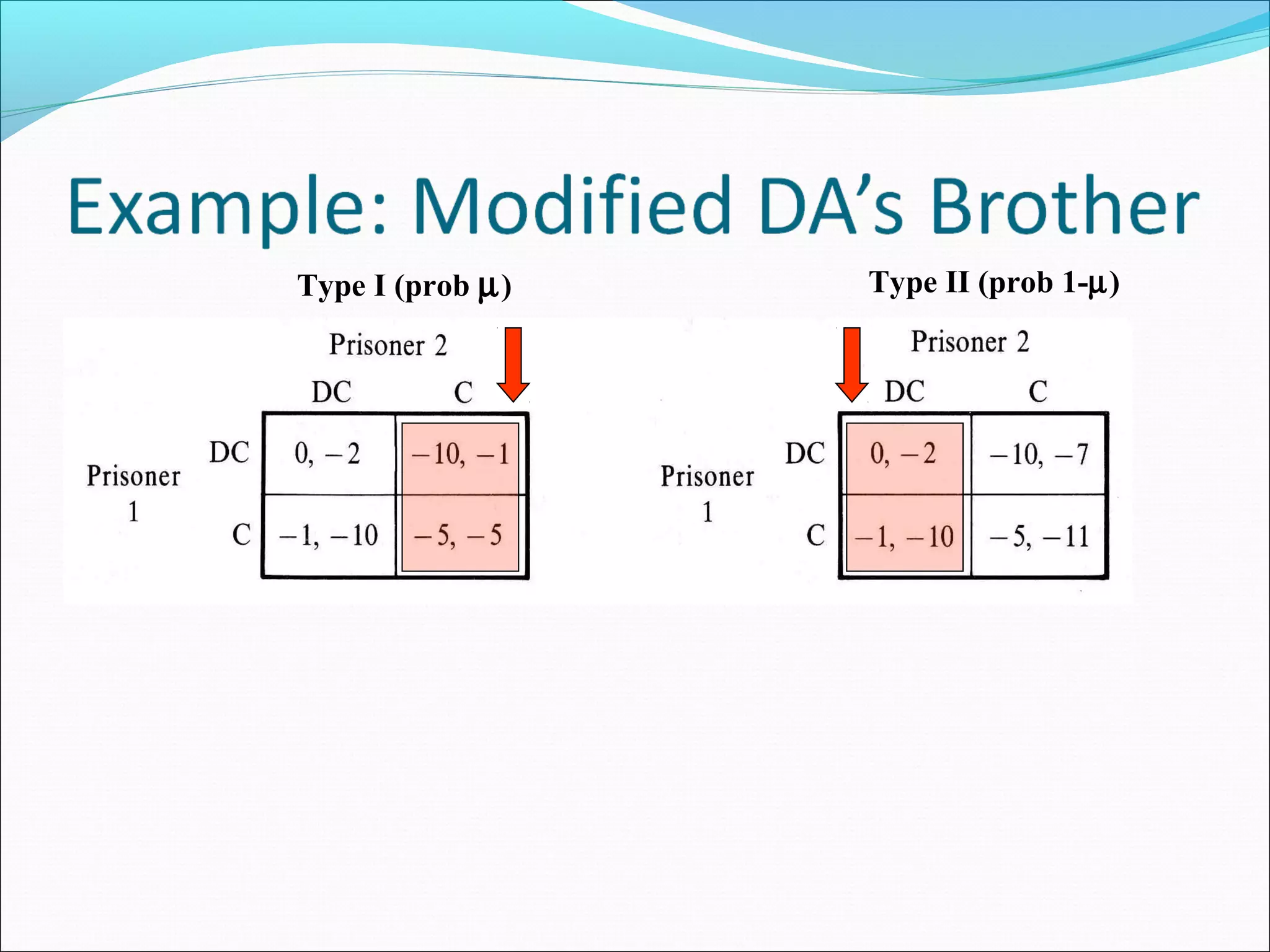
Prisoner 2 now can behave in one of two ways
with probability µ he behaves as he did in the original
game
with probability 1-µ he gets “emotional”, i.e., he gets an
additional payoff of –6 if he confesses (rats on his
accomplice)
Who determines µ?
“nature” of player 2
Note: Player 1 still behaves as he did in the
original game
Type I (prob µ) Type II (prob 1-µ)
Example: Modified DA’s
Brother
Player 2 has 4 pure strategies now
confess if type I, confess if type II
confess if type I, don’t confess if type II
don’t confess if type I, confess if type II
don’t confess if type I, don’t confess if type II
Player’s strategy is now a function of its type
Note:
Player 2’s type is not visible to player 1,
Player 1 still has two pure strategies as before
Bayesian Nash Game
Player i’s utility is written as:
ui(si,s-i, θi), where θi Є Θi
 θi: random variable chosen by nature
 Θi: distribution from which the random variable
is chosen
F(θ1,θ2,θ3,… θI): joint probability distribution of all
players
common knowledge among all players
 Θ = Θ1 X Θ2 X Θ3 …X ΘI
Bayesian Nash Game = [I, {Si}, {ui(.
)}, Θ, F(.
)]
Example: Bayesian Nash Game
Modified DA’s Brother example
Θ1={1} (some constant element because P1 does not have
types}
Θ2 ={emotional, not emotional}
Θ=Θ1X Θ2= {(emotional), (non-emotional)}
F(Θ) = <0.3, 0.7> (some probability values that give the
probabilities of {(emotional), (non-emotional)}
 This is common knowledge
Bayesian Nash Game
Pure strategy of a player is now a function of the type
of the player:
si(θi): called decision rule
Player i’s pure strategy set is S iwhich is the set of all
possible si(θi)-s
Player i’s expected payoff is given by:
ûi(s1(.
), s2(.
), s3(.
), ….sI(.
))=Eθ[ui(s1(θ1)...sI(θI), θi)]
Bayesian Nash Game as
Normal Form Game
We can rewrite the Bayesian Nash game
[I, {Si}, {ui(.
)}, Θ, F(.
)]
Bayesian Nash Game as
Normal Form Game
We can rewrite the Bayesian Nash game
[I, {Si}, {ui(.
)}, Θ, F(.
)]
as
[I, {S i}, ûi(.
)}]
Definition: Bayesian Nash Equilibrium
A pure strategy Bayesian Nash equilibrium for the
Bayesian Nash game [I, {Si}, {ui(.
)}, Θ, F(.
)] is a
profile of decision rules (s1(.
), s2(.
), s3(.
), ….sI(.
)) that
constitutes a Nash equilibrium of game [I, {S i},
{ûi(.
)}]. That is, for every i=1…I
ûi(si(.
), s-i(.
)) >= ûi(s’i(.
), s-i(.
))
for all s’i(.
) Є S i where ûi(si(.
), s-i(.
)) is the expected
payoff for player i
Proposition
A profile of decision rules (s1(.
), s2(.
), s3(.
), ….sI(.
)) is a
Bayesian Nash equilibrium in a Bayesian Nash
game [I, {Si}, {ui(.
)}, Θ, F(.
)] if and only if, for all i
and all θ’i Є Θi occurring with positive probability
Eθ-i[ui(si(θ’i), s-i(θ-i), θ’i) | θ’i)] >=
Eθ-i[ui(si’, s-i(θ-i), θ’i) | θ’i)]
for all si’ Є Si, where the expectation is taken over
realizations of the other players’ random variables
conditional on player i’s realization of signal θ’i.
Outline of Proof (by contradiction)
Necessity: Suppose the inequality (on last
slide) did not hold, i.e.,
Eθ-i[ui(si(θ’i), s-i(θ-i), θ’i) | θ’i)] <
Eθ-i[ui(si’, s-i(θ-i), θ’i) | θ’i)]
→ Some player I for whom θ’i Є Θihappens with a
positive probability, is better off by changing its
strategy and using si’ instead of si(θ’i)
→ (s1(.
), s2(.
), s3(.
), ….sI(.
)) is not a Bayesian Nash equilibrium
→ Contradiction
Outline of Proof (by contradiction)
Reverse direction:
Eθ-i[ui(si(θ’i), s-i(θ-i), θ’i) | θ’i)] >=
Eθ-i[ui(si’, s-i(θ-i), θ’i) | θ’i)] holds for
all θ’i Є Θioccurring with positive probability
→ player i cannot improve on the payoff received by
playing strategy si(.
)
→ si(.
) constitutes a Nash equilibrium
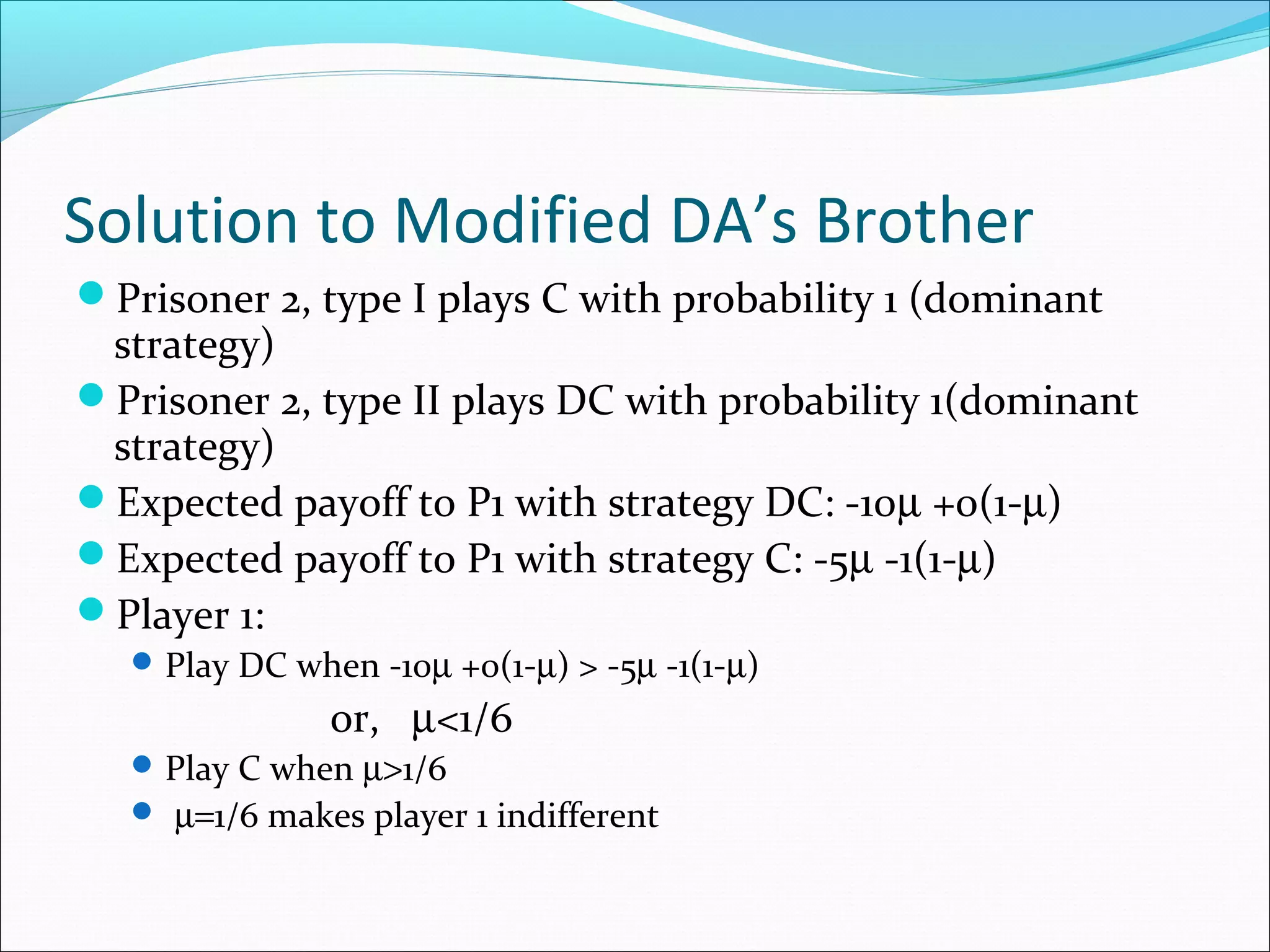
Type I (prob µ) Type II (prob 1-µ)
Solution to Modified DA’s Brother
Prisoner 2, type I plays C with probability 1 (dominant
strategy)
Prisoner 2, type II plays DC with probability 1(dominant
strategy)
Expected payoff to P1 with strategy DC: -10µ +0(1-µ)
Expected payoff to P1 with strategy C: -5µ -1(1-µ)
Player 1:
Play DC when -10µ +0(1-µ) > -5µ -1(1-µ)
or, µ<1/6
Play C when µ>1/6
 µ=1/6 makes player 1 indifferent
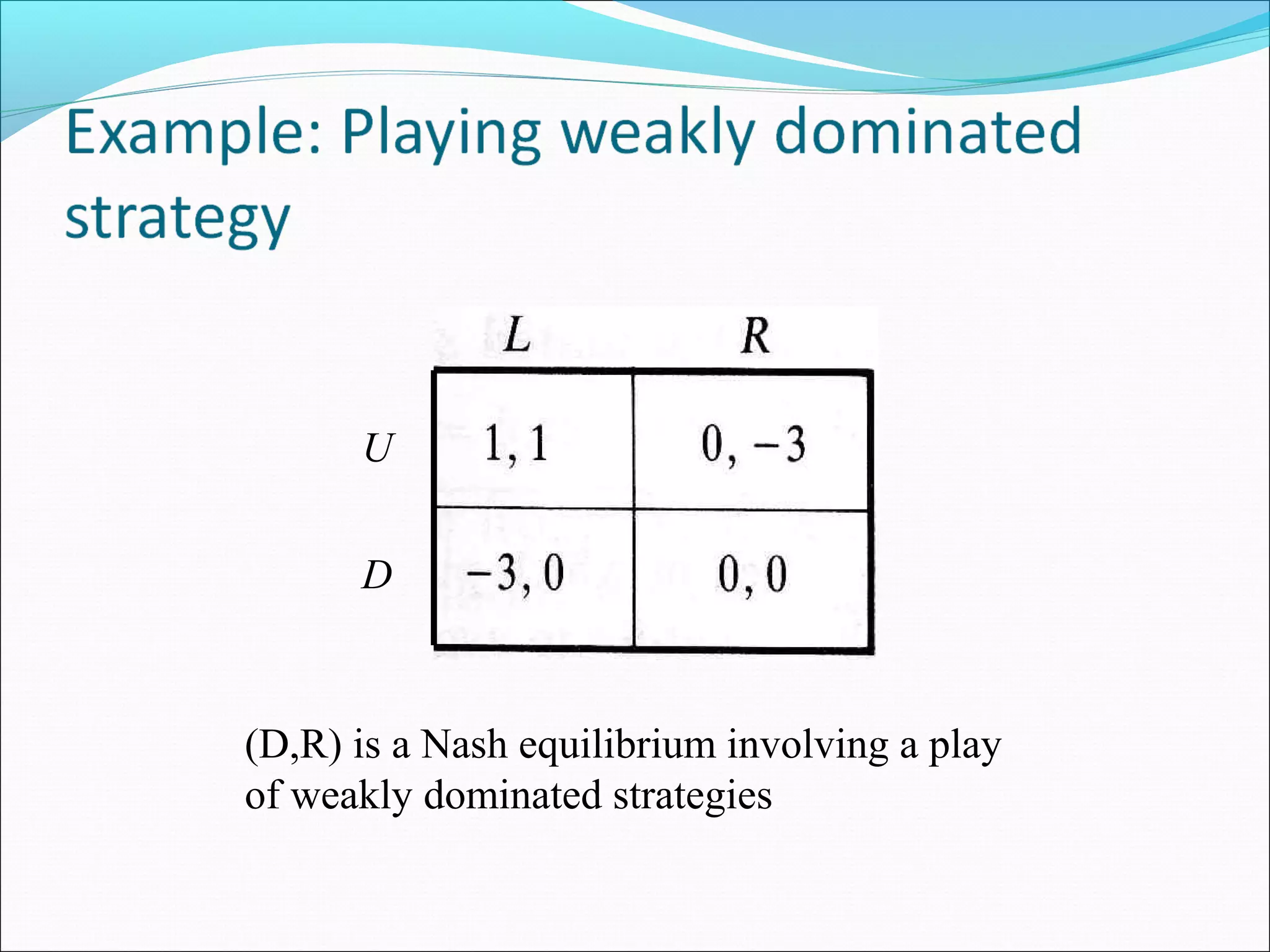
Weakly Dominated Strategy
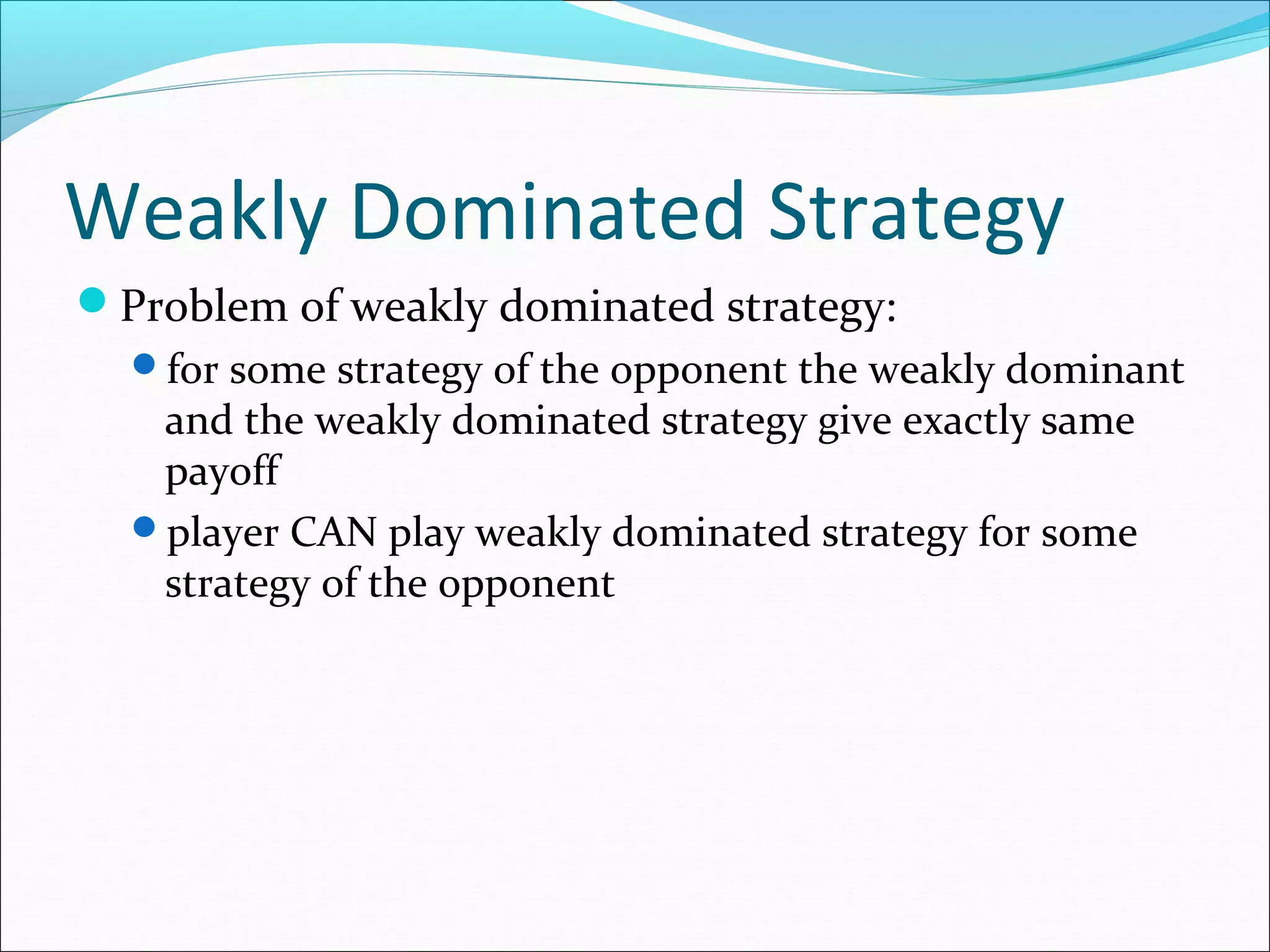
Problem of weakly dominated strategy:
for some strategy of the opponent the weakly dominant
and the weakly dominated strategy give exactly same
payoff
player CAN play weakly dominated strategy for some
strategy of the opponent
U
D
(D,R) is a Nash equilibrium involving a play
of weakly dominated strategies
Perturbed Game
Start with normal form game
ΓN=[I, {∆(Si)}, {ui(.
)}]
Define a perturbed game
Γε= [I, {∆ε(Si)}, {ui(.
)}]
where ∆ε (Sj)={(σi: σi> εi(si) for all si Є Siand Σ siЄ Siσi (si)=1}
 εi(si) denotes the minimum probability of player I playing
strategy si
Perturbed Game
Start with normal form game
ΓN=[I, {∆(Si)}, {ui(.
)}]
Define a perturbed game
Γε= [I, {∆ε(Si)}, {ui(.
)}]
where ∆ε (Sj)={(σi: σi> εi(si) for all si Є Siand Σ siЄ Siσi (si)=1}
 εi(si) denotes the minimum probability of player I playing
strategy si
εi(si) denotes the unavoidable probability of playing
strategy siby mistake
Definition: Nash equilibrium in
Trembling Hand Perfect Game
A Nash equilibrium of a game ΓN=[I, {∆(Si)}, {ui(.
)}] is
(normal form) trembling hand perfect if there is
some sequence of perturbed games {Γεk }k=1
∞
that
converges to ΓN [in the sense that lim k ∞→ (εi
k
(si) )=0 for
all I and si Є Si] for which there is some
associated sequence of Nash equilibria {σk
} k=1
∞
that
converges to σ (i.e. such that lim k ∞→ σk
= σ)
Proposition 1
A Nash equilibrium of a game ΓN=[I, {∆(Si)}, {ui(.
)}] is
(normal form) trembling hand perfect if and only if
there is some sequence of totally mixed strategies
{σk
} k=1
∞
such that lim k ∞→ σk
= σ and σi is a best response
to every element of sequence {σk
-i} k=1
∞
for all i=1…I.
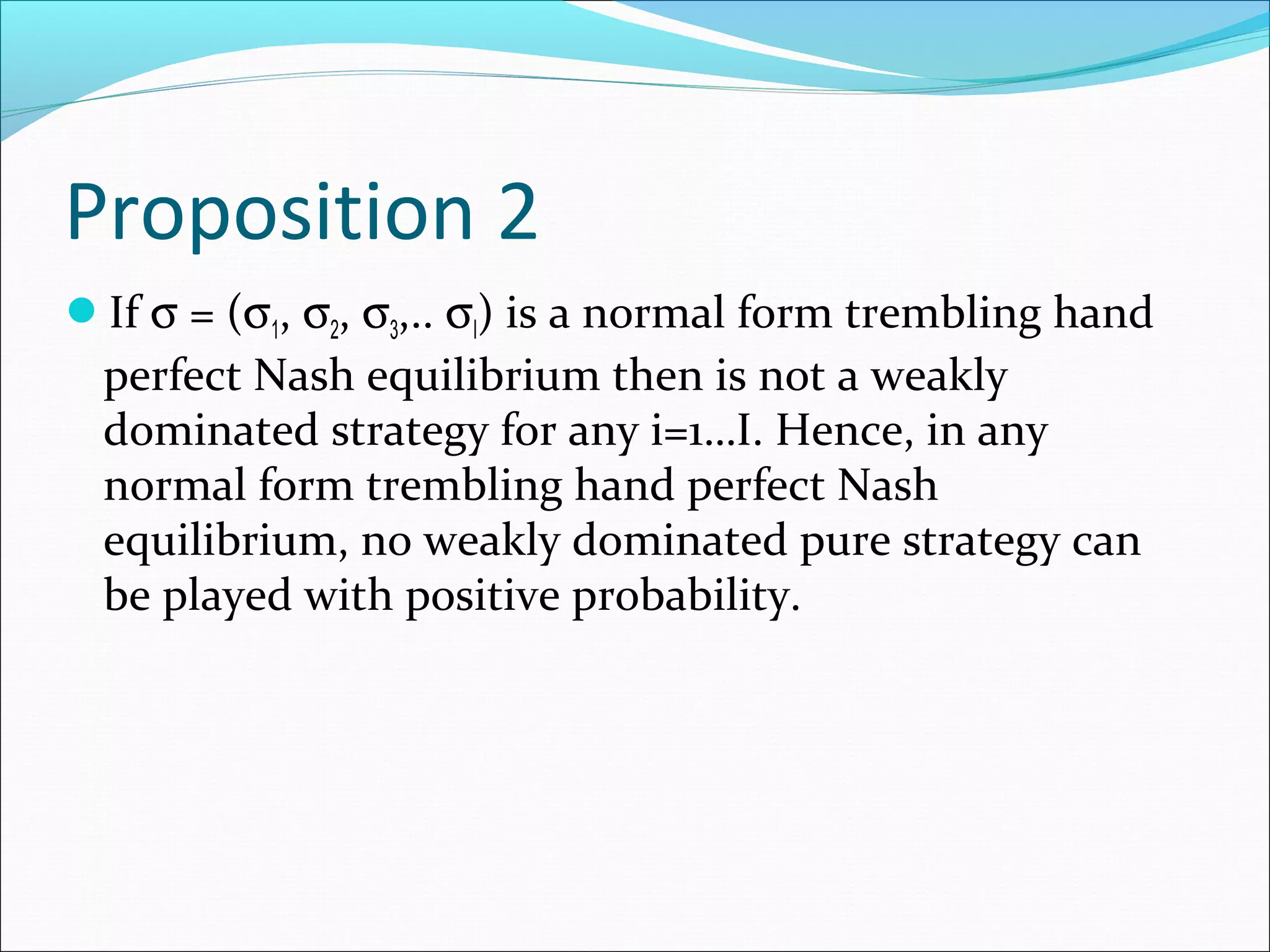
Proposition 2
If σ = (σ1, σ2, σ3,.. σI) is a normal form trembling hand
perfect Nash equilibrium then is not a weakly
dominated strategy for any i=1…I. Hence, in any
normal form trembling hand perfect Nash
equilibrium, no weakly dominated pure strategy can
be played with positive probability.

3 bayesian-games

  • 2.
    Information in Games Gameswith complete information each player knows the strategy set of all opponents each player knows the payoff of every opponent for every possible (joint) outcome of the game Strong assumption
  • 3.
    Information in Games Gameswith complete information each player knows the strategy set of all opponents each player knows the payoff of every opponent for every possible (joint) outcome of the game Strong assumption Does not happen often in real world e.g. 1: competing sellers don’t know payoffs for each other e.g. 2: corporation bargaining with union members don’t know the (dis)utility of a month’s strike for the union
  • 4.
    Incomplete Information Games inreal world scenarios have incomplete information How do we model incomplete information?
  • 5.
    Incomplete Information Games inreal world scenarios have incomplete information How do we model incomplete information? Consider a player’s beliefs about other players’ preferences, his beliefs about their beliefs about his preferences, …
  • 6.
    Modeling Games with IncompleteInformation Harsanyi’s approach: Each player’s preferences are determined by a random variable The exact value of the random variable is observed by the player alone But…
  • 7.
    Modeling Games with IncompleteInformation Harsanyi’s approach: Each player’s preferences are determined by a random variable The exact value of the random variable is observed by the player alone But…the prior probability distribution of the random variable is common knowledge among all players
  • 8.
    Modeling Games with IncompleteInformation Incomplete information now becomes imperfect information Who determines the value of the random variable for each player?
  • 9.
    Modeling Games with IncompleteInformation Incomplete information now becomes imperfect information Who determines the value of the random variable for each player? Nature  background/culture/external effects on each player
  • 10.
    Example: Modified DA’s Brother Prisoner2 now can behave in one of two ways with probability µ he behaves as he did in the original game with probability 1-µ he gets “emotional”, i.e., he gets an additional payoff of –6 if he confesses (rats on his accomplice) Who determines µ? “nature” of player 2 Note: Player 1 still behaves as he did in the original game
  • 11.
    Type I (probµ) Type II (prob 1-µ)
  • 12.
    Example: Modified DA’s Brother Player2 has 4 pure strategies now confess if type I, confess if type II confess if type I, don’t confess if type II don’t confess if type I, confess if type II don’t confess if type I, don’t confess if type II Player’s strategy is now a function of its type Note: Player 2’s type is not visible to player 1, Player 1 still has two pure strategies as before
  • 13.
    Bayesian Nash Game Playeri’s utility is written as: ui(si,s-i, θi), where θi Є Θi  θi: random variable chosen by nature  Θi: distribution from which the random variable is chosen F(θ1,θ2,θ3,… θI): joint probability distribution of all players common knowledge among all players  Θ = Θ1 X Θ2 X Θ3 …X ΘI Bayesian Nash Game = [I, {Si}, {ui(. )}, Θ, F(. )]
  • 14.
    Example: Bayesian NashGame Modified DA’s Brother example Θ1={1} (some constant element because P1 does not have types} Θ2 ={emotional, not emotional} Θ=Θ1X Θ2= {(emotional), (non-emotional)} F(Θ) = <0.3, 0.7> (some probability values that give the probabilities of {(emotional), (non-emotional)}  This is common knowledge
  • 15.
    Bayesian Nash Game Purestrategy of a player is now a function of the type of the player: si(θi): called decision rule Player i’s pure strategy set is S iwhich is the set of all possible si(θi)-s Player i’s expected payoff is given by: ûi(s1(. ), s2(. ), s3(. ), ….sI(. ))=Eθ[ui(s1(θ1)...sI(θI), θi)]
  • 16.
    Bayesian Nash Gameas Normal Form Game We can rewrite the Bayesian Nash game [I, {Si}, {ui(. )}, Θ, F(. )]
  • 17.
    Bayesian Nash Gameas Normal Form Game We can rewrite the Bayesian Nash game [I, {Si}, {ui(. )}, Θ, F(. )] as [I, {S i}, ûi(. )}]
  • 18.
    Definition: Bayesian NashEquilibrium A pure strategy Bayesian Nash equilibrium for the Bayesian Nash game [I, {Si}, {ui(. )}, Θ, F(. )] is a profile of decision rules (s1(. ), s2(. ), s3(. ), ….sI(. )) that constitutes a Nash equilibrium of game [I, {S i}, {ûi(. )}]. That is, for every i=1…I ûi(si(. ), s-i(. )) >= ûi(s’i(. ), s-i(. )) for all s’i(. ) Є S i where ûi(si(. ), s-i(. )) is the expected payoff for player i
  • 19.
    Proposition A profile ofdecision rules (s1(. ), s2(. ), s3(. ), ….sI(. )) is a Bayesian Nash equilibrium in a Bayesian Nash game [I, {Si}, {ui(. )}, Θ, F(. )] if and only if, for all i and all θ’i Є Θi occurring with positive probability Eθ-i[ui(si(θ’i), s-i(θ-i), θ’i) | θ’i)] >= Eθ-i[ui(si’, s-i(θ-i), θ’i) | θ’i)] for all si’ Є Si, where the expectation is taken over realizations of the other players’ random variables conditional on player i’s realization of signal θ’i.
  • 20.
    Outline of Proof(by contradiction) Necessity: Suppose the inequality (on last slide) did not hold, i.e., Eθ-i[ui(si(θ’i), s-i(θ-i), θ’i) | θ’i)] < Eθ-i[ui(si’, s-i(θ-i), θ’i) | θ’i)] → Some player I for whom θ’i Є Θihappens with a positive probability, is better off by changing its strategy and using si’ instead of si(θ’i) → (s1(. ), s2(. ), s3(. ), ….sI(. )) is not a Bayesian Nash equilibrium → Contradiction
  • 21.
    Outline of Proof(by contradiction) Reverse direction: Eθ-i[ui(si(θ’i), s-i(θ-i), θ’i) | θ’i)] >= Eθ-i[ui(si’, s-i(θ-i), θ’i) | θ’i)] holds for all θ’i Є Θioccurring with positive probability → player i cannot improve on the payoff received by playing strategy si(. ) → si(. ) constitutes a Nash equilibrium
  • 22.
    Type I (probµ) Type II (prob 1-µ)
  • 23.
    Solution to ModifiedDA’s Brother Prisoner 2, type I plays C with probability 1 (dominant strategy) Prisoner 2, type II plays DC with probability 1(dominant strategy) Expected payoff to P1 with strategy DC: -10µ +0(1-µ) Expected payoff to P1 with strategy C: -5µ -1(1-µ) Player 1: Play DC when -10µ +0(1-µ) > -5µ -1(1-µ) or, µ<1/6 Play C when µ>1/6  µ=1/6 makes player 1 indifferent
  • 24.
    Weakly Dominated Strategy Problemof weakly dominated strategy: for some strategy of the opponent the weakly dominant and the weakly dominated strategy give exactly same payoff player CAN play weakly dominated strategy for some strategy of the opponent
  • 25.
    U D (D,R) is aNash equilibrium involving a play of weakly dominated strategies
  • 26.
    Perturbed Game Start withnormal form game ΓN=[I, {∆(Si)}, {ui(. )}] Define a perturbed game Γε= [I, {∆ε(Si)}, {ui(. )}] where ∆ε (Sj)={(σi: σi> εi(si) for all si Є Siand Σ siЄ Siσi (si)=1}  εi(si) denotes the minimum probability of player I playing strategy si
  • 27.
    Perturbed Game Start withnormal form game ΓN=[I, {∆(Si)}, {ui(. )}] Define a perturbed game Γε= [I, {∆ε(Si)}, {ui(. )}] where ∆ε (Sj)={(σi: σi> εi(si) for all si Є Siand Σ siЄ Siσi (si)=1}  εi(si) denotes the minimum probability of player I playing strategy si εi(si) denotes the unavoidable probability of playing strategy siby mistake
  • 28.
    Definition: Nash equilibriumin Trembling Hand Perfect Game A Nash equilibrium of a game ΓN=[I, {∆(Si)}, {ui(. )}] is (normal form) trembling hand perfect if there is some sequence of perturbed games {Γεk }k=1 ∞ that converges to ΓN [in the sense that lim k ∞→ (εi k (si) )=0 for all I and si Є Si] for which there is some associated sequence of Nash equilibria {σk } k=1 ∞ that converges to σ (i.e. such that lim k ∞→ σk = σ)
  • 29.
    Proposition 1 A Nashequilibrium of a game ΓN=[I, {∆(Si)}, {ui(. )}] is (normal form) trembling hand perfect if and only if there is some sequence of totally mixed strategies {σk } k=1 ∞ such that lim k ∞→ σk = σ and σi is a best response to every element of sequence {σk -i} k=1 ∞ for all i=1…I.
  • 30.
    Proposition 2 If σ= (σ1, σ2, σ3,.. σI) is a normal form trembling hand perfect Nash equilibrium then is not a weakly dominated strategy for any i=1…I. Hence, in any normal form trembling hand perfect Nash equilibrium, no weakly dominated pure strategy can be played with positive probability.

Editor's Notes

  • #23 red arrows are dominant strategy