GHz-THz Electronics


                                                                                                          08 MAR 2012


                                                                                                             Jim Hwang
                                                                                                      Program Manager
                                                                                                           AFOSR/RSE
         Integrity  Service  Excellence                                                 Air Force Research Laboratory


15 February 2012    DISTRIBUTION A: Approved for public release; distribution is unlimited.                               1
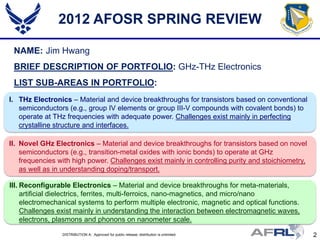
2012 AFOSR SPRING REVIEW

 NAME: Jim Hwang
 BRIEF DESCRIPTION OF PORTFOLIO: GHz-THz Electronics
 LIST SUB-AREAS IN PORTFOLIO:
I. THz Electronics – Material and device breakthroughs for transistors based on conventional
   semiconductors (e.g., group IV elements or group III-V compounds with covalent bonds) to
   operate at THz frequencies with adequate power. Challenges exist mainly in perfecting
   crystalline structure and interfaces.

II. Novel GHz Electronics – Material and device breakthroughs for transistors based on novel
    semiconductors (e.g., transition-metal oxides with ionic bonds) to operate at GHz
    frequencies with high power. Challenges exist mainly in controlling purity and stoichiometry,
    as well as in understanding doping/transport.

III. Reconfigurable Electronics – Material and device breakthroughs for meta-materials,
     artificial dielectrics, ferrites, multi-ferroics, nano-magnetics, and micro/nano
     electromechanical systems to perform multiple electronic, magnetic and optical functions.
     Challenges exist mainly in understanding the interaction between electromagnetic waves,
     electrons, plasmons and phonons on nanometer scale.
                 DISTRIBUTION A: Approved for public release; distribution is unlimited.            2
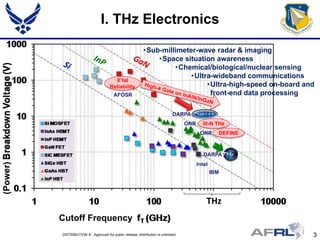
I. THz Electronics

                                                            • Sub-millimeter-wave radar & imaging
                                                                 • Space situation awareness
                                                                      • Chemical/biological/nuclear sensing
                                                                           • Ultra-wideband communications
                                         X’tal
                                       Reliability                               • Ultra-high-speed on-board and
                                         AFOSR                                     front-end data processing

                                                                              DARPA
                                                                                    ONR     III-N THz
                                                                                           ONR      DEFINE


                                                                                             DARPA
(Power)


                                                                                          Intel
                                                                                                  IBM


                                                                                              THz
          Cutoff Frequency
          DISTRIBUTION A: Approved for public release; distribution is unlimited.                              3
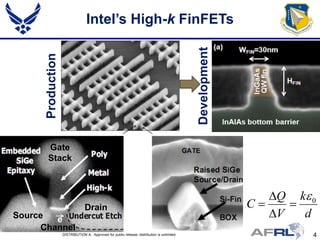
Intel’s High-k FinFETs


                                                                                                 Development
          Production


           Gate
S          Stack


                                                                                                                  Q k 0
                                    Drain                                                                      C    
    Source  e
                                                                                                                  V   d
         Channel
                       DISTRIBUTION A: Approved for public release; distribution is unlimited.                          4
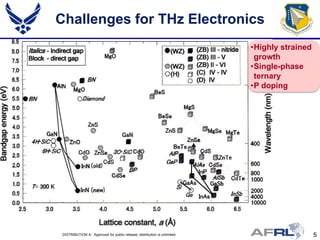
Challenges for THz Electronics
                                                                           •Highly strained
                                                                            growth
                                                                           •Single-phase
                                                                            ternary
                                                                           •P doping


 DISTRIBUTION A: Approved for public release; distribution is unlimited.                      5
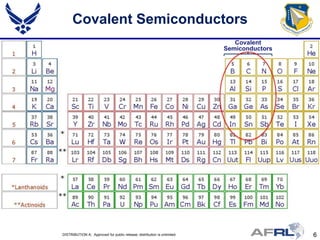
Covalent Semiconductors
                                                                             Covalent
                                                                          Semiconductors


DISTRIBUTION A: Approved for public release; distribution is unlimited.                    6
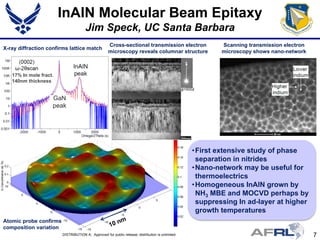
InAlN Molecular Beam Epitaxy
                                      Jim Speck, UC Santa Barbara
                                                    Cross-sectional transmission electron                 Scanning transmission electron
X-ray diffraction confirms lattice match
                                                    microscopy reveals columnar structure                 microscopy shows nano-network


   17% In mole fract.
   140nm thickness


                    GaN
                    peak


                                                                                                  •First extensive study of phase
                                                                                                   separation in nitrides
                                                                                                  •Nano-network may be useful for
                                                                                                   thermoelectrics
                                                                                                  •Homogeneous InAlN grown by
                                                                                                   NH3 MBE and MOCVD perhaps by
                                                                                                   suppressing In ad-layer at higher
                                                                                                   growth temperatures
Atomic probe confirms
composition variation
                        DISTRIBUTION A: Approved for public release; distribution is unlimited.                                            7
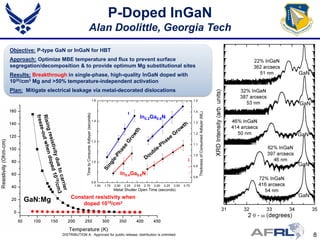
P-Doped InGaN
                                    Alan Doolittle, Georgia Tech
Objective: P-type GaN or InGaN for HBT
Approach: Optimize MBE temperature and flux to prevent surface
segregation/decomposition & to provide optimum Mg substitutional sites
Results: Breakthrough in single-phase, high-quality InGaN doped with                          GaN
1020/cm3 Mg and >50% temperature-independent activation
Plan: Mitigate electrical leakage via metal-decorated dislocations

                                                                                              GaN

                                                                    In0.2Ga0.8N


                                                                                              GaN


                                                                                              GaN
                                                       In0.4Ga0.6N


                         Constant resistivity when                                            GaN
     GaN:Mg                  doped 1019/cm3


                    DISTRIBUTION A: Approved for public release; distribution is unlimited.         8
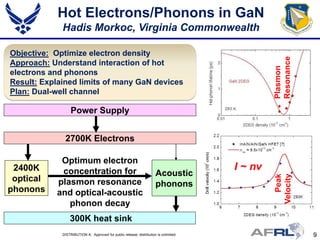
Hot Electrons/Phonons in GaN
             Hadis Morkoc, Virginia Commonwealth

Objective: Optimize electron density


                                                                                                Resonance
Approach: Understand interaction of hot


                                                                                                Plasmon
electrons and phonons
Result: Explained limits of many GaN devices
Plan: Dual-well channel

                  Power Supply


              2700K Electrons

            Optimum electron
 2400K      concentration for                                                          I ~ nv
                                                                      Acoustic


                                                                                                Velocity
                                                                                                   Peak
 optical   plasmon resonance                                          phonons
phonons    and optical-acoustic
              phonon decay
                 300K heat sink
             DISTRIBUTION A: Approved for public release; distribution is unlimited.                        9
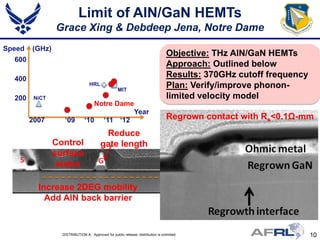
Limit of AlN/GaN HEMTs
                Grace Xing & Debdeep Jena, Notre Dame
Speed   (GHz)
                                                                                  Objective: THz AlN/GaN HEMTs
  600
                                                                                  Approach: Outlined below
  400
                                                                                  Results: 370GHz cutoff frequency
                                  HRL
                                                    MIT
                                                                                  Plan: Verify/improve phonon-
  200    NiCT                                                                     limited velocity model
                                  Notre Dame
                                            Year
        2007       ‘09         ‘10 ‘11 ‘12                                        Regrown contact with Rs<0.1Ω-mm
                                          Reduce
                Control                  gate length
                surface
                 states

          Increase 2DEG mobility
            Add AlN back barrier


                  DISTRIBUTION A: Approved for public release; distribution is unlimited.                            10
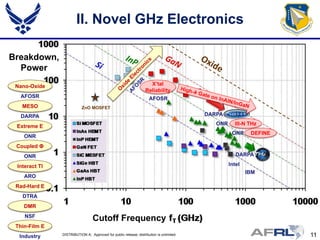
II. Novel GHz Electronics

Breakdown,
  Power
 Nano-Oxide                                                         X’tal
                                                                  Reliability
  AFOSR                                                             AFOSR
   MESO                   ZnO MOSFET
   DARPA                                                                                 DARPA

 Extreme E                                                                                  ONR     III-N THz
                                                                                                   ONR     DEFINE
    ONR
 Coupled Φ
    ONR                                                                                              DARPA

 Interact TI                                                                                      Intel
                                                                                                          IBM
    ARO
 Rad-Hard E
   DTRA
    DMR
    NSF
                                 Cutoff Frequency
 Thin-Film E
  Industry     DISTRIBUTION A: Approved for public release; distribution is unlimited.                              11
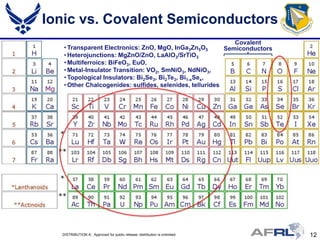
Ionic vs. Covalent Semiconductors
                                                             Covalent
   • Transparent Electronics: ZnO, MgO, InGa3Zn5O5        Semiconductors
   • Heterojunctions: MgZnO/ZnO, LaAlO3/SrTiO3
   • Multiferroics: BiFeO3, EuO,
   • Metal-Insulator Transition: VO2, SmNiO3, NdNiO3,
   • Topological Insulators: Bi2Se3, Bi2Te3, Bi1-xSex,
   • Other Chalcogenides: sulfides, selenides, tellurides


  DISTRIBUTION A: Approved for public release; distribution is unlimited.   12
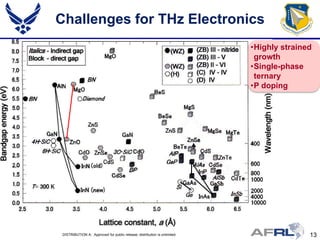
Challenges for THz Electronics
                                                                           •Highly strained
                                                                            growth
                                                                           •Single-phase
                                                                            ternary
                                                                           •P doping


 DISTRIBUTION A: Approved for public release; distribution is unlimited.                  13
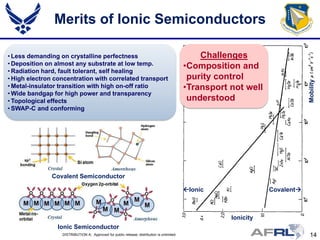
Merits of Ionic Semiconductors

• Less demanding on crystalline perfectness                                                     Challenges
• Deposition on almost any substrate at low temp.                                           •Composition and
• Radiation hard, fault tolerant, self healing
• High electron concentration with correlated transport                                      purity control


                                                                                                                              Mobility
• Metal-insulator transition with high on-off ratio                                         •Transport not well
• Wide bandgap for high power and transparency
• Topological effects                                                                        understood
• SWAP-C and conforming


               Covalent Semiconductor

                                                                                            Ionic                Covalent


                                                                                                       Ionicity
                 Ionic Semiconductor
                  DISTRIBUTION A: Approved for public release; distribution is unlimited.                                      14
Transport in ZnO
                                                      Dave Look, Wright State
                                                                                                                         •[VZn ] = 1.7x10²⁰
                                                                                                          Pulse Laser     cm-3 gives
                       32                                                                                  Deposition     E(formation) =
                                                                                                                 in Ar    0.2 eV; provides
                                                                                                                          accurate check
                       30
Mobility  (cm /V s)


                                                                                                                          on theory (DFT)
                                µ (ND, NA, m*, T)                                                                      •Reduced [VZn ]
2


                                Fitting parameters:                                                                m* with Zn anneals:
                       28                      21   -3                                                             0.30 got  = 1.4x10⁻⁴
                                ND = 1.45 x 10 cm SIMS
                                                                  20      -3
                                                                                                                        -cm, 3rd best in
                                NA = 1.71 x 10                          cm Positron                                0.34 world
                       26       m* = 0.34m0                                         Kane model                         •Future: create
                                                                                                                   0.40 GaZn donors by
                                                                                                                        filling VZn with Ga
                       24                                                                                                •Future: apply
                            0                      100                              200                     300           methods to other
                                                                                                                          TMOs
                                                                             T (K)
                                DISTRIBUTION A: Approved for public release; distribution is unlimited.                                  15
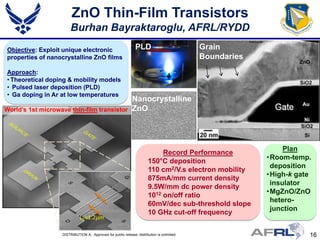
ZnO Thin-Film Transistors
                        Burhan Bayraktaroglu, AFRL/RYDD
Objective: Exploit unique electronic                            PLD                          Grain
properties of nanocrystalline ZnO films                                                      Boundaries
Approach:
• Theoretical doping & mobility models
• Pulsed laser deposition (PLD)
• Ga doping in Ar at low temperatures
                                                              Nanocrystalline
World’s 1st microwave thin-film transistor                    ZnO


                                                                                                               Plan
                                                                             Record Performance
                                                                                                          •Room-temp.
                                                                        150°C deposition
                                                                                                           deposition
                                                                        110 cm2/V.s electron mobility
                                                                                                          •High-k gate
                                                                        875mA/mm current density
                                                                                                           insulator
                                                                        9.5W/mm dc power density
                                                                                                          •MgZnO/ZnO
                                                                        1012 on/off ratio
                                                                                                           hetero-
                                                                        60mV/dec sub-threshold slope
                                                                                                           junction
                                                                        10 GHz cut-off frequency
                             LG=1.2m

                   DISTRIBUTION A: Approved for public release; distribution is unlimited.                           16
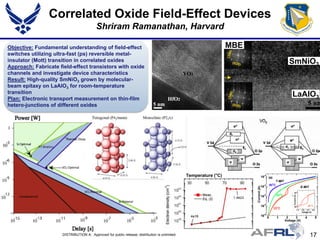
Correlated Oxide Field-Effect Devices
                                          Shriram Ramanathan, Harvard

Objective: Fundamental understanding of field-effect                                                               MBE
switches utilizing ultra-fast (ps) reversible metal-                                                                  Estimated
                                                                                                                     power-delay SmNiO3
insulator (Mott) transition in correlated oxides
Approach: Fabricate field-effect transistors with oxide
channels and investigate device characteristics                                                                         product
Result: High-quality SmNiO3 grown by molecular-                                                                      VO2 Mott FET
beam epitaxy on LaAlO3 for room-temperature
transition                                                                                                          vs. Si MOSFET
Plan: Electronic transport measurement on thin-film
                                                                                                                                 LaAlO3
hetero-junctions of different oxides


                                                                                                Temperature (°C)


                      DISTRIBUTION A: Approved for public release; distribution is unlimited.                                       17
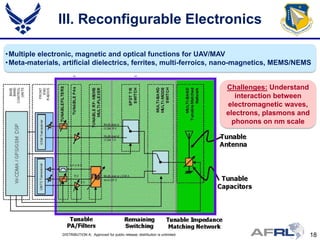
III. Reconfigurable Electronics

•Multiple electronic, magnetic and optical functions for UAV/MAV
•Meta-materials, artificial dielectrics, ferrites, multi-ferroics, nano-magnetics, MEMS/NEMS


                                                                                           Challenges: Understand
                                                                                              interaction between
                                                                                           electromagnetic waves,
                                                                                           electrons, plasmons and
                                                                                             phonons on nm scale


                 DISTRIBUTION A: Approved for public release; distribution is unlimited.                             18
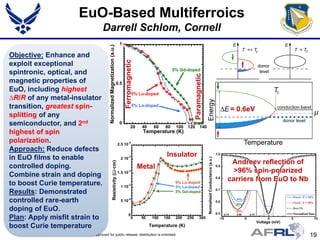
EuO-Based Multiferroics
                                         Darrell Schlom, Cornell
                                                                                1


                                             Normalized Magnetization (a.u.)
Objective: Enhance and


                                                                                     Ferromagnetic
exploit exceptional
                                                                                                                     5% Gd-doped
spintronic, optical, and


                                                                                                                                  Paramagnetic
magnetic properties of                                                         0.5
EuO, including highest
                                                                                               5% Lu-doped
∆R/R of any metal-insulator
transition, greatest spin-                                                                      5% La-doped
                                                                                                                                                 = 0.6eV
splitting of any
semiconductor, and 2nd                                                          0
                                                                                              20      40   60   80    100   120          140
highest of spin                                                                                       Temperature (K)
polarization.
Approach: Reduce defects
in EuO films to enable                                                                                          Insulator
                                                                                                                                                  Andreev reflection of
controlled doping.                                                                                   Metal
                                                                                                                                                   >96% spin-polarized
Combine strain and doping
                                                                                                                                                 carriers from EuO to Nb
to boost Curie temperature.
Results: Demonstrated
controlled rare-earth
doping of EuO.
Plan: Apply misfit strain to
boost Curie temperature
                DISTRIBUTION A: Approved for public release; distribution is unlimited.                                                                                    19
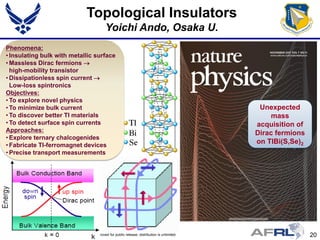
Topological Insulators
                                              Yoichi Ando, Osaka U.
Phenomena:
• Insulating bulk with metallic surface
• Massless Dirac fermions 
  high-mobility transistor
• Dissipationless spin current 
  Low-loss spintronics
Objectives:
• To explore novel physics
• To minimize bulk current                                                                     Unexpected
• To discover better TI materials                                                                  mass
• To detect surface spin currents                                                             acquisition of
Approaches:                                                                                   Dirac fermions
• Explore ternary chalcogenides
• Fabricate TI-ferromagnet devices
                                                                                              on TlBi(S,Se)2
• Precise transport measurements


                    DISTRIBUTION A: Approved for public release; distribution is unlimited.                    20
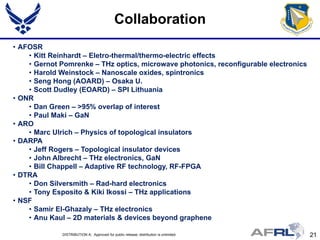
Collaboration
• AFOSR
    • Kitt Reinhardt – Eletro-thermal/thermo-electric effects
    • Gernot Pomrenke – THz optics, microwave photonics, reconfigurable electronics
    • Harold Weinstock – Nanoscale oxides, spintronics
    • Seng Hong (AOARD) – Osaka U.
    • Scott Dudley (EOARD) – SPI Lithuania
• ONR
    • Dan Green – >95% overlap of interest
    • Paul Maki – GaN
• ARO
    • Marc Ulrich – Physics of topological insulators
• DARPA
    • Jeff Rogers – Topological insulator devices
    • John Albrecht – THz electronics, GaN
    • Bill Chappell – Adaptive RF technology, RF-FPGA
• DTRA
    • Don Silversmith – Rad-hard electronics
    • Tony Esposito & Kiki Ikossi – THz applications
• NSF
    • Samir El-Ghazaly – THz electronics
    • Anu Kaul – 2D materials & devices beyond graphene

             DISTRIBUTION A: Approved for public release; distribution is unlimited.   21
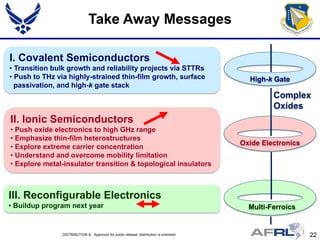
Take Away Messages

I. Covalent Semiconductors
• Transition bulk growth and reliability projects via STTRs
• Push to THz via highly-strained thin-film growth, surface                                High-k Gate
  passivation, and high-k gate stack
                                                                                                  Complex
                                                                                                  Oxides
II. Ionic Semiconductors
• Push oxide electronics to high GHz range
• Emphasize thin-film heterostructures
                                                                                         Oxide Electronics
• Explore extreme carrier concentration
• Understand and overcome mobility limitation
• Explore metal-insulator transition & topological insulators


III. Reconfigurable Electronics
• Buildup program next year                                                                Multi-Ferroics


               DISTRIBUTION A: Approved for public release; distribution is unlimited.                       22

Hwang - GHz-THz Electronics - Spring Review 2012

  • 1.
    GHz-THz Electronics 08 MAR 2012 Jim Hwang Program Manager AFOSR/RSE Integrity  Service  Excellence Air Force Research Laboratory 15 February 2012 DISTRIBUTION A: Approved for public release; distribution is unlimited. 1
  • 2.
    2012 AFOSR SPRINGREVIEW NAME: Jim Hwang BRIEF DESCRIPTION OF PORTFOLIO: GHz-THz Electronics LIST SUB-AREAS IN PORTFOLIO: I. THz Electronics – Material and device breakthroughs for transistors based on conventional semiconductors (e.g., group IV elements or group III-V compounds with covalent bonds) to operate at THz frequencies with adequate power. Challenges exist mainly in perfecting crystalline structure and interfaces. II. Novel GHz Electronics – Material and device breakthroughs for transistors based on novel semiconductors (e.g., transition-metal oxides with ionic bonds) to operate at GHz frequencies with high power. Challenges exist mainly in controlling purity and stoichiometry, as well as in understanding doping/transport. III. Reconfigurable Electronics – Material and device breakthroughs for meta-materials, artificial dielectrics, ferrites, multi-ferroics, nano-magnetics, and micro/nano electromechanical systems to perform multiple electronic, magnetic and optical functions. Challenges exist mainly in understanding the interaction between electromagnetic waves, electrons, plasmons and phonons on nanometer scale. DISTRIBUTION A: Approved for public release; distribution is unlimited. 2
  • 3.
    I. THz Electronics • Sub-millimeter-wave radar & imaging • Space situation awareness • Chemical/biological/nuclear sensing • Ultra-wideband communications X’tal Reliability • Ultra-high-speed on-board and AFOSR front-end data processing DARPA ONR III-N THz ONR DEFINE DARPA (Power) Intel IBM THz Cutoff Frequency DISTRIBUTION A: Approved for public release; distribution is unlimited. 3
  • 4.
    Intel’s High-k FinFETs Development Production Gate S Stack Q k 0 Drain C  Source e V d Channel DISTRIBUTION A: Approved for public release; distribution is unlimited. 4
  • 5.
    Challenges for THzElectronics •Highly strained growth •Single-phase ternary •P doping DISTRIBUTION A: Approved for public release; distribution is unlimited. 5
  • 6.
    Covalent Semiconductors Covalent Semiconductors DISTRIBUTION A: Approved for public release; distribution is unlimited. 6
  • 7.
    InAlN Molecular BeamEpitaxy Jim Speck, UC Santa Barbara Cross-sectional transmission electron Scanning transmission electron X-ray diffraction confirms lattice match microscopy reveals columnar structure microscopy shows nano-network 17% In mole fract. 140nm thickness GaN peak •First extensive study of phase separation in nitrides •Nano-network may be useful for thermoelectrics •Homogeneous InAlN grown by NH3 MBE and MOCVD perhaps by suppressing In ad-layer at higher growth temperatures Atomic probe confirms composition variation DISTRIBUTION A: Approved for public release; distribution is unlimited. 7
  • 8.
    P-Doped InGaN Alan Doolittle, Georgia Tech Objective: P-type GaN or InGaN for HBT Approach: Optimize MBE temperature and flux to prevent surface segregation/decomposition & to provide optimum Mg substitutional sites Results: Breakthrough in single-phase, high-quality InGaN doped with GaN 1020/cm3 Mg and >50% temperature-independent activation Plan: Mitigate electrical leakage via metal-decorated dislocations GaN In0.2Ga0.8N GaN GaN In0.4Ga0.6N Constant resistivity when GaN GaN:Mg doped 1019/cm3 DISTRIBUTION A: Approved for public release; distribution is unlimited. 8
  • 9.
    Hot Electrons/Phonons inGaN Hadis Morkoc, Virginia Commonwealth Objective: Optimize electron density Resonance Approach: Understand interaction of hot Plasmon electrons and phonons Result: Explained limits of many GaN devices Plan: Dual-well channel Power Supply 2700K Electrons Optimum electron 2400K concentration for I ~ nv Acoustic Velocity Peak optical plasmon resonance phonons phonons and optical-acoustic phonon decay 300K heat sink DISTRIBUTION A: Approved for public release; distribution is unlimited. 9
  • 10.
    Limit of AlN/GaNHEMTs Grace Xing & Debdeep Jena, Notre Dame Speed (GHz) Objective: THz AlN/GaN HEMTs 600 Approach: Outlined below 400 Results: 370GHz cutoff frequency HRL MIT Plan: Verify/improve phonon- 200 NiCT limited velocity model Notre Dame Year 2007 ‘09 ‘10 ‘11 ‘12 Regrown contact with Rs<0.1Ω-mm Reduce Control gate length surface states Increase 2DEG mobility Add AlN back barrier DISTRIBUTION A: Approved for public release; distribution is unlimited. 10
  • 11.
    II. Novel GHzElectronics Breakdown, Power Nano-Oxide X’tal Reliability AFOSR AFOSR MESO ZnO MOSFET DARPA DARPA Extreme E ONR III-N THz ONR DEFINE ONR Coupled Φ ONR DARPA Interact TI Intel IBM ARO Rad-Hard E DTRA DMR NSF Cutoff Frequency Thin-Film E Industry DISTRIBUTION A: Approved for public release; distribution is unlimited. 11
  • 12.
    Ionic vs. CovalentSemiconductors Covalent • Transparent Electronics: ZnO, MgO, InGa3Zn5O5 Semiconductors • Heterojunctions: MgZnO/ZnO, LaAlO3/SrTiO3 • Multiferroics: BiFeO3, EuO, • Metal-Insulator Transition: VO2, SmNiO3, NdNiO3, • Topological Insulators: Bi2Se3, Bi2Te3, Bi1-xSex, • Other Chalcogenides: sulfides, selenides, tellurides DISTRIBUTION A: Approved for public release; distribution is unlimited. 12
  • 13.
    Challenges for THzElectronics •Highly strained growth •Single-phase ternary •P doping DISTRIBUTION A: Approved for public release; distribution is unlimited. 13
  • 14.
    Merits of IonicSemiconductors • Less demanding on crystalline perfectness Challenges • Deposition on almost any substrate at low temp. •Composition and • Radiation hard, fault tolerant, self healing • High electron concentration with correlated transport purity control Mobility • Metal-insulator transition with high on-off ratio •Transport not well • Wide bandgap for high power and transparency • Topological effects understood • SWAP-C and conforming Covalent Semiconductor Ionic Covalent Ionicity Ionic Semiconductor DISTRIBUTION A: Approved for public release; distribution is unlimited. 14
  • 15.
    Transport in ZnO Dave Look, Wright State •[VZn ] = 1.7x10²⁰ Pulse Laser cm-3 gives 32 Deposition E(formation) = in Ar 0.2 eV; provides accurate check 30 Mobility  (cm /V s) on theory (DFT) µ (ND, NA, m*, T) •Reduced [VZn ] 2 Fitting parameters: m* with Zn anneals: 28 21 -3 0.30 got  = 1.4x10⁻⁴ ND = 1.45 x 10 cm SIMS 20 -3 -cm, 3rd best in NA = 1.71 x 10 cm Positron 0.34 world 26 m* = 0.34m0 Kane model •Future: create 0.40 GaZn donors by filling VZn with Ga 24 •Future: apply 0 100 200 300 methods to other TMOs T (K) DISTRIBUTION A: Approved for public release; distribution is unlimited. 15
  • 16.
    ZnO Thin-Film Transistors Burhan Bayraktaroglu, AFRL/RYDD Objective: Exploit unique electronic PLD Grain properties of nanocrystalline ZnO films Boundaries Approach: • Theoretical doping & mobility models • Pulsed laser deposition (PLD) • Ga doping in Ar at low temperatures Nanocrystalline World’s 1st microwave thin-film transistor ZnO Plan Record Performance •Room-temp. 150°C deposition deposition 110 cm2/V.s electron mobility •High-k gate 875mA/mm current density insulator 9.5W/mm dc power density •MgZnO/ZnO 1012 on/off ratio hetero- 60mV/dec sub-threshold slope junction 10 GHz cut-off frequency LG=1.2m DISTRIBUTION A: Approved for public release; distribution is unlimited. 16
  • 17.
    Correlated Oxide Field-EffectDevices Shriram Ramanathan, Harvard Objective: Fundamental understanding of field-effect MBE switches utilizing ultra-fast (ps) reversible metal- Estimated power-delay SmNiO3 insulator (Mott) transition in correlated oxides Approach: Fabricate field-effect transistors with oxide channels and investigate device characteristics product Result: High-quality SmNiO3 grown by molecular- VO2 Mott FET beam epitaxy on LaAlO3 for room-temperature transition vs. Si MOSFET Plan: Electronic transport measurement on thin-film LaAlO3 hetero-junctions of different oxides Temperature (°C) DISTRIBUTION A: Approved for public release; distribution is unlimited. 17
  • 18.
    III. Reconfigurable Electronics •Multipleelectronic, magnetic and optical functions for UAV/MAV •Meta-materials, artificial dielectrics, ferrites, multi-ferroics, nano-magnetics, MEMS/NEMS Challenges: Understand interaction between electromagnetic waves, electrons, plasmons and phonons on nm scale DISTRIBUTION A: Approved for public release; distribution is unlimited. 18
  • 19.
    EuO-Based Multiferroics Darrell Schlom, Cornell 1 Normalized Magnetization (a.u.) Objective: Enhance and Ferromagnetic exploit exceptional 5% Gd-doped spintronic, optical, and Paramagnetic magnetic properties of 0.5 EuO, including highest 5% Lu-doped ∆R/R of any metal-insulator transition, greatest spin- 5% La-doped = 0.6eV splitting of any semiconductor, and 2nd 0 20 40 60 80 100 120 140 highest of spin Temperature (K) polarization. Approach: Reduce defects in EuO films to enable Insulator Andreev reflection of controlled doping. Metal >96% spin-polarized Combine strain and doping carriers from EuO to Nb to boost Curie temperature. Results: Demonstrated controlled rare-earth doping of EuO. Plan: Apply misfit strain to boost Curie temperature DISTRIBUTION A: Approved for public release; distribution is unlimited. 19
  • 20.
    Topological Insulators Yoichi Ando, Osaka U. Phenomena: • Insulating bulk with metallic surface • Massless Dirac fermions  high-mobility transistor • Dissipationless spin current  Low-loss spintronics Objectives: • To explore novel physics • To minimize bulk current Unexpected • To discover better TI materials mass • To detect surface spin currents acquisition of Approaches: Dirac fermions • Explore ternary chalcogenides • Fabricate TI-ferromagnet devices on TlBi(S,Se)2 • Precise transport measurements DISTRIBUTION A: Approved for public release; distribution is unlimited. 20
  • 21.
    Collaboration • AFOSR • Kitt Reinhardt – Eletro-thermal/thermo-electric effects • Gernot Pomrenke – THz optics, microwave photonics, reconfigurable electronics • Harold Weinstock – Nanoscale oxides, spintronics • Seng Hong (AOARD) – Osaka U. • Scott Dudley (EOARD) – SPI Lithuania • ONR • Dan Green – >95% overlap of interest • Paul Maki – GaN • ARO • Marc Ulrich – Physics of topological insulators • DARPA • Jeff Rogers – Topological insulator devices • John Albrecht – THz electronics, GaN • Bill Chappell – Adaptive RF technology, RF-FPGA • DTRA • Don Silversmith – Rad-hard electronics • Tony Esposito & Kiki Ikossi – THz applications • NSF • Samir El-Ghazaly – THz electronics • Anu Kaul – 2D materials & devices beyond graphene DISTRIBUTION A: Approved for public release; distribution is unlimited. 21
  • 22.
    Take Away Messages I.Covalent Semiconductors • Transition bulk growth and reliability projects via STTRs • Push to THz via highly-strained thin-film growth, surface High-k Gate passivation, and high-k gate stack Complex Oxides II. Ionic Semiconductors • Push oxide electronics to high GHz range • Emphasize thin-film heterostructures Oxide Electronics • Explore extreme carrier concentration • Understand and overcome mobility limitation • Explore metal-insulator transition & topological insulators III. Reconfigurable Electronics • Buildup program next year Multi-Ferroics DISTRIBUTION A: Approved for public release; distribution is unlimited. 22