1Distribution A: Approved for public release; distribution is unlimited
Integrity  Service  Excellence
GHz-THz Electronics
Date: 07 03 2013
Jim Hwang
Program Officer
AFOSR/RTD
Air Force Research Laboratory
2Distribution A: Approved for public release; distribution is unlimited
2013 AFOSR SPRING REVIEW
3001B PORTFOLIO OVERVIEW
NAME: Jim Hwang
BRIEF DESCRIPTION OF PORTFOLIO: GHz-THz Electronics
LIST SUB-AREAS IN PORTFOLIO:
I. THz Electronics – Material and device breakthroughs for transistors based on conventional
semiconductors (e.g., group IV elements or group III-V compounds with covalent bonds) to
operate at THz frequencies with adequate power. Challenges exist mainly in perfecting
crystalline structure and interfaces as channel thickness is scaled to single atomic layer.
II. Novel GHz Electronics – Material and device breakthroughs for transistors based on novel
semiconductors (e.g., transition-metal oxides with ionic bonds) to operate at GHz
frequencies with high power. Challenges exist mainly in controlling purity and stoichiometry,
as well as in understanding metal-insulator transition.
III. Reconfigurable Electronics – Material and device breakthroughs for meta-materials,
artificial dielectrics, ferrites, multi-ferroics, nano-magnetics, and micro/nano
electromechanical systems to perform multiple electronic, magnetic and optical functions.
Challenges exist mainly in understanding the interaction between electromagnetic waves,
electrons, plasmons and phonons on nanometer scale.
3Distribution A: Approved for public release; distribution is unlimited
Covalent
Semiconductors
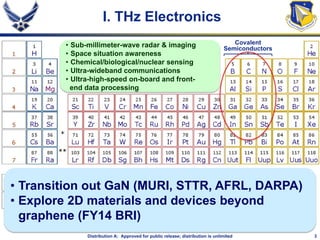
I. THz Electronics
• Sub-millimeter-wave radar & imaging
• Space situation awareness
• Chemical/biological/nuclear sensing
• Ultra-wideband communications
• Ultra-high-speed on-board and front-
end data processing
• Transition out GaN (MURI, STTR, AFRL, DARPA)
• Explore 2D materials and devices beyond
graphene (FY14 BRI)
4Distribution A: Approved for public release; distribution is unlimited
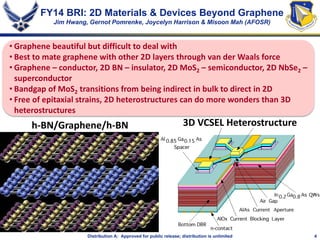
FY14 BRI: 2D Materials & Devices Beyond Graphene
Jim Hwang, Gernot Pomrenke, Joycelyn Harrison & Misoon Mah (AFOSR)
3D VCSEL Heterostructureh-BN/Graphene/h-BN
• Graphene beautiful but difficult to deal with
• Best to mate graphene with other 2D layers through van der Waals force
• Graphene – conductor, 2D BN – insulator, 2D MoS2 – semiconductor, 2D NbSe2 –
superconductor
• Bandgap of MoS2 transitions from being indirect in bulk to direct in 2D
• Free of epitaxial strains, 2D heterostructures can do more wonders than 3D
heterostructures
5Distribution A: Approved for public release; distribution is unlimited
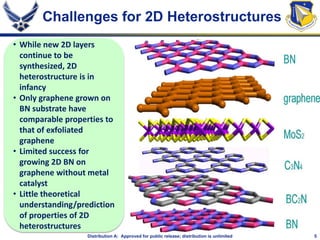
Challenges for 2D Heterostructures
• While new 2D layers
continue to be
synthesized, 2D
heterostructure is in
infancy
• Only graphene grown on
BN substrate have
comparable properties to
that of exfoliated
graphene
• Limited success for
growing 2D BN on
graphene without metal
catalyst
• Little theoretical
understanding/prediction
of properties of 2D
heterostructures
6Distribution A: Approved for public release; distribution is unlimited
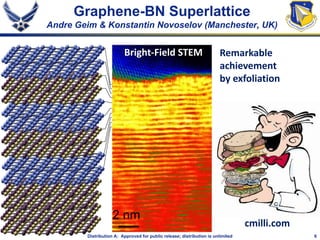
2 nm
Bright-Field STEM
Graphene-BN Superlattice
Andre Geim & Konstantin Novoselov (Manchester, UK)
cmilli.com
Remarkable
achievement
by exfoliation
7Distribution A: Approved for public release; distribution is unlimited
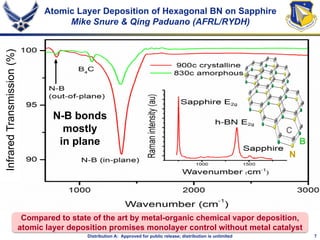
Atomic Layer Deposition of Hexagonal BN on Sapphire
Mike Snure & Qing Paduano (AFRL/RYDH)
N-B bonds
mostly
in plane
Compared to state of the art by metal-organic chemical vapor deposition,
atomic layer deposition promises monolayer control without metal catalyst
InfraredTransmission(%)
C
B
N
8Distribution A: Approved for public release; distribution is unlimited
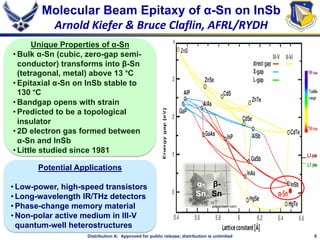
Molecular Beam Epitaxy of α-Sn on InSb
Arnold Kiefer & Bruce Claflin, AFRL/RYDH
Unique Properties of α-Sn
• Bulk α-Sn (cubic, zero-gap semi-
conductor) transforms into β-Sn
(tetragonal, metal) above 13 °C
• Epitaxial α-Sn on InSb stable to
130 °C
• Bandgap opens with strain
• Predicted to be a topological
insulator
• 2D electron gas formed between
α-Sn and InSb
• Little studied since 1981
Potential Applications
• Low-power, high-speed transistors
• Long-wavelength IR/THz detectors
• Phase-change memory material
• Non-polar active medium in III-V
quantum-well heterostructures
popscreen.com
β-
Sn
α-
Sn
9Distribution A: Approved for public release; distribution is unlimited
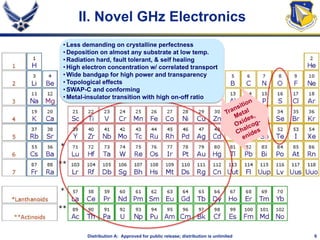
II. Novel GHz Electronics
• Less demanding on crystalline perfectness
• Deposition on almost any substrate at low temp.
• Radiation hard, fault tolerant, & self healing
• High electron concentration w/ correlated transport
• Wide bandgap for high power and transparency
• Topological effects
• SWAP-C and conforming
• Metal-insulator transition with high on-off ratio
10Distribution A: Approved for public release; distribution is unlimited
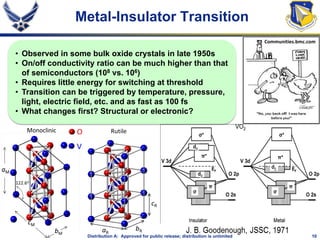
Metal-Insulator Transition
• Observed in some bulk oxide crystals in late 1950s
• On/off conductivity ratio can be much higher than that
of semiconductors (108 vs. 106)
• Requires little energy for switching at threshold
• Transition can be triggered by temperature, pressure,
light, electric field, etc. and as fast as 100 fs
• What changes first? Structural or electronic?
Communities.bmc.com
11Distribution A: Approved for public release; distribution is unlimited
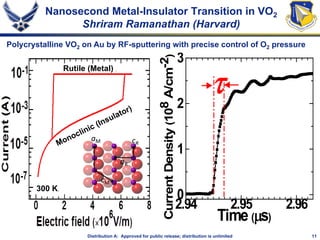
Nanosecond Metal-Insulator Transition in VO2
Shriram Ramanathan (Harvard)
300 K.
2.94 2.95 2.96
0
1
2
3
τ
CurrentDensity(108A/cm-2)
Time (µs)
Rutile (Metal) .
Polycrystalline VO2 on Au by RF-sputtering with precise control of O2 pressure
12Distribution A: Approved for public release; distribution is unlimited
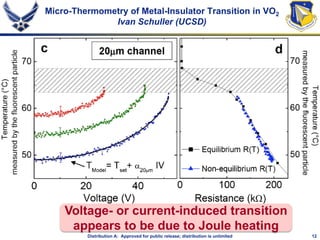
Micro-Thermometry of Metal-Insulator Transition in VO2
Ivan Schuller (UCSD)
Voltage- or current-induced transition
appears to be due to Joule heating
13Distribution A: Approved for public release; distribution is unlimited
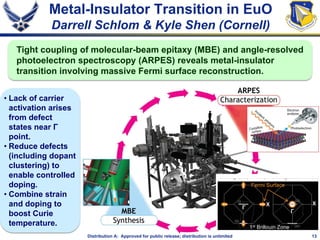
Metal-Insulator Transition in EuO
Darrell Schlom & Kyle Shen (Cornell)
Tight coupling of molecular-beam epitaxy (MBE) and angle-resolved
photoelectron spectroscopy (ARPES) reveals metal-insulator
transition involving massive Fermi surface reconstruction.
• Lack of carrier
activation arises
from defect
states near Γ
point.
• Reduce defects
(including dopant
clustering) to
enable controlled
doping.
• Combine strain
and doping to
boost Curie
temperature.
YAlO3
MBE
1st Brillouin Zone
Γ
Γ
XX
Fermi Surface
14Distribution A: Approved for public release; distribution is unlimited
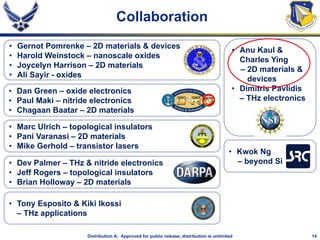
Collaboration
• Gernot Pomrenke – 2D materials & devices
• Harold Weinstock – nanoscale oxides
• Joycelyn Harrison – 2D materials
• Ali Sayir - oxides
• Dan Green – oxide electronics
• Paul Maki – nitride electronics
• Chagaan Baatar – 2D materials
• Marc Ulrich – topological insulators
• Pani Varanasi – 2D materials
• Mike Gerhold – transistor lasers
• Dev Palmer – THz & nitride electronics
• Jeff Rogers – topological insulators
• Brian Holloway – 2D materials
• Tony Esposito & Kiki Ikossi
– THz applications
• Kwok Ng
– beyond Si
• Anu Kaul &
Charles Ying
– 2D materials &
devices
• Dimitris Pavlidis
– THz electronics
15Distribution A: Approved for public release; distribution is unlimited
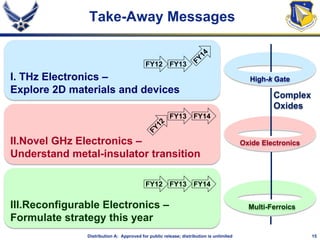
I. THz Electronics –
Explore 2D materials and devices
II.Novel GHz Electronics –
Understand metal-insulator transition
III.Reconfigurable Electronics –
Formulate strategy this year
High-k Gate
Multi-Ferroics
Complex
Oxides
Oxide Electronics
Take-Away Messages
FY13
FY14
FY14FY13FY12
FY13
FY12

Hwang - GHz-THz Electronics - Spring Review 2013

  • 1.
    1Distribution A: Approvedfor public release; distribution is unlimited Integrity  Service  Excellence GHz-THz Electronics Date: 07 03 2013 Jim Hwang Program Officer AFOSR/RTD Air Force Research Laboratory
  • 2.
    2Distribution A: Approvedfor public release; distribution is unlimited 2013 AFOSR SPRING REVIEW 3001B PORTFOLIO OVERVIEW NAME: Jim Hwang BRIEF DESCRIPTION OF PORTFOLIO: GHz-THz Electronics LIST SUB-AREAS IN PORTFOLIO: I. THz Electronics – Material and device breakthroughs for transistors based on conventional semiconductors (e.g., group IV elements or group III-V compounds with covalent bonds) to operate at THz frequencies with adequate power. Challenges exist mainly in perfecting crystalline structure and interfaces as channel thickness is scaled to single atomic layer. II. Novel GHz Electronics – Material and device breakthroughs for transistors based on novel semiconductors (e.g., transition-metal oxides with ionic bonds) to operate at GHz frequencies with high power. Challenges exist mainly in controlling purity and stoichiometry, as well as in understanding metal-insulator transition. III. Reconfigurable Electronics – Material and device breakthroughs for meta-materials, artificial dielectrics, ferrites, multi-ferroics, nano-magnetics, and micro/nano electromechanical systems to perform multiple electronic, magnetic and optical functions. Challenges exist mainly in understanding the interaction between electromagnetic waves, electrons, plasmons and phonons on nanometer scale.
  • 3.
    3Distribution A: Approvedfor public release; distribution is unlimited Covalent Semiconductors I. THz Electronics • Sub-millimeter-wave radar & imaging • Space situation awareness • Chemical/biological/nuclear sensing • Ultra-wideband communications • Ultra-high-speed on-board and front- end data processing • Transition out GaN (MURI, STTR, AFRL, DARPA) • Explore 2D materials and devices beyond graphene (FY14 BRI)
  • 4.
    4Distribution A: Approvedfor public release; distribution is unlimited FY14 BRI: 2D Materials & Devices Beyond Graphene Jim Hwang, Gernot Pomrenke, Joycelyn Harrison & Misoon Mah (AFOSR) 3D VCSEL Heterostructureh-BN/Graphene/h-BN • Graphene beautiful but difficult to deal with • Best to mate graphene with other 2D layers through van der Waals force • Graphene – conductor, 2D BN – insulator, 2D MoS2 – semiconductor, 2D NbSe2 – superconductor • Bandgap of MoS2 transitions from being indirect in bulk to direct in 2D • Free of epitaxial strains, 2D heterostructures can do more wonders than 3D heterostructures
  • 5.
    5Distribution A: Approvedfor public release; distribution is unlimited Challenges for 2D Heterostructures • While new 2D layers continue to be synthesized, 2D heterostructure is in infancy • Only graphene grown on BN substrate have comparable properties to that of exfoliated graphene • Limited success for growing 2D BN on graphene without metal catalyst • Little theoretical understanding/prediction of properties of 2D heterostructures
  • 6.
    6Distribution A: Approvedfor public release; distribution is unlimited 2 nm Bright-Field STEM Graphene-BN Superlattice Andre Geim & Konstantin Novoselov (Manchester, UK) cmilli.com Remarkable achievement by exfoliation
  • 7.
    7Distribution A: Approvedfor public release; distribution is unlimited Atomic Layer Deposition of Hexagonal BN on Sapphire Mike Snure & Qing Paduano (AFRL/RYDH) N-B bonds mostly in plane Compared to state of the art by metal-organic chemical vapor deposition, atomic layer deposition promises monolayer control without metal catalyst InfraredTransmission(%) C B N
  • 8.
    8Distribution A: Approvedfor public release; distribution is unlimited Molecular Beam Epitaxy of α-Sn on InSb Arnold Kiefer & Bruce Claflin, AFRL/RYDH Unique Properties of α-Sn • Bulk α-Sn (cubic, zero-gap semi- conductor) transforms into β-Sn (tetragonal, metal) above 13 °C • Epitaxial α-Sn on InSb stable to 130 °C • Bandgap opens with strain • Predicted to be a topological insulator • 2D electron gas formed between α-Sn and InSb • Little studied since 1981 Potential Applications • Low-power, high-speed transistors • Long-wavelength IR/THz detectors • Phase-change memory material • Non-polar active medium in III-V quantum-well heterostructures popscreen.com β- Sn α- Sn
  • 9.
    9Distribution A: Approvedfor public release; distribution is unlimited II. Novel GHz Electronics • Less demanding on crystalline perfectness • Deposition on almost any substrate at low temp. • Radiation hard, fault tolerant, & self healing • High electron concentration w/ correlated transport • Wide bandgap for high power and transparency • Topological effects • SWAP-C and conforming • Metal-insulator transition with high on-off ratio
  • 10.
    10Distribution A: Approvedfor public release; distribution is unlimited Metal-Insulator Transition • Observed in some bulk oxide crystals in late 1950s • On/off conductivity ratio can be much higher than that of semiconductors (108 vs. 106) • Requires little energy for switching at threshold • Transition can be triggered by temperature, pressure, light, electric field, etc. and as fast as 100 fs • What changes first? Structural or electronic? Communities.bmc.com
  • 11.
    11Distribution A: Approvedfor public release; distribution is unlimited Nanosecond Metal-Insulator Transition in VO2 Shriram Ramanathan (Harvard) 300 K. 2.94 2.95 2.96 0 1 2 3 τ CurrentDensity(108A/cm-2) Time (µs) Rutile (Metal) . Polycrystalline VO2 on Au by RF-sputtering with precise control of O2 pressure
  • 12.
    12Distribution A: Approvedfor public release; distribution is unlimited Micro-Thermometry of Metal-Insulator Transition in VO2 Ivan Schuller (UCSD) Voltage- or current-induced transition appears to be due to Joule heating
  • 13.
    13Distribution A: Approvedfor public release; distribution is unlimited Metal-Insulator Transition in EuO Darrell Schlom & Kyle Shen (Cornell) Tight coupling of molecular-beam epitaxy (MBE) and angle-resolved photoelectron spectroscopy (ARPES) reveals metal-insulator transition involving massive Fermi surface reconstruction. • Lack of carrier activation arises from defect states near Γ point. • Reduce defects (including dopant clustering) to enable controlled doping. • Combine strain and doping to boost Curie temperature. YAlO3 MBE 1st Brillouin Zone Γ Γ XX Fermi Surface
  • 14.
    14Distribution A: Approvedfor public release; distribution is unlimited Collaboration • Gernot Pomrenke – 2D materials & devices • Harold Weinstock – nanoscale oxides • Joycelyn Harrison – 2D materials • Ali Sayir - oxides • Dan Green – oxide electronics • Paul Maki – nitride electronics • Chagaan Baatar – 2D materials • Marc Ulrich – topological insulators • Pani Varanasi – 2D materials • Mike Gerhold – transistor lasers • Dev Palmer – THz & nitride electronics • Jeff Rogers – topological insulators • Brian Holloway – 2D materials • Tony Esposito & Kiki Ikossi – THz applications • Kwok Ng – beyond Si • Anu Kaul & Charles Ying – 2D materials & devices • Dimitris Pavlidis – THz electronics
  • 15.
    15Distribution A: Approvedfor public release; distribution is unlimited I. THz Electronics – Explore 2D materials and devices II.Novel GHz Electronics – Understand metal-insulator transition III.Reconfigurable Electronics – Formulate strategy this year High-k Gate Multi-Ferroics Complex Oxides Oxide Electronics Take-Away Messages FY13 FY14 FY14FY13FY12 FY13 FY12