Biogeochemical Cycles

An Application of Conservation of
             Matter
Conservation of Matter
• Matter cannot be created or destroyed it can
  only change form
  – The amount of matter in the universe is finite
    (unchanging)
  – Atoms (of certain elements) are recycled over and
    over again.
        – 92 naturally occurring elements make up nearly all matter.
        – Go through innumerable chemical reactions to both form and
          breakdown compounds.
        – For example some of the atoms that now make up your body
          may have once been part of a dinosaur, a rock, a tree, and a
          panda bear at one point in their existence.
Cycles
• Cycles: Track the
  movement of matter and
  energy through a system.
  Recurring series of
  events.
• System: A group of
  independent but
  interrelated parts
  forming a unified whole.
  – The planet earth can be
    viewed as one large
    system.
Biogeochemical Cycle
        • Bio = Biosphere (Living
          Things)
        • Geo = Geosphere
          (Rocks / Earth)
        • Chem = Chemical Factors
        • Biogeochemical Cycles:
          Track the repeating
          movement of atoms and
          energy through both the
          living and nonliving parts
          of the earth system.
Long Term Storage
• In most cycles only a fraction of the systems total
  material is in active circulation.
• Reservoirs: Places where elements are stored or
  held for a long period of time. Effectively takes
  them out of circulation.
• Residence Time: An estimate of how long matter
  is typically stored in a particular reservoir.
Human Impact
• Human activities can have a
  large impact on biogeochemical
  cycles.
   – Alter the natural functioning of
     systems.
   – Can have unforeseen negative
     consequences.
• The biggest anthropogenic
  (caused by humans) impact is
  mining or removing resources
  from storage in reservoirs and
  putting them back into
  circulation.
Biogeochemical Cycles and Life
• Properly functioning
  cycles are essential to all
  life on earth.
• Living things depend on
  cycles to provide the
  nutrients they need.
• Living things, like all
  matter (and elephants)
  are made of elements.
  Cycles provide those
  elemental building blocks.
The Human Element?
•   Almost 99% of the mass of the
    human body (and most other life
    forms) is made up of 6 elements:
     –   Oxygen
     –   Carbon
     –   Hydrogen
     –   Nitrogen
     –   Calcium
     –   Phosphorus.
•   Only about 0.85% is composed of
    another five elements:
     –   Potassium
     –   Sulfur
     –   Sodium
     –   Chlorine
     –   Magnesium
•   All are necessary to life.
•   Around 70% of the human body is
    made up of a single compound:
    Water.
Water
• Is a compound of hydrogen and oxygen.
   – H20
• The intermolecular forces (bonds) holding the
  atoms of a water molecule together are
  extremely strong.
   – Makes water a very stable molecule.
      • Low Reactivity.
      • Not easy to break H2O down to elements or to form new
        chemicals.
• Essential to life.
   – You could only survive about a week without water.
The Processes of the Water Cycle
     Evaporation    Condensation


   Transpiration     Precipitation
Evaporation


Process in which liquid
changes to gas (vapor)
Transpiration

A continuous process
caused by the evaporation
of water from leaves of
plants and its
corresponding uptake
from roots in the soil.
Condensation
Condensation is the
process by which matter
changes from a gas (or
vapor) phase into a liquid
phase.

 Ex. Dew on the grass in the
  morning, cold glass of liquid, fog
  on the inside of a car window
Precipitation
• When cloud (water
  molecules) particles become
  too heavy to remain
  suspended in the air, they
  fall to the earth as
  precipitation.
Surface Run-off
 Water, from rain, snowmelt,
  or other sources, that flows
  over the land surface, and is a
  major component of the water
  cycle.
 When the ground is saturated,
  the water flows into lakes,
  streams, rivers, and eventually
  ends up in oceans.
Groundwater
• The water that is
  filtered through the soil
  and remains under the
  ground.
• Is a major source of
  drinking water as well
  as agricultural
  irrigation.
Aquifer
“Water, water everywhere... but not a drop to
                       drink.”


• The overall water cycle "contains" between 1.386 and 1.46 Billion km3 of
  water in various states (liquid, solid, or gaseous).
• The vast majority of it, between 96.5 and 97.25%, is in the Oceans.
• Only about 3% of Earth's water is fresh water.
   – 2/3rds of that is frozen in the ice sheets near the poles and in glaciers.
   – Most of the rest of the fresh water is underground.
   – Less than 1% of fresh water is on the surface in lakes, wetlands, and
     rivers.
       • Only a very small fraction (~.77%) of Earth’s water is suitable for
         human consumption.
Residence Time in Water Cycle
Storage Reservoirs Within the Water
                  Cycle
• The oceans, glaciers
  and ice caps, lakes,
  underground aquifers
  and the atmosphere
  are some examples of
  reservoirs.
• Most of earth’s water
  is in “long term
  storage”.
  – Not actively circulating.
Human Impact
Death of the Aral Sea
• Located in present-day
  Kazakhstan and
  Uzbekistan.
• 1930’s it was decided
  that the area surrounding
  the sea could be used to
  grow cotton.
• By 1960, millions of acres
  of land were irrigated
  using water from the two
  large rivers that fed the
  Aral Sea.
• The sea began to shrink
1967   2007
Aral Sea Impacts
         • Salinity increased as water
           was not replenished
            – Hurt the 60,000 employee
              fishery industry.
            – 3x saltier than the ocean.
         • Lost 90% of it’s original
           volume.
         • Many health impacts for the
           people as the dried
           salt/pesticide/fertilizer/herb
           icide laden dust is carried by
           winds
            – Increased cancer, higher
              infant mortality
         • Local climate changed,
           growing season shortened,
           switch from cotton to rice.
Tragedy of the Commons...
Tragedy of the Commons
• First proposed by Garrett
  Hardin in 1968.
• When individuals, acting
  independently and
  rationally, will use and
  deplete a shared resource.
• Doing so is often not in the
  individual or larger societies
  best long-term interests.
• Dilemma: If you don’t use it
  someone else will.
• Short term personal gain is
  at odds with long term
  communal well being.
Water: The Ultimate Commons
• In most countries water is
  viewed as a common
  resource.
• If you own land, you own
  the rights to use the
  water on it and under it.
• The problem: All bodies
  of water are
  interconnected.
• Can use that water
  however you see fit.
• Leads to overuse, and
  destruction of watershed.
Carrying Capacity
• Since resources are finite Earth, and other
  systems, have a maximum carrying capacity.
• Carrying Capacity: The number of individuals a
  system (such as earth) can sustainably support at
  a given standard of living.
• Sustainable: Can be maintained over
  generations.
• Fresh water, and many other resources, are being
  used at a rate that is unsustainable. We call this
  overconsumption.
• We’re using fresh water at a rate that is faster
  than the water cycle can replenish it.
Determining Carrying Capacity
• The carrying capacity of a system is
  governed by two main factors:
    – Population:
        • The total number of individuals.
        • Each individual has certain basic needs
          that have to be met by the system in
          order to survive.
    – Standard of Living:
        • The degree of wealth and material
          comfort available to a person or
          community.
        • How many resources a person is using.
• Since the total amount of resources is
  constant, as you approach a system’s
  carrying capacity, an increase in
  population has to be accompanied by
  a decrease in standard of living.
Human Population
• There are over
  7 Billion people living
  on earth today.
• Population is growing
  exponentially.
• More people are
  being born than are
  dyeing.
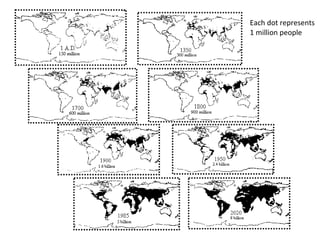
Population History
• The human population is
  now growing at a rate of
  about 3 people/second or
• 260 thousand/day or
• 1.8 million per week or
• 93 million/year
•   Each dot represents
    1 million people
Human Population and Resource Use
• Conservation of matter. The total amount of
  water and other resources is constant.
• More people means more demand for resources.
• The total amount of water on earth remains the
  same. Even as population increases.
• Growing population puts huge stress on system.
  – More people competing for the same amount of
    water.
Unequal Usage
•   25% of the world’s do not have adequate
    access to a safe and adequate water
    supply.
•   Worldwide 1 Billion people make a daily
    trip of over 3 hours just to collect water.
•   14,000 people die every day from water
    related illness.
•   All inclusive estimates (including water
    used to produce food) from the United
    Nations state that only about 13 gallons of
    water per day is the minimum required
    amount to sustain a human life.
•   With access to just 1.3 gallons of domestic
    water each day, more than a billion people
    in water poor regions around the globe
    survive on the same amount used to flush
    a toilet.
•   In Honduras people spend 25% of their
    annual income on water.
USA Water Usage
  • The average American uses 80-100
    gallons of water a day for domestic use.
  • All things considered this number sky
    rockets to around 2000 gallons of water
    per day.
     – Over 1000 times the minimum required
       to sustain life.
     – Nearly 95 percent of your water footprint
       is hidden in the food you eat, energy you
       use, products you buy, and services you
       rely on.
     – Highest per capita water use in developed
       world.
  • Water Footprint Calculator
  • Americans only spend .05% of their
    annual income on water.
Effects of Excessive Consumption
• Key Problem: Fresh water is being
  consumed at a faster rate than it is
  being replenished.
   – If trend continues we will eventually run
     out of water.
   – What about Iowa?
       • We are doing relatively well. The Jordan
         and Dakota Aquifers are being slightly
         overused but not at the high rate seen
         in other parts of the Midwest.
   – In other parts of the Midwest the water
     in the Ogallala Aquifer is being removed
     8 times faster than it is replenished.
• Only a fraction of consumption goes
  towards day-to-day domestic uses.
   – 70% Agriculture
   – 20% Manufacturing
   – 10% Domestic Use
Ogallala Aquifer: A Cautionary Tale
ANF: America Needs Farmers
• As population increases, so
  does demands for foods.
• The food that feeds the
  majority of Americans, and
  people around the world,
  comes from the Midwest.
• How do you balance demand
  for food with issues related
  to water consumption?
  – The key is responsible
    management.
Irrigation
• With increased demand for
  food, people have begun to
  farm in less than ideal climate
  zones.
   – Lack an adequate supply of
     natural water.
• Irrigation enables crops to
  grow in areas where they
  could not survive naturally.
• Problems: Uses lots of water
  and is inefficient.
   – Efficiency ranges from 50-75%
• Can lead to an increase in soil
  salinity that eventually
  renders the land totally
  unusable.
Crop Selection
• Different food crops require different
  amounts of water to grow.
• By selecting crops appropriate to your region
  the need for irrigation can be vastly reduced.
• For example:
  – Growing corn makes sense in South East Iowa
    where water is relatively abundant.
  – It doesn’t make sense in the Dakota’s where
    water is scarce.
Water Consumption Per Pound
•   Lettuce = 15 Gallons
•   Tomatoes = 22 Gallons
•   Potatoes = 30 Gallons
•   Oranges = 55 Gallons
•   Apples = 83 Gallons
•   Corn = 107 Gallons
•   Tree Nuts = 368 Gallons
•   Rice = 403 Gallons
•   Eggs = 573 Gallons
•   Chicken = 815 Gallons
•   Pork = 1630 Gallons
•   Beef = 5000 Gallons
Managing Runoff and Erosion
• Natural vegetation slows down
  the flow of rainwater. More
  water is absorbed by the
  ground, and eventually
  percolates down into aquifers.
• Clearing land for farming leads
  to an increase in the rate and
  total amount of runoff.
   – More fresh water flows into
     rivers and is ultimately lost in the
     ocean.
   – Increased erosion and loss of
     nutrient rich topsoil.
• Faster flow rates can lead to
  intense Flash Floods.
Preventing Erosion
• Plant Buffer Strips: Plant native grasses
  or trees along the edges of the field or
  on steep slopes.
   – CRP Program: Provides compensation for
     land that is reverted back to native
     species. Intended to encourage
     construction of buffer strips and protect
     highly erodible land and increase
     groundwater recharge.
• Mulching or Cover Crops: Leave waste
  material on field after harvest or plant
  cover crop.
• Contour Cultivation: Plow in such away
  that furrows align to natural contour of
  the land and act as miniature dams.
Deforestation and Urbanization
• Deforestation: The removal of trees and other natural
  vegetation from an area.
   – Can be for agriculture, industrial, or civil reasons.
• Urbanization: Rapid growth and physical expansion of
  cities.
   – The cement jungle.
• Both Deforestation and Urbanization alter the water
  cycle in the local area.
The Cement Jungle
• Urban Sprawl: The uncontrolled geographic expansion of
  development and urbanization out from the city center.
• Impervious Surface: A surface covering that water cannot
  pass through.
   – All of the precipitation that falls on an impervious surface will
     runoff.
   – Common examples include cement, asphalt, and rooftops.
   – Around 43,000 square miles of the USA is covered with
     impervious surface.
Effects of Pavement
•   When precipitation falls on impervious surfaces it runs off immediately.
•   Intensifies and speeds up the water cycle.
     – More runoff.
     – Flash flooding.
         • Flooding occurs more quickly and with greater intensity.
     – More erosion.
     – Less ground water recharge.
•   Rather than being held in the local watershed for later use, this urban runoff is
    diverted into sewer systems and routed directly into rivers and ultimately the
    ocean.
     – Quite literally (fresh) water down the drain.
Solutions
• Floodwalls and Levees
  – Build a large wall to hold back
    floodwaters.
  – Problem: Just sends that water
    downstream… someone else's
    problem.
• Reduce Impervious Surface
  – Design cities with parks in key areas.
  – Narrow streets.
  – New types of permeable pavement.
• Rain Water Capture Systems
  – Cisterns
  – Trap and hold rainfall for later use.
Dams
• Dam: A structure that impounds
  (blocks) the flow of water in a stream
  or river.
• Used to store large quantities of
  water for later use.
   – Attempt to rectify problems associated
     with urbanization and acceleration of
     runoff.
   – Reservoir fills with water during wet
     season and can be drawn from during
     dry season or droughts.
• Allow for controlled release of
  water.
   – Protect downstream areas from
     flooding.
   – Outlet flow can be used to generate
     electricity
       • Hydroelectric power
Dam Construction Worldwide
• 845,000 Number of dams in the world.
  – Rapid Growth
• 80,000 Number of dams in USA.
• 65 Percentage of the worlds river water that’s
  flow is impeded by dams.
• 292 Number of major river systems worldwide
  adversely affected by dam construction (over
  half).
• 50 Average number of years that a hydroelectric
  dam remains useable.
• 85 Percent of the world’s dams that will be
  obsolete by 2020.
Problems Associated With Dams
High Rate of Evaporation
• The water in a reservoir is
  largely stagnant (not
  flowing).
• Reservoirs, especially in
  warm dry areas, are
  prone to solar warming
  and high evaporation
  rates.
• Can also lead to the
  creation of a thermocline
  and hypoxic (oxygen
  deprived) zones.
Accumulation of Sediment &
                 Toxins
• All rivers contain sediments (from
  erosion).
• When a river is stilled behind a dam,
  the sediments it contains sink to the
  bottom of the reservoir.
• Effectively fills in the reservoir,
  eventually rendering the dam useless.
    – The reservoir behind China’s Three
      Gorges Dam is loosing capacity at a
      rate of 2.3 percent per year.
• This sediment is no longer deposited
  on floodplains.
    – Process is crucial to the creation of
      fertile farmland.
• Dams also trap many of the toxins and
  pollutants carried in river water. These
  accumulate in the reservoir over time.
Migratory Disruption
• Many fish species,
  including salmon and
  steelhead trout,
  seasonally migrate along
  river systems to
  spawning grounds.
• Dams block these fishes
  ability to travel
  upstream.
• Dams represent a major
  threat to 91 percent of
  endangered fish species.
Geographic Footprint of Reservoir
• The construction of a dam and in turn the creation of a reservoir
  floods a large area of land behind the dam.
• This destroys the natural ecosystem of the region.
• Displaces people living in the area.
    – Three Gorges Dam has displaced at least 1.3 million people.
        • Thirteen cities, 140 towns, and 1,350 villages have been intentionally flooded.
• Destroys historic and cultural sites.
    – With 635 large dams within its borders, Turkey is one of the world’s
      most active dam building countries.
        • The proposed Ilisu Dam on the Tigris River would drown the 10,000 year-old
          city of Hasankeyf.
Catastrophic Failure
• 49: Number of dam failures in the
  United States between 2000 and
  2007.
• Dam failure can lead to dangerous
  flooding downstream.
• The largest catastrophic failure of a
  dam was the 1975 Banqiao Dam
  failure.
    – Killed 26,000 people immediately.
    – 145,000 dying of disease later
    – Displacing 11,000,000 residents.
• Teton Dam Collapse
• In order to prevent failure in high
  water seasons large releases often
  have to be made.
    – Not as effective of a flood
      prevention technique as often
      believed.
Dam Removal
• There is a large push
  to remove the
  thousands of obsolete
  dams in the USA.
• Restores river system.
• Dam Removal
PSA Examples
•   We All Live Downstream
•   Funny PSA’s
•   Save Water
•   No Water No Joke
1

1

  • 1.
    Biogeochemical Cycles An Applicationof Conservation of Matter
  • 2.
    Conservation of Matter •Matter cannot be created or destroyed it can only change form – The amount of matter in the universe is finite (unchanging) – Atoms (of certain elements) are recycled over and over again. – 92 naturally occurring elements make up nearly all matter. – Go through innumerable chemical reactions to both form and breakdown compounds. – For example some of the atoms that now make up your body may have once been part of a dinosaur, a rock, a tree, and a panda bear at one point in their existence.
  • 3.
    Cycles • Cycles: Trackthe movement of matter and energy through a system. Recurring series of events. • System: A group of independent but interrelated parts forming a unified whole. – The planet earth can be viewed as one large system.
  • 4.
    Biogeochemical Cycle • Bio = Biosphere (Living Things) • Geo = Geosphere (Rocks / Earth) • Chem = Chemical Factors • Biogeochemical Cycles: Track the repeating movement of atoms and energy through both the living and nonliving parts of the earth system.
  • 5.
    Long Term Storage •In most cycles only a fraction of the systems total material is in active circulation. • Reservoirs: Places where elements are stored or held for a long period of time. Effectively takes them out of circulation. • Residence Time: An estimate of how long matter is typically stored in a particular reservoir.
  • 6.
    Human Impact • Humanactivities can have a large impact on biogeochemical cycles. – Alter the natural functioning of systems. – Can have unforeseen negative consequences. • The biggest anthropogenic (caused by humans) impact is mining or removing resources from storage in reservoirs and putting them back into circulation.
  • 7.
    Biogeochemical Cycles andLife • Properly functioning cycles are essential to all life on earth. • Living things depend on cycles to provide the nutrients they need. • Living things, like all matter (and elephants) are made of elements. Cycles provide those elemental building blocks.
  • 8.
    The Human Element? • Almost 99% of the mass of the human body (and most other life forms) is made up of 6 elements: – Oxygen – Carbon – Hydrogen – Nitrogen – Calcium – Phosphorus. • Only about 0.85% is composed of another five elements: – Potassium – Sulfur – Sodium – Chlorine – Magnesium • All are necessary to life. • Around 70% of the human body is made up of a single compound: Water.
  • 9.
    Water • Is acompound of hydrogen and oxygen. – H20 • The intermolecular forces (bonds) holding the atoms of a water molecule together are extremely strong. – Makes water a very stable molecule. • Low Reactivity. • Not easy to break H2O down to elements or to form new chemicals. • Essential to life. – You could only survive about a week without water.
  • 11.
    The Processes ofthe Water Cycle Evaporation Condensation Transpiration Precipitation
  • 12.
    Evaporation Process in whichliquid changes to gas (vapor)
  • 13.
    Transpiration A continuous process causedby the evaporation of water from leaves of plants and its corresponding uptake from roots in the soil.
  • 14.
    Condensation Condensation is the processby which matter changes from a gas (or vapor) phase into a liquid phase.  Ex. Dew on the grass in the morning, cold glass of liquid, fog on the inside of a car window
  • 15.
    Precipitation • When cloud(water molecules) particles become too heavy to remain suspended in the air, they fall to the earth as precipitation.
  • 16.
    Surface Run-off  Water,from rain, snowmelt, or other sources, that flows over the land surface, and is a major component of the water cycle.  When the ground is saturated, the water flows into lakes, streams, rivers, and eventually ends up in oceans.
  • 17.
    Groundwater • The waterthat is filtered through the soil and remains under the ground. • Is a major source of drinking water as well as agricultural irrigation.
  • 18.
  • 20.
    “Water, water everywhere...but not a drop to drink.” • The overall water cycle "contains" between 1.386 and 1.46 Billion km3 of water in various states (liquid, solid, or gaseous). • The vast majority of it, between 96.5 and 97.25%, is in the Oceans. • Only about 3% of Earth's water is fresh water. – 2/3rds of that is frozen in the ice sheets near the poles and in glaciers. – Most of the rest of the fresh water is underground. – Less than 1% of fresh water is on the surface in lakes, wetlands, and rivers. • Only a very small fraction (~.77%) of Earth’s water is suitable for human consumption.
  • 21.
    Residence Time inWater Cycle
  • 22.
    Storage Reservoirs Withinthe Water Cycle • The oceans, glaciers and ice caps, lakes, underground aquifers and the atmosphere are some examples of reservoirs. • Most of earth’s water is in “long term storage”. – Not actively circulating.
  • 23.
  • 24.
    Death of theAral Sea • Located in present-day Kazakhstan and Uzbekistan. • 1930’s it was decided that the area surrounding the sea could be used to grow cotton. • By 1960, millions of acres of land were irrigated using water from the two large rivers that fed the Aral Sea. • The sea began to shrink
  • 25.
    1967 2007
  • 26.
    Aral Sea Impacts • Salinity increased as water was not replenished – Hurt the 60,000 employee fishery industry. – 3x saltier than the ocean. • Lost 90% of it’s original volume. • Many health impacts for the people as the dried salt/pesticide/fertilizer/herb icide laden dust is carried by winds – Increased cancer, higher infant mortality • Local climate changed, growing season shortened, switch from cotton to rice.
  • 27.
    Tragedy of theCommons...
  • 28.
    Tragedy of theCommons • First proposed by Garrett Hardin in 1968. • When individuals, acting independently and rationally, will use and deplete a shared resource. • Doing so is often not in the individual or larger societies best long-term interests. • Dilemma: If you don’t use it someone else will. • Short term personal gain is at odds with long term communal well being.
  • 30.
    Water: The UltimateCommons • In most countries water is viewed as a common resource. • If you own land, you own the rights to use the water on it and under it. • The problem: All bodies of water are interconnected. • Can use that water however you see fit. • Leads to overuse, and destruction of watershed.
  • 31.
    Carrying Capacity • Sinceresources are finite Earth, and other systems, have a maximum carrying capacity. • Carrying Capacity: The number of individuals a system (such as earth) can sustainably support at a given standard of living. • Sustainable: Can be maintained over generations. • Fresh water, and many other resources, are being used at a rate that is unsustainable. We call this overconsumption. • We’re using fresh water at a rate that is faster than the water cycle can replenish it.
  • 32.
    Determining Carrying Capacity •The carrying capacity of a system is governed by two main factors: – Population: • The total number of individuals. • Each individual has certain basic needs that have to be met by the system in order to survive. – Standard of Living: • The degree of wealth and material comfort available to a person or community. • How many resources a person is using. • Since the total amount of resources is constant, as you approach a system’s carrying capacity, an increase in population has to be accompanied by a decrease in standard of living.
  • 33.
    Human Population • Thereare over 7 Billion people living on earth today. • Population is growing exponentially. • More people are being born than are dyeing.
  • 34.
  • 35.
    • The humanpopulation is now growing at a rate of about 3 people/second or • 260 thousand/day or • 1.8 million per week or • 93 million/year
  • 36.
    Each dot represents 1 million people
  • 37.
    Human Population andResource Use • Conservation of matter. The total amount of water and other resources is constant. • More people means more demand for resources. • The total amount of water on earth remains the same. Even as population increases. • Growing population puts huge stress on system. – More people competing for the same amount of water.
  • 38.
    Unequal Usage • 25% of the world’s do not have adequate access to a safe and adequate water supply. • Worldwide 1 Billion people make a daily trip of over 3 hours just to collect water. • 14,000 people die every day from water related illness. • All inclusive estimates (including water used to produce food) from the United Nations state that only about 13 gallons of water per day is the minimum required amount to sustain a human life. • With access to just 1.3 gallons of domestic water each day, more than a billion people in water poor regions around the globe survive on the same amount used to flush a toilet. • In Honduras people spend 25% of their annual income on water.
  • 39.
    USA Water Usage • The average American uses 80-100 gallons of water a day for domestic use. • All things considered this number sky rockets to around 2000 gallons of water per day. – Over 1000 times the minimum required to sustain life. – Nearly 95 percent of your water footprint is hidden in the food you eat, energy you use, products you buy, and services you rely on. – Highest per capita water use in developed world. • Water Footprint Calculator • Americans only spend .05% of their annual income on water.
  • 41.
    Effects of ExcessiveConsumption • Key Problem: Fresh water is being consumed at a faster rate than it is being replenished. – If trend continues we will eventually run out of water. – What about Iowa? • We are doing relatively well. The Jordan and Dakota Aquifers are being slightly overused but not at the high rate seen in other parts of the Midwest. – In other parts of the Midwest the water in the Ogallala Aquifer is being removed 8 times faster than it is replenished. • Only a fraction of consumption goes towards day-to-day domestic uses. – 70% Agriculture – 20% Manufacturing – 10% Domestic Use
  • 42.
    Ogallala Aquifer: ACautionary Tale
  • 43.
    ANF: America NeedsFarmers • As population increases, so does demands for foods. • The food that feeds the majority of Americans, and people around the world, comes from the Midwest. • How do you balance demand for food with issues related to water consumption? – The key is responsible management.
  • 44.
    Irrigation • With increaseddemand for food, people have begun to farm in less than ideal climate zones. – Lack an adequate supply of natural water. • Irrigation enables crops to grow in areas where they could not survive naturally. • Problems: Uses lots of water and is inefficient. – Efficiency ranges from 50-75% • Can lead to an increase in soil salinity that eventually renders the land totally unusable.
  • 45.
    Crop Selection • Differentfood crops require different amounts of water to grow. • By selecting crops appropriate to your region the need for irrigation can be vastly reduced. • For example: – Growing corn makes sense in South East Iowa where water is relatively abundant. – It doesn’t make sense in the Dakota’s where water is scarce.
  • 47.
    Water Consumption PerPound • Lettuce = 15 Gallons • Tomatoes = 22 Gallons • Potatoes = 30 Gallons • Oranges = 55 Gallons • Apples = 83 Gallons • Corn = 107 Gallons • Tree Nuts = 368 Gallons • Rice = 403 Gallons • Eggs = 573 Gallons • Chicken = 815 Gallons • Pork = 1630 Gallons • Beef = 5000 Gallons
  • 48.
    Managing Runoff andErosion • Natural vegetation slows down the flow of rainwater. More water is absorbed by the ground, and eventually percolates down into aquifers. • Clearing land for farming leads to an increase in the rate and total amount of runoff. – More fresh water flows into rivers and is ultimately lost in the ocean. – Increased erosion and loss of nutrient rich topsoil. • Faster flow rates can lead to intense Flash Floods.
  • 49.
    Preventing Erosion • PlantBuffer Strips: Plant native grasses or trees along the edges of the field or on steep slopes. – CRP Program: Provides compensation for land that is reverted back to native species. Intended to encourage construction of buffer strips and protect highly erodible land and increase groundwater recharge. • Mulching or Cover Crops: Leave waste material on field after harvest or plant cover crop. • Contour Cultivation: Plow in such away that furrows align to natural contour of the land and act as miniature dams.
  • 50.
    Deforestation and Urbanization •Deforestation: The removal of trees and other natural vegetation from an area. – Can be for agriculture, industrial, or civil reasons. • Urbanization: Rapid growth and physical expansion of cities. – The cement jungle. • Both Deforestation and Urbanization alter the water cycle in the local area.
  • 51.
    The Cement Jungle •Urban Sprawl: The uncontrolled geographic expansion of development and urbanization out from the city center. • Impervious Surface: A surface covering that water cannot pass through. – All of the precipitation that falls on an impervious surface will runoff. – Common examples include cement, asphalt, and rooftops. – Around 43,000 square miles of the USA is covered with impervious surface.
  • 54.
    Effects of Pavement • When precipitation falls on impervious surfaces it runs off immediately. • Intensifies and speeds up the water cycle. – More runoff. – Flash flooding. • Flooding occurs more quickly and with greater intensity. – More erosion. – Less ground water recharge. • Rather than being held in the local watershed for later use, this urban runoff is diverted into sewer systems and routed directly into rivers and ultimately the ocean. – Quite literally (fresh) water down the drain.
  • 57.
    Solutions • Floodwalls andLevees – Build a large wall to hold back floodwaters. – Problem: Just sends that water downstream… someone else's problem. • Reduce Impervious Surface – Design cities with parks in key areas. – Narrow streets. – New types of permeable pavement. • Rain Water Capture Systems – Cisterns – Trap and hold rainfall for later use.
  • 58.
    Dams • Dam: Astructure that impounds (blocks) the flow of water in a stream or river. • Used to store large quantities of water for later use. – Attempt to rectify problems associated with urbanization and acceleration of runoff. – Reservoir fills with water during wet season and can be drawn from during dry season or droughts. • Allow for controlled release of water. – Protect downstream areas from flooding. – Outlet flow can be used to generate electricity • Hydroelectric power
  • 59.
    Dam Construction Worldwide •845,000 Number of dams in the world. – Rapid Growth • 80,000 Number of dams in USA. • 65 Percentage of the worlds river water that’s flow is impeded by dams. • 292 Number of major river systems worldwide adversely affected by dam construction (over half). • 50 Average number of years that a hydroelectric dam remains useable. • 85 Percent of the world’s dams that will be obsolete by 2020.
  • 60.
  • 61.
    High Rate ofEvaporation • The water in a reservoir is largely stagnant (not flowing). • Reservoirs, especially in warm dry areas, are prone to solar warming and high evaporation rates. • Can also lead to the creation of a thermocline and hypoxic (oxygen deprived) zones.
  • 63.
    Accumulation of Sediment& Toxins • All rivers contain sediments (from erosion). • When a river is stilled behind a dam, the sediments it contains sink to the bottom of the reservoir. • Effectively fills in the reservoir, eventually rendering the dam useless. – The reservoir behind China’s Three Gorges Dam is loosing capacity at a rate of 2.3 percent per year. • This sediment is no longer deposited on floodplains. – Process is crucial to the creation of fertile farmland. • Dams also trap many of the toxins and pollutants carried in river water. These accumulate in the reservoir over time.
  • 64.
    Migratory Disruption • Manyfish species, including salmon and steelhead trout, seasonally migrate along river systems to spawning grounds. • Dams block these fishes ability to travel upstream. • Dams represent a major threat to 91 percent of endangered fish species.
  • 65.
    Geographic Footprint ofReservoir • The construction of a dam and in turn the creation of a reservoir floods a large area of land behind the dam. • This destroys the natural ecosystem of the region. • Displaces people living in the area. – Three Gorges Dam has displaced at least 1.3 million people. • Thirteen cities, 140 towns, and 1,350 villages have been intentionally flooded. • Destroys historic and cultural sites. – With 635 large dams within its borders, Turkey is one of the world’s most active dam building countries. • The proposed Ilisu Dam on the Tigris River would drown the 10,000 year-old city of Hasankeyf.
  • 67.
    Catastrophic Failure • 49:Number of dam failures in the United States between 2000 and 2007. • Dam failure can lead to dangerous flooding downstream. • The largest catastrophic failure of a dam was the 1975 Banqiao Dam failure. – Killed 26,000 people immediately. – 145,000 dying of disease later – Displacing 11,000,000 residents. • Teton Dam Collapse • In order to prevent failure in high water seasons large releases often have to be made. – Not as effective of a flood prevention technique as often believed.
  • 68.
    Dam Removal • Thereis a large push to remove the thousands of obsolete dams in the USA. • Restores river system. • Dam Removal
  • 69.
    PSA Examples • We All Live Downstream • Funny PSA’s • Save Water • No Water No Joke

Editor's Notes

  • #15 Condensation occurs on a glass when the air(gas) outside the glass is warmer than the substance inside the glass. Also, when the air outside of the car window is cooler than the air inside the car this creates dew on the inside of the window.
  • #17 Water flows to the lowest point it can find. This could be lakes, streams, rivers, oceans.