Unit 1: Environment(5L)
Introduction
The term environment (which means surroundings) is viewed differentially by
different environmentalists. It is defined as the sum total of all living (abiotic) and non-living
(biotic) components. In fact, environment creates favourable conditions for the existence and
growth of living organisms. The environment has never been constant or static. It has been
changing slowly, rapidly or drastically. All living organisms including human beings are
affected by changes in the environment-the changes may be harmful or beneficial. It is well
known that many species on the earth (which could not adapt with changing environment)
vanished or are on the brink of extinction (vanishing) due to environmental changes or
factors. A significant example is the extinction of dinosaurs due to hostile conditions of their
environment. It is believed that the main cause of this was attributed to the newly appeared
tiny primitive mammals, which ate the eggs of dinosaurs. Thus, for primitive mammals, the
environment was favourable while for dinosaurs it was unfavourable. For past more than two
decades, human beings have primarily been responsible for the changes in the environment.
Some of these activities are as follows:
Devastating forests by cutting trees for wood and bringing forest land under cultivation.
This caused erosion of the soil. This activity has been going on from the past thousands
of years.
Killing the gentle animals for food and the fierce animals due to safety reasons.
The industrial and scientific revolution in the recent past has a tremendous effect on the
environment. This aspect is mainly responsible for polluting the water bodies with
chemicals from industries, polluting the atmosphere Science By various poisonous and
harmful gases discharged from industrial establishments including power plants km using
coal.
A large number of episodes have affected the environment. The most important is the
London Smog that killed about 4000 people in 1952. Nuclear catastrophes including
dropping of nuclear bombs on Hiroshima and Nagasaki and Bhopal gas tragedy.To sum
up, various changes in the environment have adversely affected the ecosystem as a whole.
This aspect will be discussed subsequently.
Management of Environment
Management of environment is of top priority for all nations. The main objectives of
environment management include:
Maintenance of environmental quality
Balancing the ecosystem
Regulating and restricting the exploitation of natural resources
Preventing degradation of the environment
Renewing natural resources as far as possible
Preventing or at least regulating environment pollution
ASST PROF N. K. SHINDE
Civil Engineering Dept
2.
Preventing orat least reducing various episodes or disasters
Formulation of laws and regulations to achieve the above objectives
It is essential that the management of environment should be on long-term basis. An
Environmental Education Conference (EEC) was held at Belgrade in 1975 and later by
UNEP (United Nations Education Programme) at Tbilisi, USSR in 1977. Their main
objective was creating awareness about degradation of the environment
People have begun to recognise that the most important concern which is faced by
the society is the problem of environmental pollution. There is absolutely no doubt that
education plays a crucial role in solving such problems to achieve the so-called
sustainable development. The Earth Summit held in Rio de Janeiro in 1992, declared that
education is most critical in promoting sustainable development and improving the
capability of the people for addressing environmental and developmental issues.
Environmental education involves following three stages:
(i)Awareness-It helps the people to acquire sensitivity to the environment and its
problems. It helps people to acquire a basic understanding of how. Environment functions
and how people interact with the environment. It is most important to understand how the
environmental issues can be addressed or the environmental problems could be solved.
(ii) Attitude-It helps people to develop values and feeling of concern for the environment
and commitment to participate in environmental protection and improvement.
(iii) Action-It helps the people to acquire skills for identifying and investigating the
environmental problems and participating in their resolution. The goal of the
environmental education is to develop awareness, competence, attitude and values in the
people, so that they can be effectively involved in the sustainable development at local,
national and international levels. This is the only way to achieve a more equitable and
sustainable future.
Components of Environment
The environment is comprised of the following three components:
(1) Abiotic or Non-living components: These include
Light, Precipitation Atmospheric gases, Humidity and water, Altitude,
Temperature, Latitude, Substrate, Seasonal changes, Topography
(2) Biotic or living components: These include
Plants (Flora) Animals including humans, parasites and microorganisms (Fauna),
Decomposers
3) Energy Component:
ASST PROF N. K. SHINDE
Civil Engineering Dept
3.
It includes solarenergy, geochemical energy. Thermoelectric energy, nuclear
energy etc. Energy from other sources including radiation also plays an important role to
sustain the life processes.
2.4 Types of Environment
Broadly speaking, the environment is of the following two types:
(1) Natural Environment: The components of natural environment are air. Water, soil,
radiation, land, forest, wild life, flora and fauna etc.
(ii) Man-made Environment: These include transportation, housing, Agricultural
implements and industries, dams, energy such as hydro, thermal and nuclear energy,
industries etc.
Segments of Environment
The environment comprises of the following four segments:
(i) Atmosphere
(ii) Hydrosphere
(iii) Lithosphere
(iv) Biosphere
1. Atmosphere
The cover of air that envelops the earth is known as the atmosphere. It is responsible for
sustaining life on earth. It protects the earth from the harmful ultraviolet rays coming from the
sun. It contains life-supporting gases like oxygen for human beings and animals and carbon
dioxide for plants to help in carrying out the process of photosynthesis. The presence of nitrogen,
oxygen and carbon dioxide is of great importance, as these gases keep on cycling in nature
between organisms and the atmosphere through various cycles such as the carbon cycle, nitrogen
cycle, water cycle etc. During the past 300 years or so, due to agricultural and industrial
revolutions, human beings are responsible for dumping waste materials in the atmosphere which
are creating problems for the survival of life on the earth. For a detailed discussion on
atmosphere.
2. Hydrosphere
It covers more than two-thirds of the earth’s surface either as oceans (salt water) or as
fresh water and includes seas, rivers, oceans, lakes, ponds etc. The oceans account for about 95%
of earth’s water supply. This water is unfit for consumption due to its high salt content. The polar
ice caps and glaciers account for about 2% of the remaining water. Fresh potable water is
available only to the extent of about 1% in rivers, lakes and as ground water. Water has a high
value of latent heat and it is this property that moderates the temperature of the biosphere. It is a
ASST PROF N. K. SHINDE
Civil Engineering Dept
4.
universal solvent. Thesolubility of oxygen in water is responsible for the survival of aquatic life.
Though there is loss of water by evaporation but its amount remains constant. This is because
there is continuous circulation of water involving water bodies and natural processes which use
water. Due to rapid industrialization, human beings are discharging waste materials into water
bodies like seas, oceans, rivers etc. This has created serious problems for the survival of life not
only on the land but also in water. For a detailed discussion on hydrosphere, see chapters 5 and 6.
3. Lithosphere
The upper most layers up to 400 km of the earth’s surface is called lithosphere. It is the
region which interacts with hydrosphere, atmosphere and biosphere. About three-fourth of the
surface of lithosphere is covered by water. The earth comprises of three layers viz crust, mantle
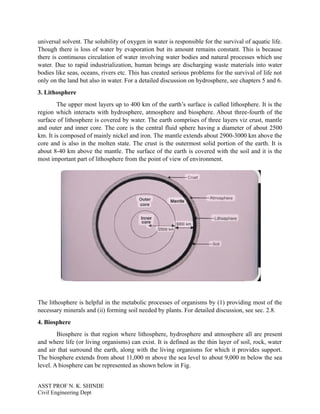
and outer and inner core. The core is the central fluid sphere having a diameter of about 2500
km. It is composed of mainly nickel and iron. The mantle extends about 2900-3000 km above the
core and is also in the molten state. The crust is the outermost solid portion of the earth. It is
about 8-40 km above the mantle. The surface of the earth is covered with the soil and it is the
most important part of lithosphere from the point of view of environment.
The lithosphere is helpful in the metabolic processes of organisms by (1) providing most of the
necessary minerals and (ii) forming soil needed by plants. For detailed discussion, see sec. 2.8.
4. Biosphere
Biosphere is that region where lithosphere, hydrosphere and atmosphere all are present
and where life (or living organisms) can exist. It is defined as the thin layer of soil, rock, water
and air that surround the earth, along with the living organisms for which it provides support.
The biosphere extends from about 11,000 m above the sea level to about 9,000 m below the sea
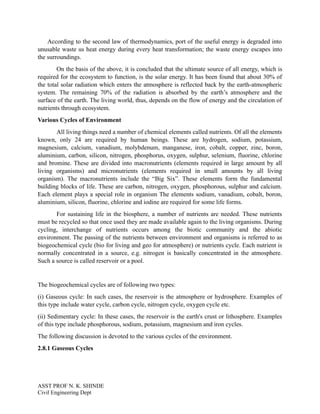
level. A biosphere can be represented as shown below in Fig.
ASST PROF N. K. SHINDE
Civil Engineering Dept
5.
Representation of thebiosphere (shaded portion)
As seen in the Fig. 2.2, biosphere is the area of contact between the three components viz,
atmosphere, hydrosphere and lithosphere. It is extremely important for life, as it is here that the
entire life is contained and basic processes of life, the photosynthesis and respiration occur. The
living organisms are confined to biosphere that receives solar radiation during the day. As
already stated, biosphere extends from the floor of the ocean (some 11,000 m below the surface
of the earth) to the top of the highest mountain (or about 9,000 m above the sea level). The most
densely populated region is just above and below the sea level. The life in biosphere exists
mostly between 600 m below the surface of the ocean and about 6000 m above the sea level. The
energy required by the living organisms in the biosphere comes from the sun and the nutrients
necessary for living organisms come from air, water and soil.
Biosphere is endowed with the necessary conditions that are essential to support life. Some
of these conditions are:
Availability of air
Availability of water
Availability of area or interface between the earth’s crust, hydrosphere and atmosphere
Availability of suitable temperature
Supply of energy or radiation from the sun
Availability of nutrient
Environmental Pollution
The term environment as far as pollution is concerned, includes the air, the water and the
land (soil). Pollution, broadly speaking is defined as the addition of harmful constituents or
ASST PROF N. K. SHINDE
Civil Engineering Dept
6.
substances to water,air or land, which adversely alter the natural quality of the environment. The
environmental pollution includes air, water and land (or soil) pollution. It is believed that there
are various factors, such as population explosion, industrialization, deforestation combined with
modern technology, which are responsible for serious environmental crisis. The industries are
responsible for adding pollutants in the environment (land, soil, water and air) and thus, cause
pollution.
Environmental pollution may be natural (which originates from natural processes such as
forest fires, natural organic or inorganic decays, volcanic eruptions, earthquakes etc.) or it may
originate due to human activities.
Types of Pollution
Most of the environmental pollution arises due to manufacturing processes, various
industries, thermal power plants, automobiles, agrochemicals etc. Besides these, we come across
noise pollution, thermal pollution and radioactive pollution. As far as environmental pollution is
concerned, the worst pollutants are those which are not biodegradable; for example, polymers,
plastics, asbestos, mica and some agrochemicals like DDT. Air pollution, water pollution and soil
pollution are discussed in subsequent Chapters. The noise pollution has been explained in
Chapter 11.Environmental pollution is responsible for a number of hazards.
Ecosystems
The term ecosystem was coined by Prof. Arthur Tansley in 1935. The prefix ‘eco’ means
environment, so an ecosystem is an environmental system. Ecosystem refers to a biotic
community and its abiotic components put together. In other words, it includes both the living
organisms, i.e. the biotic community and the non-living, i.e. abiotic environment.
Each of the biomes can be subdivided into smaller units; these are referred to as
ecological systems or ecosystems. It can also be said that the ecosystems are the subdivisions of
the biosphere. An ecosystem may be natural (e.g. a pond, a lake, a river, an ocean or a forest) or
it may be artificial or man made (e.g. an aquarium, a dam, a garden, an orchard etc.).
Ecosystem: Types of Ecosystem,
Types of Ecosystems
Broadly speaking, the ecosystems are of following two types:
(1) Terrestrial Ecosystems-
They include grassland, forest, desert, and cropland ecosystems.
(2) Aquatic Ecosystems –
They include pond, sea etc. Most of ecosystems are self sufficient for the survival of life,
i.e. they contain all the components necessary for life processes.
ASST PROF N. K. SHINDE
Civil Engineering Dept
7.
Components of Ecosystems
Anecosystem has two main components. These are abiotic components and biotic components.
(1) Abiotic Components
The abiotic components or the non-living or the physical components include the following: Soil,
water, air and light. Inorganic components like carbon, sulphur, calcium, phosphorus etc.
Atmospheric gases like oxygen, carbon dioxide, nitrogen etc. Organic components like amino
acids, proteins; these are links between abiotic and biotic components and are synthesised by
plants and living organisms by various biochemical procedures. Climate and weather conditions
like temperature, wind, humidity, heat etc.
(2) Biotic Components
The biotic components of an ecosystem interact with abiotic components: this interaction
is the basis of supporting life. These include the plants, animals and microorganisms. The
organisms are of following types:
a. Producers:
These are the autotrophic members of the ecosystem and are capable of
synthesising their own food from simple substances like carbon dioxide and water in the
presence of sunlight. Some examples include certain bacteria and algae etc. Of course,
green plants can synthesise their own food by the process of photosynthesis.
b. Consumers:
These organisms cannot make their own food but depend on other organisms for food to
meet their energy requirements to survive these are referred to as heterotrophic members of the
ecosystem. Examples of consumers are animals and humans which depend on other organisms
for the food. Animals such as goat, cow, deer and insects etc. which eat green plants are called
primary consumers or herbivores. Organisms that eat herbivores like a bird that eats
grasshoppers are called secondary consumers. The organisms that eat secondary consumers are
called tertiary consumers. The secondary and tertiary consumers are carnivores while the primary
consumers are herbivores.
c. Decomposers:
Microorganisms which attack the dead bodies of producers and consumers and decompose
them into smaller compounds are called decomposers. This process of decomposition also
releases inorganic nutrients. Examples of decomposers are certain bacteria and fungi. The
producers, consumers and decomposers interact with each other in many ways. These
interactions constitute the food chain.
(3) Energy in Ecosystems
It is well known that energy used for all life processes is derived from sun in the form of
solar energy. The flow of solar energy is unidirectional. In the absence of solar energy, the
ASST PROF N. K. SHINDE
Civil Engineering Dept
8.
ecosystem is boundto collapse. We know that plants produce their food from carbon dioxide and
water with the help of solar energy by the process known as photosynthesis. By this process, the
solar energy finds its way as chemical energy into the plants. During photosynthesis, plants also
incorporate in their protoplasm a number of inorganic elements and compounds. So the chemical
energy is in the form of carbohydrates, fats and protein. A number of nutrients are also
incorporated. When the animals (herbivores or carnivores) consume plant materials, the solar
energy find its way into the animals. Finally, when the plants and animals (after death) decay, the
nutrients etc. are returned to the soil by the decomposers and are again taken up by plants. In this
way, the energy flows. This is exhibited in Fig. 2.3 below.
Components of Ecosystem.
When the trapped energy (in plants) is transferred to another system (eg. Animals etc), it
undergoes loss at each transfer along the chain. This is governed by the two laws of
thermodynamics as given below:
According to the first law of thermodynamics, the energy can neither be created nor
destroyed but can only change from one form to another. This is amply clear from the
discussions in the above paragraph, wherein it is stated that solar energy is transformed into
chemical energy in the plants in the form of carbohydrates etc. Thus, the energy is transformed
but not lost. This chemical energy is transformed and used by the cells of the organisms via
metabolism for numerous activities.
ASST PROF N. K. SHINDE
Civil Engineering Dept
9.
According to thesecond law of thermodynamics, port of the useful energy is degraded into
unusable waste us heat energy during every heat transformation; the waste energy escapes into
the surroundings.
On the basis of the above, it is concluded that the ultimate source of all energy, which is
required for the ecosystem to function, is the solar energy. It has been found that about 30% of
the total solar radiation which enters the atmosphere is reflected back by the earth-atmospheric
system. The remaining 70% of the radiation is absorbed by the earth’s atmosphere and the
surface of the earth. The living world, thus, depends on the flow of energy and the circulation of
nutrients through ecosystem.
Various Cycles of Environment
All living things need a number of chemical elements called nutrients. Of all the elements
known, only 24 are required by human beings. These are hydrogen, sodium, potassium,
magnesium, calcium, vanadium, molybdenum, manganese, iron, cobalt, copper, zinc, boron,
aluminium, carbon, silicon, nitrogen, phosphorus, oxygen, sulphur, selenium, fluorine, chlorine
and bromine. These are divided into macronutrients (elements required in large amount by all
living organisms) and micronutrients (elements required in small amounts by all living
organism). The macronutrients include the “Big Six”. These elements form the fundamental
building blocks of life. These are carbon, nitrogen, oxygen, phosphorous, sulphur and calcium.
Each element plays a special role in organism The elements sodium, vanadium, cobalt, boron,
aluminium, silicon, fluorine, chlorine and iodine are required for some life forms.
For sustaining life in the biosphere, a number of nutrients are needed. These nutrients
must be recycled so that once used they are made available again to the living organisms. During
cycling, interchange of nutrients occurs among the biotic community and the abiotic
environment. The passing of the nutrients between environment and organisms is referred to as
biogeochemical cycle (bio for living and geo for atmosphere) or nutrients cycle. Each nutrient is
normally concentrated in a source, e.g. nitrogen is basically concentrated in the atmosphere.
Such a source is called reservoir or a pool.
The biogeochemical cycles are of following two types:
(i) Gaseous cycle: In such cases, the reservoir is the atmosphere or hydrosphere. Examples of
this type include water cycle, carbon cycle, nitrogen cycle, oxygen cycle etc.
(ii) Sedimentary cycle: In these cases, the reservoir is the earth's crust or lithosphere. Examples
of this type include phosphorous, sodium, potassium, magnesium and iron cycles.
The following discussion is devoted to the various cycles of the environment.
2.8.1 Gaseous Cycles
ASST PROF N. K. SHINDE
Civil Engineering Dept
10.
1. Water Cycle
Watercycle, also known as hydrological cycle, is the most important of various cycles of
the environment. This is because water carries along with it the materials moving through other
nutrient cycles. Water, as we know, is one of the most important substances for the life processes.
Living organisms contain about 75 percent water in them, though some plants contain less water.
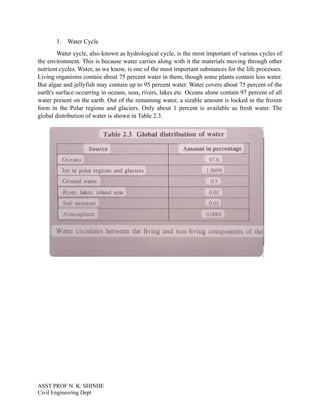
But algae and jellyfish may contain up to 95 percent water. Water covers about 75 percent of the
earth's surface occurring in oceans, seas, rivers, lakes etc. Oceans alone contain 97 percent of all
water present on the earth. Out of the remaining water, a sizable amount is locked in the frozen
form in the Polar regions and glaciers. Only about 1 percent is available as fresh water. The
global distribution of water is shown in Table 2.3.
ASST PROF N. K. SHINDE
Civil Engineering Dept