1
2
Introduction of VRV
3
Daikin Corporate Profile
 DAIKIN is the only one company which produces air-conditioner,
compressor and refrigerant in the world.
Air-conditioner
Compressor Refrigerant
4
Daikin Corporate Profile
JAPAN
Rinkai Factory,
Sakai Plant
Shiga Plant
Kanaoka Factory,
Sakai Plant
Yodogawa Plant
Daikin Industries Head Office
Daikin Group Global Production Base
5
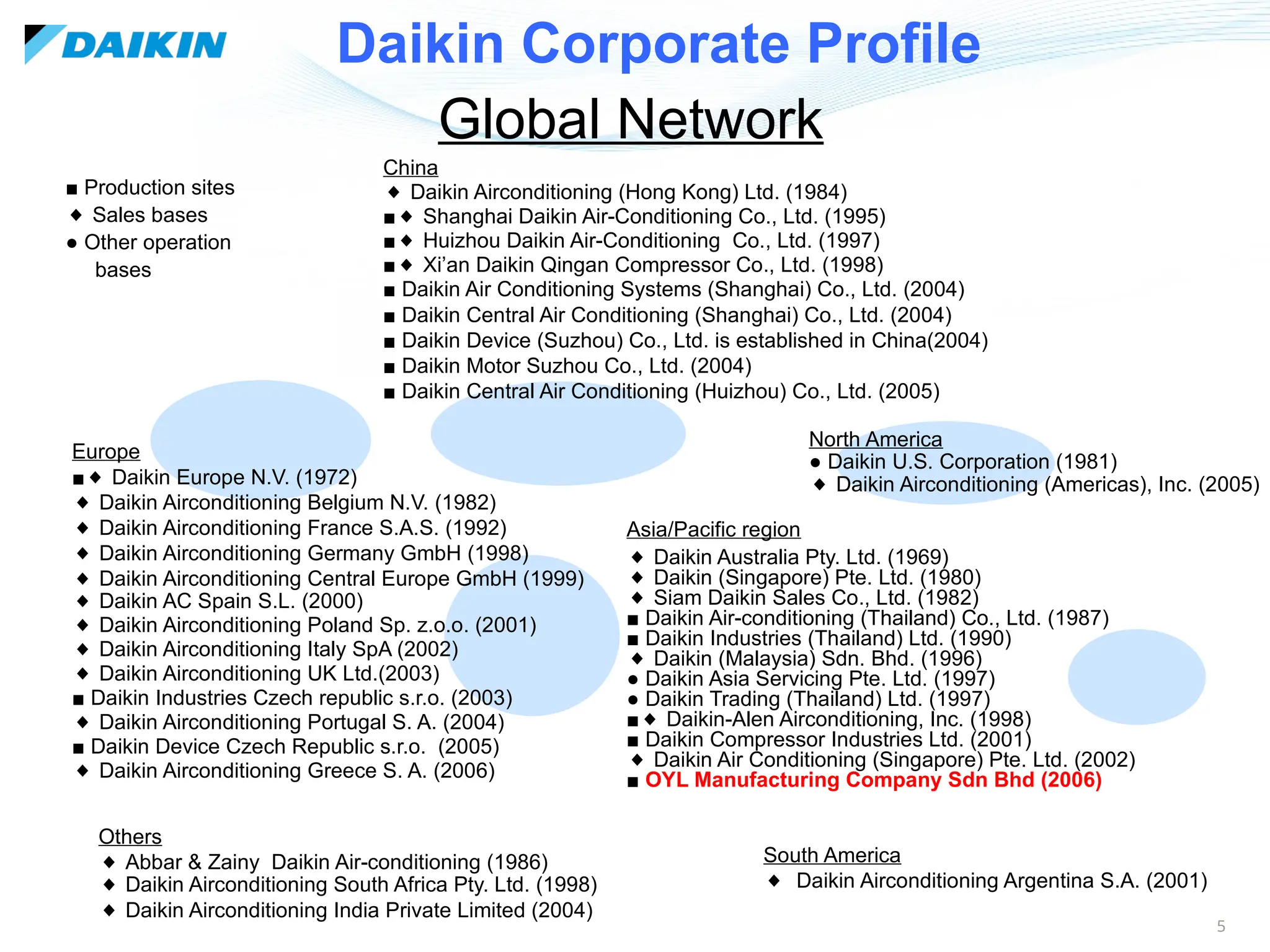
Others
◆ Abbar & Zainy Daikin Air-conditioning (1986)
◆ Daikin Airconditioning South Africa Pty. Ltd. (1998)
◆ Daikin Airconditioning India Private Limited (2004)
North America
● Daikin U.S. Corporation (1981)
◆ Daikin Airconditioning (Americas), Inc. (2005)
South America
◆ Daikin Airconditioning Argentina S.A. (2001)
Asia/Pacific region
◆ Daikin Australia Pty. Ltd. (1969)
◆ Daikin (Singapore) Pte. Ltd. (1980)
◆ Siam Daikin Sales Co., Ltd. (1982)
■ Daikin Air-conditioning (Thailand) Co., Ltd. (1987)
■ Daikin Industries (Thailand) Ltd. (1990)
◆ Daikin (Malaysia) Sdn. Bhd. (1996)
● Daikin Asia Servicing Pte. Ltd. (1997)
● Daikin Trading (Thailand) Ltd. (1997)
■◆ Daikin-Alen Airconditioning, Inc. (1998)
■ Daikin Compressor Industries Ltd. (2001)
◆ Daikin Air Conditioning (Singapore) Pte. Ltd. (2002)
■ OYL Manufacturing Company Sdn Bhd (2006)
■ Production sites
◆ Sales bases
● Other operation
bases
China
◆ Daikin Airconditioning (Hong Kong) Ltd. (1984)
■◆ Shanghai Daikin Air-Conditioning Co., Ltd. (1995)
■◆ Huizhou Daikin Air-Conditioning Co., Ltd. (1997)
■◆ Xi’an Daikin Qingan Compressor Co., Ltd. (1998)
■ Daikin Air Conditioning Systems (Shanghai) Co., Ltd. (2004)
■ Daikin Central Air Conditioning (Shanghai) Co., Ltd. (2004)
■ Daikin Device (Suzhou) Co., Ltd. is established in China(2004)
■ Daikin Motor Suzhou Co., Ltd. (2004)
■ Daikin Central Air Conditioning (Huizhou) Co., Ltd. (2005)
Europe
■◆ Daikin Europe N.V. (1972)
◆ Daikin Airconditioning Belgium N.V. (1982)
◆ Daikin Airconditioning France S.A.S. (1992)
◆ Daikin Airconditioning Germany GmbH (1998)
◆ Daikin Airconditioning Central Europe GmbH (1999)
◆ Daikin AC Spain S.L. (2000)
◆ Daikin Airconditioning Poland Sp. z.o.o. (2001)
◆ Daikin Airconditioning Italy SpA (2002)
◆ Daikin Airconditioning UK Ltd.(2003)
■ Daikin Industries Czech republic s.r.o. (2003)
◆ Daikin Airconditioning Portugal S. A. (2004)
■ Daikin Device Czech Republic s.r.o. (2005)
◆ Daikin Airconditioning Greece S. A. (2006)
Global Network
Daikin Corporate Profile
6
Europe
Daikin bases (AC) O.Y.L. bases
Daikin Europe N.V.
(Belgium) Daikin Industries Czech Republic i.e..
Daikin Device Czech Republic i.e..
McQuay, Caching (Italy)
Daikin Group Global Production Base
Daikin Corporate Profile
7
Asia/Oceania
Daikin bases (AC) O.Y.L. bases
Daikin Air-conditioning
(Shanghai) Co., Ltd.
Daikin Industries
(Thailand) Ltd. (Factory)
O.Y.L. Manufacturing
Company Sdn Bhd
(Malaysia)
McQuay, Shenzhen
Daikin Group Global Production Base
Daikin Corporate Profile
8
North America
O.Y.L. bases
McQuay, Auburn
McQuay, Faribault McQuay, Owatonna
McQuay, Staunton
Daikin Group Global Production Base
Daikin Corporate Profile
9
FY2013
Total 209 subsidiaries
Total 56,240 employees
Our Operation
Daikin Corporate Profile
10
Our Business
Air-conditioning
& related
Chemicals
Other
US$17.5
billion
89%
8%
3
%
FY2013
Daikin Corporate Profile
11
Our Business (by Region)
FY2013
18%
14%
23% 27%
18%
Japan
Europe,
Middle East
& Africa
China
Asia &
Oceania
Americas
US$17.5
billion
Overseas business ratio = 73%
Daikin Corporate Profile
12
Our Product
AHU
Ducted Type
Outdoor Unit Gas Furnace
A-shaped Coil
Unitary AC
Residential AC
Air Purifier Hot Water Heating
Control system
Water Cooled Chiller
Air Handling Unit
Centrifugal Chiller
Fan Coil Unit
Air Cooled Chiller
Applied AC
AC for facility
AC for Small Shop and Office Rooftop Type ACs
VRV
Ceiling Ducted Type
Ceiling Cassette Type
Ceiling
Suspended
Type
Humidity-control
Ventilation System
Outdoor Unit
Heat Recovery
Ventilation
Commercial Industrial
Residential
Daikin Corporate Profile
13
Commercial market - Global (Source: BSRIA)
Chiller+AHU/FCU VRV/VRF
Market
(x
million
US$)
28%
37%
72%
63%
Daikin Corporate Profile
14
Commercial market - Malaysia (Source: BSRIA)
Market
(x
million
US$)
28%
40%
72%
60%
Chiller+AHU/FCU VRV/VRF
Daikin Corporate Profile
15
Market
(x
million
US$)
48%
69%
52%
Chiller+AHU/FCU VRV/VRF
31%
Commercial market - China (Source: BSRIA)
Daikin Corporate Profile
16
Commercial market – Asia Pacific (Source: BSRIA)
Market
(x
million
US$)
58%
47%
42%
Chiller+AHU/FCU VRV/VRF
53%
Daikin Corporate Profile
17
Commercial market – Japan (Source: JRAI)
1990 1995 2000 2005
350,000
35,000
300,000
30,000
250,000
25,000
200,000
20,000
150,000
15,000
100,000
10,000
50,000
5,000
0
0
2009
Fan coil unit
Chiller
Source : Japan Refrigeration & Air -conditioning Institute
Number
of
production
(Unit)
100,000
80,000
60,000
40,000
20,000
0
120,000
140,000
VRV
Number
of
production
(Unit)
Japan
Daikin Corporate Profile
18
Daikin’s Multi Split & VRV in China
DAIKIN
Hisense-Hitachi
Toshiba
Mitsubishi Electric
Mitsubishi Heavy Industries
MHI-Haier
Midea
Gree
Haier
LG
York
SAMSUNG
Others
Daikin Corporate Profile
19
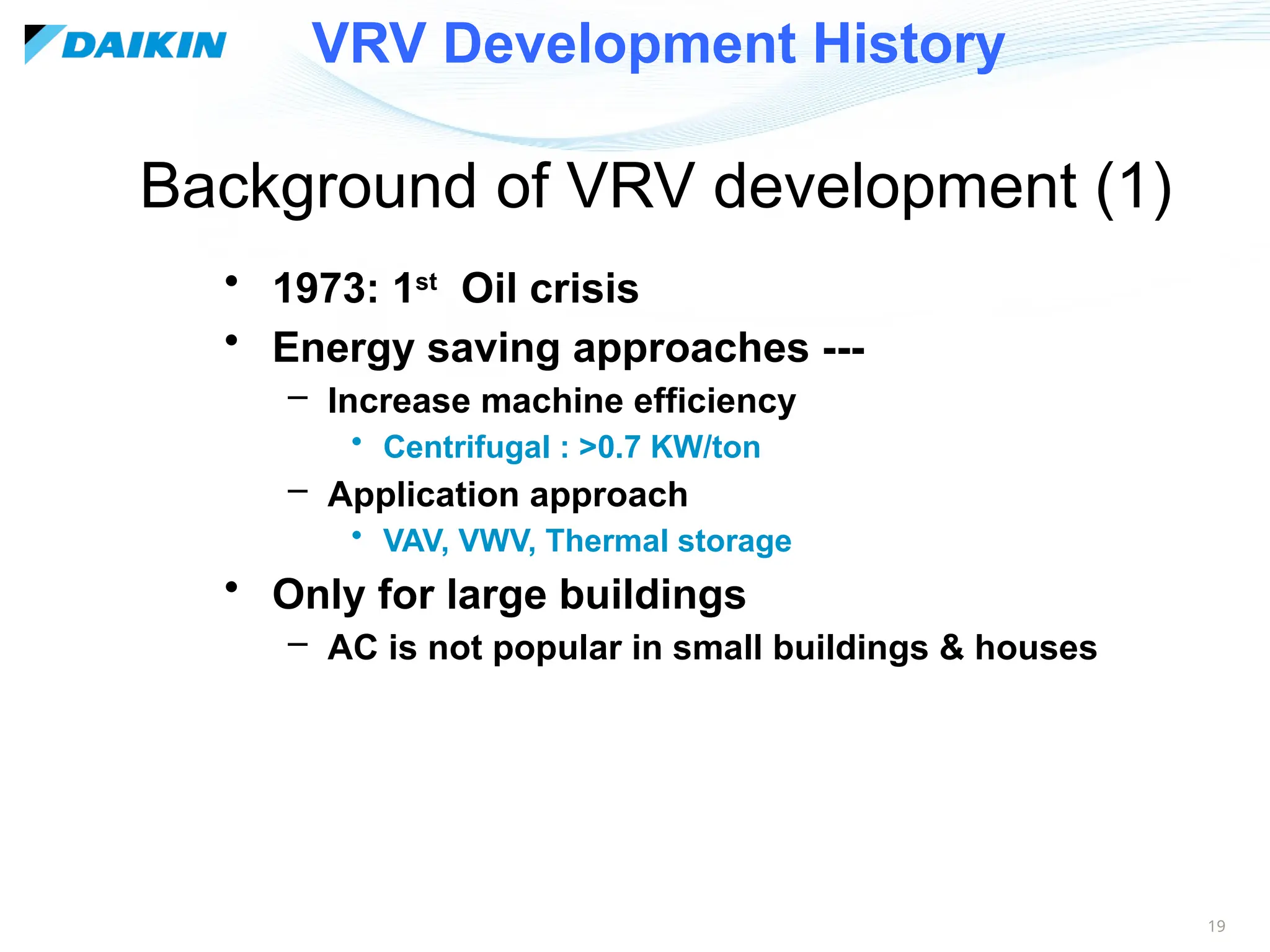
Background of VRV development (1)
• 1973: 1st
Oil crisis
• Energy saving approaches ---
– Increase machine efficiency
• Centrifugal : >0.7 KW/ton
– Application approach
• VAV, VWV, Thermal storage
• Only for large buildings
– AC is not popular in small buildings & houses
VRV Development History
20
Background of VRV development (2)
• Recovery of economy
• High energy cost was accepted in the market
• Penetration of AC to small building & housing
• Energy consumption increase
• 1979: 2nd
Oil crisis
VRV Development History
21
Background of VRV development (3)
• 1979 : Energy saving law
– Energy saving requirement for office building
– Large buildings already satisfied the requirement but not
small building
• Daikin started VRV development
• 1982 : Launching of VRV
VRV Development History
22
• How did VRF come to be?
– 1970’s: only boiler & chiller based solutions available for cooling
and heating
– Main difficulties:
• Very few technical space available in densely populated Japan
• During refurbishment difficulties to:
– split up project in different phases
– find necessary space to install water piping
– Reduction of energy consumption
(no natural energy sources, makes electricity expensive in Japan)
– No integration of A/C & controls & ventilation with existing solutions
Answer: Daikin invents the VRV®
, world’s FIRST VRF system
and installs it in 1982
VRV Development History
23
1982: VRV launched in Japan
1987: Oversea first VRV Sales
D Series
up to 5HP
up to 4 indoor units
1987
1990
G Series
up to 10HP
up to 8 indoor units
1995
H Series
up to 10HP
up to 16 indoor units
1996
K Series
up to 30HP
up to 32 indoor units
Inverter
Historical steps - 1
VRV Development History
24
Historical steps -2
2001
KA Series
up to 30HP
Up to 32 indoor units
K plus Series
up to 30HP
up to 32 indoor units
1997
2001
L Series
up to 30HP
up to 32 indoor units
R-407C
VRV Development History
25
Historical steps - 3
2003
up to 48 HP
up to 40 indoor units
2006
up to 54 HP
up to 64 indoor units
R-410A
R-410A
VRV Development History
26
2013
27
Daikin VRV since 1982
28
Sales progress : 1 Beginning Stage
• Target : Office building & creating new market
• Penetrating into chiller market
• 1st
Phase : Project Sales
– By attacking building owners, architects and consultant and got
landmark projects
– Sales force : Daikin only
• 2nd
Phase : Daikin + Engineering Dealers
– As VRV was recognized in the market, Engineering Dealers with
design & contracting capability join
• Project size : Mainly, less than 2000 m2
VRV Sales Progress
29
Sales progress : 2 Advanced stage
• Penetrating into large buildings
• Drastic sales vol. increase by Synergy Effect
– Sales force up : Daikin + Authorized ED
– Project size up: > 10000 m2
Turning point : VRV penetration ratio 30%
 Only Singapore & UK.
 Other market : > 10% = Big potential
VRV Sales Progress
30
Sales progress : 3 Big Potentials
• Refurbishment
– Huge stock : Economy growth started late ’80
and its about time for refurbishment
• Large sized building < 20000 m2
– Centrifugal dominates market
– VRVIII & WC VRV have good chance
• High class condominium
– Emerging huge volume of upper middle class
market
– Steady growth
VRV Sales Progress
31
VRV Penetration
10
%
20
%
30
%
Beginning stage
VRV is not
recognized in the
market Advanced stage
VRV is recognized in
the market, vol.
increase
Sales progress image
Small & Medium
office building new
construction
Big potentials
Refurbishment
Large building
Condominium
Sales
Vol.
VRV Sales Progress
32
VRV System is penetrating into Large-sized Buildings
-
Less than 7,000 m 2
1982
2000
Over 7,000 m 2
Floor
area
Central
52.4%
Package
27.7%
Combined
use
19.9%
Central
66.9%
Package
10.8%
Combined use
22.3%
Central
15.8% Package
57.1%
Combined
use
27.1%
Central
34.5%
Package
26.6%
Combined
use
38.9%
VRV
33.3%
VRV
14.4%
VRV
14.8%
VRV
17.5%
Building Air conditioning systems in Japan
VRV Sales Progress
33
0
20,000
40,000
60,000
80,000
100,000
120,000
140,000
160,000
1 2 3 4 5 6 7 8 9 10 11 12 13 14 15 16 17
05
95
90 00
In Japan
Overseas
VRV Sales in the World
Qty
sets
10 times
in
15 years
VRV Sales Progress
34
Daikin’s position, in
Japan, in the world
VRV Sales Progress
35
0.0 2.0 4.0 6.0 8.0 10.0 12.0 14.0 16.0 18.0 20.0
17.3
14.0
10.2
6.1
5.2
4.2
3.9
3.5
3.2
3.2
2.9
2.0
2.0
1.5
1.3
1.2
AC business global major players (including OEM)
Bil. US$
Electrolux
Gree
DAIKIN
Midea
Haier
Mitsubishi Electric
Hitachi
Panasonic
Fujitsu
Mitsubishi Heavy
Carrier
Trane
Lennox
Johnson Controls (York)
LG
Samsung
Notes)
1.Sales turnover includes residence & commercial
use air-conditioners, chiller, air-conditioning use
AHU, FCU. Note engineering business, air-purifier,
heating equipment and industry use AHU are not
included.
2.Value is estimated by Fuji Keizai.
3.1US$=97.6J, 1RMB=15.9J, 1KRW=0.09J,
1SEK=15.0J
4. OEM amount of DAIKIN < 1% of total
Resource:
Global consumer
electronics market
research 2015 by Fuji
Keizai
 As sales turnover, we are No.2 in global
market. However, huge turnover of
Chinese and Korean brands are mainly
supported by RA sales.
 In commercial & industrial AC market,
Daikin is holding outstanding position.
VRV Sales Progress
36
0.0 2.0 4.0 6.0 8.0 10.0 12.0 14.0 16.0 18.0 20.0
17.3
14.0
10.2
12.4
14.0
7.7
Bil. US$
Gree
DAIKIN
Midea
Global top 3 without OEM business
No OEM business
We proud “Daikin”
brand
VRV Sales Progress
37
4
8
%
22
%
13
%
8
%
6
% 5%
DAIKIN
ME
Hitachi
Toshiba
MHI Panasonic
126,000
units
VRV/VRF
DAIKIN
ME
Hitachi
Toshiba
MHI Panasonic
668,00
0
units
Light commercial PA
Daikin’s position in Japan
Keeping overwhelming No.1
38
Global AC Market Overview
and VRV Position
VRV Sales Progress
39
Global Applied Market Trend 2005-2013
47
51
58
63
60
65
72 74 76
40
50
60
70
80
2005 2006 2007 2008 2009 2010 2011 2012 2013
Tri
US$
Year
Global GDP Growth
GDP growth
161%
10
26
1
9
0
10
20
30
40
2005 2013
Mil
TR
Year
Global Applied Market CH+VRV)
VRV growth
900% !
CH growth
260%
 Global applied market has been achieving higher growth
than GDP. (3.2 times in 8 years)
 Especially, VRV has been growing very quickly in 8 years.
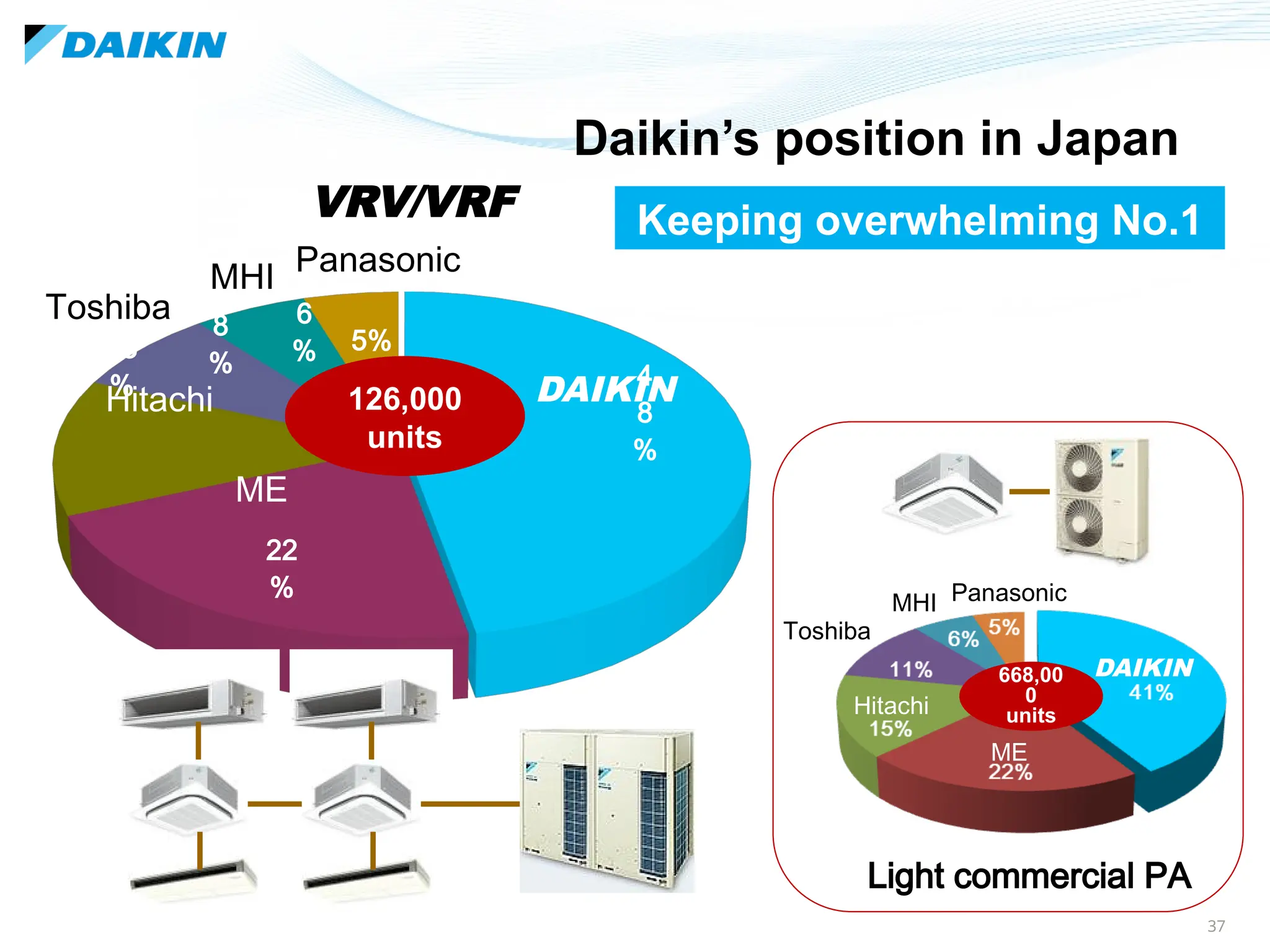
 In 2005, VRV occupied only 10% of chiller system but it
jumped up to 35% in 2013.
VRV Sales Progress
40
Source: BSRIA World air conditioning, 2013
Total Quantity
1,117,648
units
Global VRV market in 2013
China
56 %
Europe
12 %
Asia Pacific
12 %
Japan
11 %
Middle East Asia
& Africa
3 %
USA
2 %
Other Americas
2 % India
2 %
VRV Sales Progress
41
VRV (VRF) authorized by AHRI 1230
No longer “Special” but globally recognized
AC System
VRV Sales Progress
42
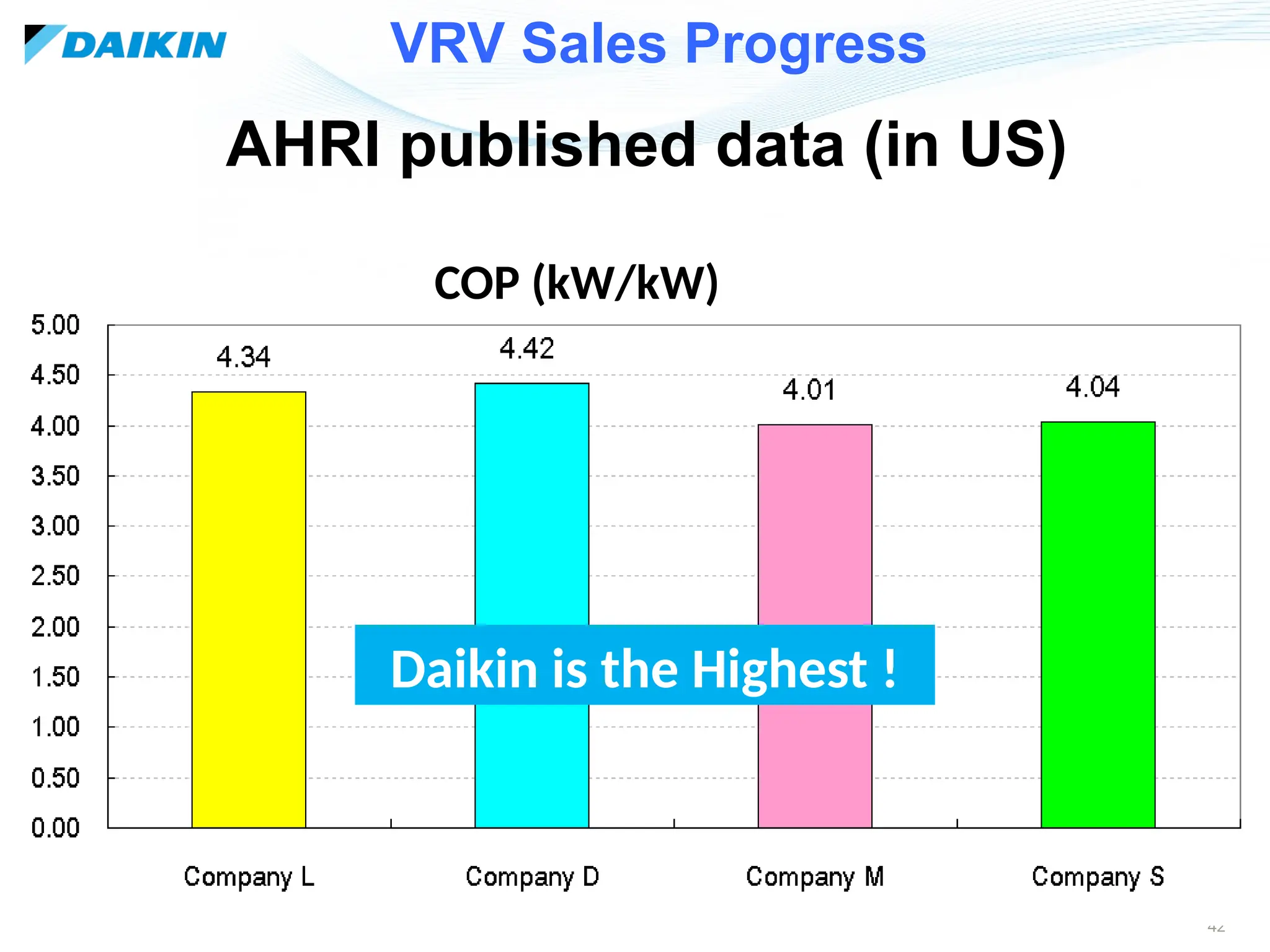
AHRI published data (in US)
COP (kW/kW)
Daikin is the Highest !
VRV Sales Progress
43
VRV Penetration in Global Applied Market
(1000TR : 2013 estimated)
Nation/Region Applied
Market
VRV Market VRV/Applied
1 China 14,684 4,967 33.8%
2 Europe 5,572 975 17.5%
3 Other Asia 4,516 1,229 27.2%
4 North America 3,267 201 6.2%
5 Middle East 2,869 283 9.9%
6 Japan 2,159 965 44.7%
7 Latin America 1,693 200 11.8%
8 Others 534 121 22.8%
Total 35,297 8,943 25.3%
VRV Sales Progress
44
Global AC Market Structure image
0
0.5
1
1.5
100 1000 10000
Grade
Upper
Middle
Residential
Bldg.
Size
Floor area : m2
Residence
market,
conditioned
by RA
Light
commercial
market,
conditioned
by Split/ PAC
Large sized
office/hotel/
commercial
complex
conditioned by
Chiller/VRV
TARGE
T!
VRV Sales Progress
45
Malaysia VRV Market
VRV Sales Progress
46
Malaysia A/C Market
Residential/Light
commercial market
Residences/Shops/Small offices
RA/Split AC/PAC
428 Mil US$
Applied market
Skyscrapers/Hotels
Chiller/VRV
146 Mil US$
Current GA coverage
New Frontier !
Huge !
VRV Sales Progress
47
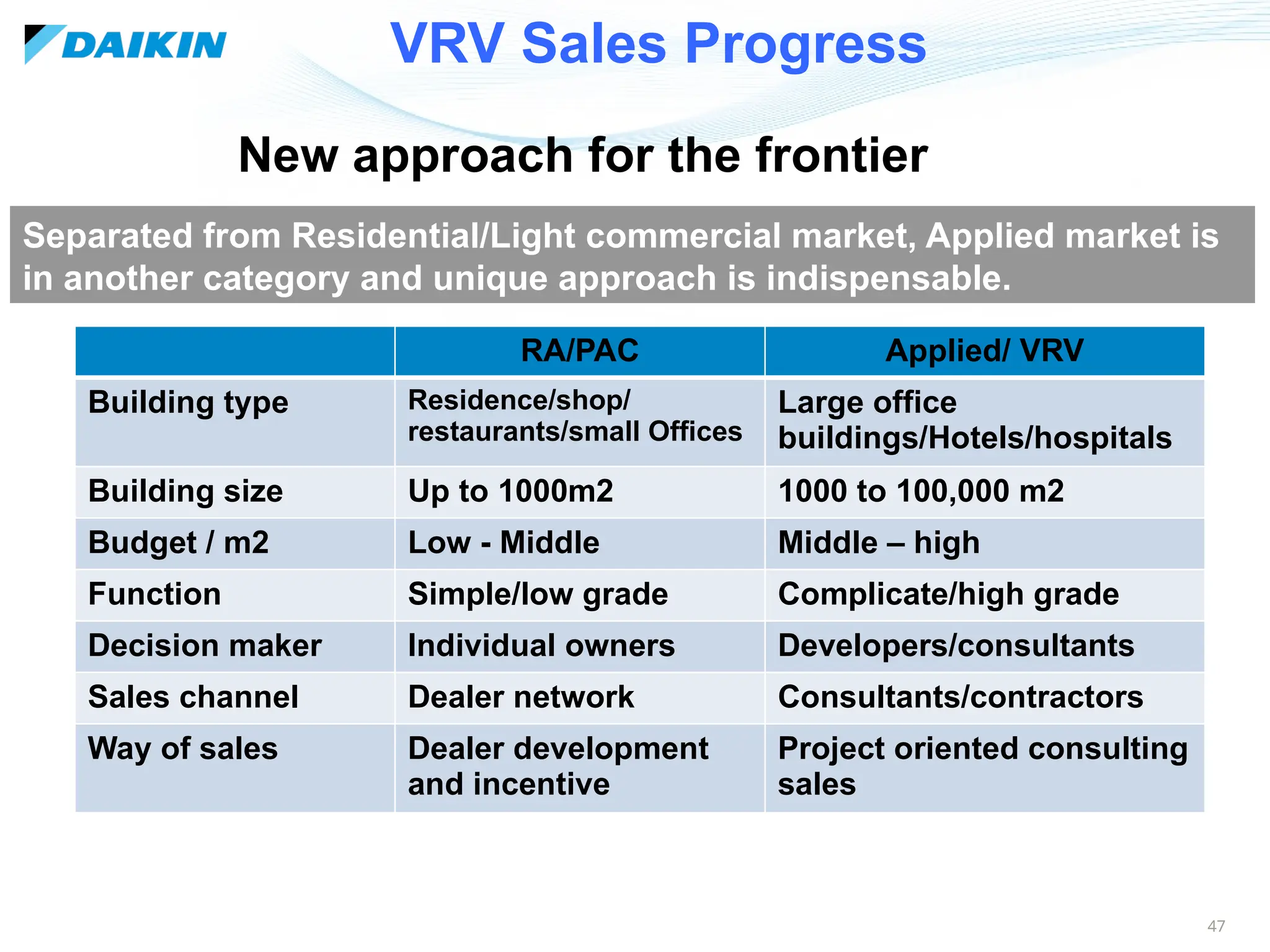
New approach for the frontier
Separated from Residential/Light commercial market, Applied market is
in another category and unique approach is indispensable.
RA/PAC Applied/ VRV
Building type Residence/shop/
restaurants/small Offices
Large office
buildings/Hotels/hospitals
Building size Up to 1000m2 1000 to 100,000 m2
Budget / m2 Low - Middle Middle – high
Function Simple/low grade Complicate/high grade
Decision maker Individual owners Developers/consultants
Sales channel Dealer network Consultants/contractors
Way of sales Dealer development
and incentive
Project oriented consulting
sales
VRV Sales Progress
48
77%
11%
7%
5%
Malaysia : Applied + VRV Market (2013)
 Applied System occupies majority,
VRV is still minor position in the
market.
 Total VRV (MHI + Daikin+ Others)
occupies only 23%
 VRV sales has been chosen as the
alternative for Applied System
(Chiller + AHU/FCU)
 VRV sales is not zero-sum battle in
closed market but demand creating
business in the new frontier.
Applied
MHI
Daikin
Others
Total : 146 Mil US$
Source :: BSRIA
VRV Sales Progress
49
VRV usage : Total Asia - Malaysia
0%
10%
20%
30%
40%
50%
60%
70%
Asia
Malaysia  Office use occupies majority and residence follows.
 Originally, VRV had been developed for targeting
office building market. Recently, as the income
growth, high class condominium market is growing
very rapidly, and 23% of VRV is used for this market.
 VRV residence use is rather low in Malaysia. This
is one of future potential target.
VRV Sales Progress
50
Unique requirements
for VRV sales
VRV Sales Progress
51
1. Expert target customers
 Promoting VRV to the engineers and the owners
 How can we convince these expert decision
makers and spec-in Daikin VRV to their projects?
Two challenges
 Speaking of VRV, it has 4 types (air cooled, water cooled, S type and Q
type), 63 outdoor unit models, 107 indoor unit models and many
control options matching for matching various applications and
requirements.
 We have also 7 kinds of Technical support software to assist air
conditioning design.
 According to the customer’s requests, project by project, optimum
design and model selections have to be done.
2. Higher technical level
Qualified and dedicated specialists are indispensable.
VRV Sales Progress
52
CPU in every indoor unit achieves accurate temperature control
Comfort, Energy saving,
Individual air
conditioning system
Over 40%
Electricity cut
DX System simplicity with Chiller System Design Flexibility
Ref. piping
System Configuration
VRV Sales Progress
53
VRV System Documents
5 Technical documents
4 Catalogs
VRV -Q
Ⅲ
6pages
VRV-WⅢ
26 pages
VRV -S
Ⅲ
24 pages
VRVⅣ
96 pages
VRVⅣ
736 pages
VRV -S
Ⅲ
308 pages
VRV -Q
Ⅲ
148 pages
VRV-WⅢ
356 pages
Option
Handbook
832 pages
VRV Sales Progress
54
 Controller : 5 models
 Interface board : 3 models
 Optional adaptor : 18 models
VRV Control System
VRV Sales Progress
55
6 Technical documents
4 Catalogs
BACnet/LON Interface
8 pages
intelligent Touch Manager
16 pages
intelligent Touch
Controller
4pages
HA Interface
4 pages
intelligent Touch Manager
400 pages
intelligent Touch Controller
290 pages
LON Interface
100 pages
HA Interface
50 pages
DBACS
design guide
420 pages
BACnet Interface
200 pages
VRV Control System Documents
VRV Sales Progress
56
These programs allow design engineers to design the projects.
Name Outline Description
DACCS-HK Load
calculation
Cooling/heating load calculation program which
covers over 50 cities allover the world.
Xpress VRV model
selection
VRV model selection program. It allows various
IDU/ODU combinations and indicated model list,
piping/control wiring diagram
DT-FLOW Analysis of
discharged air
behavior
3-D air flow simulation program. It shows temperature
and velocity of ODU discharged air for given building.
It is effective to study optimum location of ODU
DACCS-NIS ODU noise
calculation
According to the noise date of the model, it calculates
ODU noise reduction by distance.
DACCS-Ez-FLOW IDU noise
calculation
According to the noise data of the model, it calculates
IDU noise reduction by distance.
Energy-Calc PI
consumption
Annual VRV power consumption calculation. US
model only.
DACSS-RR CH-VRV PI
comparison
Chiller vs. VRV power consumption calculation
VRV Technical Support Software
VRV Sales Progress
57
Every project is unique and our customers are
professionals.
By using affluent models and options, our goal
is to deliver most comprehensive solution for
each project.
Daikin has qualified and detailed technical
assets as you found.
 Almost all technical details are published.
Provide tailor-made proposal for every project to
specify Daikin VRV in it.
Providing Professional Proposal
VRV Sales Progress
58
59
Heat Pump
Cooling Only
Product Line-up
8 basic module unit (6~20HP)
3 series line-up (65 models)
Hi-COP: 20 models (12~50HP)
Standard: 28 models (6~60HP)
Space saving: 17 models (18~50HP)
Performance
Best Balance
Cost Saving
 Strengthening the line-up by 3 series
 Outdoor Unit capacity expandable up to 60HP
※ Other combination pipe length is limited.
(actual pipe length 135m  165m, total pipe length 500m  1000m)
60
Standard
Hi COP
Example : Three Options to choose for a 20HP Outdoor Unit
Saving-Space
• The new line-up combination is flexible
to meet installation challenges.
Product Line-up
61
61
Nomenclature
62
RX(Y)Q6TY1
RX(Y)Q8TY1
RX(Y)Q10TY1
RX(Y)Q12TY1
RX(Y)Q14TY1
RX(Y)Q16TY1
RX(Y)Q18TY1
RX(Y)Q20TY1
1657 x 930 x 765 mm 1657 x 1240 x 765 mm
Heat Pump
Cooling Only
Single Modules- RX(Y)Q-TY1
• Only two module sizes.
63
Hi COP 6 HP 8HP 10 HP 12HP 14 HP 16HP 18 HP
RX(Y)Q12THY1 x2
RX(Y)Q14THY1 x1 x1
RX(Y)Q16THY1 x2
RX(Y)Q18THY1 x3
RX(Y)Q20THY1 x2 x1
RX(Y)Q22THY1 x1 x2
RX(Y)Q24THY1 x3
RX(Y)Q26THY1 x2 x1
RX(Y)Q28THY1 x2 x1
RX(Y)Q30THY1 x1 x1 x1
RX(Y)Q32THY1 x1 x2
RX(Y)Q34THY1 x1 x1 x1
RX(Y)Q36THY1 x1 x2
RX(Y)Q38THY1 x2 x1
RX(Y)Q40THY1 x1 x2
RX(Y)Q42THY1 x3
RX(Y)Q44THY1 x2 x1
RX(Y)Q46THY1 x1 x2
RX(Y)Q48THY1 x3
RX(Y)Q50THY1 x2 x1
Best COP
Combination
Hi COP Series
• 20 models (12 – 50 HP)
• Two & Three Modules
RX(Y)Q-THY1
64
Standard 6 HP 8HP 10 HP 12HP 14 HP 16HP 18 HP 20 HP
RX(Y)Q6TY1 x1
RX(Y)Q8TY1 x1
RX(Y)Q10TY1 x1
RX(Y)Q12TY1 x1
RX(Y)Q14TY1 x1
RX(Y)Q16TY1 x1
RX(Y)Q18TNY1 x1 x1
RX(Y)Q20TNY1 x1 x1
RX(Y)Q22TNY1 x1 x1
RX(Y)Q24TNY1 x1 x1
RX(Y)Q26TNY1 x1 x1
RX(Y)Q28TNY1 x2
RX(Y)Q30TNY1 x1 x1
RX(Y)Q32TNY1 x1 x1
RX(Y)Q34TNY1 x1
RX(Y)Q36TNY1 x3
RX(Y)Q38TNY1 x1 x1 x1
RX(Y)Q40TNY1 x2 x1
RX(Y)Q42TNY1 x1 x1 x1
RX(Y)Q44TNY1 x1 x2
RX(Y)Q46TNY1 x2 x1
RX(Y)Q48TNY1 x1 x1 x1
RX(Y)Q50TNY1 x1 x2
RX(Y)Q52TNY1 x1 x2
RX(Y)Q54TNY1 x3
RX(Y)Q56TNY1 x2 x1
RX(Y)Q58TNY1 x1 x2
RX(Y)Q60TNY1 x3
Standard Series
Best Standard
Combination
RX(Y)Q-TNY1
• 28 models (6 – 60 HP)
• Single, Two & Three Modules
65
Space Saving 6HP 8HP 10HP 12HP 14HP 16HP 18HP 20HP
RX(Y)Q18TY1 x1
RX(Y)Q20TY1 x1
RX(Y)Q22TSY1 x1 x1
RX(Y)Q24TSY1 x2
RX(Y)Q26TSY1 x1 x1
RX(Y)Q28TSY1 x1 x1
RX(Y)Q30TSY1 x1 x1
RX(Y)Q32TSY1 x1 x1
RX(Y)Q34TSY1 x1 x1
RX(Y)Q36TSY1 x2
RX(Y)Q38TSY1 x1 x1
RX(Y)Q40TSY1 x2
RX(Y)Q42TSY1 x2 x1
RX(Y)Q44TSY1 x2 x1
RX(Y)Q46TSY1 x1 x1 x1
RX(Y)Q48TSY1 x1 x2
RX(Y)Q50TSY1 x1 x1 x1
Space Saving Series
Smallest Footprint
Combination
RX(Y)Q-TSY1
• 17 models (18– 50 HP)
• Single, Two & Three
Modules
66
Model
RXQ(Y)
6TY1
RXQ(Y)
8TY1
RXQ(Y)
10TY1
RXQ(Y)
12TY1
RXQ(Y)
14TY1
RXQ(Y)
16TY1
RXQ(Y)
18TY1
RXQ(Y)
20TY1
Outdoor unit
Image
(HxWxD)
Cooling
capacity
(kW)
16.0 22.4 28.0 33.5 40.0 45.0 50.0 56.0
Heating
capacity
(kW)
18.0 25.0 31.5 37.5 45.0 50.0 56.0 63.0
EER 4.41 4.3 3.84 3.72 3.67 3.46 3.25 3.11
COP 4.51 4.39 4.32 4.14 4.05 3.91 3.71 3.60
Max. number
of
connectable
indoor units
9 13 16 19 22 26 29 32
1,657x930x765 1,657x1,240x765
Supplement: Basic Module Unit
67
Model
RX(Y)Q
12THY1
RX(Y)Q
14THY1
RX(Y)Q
16THY1
RX(Y)Q
18THY1
RX(Y)Q
20THY1
RX(Y)Q
22THY1
RX(Y)Q
24THY1
Combination of
module unit
(HP)
6+6 6+8 8+8 6+6+6 6+6+8 6+8+8 8+8+8
Outdoor unit
Image
(HxWxD)
Cooling capacity
(kW)
32.0 38.4 44.8 48.0 54.4 60.8 67.2
Heating capacity
(kW)
36.0 43.0 50.0 54.0 61.0 68.0 75.0
EER 4.41 4.34 4.30 4.41 4.36 4.33 4.30
COP 4.51 4.44 4.39 4.51 4.46 4.42 4.39
Max. number of
connectable
indoor units
19 22 26 29 32 35 39
1,657x(930+20+930)x765 1,657x(930+20+930+20+930)x765
Supplement: Hi COP Series
68
RX(Y)Q
26THY1
RX(Y)Q
28THY1
RX(Y)Q
30THY1
RX(Y)Q
32THY1
RX(Y)Q
34THY1
RX(Y)Q
36THY1
RX(Y)Q
38THY1
Combination of
module
(HP)
8+8+10 8+8+12 8+10+12 8+12+12 8+12+14 8+14+14 12+12+14
Outdoor unit
Image
(HxWxD)
Cooling capacity
(kW)
72.8 78.3 83.9 89.4 95.9 102.4 107.0
Heating capacity
(kW)
81.5 87.5 94.0 100.0 108.0 115.0 120.0
EER 4.11 4.03 3.90 3.85 3.82 3.78 3.70
COP 4.37 4.28 4.26 4.20 4.16 4.12 4.11
Max. number of
connectable
indoor units
42 45 48 52 55 58 61
1,657x(930+20+930+20+930)x765
1,657x(930+20
+930+20+930)
x765
1,657x(930+20
+1240+20+1240)
x765
1,657x(930+20
+930+20+930)
x765
Supplement: Hi COP Series
69
RX(Y)Q
40THY1
RX(Y)Q
42THY1
RX(Y)Q
44THY1
RX(Y)Q
46THY1
RX(Y)Q
48THY1
RX(Y)Q
50THY1
Combination of
module
(HP)
12+14+14 14+14+14 14+14+16 14+16+16 16+16+16 16+16+18
Outdoor unit
Image
(HxWxD)
Cooling capacity
(kW)
113.5 120.0 125.0 130.0 135.0 140.0
Heating capacity
(kW)
128.0 135.0 140.0 145.0 150.0 156.0
EER 3.70 3.67 3.59 3.52 3.46 3.38
COP 4.08 4.05 4.00 3.95 3.91 3.83
Max. number of
connectable
indoor units
64
1,657x
(930+20+1240+20+1240)x
765
1,657x(1240+20+1240+20+1240)x765
Supplement: Hi COP Series
70
Model
RX (Y)Q
6TY1
RX (Y) Q
8TY1
RX (Y) Q
10TY1
RX (Y) Q
12TY1
RX (Y) Q
14TY1
RX (Y) Q
16TY1
RX (Y) Q
18TNY1
RX (Y) Q
20TNY1
Combination of
module
(HP)
6 8 10 12 14 16 8+10 8+12
Outdoor unit
Image
(HxWxD)
Cooling capacity
(kW)
16.0 22.4 28.0 33.5 40.0 45.0 50.4 55.9
Heating capacity
(kW)
18.0 25.0 31.5 37.5 45.0 50.0 56.5 62.5
EER 4.41 4.3 3.84 3.72 3.67 3.46 4.03 3.93
COP 4.51 4.39 4.32 4.14 4.05 3.91 4.35 4.24
Max. number of
connectable indoor
units
13 16 19 22 26 29 32
1,657x930x765 1,657x(930+20+930)x765
Supplement: Standard Series
71
Model
RX (Y) Q
22TNY1
RX (Y) Q
24TNY1
RX (Y) Q
26TNY1
RX (Y) Q
28TNY1
RX (Y) Q
30TNY1
RX (Y) Q
32TNY1
RX (Y) Q
34TNY1
RX (Y) Q
36TNY1
Combination of
module
(HP)
8+14 8+16 12+14 14+14 14+16 14+18 10+12+12 12+12+12
Outdoor unit image
(HxWxD)
Cooling capacity
(kW)
62.4 67.4 73.5 80.0 85.0 90.0 95.0 100.5
Heating capacity
(kW)
70.0 76.5 82.5 90.0 95.0 101.0 107.0 113.0
EER 3.87 3.74 3.69 3.67 3.56 3.42 3.75 3.74
COP 4.17 4.16 4.09 4.05 3.97 3.85 4.19 4.14
Max. number of
connectable indoor
units
35 39 42 45 48 52 55 58
1,657x(930+20+1240)x765
1,657x(930+20+930+
20+930)x765
1,657x(1240+20+1240)x765
Supplement: Standard Series
72
Model
RX (Y) Q
38TNY1
RX (Y) Q
40TNY1
RX (Y) Q
42TNY1
RX (Y) Q
44TNY1
RX (Y) Q
46TNY1
RX (Y) Q
48TNY1
RX (Y) Q
50TNY1
RX (Y) Q
52TNY1
Combination of
module
(HP)
8+12+18 12+12+16 12+14+16 12+16+16 14+14+18 14+16+16 14+18+18 16+18+18
Outdoor unit image
(HxWxD)
Cooling capacity
(kW)
105.9 112.0 118.5 123.5 130.0 135.0 140.0 145.0
Heating capacity
(kW)
119.0 125.0 133.0 138.0 146.0 151.0 157.0 162.0
EER 3.58 3.61 3.62 3.54 3.49 3.44 3.36 3.31
COP 3.97 4.04 4.02 3.97 3.91 3.87 3.8 3.77
Max. number of
connectable indoor
units
61 64
1,657x(930+20+930+20+930)x765 1,657x(930+20+1240+20+1240)x765 1,657x(1240+20+1240+
20+1240)x765
Supplement: Standard Series
73
Model
RX (Y) Q
54TNY1
RX (Y) Q
56TNY1
RX (Y) Q
58TNY1
RX (Y) Q
60TNY1
Combination of
module
(HP)
18+18+18 18+18+20 18+20+20 20+20+20
Outdoor unit image
(HxWxD)
Cooling capacity
(kW)
150.0 156.0 162.0 168.0
Heating capacity
(kW)
168.0 175.0 182.0 189.0
EER 3.25 3.2 3.15 3.11
COP 3.71 3.67 3.63 3.6
Max. number of
connectable indoor
units
64
1,657x(1240+20+1240+20+1240)x765
Supplement: Standard Series
74
RX (Y) Q
18TY1
RX (Y) Q
20TY1
RX (Y) Q
22TSY1
RX (Y) Q
24TSY1
RX (Y) Q
26TSY1
RX (Y) Q
28TSY1
RX (Y) Q
30TSY1
RX (Y) Q
32TSY1
Combination of
module
(HP)
18 20 10+12 12+12 10+16 12+16 12+18 12+20
Outdoor unit
Image
(HxWxD)
Cooling capacity
(kW)
50.0 56.0 61.5 67.0 73.0 78.5 83.5 89.5
Heating capacity
(kW)
56.0 63.0 69.0 75.0 81.0 87.5 93.5 101.0
EER 3.25 3.11 3.77 3.72 3.51 3.57 3.42 3.31
COP 3.71 3.60 4.22 4.14 3.90 4.00 3.87 3.78
Max. number of
connectable indoor
units
29 32 35 39 42 45 48 52
1,657x1,240x765 1,657x(930+20+1240)x765
Supplement: Space Saving Series
75
Model
RX (Y) Q
34TSY1
RX (Y) Q
36TSY1
RX (Y) Q
38TSY1
RX (Y) Q
40TSY1
RX (Y) Q
42TSY1
RX (Y) Q
44TSY1
Combination
of module
(HP)
16+18 18+18 18+20 20+20 12+12+18 12+12+20
Outdoor unit image
(HxWxD)
Cooling capacity
(kW)
95.0 100.0 106.0 112.0 117.0 123.0
Heating capacity
(kW)
106.0 112.0 119.0 126.0 131.0 138.0
EER 3.35 3.25 3.17 3.11 3.5 3.41
COP 3.80 3.71 3.65 3.60 3.94 3.87
Max. number of
connectable indoor
units
55 58 61 64
1,657x(930+20+930+
20+930)x765
1,657x(1240+20+1240)x765
Supplement: Space Saving Series
76
Model
RX (Y) Q
46TSY1
RX (Y) Q
48TSY1
RX (Y) Q
50TSY1
Combination of
module
(HP)
12+16+18 12+18+18 12+18+20
Outdoor unit image
(HxWxD)
Cooling capacity
(kW)
128.5 133.5 139.5
Heating capacity
(kW)
144.0 150.0 157.0
EER 3.45 3.37 3.30
COP 3.88 3.81 3.76
Max. number of
connectable indoor
units
64
1,657x(930+20+930+20+930)x765 1,657x(930+20+1240+20+1240)x765
Supplement: Space Saving Series
77
What New Technologies
are incorporated in
?
78
79
Enhanced Line Up
• 3 system line up
• Wide choices of combination, up
to 60HP
• New Refrigerant cooled inverter
power module ensure stable
operation
Energy Saving
• Leading COP up to 4.41
• DC scroll compressor uses
thixocasting material improved
50% more compression volume
• New heat exchanger design
increased surface area up to
24%
• VRT technology further
improved efficiency for all-year
round operation
• Refrigerant reduction up to 30%
Comfort
• Large airflow, high static
pressure and quiet technology
• Streamlined scroll fan reduced
vibration and pressure loss
Ease of Installation &
Commissioning
• Compact and lightweight design
• 7-segment PCB display
facilitating simplified
commissioning process and
time
• More flexible installation with
enhanced equivalent piping
length up to 190m long and 90m
tall
Key Technologies
80
Energy Saving
81
Which Component in the
Air- Conditioner Consumes
the Most Energy?
The Compressor
82
What can produce An Ferrous Alloy
that is 2.4 times Stronger than Steel ?
Daikin Adopts Thixocasting
50% More Compression Volume
83
New Thixocasted Scroll Compressor
• 50% increased of compressor chamber volume
Gives 2.4 times tensile strength compared
to conventional material
Conventional Material: 250 Mpa
New Material: 600 Mpa
Thinned Wall design leads to increased of
compression chamber volume by 50%, thus
compressor can operate at lower RPM.
50% thinner
Scroll Blade
20% Higher
Scroll Blade
Thixocasting process is
capable to produce
extremely high quality iron
based alloy through
casting in semi-molten
state.
Thixocasted components
posses thin walls with
high strength and tight
tolerance, thus resulting in
excellent mechanical
performance.
COMPRESSOR USING THIXOCASTING PROCESS WITH HIGH STRENGTH MATERIAL
Gray Cast Iron
Mixture of needle
graphite and pearlite.
Smooth sliding, but
Weak.
High Strength Material
Mixture of Granular
graphite and pearlite.
Smooth sliding, yet
High Strength.
84
What is the Strongest Magnet on the
earth?
Daikin Adopts 50% More Neodymium
Magnet in Scroll Compressor
Neodymium magnets (small cylinders) can easily
lift thousands of times their own weight.
85
• 50% stronger magnetic force & higher rotation efficiency of rotor
Compact coil using concentrated motor windings reduces winding resistance
and increases motor efficiency low rpm range.
SMALL TYPE HIGH EFFICIENCY CONCENTRATED WINDING MOTOR
• 50% more neodymium magnets
• 6 pole motor – 960 rpm
• Concentrated winding yet compact size
• Higher torque
• Improved intermediate efficiency at low RPM range
Distributed Winding
(VRV III 8 HP Compressor)
Concentrated Winding
(VRV IV 12 HP Compressor)
VRV III 12 HP Compressor size = VRV IV 8 HP Compressor size
Super High Efficiency Compressor Motor
4-pole Motor 6-pole Motor
Ferrite
Magnet
Neodymium
Magnet
86
Which Static Component
Increases Energy Efficiency
in the Air-conditioning
Equipment ?
The Condenser Coil
87
Maximized
surface area
Improved Heat Exchanger Design
• Increased to 3 row coil
• Reduced fin pitch from 2mm to 1.4mm
• Reduced air flow resistance through smaller pipe (Ø7mm) design
• Reduced refrigerant charge, from 8%-30% per module
4-SIDED HEAT EXCHANGER WITH INCREASED SURFACE AREA UP TO 24%
• 50% more heat exchange surface (Max. 235 m2
) while maintaining installation space
Fine Louver Fin
(2 mm Pitch)
Waffle Fin
(1.4 mm Pitch)
88
Production line of Heat Exchanger
89
Key Technology- VRT
90
Innovative New Technology !
VRT (Variable Refrigerant Temperature)
Targets Methods Results
Compressor Speed Change Inverter Refrigerant Volume Change
Evaporating Temperature Change VRT Compressor Lift Change
What is VRT?
• Cooling load is always changing
• How can we achieve best performance in unstable condition?
New!
91
Power consumption
Comp. work
Inverter
Reduction
Comp. Work
VRT
Reduction
Compressor Work (Power Consumption) Reduction
Refrigerant
Temperature
Tc
(Condensing
Temperature)
Te
(Evaporating
Temperature)
50% 100% Refrigerant
Flow
Control Philosophy
92
System
capacity
Refrigerant
T
35°
25° 30°
20°
Efficiency
35°
25° 30°
20°
Outdoor temperature
Example: Cooling
Fixed Tr
Capacity
&
Load
35°
25° 30°
20°
Cooling
requirement
Design
point
Currently on all VRF systems
Same refrigerant temperature (Tr)
throughout the season
As outdoor temperature falls, the
capacity of the system is adjusted
merely by reducing the speed of
inverter compressors
Reducing compressor speed improves
efficiency, but only to a certain extent: at
very low compressor speeds,
compressor efficiency actually falls
VRT Control
93
Automatic VRT mode
System
capacity
Refrigerant
T
35°
25° 30°
20°
Efficiency
35°
25° 30°
20°
Outdoor temperature
Example: Cooling
System
capacity
Fixed Tr
Higher refrigerant temperature (Tr)
in mid-season
As outdoor temperature falls, the
capacity of the system is adjusted
by reducing the speed of
compressors AND by increasing
the evaporation temperature
Efficiency increases far more thanks to
lower compression ratio’s and thanks to
maintaining the compressors at optimal
speeds
Variable Tr
Capacity
&
Load
35°
25° 30°
20°
Cooling
requirement
Design
point
VRT Control
94
Automatic VRT mode
Refrigerant
T
35°
25° 30°
20°
Efficiency
35°
25° 30°
20°
Outdoor temperature
Example: Cooling
Fixed Tr
Variable Tr
+28%
Seasonal
cooling
Efficiency
 Reduced power consumption
 Reduced running costs
 Reduced CO2 emissions
System
capacity
System
capacity
Capacity
&
Load
35°
25° 30°
20°
Cooling
requirement
Design
point
VRT Control
95
 Why is increased refrigerant temperature (in cooling) good?
Efficiency benefit
Cycle example: outdoor temp 25~27°C – standard VRF
Cycle specs.:
TE = 6°C
TC = 40°C
ΔTSH = 5K
ΔTSC = 20K
ηIS = 0.6
Heat loss factor = 10%
Theoretical EER = 4.6
Cycle example: outdoor temp 25~27°C – Increased refrigerant temperature
Cycle specs.:
TE = 11°C
TC = 40°C
ΔTSH = 5K
ΔTSC = 16K
ηIS = 0.6
Heat loss factor = 10%
Theoretical EER = 5.4
+17%
VRT Control
96
20 40 60 80 100 120 140 160
Compressor frequency [rps]
 Why is increased refrigerant temperature (in cooling) good?
Efficiency benefit
The previous example did not count on increased efficiency of the compressor – but this also has
significant impact
Compressor
efficiency
With a higher refrigerant temperature, the compression ratio falls so the
compressor doesn’t have to work so much. Moreover, we prevent it operates at
it’s less efficient very low operating speeds.
Nominal
efficiency
Efficiency curve: TE = 6°C / TC = 35°C
Efficiency curve: TE = 9°C / TC = 35°C
Efficiency curve: TE = 11°C / TC = 35°C
Capacity reduction on today’s VRF systems
VRT Control
97
20 40 60 80 100 120 140 160
Compressor frequency [rps]
 Why is increased refrigerant temperature (in cooling) good?
Efficiency benefit
The previous example did not count on increased efficiency of the compressor – but this also has
significant impact
Compressor
efficiency
With a higher refrigerant temperature, the compression ratio falls so the
compressor doesn’t have to work so much. Moreover, we prevent it operates at
it’s less efficient very low operating speeds.
Efficiency curve: TE = 6°C / TC = 35°C
Efficiency curve: TE = 9°C / TC = 35°C
Efficiency curve: TE = 11°C / TC = 35°C
Nominal
efficiency
Capacity reduction on VRV IV
VRT Control
98
 Why is increased refrigerant temperature (in cooling) good?
Comfort benefit
26°CDB, 18°CWB (46.3% RH)
13.5°C
Dew point = 13.6°C
11°C
16°CDB (84% RH)
Almost no dehumidification, high discharge
temperature = no cold draft!
FXSQ100P7
Total capacity 6.3 kW
Sensible capacity
 Reduction of temperature
6.2 kW
Latent capacity
 Dehumidification
0.1 kW
0.2 kg/h
Higher refrigerant temperature also means less dehumidification of the air and higher discharge air
temperatures
 Dramatically reduced risk of cold draft feeling
 Less dehumidification when it’s not necessary (CEE comfort applications)
Example (at these conditions):
VRT Control
99
Mode a.k.a. current VRF systems
Mode for preferential use of a
certain refrigerant temperature.
The system will only deviate from
the desired refrigerant temperature
if allowed and if the load requires it
(not weather-dependent, only load
dependent)
All-round mode providing the best
balance between comfort and
efficiency.
The system will automatically adapt
to the building and climate / weather
conditions.
* Default factory settings
VRV IV Heat Pump
RYYQ-T
Special features
 Variable Refrigerant Temperature control
Details
Variable
Refrigerant
Temperature
control
Automatic*
Floating
weather-
dependent TE
Powerful
Quick
Mild*
High-sensible
Powerful
Quick
Mild
Eco
Variable Refrigerant Temperature control puts you in control of how the VRV IV operates, allowing
customized, exact design based on the design situation
Basic
No sub-
modes
All modes (*) can be set on the ODU’s PCB at service mode.
Note) *:
“Basic”, “Auto”, “High Sensible” &
“Powerful”, “Quick”, “Mild”, “Eco”.
100
VRV IV Heat Pump
RYYQ-T
Special features
 Variable Refrigerant Temperature control
Details
Automatic* High-Sensible Basic
Powerful Quick Mild* Powerful Quick Mild Eco Basic
A
Lower boundary of
weather-dependent TE
6°C - -
B
Upper boundary of
weather-dependent TE
16°C - -
C Configurable TE - 7 ~ 11°C -
D
Minimum operational TE
(when lack of capacity is
detected)
3°C 6°C 3°C 6°C
Same as
(C)
6°C
E Maximum operational TE Same as (A) Same as (C) 6°C
F
Reaction speed
(Speed of changing TE) Fast Slow Fast Slow
Does not
change
Does not
change
G Maximum capacity >100% 100% >100% 100% <100% 100%
Variable Refrigerant
Temperature control
* Default factory settings
101
• Inverter + VRT combination offers quicker cool down to shorten
uncomfortable pull down time.
Mode Target Te
Mild -
Quick 6℃
Powerful 3℃
Mild
Quick
Powerful
Room
Temp.
30℃
25℃
Time
Cooling
capacity
Mild
100%
Quick
105~110%
Powerful
115~120%
Capacity image at pull down
The compressor Is accelerated by inverter to
deliver higher capacity in pull down period.
Te is shifted down to 3℃
in powerful mode.
Start of
cooling
Achieving Comfort Condition
102
VRV IV Heat Pump
RYYQ-T
Special features
 Variable Refrigerant Temperature control
Details
Te max. = f(Ta)
Te base target =f(Ta)
Te = 6°C
Te = 3°C
Te
Tindoor
Time
Target
ƞ
Efficiency
Comfort
Refrigerant
Temperature
VRT Automatic control mode
Quick mode
Mild mode
Pow erful mode
Example of how the
different sub-modes affect
the systems performance
103
• According to the room heat load change, evaporating temp. (at cooling) and
condensing temp. (at heating) are automatically adjusted so that A/C may
become the maximum efficiency.
Higher efficiency at year-round air-conditioning
Quicker cooling and heating at pull down period
Benefits of VRT
104
• 3 modes for the customer's favorite
- Mild, Quick & Powerful mode
Ref.
Eva.
temp.
Start
Temp.
Set
Temp.
16℃
6℃
3℃
Optimal value
Actual value
Reason – Quicker Cooling
Mild
Quick
Powerful
105
6℃
9℃
11℃
5.47
4.58
3.84
0.00
1.00
2.00
3.00
4.00
5.00
6.00
COP
Te
(Evaporating temp)
19%up
42%UP!
Evidence – RX(Y)Q10TY1 (10HP)
106
Average improvement from Basic to VRT = 27%
Up
6.37
5.67
5.5
5.34
5.05
4.97
4.42
5.58 5.42 5.39
5.23 5.17
5.01
4.68
5.03
5.29 5.19
7.53
7.2
6.96 6.83
6.5 6.38
5.67
7.07
6.81 6.89
6.69 6.6
6.44
6.02
6.36
6.74
6.65
2.00
3.00
4.00
5.00
6.00
7.00
8.00
8HP
10HP
12HP
14HP
16HP
18HP
20HP
22HP
24HP
26HP
28HP
30HP
34HP
36HP
38HP
40HP
42HP
Basic VRT
Model for EC market
ESEER VRT Performance at ESEER
107
High Sensible Heat Area/Project
Project where Outdoor Air is Processed
Best Matching for VRT
108
How can the
reliability of
Electronic Components
Be extended ?
The Condenser Coil
109
Air Cooled Inverter Power Module
VRV III
Natural Air Ventilation
Air cooled radiator fins
• VRV III, inverter power module is cooled by natural air ventilation.
110
New Refrigerant Cooled Inverter
Power Module
Refrigerant cooled circuits
• VRV IV, inverter power module is cooled by refrigerant
• More efficient cooling without influent by the ambient
temperature
• Ensure stability of PCB temperature
111
New Refrigerant Cooled Inverter
Power Module
• Downsize electric component, relocate control box to dead space of bell mouth side to
decrease airflow resistance
112
Ease of Installation &
Commissioning
113
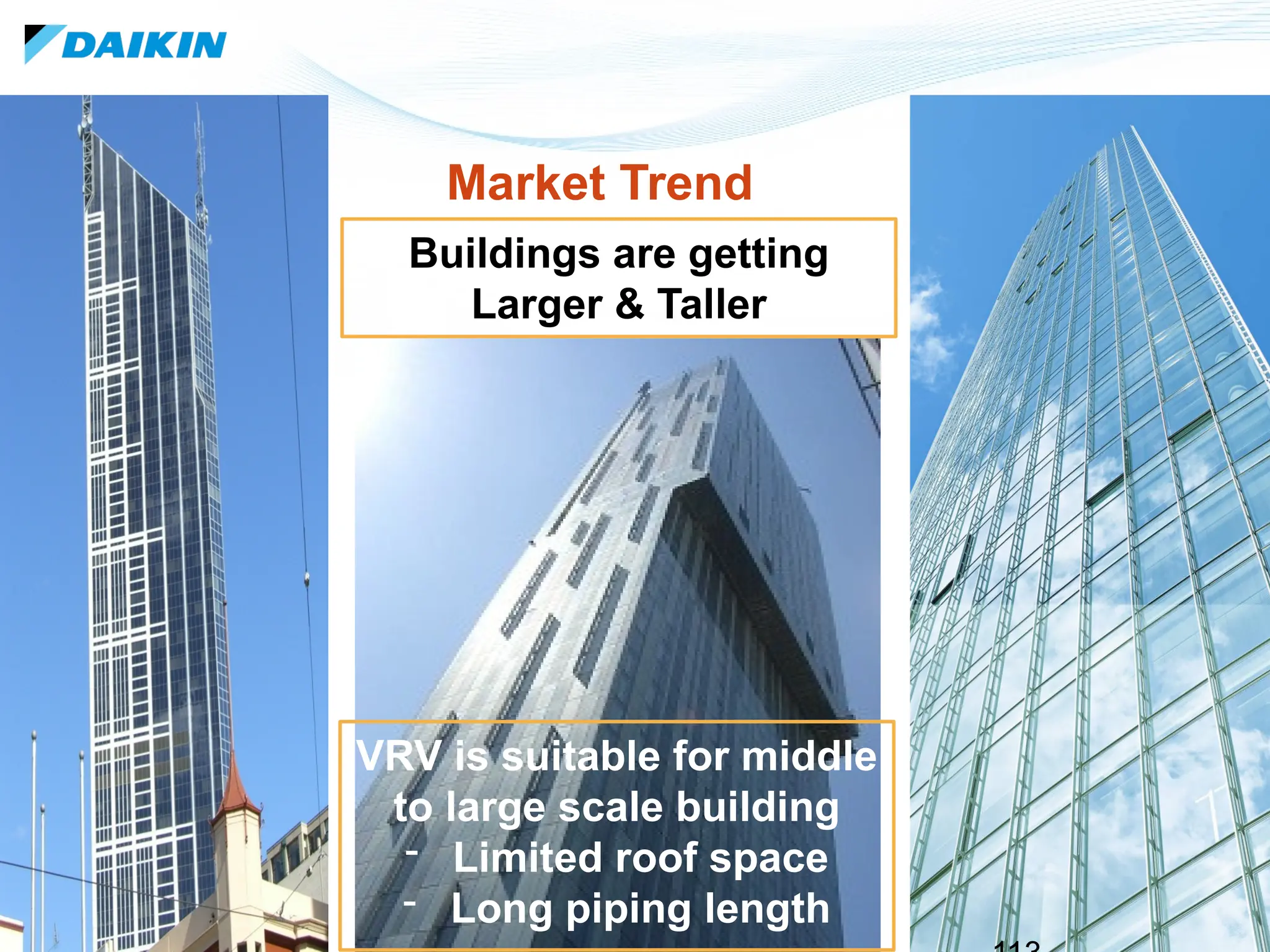
Buildings are getting
Larger & Taller
Market Trend
VRV is suitable for middle
to large scale building
- Limited roof space
- Long piping length
114
Footprint: 0.95m2 (▲43%)
Unit Weight: 310kg (▲35%)
1240
20H
P
Footprint: 1.66m2
Unit Weight: 475kg
2170
20HP
Compact & Lightweight Design
115
60HP A/C Room
• More effective space in the building!
Floor by floor installation
(2,500m2/F,
132HP/F)
2210mm less
37% Less
Space!
VRVIII
VRV IV
Larger Capacity & Compact
116
• More effective space in the building!
Centralized installation
(15Fx2,500m2/F=37,500m2, 1980HP)
VRVIII
466m2
VRV IV
286m2
39% Less
Space!
Space for VRVIII
15F
Larger Capacity & Compact Module Unit
117
Piping Limitations
• Piping length allowances for standard outdoor combinations & only VRV indoor units.
Total piping length + 1000 m actual
Outdoor unit to
indoor unit
165 m actual
190 m equivalent
1st
branch point to
indoor unit
90 m under special
conditions
40 m standard
Indoor unit to
nearest branch
40 m
Level difference
between outdoor
and indoor unit
HOI
OU above IUs
90 m with setting and
piping modifications
50 m standard
OU below IUs
90 m with setting, piping
mods. and CR limits
40 m standard
Level difference
between indoor unit
and indoor unit
HII 30 m
HOI
HII
Liquid pipe must be sized up and a field setting made on outdoor unit. In case of OU below IUs, the
minimum connection ratio is limited (as on VRV III Heat Recovery).
118
Piping Limitations
• Piping length allowances for non-standard outdoor combinations & only VRV indoor units.
Total piping length + 500 m actual
Outdoor unit to
indoor unit
135 m actual
160 m equivalent
1st
branch point to
indoor unit
90 m under special
conditions
40 m standard
Indoor unit to
nearest branch
40 m
Level difference
between outdoor
and indoor unit
HOI
OU above IUs
90 m with setting and
piping modifications
50 m standard
OU below IUs
90 m with setting, piping
mods. and CR limits
40 m standard
Level difference
between indoor unit
and indoor unit
HII 30 m
Liquid pipe must be sized up and a field setting made on outdoor unit. In case of OU below IUs, the
minimum connection ratio is limited (as on VRV III Heat Recovery).
HOI
HII
119
High External Static Pressure
• Allow more options in the opening/angle of louvre.
• Suitable for floor by floor installation.
• Outstanding heat dissipation effect in both hierarchical and intensive
arrangement.
78.4 Pa
Improvement of external static pressure
enables an installation shown above.
Exhaust duct
Louver
Window
Discharge
Suction
Exhaust duct
Suction
louver
120
Ease of Commissioning-
New 7 Segment Digital
PCB Control Display
121
New 7 Segment Digital PCB Control
Display
• VRV IV system utilizes 7 segment luminous digital tubes to display system operation
information, enabling the operation state to be visually displayed whilst facilitating
simplified commissioning and after-sales service.
• Improve commissioning, operation and maintenance efficiency
VRV III with LED display VRV IV with 7 segment display
Displays system operation information directly
122
• 50% miniaturization because of higher integration of electronic component.
• SMT packaging technology improves anti-clutter performance and protects
PCB from the adverse effect of sandy and humid weather.
Dust-proof, Water proof, & Anti-corrosion!
Current
New
Intelligent Main PCB (1)
Computer control board surface adopting SMT packaging technology
*SMT: Surface mounted technology
123
123
60~408Hz
Non-step Frequency Control Range
Compressor Inverter PCB
High Quality
Capacitor
Careful Voltage
Protection
High Frequency
Processing IC
• Maximized non-step frequency control range
Intelligent Main PCB (2)
124
• Automatically checks the
wirings between outdoor units
and indoor units.
• Confirms and corrects the
actual piping length.
• Automatically check whether
the stop valve in each outdoor
unit is in normal status.
Automatic Check
Wiring
Check
Piping
Check
Stop Valve
Check
Efficient Automatic Test Operation
• Accelerating installation process, improving field setting quality
125
Steady Improvements
126
• Conventional setting
Modern Site Setting- VRV Configurator
127
Graphical interface to configure system settings and
commissioning
 Less time on the roof required
 Commission multiple systems of key accounts in the same way
 More time available for test run
 Easily retrieve initial settings on ODU
 Easy error read-out
Digital indication:
• VRV Configurator (EKBCCAB1)
Simplified Commissioning & Servicing
Modern Site Setting- VRV Configurator
Programming Switches:
Software will be available free of charge from the Extranet or via Daikin staff.
128
 Te setting
 Tc setting
 High ESP setting
 Low Noise setting (both automatic and manual)
 Demand setting
 Last errors occurred
 No. of retries
 … and many more!
• VRV Configurator (EKBCCAB1)
Main
setting
Modern Site Setting- VRV Configurator
Software will be available free of charge from the Extranet or via Daikin staff.
129
Comfort-
Lower Operation Sound
130
Streamlined Air Grille
It promotes the discharge of
swirling airflow, further
reducing the pressure loss.
Comfort- Low Operation Sound
• Improve heat exchanger efficiency, helps to reduced operation sound.
• Advanced analytic technologies are utilized to optimize fan design and
increase air flow rate and high ESP without increasing operation sound.
6HP 8HP 10HP 12HP
VRVIII 57 57 58 60
55 56 57 59
Streamlined Scroll Fan
The sharp edge of each fan blade has
a certain curvature, reducing both the
vibration and the pressure loss.
Streamlined
Scroll Fan
Illustrated
Fan
131
• Nighttime quiet operation function
– Outdoor PCB automatically memorizes the time when the peak outdoor
temperature appears.
– It will enable quiet operation mode after 8 h(*1), and return to normal
mode after it keeps for 9 h(*2).
Notes: · This function is available in setting at site.
· The operating sound in quiet operation mode is the actual value
measured by our company.
· The relationship of outdoor temperature (load) and time shown
above is just an example
Quieter at Nighttime
132
• During system start-up, Daikin VRV IV system will automatically enable the
Unit Alternate Operation Function for longer machine life and stable
operation.
Automatic
Sequencing
Automatic
Sequencing
Automatic Sequencing Operation
NOTE : Refrigerant oil recovery process takes place once every 8 hours of compressor run time
133
A A
Single Module, single compressor
(6-12HP)
A B A
Single Module, two compressors
(14-20HP)
A
B
A B C D E F
1 4 2 5 3 6
3 6 1 4 2 5
2 5 3 6 1 4
I
II
III
Triple Module, six compressors
D
A
F
C
A
C
E
A
C
E
B
A A
C
A
C
E
B
D
A
C
E
B
Capacity
increase
Single and Two Inverter Scroll Compressor
Compressor Operation & Sequencing
134
A B C D E F
1 4 2 5 3 6
3 6 1 4 2 5
2 5 3 6 1 4
I
II
III
A B C D E F
A B C D E F
1 2 3
1 2
3
1
2 3
After 8 hours operation,
changeover of Module
Sequence
After 8 hours operation,
changeover of Module
Sequence
Compressor
Sequence
Compressor
Sequence
Compressor
Sequence
Compressor Operation & Sequencing
NOTE : Refrigerant oil recovery process takes place once every 8 hours of compressor run time
135
Unit backup operation function
If malfunction occurs in an outdoor unit...
Emergency operation can be conveniently set and
enabled by the remote controller for indoor unit (for
systems composed of two or more outdoor units ).
Compressor backup operation function
If malfunction occurs in a compressor...
Emergency operation can be easily set and
enabled by the outdoor unit (for a single
outdoor unit system RX(Y)Q 14-20TY1 models).
Double Backup Operation Functions
• In the event of a failure, emergency operation can be conveniently enabled
to allow the remaining system to operate in a limited fashion.
136
A B C D E F
A B
Emergency Operation on CU PCB
Compressor B can run again
Emergency Operation on Remote Control
Module 1 can run again
Emergency Operation on Remote Control
Module 1 & 2 can run again
Module 1 Module 2 Module 3
NOTE :
If repair has not been done after 8 hours of Emergency Operation, Error Code will be activated again
A B C D
Module 1 Module 2
Double Backup Operation Functions
137
18 types
86 models
One of the widest ranges in the industry
Indoor Units Line-up
138
Indoor Units Line-up
139
Indoor Units Line-up
140
Indoor Units Line-up
141
141
Nomenclature
142
142
Connection Ratio
143
Ceiling Mounted Cassette Type
144
1
 infrared “presence sensor” –
prevents draft
 infrared lower level sensor
Individual airflow direction
control
Auto airflow rate mode
Auto airflow direction mode
3
Greater Comfort
special features
4
145
Infrared floor sensor
4 flaps are independently controlled
Individual airflow direction
Infrared presence sensor
Automatic air flow rate
special features
4
146
• Individual airflow direction control(4 directions)
• Draft prevention by airflow block function
 4

5
Comfort
Smaller heat exchange tubes
with different diameters
(Two rows of  7 tubes 
1 row of  4 tubes and 2 rows of  5 tubes)
Energy Saving
5-step DC fan motor
Energy Saving
Infrared presence sensor
and infrared floor sensor
DC drain pump
Energy Saving
Technologies
Stylish
Air outlet becomes flat
when unit stops and
swing flap shuts down
Comfort
Energy Saving
147
Infrared presence sensor individually detect each
of the areas [A , B , C , D] for the presence of people
New Sensors
Infrared Sensors
Infrared floor sensor detects the
average floor temperature
Infrared floor sensor
Infrared presence sensor
148
Comfort
Comfortable cooling
that does not become
cold at floor level with
less draft.
Cooling without Sensing Function
Cold
floor
Cold air accumulates around
the floor, creating cold feet.
The sensor detects low
temperature at floor level to
avoid the floor temperature
become too cold.
Energy
Saving
To prevent excessive
cooling at floor level,
cooling capacity is
automatically controlled.
Cooling with Sensing function
When people are detected, the
unit controls airflow direction
to prevent direct drafts.
Sensing Function
Feels draft
149
Avoid direct air stream
Individual airflow direction control
150
Infrared floor sensor
Individual airflow direction control
151
A
C
B D
Infrared presence sensor
Individual airflow direction control
152
When there are no people in a room, set temperature is
shifted automatically.
The system saves energy automatically by detecting whether the room is
unoccupied. The set temperature is shifted automatically based on the user
preset condition if unoccupied.
*This function is not available when using the group control system.
*User can set this function with remote controller.
25
C
26
C
27
C
Occupied
Auto revert
when people
return
Setpoint
(C)
After 30 min After another 30 min
27
26
25
(Example)
• Cooling setpoint: 25C
• Shift temperature: 1.0C
• Shift time: 30 min.
• Limit cooling temperature: 27C
If people do not
return, air
conditioner will turn
off when the room
temperature reaches
27C.
Sensing Sensor Low Mode
Shift temperature and time can be selected from 1 to 4C in 0.5C increments
and 15, 30, 45, 60, 90 or 120 minutes respectively with remote controller.
Time
Unoccupied
153
Reference: Results of checking operation
with an actual Daikin system
Installed indoor unit Operation Setpoint (℃) air flow rate Power consumption (%) Louvers Operation hours
Window Cooling 20 High
100% Horizontal 8:30-17:00
Hallway 20 High
Window Cooling 22 High
70% Horizontal 8:30-17:00
Hallway 22 High
30% lower power consumption
With temperature shift of 2C:
Reference documentation: “Research into
a Database Describing How Offices Are
Used,” September 2006, Papers of the
Society of Heating, Air-Conditioning and
Sanitary Engineers of Japan
A, B: Education
C, D: Construction
Average seat occupancy at offices on
weekdays ranges from 30% to 50%
(yearly average). (In sales
departments, it may be as low as 20%
to 30%.)
Weekday average presence ratio
Presence
ratio
(%)
Weekday (1 day) seat
occupancy
Unoccupied energy-saving mode Offices and stores have many unoccupied areas.
Indoor unit: Actual energy savings
154
Sensing Sensor Stop Mode
*This function is not available when using the group control system.
*User can set this function with remote controller.
Absent stop time can be selected from 1 to 24 hrs in 1 hr
increments with remote controller
The system saves energy automatically by detecting whether the room is
unoccupied. The system automatically stops operation based on the user
preset condition if unoccupied.
When there are no people in a room, the system stops
automatically.
Unoccupied
Occupied
Operatio
n
After 2hrs
On
(Example) •Absent time : 2hrs
Off
155
No need for additional airflow
blocker (to be arranged on site)
Total comfort by individual airflow direction control
and newly-equipped “Airflow block function”
Easy setup with remote controller
Horizontal blow Airflow block
Airflow Block Function
*User can set this function with remote controller.
156
Airflow block function avoids uncomfortable
drafts by reducing air velocity.
Sealing material of air discharge outlet
(optional accessory) is not required.
Airflow block
Low air velocity
Airflow block
for cabinet
side
Additional airflow blocker (to be
arranged on site) is not required.
*User can set this function with remote controller.
When installing near the walls, space is
required to install conventional system:
1,500 mm
When using the airflow block function,
less space is required :500 mm
(Equivalent to using an optional sealing
material of air discharge outlet)
Total comfort by individual airflow direction control
and newly-equipped “Airflow block function”
Airflow Block Function
157
158
Technology that allow sensing air flow to deliver energy savings
159
VRV vs MDS
160
MDS
• Up to 60Hp
• Three product line-up provides greater
selection and installation flexibility
• Up to 50Hp
Total Capacity Range
161
MDS
• Modular combination
• Only 8 different single module for
modular combination
• Specific module for each module
• Difficult in keep stock
Combination of Models
162
MDS
• Up to 18 types of indoor units
• Greater installation flexibility
to suit different applications
• Up to 7 types of indoor unit
Indoor Model Range
163
MDS
• Two Inverter Scroll Compressors • One Digital Scroll Compressor
and Multiple Fixed Scroll
Compressor
Compressor
164
MDS
• EXV is built inside the indoor unit • EXV Box has to be installed
outside the indoor unit
Expansion Device
165
Maximum Connectable Indoor Units
MDS
• Max. 64 IDUs
• Max. 38 IDUs
166
Maximum Piping Length
MDS
Max. Actual Piping Length 165 m 150 m
Max. Equivalent Piping Length 190 m 175 m
Max. Level Difference (between first ID branch & the farthest IDU) 90 m* 65 m
Max. Level Difference (between IDUs & ODUs) 90 m* 50 m
Max. Level Difference (between IDUs) 30 m 15 m
*Refer EDB for details of conditions and requirements.
167
Connection Ratio
MDS
• 50 – 200% • 50 – 120%
168
Control Surface Board
MDS
• SMT Packaging technology improves anti-clutter performance and protects PCB
from the adverse effect of sandy and humid weather.
• Conventional type
169
Commissioning
MDS
• No extra laptops or connection
required
• Commissioning can be done by
pressing the buttons on the ODU PCB
• Auto addressing of indoor units
• Require a laptop with a MC501
gateway during system
commissioning
• Manually setting on dipswitch on
each IDU PCB
+
X
170
Centralized Control Option
MDS
• D-BACS using DIII Net
communication offers a variety of
centralized controllers (up to 64 IDUs)
• Unlimited groups of DIII equipments
can be managed with Unlimited
numbers of iTM by Web Integration
• MC303 central controller (up to
32 IDUs)
• Centralized control can manage
1536 IDUs at the same time
171
BMS Interface Option
MDS
• Compatibility with BMS by utilizing
international communication
standards, BACnet® or
LONWORKS®
• MC510 Modbus Gateway allow
MDS system communicate with
BMS based on Modbus protocol
172
VRV vs Chiller
173
173
Air Conditioners for General Use
Air Conditioners for Particular Uses
Niche for Centrifugal
Chiller System
1. Large-size building
2. Large volume of outdoor
air processing
3. Large space air-conditioning
1. Large- to middle-size building
2. Large volume of outdoor air processing
3. Large space air-conditioning
Niche for VRV System
1. Middle- to small-size building
2. Individual room air-conditioning
3. Energy-saving system
1. Constant temperature and humidity room
(Secondary side: Temperature and humidity control)
2. Clean room (Secondary side: Highly static pressure and highly airtight)
3. Hospital facilities (Particular areas like operation rooms and intensive
care units)
4. Processing use (Highly accurate water supply)
It is recommendable that chiller
system has a wide range of options as
secondary-side equipment, possibility
of highly accurate temperature
controlled water supply, and low load
control.
Segregation of Applications according to NEEDS
Niche for Chiller System
174
174
High
price
1000m2 30000m2
<Major Applications>
Luxury hotels.
Classy restaurants.
High-end condominiums.
2) Upmarket needs
Department stores. Shopping malls.
Movie theaters. High-rise office
buildings. High-end housings.
3) Middle-class needs
Public offices. Community
facilities. Restaurants. Apartment
houses. Dwelling houses. Middle-
to small-size office buildings.
4) Widely-distributed
equipment needs
Eating and drinking places. Middle- to
small-size office buildings.
Convenience stores. General housings.
Retail premises.
Floor space
VRV
Unitary type
[Duct-type PA]
Central systems
Chiller
Centri-
fugal
chiller
RA Multi-
split type
(1)
(2)
(3)
(4)
Market Structure of Air Conditioners for General Use
1) VIP needs
<Floor Space and Grade>
Grade
Low
price
10000m2
Horizontal Axis
175
175
l Segregation according to the size of complex building (commercial building)
Low-rise buildings (Retail stores, hotels,
restaurants, and offices), large shopping malls,
gymnasiums, trade fair sites, hospitals, libraries, air
ports, stations and schools
Mid-rise buildings
(Complex buildings and complex
facilities: Retail stores, hotels,
restaurants and offices)
High-rise buildings
(Office buildings and hotels)
Ultra-tall buildings
(Office buildings and hotels)
10
20
30
40
50
Chiller
system
Centrifugal
chiller system
Combination of
central system
and VRV system
Air Conditioning Systems
Recommended by Daikin
<Applications based on the number of floors>
Number of floors
VRV
VRV
30,000m2
50,000m2
70,000m2 100,000m2 Floor space
176
176
Centrifugal chiller
Refrigerant piping
Cooling water piping
Chilled/Hot water
piping
Duct
VRV indoor unit
VRV outdoor unit
Fan coil
Ceiling suspended air
handling unit
Large-size air
handling unit
Cooling tower
Boiler
Water-cooled chiller
Hotel (Hotel rooms) )
Offices
High-end condominium
Hotel (Lobby)
Department store,
movie theater,
shopping mall
Integrated air conditioning with centrifugal chiller
Big air volume, high static
pressure are required
because of Large-space
Recommended A/C System for Large-size Complex Buildings
177
177
Centrifugal chiller
Refrigerant piping
Cooling water piping
Chilled/Hot water
piping
Duct
VRV indoor unit
VRV outdoor unit
Fan coil
Ceiling suspended air
handling unit
Large-size air
handling unit
Cooling tower
Boiler
Water-cooled
chiller
Hotel (Hotel rooms)
Offices
High-end condominium
Hotel (Lobby)
Department store,
movie theater,
shopping mall
Individual air conditioning
is required because of over
time work,holiday
attendance.
Integrated air conditioning with centrifugal chiller
Recommended A/C System for Large-size Complex Buildings
178
Centrifugal chiller
Refrigerant piping
Cooling water piping
Chilled/Hot water
piping
Duct
VRV indoor unit
VRV outdoor unit
Fan coil
Ceiling suspended air
handling unit
Large-size air
handling unit
Cooling tower
Boiler
Water-cooled
chiller
Hotel (Hotel rooms)
Offices
High-end condominium
Hotel (Lobby)
Department store,
movie theater,
shopping mall
Recommended A/C System for Large-size Complex Buildings
Integrated air conditioning with centrifugal chiller
air conditioning is used
casually because of private
room
air conditioning is used
casually because of
private room
179
Centrifugal chiller
Refrigerant piping
Cooling water piping
Chilled/Hot water
piping
Duct
VRV indoor unit
VRV outdoor unit
Fan coil
Ceiling suspended air
handling unit
Large-size air
handling unit
Cooling tower
Boiler
Water-cooled
chiller
Hotel (Hotel rooms)
Offices
High-end condominium
Hotel (Lobby)
Integrated air conditioning with centrifugal chiller
Department store,
movie theater,
shopping mall
air conditioning for
Individual needs and
large-space are
required in a same
building.
Recommended A/C System for Large-size Complex Buildings
180
Centrifugal chiller
冷媒配管
冷却水配管
冷温水配管
ダクト
VRV室内
機
VRV室外
機
ファンコイ
ル
天吊エアハ
ン
大型エアハ
ン
Cooling tower
Boiler
Water-cooled
chiller
Hotel (Hotel rooms)
office
High-end condominium
Hotel (Lobby)
Department store,
movie theater,
shopping mall
Central System using
Chiller
is adopted for big
space.
Combination use of chiller system
and VRV system is recommended.
VRV
VRV is adopted for
individual air
conditioning area,
producing energy
saving.
Integrated a/c system using only
centrifugal chiller for a large-size
complex building is common idea.
Recommended A/C System for Large-size Complex Buildings
181
Floor space 30,000m2
50,000m2
100,000m2
Cooling
load 900RT 1500RT 3000RT
Integrated method with
centrifugal chiller or
absorption chiller system
500RT
× 2 units
500RT
× 3 units
1000RT
× 3 units
Method
Upper
floors
(Individual
air-condi-
tioning)
Lower floors
(Central-system
air-conditioning)
VRV Screw Chiller
Linked by
DIII Net
I-manager
+
Controlling the whole equipment
Central
system +
VRV
system
Chiller
system
240RT
× 2 unit
400RT
× 2 units
400RT
× 4 units
VRV
system
550HP
(48HP outdoor
unit × 12 units)
940HP
(48HP outdoor
unit × 20 units)
1880HP
(48HP outdoor
unit × 40 units)
Recommended A/C System for Large-size Complex Buildings
182
Good Features of VRV
Good Features of Chiller
1) Large- to middle-size building
2) Large volume of outdoor air processing
3) Large space air-conditioning
4) Good full load operation and efficiency esp water-cooled
5) Work with AHUs to achieve certain air conditions for specialised
areas like cleanrooms, operation theatres in hospitals, etc
1) Individual room controls
2) Good partial load operation
3) Good for small to medium-sized building
4) Easy design, installation, commissioning, and troubleshooting
5) Stage-by-stage, floor-by-floor design and installation possible
6) Energy saving inverter system
7) A/C equipment i.e CU, FCU, controllers, joints all from same supplier
183
How does VRV benefit ...
 Tenant
 Building Owner
 Consultant
 Contractor
184
 for Tenant ...
 Comfort air-conditioning system
• Precise temperature control
• Quiet operation
• Flexible & easy management
• Individual Control
• Energy Saving
• Individual Energy Bill
• After Hours Operation
185
 Lower running cost
- Energy saving
- Water Saving
- Operator cost saving
- Maintenance cost saving
 Lower building cost
 Save space
 Shorter & more flexible installation
 for Building Owner ...
186
 Flexible & easy for system
design
 Easy to fulfill design brief
- Energy saving
- Individual Control
- Comfort
- Space saving
- High level central control
 Faster design
 Less mistakes
 for Consultant ...
187
 Easy installation
 Save installation time
 One supplier
 Easy commissioning
 for Contractor ...
188
Pump
Pump
Cooling
tower
Water piping
AHU
FCU FCU
For
cooling
For
heating
2 heat sources
Managed by
engineer
Complicated
Inefficient part
load operation
Outdoor
unit
indoor
unit
Refrigerant piping
Space-conscious
design
Simple system
Energy efficient
Individual control
Remote
controller
Simple Operation
Chiller
Outline of the Systems
189
27.7%
19.9%
52.4%
1982
10.7%
22.4%
66.9%
Buildings up to 7,000 m2
Development of VRV market in Japan
Buildings over 7,000 m2
Packaged air-conditioners
Combined air-conditioners
Centralized air-conditioners
190
68.4%
15.5%
16.1%
34.7%
1996
28.0%
32.4%
39.6%
14.9%
Packaged air-conditioners
Combined air-conditioners
Centralized air-conditioners
VRV system
Buildings up to 7,000 m2 Buildings over 7,000 m2
Development of VRV market in Japan
191
2001
47.5%
25.2%
15.7%
59.1%
26.9%
37.9%
35.2%
32.2%
Packaged air-conditioners
Combined air-conditioners
Centralized air-conditioners
VRV system
Buildings up to 7,000 m2 Buildings over 7,000 m2
Development of VRV market in Japan
192
• For air cooled chiller, consider “filling cost”
• For water cooled chiller, consider “filling” and “drift” costs
• Also, water treatment cost
Example:
- 25 storey office
- 1300 Rt Water Cooled chiller
- 1.5% drift
- 51 ML/yr
- $65 000
Water Cost Saving
193
• Chilled water systems often require trained operator on site.
• Not necessary for VRV system.
• Chilled water systems require costly maintenance.
• Not necessary for VRV system. Just routine cleaning.
Maintenance & Operator Cost Saving
194
Example : Based on capacity 700 kW
Air cooled
Chiller
Water cooled
chiller
Other VRF Daikin VRV-IV
Primary Equipment 355,163
$ 394,625
$ 438,900
$ 462,000
$
Other 355,163
$ 394,625
$ 323,400
$ 308,000
$
Installed Cost 710,325
$ 789,250
$ 762,300
$ 770,000
$
Water Cost 50
$ 10,465
$ -
$ -
$
Water Treatment 100
$ 1,000
$ -
$ -
$
Energy Cost - Cooling 35,461
$ 31,517
$ 21,407
$ 17,662
$
Energy Cost - Heating 18,463
$ 18,463
$ 12,309
$ 10,156
$
Maintenance 31,111
$ 34,028
$ 14,933
$ 14,933
$
Operator 20,000
$ 20,000
$ -
$ -
$
Total Annual Cost 105,185
$ 115,473
$ 48,649
$ 42,751
$
Diff. Installed Cost 59,675
-$ 19,250
$ 7,700
-$
Diff. Annual Cost 62,434
$ 72,722
$ 5,898
$
Payback years 0.96 immediate 1.31
15 year savings 876,835
$ 1,110,080
$ 80,770
$
Life Cycle Cost Saving
195
How does it compare?
Improved Comfort
196
Easy Zoning compared to Chiller
 Each indoor unit is capable of individual set point control.
 Many zones possible, without complication.
 Staged installation possible.
 Floor by floor installation possible.
 Future installation possible.
Easy Planning & Design
197
All one brand
 Outdoor units, indoor units, controls, pipe sizing, pipe
joints etc all from one supplier.
 Eliminates cumulative error.
 Prevents “passing blame” between suppliers.
 Common procedures on every project.
Easy Planning & Design
198
VRV System
Simple wiring
Central A/C System
Complicated wiring
FCU
S$ 200 / point
2-6 points / piece of equipment
All monitoring points
included at no cost
Easy Network Wiring
199
Central A/C System
The systems commonly
condition the entire building at
predetermined times, with no
regard to user demands.
VRV System
The systems condition only
the necessary rooms with
regard to user demands.
After Hours Operation
200
Transport by Lift
• All models (5-54HP) can easily be carried by lift.
• Easy for floor by floor installation.
• Reduction of installation work.
Steel Base can be
used for hitching
Easy!
Lift
Air Cooled Chiller RXYQ16P 329kg
1680 x 1240 x 765
Easier to Handle
201
VRV SYSTEM
P P
1/3
CHILLER SYSTEM
Efficient Use of Space
202
CHILLER SYSTEM
VRV SYSTEM
2 -off plant & pumps Standby not required.
P P
$$$$$
No Standby Equipment
203
VRV SYSTEM
Lighter structural requirements
Lower height
Lower cost building
CHILLER SYSTEM
P P
$$$$$
$$$$$
Most Cost Effective Building
204
REFNET header
REFNET joint
Short installation
time !
- Simplified refrigerant piping system
- More flexible than water piping
REFNET Piping
205
Power
Supply 2
Super Wiring System
Power
Supply 1
- Separate Power Supply for out- and indoor units
- 2 wire multiplex transmission system
- Automatic address setting function
Easy & Quick
Installation !
No polarity!
Super Wiring System
206
 Chiller systems, VAV etc are never
“quite right”
 Auto address setting
 VRV works effectively from day one
 Simple procedures common to all
projects
Easy Commissioning & Maintenance
207
Self-diagnosis Function
- to Quickly Cope with Errors
Correct display of errors amounting to
74 items in the system
Error code
display Run lamp
Unit No.
Inspection display
 Errors related with indoor unit: 14
 Errors related with outdoor unit: 32
 Errors related with control/wiring: 16
 Central Control 4
 HRV 8
Self-diagnosis Function
208
Run lamp
Inspection
display
Unit
No.
Error code
display
Error item
Blinking Blinking Blinking A0 Indoor unit: Error of external protection device
Blinking Blinking Blinking A1 Indoor unit: Failure of PC board
On Off Blinking A1 Indoor unit: Failure of PC board
Blinking Blinking Blinking A3 Indoor unit: Malfunction of drain level control system (33H)
Blinking Blinking Blinking A6 Indoor unit: Fan motor lock
On Off Blinking A7 Indoor unit: Malfunction of swing flap motor (M1S)
Blinking Blinking Blinking A9 Indoor unit: Malfunction of moving part of electronic expansion valve (Y1E)
On Off Blinking AF Indoor unit: Drain level above limit
Blinking Blinking Blinking AH Indoor unit: Malfunction of air cleaner
Blinking Blinking Blinking AJ Indoor unit: Malfunction of capacitysetting
Blinking Blinking Blinking C4
Indoor unit: Malfunction of thermistor (R2T) for liquid pipe (loose connection,
disconnection, short circuit, failure)
Blinking Blinking Blinking C5
Indoor unit: Malfunction of thermistor (R3T) for gas pipes (loose connection,
disconnection, short circuit, failure)
Blinking Blinking Blinking C9
Indoor unit: Malfunction of thermistor (R1T) for air inlet (loose connection,
disconnection, short circuit, failure)
On On On CJ Indoor unit: Malfunction of thermostat sensor in remote controller
Blinking Blinking Blinking E0 Outdoor unit: Actuation of safetydevice
Blinking Blinking Blinking E1 Outdoor unit: PC board failure
: The system operates for malfunction codes indicated in coloured squares,
however, be sure to check and repair.
Error Code Display
209
Service Checker
210
Operation data recorded
from the units by service
checkers
Data Download from Service Checkers
211
CHILLER
VRV
Installation Work
212
CHILLER
VRV
- Copper pipes with refnet joints
provided
- Simple and straightforward pipe
sizing according to manual
- No valves needed, so no
sourcing or supply issue
- Easy brazing work with smaller
pipes
- Simple 2-core control wires
- No pipe corrosion
- Smaller ductwork
- Carbon steel pipes, white or
black
- Pipe sizing depends on required
water flowrate and speed
- Many accessories needed e.g:
valves/gauges/strainers/flow
switches/pumps
- Heavy duty welding work with
bigger pipes
- Many control wires
- Possible pipe corrosion
- Bigger ductwork, more building
height and costs
Installation Work
213
CHILLER
VRV
- Less storage and riser space for
smaller copper pipes
- Piping length limitation
- Shorter installation, test &
commissioning, troubleshooting
time
- Allows phase-by-phase or floor-by-
floor installation and
commissioning; less disruption to
existing operation
- No water cost
- More installation space needed
for bigger water pipes
- No actual pipe length limitation
but tedious pump selection
- Longer installation, test &
commissioning, troubleshooting
time
- Great disruption to existing
operation
- Cost of make-up water at cooling
tower for water-cooled chiller
system
Installation Work
214
Chilled water piping
(bigger size)
VRV piping
(smaller size)
Piping Work
215
VRV System
 Simple
 Clean
 Neat
216
217
B
VRV CU
218
219
Chiller System
220
Example 1 of Chiller System Piping Work
Cooling
Tower No.1
P T
T
P
P T
T P
M
P
P
P
P
Cooling
Tower No.2
P P
P P
P
T FS
P
T
P T
FS
P T
P
T FS
P
T
P T
FS
P T
M
M
M
Chiller No.1
Chiller No.2
CHWP No.1
CHWP No.2
CDWP No.1
CDWP No.2
To AHU & FCU
M
M
M
M
T
T
Flow
Meter
221
Example 2 of Chiller System Piping Work
222
Flow
switch
Flexible
connection
Temp
gauge
Pressure
gauge
Balancing
valve
Isolating
valve
Victaulic or
flange
connection
Victaulic or
flange
connection
Flexible
connection
Temp
gauge
Pressure
gauge Isolating
valve
Gate
valve Chilled
water
pump
Gate
valve
Strainer
Single Unit Installation
223
Automatic airvent
Balancing valve
Globe
valve
Pressure gauge
Temp gauge
Flow switch
224
Flexible
joint
Temp
gauge
Pressure
gauge
3 way
motorized
valve
balancing
valve
flange end
for future
connection
gate valve
strainer
225
Balancing valve
Gate valve
2 way valve opening
controlled by return air
temp sensor
Pressure gauge
Temp gauge
226
Heat Recovery
VRV Piping – 3 pipes
227
Regulatin
g valve
4-
pipes
Drain
pipe
Chilled Water Piping – 4 pipes FCU
228
Brazing Work Welding Work
Brazing & Welding Work
229
Chiller Wiring
VRV Wiring
Wiring Work
230
Chiller Installation
VRV Installation
supplier contractor
contractor
Supplier A
Supplier B
Supplier C
Supplier D
231
Question

1.0 A Detailed Overview of Daikin VRV.pptx

  • 1.
  • 2.
  • 3.
    3 Daikin Corporate Profile DAIKIN is the only one company which produces air-conditioner, compressor and refrigerant in the world. Air-conditioner Compressor Refrigerant
  • 4.
    4 Daikin Corporate Profile JAPAN RinkaiFactory, Sakai Plant Shiga Plant Kanaoka Factory, Sakai Plant Yodogawa Plant Daikin Industries Head Office Daikin Group Global Production Base
  • 5.
    5 Others ◆ Abbar &Zainy Daikin Air-conditioning (1986) ◆ Daikin Airconditioning South Africa Pty. Ltd. (1998) ◆ Daikin Airconditioning India Private Limited (2004) North America ● Daikin U.S. Corporation (1981) ◆ Daikin Airconditioning (Americas), Inc. (2005) South America ◆ Daikin Airconditioning Argentina S.A. (2001) Asia/Pacific region ◆ Daikin Australia Pty. Ltd. (1969) ◆ Daikin (Singapore) Pte. Ltd. (1980) ◆ Siam Daikin Sales Co., Ltd. (1982) ■ Daikin Air-conditioning (Thailand) Co., Ltd. (1987) ■ Daikin Industries (Thailand) Ltd. (1990) ◆ Daikin (Malaysia) Sdn. Bhd. (1996) ● Daikin Asia Servicing Pte. Ltd. (1997) ● Daikin Trading (Thailand) Ltd. (1997) ■◆ Daikin-Alen Airconditioning, Inc. (1998) ■ Daikin Compressor Industries Ltd. (2001) ◆ Daikin Air Conditioning (Singapore) Pte. Ltd. (2002) ■ OYL Manufacturing Company Sdn Bhd (2006) ■ Production sites ◆ Sales bases ● Other operation bases China ◆ Daikin Airconditioning (Hong Kong) Ltd. (1984) ■◆ Shanghai Daikin Air-Conditioning Co., Ltd. (1995) ■◆ Huizhou Daikin Air-Conditioning Co., Ltd. (1997) ■◆ Xi’an Daikin Qingan Compressor Co., Ltd. (1998) ■ Daikin Air Conditioning Systems (Shanghai) Co., Ltd. (2004) ■ Daikin Central Air Conditioning (Shanghai) Co., Ltd. (2004) ■ Daikin Device (Suzhou) Co., Ltd. is established in China(2004) ■ Daikin Motor Suzhou Co., Ltd. (2004) ■ Daikin Central Air Conditioning (Huizhou) Co., Ltd. (2005) Europe ■◆ Daikin Europe N.V. (1972) ◆ Daikin Airconditioning Belgium N.V. (1982) ◆ Daikin Airconditioning France S.A.S. (1992) ◆ Daikin Airconditioning Germany GmbH (1998) ◆ Daikin Airconditioning Central Europe GmbH (1999) ◆ Daikin AC Spain S.L. (2000) ◆ Daikin Airconditioning Poland Sp. z.o.o. (2001) ◆ Daikin Airconditioning Italy SpA (2002) ◆ Daikin Airconditioning UK Ltd.(2003) ■ Daikin Industries Czech republic s.r.o. (2003) ◆ Daikin Airconditioning Portugal S. A. (2004) ■ Daikin Device Czech Republic s.r.o. (2005) ◆ Daikin Airconditioning Greece S. A. (2006) Global Network Daikin Corporate Profile
  • 6.
    6 Europe Daikin bases (AC)O.Y.L. bases Daikin Europe N.V. (Belgium) Daikin Industries Czech Republic i.e.. Daikin Device Czech Republic i.e.. McQuay, Caching (Italy) Daikin Group Global Production Base Daikin Corporate Profile
  • 7.
    7 Asia/Oceania Daikin bases (AC)O.Y.L. bases Daikin Air-conditioning (Shanghai) Co., Ltd. Daikin Industries (Thailand) Ltd. (Factory) O.Y.L. Manufacturing Company Sdn Bhd (Malaysia) McQuay, Shenzhen Daikin Group Global Production Base Daikin Corporate Profile
  • 8.
    8 North America O.Y.L. bases McQuay,Auburn McQuay, Faribault McQuay, Owatonna McQuay, Staunton Daikin Group Global Production Base Daikin Corporate Profile
  • 9.
    9 FY2013 Total 209 subsidiaries Total56,240 employees Our Operation Daikin Corporate Profile
  • 10.
  • 11.
    11 Our Business (byRegion) FY2013 18% 14% 23% 27% 18% Japan Europe, Middle East & Africa China Asia & Oceania Americas US$17.5 billion Overseas business ratio = 73% Daikin Corporate Profile
  • 12.
    12 Our Product AHU Ducted Type OutdoorUnit Gas Furnace A-shaped Coil Unitary AC Residential AC Air Purifier Hot Water Heating Control system Water Cooled Chiller Air Handling Unit Centrifugal Chiller Fan Coil Unit Air Cooled Chiller Applied AC AC for facility AC for Small Shop and Office Rooftop Type ACs VRV Ceiling Ducted Type Ceiling Cassette Type Ceiling Suspended Type Humidity-control Ventilation System Outdoor Unit Heat Recovery Ventilation Commercial Industrial Residential Daikin Corporate Profile
  • 13.
    13 Commercial market -Global (Source: BSRIA) Chiller+AHU/FCU VRV/VRF Market (x million US$) 28% 37% 72% 63% Daikin Corporate Profile
  • 14.
    14 Commercial market -Malaysia (Source: BSRIA) Market (x million US$) 28% 40% 72% 60% Chiller+AHU/FCU VRV/VRF Daikin Corporate Profile
  • 15.
  • 16.
    16 Commercial market –Asia Pacific (Source: BSRIA) Market (x million US$) 58% 47% 42% Chiller+AHU/FCU VRV/VRF 53% Daikin Corporate Profile
  • 17.
    17 Commercial market –Japan (Source: JRAI) 1990 1995 2000 2005 350,000 35,000 300,000 30,000 250,000 25,000 200,000 20,000 150,000 15,000 100,000 10,000 50,000 5,000 0 0 2009 Fan coil unit Chiller Source : Japan Refrigeration & Air -conditioning Institute Number of production (Unit) 100,000 80,000 60,000 40,000 20,000 0 120,000 140,000 VRV Number of production (Unit) Japan Daikin Corporate Profile
  • 18.
    18 Daikin’s Multi Split& VRV in China DAIKIN Hisense-Hitachi Toshiba Mitsubishi Electric Mitsubishi Heavy Industries MHI-Haier Midea Gree Haier LG York SAMSUNG Others Daikin Corporate Profile
  • 19.
    19 Background of VRVdevelopment (1) • 1973: 1st Oil crisis • Energy saving approaches --- – Increase machine efficiency • Centrifugal : >0.7 KW/ton – Application approach • VAV, VWV, Thermal storage • Only for large buildings – AC is not popular in small buildings & houses VRV Development History
  • 20.
    20 Background of VRVdevelopment (2) • Recovery of economy • High energy cost was accepted in the market • Penetration of AC to small building & housing • Energy consumption increase • 1979: 2nd Oil crisis VRV Development History
  • 21.
    21 Background of VRVdevelopment (3) • 1979 : Energy saving law – Energy saving requirement for office building – Large buildings already satisfied the requirement but not small building • Daikin started VRV development • 1982 : Launching of VRV VRV Development History
  • 22.
    22 • How didVRF come to be? – 1970’s: only boiler & chiller based solutions available for cooling and heating – Main difficulties: • Very few technical space available in densely populated Japan • During refurbishment difficulties to: – split up project in different phases – find necessary space to install water piping – Reduction of energy consumption (no natural energy sources, makes electricity expensive in Japan) – No integration of A/C & controls & ventilation with existing solutions Answer: Daikin invents the VRV® , world’s FIRST VRF system and installs it in 1982 VRV Development History
  • 23.
    23 1982: VRV launchedin Japan 1987: Oversea first VRV Sales D Series up to 5HP up to 4 indoor units 1987 1990 G Series up to 10HP up to 8 indoor units 1995 H Series up to 10HP up to 16 indoor units 1996 K Series up to 30HP up to 32 indoor units Inverter Historical steps - 1 VRV Development History
  • 24.
    24 Historical steps -2 2001 KASeries up to 30HP Up to 32 indoor units K plus Series up to 30HP up to 32 indoor units 1997 2001 L Series up to 30HP up to 32 indoor units R-407C VRV Development History
  • 25.
    25 Historical steps -3 2003 up to 48 HP up to 40 indoor units 2006 up to 54 HP up to 64 indoor units R-410A R-410A VRV Development History
  • 26.
  • 27.
  • 28.
    28 Sales progress :1 Beginning Stage • Target : Office building & creating new market • Penetrating into chiller market • 1st Phase : Project Sales – By attacking building owners, architects and consultant and got landmark projects – Sales force : Daikin only • 2nd Phase : Daikin + Engineering Dealers – As VRV was recognized in the market, Engineering Dealers with design & contracting capability join • Project size : Mainly, less than 2000 m2 VRV Sales Progress
  • 29.
    29 Sales progress :2 Advanced stage • Penetrating into large buildings • Drastic sales vol. increase by Synergy Effect – Sales force up : Daikin + Authorized ED – Project size up: > 10000 m2 Turning point : VRV penetration ratio 30%  Only Singapore & UK.  Other market : > 10% = Big potential VRV Sales Progress
  • 30.
    30 Sales progress :3 Big Potentials • Refurbishment – Huge stock : Economy growth started late ’80 and its about time for refurbishment • Large sized building < 20000 m2 – Centrifugal dominates market – VRVIII & WC VRV have good chance • High class condominium – Emerging huge volume of upper middle class market – Steady growth VRV Sales Progress
  • 31.
    31 VRV Penetration 10 % 20 % 30 % Beginning stage VRVis not recognized in the market Advanced stage VRV is recognized in the market, vol. increase Sales progress image Small & Medium office building new construction Big potentials Refurbishment Large building Condominium Sales Vol. VRV Sales Progress
  • 32.
    32 VRV System ispenetrating into Large-sized Buildings - Less than 7,000 m 2 1982 2000 Over 7,000 m 2 Floor area Central 52.4% Package 27.7% Combined use 19.9% Central 66.9% Package 10.8% Combined use 22.3% Central 15.8% Package 57.1% Combined use 27.1% Central 34.5% Package 26.6% Combined use 38.9% VRV 33.3% VRV 14.4% VRV 14.8% VRV 17.5% Building Air conditioning systems in Japan VRV Sales Progress
  • 33.
    33 0 20,000 40,000 60,000 80,000 100,000 120,000 140,000 160,000 1 2 34 5 6 7 8 9 10 11 12 13 14 15 16 17 05 95 90 00 In Japan Overseas VRV Sales in the World Qty sets 10 times in 15 years VRV Sales Progress
  • 34.
    34 Daikin’s position, in Japan,in the world VRV Sales Progress
  • 35.
    35 0.0 2.0 4.06.0 8.0 10.0 12.0 14.0 16.0 18.0 20.0 17.3 14.0 10.2 6.1 5.2 4.2 3.9 3.5 3.2 3.2 2.9 2.0 2.0 1.5 1.3 1.2 AC business global major players (including OEM) Bil. US$ Electrolux Gree DAIKIN Midea Haier Mitsubishi Electric Hitachi Panasonic Fujitsu Mitsubishi Heavy Carrier Trane Lennox Johnson Controls (York) LG Samsung Notes) 1.Sales turnover includes residence & commercial use air-conditioners, chiller, air-conditioning use AHU, FCU. Note engineering business, air-purifier, heating equipment and industry use AHU are not included. 2.Value is estimated by Fuji Keizai. 3.1US$=97.6J, 1RMB=15.9J, 1KRW=0.09J, 1SEK=15.0J 4. OEM amount of DAIKIN < 1% of total Resource: Global consumer electronics market research 2015 by Fuji Keizai  As sales turnover, we are No.2 in global market. However, huge turnover of Chinese and Korean brands are mainly supported by RA sales.  In commercial & industrial AC market, Daikin is holding outstanding position. VRV Sales Progress
  • 36.
    36 0.0 2.0 4.06.0 8.0 10.0 12.0 14.0 16.0 18.0 20.0 17.3 14.0 10.2 12.4 14.0 7.7 Bil. US$ Gree DAIKIN Midea Global top 3 without OEM business No OEM business We proud “Daikin” brand VRV Sales Progress
  • 37.
    37 4 8 % 22 % 13 % 8 % 6 % 5% DAIKIN ME Hitachi Toshiba MHI Panasonic 126,000 units VRV/VRF DAIKIN ME Hitachi Toshiba MHIPanasonic 668,00 0 units Light commercial PA Daikin’s position in Japan Keeping overwhelming No.1
  • 38.
    38 Global AC MarketOverview and VRV Position VRV Sales Progress
  • 39.
    39 Global Applied MarketTrend 2005-2013 47 51 58 63 60 65 72 74 76 40 50 60 70 80 2005 2006 2007 2008 2009 2010 2011 2012 2013 Tri US$ Year Global GDP Growth GDP growth 161% 10 26 1 9 0 10 20 30 40 2005 2013 Mil TR Year Global Applied Market CH+VRV) VRV growth 900% ! CH growth 260%  Global applied market has been achieving higher growth than GDP. (3.2 times in 8 years)  Especially, VRV has been growing very quickly in 8 years.  In 2005, VRV occupied only 10% of chiller system but it jumped up to 35% in 2013. VRV Sales Progress
  • 40.
    40 Source: BSRIA Worldair conditioning, 2013 Total Quantity 1,117,648 units Global VRV market in 2013 China 56 % Europe 12 % Asia Pacific 12 % Japan 11 % Middle East Asia & Africa 3 % USA 2 % Other Americas 2 % India 2 % VRV Sales Progress
  • 41.
    41 VRV (VRF) authorizedby AHRI 1230 No longer “Special” but globally recognized AC System VRV Sales Progress
  • 42.
    42 AHRI published data(in US) COP (kW/kW) Daikin is the Highest ! VRV Sales Progress
  • 43.
    43 VRV Penetration inGlobal Applied Market (1000TR : 2013 estimated) Nation/Region Applied Market VRV Market VRV/Applied 1 China 14,684 4,967 33.8% 2 Europe 5,572 975 17.5% 3 Other Asia 4,516 1,229 27.2% 4 North America 3,267 201 6.2% 5 Middle East 2,869 283 9.9% 6 Japan 2,159 965 44.7% 7 Latin America 1,693 200 11.8% 8 Others 534 121 22.8% Total 35,297 8,943 25.3% VRV Sales Progress
  • 44.
    44 Global AC MarketStructure image 0 0.5 1 1.5 100 1000 10000 Grade Upper Middle Residential Bldg. Size Floor area : m2 Residence market, conditioned by RA Light commercial market, conditioned by Split/ PAC Large sized office/hotel/ commercial complex conditioned by Chiller/VRV TARGE T! VRV Sales Progress
  • 45.
  • 46.
    46 Malaysia A/C Market Residential/Light commercialmarket Residences/Shops/Small offices RA/Split AC/PAC 428 Mil US$ Applied market Skyscrapers/Hotels Chiller/VRV 146 Mil US$ Current GA coverage New Frontier ! Huge ! VRV Sales Progress
  • 47.
    47 New approach forthe frontier Separated from Residential/Light commercial market, Applied market is in another category and unique approach is indispensable. RA/PAC Applied/ VRV Building type Residence/shop/ restaurants/small Offices Large office buildings/Hotels/hospitals Building size Up to 1000m2 1000 to 100,000 m2 Budget / m2 Low - Middle Middle – high Function Simple/low grade Complicate/high grade Decision maker Individual owners Developers/consultants Sales channel Dealer network Consultants/contractors Way of sales Dealer development and incentive Project oriented consulting sales VRV Sales Progress
  • 48.
    48 77% 11% 7% 5% Malaysia : Applied+ VRV Market (2013)  Applied System occupies majority, VRV is still minor position in the market.  Total VRV (MHI + Daikin+ Others) occupies only 23%  VRV sales has been chosen as the alternative for Applied System (Chiller + AHU/FCU)  VRV sales is not zero-sum battle in closed market but demand creating business in the new frontier. Applied MHI Daikin Others Total : 146 Mil US$ Source :: BSRIA VRV Sales Progress
  • 49.
    49 VRV usage :Total Asia - Malaysia 0% 10% 20% 30% 40% 50% 60% 70% Asia Malaysia  Office use occupies majority and residence follows.  Originally, VRV had been developed for targeting office building market. Recently, as the income growth, high class condominium market is growing very rapidly, and 23% of VRV is used for this market.  VRV residence use is rather low in Malaysia. This is one of future potential target. VRV Sales Progress
  • 50.
    50 Unique requirements for VRVsales VRV Sales Progress
  • 51.
    51 1. Expert targetcustomers  Promoting VRV to the engineers and the owners  How can we convince these expert decision makers and spec-in Daikin VRV to their projects? Two challenges  Speaking of VRV, it has 4 types (air cooled, water cooled, S type and Q type), 63 outdoor unit models, 107 indoor unit models and many control options matching for matching various applications and requirements.  We have also 7 kinds of Technical support software to assist air conditioning design.  According to the customer’s requests, project by project, optimum design and model selections have to be done. 2. Higher technical level Qualified and dedicated specialists are indispensable. VRV Sales Progress
  • 52.
    52 CPU in everyindoor unit achieves accurate temperature control Comfort, Energy saving, Individual air conditioning system Over 40% Electricity cut DX System simplicity with Chiller System Design Flexibility Ref. piping System Configuration VRV Sales Progress
  • 53.
    53 VRV System Documents 5Technical documents 4 Catalogs VRV -Q Ⅲ 6pages VRV-WⅢ 26 pages VRV -S Ⅲ 24 pages VRVⅣ 96 pages VRVⅣ 736 pages VRV -S Ⅲ 308 pages VRV -Q Ⅲ 148 pages VRV-WⅢ 356 pages Option Handbook 832 pages VRV Sales Progress
  • 54.
    54  Controller :5 models  Interface board : 3 models  Optional adaptor : 18 models VRV Control System VRV Sales Progress
  • 55.
    55 6 Technical documents 4Catalogs BACnet/LON Interface 8 pages intelligent Touch Manager 16 pages intelligent Touch Controller 4pages HA Interface 4 pages intelligent Touch Manager 400 pages intelligent Touch Controller 290 pages LON Interface 100 pages HA Interface 50 pages DBACS design guide 420 pages BACnet Interface 200 pages VRV Control System Documents VRV Sales Progress
  • 56.
    56 These programs allowdesign engineers to design the projects. Name Outline Description DACCS-HK Load calculation Cooling/heating load calculation program which covers over 50 cities allover the world. Xpress VRV model selection VRV model selection program. It allows various IDU/ODU combinations and indicated model list, piping/control wiring diagram DT-FLOW Analysis of discharged air behavior 3-D air flow simulation program. It shows temperature and velocity of ODU discharged air for given building. It is effective to study optimum location of ODU DACCS-NIS ODU noise calculation According to the noise date of the model, it calculates ODU noise reduction by distance. DACCS-Ez-FLOW IDU noise calculation According to the noise data of the model, it calculates IDU noise reduction by distance. Energy-Calc PI consumption Annual VRV power consumption calculation. US model only. DACSS-RR CH-VRV PI comparison Chiller vs. VRV power consumption calculation VRV Technical Support Software VRV Sales Progress
  • 57.
    57 Every project isunique and our customers are professionals. By using affluent models and options, our goal is to deliver most comprehensive solution for each project. Daikin has qualified and detailed technical assets as you found.  Almost all technical details are published. Provide tailor-made proposal for every project to specify Daikin VRV in it. Providing Professional Proposal VRV Sales Progress
  • 58.
  • 59.
    59 Heat Pump Cooling Only ProductLine-up 8 basic module unit (6~20HP) 3 series line-up (65 models) Hi-COP: 20 models (12~50HP) Standard: 28 models (6~60HP) Space saving: 17 models (18~50HP) Performance Best Balance Cost Saving  Strengthening the line-up by 3 series  Outdoor Unit capacity expandable up to 60HP ※ Other combination pipe length is limited. (actual pipe length 135m  165m, total pipe length 500m  1000m)
  • 60.
    60 Standard Hi COP Example :Three Options to choose for a 20HP Outdoor Unit Saving-Space • The new line-up combination is flexible to meet installation challenges. Product Line-up
  • 61.
  • 62.
    62 RX(Y)Q6TY1 RX(Y)Q8TY1 RX(Y)Q10TY1 RX(Y)Q12TY1 RX(Y)Q14TY1 RX(Y)Q16TY1 RX(Y)Q18TY1 RX(Y)Q20TY1 1657 x 930x 765 mm 1657 x 1240 x 765 mm Heat Pump Cooling Only Single Modules- RX(Y)Q-TY1 • Only two module sizes.
  • 63.
    63 Hi COP 6HP 8HP 10 HP 12HP 14 HP 16HP 18 HP RX(Y)Q12THY1 x2 RX(Y)Q14THY1 x1 x1 RX(Y)Q16THY1 x2 RX(Y)Q18THY1 x3 RX(Y)Q20THY1 x2 x1 RX(Y)Q22THY1 x1 x2 RX(Y)Q24THY1 x3 RX(Y)Q26THY1 x2 x1 RX(Y)Q28THY1 x2 x1 RX(Y)Q30THY1 x1 x1 x1 RX(Y)Q32THY1 x1 x2 RX(Y)Q34THY1 x1 x1 x1 RX(Y)Q36THY1 x1 x2 RX(Y)Q38THY1 x2 x1 RX(Y)Q40THY1 x1 x2 RX(Y)Q42THY1 x3 RX(Y)Q44THY1 x2 x1 RX(Y)Q46THY1 x1 x2 RX(Y)Q48THY1 x3 RX(Y)Q50THY1 x2 x1 Best COP Combination Hi COP Series • 20 models (12 – 50 HP) • Two & Three Modules RX(Y)Q-THY1
  • 64.
    64 Standard 6 HP8HP 10 HP 12HP 14 HP 16HP 18 HP 20 HP RX(Y)Q6TY1 x1 RX(Y)Q8TY1 x1 RX(Y)Q10TY1 x1 RX(Y)Q12TY1 x1 RX(Y)Q14TY1 x1 RX(Y)Q16TY1 x1 RX(Y)Q18TNY1 x1 x1 RX(Y)Q20TNY1 x1 x1 RX(Y)Q22TNY1 x1 x1 RX(Y)Q24TNY1 x1 x1 RX(Y)Q26TNY1 x1 x1 RX(Y)Q28TNY1 x2 RX(Y)Q30TNY1 x1 x1 RX(Y)Q32TNY1 x1 x1 RX(Y)Q34TNY1 x1 RX(Y)Q36TNY1 x3 RX(Y)Q38TNY1 x1 x1 x1 RX(Y)Q40TNY1 x2 x1 RX(Y)Q42TNY1 x1 x1 x1 RX(Y)Q44TNY1 x1 x2 RX(Y)Q46TNY1 x2 x1 RX(Y)Q48TNY1 x1 x1 x1 RX(Y)Q50TNY1 x1 x2 RX(Y)Q52TNY1 x1 x2 RX(Y)Q54TNY1 x3 RX(Y)Q56TNY1 x2 x1 RX(Y)Q58TNY1 x1 x2 RX(Y)Q60TNY1 x3 Standard Series Best Standard Combination RX(Y)Q-TNY1 • 28 models (6 – 60 HP) • Single, Two & Three Modules
  • 65.
    65 Space Saving 6HP8HP 10HP 12HP 14HP 16HP 18HP 20HP RX(Y)Q18TY1 x1 RX(Y)Q20TY1 x1 RX(Y)Q22TSY1 x1 x1 RX(Y)Q24TSY1 x2 RX(Y)Q26TSY1 x1 x1 RX(Y)Q28TSY1 x1 x1 RX(Y)Q30TSY1 x1 x1 RX(Y)Q32TSY1 x1 x1 RX(Y)Q34TSY1 x1 x1 RX(Y)Q36TSY1 x2 RX(Y)Q38TSY1 x1 x1 RX(Y)Q40TSY1 x2 RX(Y)Q42TSY1 x2 x1 RX(Y)Q44TSY1 x2 x1 RX(Y)Q46TSY1 x1 x1 x1 RX(Y)Q48TSY1 x1 x2 RX(Y)Q50TSY1 x1 x1 x1 Space Saving Series Smallest Footprint Combination RX(Y)Q-TSY1 • 17 models (18– 50 HP) • Single, Two & Three Modules
  • 66.
    66 Model RXQ(Y) 6TY1 RXQ(Y) 8TY1 RXQ(Y) 10TY1 RXQ(Y) 12TY1 RXQ(Y) 14TY1 RXQ(Y) 16TY1 RXQ(Y) 18TY1 RXQ(Y) 20TY1 Outdoor unit Image (HxWxD) Cooling capacity (kW) 16.0 22.428.0 33.5 40.0 45.0 50.0 56.0 Heating capacity (kW) 18.0 25.0 31.5 37.5 45.0 50.0 56.0 63.0 EER 4.41 4.3 3.84 3.72 3.67 3.46 3.25 3.11 COP 4.51 4.39 4.32 4.14 4.05 3.91 3.71 3.60 Max. number of connectable indoor units 9 13 16 19 22 26 29 32 1,657x930x765 1,657x1,240x765 Supplement: Basic Module Unit
  • 67.
    67 Model RX(Y)Q 12THY1 RX(Y)Q 14THY1 RX(Y)Q 16THY1 RX(Y)Q 18THY1 RX(Y)Q 20THY1 RX(Y)Q 22THY1 RX(Y)Q 24THY1 Combination of module unit (HP) 6+66+8 8+8 6+6+6 6+6+8 6+8+8 8+8+8 Outdoor unit Image (HxWxD) Cooling capacity (kW) 32.0 38.4 44.8 48.0 54.4 60.8 67.2 Heating capacity (kW) 36.0 43.0 50.0 54.0 61.0 68.0 75.0 EER 4.41 4.34 4.30 4.41 4.36 4.33 4.30 COP 4.51 4.44 4.39 4.51 4.46 4.42 4.39 Max. number of connectable indoor units 19 22 26 29 32 35 39 1,657x(930+20+930)x765 1,657x(930+20+930+20+930)x765 Supplement: Hi COP Series
  • 68.
    68 RX(Y)Q 26THY1 RX(Y)Q 28THY1 RX(Y)Q 30THY1 RX(Y)Q 32THY1 RX(Y)Q 34THY1 RX(Y)Q 36THY1 RX(Y)Q 38THY1 Combination of module (HP) 8+8+10 8+8+128+10+12 8+12+12 8+12+14 8+14+14 12+12+14 Outdoor unit Image (HxWxD) Cooling capacity (kW) 72.8 78.3 83.9 89.4 95.9 102.4 107.0 Heating capacity (kW) 81.5 87.5 94.0 100.0 108.0 115.0 120.0 EER 4.11 4.03 3.90 3.85 3.82 3.78 3.70 COP 4.37 4.28 4.26 4.20 4.16 4.12 4.11 Max. number of connectable indoor units 42 45 48 52 55 58 61 1,657x(930+20+930+20+930)x765 1,657x(930+20 +930+20+930) x765 1,657x(930+20 +1240+20+1240) x765 1,657x(930+20 +930+20+930) x765 Supplement: Hi COP Series
  • 69.
    69 RX(Y)Q 40THY1 RX(Y)Q 42THY1 RX(Y)Q 44THY1 RX(Y)Q 46THY1 RX(Y)Q 48THY1 RX(Y)Q 50THY1 Combination of module (HP) 12+14+14 14+14+1414+14+16 14+16+16 16+16+16 16+16+18 Outdoor unit Image (HxWxD) Cooling capacity (kW) 113.5 120.0 125.0 130.0 135.0 140.0 Heating capacity (kW) 128.0 135.0 140.0 145.0 150.0 156.0 EER 3.70 3.67 3.59 3.52 3.46 3.38 COP 4.08 4.05 4.00 3.95 3.91 3.83 Max. number of connectable indoor units 64 1,657x (930+20+1240+20+1240)x 765 1,657x(1240+20+1240+20+1240)x765 Supplement: Hi COP Series
  • 70.
    70 Model RX (Y)Q 6TY1 RX (Y)Q 8TY1 RX (Y) Q 10TY1 RX (Y) Q 12TY1 RX (Y) Q 14TY1 RX (Y) Q 16TY1 RX (Y) Q 18TNY1 RX (Y) Q 20TNY1 Combination of module (HP) 6 8 10 12 14 16 8+10 8+12 Outdoor unit Image (HxWxD) Cooling capacity (kW) 16.0 22.4 28.0 33.5 40.0 45.0 50.4 55.9 Heating capacity (kW) 18.0 25.0 31.5 37.5 45.0 50.0 56.5 62.5 EER 4.41 4.3 3.84 3.72 3.67 3.46 4.03 3.93 COP 4.51 4.39 4.32 4.14 4.05 3.91 4.35 4.24 Max. number of connectable indoor units 13 16 19 22 26 29 32 1,657x930x765 1,657x(930+20+930)x765 Supplement: Standard Series
  • 71.
    71 Model RX (Y) Q 22TNY1 RX(Y) Q 24TNY1 RX (Y) Q 26TNY1 RX (Y) Q 28TNY1 RX (Y) Q 30TNY1 RX (Y) Q 32TNY1 RX (Y) Q 34TNY1 RX (Y) Q 36TNY1 Combination of module (HP) 8+14 8+16 12+14 14+14 14+16 14+18 10+12+12 12+12+12 Outdoor unit image (HxWxD) Cooling capacity (kW) 62.4 67.4 73.5 80.0 85.0 90.0 95.0 100.5 Heating capacity (kW) 70.0 76.5 82.5 90.0 95.0 101.0 107.0 113.0 EER 3.87 3.74 3.69 3.67 3.56 3.42 3.75 3.74 COP 4.17 4.16 4.09 4.05 3.97 3.85 4.19 4.14 Max. number of connectable indoor units 35 39 42 45 48 52 55 58 1,657x(930+20+1240)x765 1,657x(930+20+930+ 20+930)x765 1,657x(1240+20+1240)x765 Supplement: Standard Series
  • 72.
    72 Model RX (Y) Q 38TNY1 RX(Y) Q 40TNY1 RX (Y) Q 42TNY1 RX (Y) Q 44TNY1 RX (Y) Q 46TNY1 RX (Y) Q 48TNY1 RX (Y) Q 50TNY1 RX (Y) Q 52TNY1 Combination of module (HP) 8+12+18 12+12+16 12+14+16 12+16+16 14+14+18 14+16+16 14+18+18 16+18+18 Outdoor unit image (HxWxD) Cooling capacity (kW) 105.9 112.0 118.5 123.5 130.0 135.0 140.0 145.0 Heating capacity (kW) 119.0 125.0 133.0 138.0 146.0 151.0 157.0 162.0 EER 3.58 3.61 3.62 3.54 3.49 3.44 3.36 3.31 COP 3.97 4.04 4.02 3.97 3.91 3.87 3.8 3.77 Max. number of connectable indoor units 61 64 1,657x(930+20+930+20+930)x765 1,657x(930+20+1240+20+1240)x765 1,657x(1240+20+1240+ 20+1240)x765 Supplement: Standard Series
  • 73.
    73 Model RX (Y) Q 54TNY1 RX(Y) Q 56TNY1 RX (Y) Q 58TNY1 RX (Y) Q 60TNY1 Combination of module (HP) 18+18+18 18+18+20 18+20+20 20+20+20 Outdoor unit image (HxWxD) Cooling capacity (kW) 150.0 156.0 162.0 168.0 Heating capacity (kW) 168.0 175.0 182.0 189.0 EER 3.25 3.2 3.15 3.11 COP 3.71 3.67 3.63 3.6 Max. number of connectable indoor units 64 1,657x(1240+20+1240+20+1240)x765 Supplement: Standard Series
  • 74.
    74 RX (Y) Q 18TY1 RX(Y) Q 20TY1 RX (Y) Q 22TSY1 RX (Y) Q 24TSY1 RX (Y) Q 26TSY1 RX (Y) Q 28TSY1 RX (Y) Q 30TSY1 RX (Y) Q 32TSY1 Combination of module (HP) 18 20 10+12 12+12 10+16 12+16 12+18 12+20 Outdoor unit Image (HxWxD) Cooling capacity (kW) 50.0 56.0 61.5 67.0 73.0 78.5 83.5 89.5 Heating capacity (kW) 56.0 63.0 69.0 75.0 81.0 87.5 93.5 101.0 EER 3.25 3.11 3.77 3.72 3.51 3.57 3.42 3.31 COP 3.71 3.60 4.22 4.14 3.90 4.00 3.87 3.78 Max. number of connectable indoor units 29 32 35 39 42 45 48 52 1,657x1,240x765 1,657x(930+20+1240)x765 Supplement: Space Saving Series
  • 75.
    75 Model RX (Y) Q 34TSY1 RX(Y) Q 36TSY1 RX (Y) Q 38TSY1 RX (Y) Q 40TSY1 RX (Y) Q 42TSY1 RX (Y) Q 44TSY1 Combination of module (HP) 16+18 18+18 18+20 20+20 12+12+18 12+12+20 Outdoor unit image (HxWxD) Cooling capacity (kW) 95.0 100.0 106.0 112.0 117.0 123.0 Heating capacity (kW) 106.0 112.0 119.0 126.0 131.0 138.0 EER 3.35 3.25 3.17 3.11 3.5 3.41 COP 3.80 3.71 3.65 3.60 3.94 3.87 Max. number of connectable indoor units 55 58 61 64 1,657x(930+20+930+ 20+930)x765 1,657x(1240+20+1240)x765 Supplement: Space Saving Series
  • 76.
    76 Model RX (Y) Q 46TSY1 RX(Y) Q 48TSY1 RX (Y) Q 50TSY1 Combination of module (HP) 12+16+18 12+18+18 12+18+20 Outdoor unit image (HxWxD) Cooling capacity (kW) 128.5 133.5 139.5 Heating capacity (kW) 144.0 150.0 157.0 EER 3.45 3.37 3.30 COP 3.88 3.81 3.76 Max. number of connectable indoor units 64 1,657x(930+20+930+20+930)x765 1,657x(930+20+1240+20+1240)x765 Supplement: Space Saving Series
  • 77.
  • 78.
  • 79.
    79 Enhanced Line Up •3 system line up • Wide choices of combination, up to 60HP • New Refrigerant cooled inverter power module ensure stable operation Energy Saving • Leading COP up to 4.41 • DC scroll compressor uses thixocasting material improved 50% more compression volume • New heat exchanger design increased surface area up to 24% • VRT technology further improved efficiency for all-year round operation • Refrigerant reduction up to 30% Comfort • Large airflow, high static pressure and quiet technology • Streamlined scroll fan reduced vibration and pressure loss Ease of Installation & Commissioning • Compact and lightweight design • 7-segment PCB display facilitating simplified commissioning process and time • More flexible installation with enhanced equivalent piping length up to 190m long and 90m tall Key Technologies
  • 80.
  • 81.
    81 Which Component inthe Air- Conditioner Consumes the Most Energy? The Compressor
  • 82.
    82 What can produceAn Ferrous Alloy that is 2.4 times Stronger than Steel ? Daikin Adopts Thixocasting 50% More Compression Volume
  • 83.
    83 New Thixocasted ScrollCompressor • 50% increased of compressor chamber volume Gives 2.4 times tensile strength compared to conventional material Conventional Material: 250 Mpa New Material: 600 Mpa Thinned Wall design leads to increased of compression chamber volume by 50%, thus compressor can operate at lower RPM. 50% thinner Scroll Blade 20% Higher Scroll Blade Thixocasting process is capable to produce extremely high quality iron based alloy through casting in semi-molten state. Thixocasted components posses thin walls with high strength and tight tolerance, thus resulting in excellent mechanical performance. COMPRESSOR USING THIXOCASTING PROCESS WITH HIGH STRENGTH MATERIAL Gray Cast Iron Mixture of needle graphite and pearlite. Smooth sliding, but Weak. High Strength Material Mixture of Granular graphite and pearlite. Smooth sliding, yet High Strength.
  • 84.
    84 What is theStrongest Magnet on the earth? Daikin Adopts 50% More Neodymium Magnet in Scroll Compressor Neodymium magnets (small cylinders) can easily lift thousands of times their own weight.
  • 85.
    85 • 50% strongermagnetic force & higher rotation efficiency of rotor Compact coil using concentrated motor windings reduces winding resistance and increases motor efficiency low rpm range. SMALL TYPE HIGH EFFICIENCY CONCENTRATED WINDING MOTOR • 50% more neodymium magnets • 6 pole motor – 960 rpm • Concentrated winding yet compact size • Higher torque • Improved intermediate efficiency at low RPM range Distributed Winding (VRV III 8 HP Compressor) Concentrated Winding (VRV IV 12 HP Compressor) VRV III 12 HP Compressor size = VRV IV 8 HP Compressor size Super High Efficiency Compressor Motor 4-pole Motor 6-pole Motor Ferrite Magnet Neodymium Magnet
  • 86.
    86 Which Static Component IncreasesEnergy Efficiency in the Air-conditioning Equipment ? The Condenser Coil
  • 87.
    87 Maximized surface area Improved HeatExchanger Design • Increased to 3 row coil • Reduced fin pitch from 2mm to 1.4mm • Reduced air flow resistance through smaller pipe (Ø7mm) design • Reduced refrigerant charge, from 8%-30% per module 4-SIDED HEAT EXCHANGER WITH INCREASED SURFACE AREA UP TO 24% • 50% more heat exchange surface (Max. 235 m2 ) while maintaining installation space Fine Louver Fin (2 mm Pitch) Waffle Fin (1.4 mm Pitch)
  • 88.
    88 Production line ofHeat Exchanger
  • 89.
  • 90.
    90 Innovative New Technology! VRT (Variable Refrigerant Temperature) Targets Methods Results Compressor Speed Change Inverter Refrigerant Volume Change Evaporating Temperature Change VRT Compressor Lift Change What is VRT? • Cooling load is always changing • How can we achieve best performance in unstable condition? New!
  • 91.
    91 Power consumption Comp. work Inverter Reduction Comp.Work VRT Reduction Compressor Work (Power Consumption) Reduction Refrigerant Temperature Tc (Condensing Temperature) Te (Evaporating Temperature) 50% 100% Refrigerant Flow Control Philosophy
  • 92.
    92 System capacity Refrigerant T 35° 25° 30° 20° Efficiency 35° 25° 30° 20° Outdoortemperature Example: Cooling Fixed Tr Capacity & Load 35° 25° 30° 20° Cooling requirement Design point Currently on all VRF systems Same refrigerant temperature (Tr) throughout the season As outdoor temperature falls, the capacity of the system is adjusted merely by reducing the speed of inverter compressors Reducing compressor speed improves efficiency, but only to a certain extent: at very low compressor speeds, compressor efficiency actually falls VRT Control
  • 93.
    93 Automatic VRT mode System capacity Refrigerant T 35° 25°30° 20° Efficiency 35° 25° 30° 20° Outdoor temperature Example: Cooling System capacity Fixed Tr Higher refrigerant temperature (Tr) in mid-season As outdoor temperature falls, the capacity of the system is adjusted by reducing the speed of compressors AND by increasing the evaporation temperature Efficiency increases far more thanks to lower compression ratio’s and thanks to maintaining the compressors at optimal speeds Variable Tr Capacity & Load 35° 25° 30° 20° Cooling requirement Design point VRT Control
  • 94.
    94 Automatic VRT mode Refrigerant T 35° 25°30° 20° Efficiency 35° 25° 30° 20° Outdoor temperature Example: Cooling Fixed Tr Variable Tr +28% Seasonal cooling Efficiency  Reduced power consumption  Reduced running costs  Reduced CO2 emissions System capacity System capacity Capacity & Load 35° 25° 30° 20° Cooling requirement Design point VRT Control
  • 95.
    95  Why isincreased refrigerant temperature (in cooling) good? Efficiency benefit Cycle example: outdoor temp 25~27°C – standard VRF Cycle specs.: TE = 6°C TC = 40°C ΔTSH = 5K ΔTSC = 20K ηIS = 0.6 Heat loss factor = 10% Theoretical EER = 4.6 Cycle example: outdoor temp 25~27°C – Increased refrigerant temperature Cycle specs.: TE = 11°C TC = 40°C ΔTSH = 5K ΔTSC = 16K ηIS = 0.6 Heat loss factor = 10% Theoretical EER = 5.4 +17% VRT Control
  • 96.
    96 20 40 6080 100 120 140 160 Compressor frequency [rps]  Why is increased refrigerant temperature (in cooling) good? Efficiency benefit The previous example did not count on increased efficiency of the compressor – but this also has significant impact Compressor efficiency With a higher refrigerant temperature, the compression ratio falls so the compressor doesn’t have to work so much. Moreover, we prevent it operates at it’s less efficient very low operating speeds. Nominal efficiency Efficiency curve: TE = 6°C / TC = 35°C Efficiency curve: TE = 9°C / TC = 35°C Efficiency curve: TE = 11°C / TC = 35°C Capacity reduction on today’s VRF systems VRT Control
  • 97.
    97 20 40 6080 100 120 140 160 Compressor frequency [rps]  Why is increased refrigerant temperature (in cooling) good? Efficiency benefit The previous example did not count on increased efficiency of the compressor – but this also has significant impact Compressor efficiency With a higher refrigerant temperature, the compression ratio falls so the compressor doesn’t have to work so much. Moreover, we prevent it operates at it’s less efficient very low operating speeds. Efficiency curve: TE = 6°C / TC = 35°C Efficiency curve: TE = 9°C / TC = 35°C Efficiency curve: TE = 11°C / TC = 35°C Nominal efficiency Capacity reduction on VRV IV VRT Control
  • 98.
    98  Why isincreased refrigerant temperature (in cooling) good? Comfort benefit 26°CDB, 18°CWB (46.3% RH) 13.5°C Dew point = 13.6°C 11°C 16°CDB (84% RH) Almost no dehumidification, high discharge temperature = no cold draft! FXSQ100P7 Total capacity 6.3 kW Sensible capacity  Reduction of temperature 6.2 kW Latent capacity  Dehumidification 0.1 kW 0.2 kg/h Higher refrigerant temperature also means less dehumidification of the air and higher discharge air temperatures  Dramatically reduced risk of cold draft feeling  Less dehumidification when it’s not necessary (CEE comfort applications) Example (at these conditions): VRT Control
  • 99.
    99 Mode a.k.a. currentVRF systems Mode for preferential use of a certain refrigerant temperature. The system will only deviate from the desired refrigerant temperature if allowed and if the load requires it (not weather-dependent, only load dependent) All-round mode providing the best balance between comfort and efficiency. The system will automatically adapt to the building and climate / weather conditions. * Default factory settings VRV IV Heat Pump RYYQ-T Special features  Variable Refrigerant Temperature control Details Variable Refrigerant Temperature control Automatic* Floating weather- dependent TE Powerful Quick Mild* High-sensible Powerful Quick Mild Eco Variable Refrigerant Temperature control puts you in control of how the VRV IV operates, allowing customized, exact design based on the design situation Basic No sub- modes All modes (*) can be set on the ODU’s PCB at service mode. Note) *: “Basic”, “Auto”, “High Sensible” & “Powerful”, “Quick”, “Mild”, “Eco”.
  • 100.
    100 VRV IV HeatPump RYYQ-T Special features  Variable Refrigerant Temperature control Details Automatic* High-Sensible Basic Powerful Quick Mild* Powerful Quick Mild Eco Basic A Lower boundary of weather-dependent TE 6°C - - B Upper boundary of weather-dependent TE 16°C - - C Configurable TE - 7 ~ 11°C - D Minimum operational TE (when lack of capacity is detected) 3°C 6°C 3°C 6°C Same as (C) 6°C E Maximum operational TE Same as (A) Same as (C) 6°C F Reaction speed (Speed of changing TE) Fast Slow Fast Slow Does not change Does not change G Maximum capacity >100% 100% >100% 100% <100% 100% Variable Refrigerant Temperature control * Default factory settings
  • 101.
    101 • Inverter +VRT combination offers quicker cool down to shorten uncomfortable pull down time. Mode Target Te Mild - Quick 6℃ Powerful 3℃ Mild Quick Powerful Room Temp. 30℃ 25℃ Time Cooling capacity Mild 100% Quick 105~110% Powerful 115~120% Capacity image at pull down The compressor Is accelerated by inverter to deliver higher capacity in pull down period. Te is shifted down to 3℃ in powerful mode. Start of cooling Achieving Comfort Condition
  • 102.
    102 VRV IV HeatPump RYYQ-T Special features  Variable Refrigerant Temperature control Details Te max. = f(Ta) Te base target =f(Ta) Te = 6°C Te = 3°C Te Tindoor Time Target ƞ Efficiency Comfort Refrigerant Temperature VRT Automatic control mode Quick mode Mild mode Pow erful mode Example of how the different sub-modes affect the systems performance
  • 103.
    103 • According tothe room heat load change, evaporating temp. (at cooling) and condensing temp. (at heating) are automatically adjusted so that A/C may become the maximum efficiency. Higher efficiency at year-round air-conditioning Quicker cooling and heating at pull down period Benefits of VRT
  • 104.
    104 • 3 modesfor the customer's favorite - Mild, Quick & Powerful mode Ref. Eva. temp. Start Temp. Set Temp. 16℃ 6℃ 3℃ Optimal value Actual value Reason – Quicker Cooling Mild Quick Powerful
  • 105.
  • 106.
    106 Average improvement fromBasic to VRT = 27% Up 6.37 5.67 5.5 5.34 5.05 4.97 4.42 5.58 5.42 5.39 5.23 5.17 5.01 4.68 5.03 5.29 5.19 7.53 7.2 6.96 6.83 6.5 6.38 5.67 7.07 6.81 6.89 6.69 6.6 6.44 6.02 6.36 6.74 6.65 2.00 3.00 4.00 5.00 6.00 7.00 8.00 8HP 10HP 12HP 14HP 16HP 18HP 20HP 22HP 24HP 26HP 28HP 30HP 34HP 36HP 38HP 40HP 42HP Basic VRT Model for EC market ESEER VRT Performance at ESEER
  • 107.
    107 High Sensible HeatArea/Project Project where Outdoor Air is Processed Best Matching for VRT
  • 108.
    108 How can the reliabilityof Electronic Components Be extended ? The Condenser Coil
  • 109.
    109 Air Cooled InverterPower Module VRV III Natural Air Ventilation Air cooled radiator fins • VRV III, inverter power module is cooled by natural air ventilation.
  • 110.
    110 New Refrigerant CooledInverter Power Module Refrigerant cooled circuits • VRV IV, inverter power module is cooled by refrigerant • More efficient cooling without influent by the ambient temperature • Ensure stability of PCB temperature
  • 111.
    111 New Refrigerant CooledInverter Power Module • Downsize electric component, relocate control box to dead space of bell mouth side to decrease airflow resistance
  • 112.
    112 Ease of Installation& Commissioning
  • 113.
    113 Buildings are getting Larger& Taller Market Trend VRV is suitable for middle to large scale building - Limited roof space - Long piping length
  • 114.
    114 Footprint: 0.95m2 (▲43%) UnitWeight: 310kg (▲35%) 1240 20H P Footprint: 1.66m2 Unit Weight: 475kg 2170 20HP Compact & Lightweight Design
  • 115.
    115 60HP A/C Room •More effective space in the building! Floor by floor installation (2,500m2/F, 132HP/F) 2210mm less 37% Less Space! VRVIII VRV IV Larger Capacity & Compact
  • 116.
    116 • More effectivespace in the building! Centralized installation (15Fx2,500m2/F=37,500m2, 1980HP) VRVIII 466m2 VRV IV 286m2 39% Less Space! Space for VRVIII 15F Larger Capacity & Compact Module Unit
  • 117.
    117 Piping Limitations • Pipinglength allowances for standard outdoor combinations & only VRV indoor units. Total piping length + 1000 m actual Outdoor unit to indoor unit 165 m actual 190 m equivalent 1st branch point to indoor unit 90 m under special conditions 40 m standard Indoor unit to nearest branch 40 m Level difference between outdoor and indoor unit HOI OU above IUs 90 m with setting and piping modifications 50 m standard OU below IUs 90 m with setting, piping mods. and CR limits 40 m standard Level difference between indoor unit and indoor unit HII 30 m HOI HII Liquid pipe must be sized up and a field setting made on outdoor unit. In case of OU below IUs, the minimum connection ratio is limited (as on VRV III Heat Recovery).
  • 118.
    118 Piping Limitations • Pipinglength allowances for non-standard outdoor combinations & only VRV indoor units. Total piping length + 500 m actual Outdoor unit to indoor unit 135 m actual 160 m equivalent 1st branch point to indoor unit 90 m under special conditions 40 m standard Indoor unit to nearest branch 40 m Level difference between outdoor and indoor unit HOI OU above IUs 90 m with setting and piping modifications 50 m standard OU below IUs 90 m with setting, piping mods. and CR limits 40 m standard Level difference between indoor unit and indoor unit HII 30 m Liquid pipe must be sized up and a field setting made on outdoor unit. In case of OU below IUs, the minimum connection ratio is limited (as on VRV III Heat Recovery). HOI HII
  • 119.
    119 High External StaticPressure • Allow more options in the opening/angle of louvre. • Suitable for floor by floor installation. • Outstanding heat dissipation effect in both hierarchical and intensive arrangement. 78.4 Pa Improvement of external static pressure enables an installation shown above. Exhaust duct Louver Window Discharge Suction Exhaust duct Suction louver
  • 120.
    120 Ease of Commissioning- New7 Segment Digital PCB Control Display
  • 121.
    121 New 7 SegmentDigital PCB Control Display • VRV IV system utilizes 7 segment luminous digital tubes to display system operation information, enabling the operation state to be visually displayed whilst facilitating simplified commissioning and after-sales service. • Improve commissioning, operation and maintenance efficiency VRV III with LED display VRV IV with 7 segment display Displays system operation information directly
  • 122.
    122 • 50% miniaturizationbecause of higher integration of electronic component. • SMT packaging technology improves anti-clutter performance and protects PCB from the adverse effect of sandy and humid weather. Dust-proof, Water proof, & Anti-corrosion! Current New Intelligent Main PCB (1) Computer control board surface adopting SMT packaging technology *SMT: Surface mounted technology
  • 123.
    123 123 60~408Hz Non-step Frequency ControlRange Compressor Inverter PCB High Quality Capacitor Careful Voltage Protection High Frequency Processing IC • Maximized non-step frequency control range Intelligent Main PCB (2)
  • 124.
    124 • Automatically checksthe wirings between outdoor units and indoor units. • Confirms and corrects the actual piping length. • Automatically check whether the stop valve in each outdoor unit is in normal status. Automatic Check Wiring Check Piping Check Stop Valve Check Efficient Automatic Test Operation • Accelerating installation process, improving field setting quality
  • 125.
  • 126.
    126 • Conventional setting ModernSite Setting- VRV Configurator
  • 127.
    127 Graphical interface toconfigure system settings and commissioning  Less time on the roof required  Commission multiple systems of key accounts in the same way  More time available for test run  Easily retrieve initial settings on ODU  Easy error read-out Digital indication: • VRV Configurator (EKBCCAB1) Simplified Commissioning & Servicing Modern Site Setting- VRV Configurator Programming Switches: Software will be available free of charge from the Extranet or via Daikin staff.
  • 128.
    128  Te setting Tc setting  High ESP setting  Low Noise setting (both automatic and manual)  Demand setting  Last errors occurred  No. of retries  … and many more! • VRV Configurator (EKBCCAB1) Main setting Modern Site Setting- VRV Configurator Software will be available free of charge from the Extranet or via Daikin staff.
  • 129.
  • 130.
    130 Streamlined Air Grille Itpromotes the discharge of swirling airflow, further reducing the pressure loss. Comfort- Low Operation Sound • Improve heat exchanger efficiency, helps to reduced operation sound. • Advanced analytic technologies are utilized to optimize fan design and increase air flow rate and high ESP without increasing operation sound. 6HP 8HP 10HP 12HP VRVIII 57 57 58 60 55 56 57 59 Streamlined Scroll Fan The sharp edge of each fan blade has a certain curvature, reducing both the vibration and the pressure loss. Streamlined Scroll Fan Illustrated Fan
  • 131.
    131 • Nighttime quietoperation function – Outdoor PCB automatically memorizes the time when the peak outdoor temperature appears. – It will enable quiet operation mode after 8 h(*1), and return to normal mode after it keeps for 9 h(*2). Notes: · This function is available in setting at site. · The operating sound in quiet operation mode is the actual value measured by our company. · The relationship of outdoor temperature (load) and time shown above is just an example Quieter at Nighttime
  • 132.
    132 • During systemstart-up, Daikin VRV IV system will automatically enable the Unit Alternate Operation Function for longer machine life and stable operation. Automatic Sequencing Automatic Sequencing Automatic Sequencing Operation NOTE : Refrigerant oil recovery process takes place once every 8 hours of compressor run time
  • 133.
    133 A A Single Module,single compressor (6-12HP) A B A Single Module, two compressors (14-20HP) A B A B C D E F 1 4 2 5 3 6 3 6 1 4 2 5 2 5 3 6 1 4 I II III Triple Module, six compressors D A F C A C E A C E B A A C A C E B D A C E B Capacity increase Single and Two Inverter Scroll Compressor Compressor Operation & Sequencing
  • 134.
    134 A B CD E F 1 4 2 5 3 6 3 6 1 4 2 5 2 5 3 6 1 4 I II III A B C D E F A B C D E F 1 2 3 1 2 3 1 2 3 After 8 hours operation, changeover of Module Sequence After 8 hours operation, changeover of Module Sequence Compressor Sequence Compressor Sequence Compressor Sequence Compressor Operation & Sequencing NOTE : Refrigerant oil recovery process takes place once every 8 hours of compressor run time
  • 135.
    135 Unit backup operationfunction If malfunction occurs in an outdoor unit... Emergency operation can be conveniently set and enabled by the remote controller for indoor unit (for systems composed of two or more outdoor units ). Compressor backup operation function If malfunction occurs in a compressor... Emergency operation can be easily set and enabled by the outdoor unit (for a single outdoor unit system RX(Y)Q 14-20TY1 models). Double Backup Operation Functions • In the event of a failure, emergency operation can be conveniently enabled to allow the remaining system to operate in a limited fashion.
  • 136.
    136 A B CD E F A B Emergency Operation on CU PCB Compressor B can run again Emergency Operation on Remote Control Module 1 can run again Emergency Operation on Remote Control Module 1 & 2 can run again Module 1 Module 2 Module 3 NOTE : If repair has not been done after 8 hours of Emergency Operation, Error Code will be activated again A B C D Module 1 Module 2 Double Backup Operation Functions
  • 137.
    137 18 types 86 models Oneof the widest ranges in the industry Indoor Units Line-up
  • 138.
  • 139.
  • 140.
  • 141.
  • 142.
  • 143.
  • 144.
    144 1  infrared “presencesensor” – prevents draft  infrared lower level sensor Individual airflow direction control Auto airflow rate mode Auto airflow direction mode 3 Greater Comfort special features 4
  • 145.
    145 Infrared floor sensor 4flaps are independently controlled Individual airflow direction Infrared presence sensor Automatic air flow rate special features 4
  • 146.
    146 • Individual airflowdirection control(4 directions) • Draft prevention by airflow block function  4  5 Comfort Smaller heat exchange tubes with different diameters (Two rows of  7 tubes  1 row of  4 tubes and 2 rows of  5 tubes) Energy Saving 5-step DC fan motor Energy Saving Infrared presence sensor and infrared floor sensor DC drain pump Energy Saving Technologies Stylish Air outlet becomes flat when unit stops and swing flap shuts down Comfort Energy Saving
  • 147.
    147 Infrared presence sensorindividually detect each of the areas [A , B , C , D] for the presence of people New Sensors Infrared Sensors Infrared floor sensor detects the average floor temperature Infrared floor sensor Infrared presence sensor
  • 148.
    148 Comfort Comfortable cooling that doesnot become cold at floor level with less draft. Cooling without Sensing Function Cold floor Cold air accumulates around the floor, creating cold feet. The sensor detects low temperature at floor level to avoid the floor temperature become too cold. Energy Saving To prevent excessive cooling at floor level, cooling capacity is automatically controlled. Cooling with Sensing function When people are detected, the unit controls airflow direction to prevent direct drafts. Sensing Function Feels draft
  • 149.
    149 Avoid direct airstream Individual airflow direction control
  • 150.
    150 Infrared floor sensor Individualairflow direction control
  • 151.
    151 A C B D Infrared presencesensor Individual airflow direction control
  • 152.
    152 When there areno people in a room, set temperature is shifted automatically. The system saves energy automatically by detecting whether the room is unoccupied. The set temperature is shifted automatically based on the user preset condition if unoccupied. *This function is not available when using the group control system. *User can set this function with remote controller. 25 C 26 C 27 C Occupied Auto revert when people return Setpoint (C) After 30 min After another 30 min 27 26 25 (Example) • Cooling setpoint: 25C • Shift temperature: 1.0C • Shift time: 30 min. • Limit cooling temperature: 27C If people do not return, air conditioner will turn off when the room temperature reaches 27C. Sensing Sensor Low Mode Shift temperature and time can be selected from 1 to 4C in 0.5C increments and 15, 30, 45, 60, 90 or 120 minutes respectively with remote controller. Time Unoccupied
  • 153.
    153 Reference: Results ofchecking operation with an actual Daikin system Installed indoor unit Operation Setpoint (℃) air flow rate Power consumption (%) Louvers Operation hours Window Cooling 20 High 100% Horizontal 8:30-17:00 Hallway 20 High Window Cooling 22 High 70% Horizontal 8:30-17:00 Hallway 22 High 30% lower power consumption With temperature shift of 2C: Reference documentation: “Research into a Database Describing How Offices Are Used,” September 2006, Papers of the Society of Heating, Air-Conditioning and Sanitary Engineers of Japan A, B: Education C, D: Construction Average seat occupancy at offices on weekdays ranges from 30% to 50% (yearly average). (In sales departments, it may be as low as 20% to 30%.) Weekday average presence ratio Presence ratio (%) Weekday (1 day) seat occupancy Unoccupied energy-saving mode Offices and stores have many unoccupied areas. Indoor unit: Actual energy savings
  • 154.
    154 Sensing Sensor StopMode *This function is not available when using the group control system. *User can set this function with remote controller. Absent stop time can be selected from 1 to 24 hrs in 1 hr increments with remote controller The system saves energy automatically by detecting whether the room is unoccupied. The system automatically stops operation based on the user preset condition if unoccupied. When there are no people in a room, the system stops automatically. Unoccupied Occupied Operatio n After 2hrs On (Example) •Absent time : 2hrs Off
  • 155.
    155 No need foradditional airflow blocker (to be arranged on site) Total comfort by individual airflow direction control and newly-equipped “Airflow block function” Easy setup with remote controller Horizontal blow Airflow block Airflow Block Function *User can set this function with remote controller.
  • 156.
    156 Airflow block functionavoids uncomfortable drafts by reducing air velocity. Sealing material of air discharge outlet (optional accessory) is not required. Airflow block Low air velocity Airflow block for cabinet side Additional airflow blocker (to be arranged on site) is not required. *User can set this function with remote controller. When installing near the walls, space is required to install conventional system: 1,500 mm When using the airflow block function, less space is required :500 mm (Equivalent to using an optional sealing material of air discharge outlet) Total comfort by individual airflow direction control and newly-equipped “Airflow block function” Airflow Block Function
  • 157.
  • 158.
    158 Technology that allowsensing air flow to deliver energy savings
  • 159.
  • 160.
    160 MDS • Up to60Hp • Three product line-up provides greater selection and installation flexibility • Up to 50Hp Total Capacity Range
  • 161.
    161 MDS • Modular combination •Only 8 different single module for modular combination • Specific module for each module • Difficult in keep stock Combination of Models
  • 162.
    162 MDS • Up to18 types of indoor units • Greater installation flexibility to suit different applications • Up to 7 types of indoor unit Indoor Model Range
  • 163.
    163 MDS • Two InverterScroll Compressors • One Digital Scroll Compressor and Multiple Fixed Scroll Compressor Compressor
  • 164.
    164 MDS • EXV isbuilt inside the indoor unit • EXV Box has to be installed outside the indoor unit Expansion Device
  • 165.
    165 Maximum Connectable IndoorUnits MDS • Max. 64 IDUs • Max. 38 IDUs
  • 166.
    166 Maximum Piping Length MDS Max.Actual Piping Length 165 m 150 m Max. Equivalent Piping Length 190 m 175 m Max. Level Difference (between first ID branch & the farthest IDU) 90 m* 65 m Max. Level Difference (between IDUs & ODUs) 90 m* 50 m Max. Level Difference (between IDUs) 30 m 15 m *Refer EDB for details of conditions and requirements.
  • 167.
    167 Connection Ratio MDS • 50– 200% • 50 – 120%
  • 168.
    168 Control Surface Board MDS •SMT Packaging technology improves anti-clutter performance and protects PCB from the adverse effect of sandy and humid weather. • Conventional type
  • 169.
    169 Commissioning MDS • No extralaptops or connection required • Commissioning can be done by pressing the buttons on the ODU PCB • Auto addressing of indoor units • Require a laptop with a MC501 gateway during system commissioning • Manually setting on dipswitch on each IDU PCB + X
  • 170.
    170 Centralized Control Option MDS •D-BACS using DIII Net communication offers a variety of centralized controllers (up to 64 IDUs) • Unlimited groups of DIII equipments can be managed with Unlimited numbers of iTM by Web Integration • MC303 central controller (up to 32 IDUs) • Centralized control can manage 1536 IDUs at the same time
  • 171.
    171 BMS Interface Option MDS •Compatibility with BMS by utilizing international communication standards, BACnet® or LONWORKS® • MC510 Modbus Gateway allow MDS system communicate with BMS based on Modbus protocol
  • 172.
  • 173.
    173 173 Air Conditioners forGeneral Use Air Conditioners for Particular Uses Niche for Centrifugal Chiller System 1. Large-size building 2. Large volume of outdoor air processing 3. Large space air-conditioning 1. Large- to middle-size building 2. Large volume of outdoor air processing 3. Large space air-conditioning Niche for VRV System 1. Middle- to small-size building 2. Individual room air-conditioning 3. Energy-saving system 1. Constant temperature and humidity room (Secondary side: Temperature and humidity control) 2. Clean room (Secondary side: Highly static pressure and highly airtight) 3. Hospital facilities (Particular areas like operation rooms and intensive care units) 4. Processing use (Highly accurate water supply) It is recommendable that chiller system has a wide range of options as secondary-side equipment, possibility of highly accurate temperature controlled water supply, and low load control. Segregation of Applications according to NEEDS Niche for Chiller System
  • 174.
    174 174 High price 1000m2 30000m2 <Major Applications> Luxuryhotels. Classy restaurants. High-end condominiums. 2) Upmarket needs Department stores. Shopping malls. Movie theaters. High-rise office buildings. High-end housings. 3) Middle-class needs Public offices. Community facilities. Restaurants. Apartment houses. Dwelling houses. Middle- to small-size office buildings. 4) Widely-distributed equipment needs Eating and drinking places. Middle- to small-size office buildings. Convenience stores. General housings. Retail premises. Floor space VRV Unitary type [Duct-type PA] Central systems Chiller Centri- fugal chiller RA Multi- split type (1) (2) (3) (4) Market Structure of Air Conditioners for General Use 1) VIP needs <Floor Space and Grade> Grade Low price 10000m2 Horizontal Axis
  • 175.
    175 175 l Segregation accordingto the size of complex building (commercial building) Low-rise buildings (Retail stores, hotels, restaurants, and offices), large shopping malls, gymnasiums, trade fair sites, hospitals, libraries, air ports, stations and schools Mid-rise buildings (Complex buildings and complex facilities: Retail stores, hotels, restaurants and offices) High-rise buildings (Office buildings and hotels) Ultra-tall buildings (Office buildings and hotels) 10 20 30 40 50 Chiller system Centrifugal chiller system Combination of central system and VRV system Air Conditioning Systems Recommended by Daikin <Applications based on the number of floors> Number of floors VRV VRV 30,000m2 50,000m2 70,000m2 100,000m2 Floor space
  • 176.
    176 176 Centrifugal chiller Refrigerant piping Coolingwater piping Chilled/Hot water piping Duct VRV indoor unit VRV outdoor unit Fan coil Ceiling suspended air handling unit Large-size air handling unit Cooling tower Boiler Water-cooled chiller Hotel (Hotel rooms) ) Offices High-end condominium Hotel (Lobby) Department store, movie theater, shopping mall Integrated air conditioning with centrifugal chiller Big air volume, high static pressure are required because of Large-space Recommended A/C System for Large-size Complex Buildings
  • 177.
    177 177 Centrifugal chiller Refrigerant piping Coolingwater piping Chilled/Hot water piping Duct VRV indoor unit VRV outdoor unit Fan coil Ceiling suspended air handling unit Large-size air handling unit Cooling tower Boiler Water-cooled chiller Hotel (Hotel rooms) Offices High-end condominium Hotel (Lobby) Department store, movie theater, shopping mall Individual air conditioning is required because of over time work,holiday attendance. Integrated air conditioning with centrifugal chiller Recommended A/C System for Large-size Complex Buildings
  • 178.
    178 Centrifugal chiller Refrigerant piping Coolingwater piping Chilled/Hot water piping Duct VRV indoor unit VRV outdoor unit Fan coil Ceiling suspended air handling unit Large-size air handling unit Cooling tower Boiler Water-cooled chiller Hotel (Hotel rooms) Offices High-end condominium Hotel (Lobby) Department store, movie theater, shopping mall Recommended A/C System for Large-size Complex Buildings Integrated air conditioning with centrifugal chiller air conditioning is used casually because of private room air conditioning is used casually because of private room
  • 179.
    179 Centrifugal chiller Refrigerant piping Coolingwater piping Chilled/Hot water piping Duct VRV indoor unit VRV outdoor unit Fan coil Ceiling suspended air handling unit Large-size air handling unit Cooling tower Boiler Water-cooled chiller Hotel (Hotel rooms) Offices High-end condominium Hotel (Lobby) Integrated air conditioning with centrifugal chiller Department store, movie theater, shopping mall air conditioning for Individual needs and large-space are required in a same building. Recommended A/C System for Large-size Complex Buildings
  • 180.
    180 Centrifugal chiller 冷媒配管 冷却水配管 冷温水配管 ダクト VRV室内 機 VRV室外 機 ファンコイ ル 天吊エアハ ン 大型エアハ ン Cooling tower Boiler Water-cooled chiller Hotel(Hotel rooms) office High-end condominium Hotel (Lobby) Department store, movie theater, shopping mall Central System using Chiller is adopted for big space. Combination use of chiller system and VRV system is recommended. VRV VRV is adopted for individual air conditioning area, producing energy saving. Integrated a/c system using only centrifugal chiller for a large-size complex building is common idea. Recommended A/C System for Large-size Complex Buildings
  • 181.
    181 Floor space 30,000m2 50,000m2 100,000m2 Cooling load900RT 1500RT 3000RT Integrated method with centrifugal chiller or absorption chiller system 500RT × 2 units 500RT × 3 units 1000RT × 3 units Method Upper floors (Individual air-condi- tioning) Lower floors (Central-system air-conditioning) VRV Screw Chiller Linked by DIII Net I-manager + Controlling the whole equipment Central system + VRV system Chiller system 240RT × 2 unit 400RT × 2 units 400RT × 4 units VRV system 550HP (48HP outdoor unit × 12 units) 940HP (48HP outdoor unit × 20 units) 1880HP (48HP outdoor unit × 40 units) Recommended A/C System for Large-size Complex Buildings
  • 182.
    182 Good Features ofVRV Good Features of Chiller 1) Large- to middle-size building 2) Large volume of outdoor air processing 3) Large space air-conditioning 4) Good full load operation and efficiency esp water-cooled 5) Work with AHUs to achieve certain air conditions for specialised areas like cleanrooms, operation theatres in hospitals, etc 1) Individual room controls 2) Good partial load operation 3) Good for small to medium-sized building 4) Easy design, installation, commissioning, and troubleshooting 5) Stage-by-stage, floor-by-floor design and installation possible 6) Energy saving inverter system 7) A/C equipment i.e CU, FCU, controllers, joints all from same supplier
  • 183.
    183 How does VRVbenefit ...  Tenant  Building Owner  Consultant  Contractor
  • 184.
    184  for Tenant...  Comfort air-conditioning system • Precise temperature control • Quiet operation • Flexible & easy management • Individual Control • Energy Saving • Individual Energy Bill • After Hours Operation
  • 185.
    185  Lower runningcost - Energy saving - Water Saving - Operator cost saving - Maintenance cost saving  Lower building cost  Save space  Shorter & more flexible installation  for Building Owner ...
  • 186.
    186  Flexible &easy for system design  Easy to fulfill design brief - Energy saving - Individual Control - Comfort - Space saving - High level central control  Faster design  Less mistakes  for Consultant ...
  • 187.
    187  Easy installation Save installation time  One supplier  Easy commissioning  for Contractor ...
  • 188.
    188 Pump Pump Cooling tower Water piping AHU FCU FCU For cooling For heating 2heat sources Managed by engineer Complicated Inefficient part load operation Outdoor unit indoor unit Refrigerant piping Space-conscious design Simple system Energy efficient Individual control Remote controller Simple Operation Chiller Outline of the Systems
  • 189.
    189 27.7% 19.9% 52.4% 1982 10.7% 22.4% 66.9% Buildings up to7,000 m2 Development of VRV market in Japan Buildings over 7,000 m2 Packaged air-conditioners Combined air-conditioners Centralized air-conditioners
  • 190.
    190 68.4% 15.5% 16.1% 34.7% 1996 28.0% 32.4% 39.6% 14.9% Packaged air-conditioners Combined air-conditioners Centralizedair-conditioners VRV system Buildings up to 7,000 m2 Buildings over 7,000 m2 Development of VRV market in Japan
  • 191.
    191 2001 47.5% 25.2% 15.7% 59.1% 26.9% 37.9% 35.2% 32.2% Packaged air-conditioners Combined air-conditioners Centralizedair-conditioners VRV system Buildings up to 7,000 m2 Buildings over 7,000 m2 Development of VRV market in Japan
  • 192.
    192 • For aircooled chiller, consider “filling cost” • For water cooled chiller, consider “filling” and “drift” costs • Also, water treatment cost Example: - 25 storey office - 1300 Rt Water Cooled chiller - 1.5% drift - 51 ML/yr - $65 000 Water Cost Saving
  • 193.
    193 • Chilled watersystems often require trained operator on site. • Not necessary for VRV system. • Chilled water systems require costly maintenance. • Not necessary for VRV system. Just routine cleaning. Maintenance & Operator Cost Saving
  • 194.
    194 Example : Basedon capacity 700 kW Air cooled Chiller Water cooled chiller Other VRF Daikin VRV-IV Primary Equipment 355,163 $ 394,625 $ 438,900 $ 462,000 $ Other 355,163 $ 394,625 $ 323,400 $ 308,000 $ Installed Cost 710,325 $ 789,250 $ 762,300 $ 770,000 $ Water Cost 50 $ 10,465 $ - $ - $ Water Treatment 100 $ 1,000 $ - $ - $ Energy Cost - Cooling 35,461 $ 31,517 $ 21,407 $ 17,662 $ Energy Cost - Heating 18,463 $ 18,463 $ 12,309 $ 10,156 $ Maintenance 31,111 $ 34,028 $ 14,933 $ 14,933 $ Operator 20,000 $ 20,000 $ - $ - $ Total Annual Cost 105,185 $ 115,473 $ 48,649 $ 42,751 $ Diff. Installed Cost 59,675 -$ 19,250 $ 7,700 -$ Diff. Annual Cost 62,434 $ 72,722 $ 5,898 $ Payback years 0.96 immediate 1.31 15 year savings 876,835 $ 1,110,080 $ 80,770 $ Life Cycle Cost Saving
  • 195.
    195 How does itcompare? Improved Comfort
  • 196.
    196 Easy Zoning comparedto Chiller  Each indoor unit is capable of individual set point control.  Many zones possible, without complication.  Staged installation possible.  Floor by floor installation possible.  Future installation possible. Easy Planning & Design
  • 197.
    197 All one brand Outdoor units, indoor units, controls, pipe sizing, pipe joints etc all from one supplier.  Eliminates cumulative error.  Prevents “passing blame” between suppliers.  Common procedures on every project. Easy Planning & Design
  • 198.
    198 VRV System Simple wiring CentralA/C System Complicated wiring FCU S$ 200 / point 2-6 points / piece of equipment All monitoring points included at no cost Easy Network Wiring
  • 199.
    199 Central A/C System Thesystems commonly condition the entire building at predetermined times, with no regard to user demands. VRV System The systems condition only the necessary rooms with regard to user demands. After Hours Operation
  • 200.
    200 Transport by Lift •All models (5-54HP) can easily be carried by lift. • Easy for floor by floor installation. • Reduction of installation work. Steel Base can be used for hitching Easy! Lift Air Cooled Chiller RXYQ16P 329kg 1680 x 1240 x 765 Easier to Handle
  • 201.
    201 VRV SYSTEM P P 1/3 CHILLERSYSTEM Efficient Use of Space
  • 202.
    202 CHILLER SYSTEM VRV SYSTEM 2-off plant & pumps Standby not required. P P $$$$$ No Standby Equipment
  • 203.
    203 VRV SYSTEM Lighter structuralrequirements Lower height Lower cost building CHILLER SYSTEM P P $$$$$ $$$$$ Most Cost Effective Building
  • 204.
    204 REFNET header REFNET joint Shortinstallation time ! - Simplified refrigerant piping system - More flexible than water piping REFNET Piping
  • 205.
    205 Power Supply 2 Super WiringSystem Power Supply 1 - Separate Power Supply for out- and indoor units - 2 wire multiplex transmission system - Automatic address setting function Easy & Quick Installation ! No polarity! Super Wiring System
  • 206.
    206  Chiller systems,VAV etc are never “quite right”  Auto address setting  VRV works effectively from day one  Simple procedures common to all projects Easy Commissioning & Maintenance
  • 207.
    207 Self-diagnosis Function - toQuickly Cope with Errors Correct display of errors amounting to 74 items in the system Error code display Run lamp Unit No. Inspection display  Errors related with indoor unit: 14  Errors related with outdoor unit: 32  Errors related with control/wiring: 16  Central Control 4  HRV 8 Self-diagnosis Function
  • 208.
    208 Run lamp Inspection display Unit No. Error code display Erroritem Blinking Blinking Blinking A0 Indoor unit: Error of external protection device Blinking Blinking Blinking A1 Indoor unit: Failure of PC board On Off Blinking A1 Indoor unit: Failure of PC board Blinking Blinking Blinking A3 Indoor unit: Malfunction of drain level control system (33H) Blinking Blinking Blinking A6 Indoor unit: Fan motor lock On Off Blinking A7 Indoor unit: Malfunction of swing flap motor (M1S) Blinking Blinking Blinking A9 Indoor unit: Malfunction of moving part of electronic expansion valve (Y1E) On Off Blinking AF Indoor unit: Drain level above limit Blinking Blinking Blinking AH Indoor unit: Malfunction of air cleaner Blinking Blinking Blinking AJ Indoor unit: Malfunction of capacitysetting Blinking Blinking Blinking C4 Indoor unit: Malfunction of thermistor (R2T) for liquid pipe (loose connection, disconnection, short circuit, failure) Blinking Blinking Blinking C5 Indoor unit: Malfunction of thermistor (R3T) for gas pipes (loose connection, disconnection, short circuit, failure) Blinking Blinking Blinking C9 Indoor unit: Malfunction of thermistor (R1T) for air inlet (loose connection, disconnection, short circuit, failure) On On On CJ Indoor unit: Malfunction of thermostat sensor in remote controller Blinking Blinking Blinking E0 Outdoor unit: Actuation of safetydevice Blinking Blinking Blinking E1 Outdoor unit: PC board failure : The system operates for malfunction codes indicated in coloured squares, however, be sure to check and repair. Error Code Display
  • 209.
  • 210.
    210 Operation data recorded fromthe units by service checkers Data Download from Service Checkers
  • 211.
  • 212.
    212 CHILLER VRV - Copper pipeswith refnet joints provided - Simple and straightforward pipe sizing according to manual - No valves needed, so no sourcing or supply issue - Easy brazing work with smaller pipes - Simple 2-core control wires - No pipe corrosion - Smaller ductwork - Carbon steel pipes, white or black - Pipe sizing depends on required water flowrate and speed - Many accessories needed e.g: valves/gauges/strainers/flow switches/pumps - Heavy duty welding work with bigger pipes - Many control wires - Possible pipe corrosion - Bigger ductwork, more building height and costs Installation Work
  • 213.
    213 CHILLER VRV - Less storageand riser space for smaller copper pipes - Piping length limitation - Shorter installation, test & commissioning, troubleshooting time - Allows phase-by-phase or floor-by- floor installation and commissioning; less disruption to existing operation - No water cost - More installation space needed for bigger water pipes - No actual pipe length limitation but tedious pump selection - Longer installation, test & commissioning, troubleshooting time - Great disruption to existing operation - Cost of make-up water at cooling tower for water-cooled chiller system Installation Work
  • 214.
    214 Chilled water piping (biggersize) VRV piping (smaller size) Piping Work
  • 215.
  • 216.
  • 217.
  • 218.
  • 219.
  • 220.
    220 Example 1 ofChiller System Piping Work Cooling Tower No.1 P T T P P T T P M P P P P Cooling Tower No.2 P P P P P T FS P T P T FS P T P T FS P T P T FS P T M M M Chiller No.1 Chiller No.2 CHWP No.1 CHWP No.2 CDWP No.1 CDWP No.2 To AHU & FCU M M M M T T Flow Meter
  • 221.
    221 Example 2 ofChiller System Piping Work
  • 222.
  • 223.
  • 224.
  • 225.
    225 Balancing valve Gate valve 2way valve opening controlled by return air temp sensor Pressure gauge Temp gauge
  • 226.
  • 227.
  • 228.
    228 Brazing Work WeldingWork Brazing & Welding Work
  • 229.
  • 230.
    230 Chiller Installation VRV Installation suppliercontractor contractor Supplier A Supplier B Supplier C Supplier D
  • 231.

Editor's Notes

  • #19 Organization of Arab Petroleum Exporting Countries (OAPEC, consisting of the Arab members of the OPECplus Egypt, Syria and Tunisia) proclaimed an oil embargo, in order to win the military campaign against Israel, and the other supporting countries, including US. In response to this, OAPEC announced an oil embargo against Canada, Japan, the Netherlands, the United Kingdom and the US.
  • #23 最初に商品の歴史を紹介します。 1987年に海外でVRVの販売を開始しました。 1996年発売のK型では大容量化30HPが可能になりました。
  • #24 1997年には高外気VRV、2001年からは新冷媒VRVが投入されました。
  • #25 1997年には高外気VRV、2001年からは新冷媒VRVが投入されました。
  • #32 These pie charts show transition of air conditioning system in the buildings for their sizes in 1982 and 2002. During this period, air conditioning systems changed from central systems to packaged AC systems which are suitable for individual control and decentralization. Packaged AC systems, especially VRV systems have been penetrating into large buildings.
  • #83 如F1的V8发动机一样强劲,与提供源源不断的动力
  • #87 The BCA Green Mark Scheme, launched in 2005, is a green building rating system, a yardstick to rate the environmental sustainability of a building.
  • #107 Type of dehumidifier Compressor type dehumidifier [Merit] Big dehumidifying capacity at high suction air temp. (≧25℃) Smaller room temp. rise (Approx.1~2℃) [Demerit] Bigger vibration & sound because of compressor Bigger heavy unit size DESICANT type dehumidifier [Merit] Big dehumidifying capacity at low suction air temp. Possible to use in winter (Year round dehumidifier) Light weight, compact & silent because of no compressor [Demerit] Bigger power consumption because of heater at exhausting dehumidified water for evaporation of absorbed water Bigger room temp. rise (Approx.3~8℃)
  • #113 しかしながら、昨今の建物はさらに大きく、高層化しております。
  • #231 Thank you foto in allerlei talen!