Occupational Therapy
Amino Acids & Proteins
Amino Acids and Proteins
- Amino acids are relatively small molecules with molecular
weights around 100-200.
- They are used to produce energy, to synthesize other molecules
like hormones, and to make proteins.
- Proteins are polymers of amino acids. They fold into specific
shapes and range in molecular weight from several thousand to
over a million.
- Proteins function as enzymes (which catalyze reactions),
structural elements, transport molecules, antibodies, etc.
Proteins
- Polymers of Amino Acids (AA)
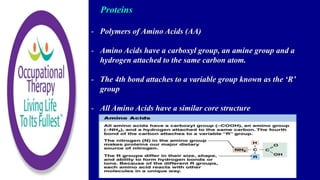
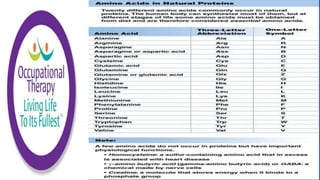
- Amino Acids have a carboxyl group, an amine group and a
hydrogen attached to the same carbon atom.
- The 4th bond attaches to a variable group known as the ‘R’
group
- All Amino Acids have a similar core structure
Proteins
Amino acid consists of
- A carboxylic acid group (-COOH)
- An amino group (-NH2)
- A side chain (-R)
- A hydrogen atom (-H)
- R groups vary in size, shape & ability to form ions or H bonds so
make each Amino Acid unique
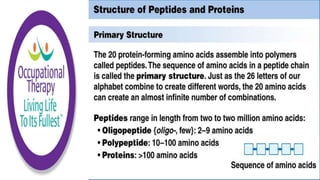
- 20 protein forming AA assemble into polymers with almost
infinite combinations possible
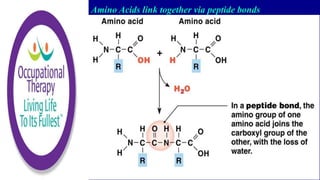
Amino Acids link together via peptide bonds
Proteins
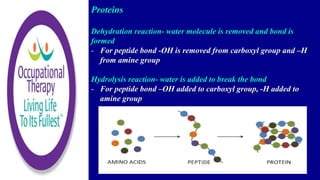
Dehydration reaction- water molecule is removed and bond is
formed
- For peptide bond -OH is removed from carboxyl group and –H
from amine group
Hydrolysis reaction- water is added to break the bond
- For peptide bond –OH added to carboxyl group, -H added to
amine group
Protein synthesis
- A gene is a segment of a DNA molecule that contains the
instructions needed to make a unique protein. All of our cells
contain the same DNA molecules, but each cell uses a different
combination of genes to build the particular proteins it needs to
perform its specialized functions.
Protein synthesis has 2 main stages.
- The 1st stage is known as transcription, where a messenger
molecule (mRNA) is formed. This molecule is transcribed from
the DNA molecule and carries a copy of the information needed
to make a protein.
- In the 2nd stage, the mRNA molecule leaves the nucleus for the
cytoplasm where the cell’s ribosomes read the information and
start to assemble a protein in a process called translation
Protein synthesis
- During translation, the ribosomes read the mRNA sequence of
bases 3 at a time. These 3-letter combinations (called codons)
each code a particular amino acid.
- There are 4 bases (adenine, thymine, guanine and cytosine) and
therefore 64 (43) possible codons specified using some
combination of 3 bases. However, only 20 amino acids are
required to build all of the proteins in our bodies (some amino
acids are specified by more than 1 codon). It is the particular
sequence of amino acids that determines the shape and function
of the protein.
- Protein synthesis, like many other biological processes, can be
affected by environmental factors. These include maternal
nutrition, temperature stress, oxygen levels and exposure to
chemicals
Different types of proteins
There are many different types of proteins in our bodies. They all
serve important roles in our growth, development and everyday
functioning.
- Enzymes are proteins that facilitate biochemical reactions, for
example, pepsin is a digestive enzyme in your stomach that helps
to break down proteins in food.
- Antibodies are proteins produced by the immune system to help
remove foreign substances and fight infections.
- DNA-associated proteins regulate chromosome structure during
cell division and/or play a role in regulating gene expression, for
example, histones and cohesin proteins
- Contractile proteins are involved in muscle contraction and
movement, for example, actin and myosin
Different types of proteins
- Structural proteins provide support in our bodies, for example,
the proteins in our connective tissues, such as collagen and
elastin.
- Hormone proteins co-ordinate bodily functions, for example,
insulin controls our blood sugar concentration by regulating the
uptake of glucose into cells.
- Transport proteins move molecules around our bodies, for
example, hemoglobin transports oxygen through the blood.
.
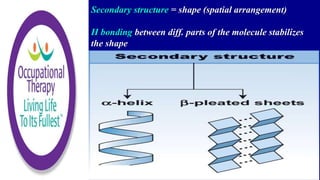
Secondary structure = shape (spatial arrangement)
H bonding between diff. parts of the molecule stabilizes
the shape
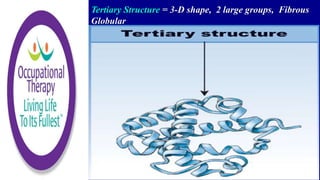
Tertiary Structure = 3-D shape, 2 large groups, Fibrous
Globular
Tertiary Structure
Fibrous
- Found in pleated sheets or long chains of helices
- Insoluble in water
- Important structural component of cells and tissues e.g.;
collagen, keratin
Globular
- Amino Acid chains fold back on selves creating pockets,
channels, knobs etc.
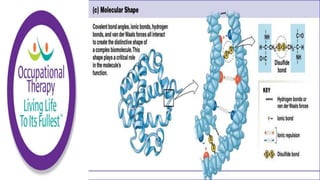
- Structure results partly from angles of covalent bonds between
AA, hydrogen bonds, van der Waals forces and ionic bonds.
.
Globular Proteins
- Also the Amino Acid cysteine has Sulphur as part of a sulfhydryl
group. 2 cysteine's can bond covalently forming a disulphide
bond pulling different parts of the chain together.
- Water soluble- act as carriers for water insoluble lipids in blood
(bind to lipids and make them soluble)
- Enzymes, hormones, neurotransmitters, defense molecules
Quaternary structure
Several protein chains associate with one another to form a
functional protein e.g.; hemoglobin- has 4 subunits
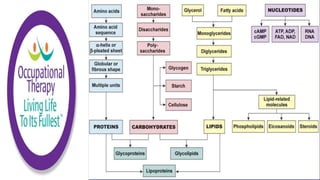
Combined Molecules
- Biomolecules can be combinations of Carbohydrate, Lipid and
Protein
Conjugated protein= protein molecule combined with another kind
of biomolecule
- E.g.; lipoprotein= lipid and protein (found in cell membranes,
transport hydrophobic molecules in blood e.g.; cholesterol
Glycosylated molecule- a carbohydrate has been attached
- E.g.; glycoprotein, glycolipid= both important parts of cell
membranes
Occupational Therapy Amino Acids & Proteins

Occupational Therapy Amino Acids & Proteins

  • 1.
  • 2.
    Amino Acids andProteins - Amino acids are relatively small molecules with molecular weights around 100-200. - They are used to produce energy, to synthesize other molecules like hormones, and to make proteins. - Proteins are polymers of amino acids. They fold into specific shapes and range in molecular weight from several thousand to over a million. - Proteins function as enzymes (which catalyze reactions), structural elements, transport molecules, antibodies, etc.
  • 3.
    Proteins - Polymers ofAmino Acids (AA) - Amino Acids have a carboxyl group, an amine group and a hydrogen attached to the same carbon atom. - The 4th bond attaches to a variable group known as the ‘R’ group - All Amino Acids have a similar core structure
  • 4.
    Proteins Amino acid consistsof - A carboxylic acid group (-COOH) - An amino group (-NH2) - A side chain (-R) - A hydrogen atom (-H) - R groups vary in size, shape & ability to form ions or H bonds so make each Amino Acid unique - 20 protein forming AA assemble into polymers with almost infinite combinations possible
  • 7.
    Amino Acids linktogether via peptide bonds
  • 8.
    Proteins Dehydration reaction- watermolecule is removed and bond is formed - For peptide bond -OH is removed from carboxyl group and –H from amine group Hydrolysis reaction- water is added to break the bond - For peptide bond –OH added to carboxyl group, -H added to amine group
  • 9.
    Protein synthesis - Agene is a segment of a DNA molecule that contains the instructions needed to make a unique protein. All of our cells contain the same DNA molecules, but each cell uses a different combination of genes to build the particular proteins it needs to perform its specialized functions. Protein synthesis has 2 main stages. - The 1st stage is known as transcription, where a messenger molecule (mRNA) is formed. This molecule is transcribed from the DNA molecule and carries a copy of the information needed to make a protein. - In the 2nd stage, the mRNA molecule leaves the nucleus for the cytoplasm where the cell’s ribosomes read the information and start to assemble a protein in a process called translation
  • 10.
    Protein synthesis - Duringtranslation, the ribosomes read the mRNA sequence of bases 3 at a time. These 3-letter combinations (called codons) each code a particular amino acid. - There are 4 bases (adenine, thymine, guanine and cytosine) and therefore 64 (43) possible codons specified using some combination of 3 bases. However, only 20 amino acids are required to build all of the proteins in our bodies (some amino acids are specified by more than 1 codon). It is the particular sequence of amino acids that determines the shape and function of the protein. - Protein synthesis, like many other biological processes, can be affected by environmental factors. These include maternal nutrition, temperature stress, oxygen levels and exposure to chemicals
  • 12.
    Different types ofproteins There are many different types of proteins in our bodies. They all serve important roles in our growth, development and everyday functioning. - Enzymes are proteins that facilitate biochemical reactions, for example, pepsin is a digestive enzyme in your stomach that helps to break down proteins in food. - Antibodies are proteins produced by the immune system to help remove foreign substances and fight infections. - DNA-associated proteins regulate chromosome structure during cell division and/or play a role in regulating gene expression, for example, histones and cohesin proteins - Contractile proteins are involved in muscle contraction and movement, for example, actin and myosin
  • 13.
    Different types ofproteins - Structural proteins provide support in our bodies, for example, the proteins in our connective tissues, such as collagen and elastin. - Hormone proteins co-ordinate bodily functions, for example, insulin controls our blood sugar concentration by regulating the uptake of glucose into cells. - Transport proteins move molecules around our bodies, for example, hemoglobin transports oxygen through the blood.
  • 15.
  • 16.
    Secondary structure =shape (spatial arrangement) H bonding between diff. parts of the molecule stabilizes the shape
  • 17.
    Tertiary Structure =3-D shape, 2 large groups, Fibrous Globular
  • 18.
    Tertiary Structure Fibrous - Foundin pleated sheets or long chains of helices - Insoluble in water - Important structural component of cells and tissues e.g.; collagen, keratin Globular - Amino Acid chains fold back on selves creating pockets, channels, knobs etc. - Structure results partly from angles of covalent bonds between AA, hydrogen bonds, van der Waals forces and ionic bonds.
  • 19.
  • 20.
    Globular Proteins - Alsothe Amino Acid cysteine has Sulphur as part of a sulfhydryl group. 2 cysteine's can bond covalently forming a disulphide bond pulling different parts of the chain together. - Water soluble- act as carriers for water insoluble lipids in blood (bind to lipids and make them soluble) - Enzymes, hormones, neurotransmitters, defense molecules
  • 21.
    Quaternary structure Several proteinchains associate with one another to form a functional protein e.g.; hemoglobin- has 4 subunits
  • 22.
    Combined Molecules - Biomoleculescan be combinations of Carbohydrate, Lipid and Protein Conjugated protein= protein molecule combined with another kind of biomolecule - E.g.; lipoprotein= lipid and protein (found in cell membranes, transport hydrophobic molecules in blood e.g.; cholesterol Glycosylated molecule- a carbohydrate has been attached - E.g.; glycoprotein, glycolipid= both important parts of cell membranes