FAMILY STORIES PROJECT
Rationale: The What
and The Why
Students will engage in a project based
learning activity in which they have a choice
in creating products such as storytelling or
poetry for digital publication by collecting
family stories, they can interview family
members about family artifacts and create a
living museum, a photo gallery or videos.
The reason why I chose this project is
because throughout my years of teaching, I
noticed that many of my students had no
knowledge of their family’s history. I feel
possessing this knowledge is essential to
shaping self-identity and awareness. I also
like the idea of this project because it forces
families to do something that we are now
often too busy to engage in – conversation.
The focus on exploring their family history
is an experience in which self-perceptions
can be affirmed, challenged or reinvented.
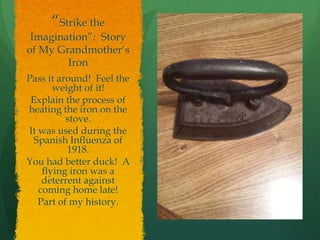
“Strike the
Imagination”: Story
of My Grandmother’s
Iron
Pass it around! Feel the
weight of it!
Explain the process of
heating the iron on the
stove.
It was used during the
Spanish Influenza of
1918.
You had better duck! A
flying iron was a
deterrent against
coming home late!
Part of my history.
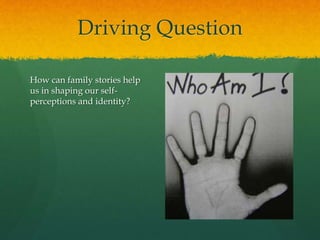
Driving Question
How can family stories help
us in shaping our self-
perceptions and identity?
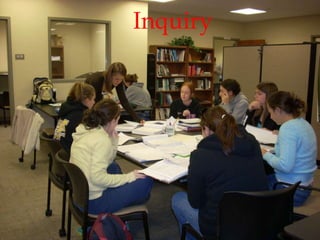
Inquiry
Inquiry: Set
Team Goals
• What are roles of the
team members?
• How will students
collaborate during
meetings? What is
the format of the
meetings?
• Who will do what?
• Will teams have daily
meetings?
• What is the goal of
the project?
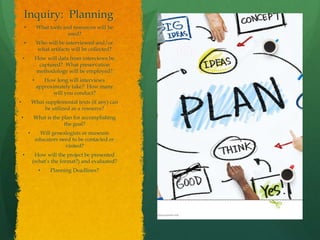
Inquiry: Planning
• What tools and resources will be
used?
• Who will be interviewed and/or
what artifacts will be collected?
• How will data from interviews be
captured? What preservation
methodology will be employed?
• How long will interviews
approximately take? How many
will you conduct?
• What supplemental texts (if any) can
be utilized as a resource?
• What is the plan for accomplishing
the goal?
• Will genealogists or museum
educators need to be contacted or
visited?
• How will the project be presented
(what’s the format?) and evaluated?
• Planning Deadlines?
Inquiry:
Questioning
After students determine
interviewees and/or
artifacts, what interview
questions do students
want to ask family
members?
Review: open versus
closed questions.
Question and challenge
assumptions.
Students must be prepared
to return to interviewees to
ask additional questions.
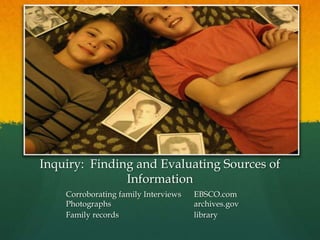
Inquiry: Finding and Evaluating Sources of
Information
Corroborating family Interviews EBSCO.com
Photographs archives.gov
Family records library
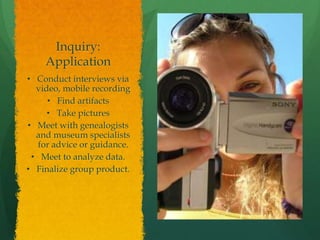
Inquiry:
Application
• Conduct interviews via
video, mobile recording
• Find artifacts
• Take pictures
• Meet with genealogists
and museum specialists
for advice or guidance.
• Meet to analyze data.
• Finalize group product.
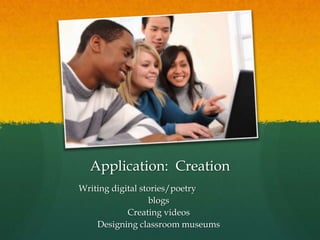
Application: Creation
Writing digital stories/poetry
blogs
Creating videos
Designing classroom museums
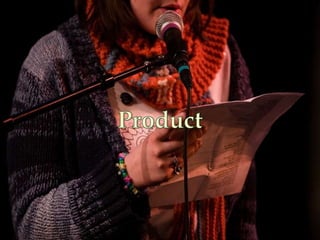
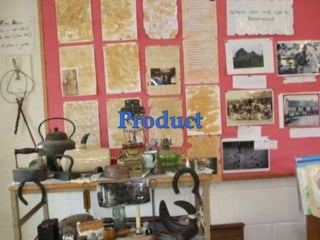
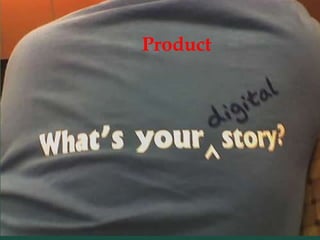
Product
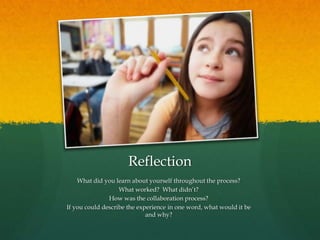
Reflection
What did you learn about yourself throughout the process?
What worked? What didn’t?
How was the collaboration process?
If you could describe the experience in one word, what would it be
and why?
Sources
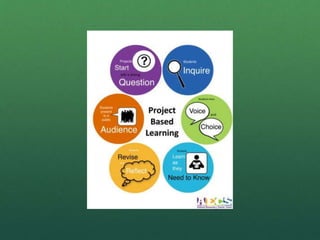
 John, L. (2015, May 1). Why We Changed Our
Model of the "8 Essential Elements of PBL" (by BIE)
Project Based Learning. BIE. Retrieved September
20, 2015.
 John, L. & Mergendollar, J. (2010, September). Seven
Essentials for Project-Based Learning. Retrieved
September 20, 2015.

Family stories project

  • 1.
  • 2.
    Rationale: The What andThe Why Students will engage in a project based learning activity in which they have a choice in creating products such as storytelling or poetry for digital publication by collecting family stories, they can interview family members about family artifacts and create a living museum, a photo gallery or videos. The reason why I chose this project is because throughout my years of teaching, I noticed that many of my students had no knowledge of their family’s history. I feel possessing this knowledge is essential to shaping self-identity and awareness. I also like the idea of this project because it forces families to do something that we are now often too busy to engage in – conversation. The focus on exploring their family history is an experience in which self-perceptions can be affirmed, challenged or reinvented.
  • 5.
    “Strike the Imagination”: Story ofMy Grandmother’s Iron Pass it around! Feel the weight of it! Explain the process of heating the iron on the stove. It was used during the Spanish Influenza of 1918. You had better duck! A flying iron was a deterrent against coming home late! Part of my history.
  • 6.
    Driving Question How canfamily stories help us in shaping our self- perceptions and identity?
  • 7.
  • 8.
    Inquiry: Set Team Goals •What are roles of the team members? • How will students collaborate during meetings? What is the format of the meetings? • Who will do what? • Will teams have daily meetings? • What is the goal of the project?
  • 9.
    Inquiry: Planning • Whattools and resources will be used? • Who will be interviewed and/or what artifacts will be collected? • How will data from interviews be captured? What preservation methodology will be employed? • How long will interviews approximately take? How many will you conduct? • What supplemental texts (if any) can be utilized as a resource? • What is the plan for accomplishing the goal? • Will genealogists or museum educators need to be contacted or visited? • How will the project be presented (what’s the format?) and evaluated? • Planning Deadlines?
  • 10.
    Inquiry: Questioning After students determine intervieweesand/or artifacts, what interview questions do students want to ask family members? Review: open versus closed questions. Question and challenge assumptions. Students must be prepared to return to interviewees to ask additional questions.
  • 11.
    Inquiry: Finding andEvaluating Sources of Information Corroborating family Interviews EBSCO.com Photographs archives.gov Family records library
  • 13.
    Inquiry: Application • Conduct interviewsvia video, mobile recording • Find artifacts • Take pictures • Meet with genealogists and museum specialists for advice or guidance. • Meet to analyze data. • Finalize group product.
  • 14.
    Application: Creation Writing digitalstories/poetry blogs Creating videos Designing classroom museums
  • 17.
  • 18.
    Reflection What did youlearn about yourself throughout the process? What worked? What didn’t? How was the collaboration process? If you could describe the experience in one word, what would it be and why?
  • 19.
    Sources  John, L.(2015, May 1). Why We Changed Our Model of the "8 Essential Elements of PBL" (by BIE) Project Based Learning. BIE. Retrieved September 20, 2015.  John, L. & Mergendollar, J. (2010, September). Seven Essentials for Project-Based Learning. Retrieved September 20, 2015.