Introductions
 How to hook your readers
   like slimy little fish.
First and Foremost
Think of Hollywood. If the first
ten minutes of a movie are
boring, you might turn it off or
walk out. A catchy introduction is
a film maker’s challenge. A writer
has the same challenge: an essay
introduction should catch readers’
attention, pull them in.
An introduction should . . .
• Hook readers, make them want to
  keep reading, and be enjoyable to
  read.
• Be original, creative, clever and
  memorable.
• Smoothly transition to your thesis.
• Clearly and logically introduce the
  purpose of your paper (the thesis).
Ask yourself these
      questions:
• Is the introduction clever and
  original?
• Would I want to keep reading this
  paper based on the introduction?
• Could a reader state what this paper
  is about based on my introduction?
Introduction No-No’s
• Don’t start out with ―This paper is
  about,‖ ―In this essay, I will tell you
  about,‖ ―today you will read about‖ or
  any other variations.
• Unless you are writing a lengthy
  paper (over five pages), you don’t
  need to state all of your main points in
  the introduction. You can hint at
  them, though . . .
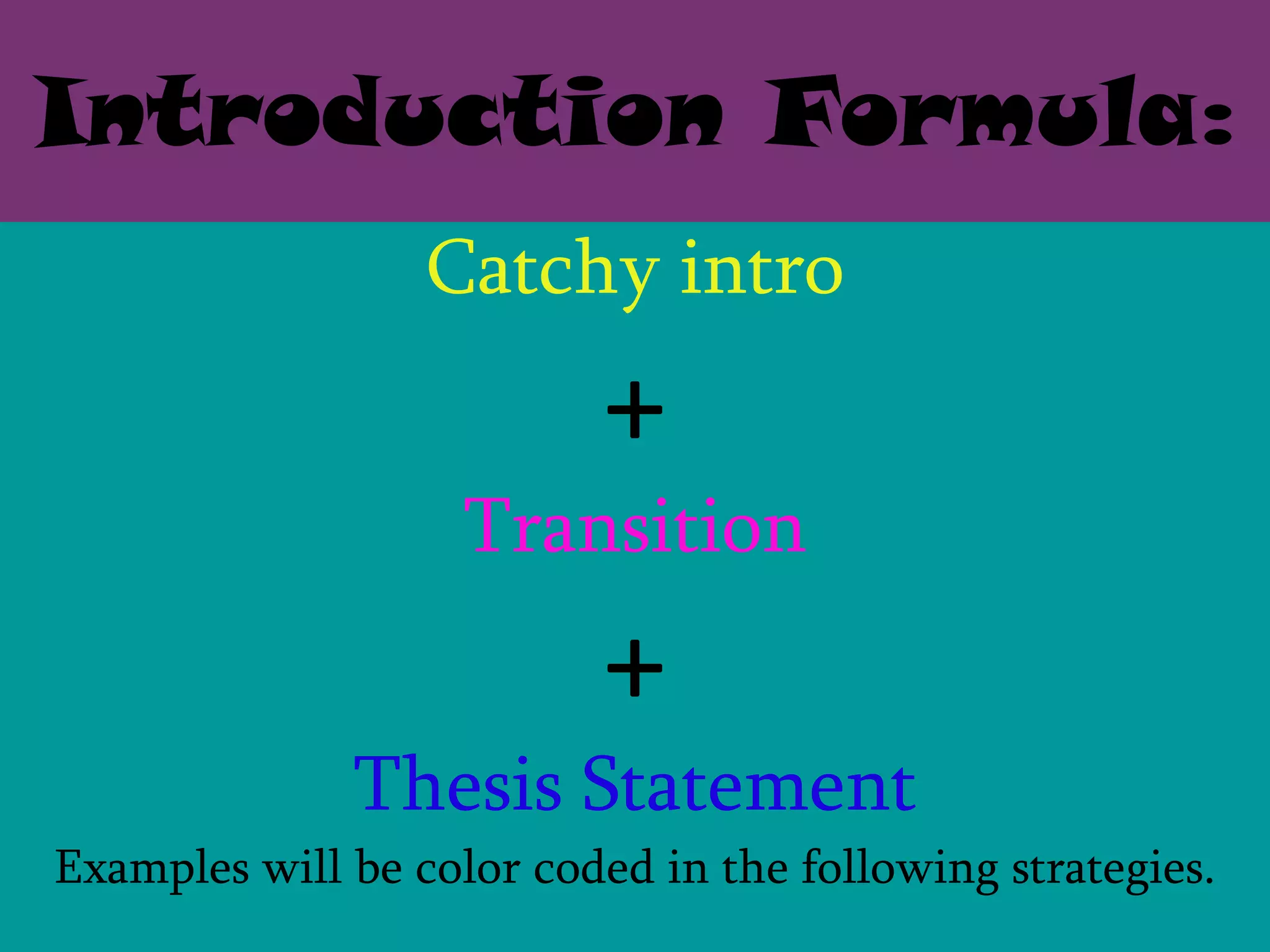
Introduction Formula:
                  Catchy intro
                           +
                    Transition
                           +
              Thesis Statement
Examples will be color coded in the following strategies.
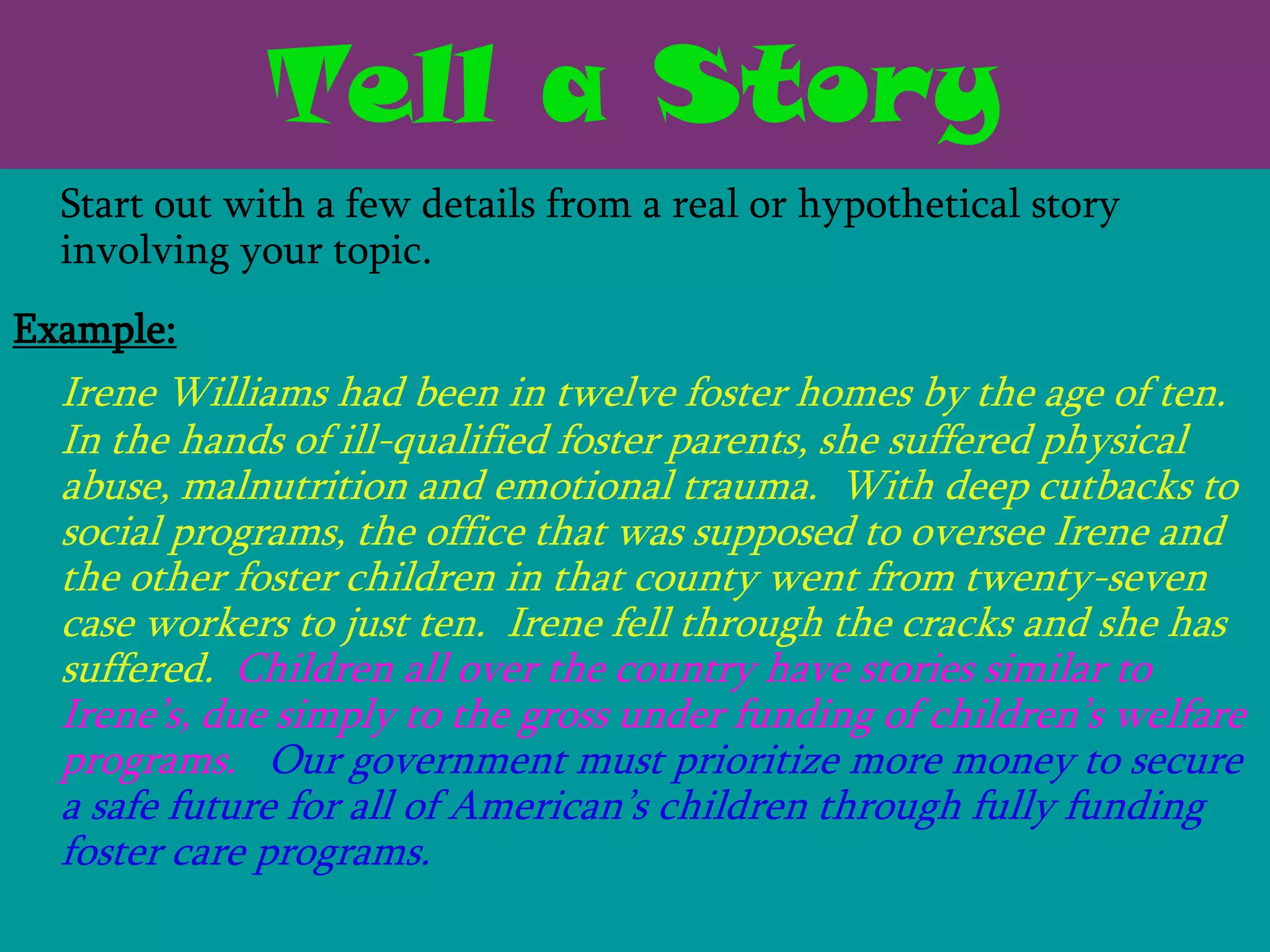
Tell a Story
  Start out with a few details from a real or hypothetical story
  involving your topic.
Example:
  Irene Williams had been in twelve foster homes by the age of ten.
  In the hands of ill-qualified foster parents, she suffered physical
  abuse, malnutrition and emotional trauma. With deep cutbacks to
  social programs, the office that was supposed to oversee Irene and
  the other foster children in that county went from twenty-seven
  case workers to just ten. Irene fell through the cracks and she has
  suffered. Children all over the country have stories similar to
  Irene’s, due simply to the gross under funding of children’s welfare
  programs. Our government must prioritize more money to secure
  a safe future for all of American’s children through fully funding
  foster care programs.
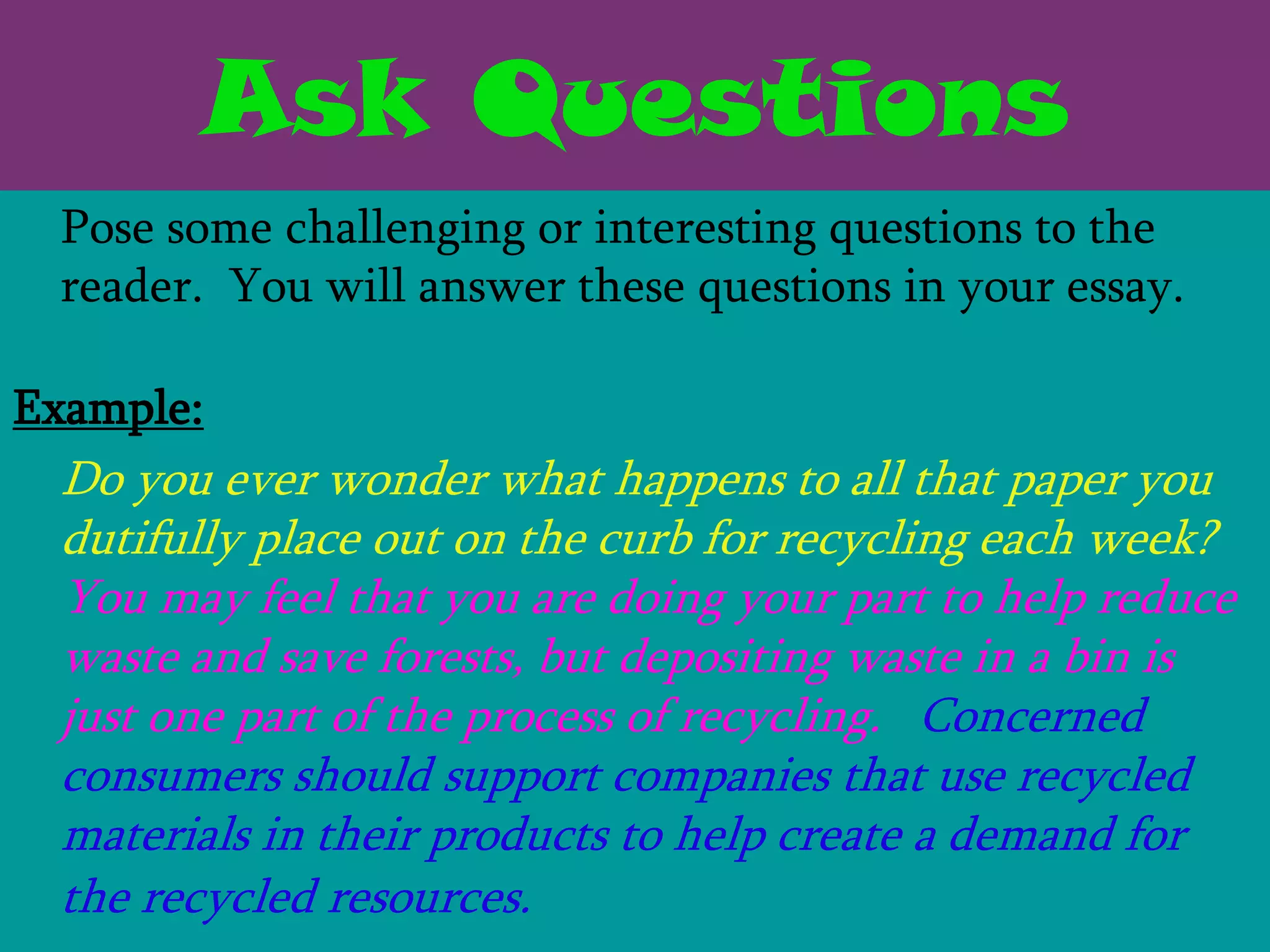
Ask Questions
 Pose some challenging or interesting questions to the
 reader. You will answer these questions in your essay.

Example:
 Do you ever wonder what happens to all that paper you
 dutifully place out on the curb for recycling each week?
 You may feel that you are doing your part to help reduce
 waste and save forests, but depositing waste in a bin is
 just one part of the process of recycling. Concerned
 consumers should support companies that use recycled
 materials in their products to help create a demand for
 the recycled resources.
Use a Theme Statement
 Give a general statement about the/a larger idea.

Example:
 Doubt, fear, hopes and insecurities may be influenced by
 the outside world, but are largely constructs of our own
 mind. Humans have long sought to understand and
 master the mind, through rituals, physical
 endurance, meditation and most recently psychology .
 But perhaps the most prominent, universal way to
 explore ourselves is through storytelling, beginning with
 ancient myths and legends. Indeed, mythological stories
 are but extensions of the universal struggles of the
Give Background Information
       or Define Terms
 Depending on your topic, it can be helpful to give some minimal
 background to ensure all readers are on the same page.

Example:
 ―Solid waste management‖ is a sanitary way of saying ―dealing with
 your garbage.‖ Though it’s something that most Americans will
 gladly avoid thinking about, we shouldn’t. With the average
 American producing about four pounds of solid garbage per
 day, landfills are, well, filling up. Some cities have dealt with this
 problem by imposing fines on people and businesses that don’t
 recycle and/or compost, a practical and necessary step for all
 American cities to take to help reduce our garbage and help
 American rethink their disposable lifestyles.
Set the Scene
   Create a visual location to set up your topic.

Example:
   Shadows sweep across the grassy hillocks and sagebrush in
   Yellowstone National Park’s Lamar River Valley, with the deep
   quiet of a late fall evening broken by the haunting howl of a wolf
   coming from the valley floor. It’s a member of the Druid pack—
   one of twelve packs of wild wolves in the park. Like other wolves
   in the park and the rest of the northern Rockies, this pack is
   thriving. But that doesn’t keep Doug Smith, lead wolf biologist at
   Yellowstone, from worrying about their future.
From ―Rocky Road Ahead for Wolves?‖ by Heidi Ridgley, published in Defenders magazine, Spring 2008.
Use Surprise or Shock
   Shake the reader up a bit with a surprising or shocking
   statement, then go on to explain it.

Example:
   Hitler was a hero. Maybe not to people today, but in the
   1930s, for many unwitting Germans, he was the man who
   was leading Germany back to prosperity and
   greatness. Of course, these Germans later found out their
   leader was a monster. We always hear how societies
   need heroes, but when taken too far, hero worship
   destroys both hero and followers.
“Writing Introductions.” Teaching and learning Center at Superstition Mountain Campus.
          Central Arizona College, 2004.
          <http://www.cac.cc.az.us/smc/writing/intros.htm>
Use a Quotation
   Find a relevant quote from a source of authority.

Example:
   "The novel Lolita," the critic Charles Blight said in 1959,
   "is proof that American civilization is on the verge of
   total moral collapse" (45). The judgment of critics and
   readers in subsequent years, however, has proclaimed
   Lolita [is/to be] one of the greatest love stories of all time
   and one of the best proofs that American civilization is
   still vibrant and alive.
“Introduction Strategies.” MIT Online Writing and Communication Center. Massachusetts
         Institute of Technology, 2001.
         <http://web.mit.edu/writing/Writing_Types/introstrategies.html>
Give a Fact or Statistic
   Use a piece of information to startle the reader into wanting to read
   more.

Example:
   Ask most kids who smoke if they plan to puff away for their entire
   lives and they will say no, they can quit any time they want to.
   However, ninety percent of adult smokers started before the age of
   eighteen, and fifty percent before age fourteen. Bet they thought
   they could quit, too. The truth is, whether a person will be a life-
   long smoker or not is most often determined in the teen years. All
   teens should be educated with the latest information on the
   realities and danger of smoking at an early age.
Zibisky-Silver, Michelle. “Efficacy of anti-tobacco mass media
         campaigns on adolescent tobacco use.” Pediatric Nursing. May/June 2001,
         pg. 293-296.
Final Word
Since we are often too embedded in our own
work to look at it with an outsider’s
perspective, make sure to have a few friends
look over your introduction. Ask them:
 – Does this get your attention? (If not, ask
  them what might.)
– Does it make you want to keep reading?
– Do you have a pretty good idea of what my
  paper is about?
Now go for it, young
 writers. Begin the
race strong and you
  shall prevail!
CONCLUSIONS
 How to say the end without saying
           “The End.”
First and Foremost

A conclusion should sound
natural. If the end of your last
paragraph already brings the
essay to its logical end, then
don’t force a concluding
paragraph.
A conclusion should. . .
• stress the importance of your main point
  (the idea in your thesis statement, but not
  in the same exact words).
• give the essay a sense of completeness for
  the reader.
• leave a final impression on the reader.
 “Strategies for Writing a Conclusion.” LEO: Literacy Education Online. St. Cloud
           State University, 2004. <http://leo.stcloudstate.edu/acadwrite/conclude.html>
Ask Yourself Two Questions


• Does it bring the discussion to a
  logical conclusion?
• Does it engage the reader and
  make the main point of the essay
  memorable?
 “Strategies for Writing an Effective Conclusion.” ___________. West Chester
           University, 2002. <http://brainstorm-services.com/wcu-2002/conclusions.html>
Conclusion Suggestions
• Answer the question ―So what?‖
   (Show what’s important about your topic.)
• Synthesize, don’t summarize.
• Redirect your readers.
• Create new meaning.
“Strategies for Writing a Conclusion.” LEO: Literacy Education Online. St. Cloud
         State University, 2004. <http://leo.stcloudstate.edu/acadwrite/conclude.html>
Conclusion No-no’s
Avoid the phrases
 • ―In summary‖
 • ―In conclusion‖
 • ―In closing‖
  These sound stiff and forced. You
  should show the reader your
  conclusion, not tell her.
Conclusion Formula

 A reminder of the point of your
             paper
                     +
 Something to leave your reader
  thinking (specific strategies follow)
Examples are colored-coded on the strategies.
Echo the Introduction
 Refer back in some creative way to your
 introductory story and scenario. You might finish
 the story or give an alternate ending, for example

Example:
 If we are to call ourselves a civilized society, we
 must dedicate more resources to social services
 that help children through the nightmare of
 abuse. Not every child has to become an Irene
 Williams.
Tie Together Some Details
       From the Essay
   Refer back in some creative way to a few salient and
   memorable details brought up in the article.

Example:
   All this means , of course, is that statistically in
   New Hampshire I am far more likely to be hurt by
   my ceiling or underpants—to cite just two
   potentially lethal examples—than by a stranger,
   and, frankly, I don’t find that comforting at all.
From ―Well, Doctor, I Was Just Trying to Lie Down. . .‖ by Bill Bryson.
Challenge the Reader
 Give your reader a call to action or a challenge to
 change his or her mind!
Example:
 Consumers have the power to make this change. It’s
 time to stop giving lip service to recycling; use the
 power of the dollar to make a statement. Next time
 you are in the store, don’t just look for products that
 are recyclable, but also made from recycled materials.
 If we all commit to buying recycled products, the
 demand will increase, and all that paper we feel so
 good about setting out on the curb won’t go to –
 think about this – waste.
Look to the Future
 Give your reader a look into the future if the actions you
 are speaking about either do or do not happen. The
 future, is after all, what you are trying to change in a
 persuasive essay.

Example:
 Without well-qualified teachers, schools are little more
 than buildings and equipment. If higher-paying careers
 continue to attract the best and the brightest college
 students, there will not only be a shortage of teachers, but
 the teachers available may not have the best
 qualifications. Our youth will suffer. And when youth
 suffers, the future suffers.
Pose Questions
   Asking questions that prompt deep thought may help you and
   your readers gain new insight on the issues.

Example:
   Campaign advertisers should help us understand the candidate's
   qualifications and positions on the issues. Instead, most present
   only general or emotional images of a family man or a God-
   fearing American. Do such advertisements contribute to
   creating informed voters or people who chose leaders the same
   way they choose soft drinks and soap?

“Strategies for Writing a Conclusion.” LEO: Literacy Education Online. St. Cloud
         State University, 2004. <http://leo.stcloudstate.edu/acadwrite/conclude.html>
Final Word
The conclusion of your paper needs to feel like a
natural ending. You should, in effect, say the
end, without ever using the words ―The End.‖


 That is your challenge, young
 warriors of the paper. Wield
 your pens well and be brave.

Introductions and Conclusions

  • 1.
    Introductions How tohook your readers like slimy little fish.
  • 2.
    First and Foremost Thinkof Hollywood. If the first ten minutes of a movie are boring, you might turn it off or walk out. A catchy introduction is a film maker’s challenge. A writer has the same challenge: an essay introduction should catch readers’ attention, pull them in.
  • 3.
    An introduction should. . . • Hook readers, make them want to keep reading, and be enjoyable to read. • Be original, creative, clever and memorable. • Smoothly transition to your thesis. • Clearly and logically introduce the purpose of your paper (the thesis).
  • 4.
    Ask yourself these questions: • Is the introduction clever and original? • Would I want to keep reading this paper based on the introduction? • Could a reader state what this paper is about based on my introduction?
  • 5.
    Introduction No-No’s • Don’tstart out with ―This paper is about,‖ ―In this essay, I will tell you about,‖ ―today you will read about‖ or any other variations. • Unless you are writing a lengthy paper (over five pages), you don’t need to state all of your main points in the introduction. You can hint at them, though . . .
  • 6.
    Introduction Formula: Catchy intro + Transition + Thesis Statement Examples will be color coded in the following strategies.
  • 8.
    Tell a Story Start out with a few details from a real or hypothetical story involving your topic. Example: Irene Williams had been in twelve foster homes by the age of ten. In the hands of ill-qualified foster parents, she suffered physical abuse, malnutrition and emotional trauma. With deep cutbacks to social programs, the office that was supposed to oversee Irene and the other foster children in that county went from twenty-seven case workers to just ten. Irene fell through the cracks and she has suffered. Children all over the country have stories similar to Irene’s, due simply to the gross under funding of children’s welfare programs. Our government must prioritize more money to secure a safe future for all of American’s children through fully funding foster care programs.
  • 9.
    Ask Questions Posesome challenging or interesting questions to the reader. You will answer these questions in your essay. Example: Do you ever wonder what happens to all that paper you dutifully place out on the curb for recycling each week? You may feel that you are doing your part to help reduce waste and save forests, but depositing waste in a bin is just one part of the process of recycling. Concerned consumers should support companies that use recycled materials in their products to help create a demand for the recycled resources.
  • 10.
    Use a ThemeStatement Give a general statement about the/a larger idea. Example: Doubt, fear, hopes and insecurities may be influenced by the outside world, but are largely constructs of our own mind. Humans have long sought to understand and master the mind, through rituals, physical endurance, meditation and most recently psychology . But perhaps the most prominent, universal way to explore ourselves is through storytelling, beginning with ancient myths and legends. Indeed, mythological stories are but extensions of the universal struggles of the
  • 11.
    Give Background Information or Define Terms Depending on your topic, it can be helpful to give some minimal background to ensure all readers are on the same page. Example: ―Solid waste management‖ is a sanitary way of saying ―dealing with your garbage.‖ Though it’s something that most Americans will gladly avoid thinking about, we shouldn’t. With the average American producing about four pounds of solid garbage per day, landfills are, well, filling up. Some cities have dealt with this problem by imposing fines on people and businesses that don’t recycle and/or compost, a practical and necessary step for all American cities to take to help reduce our garbage and help American rethink their disposable lifestyles.
  • 12.
    Set the Scene Create a visual location to set up your topic. Example: Shadows sweep across the grassy hillocks and sagebrush in Yellowstone National Park’s Lamar River Valley, with the deep quiet of a late fall evening broken by the haunting howl of a wolf coming from the valley floor. It’s a member of the Druid pack— one of twelve packs of wild wolves in the park. Like other wolves in the park and the rest of the northern Rockies, this pack is thriving. But that doesn’t keep Doug Smith, lead wolf biologist at Yellowstone, from worrying about their future. From ―Rocky Road Ahead for Wolves?‖ by Heidi Ridgley, published in Defenders magazine, Spring 2008.
  • 13.
    Use Surprise orShock Shake the reader up a bit with a surprising or shocking statement, then go on to explain it. Example: Hitler was a hero. Maybe not to people today, but in the 1930s, for many unwitting Germans, he was the man who was leading Germany back to prosperity and greatness. Of course, these Germans later found out their leader was a monster. We always hear how societies need heroes, but when taken too far, hero worship destroys both hero and followers. “Writing Introductions.” Teaching and learning Center at Superstition Mountain Campus. Central Arizona College, 2004. <http://www.cac.cc.az.us/smc/writing/intros.htm>
  • 14.
    Use a Quotation Find a relevant quote from a source of authority. Example: "The novel Lolita," the critic Charles Blight said in 1959, "is proof that American civilization is on the verge of total moral collapse" (45). The judgment of critics and readers in subsequent years, however, has proclaimed Lolita [is/to be] one of the greatest love stories of all time and one of the best proofs that American civilization is still vibrant and alive. “Introduction Strategies.” MIT Online Writing and Communication Center. Massachusetts Institute of Technology, 2001. <http://web.mit.edu/writing/Writing_Types/introstrategies.html>
  • 15.
    Give a Factor Statistic Use a piece of information to startle the reader into wanting to read more. Example: Ask most kids who smoke if they plan to puff away for their entire lives and they will say no, they can quit any time they want to. However, ninety percent of adult smokers started before the age of eighteen, and fifty percent before age fourteen. Bet they thought they could quit, too. The truth is, whether a person will be a life- long smoker or not is most often determined in the teen years. All teens should be educated with the latest information on the realities and danger of smoking at an early age. Zibisky-Silver, Michelle. “Efficacy of anti-tobacco mass media campaigns on adolescent tobacco use.” Pediatric Nursing. May/June 2001, pg. 293-296.
  • 16.
    Final Word Since weare often too embedded in our own work to look at it with an outsider’s perspective, make sure to have a few friends look over your introduction. Ask them: – Does this get your attention? (If not, ask them what might.) – Does it make you want to keep reading? – Do you have a pretty good idea of what my paper is about?
  • 17.
    Now go forit, young writers. Begin the race strong and you shall prevail!
  • 18.
    CONCLUSIONS How tosay the end without saying “The End.”
  • 19.
    First and Foremost Aconclusion should sound natural. If the end of your last paragraph already brings the essay to its logical end, then don’t force a concluding paragraph.
  • 20.
    A conclusion should.. . • stress the importance of your main point (the idea in your thesis statement, but not in the same exact words). • give the essay a sense of completeness for the reader. • leave a final impression on the reader. “Strategies for Writing a Conclusion.” LEO: Literacy Education Online. St. Cloud State University, 2004. <http://leo.stcloudstate.edu/acadwrite/conclude.html>
  • 21.
    Ask Yourself TwoQuestions • Does it bring the discussion to a logical conclusion? • Does it engage the reader and make the main point of the essay memorable? “Strategies for Writing an Effective Conclusion.” ___________. West Chester University, 2002. <http://brainstorm-services.com/wcu-2002/conclusions.html>
  • 22.
    Conclusion Suggestions • Answerthe question ―So what?‖ (Show what’s important about your topic.) • Synthesize, don’t summarize. • Redirect your readers. • Create new meaning. “Strategies for Writing a Conclusion.” LEO: Literacy Education Online. St. Cloud State University, 2004. <http://leo.stcloudstate.edu/acadwrite/conclude.html>
  • 23.
    Conclusion No-no’s Avoid thephrases • ―In summary‖ • ―In conclusion‖ • ―In closing‖ These sound stiff and forced. You should show the reader your conclusion, not tell her.
  • 24.
    Conclusion Formula Areminder of the point of your paper + Something to leave your reader thinking (specific strategies follow) Examples are colored-coded on the strategies.
  • 26.
    Echo the Introduction Refer back in some creative way to your introductory story and scenario. You might finish the story or give an alternate ending, for example Example: If we are to call ourselves a civilized society, we must dedicate more resources to social services that help children through the nightmare of abuse. Not every child has to become an Irene Williams.
  • 27.
    Tie Together SomeDetails From the Essay Refer back in some creative way to a few salient and memorable details brought up in the article. Example: All this means , of course, is that statistically in New Hampshire I am far more likely to be hurt by my ceiling or underpants—to cite just two potentially lethal examples—than by a stranger, and, frankly, I don’t find that comforting at all. From ―Well, Doctor, I Was Just Trying to Lie Down. . .‖ by Bill Bryson.
  • 28.
    Challenge the Reader Give your reader a call to action or a challenge to change his or her mind! Example: Consumers have the power to make this change. It’s time to stop giving lip service to recycling; use the power of the dollar to make a statement. Next time you are in the store, don’t just look for products that are recyclable, but also made from recycled materials. If we all commit to buying recycled products, the demand will increase, and all that paper we feel so good about setting out on the curb won’t go to – think about this – waste.
  • 29.
    Look to theFuture Give your reader a look into the future if the actions you are speaking about either do or do not happen. The future, is after all, what you are trying to change in a persuasive essay. Example: Without well-qualified teachers, schools are little more than buildings and equipment. If higher-paying careers continue to attract the best and the brightest college students, there will not only be a shortage of teachers, but the teachers available may not have the best qualifications. Our youth will suffer. And when youth suffers, the future suffers.
  • 30.
    Pose Questions Asking questions that prompt deep thought may help you and your readers gain new insight on the issues. Example: Campaign advertisers should help us understand the candidate's qualifications and positions on the issues. Instead, most present only general or emotional images of a family man or a God- fearing American. Do such advertisements contribute to creating informed voters or people who chose leaders the same way they choose soft drinks and soap? “Strategies for Writing a Conclusion.” LEO: Literacy Education Online. St. Cloud State University, 2004. <http://leo.stcloudstate.edu/acadwrite/conclude.html>
  • 31.
    Final Word The conclusionof your paper needs to feel like a natural ending. You should, in effect, say the end, without ever using the words ―The End.‖ That is your challenge, young warriors of the paper. Wield your pens well and be brave.