Trauma, multiple casualties
Polytrauma  Multisystem trauma Terminology: Injury = the result of harmful event that arieses from the release of specific forms of energy. “polytrauma” = Multisystem trauma = injury of two or more systems, one or the combination  imperil vital signs .
Trauma deaths First peak  Within minutes of injury  Due to major neurological or vascular injury  Medical treatment can rarely improve outcome  Second peak  Occurs during the 'golden hour'  Due to intracranial haematoma, major thoracic or abdominal injury  Primary focus of intervention for the Advanced Trauma Life Support (ATLS) methodology  Third peak  Occurs after days or weeks  Due to sepsis and multiple organ failure
Assessment of the injured patient  Primary survey and resuscitation  A = Airway and cervical spine  B = Breathing  C = Circulation and haemorrhage control  D = Dysfunction of the central nervous system  E = Exposure  Secondary survey  Definitive treatment Call for help  ER  155
Airway and cervical spine Always assume that patient has cervical spine injury If patient can talk then he is able to maintain own airway If airway compromised initially attempt a  chin lift  and clear airway of foreign bodies  Intubate or cricothyroidotomy  Give 100%  Oxygen
Breathing Check position of trachea, respiratory rate and air entry If clinical evidence of tension pneumothorax will need immediate relief  Place venous cannula through second intercostal space in the mid-clavicular line  If open chest wound seal with occlusive dressing
Circulation and haemorrhage control Assess pulse, capillary return and state of neck veins  Identify exsanguinating haemorrhage and apply direct pressure  Place two large calibre intravenous cannulas  Give intravenous fluids  ( c rystalloid or colloid) Attach patient to ECG monitor
Dysfunction Assess level of consciousness using AVPU method  A = alert  V = responding to voice  P = responding to pain  U = unresponsive  Assess pupil size, equality and responsiveness
Exposure Avoid hypothermia Fully undress patients  Avoid hypothermia
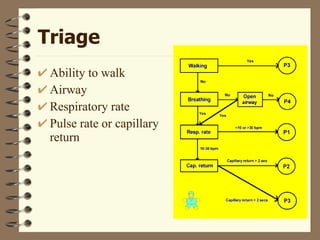
Multiple casualties several causalties at the same time . 1.  Alarm  ER services 2. Assess the scene  - without puting your safety  at risk. 3. Triage  'do the most for the most'
Triage Ability to walk  Airway  Respiratory rate  Pulse rate or capillary return
 
Road accidents fall from a bicycle …. major incident with many causalties. serious risks to safety  - traffic
1. Make the area safe  protect yourself,  the causalty and other road users. Park your car safely, turn lights on, set hazard lights flashing. Do not across a bussy motorway to reach other side Set others to warn other comming drivers Set up warning triangles or lights 200 metres in each direction. Swich off ignition  of any damaged vehicle.  Is anyone smoking?
2. Check  all  caulsalties quick assess no moving  apply life-saving treatment
3. Treat in the position found first life-threatening or potentialy serious injuries
4. search all area
 
How to move unconscious casualty do not move  the casualty unless it is absolutely necessary assume  neck injury  until proved otherwise  support head and neck with your hands, so he can breathe freely Apply a collar, if possible There should be only  1 axis  (head, neck, thorax) no moving to sides, no flexion, no extension. with other 3-4 people 1 support head (he is directing others), other one  shoulders and chest, other one hips and abdomen, last one - legs.


08 polytrauma

  • 1.
  • 2.
    Polytrauma Multisystemtrauma Terminology: Injury = the result of harmful event that arieses from the release of specific forms of energy. “polytrauma” = Multisystem trauma = injury of two or more systems, one or the combination imperil vital signs .
  • 3.
    Trauma deaths Firstpeak Within minutes of injury Due to major neurological or vascular injury Medical treatment can rarely improve outcome Second peak Occurs during the 'golden hour' Due to intracranial haematoma, major thoracic or abdominal injury Primary focus of intervention for the Advanced Trauma Life Support (ATLS) methodology Third peak Occurs after days or weeks Due to sepsis and multiple organ failure
  • 4.
    Assessment of theinjured patient Primary survey and resuscitation A = Airway and cervical spine B = Breathing C = Circulation and haemorrhage control D = Dysfunction of the central nervous system E = Exposure Secondary survey Definitive treatment Call for help ER 155
  • 5.
    Airway and cervicalspine Always assume that patient has cervical spine injury If patient can talk then he is able to maintain own airway If airway compromised initially attempt a chin lift and clear airway of foreign bodies Intubate or cricothyroidotomy Give 100% Oxygen
  • 6.
    Breathing Check positionof trachea, respiratory rate and air entry If clinical evidence of tension pneumothorax will need immediate relief Place venous cannula through second intercostal space in the mid-clavicular line If open chest wound seal with occlusive dressing
  • 7.
    Circulation and haemorrhagecontrol Assess pulse, capillary return and state of neck veins Identify exsanguinating haemorrhage and apply direct pressure Place two large calibre intravenous cannulas Give intravenous fluids ( c rystalloid or colloid) Attach patient to ECG monitor
  • 8.
    Dysfunction Assess levelof consciousness using AVPU method A = alert V = responding to voice P = responding to pain U = unresponsive Assess pupil size, equality and responsiveness
  • 9.
    Exposure Avoid hypothermiaFully undress patients Avoid hypothermia
  • 10.
    Multiple casualties severalcausalties at the same time . 1. Alarm ER services 2. Assess the scene - without puting your safety at risk. 3. Triage 'do the most for the most'
  • 11.
    Triage Ability towalk Airway Respiratory rate Pulse rate or capillary return
  • 12.
  • 13.
    Road accidents fallfrom a bicycle …. major incident with many causalties. serious risks to safety - traffic
  • 14.
    1. Make thearea safe protect yourself, the causalty and other road users. Park your car safely, turn lights on, set hazard lights flashing. Do not across a bussy motorway to reach other side Set others to warn other comming drivers Set up warning triangles or lights 200 metres in each direction. Swich off ignition of any damaged vehicle. Is anyone smoking?
  • 15.
    2. Check all caulsalties quick assess no moving apply life-saving treatment
  • 16.
    3. Treat inthe position found first life-threatening or potentialy serious injuries
  • 17.
  • 18.
  • 19.
    How to moveunconscious casualty do not move the casualty unless it is absolutely necessary assume neck injury until proved otherwise support head and neck with your hands, so he can breathe freely Apply a collar, if possible There should be only 1 axis (head, neck, thorax) no moving to sides, no flexion, no extension. with other 3-4 people 1 support head (he is directing others), other one shoulders and chest, other one hips and abdomen, last one - legs.
  • 20.
  • 21.
  • 22.
  • 23.