Component Level Design


                   Different Methods/Styles for Component
                                               Level design


January 13, 2012         Made By Utpal Ray                    1
Component Level Design


  This is also called Procedural Design.

  The objective here is to translate the design into operational software.

  To accomplish this, the component level design must be represented at
    a level of abstraction that is close to the code.

  Whatever output we have got from the Data Design, Architectural
    Design and the Interface Design phase; will be translated to the
    procedural design in this phase.


January 13, 2012      Made By Utpal Ray                                       2
Component Level Design


        There are three types of methods for component level design. They
         are:-

 1.      Graphical Design Notation ( Flowchart )
 2.      Tabular Design Notation ( Decision Table )
 3.      Program Design Language ( Pseudo-code )


        Which method will be used, will depend upon the discretion of the
         component level designer. For certain module he may choose
         method 1; but for some other module he may choose method 2. It
         entirely depends upon his convenience to do the component level
         design for that particular module.


January 13, 2012      Made By Utpal Ray                                      3
Component Level Design
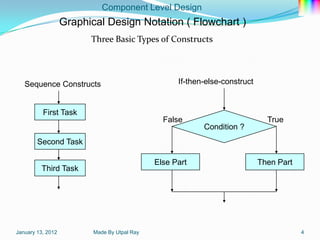
                   Graphical Design Notation ( Flowchart )
                         Three Basic Types of Constructs


   Sequence Constructs                              If-then-else-construct


          First Task
                                                False                          True
                                                           Condition ?
        Second Task

                                              Else Part                      Then Part
         Third Task


January 13, 2012          Made By Utpal Ray                                              4
Component Level Design
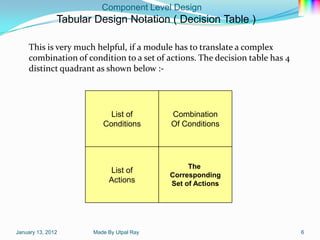
                            Flowchart ( Contd. )


                        REPETITION CONSTRUCT


                                                       Task

                       True
      Condition ?                   Task
                                                     Condition ?
               False                                                   False

                       Do-While                     True


                                                        Repeat-Until


January 13, 2012        Made By Utpal Ray                                      5
Component Level Design
               Tabular Design Notation ( Decision Table )

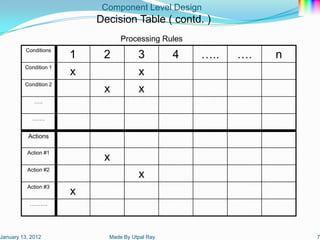
    This is very much helpful, if a module has to translate a complex
    combination of condition to a set of actions. The decision table has 4
    distinct quadrant as shown below :-


                           List of        Combination
                         Conditions       Of Conditions


                                               The
                           List of
                                          Corresponding
                           Actions        Set of Actions


January 13, 2012      Made By Utpal Ray                                      6
Component Level Design
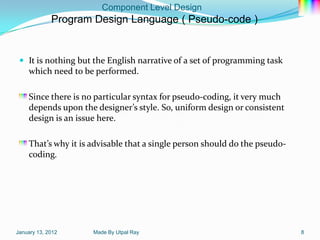
                           Decision Table ( contd. )
                                 Processing Rules

                                                     …..   ….
          Conditions
                       1    2          3         4              n
         Condition 1
                       x               x
         Condition 2
                            x          x
             …..


            …….


          Actions

          Action #1
                            x
          Action #2
                                       x
          Action #3
                       x
           ……….


January 13, 2012             Made By Utpal Ray                      7
Component Level Design
             Program Design Language ( Pseudo-code )


  It is nothing but the English narrative of a set of programming task
    which need to be performed.

    Since there is no particular syntax for pseudo-coding, it very much
    depends upon the designer’s style. So, uniform design or consistent
    design is an issue here.

    That’s why it is advisable that a single person should do the pseudo-
    coding.


January 13, 2012     Made By Utpal Ray                                      8
Component Level Design
                                Home Task

 1.      For the SafeHome problem, draw a flowchart for the ‘Asses Against
         Setup’ module.

 2.      For the SafeHome problem, assume that the system is connected to
         the network. Write a decision table based on the following facts;-

         The homeowner is supposed to get an E-Mail if and only if noise
         level goes beyond a level. If the temperature goes beyond a level not
         only homeowner will be getting an E-Mail, but also alarm has to be
         switched on along with a telephone call to a local police station.
         Same thing goes by for the fact when pressure goes beyond certain
         level.


January 13, 2012       Made By Utpal Ray                                         9

08 component level_design

  • 1.
    Component Level Design Different Methods/Styles for Component Level design January 13, 2012 Made By Utpal Ray 1
  • 2.
    Component Level Design  This is also called Procedural Design.  The objective here is to translate the design into operational software.  To accomplish this, the component level design must be represented at a level of abstraction that is close to the code.  Whatever output we have got from the Data Design, Architectural Design and the Interface Design phase; will be translated to the procedural design in this phase. January 13, 2012 Made By Utpal Ray 2
  • 3.
    Component Level Design  There are three types of methods for component level design. They are:- 1. Graphical Design Notation ( Flowchart ) 2. Tabular Design Notation ( Decision Table ) 3. Program Design Language ( Pseudo-code )  Which method will be used, will depend upon the discretion of the component level designer. For certain module he may choose method 1; but for some other module he may choose method 2. It entirely depends upon his convenience to do the component level design for that particular module. January 13, 2012 Made By Utpal Ray 3
  • 4.
    Component Level Design Graphical Design Notation ( Flowchart ) Three Basic Types of Constructs Sequence Constructs If-then-else-construct First Task False True Condition ? Second Task Else Part Then Part Third Task January 13, 2012 Made By Utpal Ray 4
  • 5.
    Component Level Design Flowchart ( Contd. ) REPETITION CONSTRUCT Task True Condition ? Task Condition ? False False Do-While True Repeat-Until January 13, 2012 Made By Utpal Ray 5
  • 6.
    Component Level Design Tabular Design Notation ( Decision Table ) This is very much helpful, if a module has to translate a complex combination of condition to a set of actions. The decision table has 4 distinct quadrant as shown below :- List of Combination Conditions Of Conditions The List of Corresponding Actions Set of Actions January 13, 2012 Made By Utpal Ray 6
  • 7.
    Component Level Design Decision Table ( contd. ) Processing Rules ….. …. Conditions 1 2 3 4 n Condition 1 x x Condition 2 x x ….. ……. Actions Action #1 x Action #2 x Action #3 x ………. January 13, 2012 Made By Utpal Ray 7
  • 8.
    Component Level Design Program Design Language ( Pseudo-code )  It is nothing but the English narrative of a set of programming task which need to be performed. Since there is no particular syntax for pseudo-coding, it very much depends upon the designer’s style. So, uniform design or consistent design is an issue here. That’s why it is advisable that a single person should do the pseudo- coding. January 13, 2012 Made By Utpal Ray 8
  • 9.
    Component Level Design Home Task 1. For the SafeHome problem, draw a flowchart for the ‘Asses Against Setup’ module. 2. For the SafeHome problem, assume that the system is connected to the network. Write a decision table based on the following facts;- The homeowner is supposed to get an E-Mail if and only if noise level goes beyond a level. If the temperature goes beyond a level not only homeowner will be getting an E-Mail, but also alarm has to be switched on along with a telephone call to a local police station. Same thing goes by for the fact when pressure goes beyond certain level. January 13, 2012 Made By Utpal Ray 9