Computer Networks
LEC #2
Communicating Over the
Network
Computer Networks
LEC #8
Addressing the Network
IPv4 and IPv6
Lecture Outlines
 Explain the use of IPv4 addresses.
IPv4 Unicast, Broadcast, and Multicast
Explain public, private, and reserved IPv4
addresses
IPv6 Network Addresses
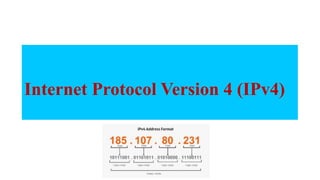
Internet Protocol Version 4 (IPv4)
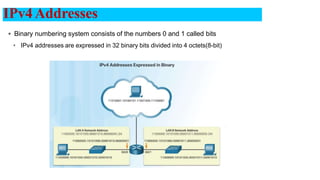
 Binary numbering system consists of the numbers 0 and 1 called bits
• IPv4 addresses are expressed in 32 binary bits divided into 4 octets(8-bit)
IPv4Addresses
4
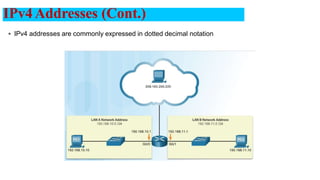
 IPv4 addresses are commonly expressed in dotted decimal notation
IPv4Addresses (Cont.)
5
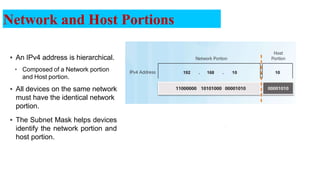
 An IPv4 address is hierarchical.
• Composed of a Network portion
and Host portion.
 All devices on the same network
must have the identical network
portion.
 The Subnet Mask helps devices
identify the network portion and
host portion.
Network and Host Portions
6
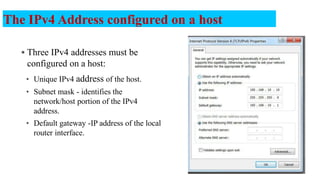
 Three IPv4 addresses must be
configured on a host:
• Unique IPv4 address of the host.
• Subnet mask - identifies the
network/host portion of the IPv4
address.
• Default gateway -IP address of the local
router interface.
The IPv4 Address configured on a host
7
IPv4Address Structure
The Subnet Mask
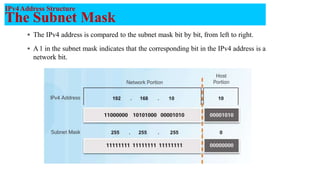
 The IPv4 address is compared to the subnet mask bit by bit, from left to right.
 A1 in the subnet mask indicates that the corresponding bit in the IPv4 address is a
network bit.
8
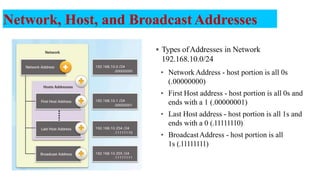
Network, Host, and Broadcast Addresses
 Types ofAddresses in Network
192.168.10.0/24
• NetworkAddress - host portion is all 0s
(.00000000)
• First Host address - host portion is all 0s and
ends with a 1 (.00000001)
• Last Host address - host portion is all 1s and
ends with a 0 (.11111110)
• BroadcastAddress - host portion is all
1s (.11111111)
9
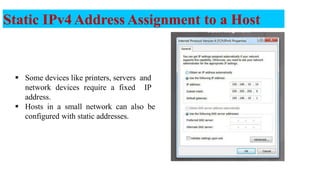
Static IPv4Address Assignment to a Host
 Some devices like printers, servers and
network devices require a fixed IP
address.
 Hosts in a small network can also be
configured with static addresses.
10
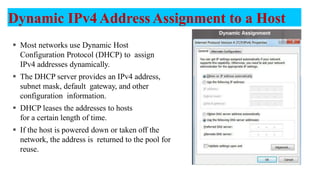
Dynamic IPv4 Address Assignment to a Host
 Most networks use Dynamic Host
Configuration Protocol (DHCP) to assign
IPv4 addresses dynamically.
 The DHCP server provides an IPv4 address,
subnet mask, default gateway, and other
configuration information.
 DHCP leases the addresses to hosts
for a certain length of time.
 If the host is powered down or taken off the
network, the address is returned to the pool for
reuse.
11
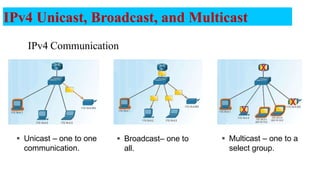
IPv4 Unicast, Broadcast, and Multicast
 Unicast – one to one
communication.
 Broadcast– one to
all.
12
 Multicast – one to a
select group.
IPv4 Communication
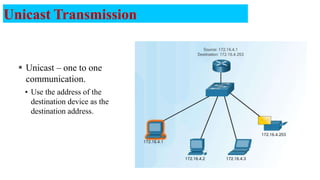
Unicast Transmission
 Unicast – one to one
communication.
• Use the address of the
destination device as the
destination address.
13
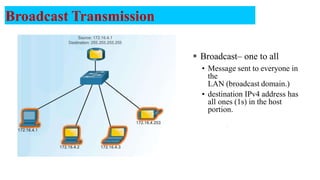
Broadcast Transmission
 Broadcast– one to all
• Message sent to everyone in
the
LAN (broadcast domain.)
• destination IPv4 address has
all ones (1s) in the host
portion.
14
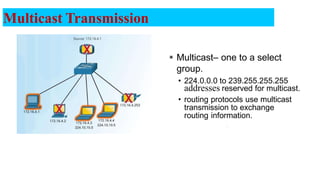
Multicast Transmission
 Multicast– one to a select
group.
• 224.0.0.0 to 239.255.255.255
addresses reserved for multicast.
• routing protocols use multicast
transmission to exchange
routing information.
15
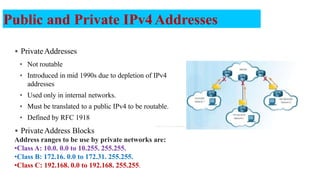
Public and Private IPv4Addresses
 PrivateAddresses
• Not routable
• Introduced in mid 1990s due to depletion of IPv4
addresses
• Used only in internal networks.
• Must be translated to a public IPv4 to be routable.
• Defined by RFC 1918
 PrivateAddress Blocks
Address ranges to be use by private networks are:
•Class A: 10.0. 0.0 to 10.255. 255.255.
•Class B: 172.16. 0.0 to 172.31. 255.255.
•Class C: 192.168. 0.0 to 192.168. 255.255.
© 2016 Cisco and/or its affiliates.All rights reserved. Cisco Confidential 16
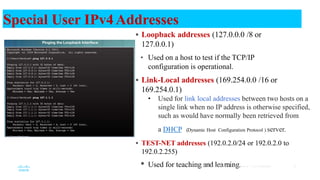
 Loopback addresses (127.0.0.0 /8 or
127.0.0.1)
• Used on a host to test if the TCP/IP
configuration is operational.
 Link-Local addresses (169.254.0.0 /16 or
169.254.0.1)
• Used for link local addresses between two hosts on a
single link when no IP address is otherwise specified,
such as would have normally been retrieved from
a DHCP (Dynamic Host Configuration Protocol ) server.
 TEST-NET addresses (192.0.2.0/24 or 192.0.2.0 to
192.0.2.255)
• Used for teachin
© 2
g
016a
Cis
n
co d
and/olre
its a
a
ffilir
ate
n
s.A
il
n
l rig
g
hts.reserved. Cisco Confidential 25
Special User IPv4Addresses
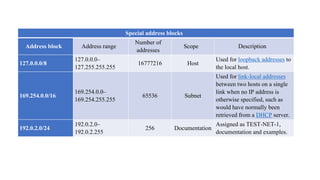
Special address blocks
Address block Address range
Number of
addresses
Scope Description
127.0.0.0/8
127.0.0.0–
127.255.255.255
16777216 Host
Used for loopback addresses to
the local host.
169.254.0.0/16
169.254.0.0–
169.254.255.255
65536 Subnet
Used for link-local addresses
between two hosts on a single
link when no IP address is
otherwise specified, such as
would have normally been
retrieved from a DHCP server.
192.0.2.0/24
192.0.2.0–
192.0.2.255
256 Documentation
Assigned as TEST-NET-1,
documentation and examples.
IPv4 Packet Header
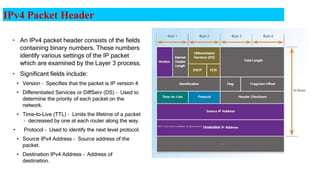
• An IPv4 packet header consists of the fields
containing binary numbers. These numbers
identify various settings of the IP packet
which are examined by the Layer 3 process.
• Significant fields include:
• Version – Specifies that the packet is IP version 4
• Differentiated Services or DiffServ (DS) – Used to
determine the priority of each packet on the
network.
• Time-to-Live (TTL) – Limits the lifetime of a packet
– decreased by one at each router along the way.
• Protocol – Used to identify the next level protocol.
• Source IPv4 Address – Source address of the
packet.
• Destination IPv4 Address – Address of
destination.
© 2016 Cisco and/or its affiliates. All rights reserved. Cisco Confidential 19
Internet Protocol Version 6 (IPv6)
IPv6
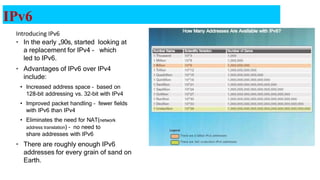
Introducing IPv6
• In the early „90s, started looking at
a replacement for IPv4 – which
led to IPv6.
• Advantages of IPv6 over IPv4
include:
• Increased address space – based on
128-bit addressing vs. 32-bit with IPv4
• Improved packet handling – fewer fields
with IPv6 than IPv4
• Eliminates the need for NAT(network
address translation) – no need to
share addresses with IPv6
• There are roughly enough IPv6
addresses for every grain of sand on
Earth.
21
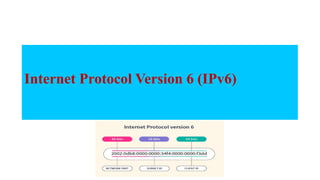
IPv6Address Representation
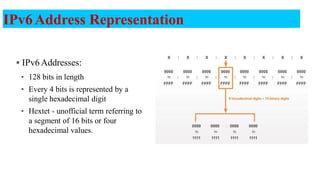
 IPv6Addresses:
• 128 bits in length
• Every 4 bits is represented by a
single hexadecimal digit
• Hextet - unofficial term referring to
a segment of 16 bits or four
hexadecimal values.
22
Encapsulating IPv6
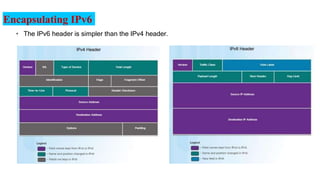
• The IPv6 header is simpler than the IPv4 header.
Encapsulating IPv6 (Cont.)
24
• Advantages of IPv6 over IPv4 using the simplified header:
• Simplified header format for efficient packet handling
• Hierarchical network architecture for routing efficiency
• Autoconfiguration for addresses
• Elimination of need for network address translation (NAT) between
private and public addresses
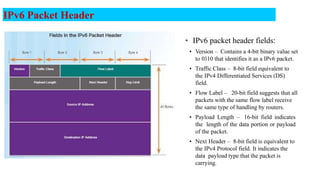
IPv6 Packet Header
• IPv6 packet header fields:
• Version – Contains a 4-bit binary value set
to 0110 that identifies it as a IPv6 packet.
• Traffic Class – 8-bit field equivalent to
the IPv4 Differentiated Services (DS)
field.
• Flow Label – 20-bit field suggests that all
packets with the same flow label receive
the same type of handling by routers.
• Payload Length – 16-bit field indicates
the length of the data portion or payload
of the packet.
• Next Header – 8-bit field is equivalent to
the IPv4 Protocol field. It indicates the
data payload type that the packet is
carrying.
25
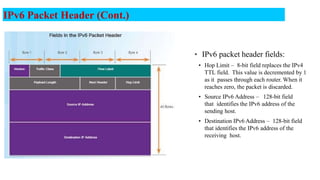
IPv6 Packet Header (Cont.)
• IPv6 packet header fields:
• Hop Limit – 8-bit field replaces the IPv4
TTL field. This value is decremented by 1
as it passes through each router. When it
reaches zero, the packet is discarded.
• Source IPv6 Address – 128-bit field
that identifies the IPv6 address of the
sending host.
• Destination IPv6 Address – 128-bit field
that identifies the IPv6 address of the
receiving host.
26
27

8-Lect_8 Addressing the Network.tcp.pptx

  • 1.
    Computer Networks LEC #2 CommunicatingOver the Network Computer Networks LEC #8 Addressing the Network IPv4 and IPv6
  • 2.
    Lecture Outlines  Explainthe use of IPv4 addresses. IPv4 Unicast, Broadcast, and Multicast Explain public, private, and reserved IPv4 addresses IPv6 Network Addresses
  • 3.
  • 4.
     Binary numberingsystem consists of the numbers 0 and 1 called bits • IPv4 addresses are expressed in 32 binary bits divided into 4 octets(8-bit) IPv4Addresses 4
  • 5.
     IPv4 addressesare commonly expressed in dotted decimal notation IPv4Addresses (Cont.) 5
  • 6.
     An IPv4address is hierarchical. • Composed of a Network portion and Host portion.  All devices on the same network must have the identical network portion.  The Subnet Mask helps devices identify the network portion and host portion. Network and Host Portions 6
  • 7.
     Three IPv4addresses must be configured on a host: • Unique IPv4 address of the host. • Subnet mask - identifies the network/host portion of the IPv4 address. • Default gateway -IP address of the local router interface. The IPv4 Address configured on a host 7
  • 8.
    IPv4Address Structure The SubnetMask  The IPv4 address is compared to the subnet mask bit by bit, from left to right.  A1 in the subnet mask indicates that the corresponding bit in the IPv4 address is a network bit. 8
  • 9.
    Network, Host, andBroadcast Addresses  Types ofAddresses in Network 192.168.10.0/24 • NetworkAddress - host portion is all 0s (.00000000) • First Host address - host portion is all 0s and ends with a 1 (.00000001) • Last Host address - host portion is all 1s and ends with a 0 (.11111110) • BroadcastAddress - host portion is all 1s (.11111111) 9
  • 10.
    Static IPv4Address Assignmentto a Host  Some devices like printers, servers and network devices require a fixed IP address.  Hosts in a small network can also be configured with static addresses. 10
  • 11.
    Dynamic IPv4 AddressAssignment to a Host  Most networks use Dynamic Host Configuration Protocol (DHCP) to assign IPv4 addresses dynamically.  The DHCP server provides an IPv4 address, subnet mask, default gateway, and other configuration information.  DHCP leases the addresses to hosts for a certain length of time.  If the host is powered down or taken off the network, the address is returned to the pool for reuse. 11
  • 12.
    IPv4 Unicast, Broadcast,and Multicast  Unicast – one to one communication.  Broadcast– one to all. 12  Multicast – one to a select group. IPv4 Communication
  • 13.
    Unicast Transmission  Unicast– one to one communication. • Use the address of the destination device as the destination address. 13
  • 14.
    Broadcast Transmission  Broadcast–one to all • Message sent to everyone in the LAN (broadcast domain.) • destination IPv4 address has all ones (1s) in the host portion. 14
  • 15.
    Multicast Transmission  Multicast–one to a select group. • 224.0.0.0 to 239.255.255.255 addresses reserved for multicast. • routing protocols use multicast transmission to exchange routing information. 15
  • 16.
    Public and PrivateIPv4Addresses  PrivateAddresses • Not routable • Introduced in mid 1990s due to depletion of IPv4 addresses • Used only in internal networks. • Must be translated to a public IPv4 to be routable. • Defined by RFC 1918  PrivateAddress Blocks Address ranges to be use by private networks are: •Class A: 10.0. 0.0 to 10.255. 255.255. •Class B: 172.16. 0.0 to 172.31. 255.255. •Class C: 192.168. 0.0 to 192.168. 255.255. © 2016 Cisco and/or its affiliates.All rights reserved. Cisco Confidential 16
  • 17.
     Loopback addresses(127.0.0.0 /8 or 127.0.0.1) • Used on a host to test if the TCP/IP configuration is operational.  Link-Local addresses (169.254.0.0 /16 or 169.254.0.1) • Used for link local addresses between two hosts on a single link when no IP address is otherwise specified, such as would have normally been retrieved from a DHCP (Dynamic Host Configuration Protocol ) server.  TEST-NET addresses (192.0.2.0/24 or 192.0.2.0 to 192.0.2.255) • Used for teachin © 2 g 016a Cis n co d and/olre its a a ffilir ate n s.A il n l rig g hts.reserved. Cisco Confidential 25 Special User IPv4Addresses
  • 18.
    Special address blocks Addressblock Address range Number of addresses Scope Description 127.0.0.0/8 127.0.0.0– 127.255.255.255 16777216 Host Used for loopback addresses to the local host. 169.254.0.0/16 169.254.0.0– 169.254.255.255 65536 Subnet Used for link-local addresses between two hosts on a single link when no IP address is otherwise specified, such as would have normally been retrieved from a DHCP server. 192.0.2.0/24 192.0.2.0– 192.0.2.255 256 Documentation Assigned as TEST-NET-1, documentation and examples.
  • 19.
    IPv4 Packet Header •An IPv4 packet header consists of the fields containing binary numbers. These numbers identify various settings of the IP packet which are examined by the Layer 3 process. • Significant fields include: • Version – Specifies that the packet is IP version 4 • Differentiated Services or DiffServ (DS) – Used to determine the priority of each packet on the network. • Time-to-Live (TTL) – Limits the lifetime of a packet – decreased by one at each router along the way. • Protocol – Used to identify the next level protocol. • Source IPv4 Address – Source address of the packet. • Destination IPv4 Address – Address of destination. © 2016 Cisco and/or its affiliates. All rights reserved. Cisco Confidential 19
  • 20.
  • 21.
    IPv6 Introducing IPv6 • Inthe early „90s, started looking at a replacement for IPv4 – which led to IPv6. • Advantages of IPv6 over IPv4 include: • Increased address space – based on 128-bit addressing vs. 32-bit with IPv4 • Improved packet handling – fewer fields with IPv6 than IPv4 • Eliminates the need for NAT(network address translation) – no need to share addresses with IPv6 • There are roughly enough IPv6 addresses for every grain of sand on Earth. 21
  • 22.
    IPv6Address Representation  IPv6Addresses: •128 bits in length • Every 4 bits is represented by a single hexadecimal digit • Hextet - unofficial term referring to a segment of 16 bits or four hexadecimal values. 22
  • 23.
    Encapsulating IPv6 • TheIPv6 header is simpler than the IPv4 header.
  • 24.
    Encapsulating IPv6 (Cont.) 24 •Advantages of IPv6 over IPv4 using the simplified header: • Simplified header format for efficient packet handling • Hierarchical network architecture for routing efficiency • Autoconfiguration for addresses • Elimination of need for network address translation (NAT) between private and public addresses
  • 25.
    IPv6 Packet Header •IPv6 packet header fields: • Version – Contains a 4-bit binary value set to 0110 that identifies it as a IPv6 packet. • Traffic Class – 8-bit field equivalent to the IPv4 Differentiated Services (DS) field. • Flow Label – 20-bit field suggests that all packets with the same flow label receive the same type of handling by routers. • Payload Length – 16-bit field indicates the length of the data portion or payload of the packet. • Next Header – 8-bit field is equivalent to the IPv4 Protocol field. It indicates the data payload type that the packet is carrying. 25
  • 26.
    IPv6 Packet Header(Cont.) • IPv6 packet header fields: • Hop Limit – 8-bit field replaces the IPv4 TTL field. This value is decremented by 1 as it passes through each router. When it reaches zero, the packet is discarded. • Source IPv6 Address – 128-bit field that identifies the IPv6 address of the sending host. • Destination IPv6 Address – 128-bit field that identifies the IPv6 address of the receiving host. 26
  • 27.