









USABILITY
PRINCIPLES 1
AFFORDANCES, CONSTRAINTS, MAPPING,
FEEDBACK
OBJECTIVES
At the end of class, students will be able to:
1. Define the terms “affordance” and “constraint.”
2. Explain the principles of mapping and feedback.
3. Identify examples of affordances and constraints
4. Apply the the 4 concepts (affordances, constraints,
feedback, mapping) to solving design problems
AFFORDANCE
A relationship between:
• the properties of an object and
• the capabilities of an agent
that determines how the object could be used.
Affordances exist even if they are not visible.
For designers, visibility is critical.
Affordances determine what actions are possible. Signifiers
communicate where the action should take place.
Perceived affordances may be real affordances, or may be
misleading signifiers.
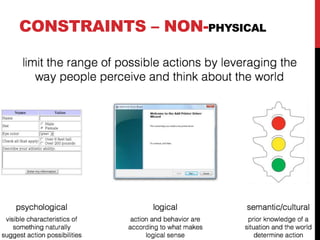
CONSTRAINTS
Limits on action and thoughts
Physical non-Physical
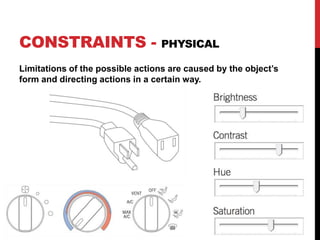
CONSTRAINTS - PHYSICAL
Limitations of the possible actions are caused by the object’s
form and directing actions in a certain way.
CONSTRAINTS – NON-PHYSICAL
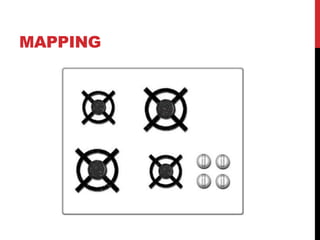
MAPPING
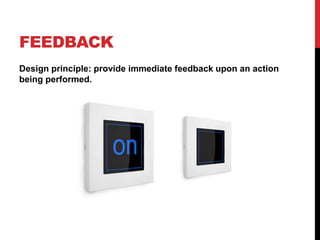
FEEDBACK
Design principle: provide immediate feedback upon an action
being performed.
DISCOVERABILITY
The possibility to figure out what actions are possible and
how to perform them.
Results from application of:
• affordances
• signifiers
• constraints
• mappings
• feedback
MORE
EXAMPLES
07 principles 1 affordance

07 principles 1 affordance