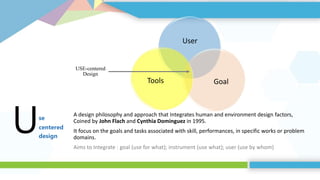
A design philosophy and approach that Integrates human and environment design factors,
Coined by John Flach and Cynthia Dominguez in 1995.
It focus on the goals and tasks associated with skill, performances, in specific works or problem
domains.
Aims to Integrate : goal (use for what); instrument (use what); user (use by whom)
User
GoalTools
USE-centered
Design
Use
centered
design
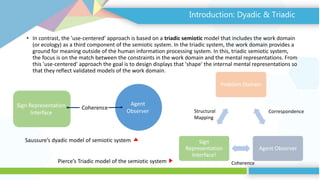
• In contrast, the 'use-centered' approach is based on a triadic semiotic model that includes the work domain
(or ecology) as a third component of the semiotic system. In the triadic system, the work domain provides a
ground for meaning outside of the human information processing system. In this, triadic semiotic system,
the focus is on the match between the constraints in the work domain and the mental representations. From
this 'use-centered' approach the goal is to design displays that 'shape' the internal mental representations so
that they reflect validated models of the work domain.
Introduction: Dyadic & Triadic
Problem Domain
Agent Observer
Sign
Representation
Interface!
Structural
Mapping
Correspondence
Coherence
Coherence
Agent
Observer
Sign Representation
Interface
Saussure’s dyadic model of semiotic system
Pierce’s Triadic model of the semiotic system
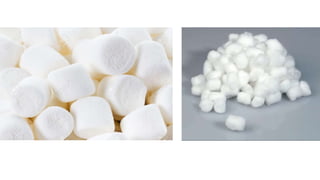
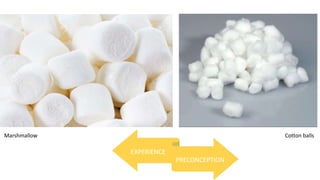
Marshmallow Cotton balls
EXPERIENCE
PRECONCEPTION
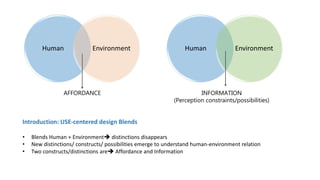
• Blends Human + Environment distinctions disappears
• New distinctions/ constructs/ possibilities emerge to understand human-environment relation
• Two constructs/distinctions are Affordance and Information
Introduction: USE-centered design Blends
INFORMATION
(Perception constraints/possibilities)
Human Environment
AFFORDANCE
Human Environment
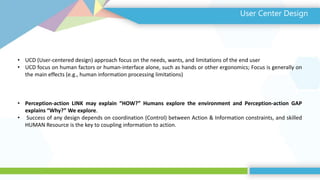
• UCD (User-centered design) approach focus on the needs, wants, and limitations of the end user
• UCD focus on human factors or human-interface alone, such as hands or other ergonomics; Focus is generally on
the main effects (e.g., human information processing limitations)
• Perception-action LINK may explain “HOW?” Humans explore the environment and Perception-action GAP
explains “Why?” We explore.
• Success of any design depends on coordination (Control) between Action & Information constraints, and skilled
HUMAN Resource is the key to coupling information to action.
User Center Design
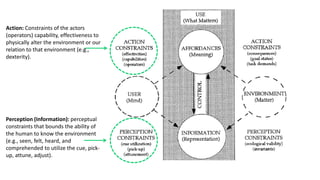
Action: Constraints of the actors
(operators) capability, effectiveness to
physically alter the environment or our
relation to that environment (e.g.,
dexterity).
Perception (Information): perceptual
constraints that bounds the ability of
the human to know the environment
(e.g., seen, felt, heard, and
comprehended to utilize the cue, pick-
up, attune, adjust).
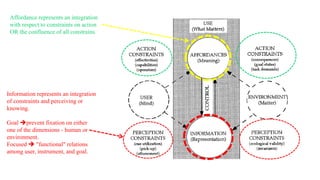
Affordance represents an integration
with respect to constraints on action
OR the confluence of all constrains.
Information represents an integration
of constraints and perceiving or
knowing.
Goal prevent fixation on either
one of the dimensions - human or
environment.
Focused  "functional" relations
among user, instrument, and goal.
Affordance
We live in a world filled with objects, many natural, the rest artificial.
Every day we encounter thousands of objects, many of them new to us.
Many of the new objects are similar to ones we already used, but many are
unique, yet we manage quite well.
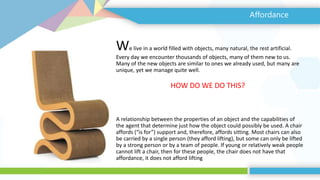
A relationship between the properties of an object and the capabilities of
the agent that determine just how the object could possibly be used. A chair
affords (“is for”) support and, therefore, affords sitting. Most chairs can also
be carried by a single person (they afford lifting), but some can only be lifted
by a strong person or by a team of people. If young or relatively weak people
cannot lift a chair, then for these people, the chair does not have that
affordance, it does not afford lifting
HOW DO WE DO THIS?
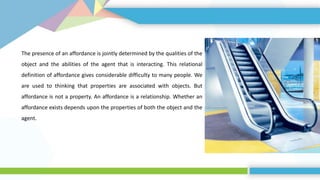
The presence of an affordance is jointly determined by the qualities of the
object and the abilities of the agent that is interacting. This relational
definition of affordance gives considerable difficulty to many people. We
are used to thinking that properties are associated with objects. But
affordance is not a property. An affordance is a relationship. Whether an
affordance exists depends upon the properties of both the object and the
agent.
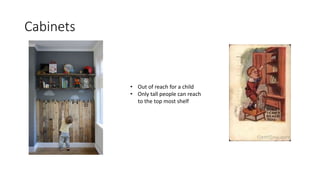
Cabinets
• Out of reach for a child
• Only tall people can reach
to the top most shelf
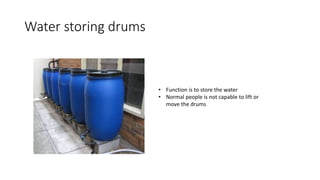
Water storing drums
• Function is to store the water
• Normal people is not capable to lift or
move the drums
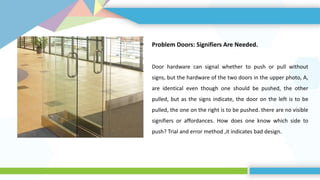
Problem Doors: Signifiers Are Needed.
Door hardware can signal whether to push or pull without
signs, but the hardware of the two doors in the upper photo, A,
are identical even though one should be pushed, the other
pulled, but as the signs indicate, the door on the left is to be
pulled, the one on the right is to be pushed. there are no visible
signifiers or affordances. How does one know which side to
push? Trial and error method ,it indicates bad design.
• The-design-of-everyday-things-revised-and-expanded-edition
• Use Centered Design www.municode.Com
References
T H A N K Y O U
Presented by:
Abhishek Sethi
Suchetana Chakravarty

Use centered design

  • 2.
    A design philosophyand approach that Integrates human and environment design factors, Coined by John Flach and Cynthia Dominguez in 1995. It focus on the goals and tasks associated with skill, performances, in specific works or problem domains. Aims to Integrate : goal (use for what); instrument (use what); user (use by whom) User GoalTools USE-centered Design Use centered design
  • 3.
    • In contrast,the 'use-centered' approach is based on a triadic semiotic model that includes the work domain (or ecology) as a third component of the semiotic system. In the triadic system, the work domain provides a ground for meaning outside of the human information processing system. In this, triadic semiotic system, the focus is on the match between the constraints in the work domain and the mental representations. From this 'use-centered' approach the goal is to design displays that 'shape' the internal mental representations so that they reflect validated models of the work domain. Introduction: Dyadic & Triadic Problem Domain Agent Observer Sign Representation Interface! Structural Mapping Correspondence Coherence Coherence Agent Observer Sign Representation Interface Saussure’s dyadic model of semiotic system Pierce’s Triadic model of the semiotic system
  • 5.
  • 6.
    • Blends Human+ Environment distinctions disappears • New distinctions/ constructs/ possibilities emerge to understand human-environment relation • Two constructs/distinctions are Affordance and Information Introduction: USE-centered design Blends INFORMATION (Perception constraints/possibilities) Human Environment AFFORDANCE Human Environment
  • 7.
    • UCD (User-centereddesign) approach focus on the needs, wants, and limitations of the end user • UCD focus on human factors or human-interface alone, such as hands or other ergonomics; Focus is generally on the main effects (e.g., human information processing limitations) • Perception-action LINK may explain “HOW?” Humans explore the environment and Perception-action GAP explains “Why?” We explore. • Success of any design depends on coordination (Control) between Action & Information constraints, and skilled HUMAN Resource is the key to coupling information to action. User Center Design
  • 8.
    Action: Constraints ofthe actors (operators) capability, effectiveness to physically alter the environment or our relation to that environment (e.g., dexterity). Perception (Information): perceptual constraints that bounds the ability of the human to know the environment (e.g., seen, felt, heard, and comprehended to utilize the cue, pick- up, attune, adjust).
  • 9.
    Affordance represents anintegration with respect to constraints on action OR the confluence of all constrains. Information represents an integration of constraints and perceiving or knowing. Goal prevent fixation on either one of the dimensions - human or environment. Focused  "functional" relations among user, instrument, and goal.
  • 10.
    Affordance We live ina world filled with objects, many natural, the rest artificial. Every day we encounter thousands of objects, many of them new to us. Many of the new objects are similar to ones we already used, but many are unique, yet we manage quite well. A relationship between the properties of an object and the capabilities of the agent that determine just how the object could possibly be used. A chair affords (“is for”) support and, therefore, affords sitting. Most chairs can also be carried by a single person (they afford lifting), but some can only be lifted by a strong person or by a team of people. If young or relatively weak people cannot lift a chair, then for these people, the chair does not have that affordance, it does not afford lifting HOW DO WE DO THIS?
  • 11.
    The presence ofan affordance is jointly determined by the qualities of the object and the abilities of the agent that is interacting. This relational definition of affordance gives considerable difficulty to many people. We are used to thinking that properties are associated with objects. But affordance is not a property. An affordance is a relationship. Whether an affordance exists depends upon the properties of both the object and the agent.
  • 12.
    Cabinets • Out ofreach for a child • Only tall people can reach to the top most shelf
  • 13.
    Water storing drums •Function is to store the water • Normal people is not capable to lift or move the drums
  • 14.
    Problem Doors: SignifiersAre Needed. Door hardware can signal whether to push or pull without signs, but the hardware of the two doors in the upper photo, A, are identical even though one should be pushed, the other pulled, but as the signs indicate, the door on the left is to be pulled, the one on the right is to be pushed. there are no visible signifiers or affordances. How does one know which side to push? Trial and error method ,it indicates bad design.
  • 15.
  • 16.
    T H AN K Y O U Presented by: Abhishek Sethi Suchetana Chakravarty