Announcements
• CS 414Homework next Wednesday, Feb 7th
• CS 415 initial design documents due TODAY, Friday, Feb 2nd
– Project due following Monday, February 12th
• Everyone should have access to CMS
(http://cms3.csuglab.cornell.edu)
– Check and contact me (hweather@cs.cornell.edu) or Bill Hogan
(whh@cs.cornell.edu) today if you do not have access to CMS
• Also, everyone should have CSUGLab account
– Contact Bill or I if you do not
3.
Review: Threads
• Eachthread has its own PC, registers, and stack pointer
• But shares code, data, accounting info (address space)
• Pthreads (POSIX - “Portable Operating System Interface for uniX)
– A POSIX standard (IEEE 1003.1c) API for thread creation and synchronization
– API specifies behavior of the thread library, implementation is up to development of the
library
– Common in UNIX operating systems (Solaris, Linux, Mac OS X)
• Windows XP Threads
– Implements the one-to-one mapping
– Each thread contains
• A thread id
• Register set
• Separate user and kernel stacks
• Private data storage area
– The register set, stacks, and private storage area are known as the context
of the threads
4.
Review Threads
• LinuxThreads
– Linux refers to them as tasks rather than threads
– Thread creation is done through clone() system call
– clone() allows a child task to share the address space of the parent
task (process)
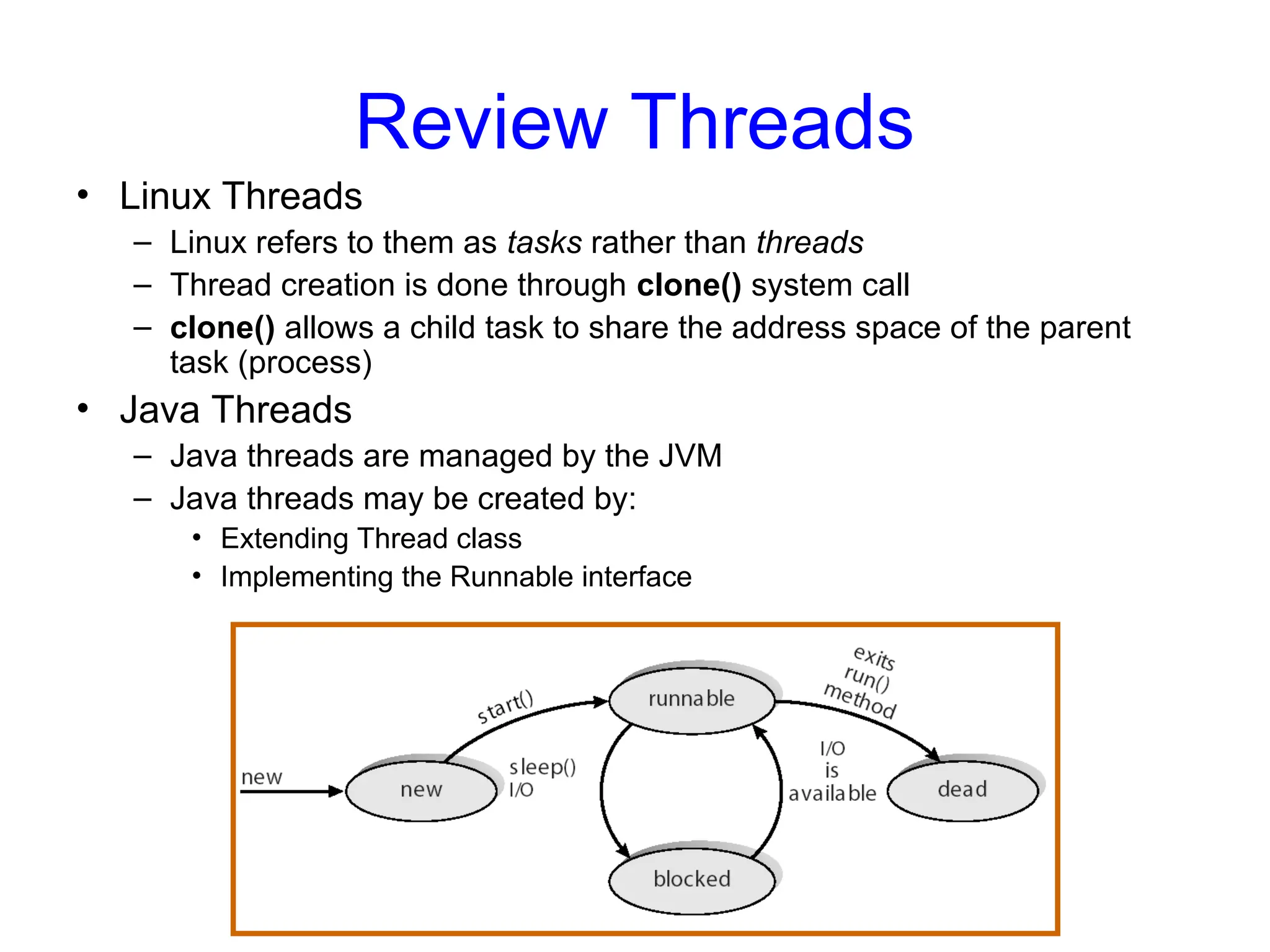
• Java Threads
– Java threads are managed by the JVM
– Java threads may be created by:
• Extending Thread class
• Implementing the Runnable interface
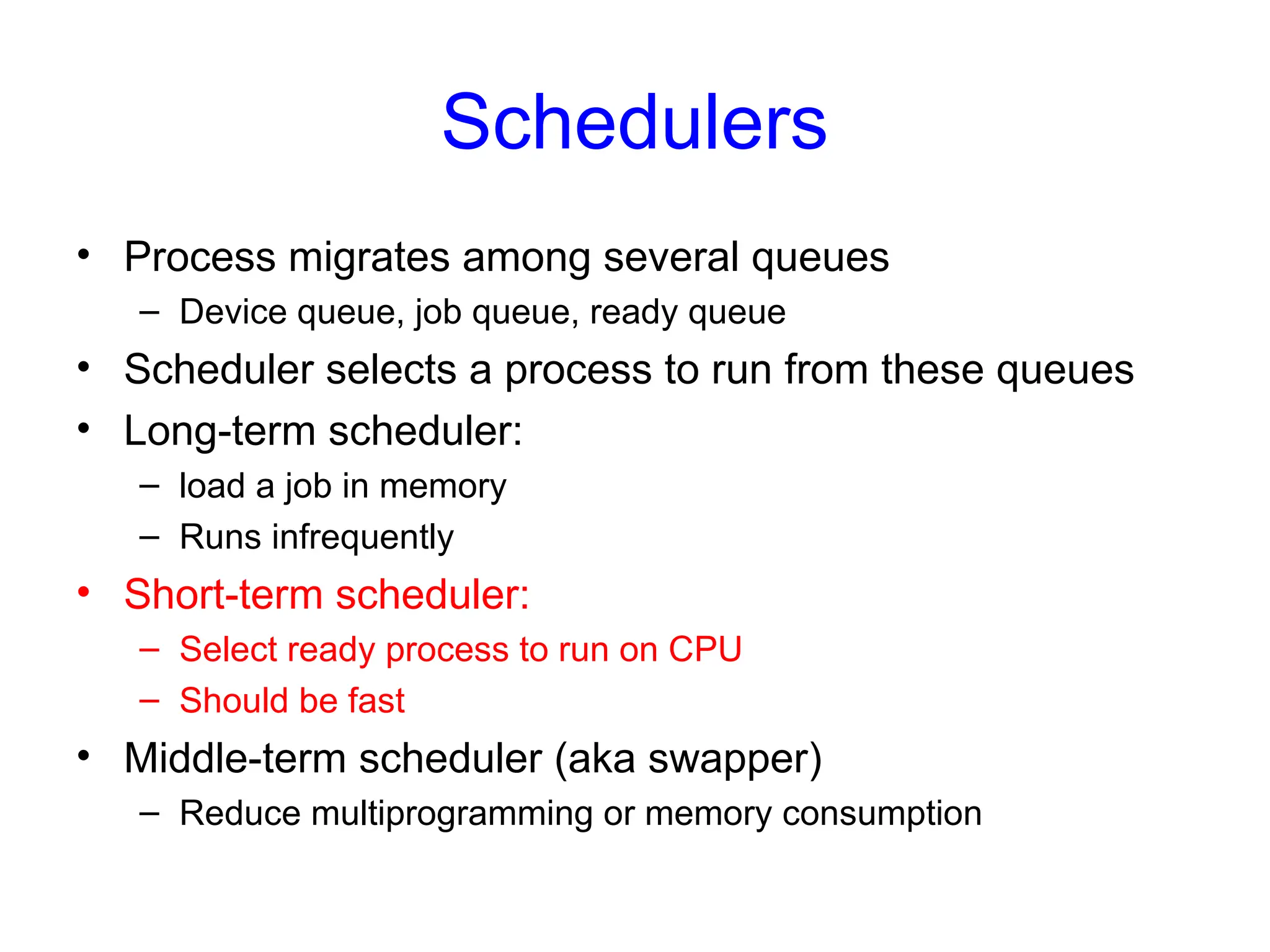
Schedulers
• Process migratesamong several queues
– Device queue, job queue, ready queue
• Scheduler selects a process to run from these queues
• Long-term scheduler:
– load a job in memory
– Runs infrequently
• Short-term scheduler:
– Select ready process to run on CPU
– Should be fast
• Middle-term scheduler (aka swapper)
– Reduce multiprogramming or memory consumption
7.
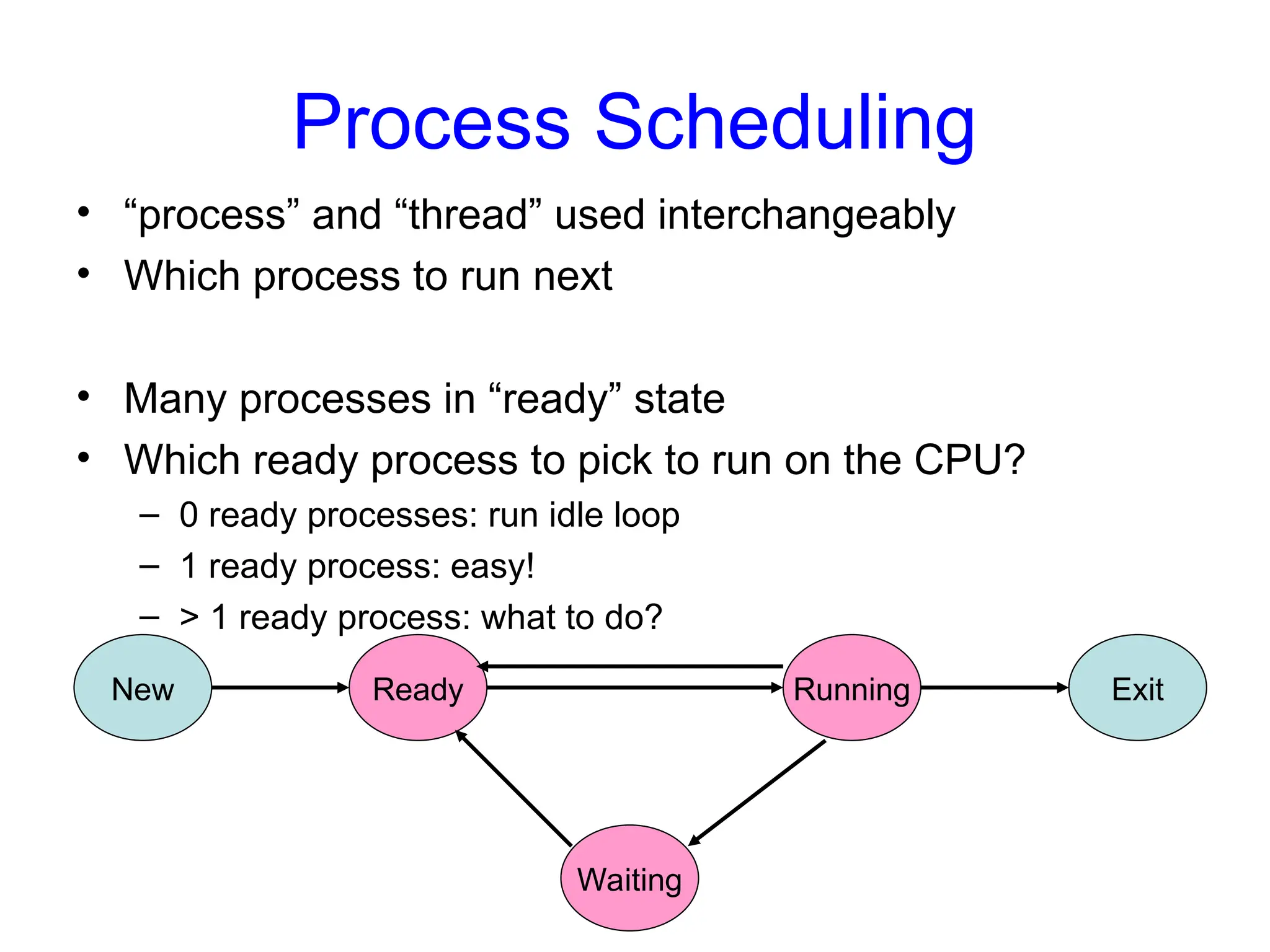
Process Scheduling
• “process”and “thread” used interchangeably
• Which process to run next
• Many processes in “ready” state
• Which ready process to pick to run on the CPU?
– 0 ready processes: run idle loop
– 1 ready process: easy!
– > 1 ready process: what to do?
New Ready Running Exit
Waiting
8.
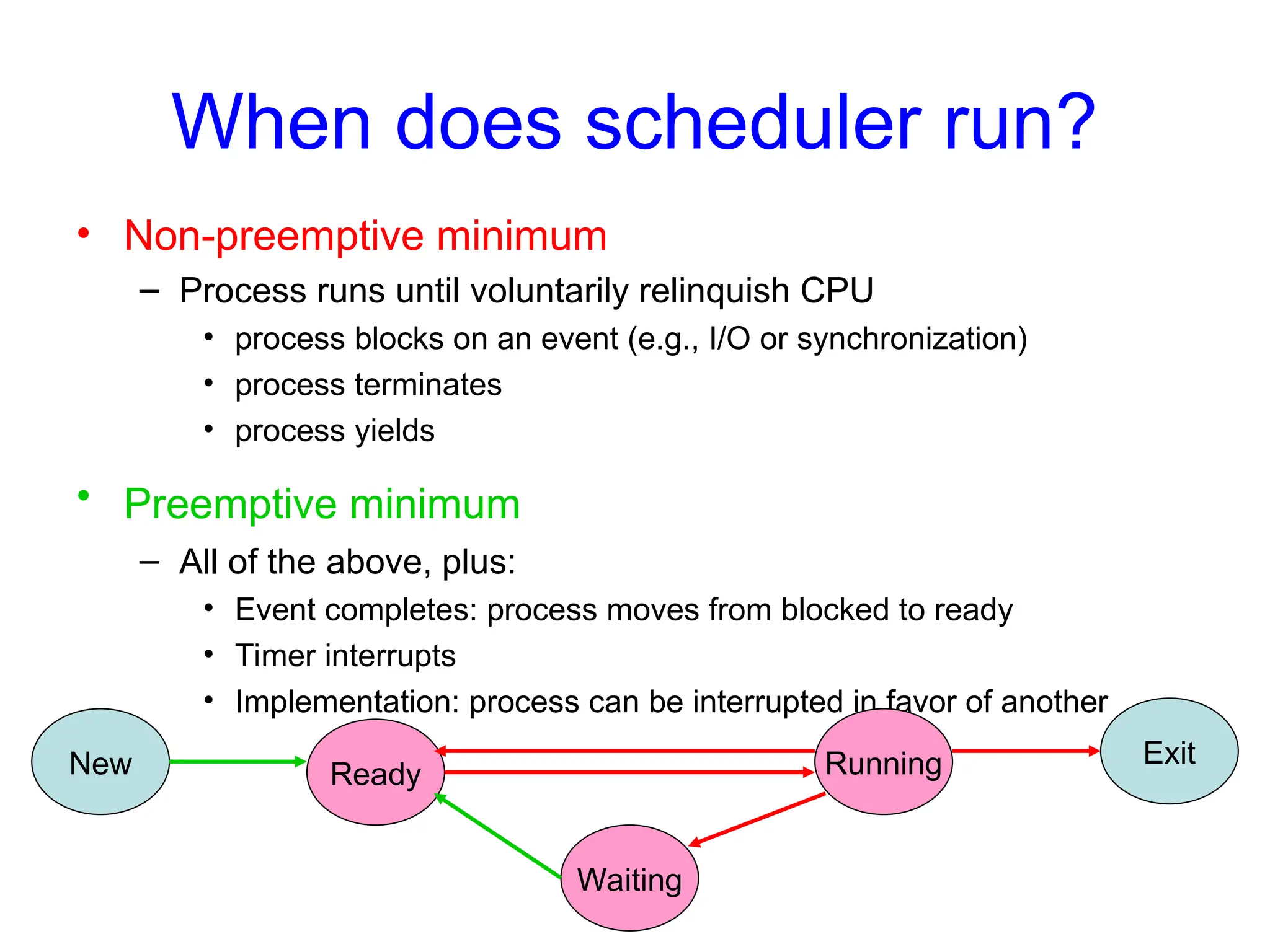
When does schedulerrun?
• Non-preemptive minimum
– Process runs until voluntarily relinquish CPU
• process blocks on an event (e.g., I/O or synchronization)
• process terminates
• process yields
• Preemptive minimum
– All of the above, plus:
• Event completes: process moves from blocked to ready
• Timer interrupts
• Implementation: process can be interrupted in favor of another
New Ready Running Exit
Waiting
9.
Process Model
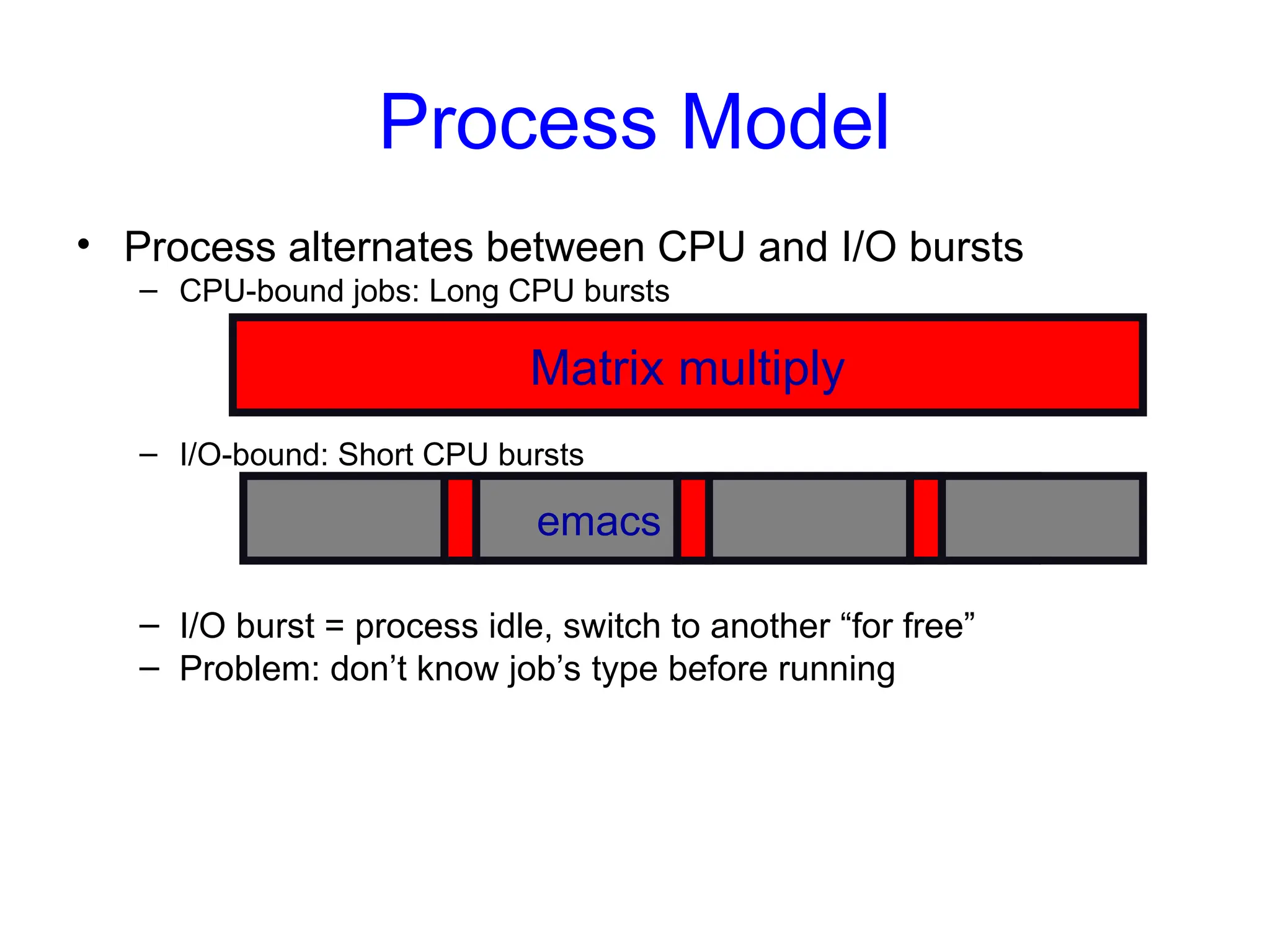
• Processalternates between CPU and I/O bursts
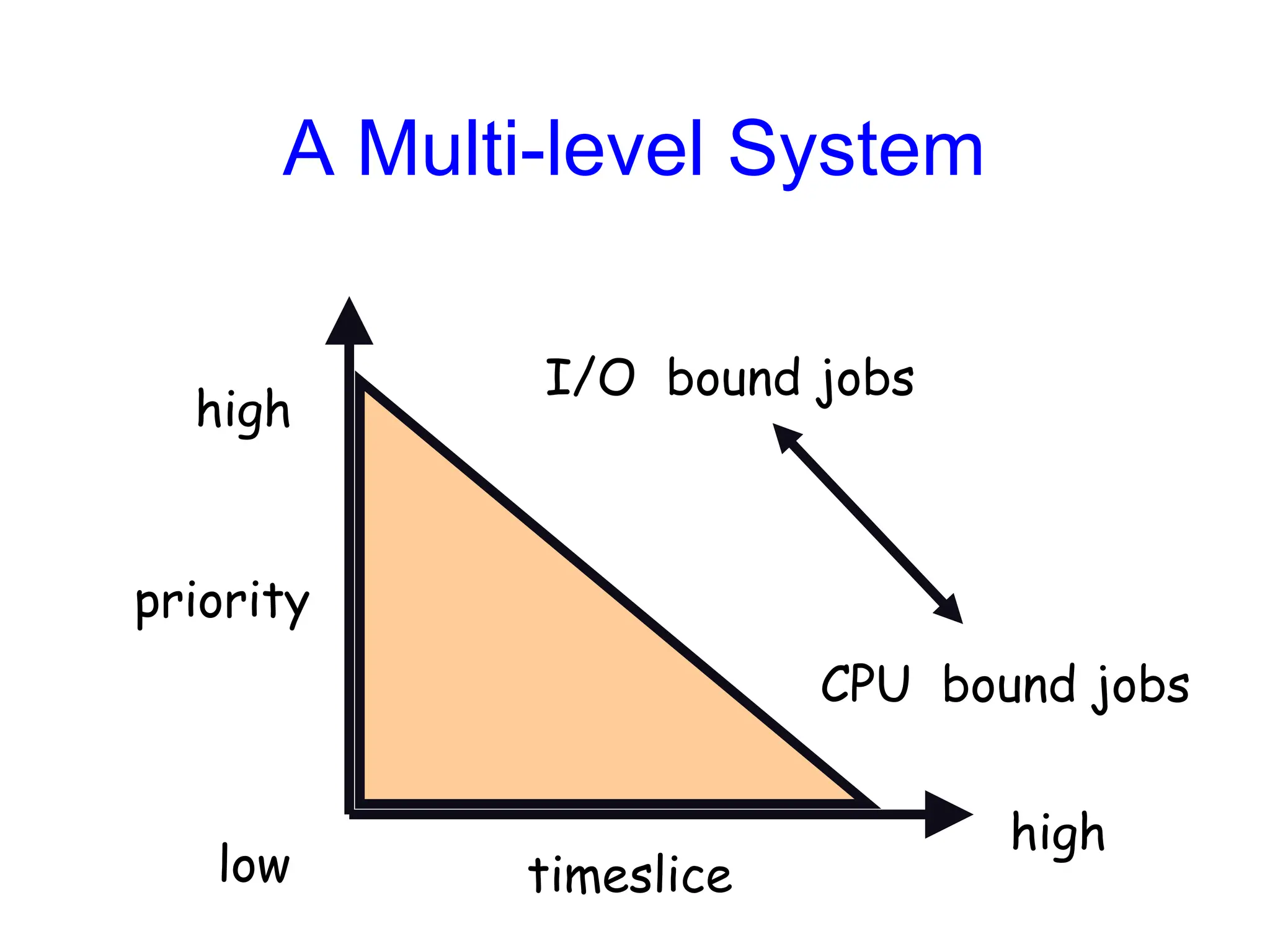
– CPU-bound jobs: Long CPU bursts
– I/O-bound: Short CPU bursts
– I/O burst = process idle, switch to another “for free”
– Problem: don’t know job’s type before running
Matrix multiply
emacs
emacs
10.
Superbowl XLI thisSunday!
• Why watch?
– Want to see what hype is about
– Professor played with Chicago Bears Center, Olin Kreutz
• Olin is known as a “jaw breaker”
– First African-americans to coach in Superbowl history?
• What does the Superbowl have to do with scheduling?!
– Also, want to watch Law & Order, Desperate House wives, etc
– But, have to finish Project and Homework!
– What criteria to use to schedule events?
11.
Scheduling Evaluation Metrics
•Many quantitative criteria for evaluating sched algorithm:
– CPU utilization: percentage of time the CPU is not idle
– Throughput: completed processes per time unit
– Turnaround time: submission to completion
– Waiting time: time spent on the ready queue
– Response time: response latency
– Predictability: variance in any of these measures
• The right metric depends on the context
• An underlying assumption:
– “response time” most important for interactive jobs (I/O bound)
12.
“The perfect CPUscheduler”
• Minimize latency: response or job completion time
• Maximize throughput: Maximize jobs / time.
• Maximize utilization: keep I/O devices busy.
– Recurring theme with OS scheduling
• Fairness: everyone makes progress, no one starves
13.
Problem Cases
• Blindnessabout job types
– I/O goes idle
• Optimization involves favoring jobs of type “A” over “B”.
– Lots of A’s? B’s starve
• Interactive process trapped behind others.
– Response time sucks for no reason
• Priority Inversion: A depends on B. A’s priority > B’s.
– B never runs
14.
Scheduling Algorithms FCFS
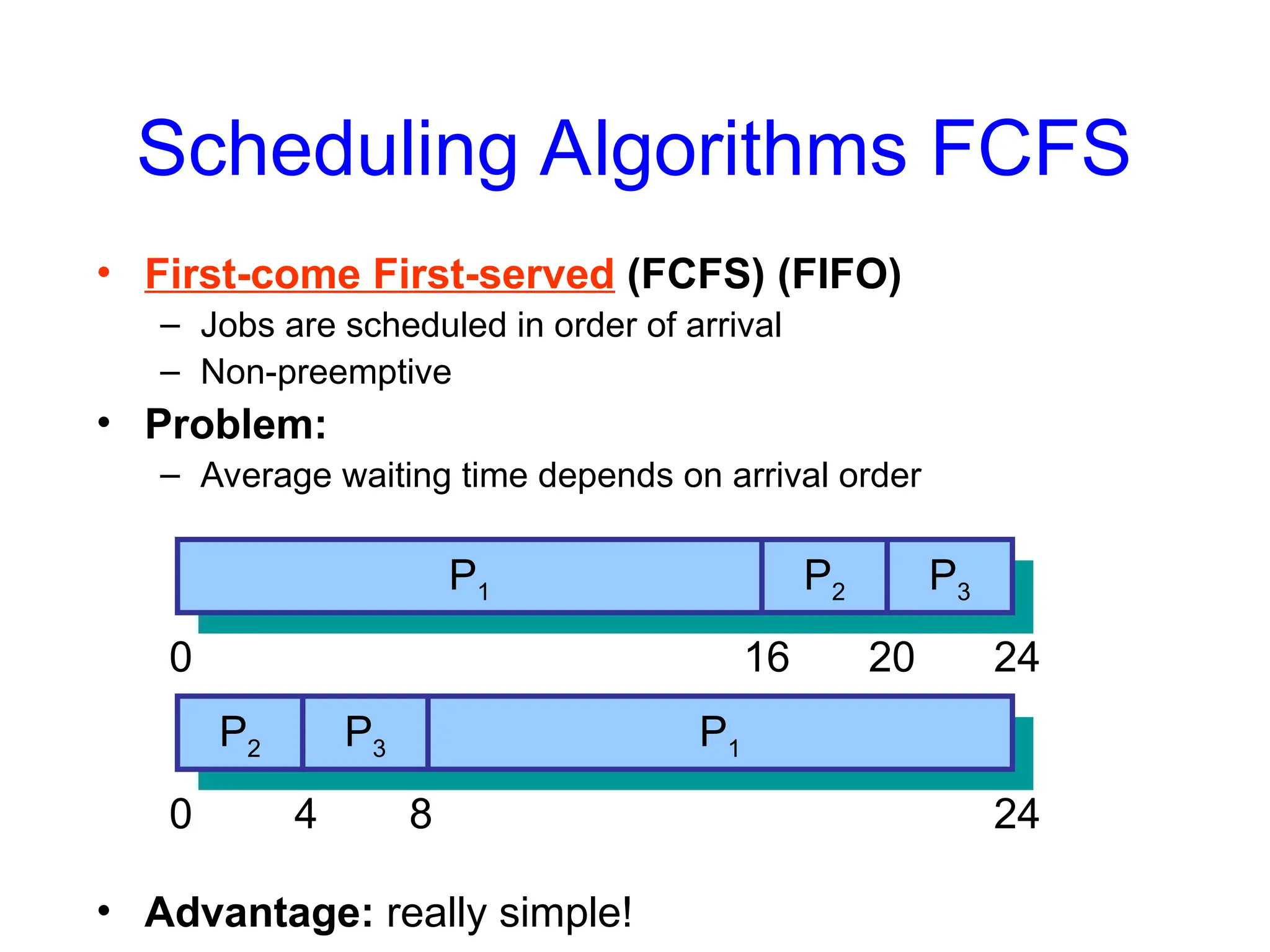
•First-come First-served (FCFS) (FIFO)
– Jobs are scheduled in order of arrival
– Non-preemptive
• Problem:
– Average waiting time depends on arrival order
• Advantage: really simple!
time
P1 P2 P3
0 16 20 24
P1
P2 P3
0 4 8 24
15.
Convoy Effect
• ACPU bound job will hold CPU until done,
– or it causes an I/O burst
• rare occurrence, since the thread is CPU-bound
long periods where no I/O requests issued, and CPU held
– Result: poor I/O device utilization
• Example: one CPU bound job, many I/O bound
• CPU bound runs (I/O devices idle)
• CPU bound blocks
• I/O bound job(s) run, quickly block on I/O
• CPU bound runs again
• I/O completes
• CPU bound still runs while I/O devices idle (continues…)
– Simple hack: run process whose I/O completed?
• What is a potential problem?
16.
Scheduling Algorithms LIFO
•Last-In First-out (LIFO)
– Newly arrived jobs are placed at head of ready queue
– Improves response time for newly created threads
• Problem:
– May lead to starvation – early processes may never get
CPU
17.
Problem
• You workas a short-order cook
– Customers come in and specify which dish they want
– Each dish takes a different amount of time to prepare
• Your goal:
– minimize average time the customers wait for their food
• What strategy would you use ?
– Note: most restaurants use FCFS.
18.
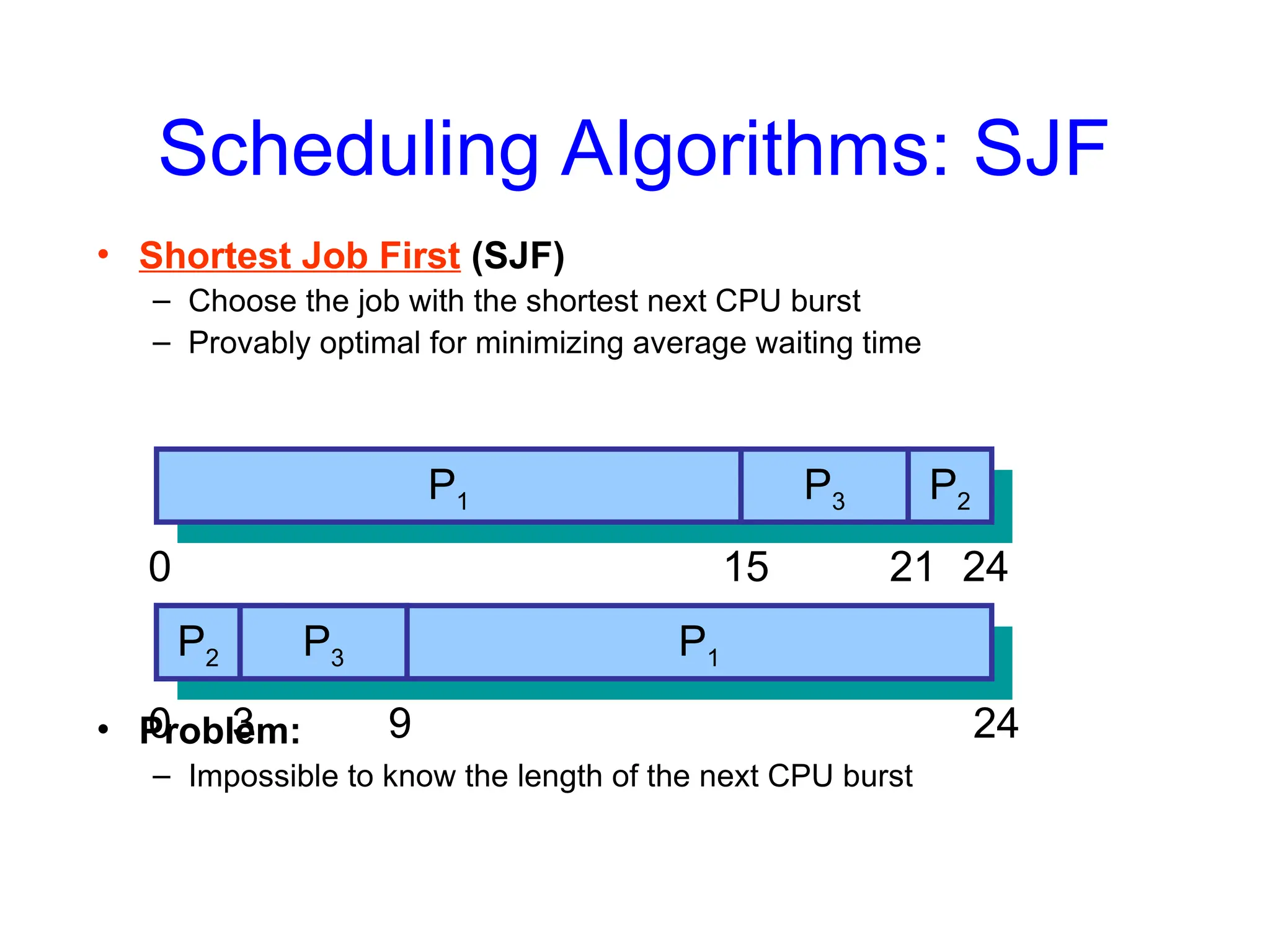
Scheduling Algorithms: SJF
•Shortest Job First (SJF)
– Choose the job with the shortest next CPU burst
– Provably optimal for minimizing average waiting time
• Problem:
– Impossible to know the length of the next CPU burst
P1 P2
P3
0 15 21 24
P1
P2 P3
0 3 9 24
P2 P3
19.
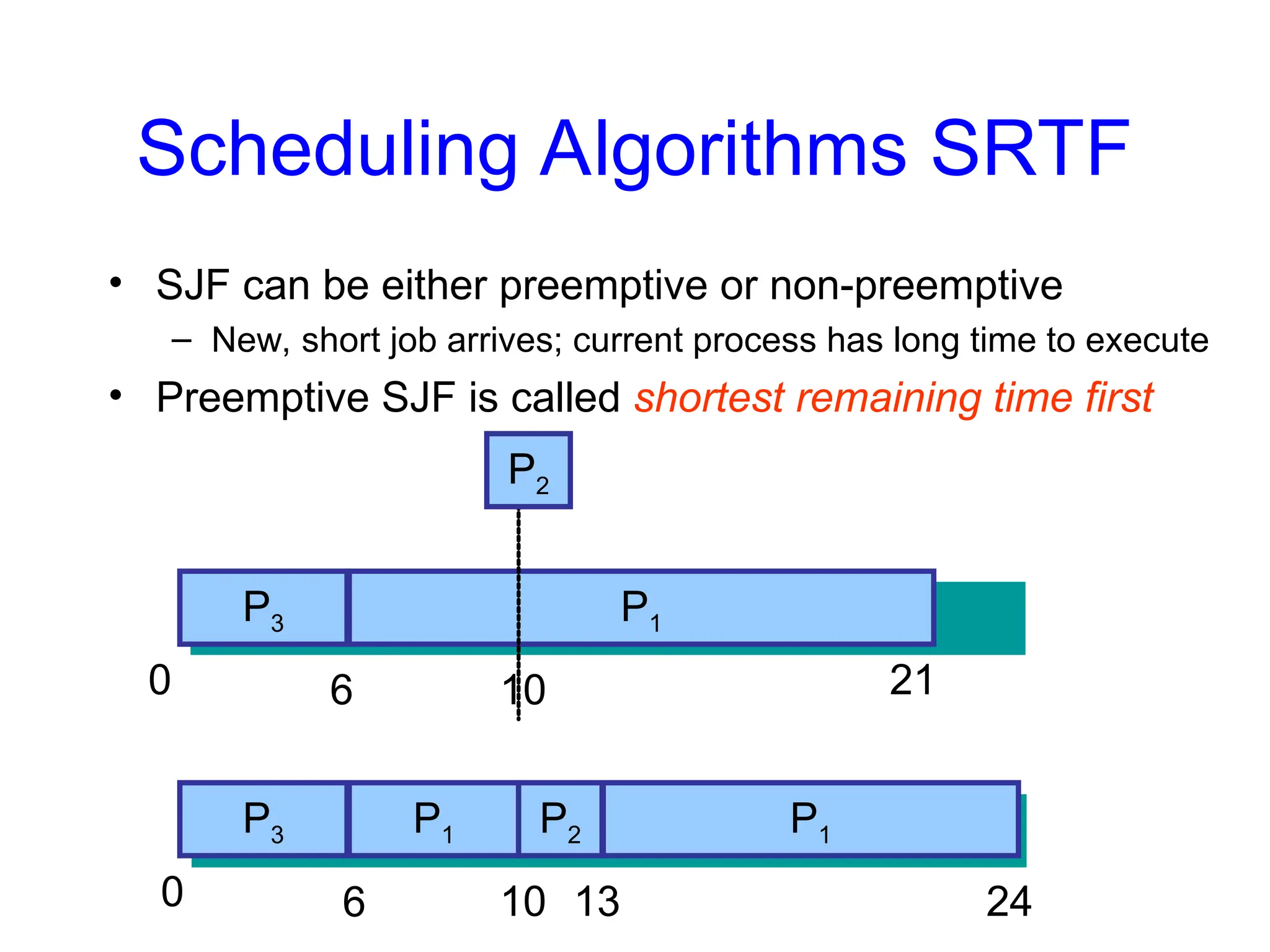
Scheduling Algorithms SRTF
•SJF can be either preemptive or non-preemptive
– New, short job arrives; current process has long time to execute
• Preemptive SJF is called shortest remaining time first
P1
P2
P3
0 6 21
10
P1
P3 P1
P2
0 6 24
10 13
20.
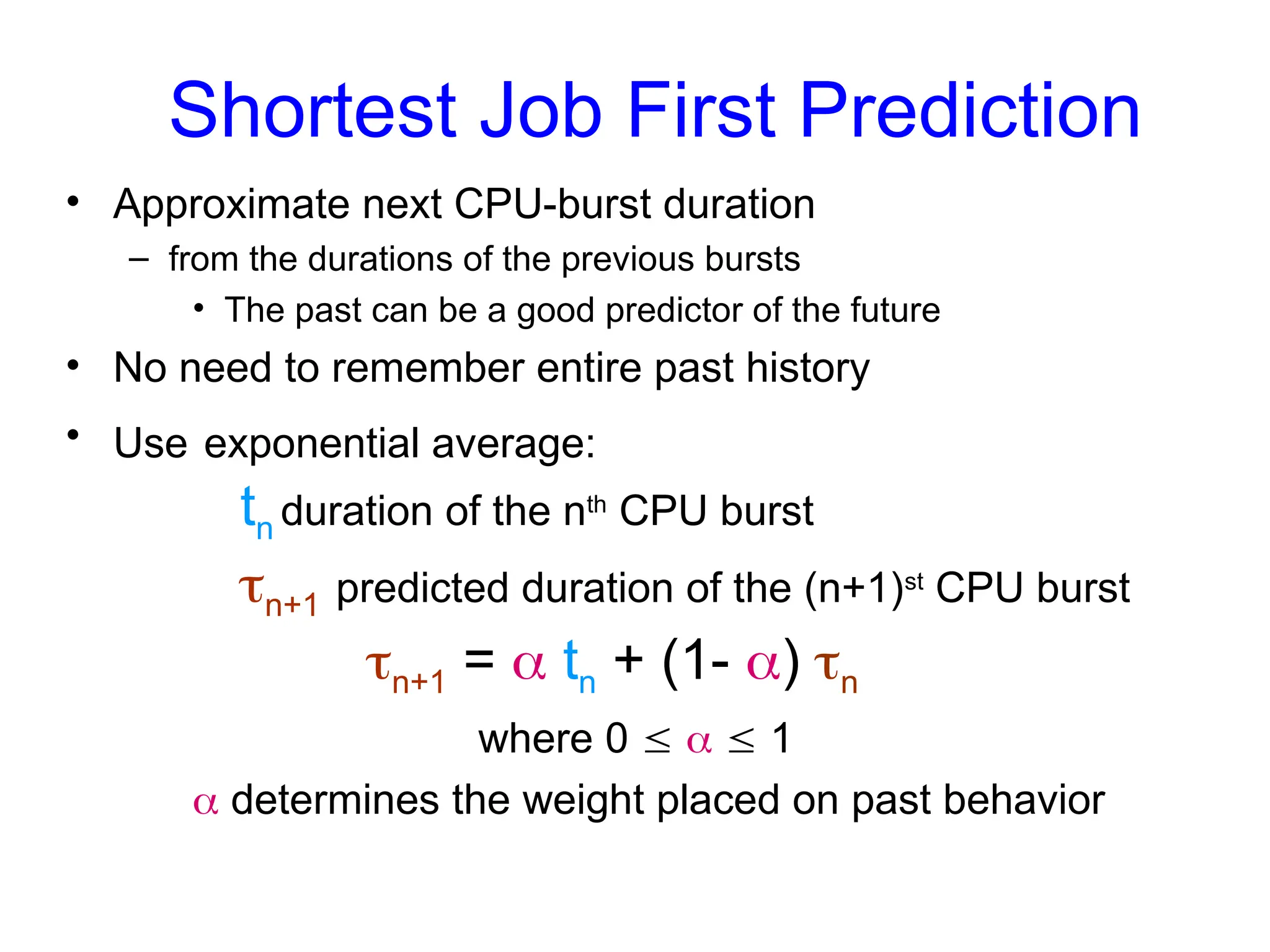
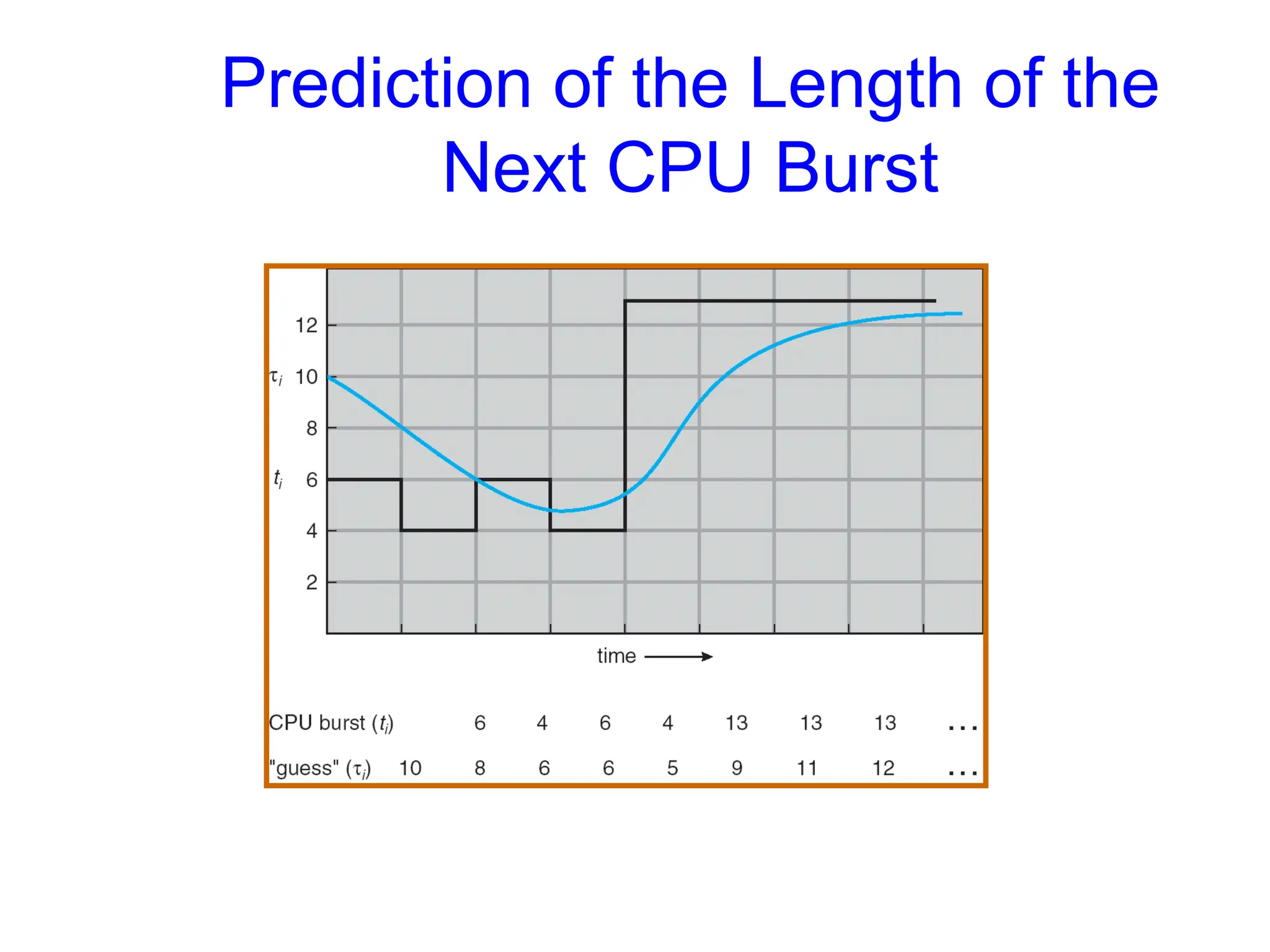
• Approximate nextCPU-burst duration
– from the durations of the previous bursts
• The past can be a good predictor of the future
• No need to remember entire past history
• Use exponential average:
tn duration of the nth
CPU burst
n+1 predicted duration of the (n+1)st
CPU burst
n+1 = tn + (1- ) n
where 0 1
determines the weight placed on past behavior
Shortest Job First Prediction
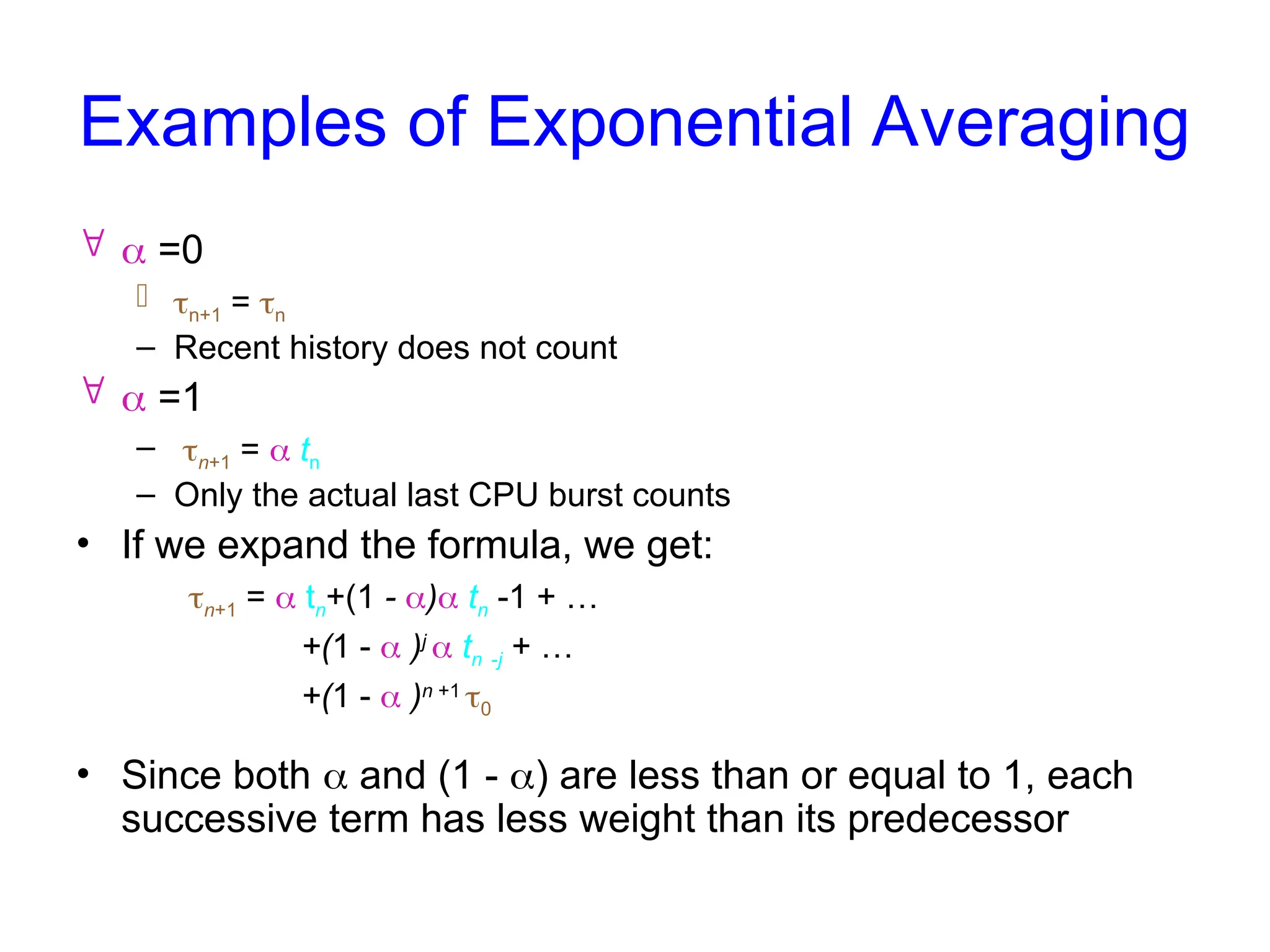
Examples of ExponentialAveraging
=0
n+1 = n
– Recent history does not count
=1
– n+1 = tn
– Only the actual last CPU burst counts
• If we expand the formula, we get:
n+1 = tn+(1 - ) tn -1 + …
+(1 - )j
tn -j + …
+(1 - )n +1
0
• Since both and (1 - ) are less than or equal to 1, each
successive term has less weight than its predecessor
23.
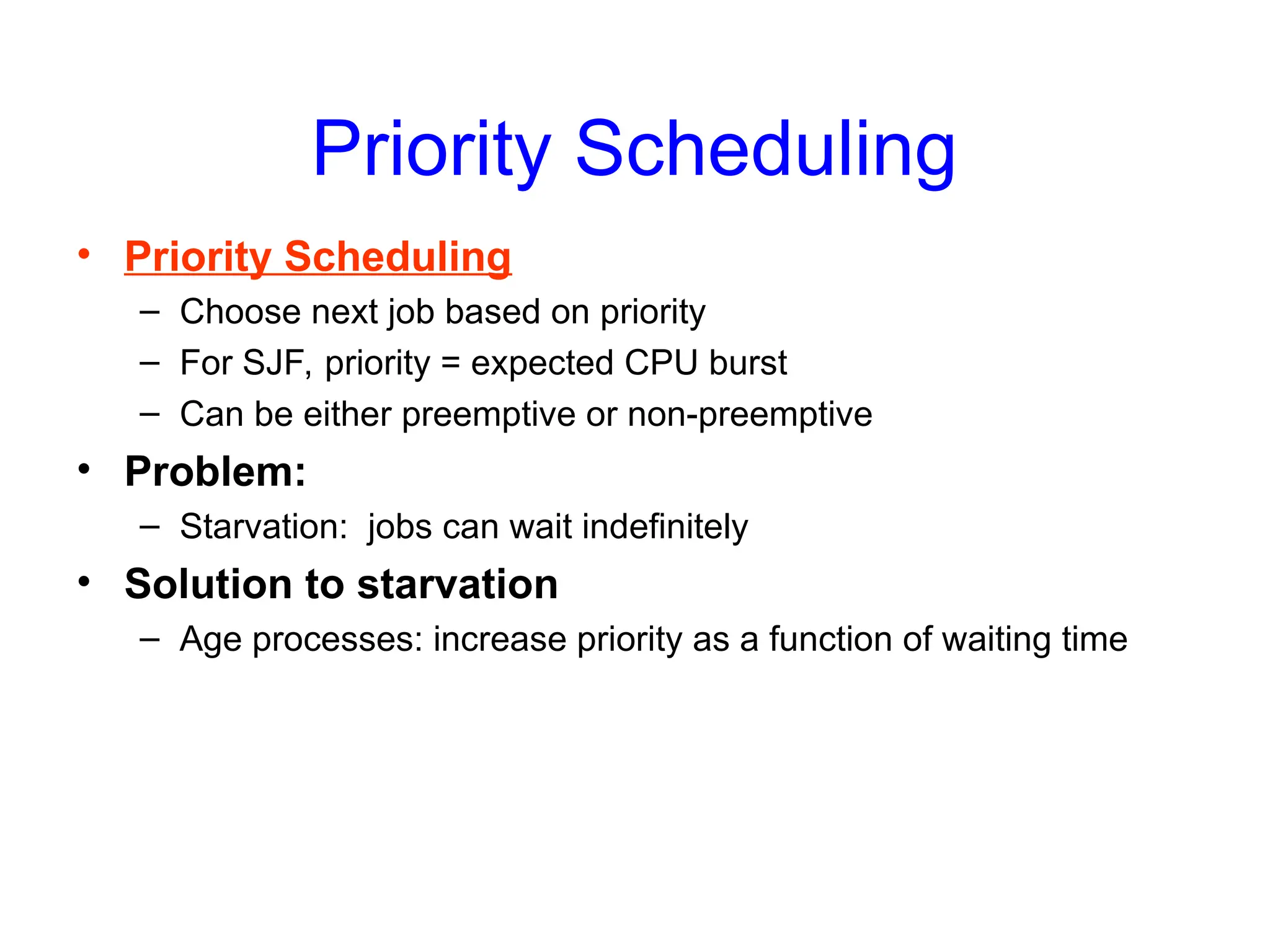
Priority Scheduling
• PriorityScheduling
– Choose next job based on priority
– For SJF, priority = expected CPU burst
– Can be either preemptive or non-preemptive
• Problem:
– Starvation: jobs can wait indefinitely
• Solution to starvation
– Age processes: increase priority as a function of waiting time
24.
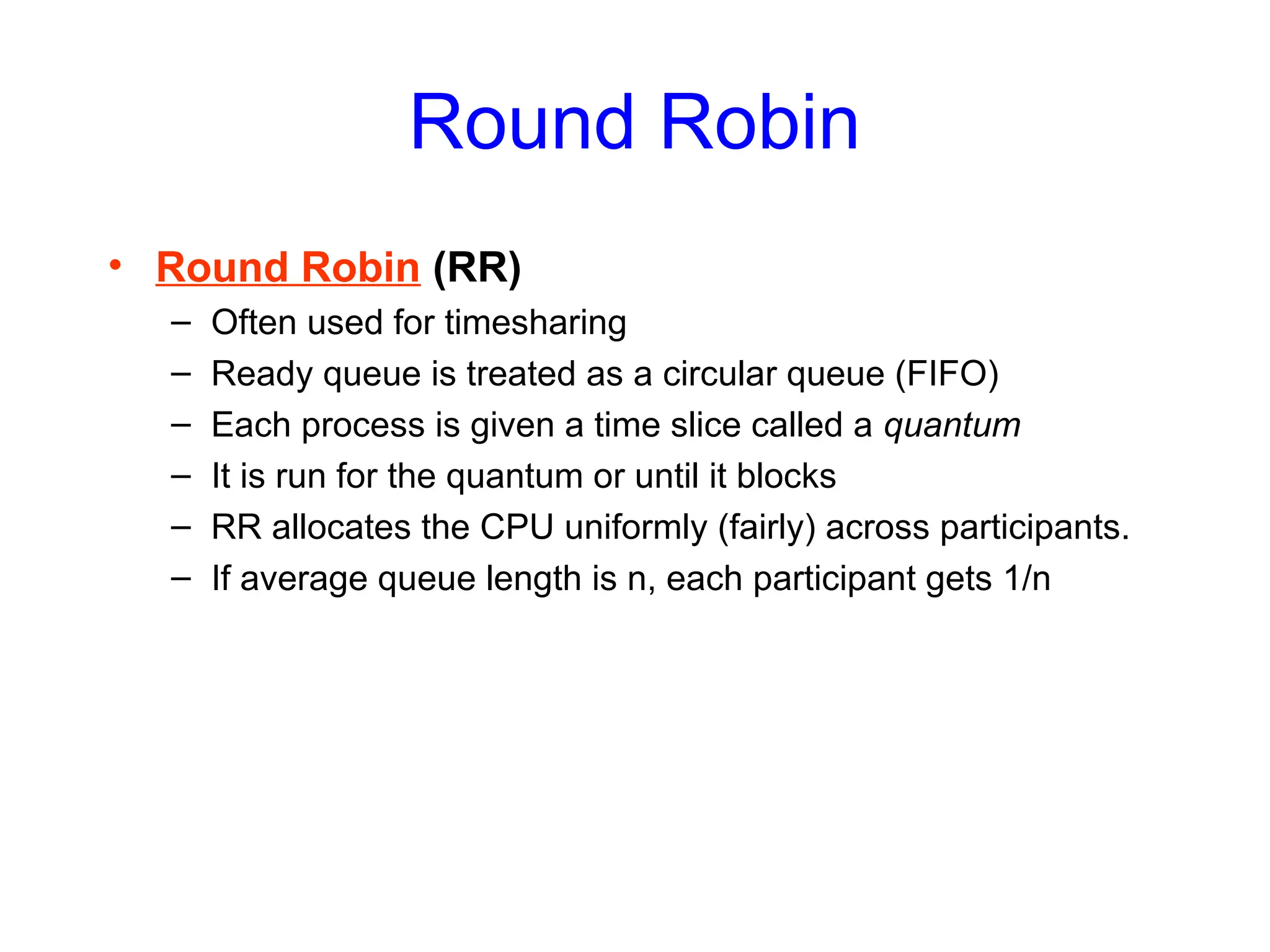
Round Robin
• RoundRobin (RR)
– Often used for timesharing
– Ready queue is treated as a circular queue (FIFO)
– Each process is given a time slice called a quantum
– It is run for the quantum or until it blocks
– RR allocates the CPU uniformly (fairly) across participants.
– If average queue length is n, each participant gets 1/n
25.
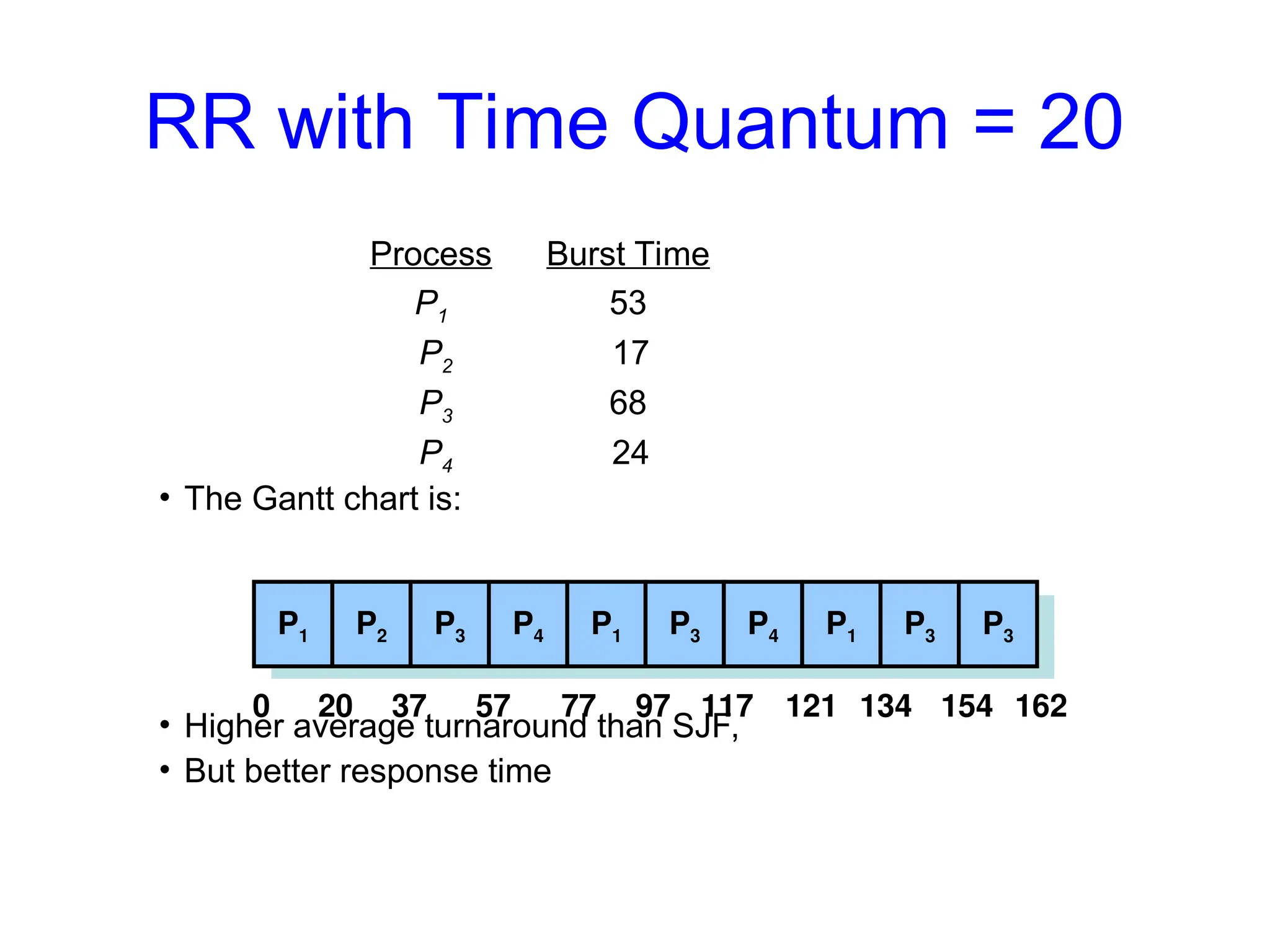
RR with TimeQuantum = 20
Process Burst Time
P1 53
P2 17
P3 68
P4 24
• The Gantt chart is:
• Higher average turnaround than SJF,
• But better response time
P1 P2 P3 P4 P1 P3 P4 P1 P3 P3
0 20 37 57 77 97 117 121 134 154 162
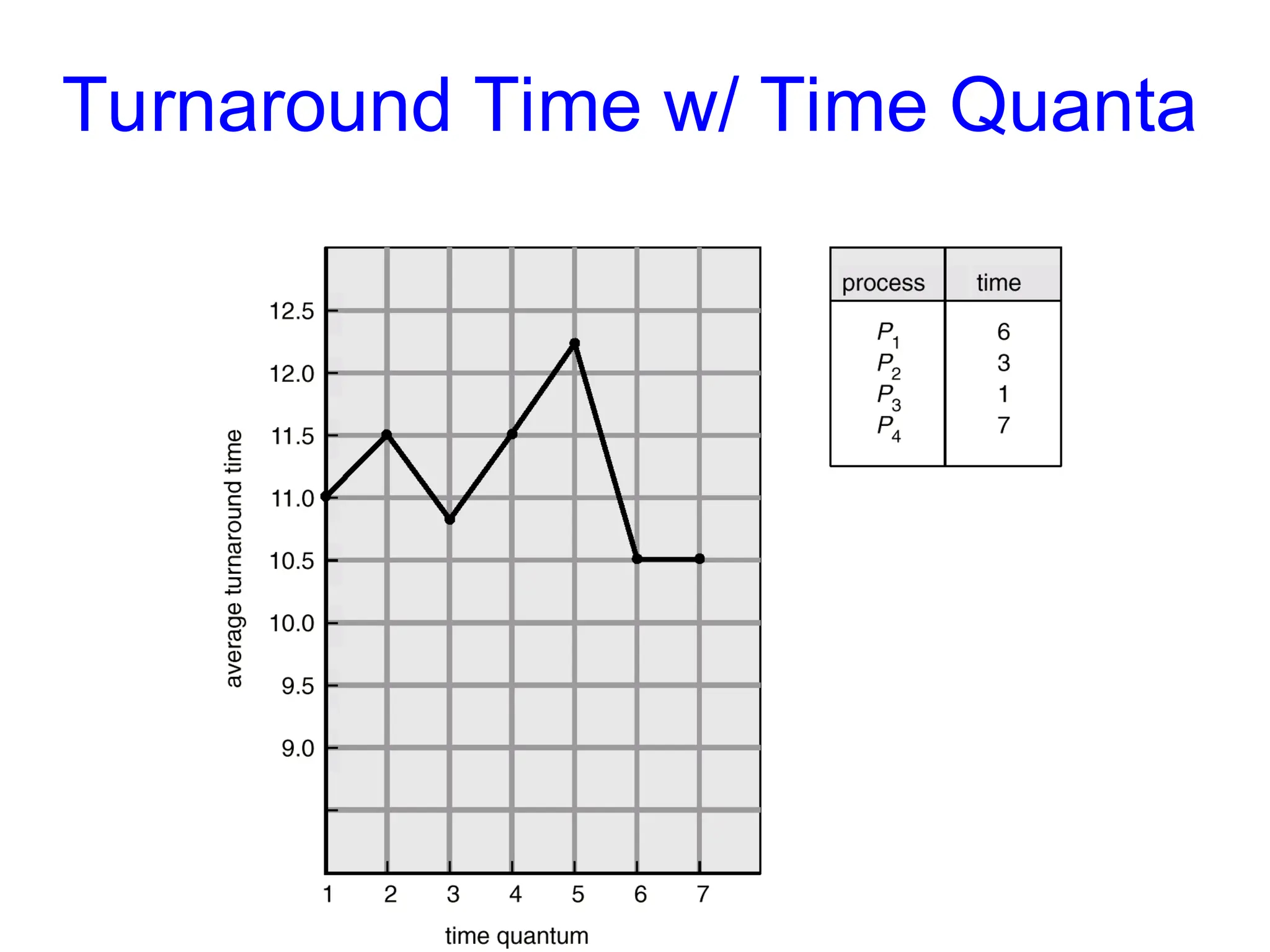
RR: Choice ofTime Quantum
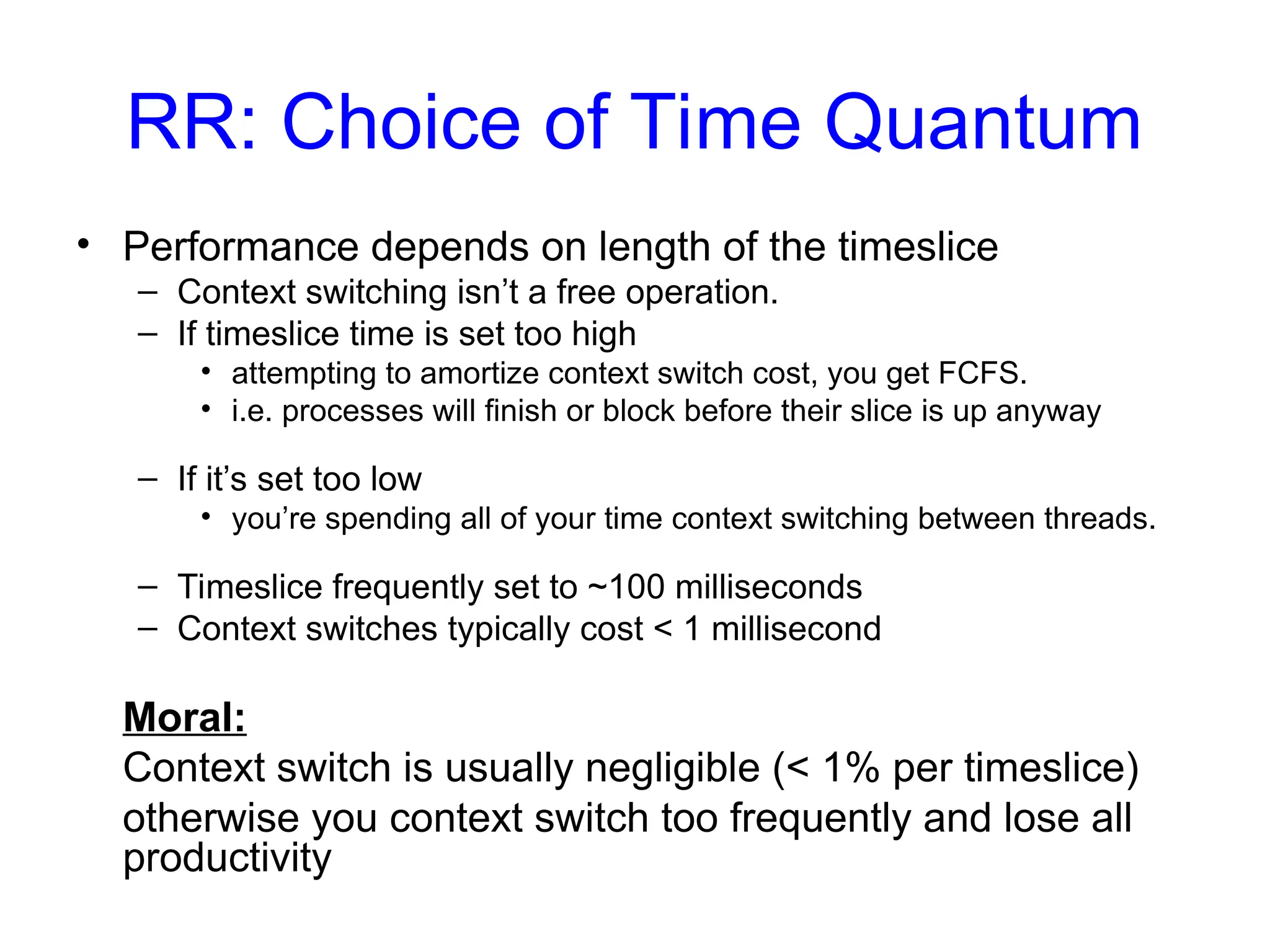
• Performance depends on length of the timeslice
– Context switching isn’t a free operation.
– If timeslice time is set too high
• attempting to amortize context switch cost, you get FCFS.
• i.e. processes will finish or block before their slice is up anyway
– If it’s set too low
• you’re spending all of your time context switching between threads.
– Timeslice frequently set to ~100 milliseconds
– Context switches typically cost < 1 millisecond
Moral:
Context switch is usually negligible (< 1% per timeslice)
otherwise you context switch too frequently and lose all
productivity
28.
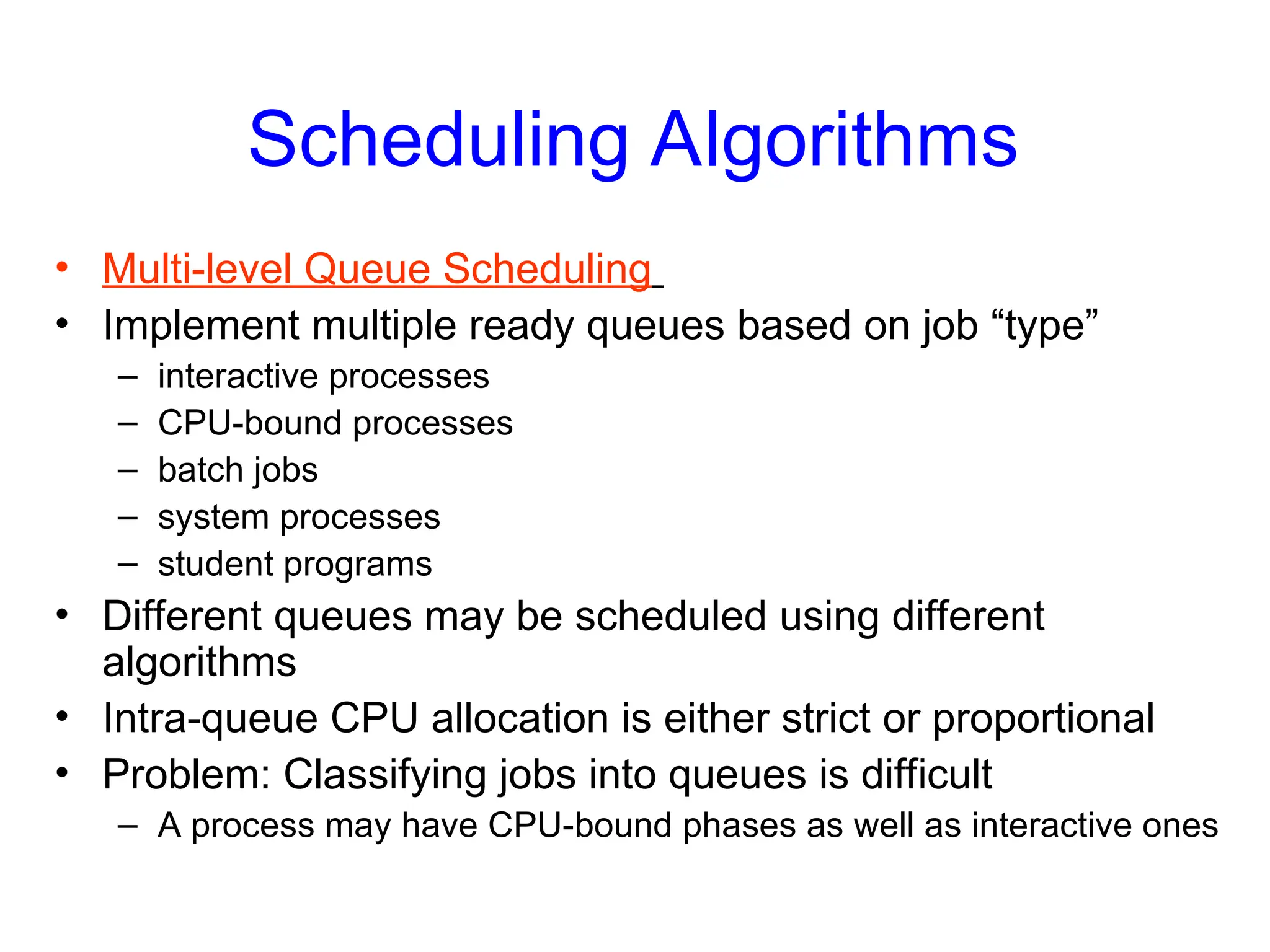
Scheduling Algorithms
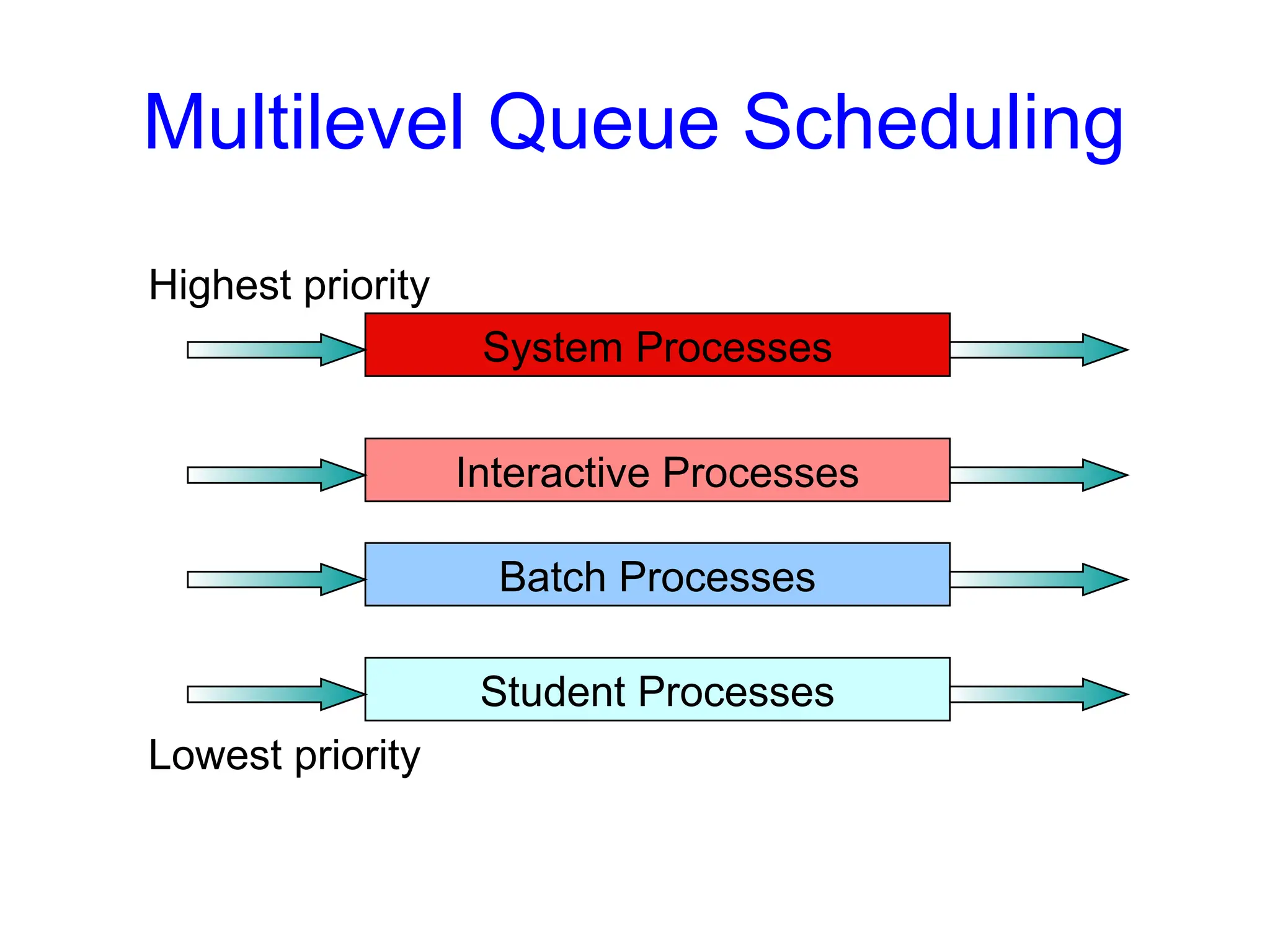
• Multi-levelQueue Scheduling
• Implement multiple ready queues based on job “type”
– interactive processes
– CPU-bound processes
– batch jobs
– system processes
– student programs
• Different queues may be scheduled using different
algorithms
• Intra-queue CPU allocation is either strict or proportional
• Problem: Classifying jobs into queues is difficult
– A process may have CPU-bound phases as well as interactive ones
Scheduling Algorithms
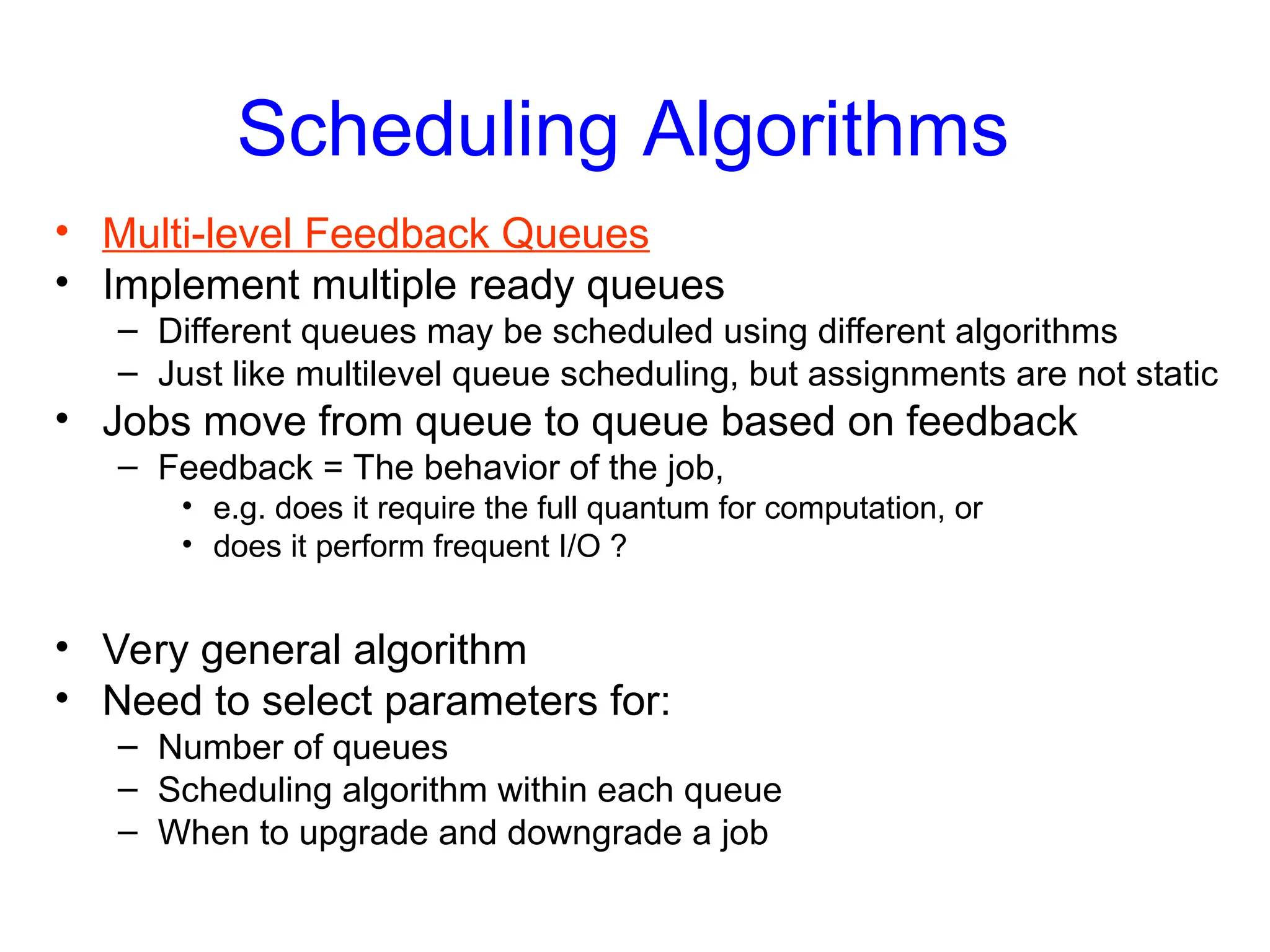
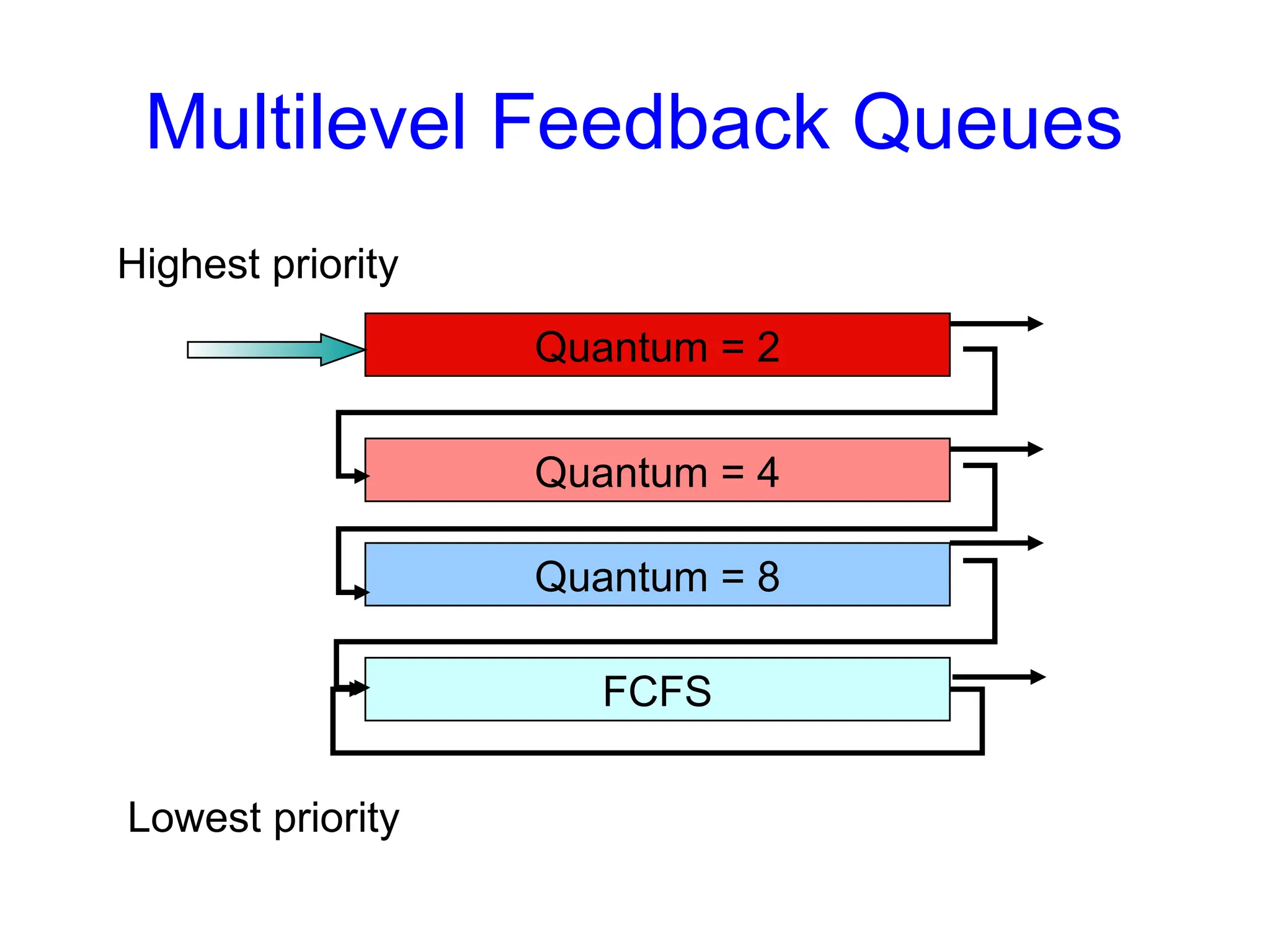
• Multi-levelFeedback Queues
• Implement multiple ready queues
– Different queues may be scheduled using different algorithms
– Just like multilevel queue scheduling, but assignments are not static
• Jobs move from queue to queue based on feedback
– Feedback = The behavior of the job,
• e.g. does it require the full quantum for computation, or
• does it perform frequent I/O ?
• Very general algorithm
• Need to select parameters for:
– Number of queues
– Scheduling algorithm within each queue
– When to upgrade and downgrade a job
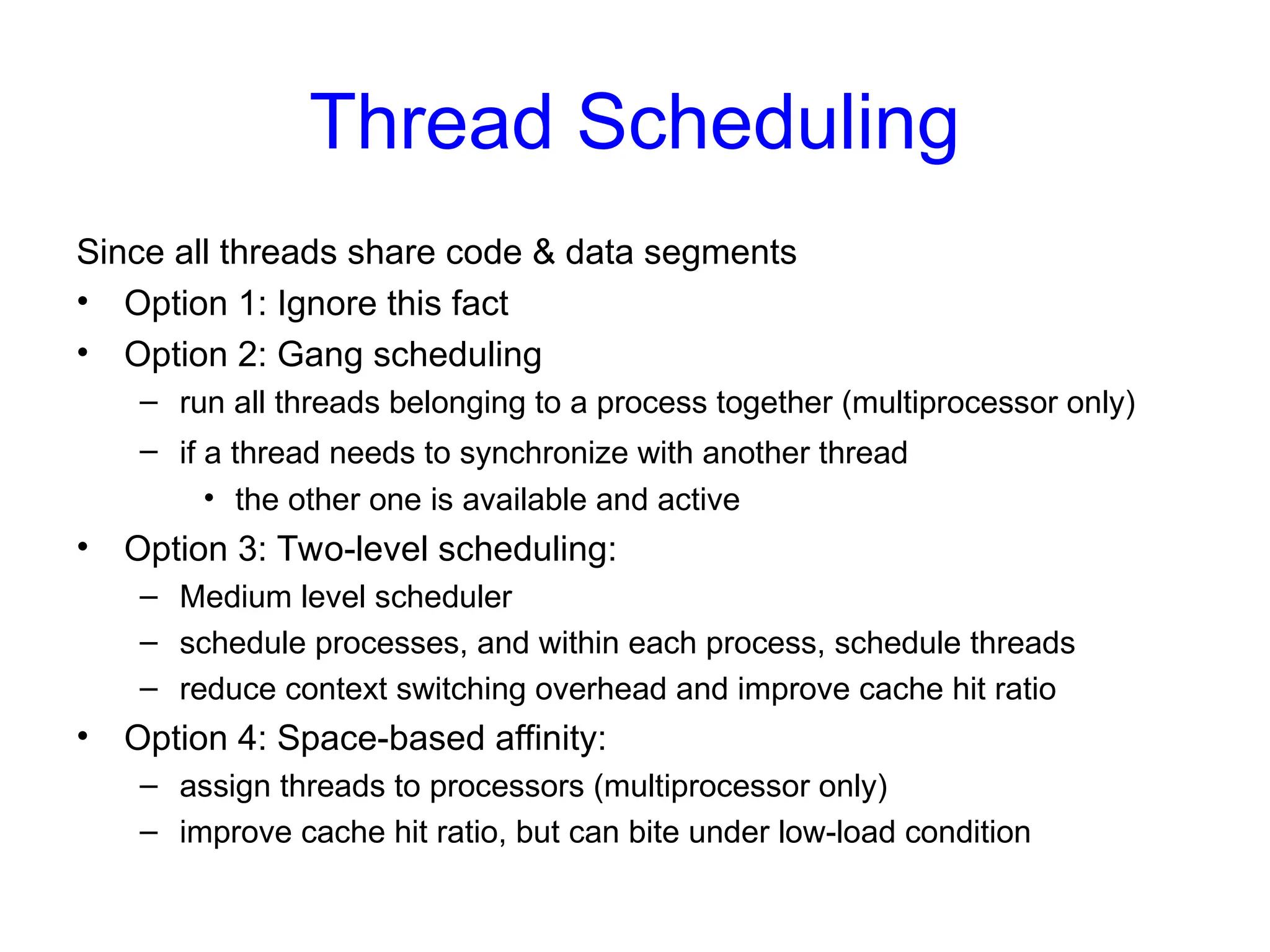
Thread Scheduling
Since allthreads share code & data segments
• Option 1: Ignore this fact
• Option 2: Gang scheduling
– run all threads belonging to a process together (multiprocessor only)
– if a thread needs to synchronize with another thread
• the other one is available and active
• Option 3: Two-level scheduling:
– Medium level scheduler
– schedule processes, and within each process, schedule threads
– reduce context switching overhead and improve cache hit ratio
• Option 4: Space-based affinity:
– assign threads to processors (multiprocessor only)
– improve cache hit ratio, but can bite under low-load condition
34.
Real-time Scheduling
• Real-timeprocesses have timing constraints
– Expressed as deadlines or rate requirements
• Common RT scheduling policies
– Rate monotonic
• Just one scalar priority related to the periodicity of the job
• Priority = 1/rate
• Static
– Earliest deadline first (EDF)
• Dynamic but more complex
• Priority = deadline
• Both require admission control to provide guarantees
35.
Postscript
• The bestschemes are adaptive.
• To do absolutely best we’d have to predict the future.
– Most current algorithms give highest priority to those that need
the least!
• Scheduling become increasingly ad hoc over the years.
– 1960s papers very math heavy, now mostly “tweak and see”



![Vibe Coding vs. Spec-Driven Development [Free Meetup]](https://cdn.slidesharecdn.com/ss_thumbnails/vibecodingvsspecdrivendevelopment-251209105622-43f455e7-thumbnail.jpg?width=640&height=640&fit=bounds)


