Eeng360 1
Eeng 360 Communication Systems I
Course Information
 Instructor: Huseyin Bilgekul, Room No: EE 207, Office Tel: 630 1333
 Course Webpage: http://faraday.ee.emu.edu.tr/eee360/
 Lab Assistant: Ayşe Kortun Office Tel: 630 1653.
 Textbook: L. W. COUCH II, Digital and Analog Communication Systems, 6th Edition, Prentice Hall.
 Grading: Midterm 1 Exam: % 20 Midterm 2 Exam: % 20
Final Examination : % 30
HW & Quizzes : % 15
Lab Work : % 15
 Prerequisite: EEE226 Signals and Systems
 NG Policy: NG grade will be given to students who do not attend more than 50% of the course
lecture hours, miss the exams and fail.
Huseyin Bilgekul
Eeng360 Communication Systems I
Department of Electrical and Electronic Engineering
Eastern Mediterranean University
Eeng360 2
Eeng360 3
Eeng360 4
Eeng360 5
Eeng360 6
Eeng360 7
Eeng360 8
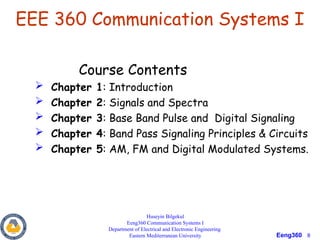
EEE 360 Communication Systems I
Course Contents
 Chapter 1: Introduction
 Chapter 2: Signals and Spectra
 Chapter 3: Base Band Pulse and Digital Signaling
 Chapter 4: Band Pass Signaling Principles & Circuits
 Chapter 5: AM, FM and Digital Modulated Systems.
Huseyin Bilgekul
Eeng360 Communication Systems I
Department of Electrical and Electronic Engineering
Eastern Mediterranean University
Eeng360 9
Chapter 1
INTRODUCTION
Chapter Objectives:
 How communication systems work.
 Frequency allocation and propagation characteristics.
 Computer solutions using MATLAB.
 Information measure.
 Coding performance.
Huseyin Bilgekul
Eeng360 Communication Systems I
Department of Electrical and Electronic Engineering
Eastern Mediterranean University
Eeng360 10
What is a communication system?.
 Communication systems are designed to transmit
information.
 Communication systems Design concerns:
• Selection of the information–bearing waveform;
• Bandwidth and power of the waveform;
• Effect of system noise on the received information;
• Cost of the system.
These factors will be discussed later in this course
Eeng360 11
Digital and Analog Sources and Systems
Basic Definitions:
• Analog Information Source:
An analog information source produces messages which are
defined on a continuum. (E.g. :Microphone)
• Digital Information Source:
A digital information source produces a finite set of possible
messages. (E.g. :Typewriter)
t
x(t)
t
x(t)
Analog Digital
Eeng360 12
Digital and Analog Sources and Systems
 A digital communication system transfers
information from a digital source to the intended
receiver (also called the sink).
 An analog communication system transfers
information from an analog source to the sink.
 A digital waveform is defined as a function of
time that can have a discrete set of amplitude
values.
 An Analog waveform is a function that has a
continuous range of values.
Eeng360 13
Digital Communication
 Advantages
• Relatively inexpensive digital circuits may be used;
• Privacy is preserved by using data encryption;
• Data from voice, video, and data sources may be merged and
transmitted over a common digital transmission system;
• In long-distance systems, noise dose not accumulate from repeater
to repeater. Data regeneration is possible
• Errors in detected data may be small, even when there is a large
amount of noise on the received signal;
• Errors may often be corrected by the use of coding.
 Disadvantages
• Generally, more bandwidth is required than that for analog systems;
• Synchronization is required.
Eeng360 14
Encoding and Decoding for Digital
Communication
 Coding involves adding extra (redundant) bits to data to reduce or
correct errors at the output of the receiver.
The disadvantage of these extra bits is to increase the data rate
and the bandwidth of the encoded signal.
General Digital Communication System
Eeng360 15
Deterministic and Random Waveforms
 A Deterministic waveform can be modeled as a
completely specified function of time.
 A Random Waveform (or stochastic waveform)
cannot be modeled as a completely specified
function of time and must be modeled
probabilistically.
 In this course we will focus mainly on
deterministic waveforms.
0 0
( ) cos( )
w t A t
 
 
Eeng360 16
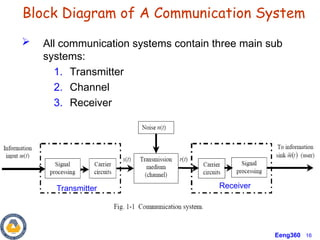
Block Diagram of A Communication System
 All communication systems contain three main sub
systems:
1. Transmitter
2. Channel
3. Receiver
Transmitter Receiver
Eeng360 17
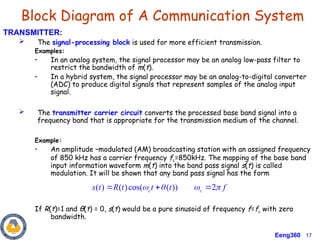
Block Diagram of A Communication System
TRANSMITTER:
 The signal-processing block is used for more efficient transmission.
Examples:
• In an analog system, the signal processor may be an analog low-pass filter to
restrict the bandwidth of m(t).
• In a hybrid system, the signal processor may be an analog-to-digital converter
(ADC) to produce digital signals that represent samples of the analog input
signal.
 The transmitter carrier circuit converts the processed base band signal into a
frequency band that is appropriate for the transmission medium of the channel.
Example:
• An amplitude –modulated (AM) broadcasting station with an assigned frequency
of 850 kHz has a carrier frequency fc=850kHz. The mapping of the base band
input information waveform m(t) into the band pass signal s(t) is called
modulation. It will be shown that any band pass signal has the form
If R(t)=1 and θ(t) = 0, s(t) would be a pure sinusoid of frequency f=fc with zero
bandwidth.
( ) ( )cos( ( )) 2
c c
s t R t t t f
   
  
Eeng360 18
Channel:
 Channels represents the path in which signals travel from transmitter to receiver.
Very general classification of channels are:
• Wire: Twisted-pair telephone line, coaxial cable, waveguide, and fiber-optic
cables.
• Wireless: Air vacuum, and seawater.
In general, the channel medium attenuates the signal so that the delivered
information deteriorated from that of the source. The channel noise may arise
from natural electrical disturbances or from artificial sources.
Block Diagram of A Communication System
Transmitter Receiver
Eeng360 19
Receiver:
 The receiver takes the corrupted signal at the channel output and converts it to
be a base band signal that can be handled by the receiver’s base band processor.
 The base band processor cleans up this signal and delivers an estimate of
the source information m(t) to the communication system output.
 In digital systems, the measure of signal deterioration is usually taken to be the
probability of bit error P(e) – also called Bit Error Rate (BER) of the delivered
data m(t).
 In analog systems, the performance measure is usually taken to be the Signal-to-
noise Ratio (SNR) at the receiver output.
Block Diagram of A Communication System
Transmitter Receiver
Eeng360 20
What makes a Communication System GOOD
 We can measure the “GOODNESS” of a communication
system in many ways:
 How close is the estimate to the original signal m(t)
• Better estimate = higher quality transmission
• Signal to Noise Ratio (SNR) for analog m(t)
• Bit Error Rate (BER) for digital m(t)
 How much power is required to transmit s(t)?
• Lower power = longer battery life, less interference
 How much bandwidth B is required to transmit s(t)?
• Less B means more users can share the channel
• Exception: Spread Spectrum -- users use same B.
 How much information is transmitted?
• In analog systems information is related to B of m(t).
• In digital systems information is expressed in bits/sec.
Engineering Communication Systems Course

  • 1.
    Eeng360 1 Eeng 360Communication Systems I Course Information  Instructor: Huseyin Bilgekul, Room No: EE 207, Office Tel: 630 1333  Course Webpage: http://faraday.ee.emu.edu.tr/eee360/  Lab Assistant: Ayşe Kortun Office Tel: 630 1653.  Textbook: L. W. COUCH II, Digital and Analog Communication Systems, 6th Edition, Prentice Hall.  Grading: Midterm 1 Exam: % 20 Midterm 2 Exam: % 20 Final Examination : % 30 HW & Quizzes : % 15 Lab Work : % 15  Prerequisite: EEE226 Signals and Systems  NG Policy: NG grade will be given to students who do not attend more than 50% of the course lecture hours, miss the exams and fail. Huseyin Bilgekul Eeng360 Communication Systems I Department of Electrical and Electronic Engineering Eastern Mediterranean University
  • 2.
  • 3.
  • 4.
  • 5.
  • 6.
  • 7.
  • 8.
    Eeng360 8 EEE 360Communication Systems I Course Contents  Chapter 1: Introduction  Chapter 2: Signals and Spectra  Chapter 3: Base Band Pulse and Digital Signaling  Chapter 4: Band Pass Signaling Principles & Circuits  Chapter 5: AM, FM and Digital Modulated Systems. Huseyin Bilgekul Eeng360 Communication Systems I Department of Electrical and Electronic Engineering Eastern Mediterranean University
  • 9.
    Eeng360 9 Chapter 1 INTRODUCTION ChapterObjectives:  How communication systems work.  Frequency allocation and propagation characteristics.  Computer solutions using MATLAB.  Information measure.  Coding performance. Huseyin Bilgekul Eeng360 Communication Systems I Department of Electrical and Electronic Engineering Eastern Mediterranean University
  • 10.
    Eeng360 10 What isa communication system?.  Communication systems are designed to transmit information.  Communication systems Design concerns: • Selection of the information–bearing waveform; • Bandwidth and power of the waveform; • Effect of system noise on the received information; • Cost of the system. These factors will be discussed later in this course
  • 11.
    Eeng360 11 Digital andAnalog Sources and Systems Basic Definitions: • Analog Information Source: An analog information source produces messages which are defined on a continuum. (E.g. :Microphone) • Digital Information Source: A digital information source produces a finite set of possible messages. (E.g. :Typewriter) t x(t) t x(t) Analog Digital
  • 12.
    Eeng360 12 Digital andAnalog Sources and Systems  A digital communication system transfers information from a digital source to the intended receiver (also called the sink).  An analog communication system transfers information from an analog source to the sink.  A digital waveform is defined as a function of time that can have a discrete set of amplitude values.  An Analog waveform is a function that has a continuous range of values.
  • 13.
    Eeng360 13 Digital Communication Advantages • Relatively inexpensive digital circuits may be used; • Privacy is preserved by using data encryption; • Data from voice, video, and data sources may be merged and transmitted over a common digital transmission system; • In long-distance systems, noise dose not accumulate from repeater to repeater. Data regeneration is possible • Errors in detected data may be small, even when there is a large amount of noise on the received signal; • Errors may often be corrected by the use of coding.  Disadvantages • Generally, more bandwidth is required than that for analog systems; • Synchronization is required.
  • 14.
    Eeng360 14 Encoding andDecoding for Digital Communication  Coding involves adding extra (redundant) bits to data to reduce or correct errors at the output of the receiver. The disadvantage of these extra bits is to increase the data rate and the bandwidth of the encoded signal. General Digital Communication System
  • 15.
    Eeng360 15 Deterministic andRandom Waveforms  A Deterministic waveform can be modeled as a completely specified function of time.  A Random Waveform (or stochastic waveform) cannot be modeled as a completely specified function of time and must be modeled probabilistically.  In this course we will focus mainly on deterministic waveforms. 0 0 ( ) cos( ) w t A t    
  • 16.
    Eeng360 16 Block Diagramof A Communication System  All communication systems contain three main sub systems: 1. Transmitter 2. Channel 3. Receiver Transmitter Receiver
  • 17.
    Eeng360 17 Block Diagramof A Communication System TRANSMITTER:  The signal-processing block is used for more efficient transmission. Examples: • In an analog system, the signal processor may be an analog low-pass filter to restrict the bandwidth of m(t). • In a hybrid system, the signal processor may be an analog-to-digital converter (ADC) to produce digital signals that represent samples of the analog input signal.  The transmitter carrier circuit converts the processed base band signal into a frequency band that is appropriate for the transmission medium of the channel. Example: • An amplitude –modulated (AM) broadcasting station with an assigned frequency of 850 kHz has a carrier frequency fc=850kHz. The mapping of the base band input information waveform m(t) into the band pass signal s(t) is called modulation. It will be shown that any band pass signal has the form If R(t)=1 and θ(t) = 0, s(t) would be a pure sinusoid of frequency f=fc with zero bandwidth. ( ) ( )cos( ( )) 2 c c s t R t t t f       
  • 18.
    Eeng360 18 Channel:  Channelsrepresents the path in which signals travel from transmitter to receiver. Very general classification of channels are: • Wire: Twisted-pair telephone line, coaxial cable, waveguide, and fiber-optic cables. • Wireless: Air vacuum, and seawater. In general, the channel medium attenuates the signal so that the delivered information deteriorated from that of the source. The channel noise may arise from natural electrical disturbances or from artificial sources. Block Diagram of A Communication System Transmitter Receiver
  • 19.
    Eeng360 19 Receiver:  Thereceiver takes the corrupted signal at the channel output and converts it to be a base band signal that can be handled by the receiver’s base band processor.  The base band processor cleans up this signal and delivers an estimate of the source information m(t) to the communication system output.  In digital systems, the measure of signal deterioration is usually taken to be the probability of bit error P(e) – also called Bit Error Rate (BER) of the delivered data m(t).  In analog systems, the performance measure is usually taken to be the Signal-to- noise Ratio (SNR) at the receiver output. Block Diagram of A Communication System Transmitter Receiver
  • 20.
    Eeng360 20 What makesa Communication System GOOD  We can measure the “GOODNESS” of a communication system in many ways:  How close is the estimate to the original signal m(t) • Better estimate = higher quality transmission • Signal to Noise Ratio (SNR) for analog m(t) • Bit Error Rate (BER) for digital m(t)  How much power is required to transmit s(t)? • Lower power = longer battery life, less interference  How much bandwidth B is required to transmit s(t)? • Less B means more users can share the channel • Exception: Spread Spectrum -- users use same B.  How much information is transmitted? • In analog systems information is related to B of m(t). • In digital systems information is expressed in bits/sec.