+

Games
Current Issues in Web Technology
Michael Heron
+

Introduction


Games are big business.


In 2011, UK gamers spent three billion on the industry.



Games advertise on television.



Big game launches are worthy of television news coverage.



There are massive conventions dedicated to games of all
types.




And games of any type.

The ‘internet culture’ is full of memetic references to games,
and tributes to the forms.


Such as the dozens of game webcomics and review videos.
+

So?


But why should you, as a Serious Professional care about
games?




While games are (supposed to be) fun and (supposed to) tell a
story, that’s not all they are.






You should care because games contain with them very valuable
lessons for how to build our own projects.

They are tremendously efficient teaching engines.
They can create a positive mental state known as flow.
They are ruthless engines for creating addiction.

This has led to a research field of known as serious games.


And an associated topic known as hard fun.
+

The First Serious Games


Perhaps the first serious game was The Oregon Trail (1971).





It was designed to teach children about pioneer life on the Oregon Trail.
https://www.youtube.com/watch?v=5GH0-hr1u_k

The player leads the party of settlers from Missouri to Oregon.


And along the way have all kinds of whacky adventures like dying of
dysentery.



A huge number of variants have been developed over the years.



And its popularity has resulted in it having considerable memetic
popularity.
+

The First Serious Games


One of the earliest examples of a Serious Game was the
vignette driven ‘Alter Ego (1984).


http://www.playalterego.com/



The design of the game was derived from hundreds of
psychological interviews and written by a qualified psychologist.



The aim was to allow people to explore the consequences of
their decisions in a safe, sand-box environment.


Similar in general subject matter to The Sims, but a serious game.
+

The First Serious Games


Will Wright’s Sim City (a precursor to the Sims) was a city
simulator in which players took on the role of mayor of a city
they created themselves.




Despite its relatively primitive look, it and its descendants have
been used in universities across the world to teach lessons in
urban planning.




https://www.youtube.com/watch?v=OKI2SI9mp8I

https://www.youtube.com/watch?v=1Wp1e3UqGoQ

Electronic Arts, in deference to its role as a teaching tool, have
donated it to the one laptop per child project.
+

The First Serious Games


Sid Meier’s Civilization places the player in the position of an
immortal leader from history.




https://www.youtube.com/watch?v=w_28ZS3jcgA

Technologies are researched by the player.


When they are researched, an encyclopaedic description is given.



Technologies have pre-requisites, requiring a technology tree to
be traversed.



This has been used to within schools to give a context for
history lessons.
+

Other Serious Games


Games have also been used to highlight sensitive political
issues.




They have been used to create positive impressions of
organisations.




Darfur is Dying
 http://www.darfurisdying.com/

Such as the American Army who used games to recruit:
 http://www.americasarmy.com/

They have been used to train police officers.


http://www.policeone.com/police-products/training/articles/5468350Video-game-just-for-cops-NH-trains-cops-with-simulators/
+

Why?


Why has so much effort been spent on making serious games?




Have you ever worked with educational software?




On the whole, it’s dire.

Early educational games missed an important element of the
formula.




Why not just make serious educational tools?

They weren’t fun.

And yet, nowadays…


https://www.youtube.com/watch?v=MJFHPD5R8y0
+

Games gotta be fun, yo


Games have to be fun before they trigger the benefits we
talked about earlier.



Learning





Flow
Addiction

However, it’s hard to define specifically what it is that makes
games fun.




We know it when we see it.

It’s surprisingly difficult to even define what is meant by a
‘game’
+

Why are games fun?


Game playing is core to humanity.




And many other animals.

We learn through play.


As do animals.






Dogs learn what is an acceptable level of biting by playing with
other dogs.

Raph Koster phrases it – ‘After all, the young of all species play’

Even games as sophisticated as Chess have been played for
millennia.
+

Crawford and Koster


Chris Crawford and Raph Koster believe that games are
fundamentally tools for learning.





They are engines for providing opportunities for people to make
interesting decisions and develop mastery.
Koster - In other words, games serve as very fundamental and powerful
learning tools. It's one thing to read in a book that 'the map is not the
territory' and another to have your armies rolled over by your opponent
in a game. When the latter happens, you're gonna get the point even if
the actual armies aren't marching into your suburban home.

Crawford identifies the following elements:






Fantasy fulfilment
Overcoming social restrictions
Demonstrating prowess
Social lubrication
A need for recognition
+

Nicole Lazzero


Nicole Lazzero identifies the following elements:


Easy Fun




Hard fun




Social lubrication and overcoming social restrictions.

The Generation of Emotion




Challenge and demonstrating mastery

The People Factor




Fantasy fulfilment

Bringing about of altered states.

Richard Rouse broadly agrees, adding in bragging rights and
an emotional payoff from participation.
+

Fun


The rewards that come from game-play trigger genuine
physiological reactions within our bodies.




Raph Koster again:




The release of dopamine, for example.

One of the subtlest releases of chemicals is at that moment of triumph
when we learn something or master a task. This almost always causes
us to break out into a smile. After all, it is important to the survival of the
species that we learn - therefore our bodies reward us for it with
moments of pleasure. There are many ways we find fun in games, and I
will talk about the others. But this is the most important.

Serious Games derive from these lessons.


We can co-opt them for other purposes.
+

A Facsimile of Fun


Some games have all the payoffs but none of the ability to develop
mastery.




We talked about Farmville briefly last week.

It is possible to tickle certain parts of the game without actually
having a ‘game’ to go with it.





Reciprocity effect
 Addiction
Manipulation of social networks
 Recognition by peers
Random treasure
 Gambling dopamine releases
Sunk Cost
 I can’t give up, look how high level I am.
+

Brain Chemistry


Games are tremendously efficient manipulators of brain chemistry.




In some cases, playing a game causes increases of 100% in the
brain’s dopamine levels over a long period of time.




It’s very easy to fall to the Dark Side when consciously designing these
kind of game experiences.

Not as much as eating good food or having good sex, but noticeable.

Randomness hooks into this.




If we always lose, we get a decaying amount of dopamine.
If we always win, we get a decaying amount of dopamine.
If we win often enough to be interesting, we can sustain dopamine
levels indefinitely.
+

Casual and Hardcore Games


Something of a division has emerged in gaming design, between
casual and hardcore games.



Hardcore games require significant investment on the part of a
player.



Hardcore games (usually) involve at least something of a
narrative.



Hardcore games are designed to build incremental mastery
through sustained interaction.



Some hardcore games have dozens of hours of playtime and
complex internal mythologies.


The Mass Effect series, for example.
+

Casual and Hardcore Games


Casual games go entirely the other way.



They are designed to be accessible to everyone.


Just pick one up and play.



They are designed to be easy to learn and difficult to truly master.



They are designed to be very short term, intense experiences.




Although you may accumulate benefits on the basis of many of these
sessions.

Popcap is the premier purveyor of games in this genre.



Peggle
Bejewelled
+

Casual and Hardcore Games


Two entirely different demographics are being dealt with here.




There’s some crossover, but not as much as you’d think.

Platforms such as smartphones and tablets have massively
boosted the market for casual games.






Not everyone wants to spend a day of their life getting to the end of
some fictional character’s story arc.
Almost everyone has a few minutes to kill at various points during
the day.

Perhaps the most instantly recognisable game in popular
consciousness is Angry Birds.
+

Angry Birds


You can play this online in various forms.





How successful was it?




http://chrome.angrybirds.com/ if you have chrome
http://www.youtube.com/watch?v=zArI_kyB3Y0

It earned ONE TRILLION DOLLARS.
 Not really. Roxio earns an estimate 80 million dollars a year from it.

Why was it so successful?






Sense of progression
Easy to learn
Difficult to master
Cute and entertaining
Evokes flow
+

Angry Birds


What does Angry Birds do right?








Response time between release and result
 Time to relax and examine consequences of actions.
Opportunities for mastery
 Short term memory
 Calculation of trajectory
 Strategic placement of projectile birds
Mysteries
 Question marks on future levels
Sound
 Evokes positive neurological responses.
 Action syncing
+

So, why are we talking about this?


In the next two lectures we are going to delve into two main topics.





Flow
Gamification

Both of these topics are informed by our understanding of the topics
discussed today.


And they’re two topics that are generically applicable to a wide range of nongameplay situations.



If we want people to become immersed in our products, we need to inspire
flow.



If we want people to persist with our products, we need to inspire
addiction.



Gamification is the way in which we do both of these things.
+

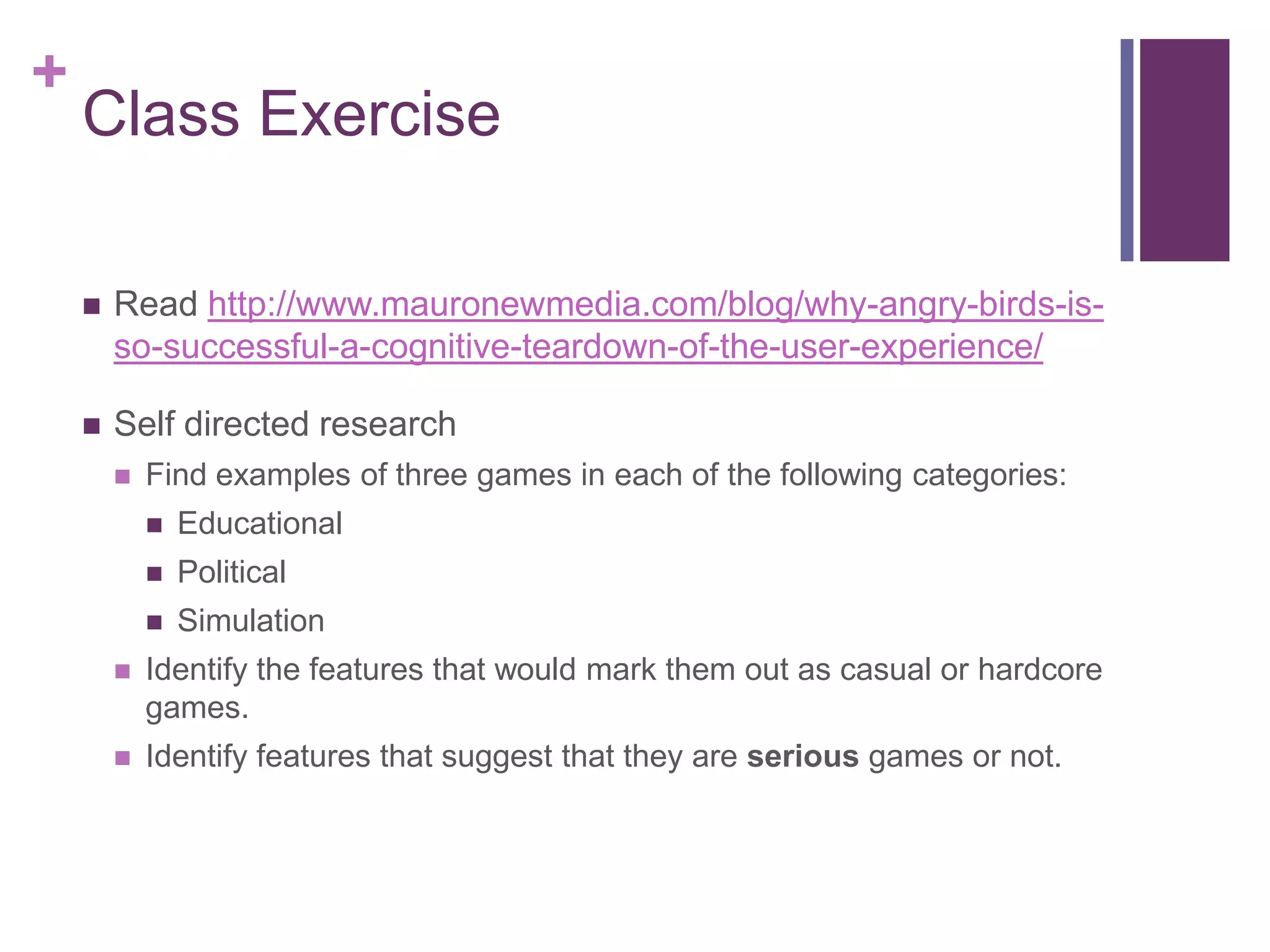
Class Exercise


Read http://www.mauronewmedia.com/blog/why-angry-birds-isso-successful-a-cognitive-teardown-of-the-user-experience/



Self directed research


Find examples of three games in each of the following categories:


Educational



Political



Simulation



Identify the features that would mark them out as casual or hardcore
games.



Identify features that suggest that they are serious games or not.

COMPISSUES04 - Games

  • 1.
    + Games Current Issues inWeb Technology Michael Heron
  • 2.
    + Introduction  Games are bigbusiness.  In 2011, UK gamers spent three billion on the industry.  Games advertise on television.  Big game launches are worthy of television news coverage.  There are massive conventions dedicated to games of all types.   And games of any type. The ‘internet culture’ is full of memetic references to games, and tributes to the forms.  Such as the dozens of game webcomics and review videos.
  • 3.
    + So?  But why shouldyou, as a Serious Professional care about games?   While games are (supposed to be) fun and (supposed to) tell a story, that’s not all they are.     You should care because games contain with them very valuable lessons for how to build our own projects. They are tremendously efficient teaching engines. They can create a positive mental state known as flow. They are ruthless engines for creating addiction. This has led to a research field of known as serious games.  And an associated topic known as hard fun.
  • 4.
    + The First SeriousGames  Perhaps the first serious game was The Oregon Trail (1971).    It was designed to teach children about pioneer life on the Oregon Trail. https://www.youtube.com/watch?v=5GH0-hr1u_k The player leads the party of settlers from Missouri to Oregon.  And along the way have all kinds of whacky adventures like dying of dysentery.  A huge number of variants have been developed over the years.  And its popularity has resulted in it having considerable memetic popularity.
  • 5.
    + The First SeriousGames  One of the earliest examples of a Serious Game was the vignette driven ‘Alter Ego (1984).  http://www.playalterego.com/  The design of the game was derived from hundreds of psychological interviews and written by a qualified psychologist.  The aim was to allow people to explore the consequences of their decisions in a safe, sand-box environment.  Similar in general subject matter to The Sims, but a serious game.
  • 6.
    + The First SeriousGames  Will Wright’s Sim City (a precursor to the Sims) was a city simulator in which players took on the role of mayor of a city they created themselves.   Despite its relatively primitive look, it and its descendants have been used in universities across the world to teach lessons in urban planning.   https://www.youtube.com/watch?v=OKI2SI9mp8I https://www.youtube.com/watch?v=1Wp1e3UqGoQ Electronic Arts, in deference to its role as a teaching tool, have donated it to the one laptop per child project.
  • 7.
    + The First SeriousGames  Sid Meier’s Civilization places the player in the position of an immortal leader from history.   https://www.youtube.com/watch?v=w_28ZS3jcgA Technologies are researched by the player.  When they are researched, an encyclopaedic description is given.  Technologies have pre-requisites, requiring a technology tree to be traversed.  This has been used to within schools to give a context for history lessons.
  • 8.
    + Other Serious Games  Gameshave also been used to highlight sensitive political issues.   They have been used to create positive impressions of organisations.   Darfur is Dying  http://www.darfurisdying.com/ Such as the American Army who used games to recruit:  http://www.americasarmy.com/ They have been used to train police officers.  http://www.policeone.com/police-products/training/articles/5468350Video-game-just-for-cops-NH-trains-cops-with-simulators/
  • 9.
    + Why?  Why has somuch effort been spent on making serious games?   Have you ever worked with educational software?   On the whole, it’s dire. Early educational games missed an important element of the formula.   Why not just make serious educational tools? They weren’t fun. And yet, nowadays…  https://www.youtube.com/watch?v=MJFHPD5R8y0
  • 10.
    + Games gotta befun, yo  Games have to be fun before they trigger the benefits we talked about earlier.   Learning   Flow Addiction However, it’s hard to define specifically what it is that makes games fun.   We know it when we see it. It’s surprisingly difficult to even define what is meant by a ‘game’
  • 11.
    + Why are gamesfun?  Game playing is core to humanity.   And many other animals. We learn through play.  As do animals.    Dogs learn what is an acceptable level of biting by playing with other dogs. Raph Koster phrases it – ‘After all, the young of all species play’ Even games as sophisticated as Chess have been played for millennia.
  • 12.
    + Crawford and Koster  ChrisCrawford and Raph Koster believe that games are fundamentally tools for learning.    They are engines for providing opportunities for people to make interesting decisions and develop mastery. Koster - In other words, games serve as very fundamental and powerful learning tools. It's one thing to read in a book that 'the map is not the territory' and another to have your armies rolled over by your opponent in a game. When the latter happens, you're gonna get the point even if the actual armies aren't marching into your suburban home. Crawford identifies the following elements:      Fantasy fulfilment Overcoming social restrictions Demonstrating prowess Social lubrication A need for recognition
  • 13.
    + Nicole Lazzero  Nicole Lazzeroidentifies the following elements:  Easy Fun   Hard fun   Social lubrication and overcoming social restrictions. The Generation of Emotion   Challenge and demonstrating mastery The People Factor   Fantasy fulfilment Bringing about of altered states. Richard Rouse broadly agrees, adding in bragging rights and an emotional payoff from participation.
  • 14.
    + Fun  The rewards thatcome from game-play trigger genuine physiological reactions within our bodies.   Raph Koster again:   The release of dopamine, for example. One of the subtlest releases of chemicals is at that moment of triumph when we learn something or master a task. This almost always causes us to break out into a smile. After all, it is important to the survival of the species that we learn - therefore our bodies reward us for it with moments of pleasure. There are many ways we find fun in games, and I will talk about the others. But this is the most important. Serious Games derive from these lessons.  We can co-opt them for other purposes.
  • 15.
    + A Facsimile ofFun  Some games have all the payoffs but none of the ability to develop mastery.   We talked about Farmville briefly last week. It is possible to tickle certain parts of the game without actually having a ‘game’ to go with it.     Reciprocity effect  Addiction Manipulation of social networks  Recognition by peers Random treasure  Gambling dopamine releases Sunk Cost  I can’t give up, look how high level I am.
  • 16.
    + Brain Chemistry  Games aretremendously efficient manipulators of brain chemistry.   In some cases, playing a game causes increases of 100% in the brain’s dopamine levels over a long period of time.   It’s very easy to fall to the Dark Side when consciously designing these kind of game experiences. Not as much as eating good food or having good sex, but noticeable. Randomness hooks into this.    If we always lose, we get a decaying amount of dopamine. If we always win, we get a decaying amount of dopamine. If we win often enough to be interesting, we can sustain dopamine levels indefinitely.
  • 17.
    + Casual and HardcoreGames  Something of a division has emerged in gaming design, between casual and hardcore games.  Hardcore games require significant investment on the part of a player.  Hardcore games (usually) involve at least something of a narrative.  Hardcore games are designed to build incremental mastery through sustained interaction.  Some hardcore games have dozens of hours of playtime and complex internal mythologies.  The Mass Effect series, for example.
  • 18.
    + Casual and HardcoreGames  Casual games go entirely the other way.  They are designed to be accessible to everyone.  Just pick one up and play.  They are designed to be easy to learn and difficult to truly master.  They are designed to be very short term, intense experiences.   Although you may accumulate benefits on the basis of many of these sessions. Popcap is the premier purveyor of games in this genre.   Peggle Bejewelled
  • 19.
    + Casual and HardcoreGames  Two entirely different demographics are being dealt with here.   There’s some crossover, but not as much as you’d think. Platforms such as smartphones and tablets have massively boosted the market for casual games.    Not everyone wants to spend a day of their life getting to the end of some fictional character’s story arc. Almost everyone has a few minutes to kill at various points during the day. Perhaps the most instantly recognisable game in popular consciousness is Angry Birds.
  • 20.
    + Angry Birds  You canplay this online in various forms.    How successful was it?   http://chrome.angrybirds.com/ if you have chrome http://www.youtube.com/watch?v=zArI_kyB3Y0 It earned ONE TRILLION DOLLARS.  Not really. Roxio earns an estimate 80 million dollars a year from it. Why was it so successful?      Sense of progression Easy to learn Difficult to master Cute and entertaining Evokes flow
  • 21.
    + Angry Birds  What doesAngry Birds do right?     Response time between release and result  Time to relax and examine consequences of actions. Opportunities for mastery  Short term memory  Calculation of trajectory  Strategic placement of projectile birds Mysteries  Question marks on future levels Sound  Evokes positive neurological responses.  Action syncing
  • 22.
    + So, why arewe talking about this?  In the next two lectures we are going to delve into two main topics.    Flow Gamification Both of these topics are informed by our understanding of the topics discussed today.  And they’re two topics that are generically applicable to a wide range of nongameplay situations.  If we want people to become immersed in our products, we need to inspire flow.  If we want people to persist with our products, we need to inspire addiction.  Gamification is the way in which we do both of these things.
  • 23.
    + Class Exercise  Read http://www.mauronewmedia.com/blog/why-angry-birds-isso-successful-a-cognitive-teardown-of-the-user-experience/  Selfdirected research  Find examples of three games in each of the following categories:  Educational  Political  Simulation  Identify the features that would mark them out as casual or hardcore games.  Identify features that suggest that they are serious games or not.